


Introduction
The North China Plain (NCP) is an important food producing area, which plays an important role in food security. The conventional tillage (CT) method in this area has used plough and other tools to shovel, loosen, and turn over the soil ridge. Such soil is ploughed many times, which can easily remove weeds and leave a stubble of mixed crops. However, long-term CT has caused problems such as a loose and thin plow layer, soil erosion, and crop yield reduction, which can also reduce the stability of soil aggregates and increase greenhouse gas emissions, thus reducing organic carbon storage and promoting soil degradation (Arai et al., Reference Arai, Miura, Tsuzura, Minamiya and Kaneko2018). Therefore, improper agricultural tillage measures make the soil particularly prone to severe degradation process (Doni et al., Reference Doni, Macci, Longo, Souid, Garcia and Masciandaro2017), decrease crop yield, and further endanger food security.
Conservation agriculture is a management method to reduce soil erosion and increase carbon sequestration and crop yield (Govaerts et al., Reference Govaerts, Verhulst, Castellanos-Navarrete, Sayre, Dixon and Dendooven2009), including minimal soil disturbance and maximum stubble return. No tillage (NT) is a tillage practice that uses minimal tillage to reduce the compaction applied to the field, and it is the main method of conservation tillage. NT can reduce soil carbon loss caused by soil erosion (Müller-Nedebock and Chaplot, Reference Müller-Nedebock and Chaplot2015), improve soil nutrient and organic matter content, improve soil structure, and affect crop physiology and yield. As one of the core technologies of conservation tillage, subsoiling (SS) can replace ploughing, while the damage to the soil is small. SS can break the plow pan, deepen the arable layer, improve the soil structure, and promote root growth, thus contributing to increased crop yield (Xu et al., Reference Xu, Han, Ning, Li and Lal2019).
Although there is a lot of research on the effects of tillage on soil, the benefits of tillage are long-term and complex, and they cannot be clearly demonstrated in the short term. Here, we hypothesized that long-term conservation tillage could improve maize yield and soil structure in the NCP. Based on this hypothesis, we conducted a long-term tillage experiment between 2002 and 2017, including four tillage methods: NT, rotary tillage (RT), SS, and CT. In 2016/2017, we further verified this hypothesis by analyzing the composition of water-stable aggregates, aggregate-associated carbon content, maize yield, and profit.
Materials and Methods
Experimental site
The experiment was conducted at the Experimental Station of Shandong Agricultural University (36°10″9′N, 117°9″03′E, 125 m above sea level). In this area, summer maize and winter wheat are rotated, and the full amount of straw produced is returned to the field. The experimental area exhibits climatic characteristics typical of the NCP, with abundant sunlight and distinct seasons. The average annual temperature is 13.6oC, the average annual number of sunshine hours is 2624 h, and the average annual rainfall is 697 mm. The soil type is brown loam with a bulk density of 1.4 g cm−3. The contents of silt, sand, and clay in soil are 44, 40, and 16%, respectively. Before the experiment, the pH of soil was 6.8, and the soil organic carbon, total nitrogen, and total phosphorus contents were 6.7, 1.3, and 7.2 g kg−1, respectively.
Experimental design and soil sampling
The experiment was conducted from 2002 to 2017. Four tillage methods were used in the field: NT, tillage depth 0 cm; RT, tillage depth 10 cm; CT, tillage depth 20 cm; and SS, tillage depth 40 cm. All tillage measures were carried out after maize harvest in mid-October and before wheat sowing.
The area of each experimental plot was 30 × 4 m2, and each plot had three duplicates. To minimize the edge effect, we provided a 0.5 m buffer around each experimental plot. The summer maize (Zea mays L. cv ‘Zhengdan 958’) was sown from June 18 to 25 every year with a density of 6.66 × 10⁴ plants ha−1 and harvested from October 8 to 12. During the growing period of summer maize, basal fertilizer was applied at rates of 120 kg N ha−1, 120 kg P2O5 ha−1, and 100 kg K2O ha−1. More nitrogen (120 kg N ha−1) was applied as topdressing at the maize jointing stage. The field management was the same as that of local farmland.
After maize harvest in October 2017, soil samples taken at different depths (0–10, 10–20, and 20–40 cm) were collected. Composite undisturbed soil samples (homogenized soil from three replicate plots in one treatment) were collected from the different soil layers, and each sample was transported to the laboratory. To prevent soil deformation, samples were peeled into soil blocks along their structural textures, and soil samples that passed through the 1-cm sieve were retained. After the removal of visible organic residue, the samples were air-dried and wet-sieved (Zhang et al., Reference Zhang, Wei, Liu, Yuan, Liang, Ren and Cai2019).
Water-stable soil aggregates and aggregate-associated carbon
Soil water-stable aggregates were separated into three size grades by wet sieving, namely 5–2, 2–0.25, and 0.25–0.053 mm (Cambardella and Elliott, Reference Cambardella and Elliott1993). After drying the screened aggregates, soil samples (1 g) were sieved (2 mm), and the organic carbon content of the screened aggregates was determined using the potassium dichromate external heating method (Bao, Reference Bao2000). The moisture content of the aggregates was adjusted to 45%, and the aggregate-associated microbial biomass carbon (AMBC) was determined by the chloroform fumigation extraction method after 7–10 d of incubation at 25 °C (Vance et al., Reference Vance, Brookes and Jenkinson1987).
Maize yield
Samples were collected at the mature stage of maize to determine grain yield. In each treatment, two rows of maize with a continuous length of 10 m were collected, and the output area was 5 m2. The number of ears on the measured yield area was calculated while collecting ears. Among the harvested ears, 15 spikes were chosen to measure rows per spike and kernels number per row after 20 d under natural air drying. After attaining these measurements, kernels were passed through a grain thresher, and their 1000-kernel weights were determined.
Economic benefit analysis
The annual yield under different tillage treatments was expressed by equivalent maize yield, as follows (Choudhury et al., Reference Choudhury, Srivastava, Singh, Chaudhari, Sharma, Singh and Sarkar2014):
 $$EMY = {{WY \times WP} \over {MP}} + MY$$
where WY is the wheat yield (Mg ha−1), WP and MP are the minimum support prices of wheat maize, respectively, fixed by the Government, and MY is the maize yield (Mg ha−1).
Data processing
Analysis of variance was used to evaluate the soil variables and crop yield of each treatment, and the Duncan test was used for multiple comparisons. The significance level of all hypothesis tests was p < 0.05. Pearson’s correlation coefficients were used to analyze the correlations between variables. SPSS (SPSS for Windows, version 20.0), Origin 2017 (OriginLab Corporation), and Microsoft Excel 2016 (Microsoft Corporation, Redmond, Washington, USA) were used for data processing and statistical analysis.
Results
Aggregate distribution
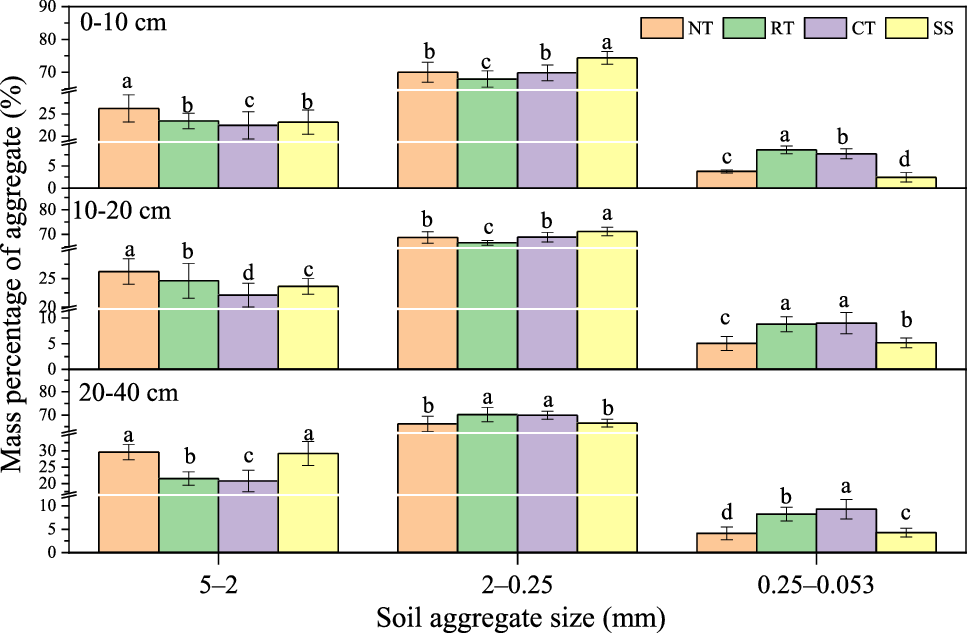
For a given soil layer, the aggregate content distribution was: 2–0.25 mm > 5–2 mm > 0.25–0.053 mm (Figure 1). For 5–2 mm aggregate, NT significantly increased the content of aggregate in each soil layer depth. Further, the content of 5–2 mm aggregate in SS treatment was higher than that in CT and RT in the 20–40 cm soil layer. The content of the aggregates in RT treatment was significantly higher than that in CT treatment. The order of the tillage methods for the formation of 5–2 mm aggregates was NT > SS > RT > CT. For 2–0.25 mm particle size in the soil layer of 0–10 and 10–20 cm depth, the aggregate content was the highest under SS treatment. However, the advantages of RT and CT treatment regarding the formation of 2–0.25 mm particle size aggregate gradually increased with the increase in soil depth. With the deepening of soil layer, the advantages of NT and SS decreased gradually. For 0.25–0.053 mm soil samples, the content was significantly higher in RT and CT than in NT and SS treatments, regardless soil layer.
The mass percentage content of water-stable aggregates with different particle sizes at 0–10, 10–20, and 20–40 cm soil depth under different tillage methods: no tillage (NT); rotary tillage (RT); conventional tillage (CT); and subsoiling (SS). Duncan test was used for multiple comparisons (p < 0.05). Vertical bars are standard errors.
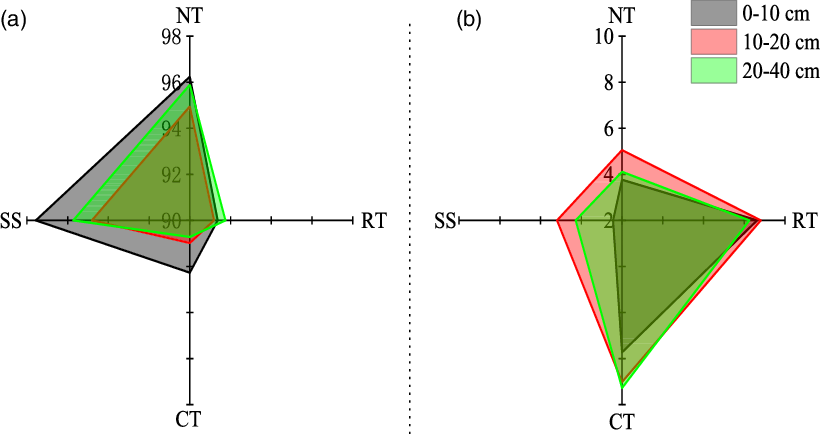
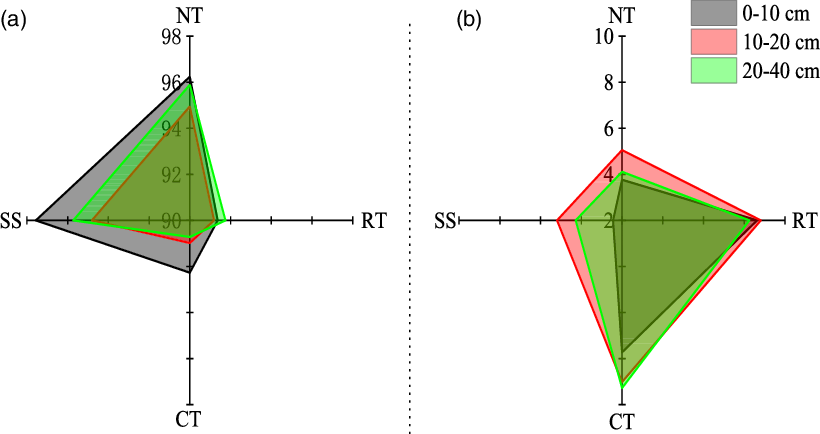
The aggregates were divided into micro-aggregates and macro-aggregates with a diameter of 0.25 mm. Generally, the aggregates with a diameter lower than 0.25 mm in the soil were soil micro-aggregates and their respective contents under different tillage methods are shown in Figure 2. The macro-aggregates content was the highest at 0–10 cm (Figure 2a), while the micro-aggregates content was the lowest at 0–10 cm (Figure 2b). In each treatment, the percentage of the mass of macro-aggregates in relation to the total mass of all aggregates was >90% (Figure 2a). Among the four tillage methods, SS and NT treatments increased significantly the macro-aggregates content and reduced the micro-aggregates content in all soil layer depths, and the effect of SS treatment was clear in the 0–10 cm soil layer (Figure 2). Compared with CT, SS and NT increased the content of macro-aggregates by an average of 5.2 and 4.8%, respectively. There was no significant difference in the content of aggregates in different soil layers under RT treatment, and it was not conducive to the formation of macro-aggregates. The micro-aggregates content in RT and CT was significantly higher than that in NT and SS.
Content of macro-aggregates (a) and micro-aggregates (b) at 0–10, 10–20, and 20–40 cm soil depth under different tillage methods: no tillage (NT); rotary tillage (RT); conventional tillage (CT); and subsoiling (SS). Macro-aggregates mean aggregate with particle size >0.25 mm, while micro-aggregates are <0.25 mm.
Aggregate-associated organic carbon
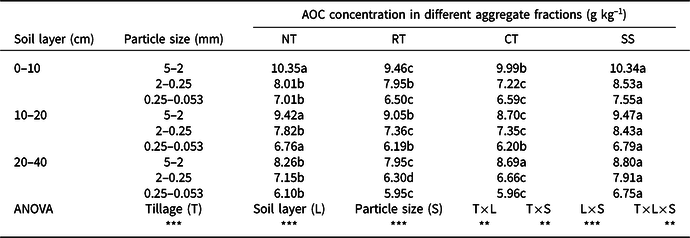
Tillage, soil layer, aggregate particle size, and their interaction had significant effects on the associated organic carbon (AOC) content (Table 1). Most of the AOC content in SS treatment was higher than that of other treatments (except for 5–2 mm aggregate in the 0–10 cm soil layer of NT treatment), followed by NT treatment with high AOC content. In most cases, the AOC contents in SS and NT treatments were higher than that of RT and CT. The soil layer depth and aggregate particle size also had significant influence on AOC content. With the increase of soil depth, AOC content decreased gradually. With the decrease in aggregate size, the AOC content in each gram of aggregate decreased gradually.
Aggregate-associated organic carbon (AOC) content under different treatments

NT, no tillage; RT, rotary tillage; CT, conventional tillage; SS, subsoiling.
Different letters in each line indicate significant differences among tillage methods (p < 0.05, Duncan’s test). **p < 0.01, ***p < 0.001.
Supplementary Table 1 shows the results of AOC content analysis by combining the AOC content per unit weight of aggregate with the weight percentage of aggregate. The AOC content of the macro-aggregates in NT and SS was higher than that of RT and CT; however, the AOC content of the aggregate with 0.25–0.053 mm particle size was lower than that of RT and CT. The distribution of AOC content in the whole aggregate was 2–0.25 mm > 5–2 mm > 0.25–0.053 mm, which was caused by the different content of aggregates with different particle sizes. Compared with CT, SS and NT increased AOC content by an average of 14.7 and 8.3%, respectively.
Aggregate-AMBC
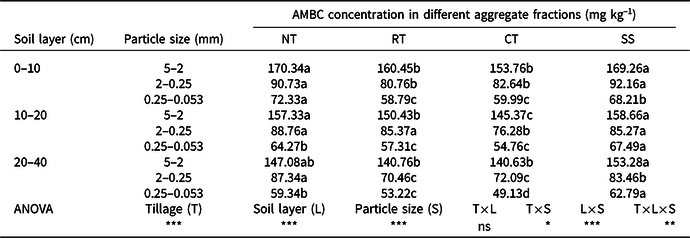
The result of AMBC content is shown in Table 2. With exception of the interaction between tillage and soil layer, tillage, soil layer, aggregate particle size, and their interactions have significant influence on the AMBC content. At different soil depths, the AMBC content of each gram of aggregate decreased with the increase in soil depth. With the decrease in aggregate size, the content of AMBC in aggregate decreased gradually, namely 5–2 mm > 2–0.25 mm > 0.25–0.053 mm (Table 2). The order of AMBC content in each gram of aggregate soil under different tillage treatments was NT > SS > RT > CT in the 0–10 cm soil layer, and it was SS > NT > RT > CT in the 10–20 cm and 20–40 cm soil layers. Among the four different tillage methods, the AMBC contents per gram of aggregate soil under NT and SS treatments were significantly higher than those under RT and CT treatment and showed obvious advantages in aggregates with different particle sizes. Meanwhile, the AMBC content under RT and CT treatment was relatively less but the AMBC content in RT was higher than that in CT (Table 2).
Aggregate-associated microbial biomass carbon (AMBC) content under different treatments
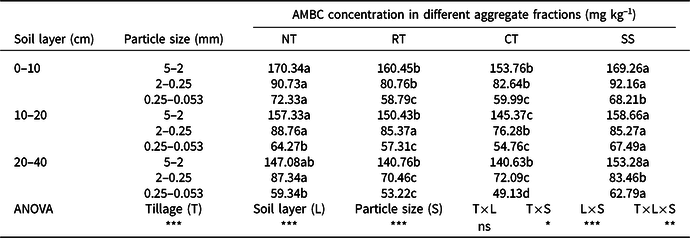
NT, no tillage; RT, rotary tillage; CT, conventional tillage; SS, subsoiling, ns, not significant.
Different letters in each line indicate significant differences among tillage methods (p < 0.05; Duncan’s test). *p < 0.05, ** p < 0.01, *** p < 0.001.
The distribution of AMBC content in the whole aggregate was 2–0.25 mm > 5–2 mm > 0.25–0.053 mm (Table S2). The AMBC content of the macro-aggregates in NT and SS treatments was higher than that of RT and CT; however, the AMBC content of the aggregate with 0.25–0.053 mm particle size was lower than that of RT and CT. Compared with CT, SS and NT increased AMBC content by an average of 16 and 18.3%, respectively.
Maize yields
Tillage measures had no significant effect on the number of effective ears and 1000-grain mass but had a significant effect on the number of grains per ear and yield (Table 3). The yield of maize under SS treatment was the highest, but there was no significant difference between SS and CT treatments. Compared with CT, SS increased yield by 0.22% and NT and RT reduced yield by 11.5 and 16.1%, respectively. Moreover, compared with the CT treatment, the number of grains per panicle significantly increased under SS treatment.
Effects of tillage on maize yield and its components

NT, no tillage; RT, rotary tillage; CT, conventional tillage; SS, subsoiling; ns, not significant.
Different letters in each column indicate significant differences among tillage methods (p < 0.05; Duncan’s test). *p < 0.05, ***p < 0.001.
Correlations
There is a significant positive correlation between organic carbon, microbial biomass carbon in the aggregates of each size and the macro-aggregates content. There was a significant positive correlation between yield and aggregate organic carbon, microbial biomass carbon, and macro-aggregates content, and a significant negative correlation between yield and micro-aggregate content (Table 4).
Correlation analysis of soil aggregate, soil aggregate-associated carbon content, and yield

1, organic carbon content in 5–2 mm aggregates; 2, organic carbon content in 2–0.25 mm aggregates; 3, organic carbon content in 0.25–0.053 mm aggregates; 4, microbial biomass carbon content in 5–2 mm aggregate; 5, microbial biomass carbon content in 2–0.25 mm aggregate; 6, microbial biomass carbon content in 0.25–0.053 mm aggregate; 7, the content of macro-aggregate; 8, the content of micro-aggregate; 9, the yield. *p < 0.05, **p < 0.01, ***p < 0.001.
Economic benefit analysis of maize under different tillage measures
The experimental plots were based on a winter wheat summer maize double-cropping system, and all the tillage methods were carried out after maize harvest and before wheat sowing. Therefore, when considering which tillage method can be more economically beneficial, differences in wheat yield cannot be ignored. Therefore, considering maize as the standard, the yield of wheat was converted into the yield of maize according to the unit price ratio of maize and wheat, and the economic benefits of different tillage methods were analyzed.
The annual maize equivalent yields were 23.77, 23.47, 26.16, and 26.52 Mg ha−1 under NT, RT, CT, and SS treatments, respectively. At the time of maize harvest in 2017, the unit price of maize in Tai’an was US$ 0.26 kg−1. The tillage costs of RT, CT, and SS treatments were US$ 115.87, 185.4, and 139.05 ha−1, respectively. Overall, NT, RT, CT, and SS treatment profits were US$ 5079.4, 4885.53, 5515.4, and 5,655.35 ha−1, respectively. Among the four tillage methods, SS had the highest benefit, followed by CT (Table 5). The SS treatment not only benefits soil ecology and reduces carbon loss (Tables 1 and 2) but also increases maize yield and farmers’ income (Table 5).
Profits of equivalent maize yield under different tillage treatments

NT, no tillage; RT, rotary tillage; CT, conventional tillage; SS, subsoiling; EMY, equivalent maize yield.
The unit price of maize in Tai'an was US$ 0.26 kg–1 and the exchange rate of 1 CNY = 0.1545 USD.
Discussion
Effect of tillage on aggregate stability
Herein, different tillage treatments had a significant impact on aggregates. Soil tillage is the main factor driving the turnover of soil aggregates, and different tillage depth and soil disturbance degree have different effects on the distribution of soil aggregates (Six et al., Reference Six, Elliott, Paustian and Doran1998). Zhao et al. (Reference Zhao, Zhang, Xue, Pu, Zhang, Liu, Chen, Rattan and Zhang2015) also showed that tillage will have a significant impact on soil aggregates and increasing tillage intensity will reduce the occurrence of soil aggregates, which is not conducive to the formation of macro-aggregates. Among the four tillage methods, NT significantly increased the macro-aggregates (Figure 2a) content because it greatly reduced the impact of tillage on the soil, which is similar to the results of Sarker et al. (Reference Sarker, Singh, Cowie, Fang, Collins, Badgery and Dalal2018). Furthermore, Blanco-Canqui and Ruis (Reference Blanco-Canqui and Ruis2018) found that NT has a hydrophobic effect on soil, which can reduce the disintegration of soil aggregates. In addition to NT treatment, SS treatment also significantly increased the content of macro-aggregates (Figure 2a). Wang et al. (Reference Wang, Li, Li and Bai2014) found that increasing tillage can not only reduce soil compaction and permeability but also promote the decomposition and transformation of organic matter and reduce soil cementation, which is not conducive to the formation of soil aggregates. However, SS can reduce the interference to the soil, increase soil permeability, reduce soil bulk density (Hou et al., Reference Hou, Li, Jia and Han2016), and provide a suitable environment for crop growth. Li et al. (Reference Li, Wu, Wu, Cai, Yao, Lv, Zheng and Liu2015) also found that SS can not only reduce the extent of soil cultivation but also affect the combination of micro and macro-aggregates by changing the mixing depth and decomposition rate of straw. This may also be the reason for the increase in macro-aggregates content under SS treatment in this study (Figures 1 and 2). RT could significantly reduce the stability of surface soil aggregates and then reduce the aggregation degree and stability of soil aggregates at tillage depth (Tian et al., Reference Tian, Wang, Zhang, Bian, Dong, Luo and Guo2017; Zhou et al., Reference Zhou, Lv, Yang and Li2007). In fact, the content of macro-aggregates in RT treatment was lower than that in NT and SS treatment, and the content of micro-aggregates was higher, which was not conducive to the formation of good soil structure (Figure 2). The increase in macro-aggregates content under CT treatment was relatively low because frequent tillage accelerates the mineralization rate of AOC and reduces the stable cementitious material of aggregates (Liu et al., Reference Liu, Zhang, Li and Wang2018). In addition, the amount of CT straw returned to the field was small, which does not contribute to the formation of new macro-aggregates. Overall, conservation tillage can increase the content of water-stable aggregates and improve soil structure, as also found by Jing et al. (Reference Jing, Wu, Wu, Cai, Yao, Lu, Zheng and Liu2015).
Effects of different tillage measures on aggregate-associated carbon
Land management practices have shown that the content of organic carbon is a suitable index reflecting the degree of soil degradation (Somasundaram et al., Reference Somasundaram, Chaudhary, Awanish, Biswas, Sinha, Mohanty, Hati, Jha, Sankar, Patra, Dalal and Chaudhari2018) and we found AOC content under the SS and NT treatment increased significantly compared with other treatments (Table 1). As also reported by Li et al. (Reference Li, Wu, Wu, Wang, Yao and Lv2021) and Chan et al. (Reference Chan, Heenan and Oates2002), long-term SS improved the content, structure, and quality of soil organic matter. SS could reduce soil compaction and bulk density and promote the transformation of straw, stubble, and roots in deep soils, thus increasing the carbon content of deep soils (Liu Reference Liu2019; Zhang et al., Reference Zhang, Wang, Wang, Wang, Xu, Jia, Wang and Li2017), which may be the reason for the increase in AOC content in SS treatment in this study (Table 1). Chen et al. (Reference Chen, Wang, Shi, Zhang, Liang, Jia, Fan and Wei2013) showed that NT treatment did not turn over the soil but increased the surface cover and decreased the bare area, soil permeability, and mineralization rate of organic carbon, and the long-term accumulation of organic carbon increased AOC. On the other hand, CT could destroy the soil structure, accelerate the decomposition of aggregates, increase the exposure and decomposition of AOC, and reduce the content of AOC (Kushwa et al., Reference Kushwa, Hati, Sinha, Singh, Mohanty, Jain and Patra2016).
AOC and AMBC are two important indices to measure soil carbon pool and AMBC is the most active organic component in the soil (Zhou et al., Reference Zhou, Chen, Jiang, Hu, Long, Pei, Li and Xu2020). Soil aggregates provide habitat for soil microorganisms (Gupta and Germida, Reference Gupta and Germida2015; Yang et al., Reference Yang, Liu and Zhang2018), and tillage measures affect the physical and chemical properties of soil and change the structure of aggregates and then the microenvironment of microbial survival (Gu et al., Reference Gu, Wu, Guan, Zhai, Zhang, Bello, Guo and Yang2020; Kraut-Cohen et al., Reference Kraut-Cohen, Zolti, Shaltiel-Harpaz, Argaman, Rabinovich, Green and Minz2020), changing the content of AMBC. Lupwayi et al. (Reference Lupwayi, Arshad, Rice and Clayton2001a; Reference Lupwayi, Monreal, Clayton, Grant, Johnston and Rice2001b) found that CT disturbed soil layers and reduced soil microbial activity, while conservation tillage, on the contrary, was conducive to maintaining a stable soil microenvironment (Sun et al., Reference Sun, Jia, Zhang, McLaughlin, Zhang, Liang, Chen, Wei and Liu2016) and improving soil microbial diversity and microbial activity, thus increasing the content of AMBC. The results of these studies are in agreement with our findings that NT and SS increase the content of AMBC in the soil as part of conservation tillage.
We found that the content of AOC and AMBC in soil decreased with the increase in soil depth (Tables 1 and 2). This is mainly because the input of exogenous organic matter and the transformation and exchange of soil organic carbon mostly occur on the soil surface.It is generally believed that the newly imported organic matter first accumulates and decomposes on the soil surface and then penetrates the deep soil, resulting in different AOC and AMBC contents at different depths (Qiu et al., Reference Qiu, Wei, Gao and Zhang2015). Somasundaram et al. (Reference Somasundaram, Reeves, Wang, Heenan and Dalal2017) found that 90% of carbon in soil exists in soil aggregates, and soil carbon fixation occurs with the formation and transformation of soil aggregates (Chen et al., Reference Chen, Tian, Yan, Xiang and Fang2011). Herein, the distribution of AOC and AMBC in aggregates is similar, and the carbon content decreases with the decrease in aggregate size (Tables 1 and 2), results similar to those obtained by Jastrow (Reference Jastrow1996).
Effects of different tillage on maize yield
The SS treatment was beneficial to the increase in maize yield (Table 3), as also noticed by Kuang et al. (Reference Kuang, Tan, Li, Gou, Li and Han2020). Accordingly, Wang et al. (Reference Wang, Cai, Hoogmoed, Oenema and Perdok2007) found that SS can plough into deeper soil, improve soil pore conditions, and increase soil permeability (Schneider et al., Reference Schneider, Don, Hennings, Schmittmann and Seidel2017), which would promote in-situ water infiltration, increase soil water content, and thus increase yield. Furthermore, SS treatment can break the bottom layer of plough, which is conducive to the distribution of plant roots to deeper soil and improving the utilization of nutrients and water in deeper soil. These factors may explain the increase in maize yield in SS treatment.
Research on the effects of NT treatment on crop yield is not consistent. While Lamm et al. (Reference Lamm, Aiken and Kheira2009) showed that NT treatment can effectively improve crop yield, Wang and Li (Reference Wang, Li, Li and Bai2014) reported that continuous application of NT treatment in some areas of China may reduce crop yield by 12–18%. The study by Boomsma et al. (Reference Boomsma, Santini, West, Brewer, McIntyre and Vyn2010) also proved that NT effects on yield vary according to the region, a possible consequence of different times under NT treatment. There is a close relationship between yield and soil organic carbon (Lal Reference Lal2009), and we found that maize yield was significantly and positively correlated with aggregate-associated carbon content and macro-aggregates content (Table 4). Among the four tillage methods, SS and NT treatment not only benefited the formation of macro-aggregates but also increased the aggregate carbon content (Figure 2a; Tables 1 and 2). RT treatment caused high soil compactness, which was not conducive to the growth of maize and reduced maize yield (Table 3). He et al. (Reference He, Shi, Zhao and Yu2020) also explained that RT causes soil compaction, limiting water uptake and root growth and reducing crop yield. CT treatment showed no obvious advantage in aggregate distribution and aggregate-associated carbon content (Figures 1 and 2; Tables 1 and 2). Wang et al. (Reference Wang, Wu, Dai, Zhang, Feng, Zhao, Wu, Jin, Cai, Oenema and Hoogmoed2012) also showed that long-term CT disrupts soil chemical and physical properties and further leads to serious sustainability issues, as soil erosion and productivity decline.
Conclusion
There was a significant positive correlation between maize yield and aggregate-AOC, microbial biomass carbon content, and macro-aggregates content. Long-term conservation tillage, that is, NT and SS, increased the content of macro-aggregates in soil, increased aggregate-associated carbon content, increased soil carbon storage, and improved soil quality. The maize yield under SS treatment was the highest, and that under CT treatment was slightly lower than that under SS treatment. Such difference was not significant, but SS treatment promoted the greatest economic benefit. In addition, CT treatment had a negative impact on aggregate carbon content and macro-aggregates content. The maize yield under NT and RT treatment was lower. Among the indexes involved in the experiment, long-term RT has no obvious advantage. Comprehensive analysis shows that SS treatment can be used as an appropriate tillage method to improve the macro-aggregates content, aggregate-associated carbon content, yield, and economic benefits of summer maize.
Supplementary material
For supplementary material for this article, please visit https://doi.org/10.1017/S001447972100020X
Acknowledgements
The authors are very grateful for the support of the National Natural Science Foundation of China (grant numbers 31771737 and 31471453) and the Special Fund for Agro-scientific Research in the Public Interest of China (grant number 201503117).
Financial support
The National Natural Science Foundation of China (grant numbers 31771737 and 31471453) and the Special Fund for Agro-scientific Research in the Public Interest of China (grant number 201503117).