Significant outcomes
-
∙ The clinical utility of neurological soft signs (NSS) may be improved by simplifying their measurement.
-
∙ 12 items of neurological examination overlapping with previously described categories of NSS in schizophrenia were identified by factor analyses.
-
∙ The 12 items showed high agreement with the referent standard 26-item Neurological Evaluation Scale (NES) in initial validation analyses.
-
∙ The design and standardisation of a short-NES (S-NES) based on empirically identified 12 items of neurological examination in an independent study is justified.
Limitations
-
∙ Analyses were based on existing data collected using the standard 26-item NES.
-
∙ Given the heterogeneous nature of both NSS and schizophrenia, the possibility exists that the identified 12 items of neurological examination are specific to the studied sample, thus limiting generalisation.
Introduction
NSS are subtle but observable neurological abnormalities. They include impairments in fine motor and sensory functions, as well as persistence of some primitive reflexes on neurological examination. These signs are often associated with abnormalities in widespread cortical and sub-cortical brain connections (Reference Kong, Herold and Lasser1–Reference Zhao, Li and Huang7). They may also be indicative of both vulnerability (Reference Ojagbemi, Esan, Emsley and Gureje8–Reference Peng, Xu and Miao12) and clinical course characteristics of a variety of neuropsychiatric disorders (Reference Peng, Xu and Miao12–Reference Greenberg, Wood and Spring15).
NSS are documented to be in excess in schizophrenia patients at various stages of disease (Reference Prikryl, Ceskova and Tronerova14,Reference Mechri, Bourdel, Slama, Gourion, Gaha and Krebs16), their unaffected first-degree relatives (Reference Neelam, Garg and Marshall17), and those with schizophrenia spectrum disorders (Reference Chan, Wang and Zhao18). They are thus an important subset in the heterogeneous manifestation of schizophrenia, and satisfy consensus criteria as endophenotypes of the disease (Reference Chan, Xie and Geng10,Reference Braff, Freedman, Schork and Gottesman19).
Endophenotype markers may represent more accessible readout of gene functions in the effort to identify genes conferring vulnerability to schizophrenia. In this way, they could be used in ordinary clinical settings to establish that an individual had progressed along the neuro-developmental pathway to schizophrenia. The presence of higher rates of NSS may therefore have the potential to augment the predictive power of psychopathological tests for individuals at risk of developing the disease. The clinical importance of NSS in schizophrenia is that they may also allow us to define a specific subset of patients with a distinct course of illness and specific requirements regarding treatment interventions.
Among available measures of NSS, the most fully described and widely employed in adult psychiatry is the NES (Reference Buchanan and Heinrichs20). Other scales that have been developed for this purpose include the quantified neurological scale (Reference Convit, Volavka, Czobor, de Asis and Evangelista21), Heidelberg scale (Reference Schroder, Niethammer and Geider22), Cambridge neurological inventory (Reference Chen, Shapleske and Luque23), and brief motor scale (Reference Jahn, Cohen and Hubmann24). Apart from the brief motor scale designed specifically for motor soft signs, other batteries are composed of a heterogeneous inventory of neurological examination abnormalities, including behavioural observations. As such, different items contribute to the composite NSS scores of the various instruments. This limits interpretation as to the meaning of NSS in categories of patients with schizophrenia.
In our previous exploratory (Reference Ojagbemi, Emsley and Gureje25) and confirmatory (Reference Ojagbemi, Akpa, Esan, Emsley and Gureje26) factor analyses of the standard (26 items) NES in a sample of 84 unmedicated or minimally treated patients with first-episode schizophrenia, we identified 12 items showing significant overlap with previous theoretical (Reference Heinrichs and Buchanan27) and empirical categories (Reference Sanders, Allen, D Forman, Tarpey, Keshavan and Goldstein28–Reference Prasad, Sanders and Sweeney32). This raised the possibility for the development of a shorter version of the NES (S-NES) based on the 12 empirically identified items of NSS. In the present study, we investigate the validity of the 12 items of NSS within existing data on first-episode schizophrenia to determine whether there is sufficient merit in proceeding from factor analysis to the design of the S-NES from the standard (26 items) NES in an independent study.
As NSS appear to identify a group of patients who may have a more severe schizophrenia as well as poorer response to treatment, the S-NES will be especially useful for rapid examination of NSS in busy clinical settings to provide information, in addition to history and gross findings on physical examination, that an individual had progressed along a more neurobiological pathway to the disease. This is of considerable importance in clinical practice when formulating aetiological models, planning both pharmacological and psychosocial interventions, and assessing the likelihood of adverse effects, including longer term prognosis. In addition to the clinical utility, the S-NES will save valuable research time by enabling a relatively rapid, but accurate, assessment of NSS in investigating variations in the risk of schizophrenia.
Material and methods
The present study is part of an investigation of the socio-demographic, clinical, biological, and treatment aspects of schizophrenia (and related disorders) in patients presenting for biomedical treatment for the first time as out- or in-patients in two general hospitals with psychiatric units in Nigeria. Ethical approval was obtained from the University of Ibadan ethics committee.
Subjects
The sample examined for the present study has been fully described (Reference Ojagbemi, Esan, Emsley and Gureje8,Reference Ojagbemi, Emsley and Gureje25,Reference Ojagbemi, Akpa, Esan, Emsley and Gureje26); we give a brief overview here. Patients were mostly anti-psychotic naive or had received minimal treatment (6.0% had <12 weeks of lifetime oral anti-psychotic exposure). They comprised of 47 males and 37 females, aged between 16 and 45 years. Participants were consecutively recruited between April 2009 and June 2011 (about 26 months). They were from the Yoruba ethnic group and were resident within and around Ibadan.
Patients were approached after they had been seen by the clinician, usually a consultant psychiatrist who was responsible for their routine clinical assessment at presentation. Only those who were assessed by the clinician to have a psychotic illness were approached for possible participation in the study. Written informed consent was obtained from all patients and/or their guardians after the data collection procedure was explained to them in either English or the local Yoruba language. The structured clinical interview for diagnostic and statistical manual for mental disorders – fourth edition (DSM-IV) patients edition (Reference First, Spitzer, Gibbon and Williams33) was employed to provide for a standardised assessment of patients after a semi-structured interview. The diagnosis of schizophrenia or schizophreniform disorder was then verified using criteria from the DSM-IV (34).
Patients meeting inclusion criteria were cross-sectionally evaluated as far as possible before anti-psychotic medications were prescribed. A wash-out period of 1 week was allowed for the five patients who had a lifetime exposure to oral antipsychotics. We obtained baseline information on demographic, personal, medical, and psychiatric history, as well as family history.
Assessment of NSS
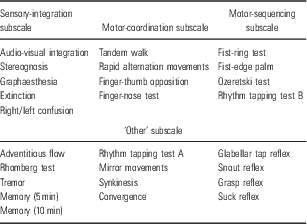
NSS in the sample of 84 patients with confirmed DSM-IV diagnosis of schizophrenia or schizophreniform disorder were assessed using the standard 26-item NES (Reference Buchanan and Heinrichs20). The measure includes tests such as tandem walk, rapid alternation movements, finger-to-thumb opposition, the finger-to-nose test, audio-visual integration, stereognosis, graphesthesia, extinction, right-to-left confusion, the first-ring, first-edge-palm, Ozeretski, and rhythm tapping tests (Table 1). The other signs assessed by the NES include cerebral dominance, short-term memory, frontal release, and eye movement signs. The NES items are scored with reference to the descriptive anchors provided on a three-point scale (no abnormality=0; mild, but definite impairment=1; marked impairment=2) with the exception of ‘suck’ and ‘snout’ reflexes which are scored 0 or 2. In the present study, marked neurological abnormality was defined as the rating of 2 on any one item on the NES.
Items in the referent standard 26-item Neurological Evaluation Scale with conceptually defined subscales

The tests were administered by two independent raters (both psychiatrists) after a total of 18 h of training spread across 3 days, including practical sessions on administering the 26-item NES and inter-rater reliability (IRR) measurements. Assessments were conducted in English and/or the Yoruba language. Each item was assessed according to a fixed order. The IRR conducted after training ranged from κ=0.62 to 0.82, whereas the intra-class correlation (ICC) across the measurements of NSS after the study was 0.98 [95% confidence interval (CI)=0.97–0.98].
Data analyses
Analyses were conducted using SPSS version 18.0 and AMOS 18.0. Descriptive statistics such as means and standard deviations were used to summarise quantitative variables, whereas frequencies and proportions were used for discrete variables.
Background factor analyses
The methods, results, and interpretation of the initial factor analyses leading to the present study have been fully described (Reference Ojagbemi, Emsley and Gureje25,Reference Ojagbemi, Akpa, Esan, Emsley and Gureje26). Briefly, we conducted exploratory factor analysis (EFA) on NES items that were abnormal in >10% of the entire sample of 84 patients. Items testing for cerebral dominance were excluded from the analyses. Factors obtained following initial maximum-likelihood exploration were further rotated using the varimax procedure. Factors were recorded when they have eigenvalues greater than unity and contributed a minimum of 10% to the cumulative variance (Reference Sewell, Perry and Karper35). For the factor extraction, loadings of ≥0.5 were considered meaningful. Following EFA, maximum-likelihood estimation of confirmatory factor analyses (CFA) was next conducted. For this, four competing models based on the four categories in EFA which, in theory, may provide good fit to the data were considered. Incremental fit statistics were used to provide information on the relative goodness-of-fit of each model (Reference Hooper, Coughlan and Mullen36).
The background EFA generated a four factor loading comprising of 12 NES items; audio-visual integration, fist-edge palm, rhythm tapping tests, extinction, right-left confusion, synkinesis, convergence, gaze impersistence, tandem walk, adventitious flow, graphaesthesis, and stereognosis. In CFA, a final three correlated factor structure in which stereognosis is prescribed to load into a ‘Perceptual and motor sequencing’ category (audio-visual integration, fist-edge palm, rhythm tapping, extinction, and right-left confusion) provided the best fit to the data (χ 2 goodness-of-fit test=1.25; comparative fit index=0.95; root square means error of approximation <0.05). The other two factors were: ‘Eye movement’ (synkinesis, convergence, gaze impersistence) and ‘Motor co-ordination and graphaesthesia’ (tandem walk, adventitious flow, graphaesthesia).
The present psychometric analyses
For the present study, we compared the phenomena of being positive for NSS using the referent standard 26-item NES versus being positive using the 12 empirically determined NES items. For this, we first classified the entire sample of 84 patients into four groups using the result of the referent standard, and that for the S-NES. We then determined subjects showing positive result for the referent standard (total abnormal) and those showing negative results (total normal). We next determine participants showing positive tests (true positive) and those showing negative results using S-NES (false negative) among the ‘total abnormal’ group. Among participants belonging in the ‘total normal’ group, we determined ‘true negative’ when participants show negative S-NES results and ‘false positive’ when they show positive results using the same screening.
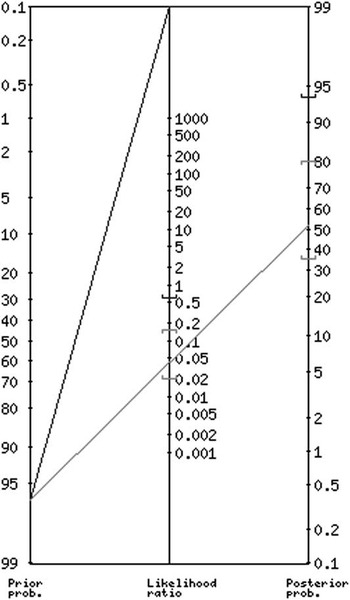
Next, we calculated sensitivity (number of ‘true positive’ participants divided by number of participants in the ‘total abnormal’ group), and specificity (number of ‘true negative’ participants divided by number of participants in the ‘total normal’ groups). We also estimated likelihood ratios (LR) for positive and negative S-NES tests and plotted these values against the proportion of ‘total abnormal’ NSS (pre-test probability) in the sample to determine the posterior-test probabilities of abnormal NSS when using the S-NES for the sample. The Bayesian plot of the LR, pre-test, and posterior-test probabilities is presented.
Results
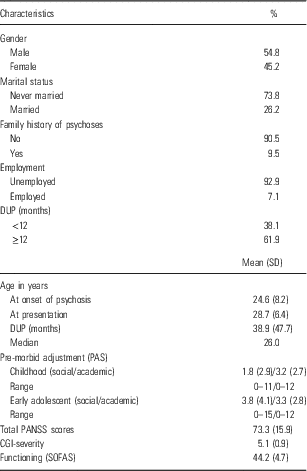
Out of 89 patients meeting criteria for the present study, five refused to participate out of their initiatives or those of their parents/guardians. Among those agreeing to participate, the mean ages at onset schizophrenia and presentation for treatment were 24.6 (±8.2) and 28.7 (±6.4) years, respectively. The mean duration of untreated psychosis was 38.9 months, with a median of 26.0 months. The baseline characteristics of the study sample are presented in Table 2.
Characteristics of 84 patients with first episode schizophrenia

DUP, Duration of untreated psychoses; PAS, pre-morbid adjustment scale; PANSS, positive and negative syndrome scale; CGI, clinical global impression; SOFAS, social and occupational functioning scale.
The mean NES score of the subjects was 21.5±11.1, with 81 (96.4%) subjects having marked impairment in NSS using the referent standard NES test (Fig. 1). In the same figure, the number of patients with and without marked NSS who test positive and negative for the S-NES is also presented.
Number of patients with or without marked neurological soft signs who test positive using the 12-item Neurological Evaluation Scale (NES). S-NES, 12-item short NES.

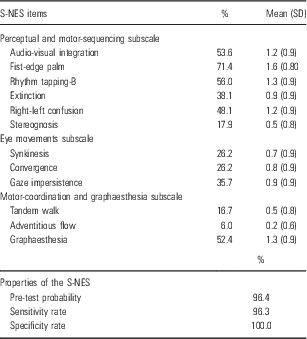
The items in the S-NES, their sub-categories determined using CFA, and mean severity scores is presented in Table 3. The S-NES items showed high agreement with the referent standard NES with a sensitivity rate of 96.3% and specificity of 100% (Table 3). The result of the Bayesian nomogram plot indicates a posterior-test probability of 100% when using the S-NES (Fig. 2).
Probability that a patient has a neurological soft sign after testing positive or negative on the Neurological Evaluation Scale 12.

Prevalence and severity scores of items in the short Neurological Evaluation Scale (S-NES), its properties in comparison with the referent standard 26-item NES in 84 patients with first episode schizophrenia

Discussion
We found in the present study that within existing data from a fairly large sample of minimally medicated or never treated patients with first episode schizophrenia, empirically determined 12 items of neurological examination showed high agreement with the traditional 26-item NES battery. These results would suggest that the design of a short version of the NES (S-NES) based on 12 items of neurological examination investigated in the present study is a logical step. If successful, the S-NES will be particularly useful for rapid screening of NSS in busy clinical settings, and also in research.
Observations from over three decades of research on the subject of NSS in schizophrenia suggest that the wide variation of items of neurological examination in the standard 26-item NES makes it too heterogeneous to identify specific aspects of the neurobiological underpinnings of the disease process (Reference Ojagbemi37). This is because different items are likely to contribute to the total score at different stages of the disease. This observation has added to persisting uncertainty about the meaning of NSS in schizophrenia (Reference Bombin, Arango and Buchanan38,Reference Chan and Gottesman39). For example, in a previous study by our team using the 26-item NES (Reference Ojagbemi, Esan, Emsley and Gureje8), we observed that while some NSS categories exhibited trait marking characteristics, other abnormalities, including the total NES score, did not reflect significant vulnerability marking potentials. The length of time required in completing the 26 items of neurological examinations in the standard NES battery may also limit its utility in pragmatic clinical situations.
Starting with their organisation into sensory integration, motor co-ordination, and motor sequencing NSS based on 13 items presumed to have ‘meaningful’ theoretical underpinnings (Reference Heinrichs and Buchanan27), there have been many previous effort to distil the multiplicity of neurological abnormalities measured in the standard NES battery into more parsimonious categories. This includes a total of 13, mostly exploratory, factor-analytic studies in the literature (Reference Ojagbemi, Akpa, Esan, Emsley and Gureje26–Reference Goldstein, Sanders and Forman31,Reference Sewell, Perry and Karper35,Reference Compton, Bercu, Bollini and Walker40–Reference Schroder, Geider, Binkert, Reitz, Jauss and Sauer45). Progress beyond factor analyses to the development of a shorter version of the standard NES battery has often been hindered because each subsequent factor-analytic study has often failed to replicate any of the preceding studies (Reference Sewell, Perry and Karper35,Reference Compton, Bercu, Bollini and Walker40). The nearest approximation to replicating a previous factor analysis has been achieved by studies relying on similar items or number of items hand-picked from the standard (26 items) NES battery. For instance, Goldstein et al. (Reference Goldstein, Sanders and Forman31) and Keshavan et al. (Reference Keshavan, Sanders and Sweeney30) included the same 13 items previously used by the Sanders et al. (Reference Sanders, Keshavan and Forman29) factor analysis. Similarly, Emsley et al. (Reference Emsley, Turner, Oosthuizen and Carr41) used 13 items that bore similarities with those of Keshavan et al. (Reference Sanders, Allen, D Forman, Tarpey, Keshavan and Goldstein28,Reference Keshavan, Sanders and Sweeney30). It is noteworthy that apart from Emsley et al. (Reference Emsley, Turner, Oosthuizen and Carr41), the other studies reviewed have relied on the same sample for their analysis (Reference Sanders, Allen, D Forman, Tarpey, Keshavan and Goldstein28–Reference Goldstein, Sanders and Forman31), thus making the findings of such studies difficult to generalise. In the CFA conducted by our group using the entire 26 items in the standard NES battery, NSS loaded into a three factor structure with significant overlaps with previously described categories (Reference Ojagbemi, Emsley and Gureje25,Reference Ojagbemi, Akpa, Esan, Emsley and Gureje26). This provided support for the findings in the present psychometric analyses of 12 empirically identified items in comparison with the 26 items in the standard NES battery (Reference Buchanan and Heinrichs20).
We are mindful of the limitations of the present study. The tests of validity were conducted within data collected using the 26 items NES, rather than independently using the two versions; 12 items versus 26 items. This methodology is likely to produce high agreements between the two versions and introduce contamination, as it were, to the results derived from such analyses. Contrariwise, we reasoned that as the results are derived from neurological examinations according to a standard procedure, the observations made by an expert clinician as to whether a patient has neurological abnormality, or not, may not be very different from those derived using 12 or 26 items. As an example, the ICC conducted across ratings using the 26-item NES was 0.98 (95% CI=0.97–0.98). The near perfect ICC would suggest a consensus of measurements between raters. Therefore, the results of the present study provide support for further development of the S-NES through an investigation comparing the proposed S-NES with the standard (26 items) NES among patients at different stages of the schizophrenia spectrum: first episode unmedicated, medicated patients and/or those with chronic schizophrenia, including first-degree relatives of patients. Such investigation will also generate reliability data for both the individual items and empirically determined sub-categories of the proposed S-NES, including cut-off scores providing the best balance between sensitivity and specificity.
In concluding, we believe that the clinical utility of NSS can be improved by further simplifying their assessment using a shorter version of the standard 26-item NES. This is because these specific NSS have an established profile as viable intermediate phenotypes of schizophrenia (Reference Ojagbemi, Esan, Emsley and Gureje8,Reference Prikryl, Ceskova and Tronerova14,Reference Neelam, Garg and Marshall17,Reference Emsley, Turner, Oosthuizen and Carr41,Reference Sanders, Joo and Almasy46), and may be relevant to establish that an individual had progressed along the neuro-developmental pathway to the disease. Given observations that NSS may identify a group of patients with schizophrenia who may have a more severe illness and poorer treatment response, the S-NES will be especially useful for rapid examination of NSS in busy clinical settings. This will be of considerable importance in clinical practice when planning both pharmacological and psychosocial interventions, and assessing the likelihood of adverse effects.
Acknowledgements
The authors would like to thank Taiwo Abiona for his work on data management. Authors’ Contribution: A.A. was responsible for data acquisition, analyses, and interpretation, produced the first draft and approved the final draft for publication. R.E. conceived and designed the study, sourced for funding, produced the first draft, and approved the final draft for publication. O.G. conceived and designed the study, sourced for funding, produced the first draft, and approved the final draft for publication.
Financial Support
This study was made possible by grants from the New Partnership for Africa’s Development, through the South African Department of Science and Technology.
Conflicts of Interest
None.
Ethical Standards
The authors assert that all procedures contributing to this work comply with the ethical standards of the relevant national and institutional committees on human experimentation and with the Helsinki Declaration of 1975, as revised in 2008.