Implications
The transition from late pregnancy to lactation is the most challenging period of a dairy cow’s life due to the high nutrient requirements by the fetal growth and lactogenesis and low feed intake. Feeding whole oilseeds to transition cows is a strategy to improve energy balance (EB) and metabolic status without impairing nutrient digestion. In addition, whole soybeans may replace calcium salts in diets without harming milk yield and improving milk composition. Furthermore, fat supplementation increased C18:3 fatty acids (FA) in milk, which has been demonstrated to alter physiology and metabolism in mammals.
Introduction
The transition period is the most tumultuous period of a cow’s life (Grummer et al., Reference Grummer, Mashek and Hayirli2004) and is characterized by homeorhetic adaptations, including mobilization of body reserves, which prepare animals for lactogenesis. The magnitude of negative EB during early lactation is associated with health problems (Drackley, Reference Drackley1999), thus strategies to avoid a severe negative EB have been extensively studied (Overton and Waldron, Reference Overton and Waldron2004). Fat supplementation is one way to increase dietary energy density, and if dry matter intake (DMI) is not decreased, fat supplementation may increase net energy of lactation (NEL) intake and EB of cows.
Although unsaturated FA are known as modifiers of physiology and metabolism, for example, modulating immune function and reproduction in dairy cows (Silvestre et al., Reference Silvestre, Carvalho, Crawford, Santos, Staples, Jenkins and Thatcher2011a and Reference Silvestre, Carvalho, Francisco, Santos, Staples, Jenkin and Thatcher2011b), they alter bacterial cell integrity (Maia et al., Reference Maia, Chaudahary, Figueres and Wallace2007) and impair ruminal fermentation. The matrix complex that surrounds the cotyledon(s) (which represents 90% of the weight and contains practically all the oil and protein) of oilseeds offers some protection to the access of ruminal microorganisms (Lock and Bauman, Reference Lock and Bauman2004), and can be added in lactating cow diets without decreasing NDF total tract digestion and impairing ruminal fermentation (Almeida et al., Reference Almeida, Del Valle, Paiva, Jesus, Barletta, Gandra, Bettero, Takiya and Rennó2015).
The objective of this study was to evaluate the effects of whole flaxseed (WF), whole raw soybeans (WS) and calcium salts of unsaturated fatty acids (CSFA) in diets of dairy cows during the transition period and early lactation on DMI, nutrient total tract digestion, N utilization, milk yield and composition, and EB. Our hypothesis was that unsaturated FA supplementation would improve EB of transition cows without impairing nutrient digestion and milk yield. Furthermore, we expected that cows fed C18:3 and C18:2 FA sources would increase unsaturated FA in milk, and WS would demonstrate different effects on apparent total tract nutrient digestibility and milk FA profile when compared with CSFA.
Material and methods
This study was approved by the Bioethics Committee of School of Veterinary Medicine and Animal Sciences of University of Sao Paulo, in accordance with the ethical principles of animal experimentation (approval number 1783/2009).
Animals, experimental design and diets
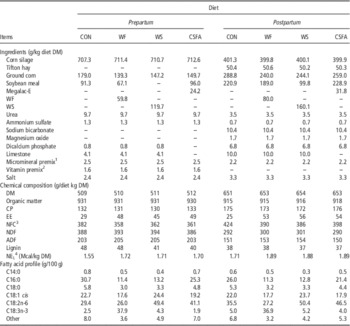
In total, 42 multiparous Holstein cows were fed a diet consisting of corn silage and concentrates and were randomly assigned to receive one of the four treatments: no supplement or Control (CON, n=11); WF (n=10), 60 and 80 g/kg (diet dry matter (DM) basis) of WF during the prepartum and postpartum periods, respectively; WS (n=10), 120 and 160 g/kg (diet DM basis) of WS during the prepartum and postpartum periods, respectively; and CSFA (Megalac®-E, Arm & HammerTM; Church & Dwight Co. Inc., Ewin, NJ, USA, marketed in Brazil by Elanco-Eli Lilly and Company, Indianapolis, IN, USA, n=11), 24 and 32 g/kg (diet DM basis) of CSFA during the prepartum and postpartum periods, respectively. Experimental diets were formulated according to National Research Council (NRC) (2001) recommendations (Table 1) and to differ in C18:3n-3 and C18:2n-6 FA concentration. Diets were provided daily, at 0800 and 1300 h, as a total mixed ration from 35 days before the expected calving date until 84 days in milk. Amounts of feed and orts of each cow were weighed daily and orts were restricted to 5% to 10% of feed intake on an as-fed basis. Throughout the experiment, cows were housed in individual pens containing forced ventilation, sand beds and individual troughs.
Ingredients, chemical composition and fatty acid profile of experimental diets

CON=control; WF=whole flaxseed, WS=whole raw soybean; CSFA=calcium salts of unsaturated fatty acids; DM=dry matter; NEL=net energy of lactation; EE=ether extract; NFC=non-fiber carbohydrates.
1 Contained per kg: 10 g of Mg, 9 g of S, 23 750 mg of Zn, 5625 mg of Cu, 18 125 mg of Mn, 5000 mg of Fe, 125 mg of Co, 312 mg of I, 144 mg of Se, 900 mg F (maximum); vitamin A, 2000 IU; vitamin E, 12 500 mg; and vitamin D, 5000 IU.
2 Vitamin premix (kg): vitamin A, 8000 IU; vitamin E, 50 000 mg; vitamin D, 2300 IU.
3 NFC=1000−[(CP−CP of urea+%urea)+NDF+EE+ash], from Hall (Reference Hall2000).
4 Estimated using the NRC (2001) model.
At the beginning of the experiment, CON group composed of cows with 3.5±0.5 parturitions, 762±14.1 kg of BW and 3.1±0.18 of body condition score (BCS); WF group composed of cows with 4.0±0.5 parturitions, 782±27.1 kg of BW and 3.25±0.20 of BCS; WS group composed of cows with 4.0±1.5 parturitions, 712±22.5 kg of BW and 3.05±0.15 of BCS; and CSFA group composed of cows with 4.0±1.0 parturitions, 734±21.7 kg of BW and 3.1±0.15 of BCS (mean±SD).
Sample collection and chemical analyses
The corn silage and Tifton hay (fed as structure feed during early lactation) were sampled weekly (n=17) and the concentrate ingredients were sampled during the preparation of the mixture (n=4) for chemical analysis. Orts samples (12.5% of total daily orts) were collected daily from each cow and were combined into a single weekly sample, stored at −20°C, for posterior chemical analysis. Feed intake was recorded daily as the difference between feed offered and refused. The DM of corn silage and Tifton hay were assessed weekly and the DM of the concentrate ingredients was analyzed before the preparation of the concentrates. The adjustments in diets were made when necessary.
To analyze the FA in ingredients, lipids extraction and methylation were performed as described by Sukhija and Palmquist (Reference Sukhija and Palmquist1988) with minor modifications, which were as follows: extraction was done with 6 ml of chloroform, instead of 2 ml, and methylations were done with methanolic-HCl, but using a concentration of 6.5% instead of 10%, and a volume of 9 ml instead of 3 ml. Thus, the ratio of extracting solvent to methylation reagent was the same as described by Sukhija and Palmquist (Reference Sukhija and Palmquist1988). Incubation time was increased from 2 to 2.5 h, and temperature was reduced from 80°C to 65°C. Tubes were continuously checked for leaks during incubation and were repeated if substantial leaks occurred. FAs were quantified by gas chromatography (GC Shimatzu 2010 with automatic injection; Shimadzu Corporation, Kyoto, Japan) equipped with an SP-2560 capillary column (100 m×0.25 mm i.d. with 0.02 µm film thickness; Supelco, Bellefonte, PA, USA). The oven temperature was held on 70°C for 4 min, increased by 13°C/min until 175°C and then held at this temperature for 27 min. Finally, temperature was increased by 4°C/min until it reached 215°C, and then was kept at this temperature for 31 min. Hydrogen was used as the carrier gas with a flow rate of 40 cm3/s. Four standards were used for FA identification: standard C4-C24 (TM 37; Supelco Sigma-Aldrich Group, Bellefonte, PA, USA), vaccenic acid C18:1 trans-11 (V038-1G; Supelco Sigma-Aldrich Group), C18:2 trans-10, cis-12 (UC-61M, 100 mg; Nu-Chek-Prep Inc., Elysian, MN, USA), C18:2 cis-9, trans-11 (UC-60M, 100 mg; Nu-Chek-Prep Inc.).
During the prepartum period fecal samples were collected twice daily (0800 and 1300 h) on days 28 and 14 before the expected calving date, and postpartum fecal samples were collected after milking (morning and afternoon) on days 21, 42 and 84 to determine nutrients excreted in feces and the daily fecal excretion.
Samples of feed, orts and feces were dried at 55°C in a forced-air oven for 72 h and ground in a knives mill to pass through a 1-mm screen (Wiley Mill, A. H. Thomas, Philadelphia, PA, USA) and analyzed for gross energy (GE, assessed in a bomb calorimeter; IKA Works GmbH & Co., Staufen, Germany), DM (Association of Official Analytical Chemistry (AOAC) 950.15), ash (AOAC 942.05), ether extract (EE, AOAC 920.39), CP (CP=N×6.25; AOAC 984.13) and lignin (AOAC 973.18) according to the methods described by AOAC (2000). NDF was analyzed using α-amylase without addition of sodium sulfite to the detergent (TE-149 fiber analyzer; Tecnal Equipments for Laboratory Inc., Piracicaba, Brazil). ADF was determined as described by Van Soest et al. (Reference Van Soest, Robertson and Lewis1991). Non-fiber carbohydrates (NFC) concentrations were estimated according to Hall (Reference Hall2000) where NFC=100−[(%CP−%CP from urea+%urea)+%EE+%ash+%NDF].
Indigestible ADF (iADF) was used as an internal marker to estimate daily fecal DM excretion of cows (Nocek, Reference Nocek1988). Samples of feed, orts and feces were dried at 55°C in a forced-air oven for 72 h and ground in a knives mill to pass through a 2-mm screen (Wiley Mill, A. H. Thomas). Samples were placed in 4×5 cm non-woven textile bags (20 mg DM/cm2 of surface) as described by Nocek (Reference Nocek1988) and then bags were incubated during 288 h in the rumen of two fistulated dry cows adapted to the CON diet of the present experiment. After 288 h, bags were removed from the rumen and washed in running tap water, dried at 55°C in a forced-air oven for 72 h and submitted to treatment with acid detergent (Van Soest et al., Reference Van Soest, Robertson and Lewis1991) in a fiber analyzer (TE-149 fiber analyzer) to determine iADF concentrations.
Apparent total tract digestibility values were obtained as follows:
 $$\eqalignno{ & {\rm Digestibility}\,{\rm of}\,{\rm DM}\,{\equals}\,100{\minus}\left[ {100\,{\times}\left( {{{\,\%\,{\rm iADF}\,{\rm in}\,{\rm diet}} \over {\,\%\,{\rm iADF}\,{\rm in}\,{\rm feces}}}} \right)} \right] \cr & {\rm Digestibility}\,{\rm of}\,{\rm nutrient}\,\cr{\equals}\,100{\minus}\left[ {100\,{\times}\left( {{{\,\%\,{\rm iADF}\,{\rm in}\,{\rm diet}} \over {\,\%\,{\rm iADF}\,{\rm in}\,{\rm feces}}}} \right)\!{\times}\!\left( {{{\,\%\,{\rm nutrient}\,{\rm in}\,{\rm feces}} \over {\,\%\,{\rm nutrient}\,{\rm in}\,{\rm diet}}}} \right)} \right] $$
Body condition score and body weight
BWs were measured weekly before the morning feeding and after milking, using a livestock scale for large animals (Brete ME 2.80; Coimma®, Dracena, Brazil). BCS was measured weekly using a five-point system (1=emaciated to 5=obese) according to Wildman et al. (Reference Wildman, Jones and Wagner1982).
Energy balance and absorbable nitrogen
Energy values were calculated as follows: digestible energy (DE) intake=GE intake×GE digestibility; NEL intake was calculated from DE through metabolizable energy according to NRC (2001). Milk NEL (Mcal/day)=milk yield (kg)×[0.0929×(fat %)+0.0563×(true protein %)+0.0395×(lactose %)] (NRC, 2001); NEL BW gain was calculated according to NRC (2001); NEL requirements for maintenance=0.080 Mcal/kg BW0.75 (NRC, 2001); and NEL available for maintenance=NEL intake−NEL milk−NEL BW gain. EB was calculated as follows: EB (Mcal/day)=NEL intake−(milk NEL+NE BW gain) according to NRC (2001). Efficiency of energy utilization was calculated as follows: efficiency=NEL/DE intake. Absorbable N (g/day) was estimated as follows: N intake−N excreted in feces.
Milk yield and composition
Cows were mechanically milked daily at 0600 and 1600 h, and production was measured by an automatic milk meter (Alpro® DeLaval, Tumba, Sweden). Milk production was corrected to 3.5% of fat (FCM) according to Sklan et al. (Reference Sklan, Ashkenazi, Braun, Devorin and Tabori1992), in which FCM=(0.432+0.1625×milk fat concentration)×kg of milk. Milk samples were automatically collected (Alpro® DeLaval) every week, according to milk yield of each cow in each milking. Milk samples were analyzed fresh for fat, protein and lactose by IR methodology (Lactoscan®; Entelbra, Sao Paulo, Brazil). Samples were stored at 5°C after the morning milking and mixed with samples of the afternoon milking. After the milk composition assay, samples were stored at −20°C for later analyses of FA profile.
Milk lipid extraction was performed according to Feng et al. (Reference Feng, Lock and Garnsworthy2004) and methylated according to Kramer et al. (Reference Kramer, Fellner, Dugan, Sauer, Mossoba and Yurawecz1997). FAs were quantified by GC as previously described.
Statistical analyses
The data were subjected to SAS (version 9.1.3; SAS Institute, Cary, NC, USA, 2004), verifying the normality of residuals and homogeneity of variances by PROC UNIVARIATE. Data were analyzed by PROC MIXED according to the following model of repeated measures:
 $$Y_{{ijk}} \,{\equals}\,\mu {\plus}A_{k} {\plus}D_{i} {\plus}T_{j} {\plus}D_{i} {\times}T_{j} {\plus}e_{{ijk}} $$
where Y ijk is the dependent variable; μ the overall mean; A k the random effect of animal; D i the fixed effect of diet; T j the fixed effect of time (weeks); D i ×T j the interaction effect of diet and time; and e ijk the residual error. DF were calculated according to Satterthwaite’s method (ddfm=satterth). Autoregressive 1 was the best covariance structure based upon the smallest Akaike’s information criterion values. Other covariance structures were tested including compound symmetry, heterogeneous compound symmetry, unstructured and heterogeneous autoregressive 1. For covariate adjustment, first we used DMI and milk yield of previous lactation, but they were not significant in the statistical model; and then, covariate adjustment was performed using the initial BW and BCS of cows. To determine differences among treatments, orthogonal contrasts were performed as follows: C1 (CON v. FA sources), C2 (WF v. WS+CSFA) and C3 (WS v. CSFA). Significant level was set at P⩽0.05.
Results
Apparent total tract digestibility, absorbable nitrogen and energy balance
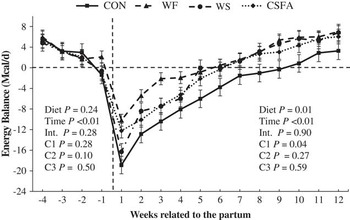
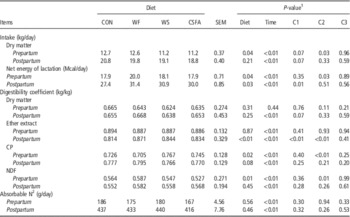
Although unsaturated FA supplementation did not alter DMI during the prepartum and postpartum periods, it increased (P=0.01) the NEL intake during the postpartum period (Table 2). Cows fed WF had higher (P=0.03) DM and NEL intake than those fed WS and CSFA during the prepartum period. Animals fed WS and CSFA showed similar (P>0.55) DM and NEL intake. Supplementation with FA increased (P<0.01) EE digestibility during the postpartum period. Cows fed WF had higher (P<0.01) EE digestibility during the postpartum period than cows fed WS and CSFA. In addition, animal fed WF had greater (P=0.01) NDF digestibility and lower (P<0.01) CP digestibility than cows fed WS and CSFA during the prepartum period. Cows fed WS and CSFA demonstrated similar digestibility of nutrients. Diets did not influence the absorbable N. Unsaturated FA supplementation increased EB during the postpartum period (P=0.04; Figure 1).
Energy balance of dairy cows fed different fatty acid sources during the transition period and early lactation. Orthogonal contrasts: C1=CON v. fatty acid sources, C2=WF v. WS+CSFA and C3=WS v. CSFA. CON=control; WF=whole flaxseed; WS=whole raw soybean; CSFA=calcium salts of unsaturated fatty acids; Int.=diet×time interaction effect.

Feed intake, nutrient apparent total tract digestibility and absorbable N of dairy cows fed different fatty acid sources during the transition period and early lactation

CON=control; WF=whole flaxseed; WS=whole raw soybean; CSFA=calcium salts of unsaturated fatty acids.
1 Orthogonal contrasts: C1=CON v. fatty acid sources (WF+WS+CSFA), C2=WF v. WS+CSFA and C3=WS v. CSFA.
2 N intake – N excreted in feces.
Milk yield and composition, efficiency of nutrient utilization and body condition score
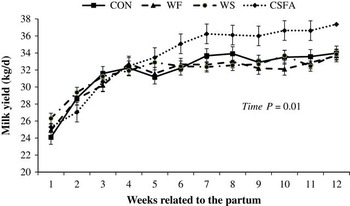
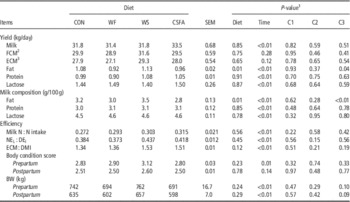
Milk yield (Figure 2) and composition were not affected (P>0.32) by fat supplementation, and also did not differ (P>0.28) among cows fed diets rich in n-3 FA (WF) and n-6 FA sources (WS and CSFA; Table 3); however, cows fed WS had higher milk fat production (P=0.04) and proportion (P<0.01) than those fed CSFA. Efficiency of N and energy utilization were not altered (P>0.22) by experimental diets. BCS and BW were similar (P>0.09) among cows fed the experimental diets.
Milk yield of dairy cows fed different fatty acid sources during the transition period and early lactation. Orthogonal contrasts: C1=CON v. fatty acid sources, C2=WF v. WS+CSFA and C3=WS v. CSFA. CON=control; WF=whole flaxseed; WS=whole raw soybean; CSFA=calcium salts of unsaturated fatty acids; Int.=diet×time interaction effect.

Milk yield and composition, nutrient utilization efficiency and body condition score of cows fed different fatty acid sources during the transition period and early lactation

CON=control; WF=whole flaxseed; WS=whole raw soybean; CSFA=calcium salts of unsaturated fatty acids; FCM=fat-corrected milk; ECM=energy-corrected milk; NEL=net energy of lactation; DEI=digestible energy intake; DMI=dry matter intake.
1 Orthogonal contrasts: C1=CON v. fatty acid sources (WF+WS+CSFA), C2=WF v. WS+CSFA and C3=WS v. CSFA.
2 3.5% FCM=(0.432+0.165×percentage of fat)×kg of milk, from Sklan et al. (Reference Sklan, Ashkenazi, Braun, Devorin and Tabori1992).
3 ECM=0.327×milk yield+12.86×fat yield+7.65×protein yield, from Dairy Records Management Systems (2014).
Milk fatty acid profile
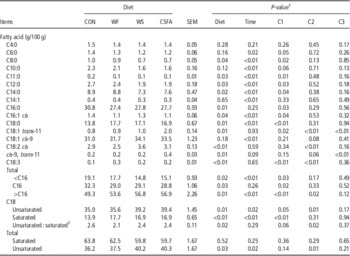
Supplemental fat decreased (P<0.05) the concentration of almost all short-chain and medium-chain FA in milk, including C6:0, C8:0, C11:0, C12:0, C14:0, C16:0 and C16:1 cis FA (Table 4). On the other hand, fat supplementation increased (P<0.05) the concentrations of long-chain FA in milk, including C18:0, C18:1 trans-11 and C18:3 FA. Although supplemental fat increased the concentrations of long-chain FAs, it did not alter (P=0.14) unsaturated FA concentration in milk. Cows fed diet rich in n-3 FA (WF) presented lower (P<0.01) concentrations of C18:1 trans-11 and C18:2 FA in milk, and higher (P<0.01) concentrations of C18:3 FA in milk than cows fed diets rich in n-6 FA (WS and CSFA). Furthermore, cows fed diets rich in n-6 FA presented greater (P=0.01) total C18 unsaturated FA and total unsaturated concentration in milk than those fed the diet rich in n-3 FA. Animals fed CSFA demonstrated higher (P<0.01) concentration of C18:1 trans-11 and C18:2 cis-9, trans-11 FA than those fed WS.
Milk fatty acid profile of dairy cows fed different fatty acid sources during the transition period and early lactation

CON=control, WF=whole flaxseed, WS=whole raw soybean; CSFA=calcium salts of unsaturated fatty acids.
1 Orthogonal contrasts: C1=CON v. fatty acid sources (WF+WS+CSFA), C2=WF v. WS+CSFA and C3=WS v. CSFA.
2 Total C18 unsaturated : total C18 saturated fatty acid ratio.
Discussion
Although the current experiment did not show differences in DMI when supplemental fat was added to the diet, cows fed WF exhibited higher DMI and consequently higher NEL intake during the prepartum period than those cows fed WS and CSFA. These results are related to the NDF digestibility that was higher during the prepartum period for cows fed WF when compared with cows fed WS and CSFA. Increased rate of NDF digestion may reduce the filling effect in the rumen–reticulum and decrease the stimulation of stretch receptors found in the rumen wall (Allen, Reference Allen2000); however, the differences in NDF digestibility among cows fed WF and WS or CSFA are unclear. These results may be related to the different rates of lipid release in the rumen between FA sources, and consequently different effects on ruminal fermentation. Calcium salts of FA were reported to not be fully inert in ruminal environment and their unsaturated FA content was extensively hydrogenated after a meal or when ruminal pH dropped below 6.5 (Van Nevel and Demeyer, Reference Van Nevel and Demeyer1996). In the present study, cows fed CSFA showed the lowest values of NDF digestibility during the prepartum period. Interestingly, during prepartum CP digestion in cows fed WF was lower when compared with cows fed WS and CSFA. The matrix which protects FA release into ruminal fluid and into intestinal lumen is composed mainly of proteins, and differences in its digestion may also alter NDF and EE digestion.
The increased digestibility of EE in cows fed supplemental fat can be related to ruminal absorption of FA and catabolism by the rumen epithelium. Goosen (Reference Goosen1975) reported that ruminal absorption of FA increases with higher FA concentration and Cook et al. (Reference Cook, McGilliar and Richard1967) demonstrated in vitro that FA can be catabolized to ketone bodies by the rumen epithelium. The higher FA digestibility with higher unsaturation degree and longer chain length (NRC, 2001) may explain the higher EE digestibility in cows fed WF compared with those fed WS and CSFA.
During the postpartum period, the higher EB of cows fed supplemental FA was primarily due to the increased NEL intake without decrease of DMI. Zachut et al. (Reference Zachut, Arieli, Lehrer, Livshitz, Yakoby and Moallem2010) reported higher EB when cows were fed WF than CON (2.3 and 0.8 Mcal/day, respectively); however, when evaluating EBnadir (the lowest value of EB), the authors observed −7.7 and −3.6 Mcal/day for WF and CON diet, respectively. Caldari-Torres et al. (Reference Caldari-Torres, Lock, Staples and Badinga2011) also observed greater EB during postpartum for animals fed a diet rich in C18:3 FA when compared with the other diets, with the values obtained during the 7th week of lactation (2.10, −0.10 and 4.70 Mcal/day for diets rich in saturated, C18:2 and C18:3 FA, respectively). Nonetheless, despite all cows presented EBnadir during the 1st week of lactation, in the current study, cows supplemented with FA presented higher EB than those cows fed CON, reaching positive EB in the 9th, 6th, 5th and 6th week of lactation for CON, WF, WS and CSFA diets, respectively.
We expected that milk yield would be altered according to the NEL intake, as cows did not show differences in BW and BCS during the experimental period. Côrtes et al. (Reference Côrtes, Silva-Kazama, Kazama, Gagnon, Benchaar, Santos, Zeoula and Petit2010) did not find differences in milk yield when supplemental fat was added to the ration, but the primary goal of their study was to evaluate digestion and ruminal fermentation parameters. In the present study, diets differing in C18:2 and C18:3 FA concentrations did not affect FCM likewise reported by Lieber et al. (Reference Lieber, Hochstrasser, Wettstein and Kreuzer2011), which studied the effects of diets containing oilseeds rich in C18:2 and C18:3 (sunflower seed and linseed, respectively) during prepartum and postpartum periods.
Cows fed CSFA had the lowest milk fat yield and concentration. DM and energy intake did not differ between cows fed WS and CSFA, thus the milk fat synthesis was affected by specific FA related to rumen biohydrogenation (Bauman and Griinari, Reference Bauman and Griinari2003). Cows fed CSFA showed higher concentrations of intermediates of biohydrogenation, including C18:1 trans-11 and cis-9, trans-11 FA. Baumgard et al. (Reference Baumgard, Corl, Dwyer, Saebø and Bauman2000) evaluated the effects of isomers of CLA on milk fat synthesis, and demonstrated that trans-10, cis-12 FA (FA from partial biohydrogenation process) inhibited milk fat synthesis.
In this study, milk long-chain FA (>16C) increased when cows were fed supplemented FA. In addition, cows fed diets containing WS and CSFA (n-6 FA sources) exhibited higher C18:1 trans-11 and C18:2 in milk fat than WF, which are related to human health benefits (Lock and Bauman, Reference Lock and Bauman2004). These results are similar to those previously cited in literature (Petit et al., Reference Petit, Palin and Doepel2007; Zachut et al., Reference Zachut, Arieli, Lehrer, Livshitz, Yakoby and Moallem2010), which reported higher concentration of C18:2 FA when cows were fed WS and CSFA. When a FA source is added to ruminant diets, most of the FA can be modified through the biohydrogenation process, which is usually not completed resulting in a wide variety of FA. Therefore, when incomplete biohydrogenation of FA occurs, duodenal flow of C18:1 trans and CLA (cis-9, trans-11 and trans-10, cis-12) increases, whereas CLA trans-10, cis-12 is related to milk fat synthesis inhibition (Bauman and Griinari, Reference Bauman and Griinari2003). In agreement with the current study, Chilliard et al. (Reference Chilliard, Glasser, Ferlay, Bernard, Rouel and Doreau2007) reported higher concentrations of the intermediate isomers of FA biohydrogenation in the milk FA profile, especially C18:1 trans-11 in cows fed CFSA.
Supplementation of diets rich in C18:2 or C18:3 FA, during the transition period and early lactation, had no influence on milk performances of dairy cows, but had a positive effect on EB and increased unsaturated long-chain FA in milk fat in early lactating dairy cows.
Acknowledgments
The authors acknowledge the University of Sao Paulo and Dairy Cattle Research Laboratory for providing the infrastructure and staff necessary for this study. In addition, the authors express appreciation to the Sao Paulo Research Foundation for financial support (grant no. 09/10180-0).