INTRODUCTION
First described in the early to mid 1990s (see Rees Reference Rees1992; Rees & Wackernagel Reference Rees, Wackernagel, Jansson, Hammer, Folke and Costanza1994), the ecological footprint (EF) provides a measure of demands upon the biological productivity and assimilative capacity of the biosphere imposed by a given human population over a certain time period (usually a year). The unique attribute of EF analysis is the expression of demand for all impact components as an equivalent, imaginary land/sea area (global hectares, or gha). Detailed descriptions of the procedures involved in EF analysis are found elsewhere (see Wackernagel et al. Reference Wackernagel, Onisto, Bello, Linareas, Falfan, Garcia, Guerrero and Guerrero1999; Chambers et al. Reference Chambers, Simmons and Wackernagel2000). Typically, calculations account for and combine the use of energy (direct and embodied), foodstuffs, raw materials and water, and also capture transport-related impacts, the production of wastes (including carbon dioxide from the burning of fossil fuels), and the loss of productive land associated with buildings, roads and other aspects of the built environment. A much-used benchmark for comparison in EF studies is the so-called ‘fair earthshare’ value, that is the global average area of productive land/sea space available annually on a per caput basis. One recent estimate of this, which excludes land set aside for non-human species, is 1.8 gha per year (WWF [Worldwide Fund for Nature] et al. 2004). Other cited values are slightly higher (for example Chambers et al. Reference Chambers, Simmons and Wackernagel2000, Reference Chambers, Griffiths, Lewis and Jenkin2004), with 2 gha per year regarded as a reasonable estimate (Venetoulis et al. Reference Venetoulis, Chazan and Gaudet2004). EF analysis provides conservative estimates of global environmental impact, excluding, for example, the effects of toxic substances (Chambers et al. Reference Chambers, Simmons and Wackernagel2000).
As awareness, understanding and use of EF analysis increases (Nijkamp et al. Reference Nijkamp, Rossi and Vindigni2004), many potential applications have been proposed (for example Wackernagel & Yount Reference Wackernagel and Yount2000). Tourism is often described as the world's largest industry (for example WTO [World Tourism Organization] 2002), and the potential contribution of EF analysis as an indicator of sustainable tourism has been recognized (Hunter Reference Hunter2002). To date, however, the application of EF analysis to tourism has been very limited. We are aware of only two previous attempts to calculate the EF of mass tourism activities. Gössling et al. (Reference Gössling, Borgstrom Hansson, Horstmeier and Saggel2002) estimated a leisure tourism EF for the Seychelles and found the per tourist EF to be some 1.9 gha per year, with an average holiday in the Seychelles corresponding to 17–37% of the annual EF of a citizen of an industrialized country. Well over 90% of the total EF was found to be due to air travel to and from the destination. WWF-UK (2002) presented EF analyses of two typical two-week UK package holiday products from London to the popular Mediterranean destinations of Majorca and Cyprus. For Majorca, the total EF per tourist was 0.37 gha, while the corresponding value for Cyprus was 0.93 gha. Accounting for approximately 50% of the total EF in both cases, air travel was by far the largest single component of the holiday EF, although a much smaller proportion than that reported by Gössling et al. (Reference Gössling, Borgstrom Hansson, Horstmeier and Saggel2002), given the relatively short flights involved to the Mediterranean area. However, details of how the air travel EF was calculated in the WWF-UK (2002) study were not provided.
These studies did not provide a procedure for the routine estimation of the holiday EF using easily accessible secondary data sources that would enable comparisons between different tourism types and products to be made. Furthermore, in both studies, ‘gross’ EF values were calculated, this being the sum of EF components generated at the destination and in transit between source and host countries. A ‘net’ estimate that recognizes the potential absence of an EF at home for the duration of the holiday provides the more appropriate, conservative basis for tourism EF accounting. It is also in keeping with the tradition in EF analysis of consciously erring on the side of caution when estimating the magnitude of a particular activity or group (for example Wackernagel & Rees Reference Wackernagel and Rees1996; Monfreda et al. Reference Monfreda, Wackernagel and Deumling2004; Nijkamp et al. Reference Nijkamp, Rossi and Vindigni2004).
It is with reference to the ecotourism segment of the international tourism market that consideration of the net tourism EF is particularly pertinent. This is because ecotourists generally originate from developed countries where the average per caput EF is high, but frequently holiday in less developed countries (for example Gössling Reference Gössling1999) with considerably lower average per caput EFs (WWF et al. 2004). Theoretically, therefore, the potential exists for some international ecotourism holiday products to reduce, in net terms, the per caput EF of an individual whilst on holiday compared with the normal EF that would have been generated at home. The need to consider the EF of an international ecotourist in the context of the EF generated by her or him at home has been recognized by Fennell (Reference Fennell2002a). Of course, the potential for a net EF reduction assumes that the tourist generates an EF whilst on holiday similar to the average per caput EF of the host population. Clearly, ecotourism activities may be relatively luxurious and resource demanding at the destination (Page & Dowling Reference Page and Dowling2002). However, products designed to be low impact at the destination occur frequently in the ecotourism sector, in contrast to other types of tourism, and include the use of renewable energy sources and various energy saving techniques, environment-friendly transport options (for example horses, manually propelled boats, cycling, collective motorized transport), materials reuse and recycling, and facilities construction using local materials only (see WTO 2003).
Ecotourism is also an important context for the application of EF analysis because it has become one of the fastest growing segments of the global tourism industry (Watkin Reference Watkin2003; Nyaupane & Thapa Reference Nyaupane and Thapa2004), and has generated a substantial body of academic and policy literature (Fennell Reference Fennell2002b). The global significance of ecotourism was confirmed by the designation of 2002 as the International Year of Ecotourism by the UN, when The World Ecotourism Summit attracted over 1000 delegates from 132 countries (World Ecotourism Summit 2002). Additionally, environmental conservation is accepted as a key goal of ecotourism activity (see Ross & Wall Reference Ross and Wall1999; Buckley Reference Buckley2003a), and ecotourism is frequently portrayed as pioneering the sustainable development of the tourism industry (for example de Villiers Reference de Villiers2003). The issue of transport to the ecotourism destination, particularly the climate change potential of long-haul flights, is also attracting increasing attention (Wall Reference Wall1997; Mowforth & Munt Reference Mowforth and Munt2003). Indeed, Simmons and Becken (Reference Simmons, Becken and Buckley2004) estimated the carbon dioxide emissions of a relatively short one-way international flight between Australia and New Zealand to be approximately equivalent to the total transport-related carbon dioxide emissions of a hypothetical 20-day self-drive ecotour in New Zealand. EF analysis enables consideration of the relative importance of transit and destination components to overall net EF estimates, and the potential of the transit EF component to outweigh any potential EF reduction arising from a difference between source and host country EFs remains unexplored.
Although the meaning of ‘product’ in the tourism context is still a matter of debate (see Fennell Reference Fennell2002a), it is clear that ecotourism experiences, or products, are very varied and all the more so given differing interpretations of ecotourism (Simmons & Becken Reference Simmons, Becken and Buckley2004). A product may encompass a short visit to an ecotourist attraction, or a bespoke/organized ecotour lasting several days. The number of ecotourism products available globally is unknown, but even adopting very conservative parameters (for example 50 countries worldwide, each with an average of 10 distinct products) the total must number many hundreds. If the different countries from which ecotourists may originate are considered, then many thousands of EF analyses would be required in order to establish a range of EFs for ecotourism products. To conduct EF analyses of even a small proportion of these using primary data on resource consumption by individual tourists collected at the destination is a daunting task. Even considering energy use alone, evidence suggests that energy use per tourist for the same types of tourist activity at the destination may vary considerably (Simmons & Becken Reference Simmons, Becken and Buckley2004). Finding ‘representative’ examples of ecotourism holidays for EF analysis using primary data, therefore, may prove problematic. We return to the issue of future data needs later in the paper in an attempt to clarify an emerging agenda for EF analysis in tourism research.
Using conservative and simplified hypothetical ecotourism scenarios, however, it is possible to seek to establish, for the first time, an indicative range of estimates for the potential minimum net EF of ecotourism. The main goal of the research reported here was to use these estimates to draw conclusions about the likely global impact of ecotourism on natural resources. This is an important undertaking because ecotourism is expanding rapidly and is frequently presented as leading the more environmentally conscious development of tourism. It is also important because EF analysis expresses environmental impact in global terms, rather than restricting consideration of impact to local conditions (Hunter Reference Hunter2002). The ecotourism scenarios adopted paired leading source countries involved in generating international tourism with geographically widespread host countries, ensuring variety in net EF estimates. Potential net EF estimates were made using readily accessible secondary data sources and an easily adopted calculation procedure as key attributes of a suitable indicator (Chambers et al. Reference Chambers, Simmons and Wackernagel2000; Bell & Morse Reference Bell and Morse2003).
Specific objectives of the research were to (1) use different source/host country scenario combinations to establish an indicative range of potential minimum net EF estimates for ecotourism activity, and (2) assess the implications of the findings for the environmental impact of ecotourism. In discussing research findings, and as a basis for continued debate, we also examine data needs and future EF analysis in tourism research towards the end of the paper.
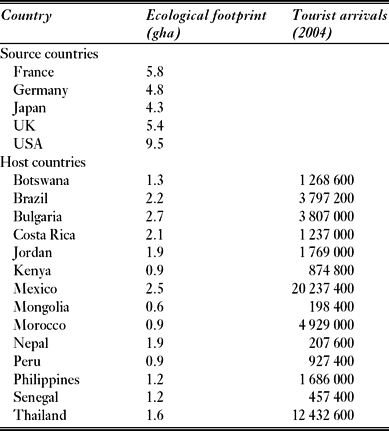
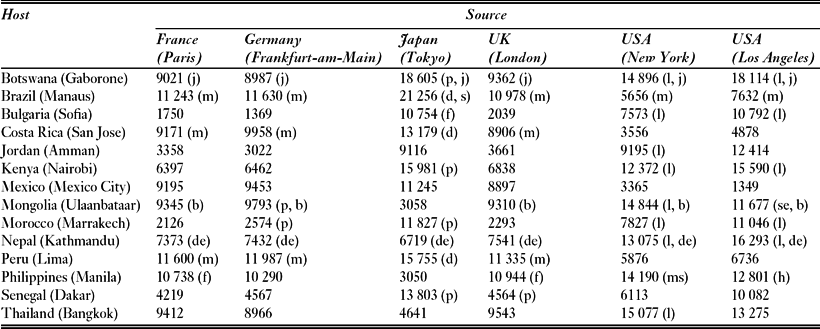
The research reported here does not consider ‘real’ ecotourism products. Rather, using conservative assumptions, the research sought to better understand the potential impact of ecotourism in global terms using hypothetical scenarios of relevance to the ecotourism sector. For objective (1), five source countries were chosen, these being the leading spending nations in international tourism (USA, Germany, UK, Japan and France; WTO Reference Wolfe2004). For the USA, two departure cities/airports were chosen (New York and Los Angeles) to reflect the size of the country and provide additional geographical diversity to EF estimates. Fourteen host countries were chosen: Botswana, Brazil, Bulgaria, Costa Rica, Jordan, Kenya, Mexico, Mongolia, Morocco, Nepal, Peru, Philippines, Senegal and Thailand. No global initiative exists for the gathering of ecotourism data (TIES [The International Ecotourism Society] 2000) and given the consequent lack of information on international ecotourist arrivals around the world, host countries were chosen on the following basis: they represent a geographically diverse group of destinations (at least one from each of the WTO's ‘world regions’); and, all either provided the WTO with information on ecotourism activities during the UN (United Nations) International Year of Ecotourism in 2002, are known to have established authorities to oversee ecotourism activities (UN General Assembly 2003), or are well known as ecotourism destinations through case study material (for example Buckley Reference Buckley2003b). Selected host countries also offered some variety in terms of per caput EF characteristics. The most recent per caput EF estimates (2001) for the source and host nations chosen are given in Table 1, along with international tourist arrivals for 2004. Source airport authorities provided flight distances and associated flight information (Table 2).
Average per caput ecological footprints of source and host countries (2001), and international tourist arrivals for host countries. Sources: WWF et al. (Reference Wolfe2004), World Bank (2004) cited in World Travel and Tourism Council (2005).

One-way flight distances (km) between source and host countries with associated flight information. Sources: Aeroports de Paris (2005); British Airports Authority (2005b); Los Angeles World Airports (2005); Narita International Airport (2005); Port Authority of New York and New Jersey (2005). All flights direct unless indicated otherwise: b = via Beijing; d = via Dallas; de = via Delhi; f = via Frankfurt-am-Main; h = via Hong Kong; j = via Johannesburg; l = via London; m = via Miami; ms = via Minneapolis-St Paul; p = via Paris; s = via Sao Paulo; se = via Seoul.

METHODS
EF estimation procedure
The procedure outlined here was for international holiday tourism involving air travel (Hunter & Shaw Reference Hunter and Shaw2006). The method for calculating an estimate of the potential annual equivalent net per caput (tourist) EF is summarized below. Steps (1)–(5), relating to the air travel EF, draw from a number of sources, as indicated. The conservative nature of the assumptions made implies that estimates should be regarded as potential minima.
Transit zone
(1) The total round-trip flight distance (km) was determined.
(2) Energy use per tourist (megajoules, MJ) was obtained by multiplying flight distance by an energy intensity conversion factor of 2.0 MJ per passenger km (see below).
(3) The equivalent land area (ha of forest) per tourist (per year) required to sequester carbon dioxide production was obtained by dividing energy use per tourist by 73GJha−1 (73000 MJha−1; i.e. the number of GJ that 1 ha of forest land will sequester, in carbon dioxide equivalent, per year when liquid fossil fuel is combusted; WWF et al. 2000).
(4) We allowed for the additional radiative forcing of aircraft emissions other than carbon dioxide emitted at altitude (Schumann Reference Schumann1994; IPCC [International Panel on Climate Change] 1999) by multiplying by a factor of 2.7(IPCC 1999), giving a new estimate of required forest land (ha; see below).
(5) We multiplied by the appropriate ‘equivalence factor’ (in 2001 this was 1.38) to correct for forest land being more productive than average world space (Chambers et al. Reference Chambers, Griffiths, Lewis and Jenkin2004; WWF et al. 2004), giving a final estimate of the transit zone per tourist footprint in gha per year (see below).
Destination area
(6) Host country average per caput EF was used as a proxy for the destination area EF of the tourist, reduced pro rata from an annualized value according to the length of stay.
Net EF
(7) Using the average per caput EF of the source country and the length of stay away from home, we calculated the per tourist EF that would have been generated at home for the period away (again reduced pro rata from an annualized value), and subtracted this from the gross per tourist EF (the sum of steps (1)–(6)).
Additional explanation is required for some of these steps. Distances were for direct flights where these were available (these can be ascertained online; see, for example, British Airports Authority 2005a), or assumed reasonably direct connections (Table 2). The shortest geographical connections flown by major airlines and their partners between city pairings were used, but other factors such as price or travel operator preference, may influence the choice of route. Also, distances for direct flights will vary in reality because of weather conditions, air traffic control flight path alterations and the like. Nevertheless, such discrepancies between the distances used for our calculations and those actually flown are likely to be relatively minor, and as such were not judged to be of significance given the resolution of the analysis.
With reference to step (2), energy intensity is the energy use per passenger km, accounting for average load factors and an average freight-to-passenger ratio (Becken Reference Becken2002). Different conversion factors have been suggested by different sources and vary according to trip length. For long-haul flights, Lenzen (Reference Lenzen1999) estimated 1.75 MJ per passenger km; Gössling et al. (Reference Gössling, Borgstrom Hansson, Horstmeier and Saggel2002), drawing on a range of sources, suggested 2.0 MJ per passenger km; and British Airways and Lufthansa cited overall energy intensities of 2.03 MJ per passenger km and 1.86 MJ per passenger km, respectively (Green Globe 2000, cited in Becken Reference Becken2002). For short-haul flights, the Energy Efficiency Conservation Authority (1999) calculated a figure of 2.75 MJ per passenger km in the context of New Zealand. The choice of value to be applied will therefore depend upon the nature of the flight under consideration. EF calculations that appear later in this paper adopted an energy intensity value of 2.0 MJ per passenger km, since this is relatively conservative and falls between the extremes noted above.
Clearly, accounting as above for the transit EF solely in terms of fuel or energy use by aircraft excluded other potential contributions to the transit EF such as motorized travel to and from airports, and in-flight food and beverage consumption by tourists. For the purposes of this paper, we assumed that tourists lived within the hinterland of the selected departure airports, and that the starting point of the ecotour was similarly close to the major arrivals airport. In any case, the size of additional components relative to the fuel consumption footprint component of even the shortest of international flights is likely to be small (see Gössling et al. Reference Gössling2002; Buckley Reference Buckley2003b). As such, they were not considered further as part of the simplified EF estimation approach presented here. In situations where tourists originate or end up a considerable distance from an international gateway airport, this part of their journey, particularly if by air, would need to be accounted for.
Step (4) recognizes the emission or formation of substances other than carbon dioxide, including nitrogen oxides, methane, water vapour and ozone, at altitude which contribute to radiative forcing (global climate change potential) by aircraft (Lee Reference Lee, Hester and Harrison2004). We have, therefore, adopted the approach of Gössling et al. (Reference Gössling, Borgstrom Hansson, Horstmeier and Saggel2002) such that the contribution to radiative forcing by other substances effectively increases the forest area required, in EF terms, to combat global climate change. The IPCC (1999) estimated, from a range of values, that aviation's carbon dioxide emission accounts for only some 37% of its total radiative forcing effect, suggesting the use of a 2.7 multiplier (100%/37% = 2.7). Lee (Reference Lee, Hester and Harrison2004) suggested that the total radiative forcing effect of aircraft emissions may be higher than previously thought, but we adopted the IPCC estimate as authoritative and conservative.
With reference to step (5), equivalence factors are specific to each year for which national per caput EFs are produced. The latest national per caput EF estimates although produced in 2004 (WWF et al. Reference Wolfe2004) were actually for the year 2001, and for this year the equivalence factor was determined to be 1.38. This highlights the broader point that care should be taken to ensure that a consistent reference year is used for all aspects of a tourism EF estimate, if applicable (i.e. if combining a per tourist EF estimate with actual international tourist arrival numbers and length of stay information in order to estimate the total EF of international tourism from a particular source country).
With this important caveat in mind, the destination area per tourist footprint (step 6) was estimated using national per caput footprint data (WWF et al. Reference Wolfe2004). In the first instance, it was assumed that, on average, tourists consumed resources at the destination in approximately the same manner as residents of the host country. Therefore, the host nation's per caput footprint was used as a proxy for tourist consumption at the destination (Hunter Reference Hunter2002), reduced from the annualized value on a pro rata basis according to the length of stay. Although for the extended adventure/ecotour type of ‘hard’ product (see, for example, Wolfe Reference Wolfe2004) resource use may be of a low-impact nature (Page & Dowling Reference Page and Dowling2002), with tourists perhaps living as locals as part of the tourism product, other so-called ecotourists will actually live relatively luxurious, resource-demanding lifestyles whilst on holiday (see Kontogeorgopoulos Reference Kontogeorgopoulos2004). Ecotourism of this form may be described as ‘popular’ or ‘soft’ (Page & Dowling Reference Page and Dowling2002). We therefore recognize that adopting the host nation per caput EF as a proxy for the EF generated by the tourist at the destination is problematic and debatable. However, it is in keeping both with the general tradition in EF analysis of erring on the side of caution, and with the aim of this research of providing scenario-based potential minimum net EF estimates. Additionally, host country per caput EF values effectively incorporate the resource demands of international tourists, including those relating to transport and accommodation provided exclusively for tourists, as this is the way in which national EF accounts are calculated (Wackernagel & Yount Reference Wackernagel and Yount2000; Hunter Reference Hunter2002). This said, we return to the implications of different types of ecotourism and higher impact at the destination later in the paper.
Step (7) in the procedure estimated the net EF by subtracting an EF component (based on the per caput EF of the source country and length of stay information) corresponding to resource use that would have been generated at home over the holiday period. This step may greatly reduce apparent impact, with net EF values substantially lower than gross EF estimates. This may particularly be the case as the length of stay increases, and the relative importance of the transit EF component therefore reduces (assuming, for the moment, that the EF in the destination area is substantially lower than the EF normally generated by the tourist in the source country). There are two further assumptions in this step of the procedure that require clarification. The first is that no EF is generated at home whilst the tourist is on holiday. In reality, a very small footprint may be generated as a result, for example, of minimal heating or security lighting being activated periodically. The normal, major EF components associated with energy use, transportation, food consumption, the consumption of various raw materials, and waste production, however, will be absent. Nevertheless, we consider the possible effect of a small ‘at-home’ EF later in the paper. Our initial assumption of no at-home EF component may underestimate potential net EF values. This contrasts with the second assumption implicit in step (7) that ecotourists generate EFs at home at the average per caput rate of the source country. The prevailing view (for example Page & Dowling Reference Page and Dowling2002) appears to be that ecotourists generally enjoy higher incomes than other tourist types. Given growing evidence of a positive correlation between household EF and income (see Lenzen & Murray Reference Lenzen and Murray2001; Lenzen et al. Reference Lenzen, Dey and Foran2004; Wiedmann et al. Reference Wiedmann, Minx, Barrett and Wackernagel2005), it is likely that an ecotourist will contribute at a higher than average rate to the source country EF. Thus this aspect of step (7) may overestimate ecotourism scenario net EF values. We consider the influence of this initial assumption later in the paper.
Obtaining EF estimates of ecotourism scenarios
The combination of six source cities (in five countries) and 14 destination countries resulted in 84 net EF estimates being made for a particular length of stay period. Three lengths of stay were used (7 days, 14 days and 21 days) to provide added variety to the chosen source/host country combinations. The 21-day scenario may be particularly long for most ecotourism holidays (see Page & Dowling Reference Page and Dowling2002), but a long stay increases the likelihood of obtaining small potential net EF values, and it was felt important to allow for this theoretical possibility. Decreasing net EF estimates with increasing length of stay rests on the assumption that the EF generated by the tourist at the destination area is lower than that normally generated by her or him at home.
RESULTS
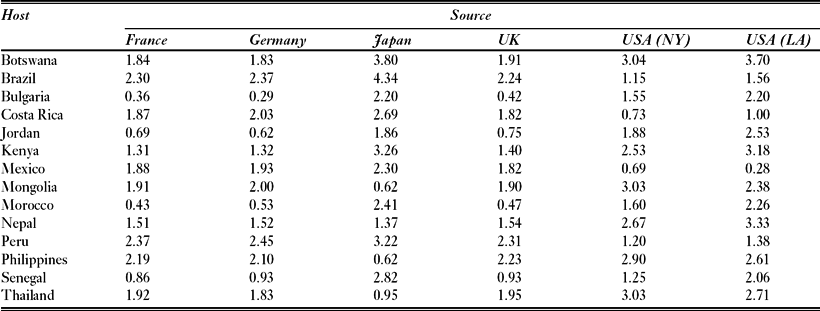
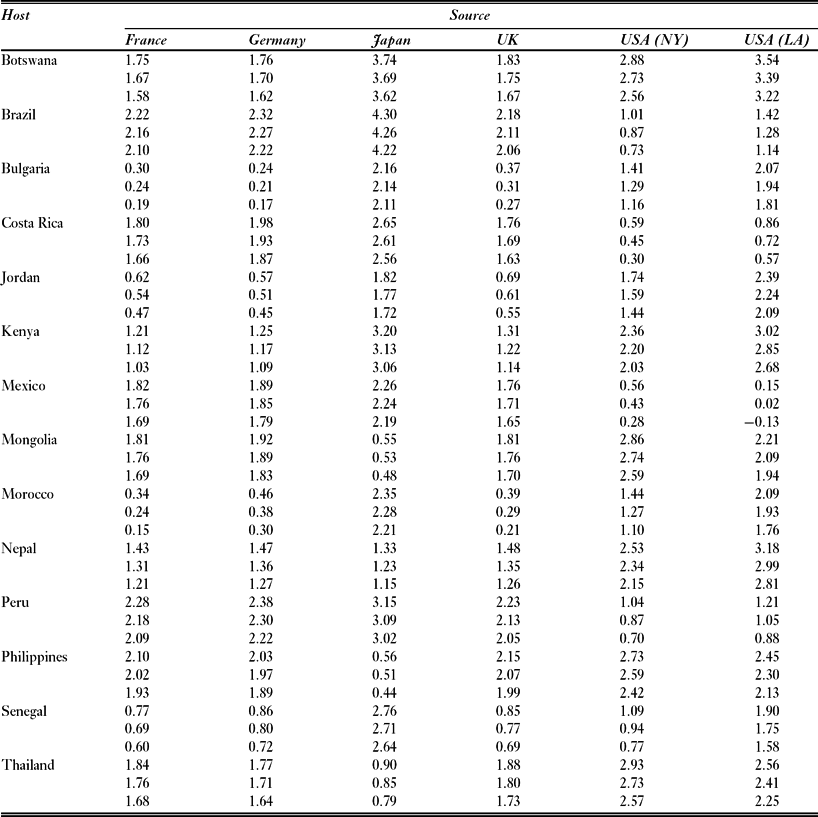
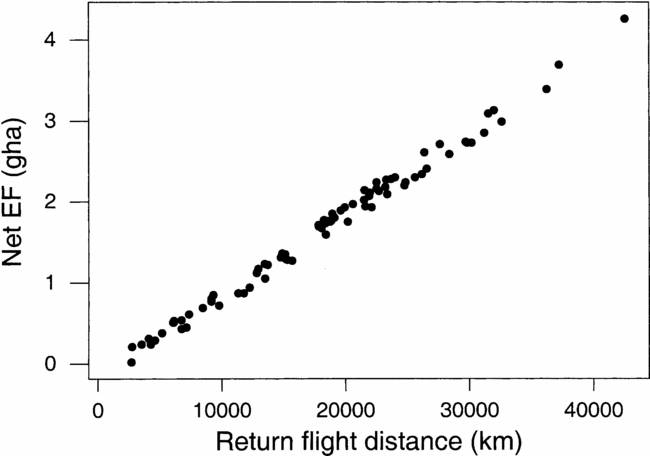
Assumptions notwithstanding, the USA (Los Angeles/Mexico) scenario involved the shortest flight (some 1349 km, one-way), with the longest one-way flight (at over 21 000 km) between Japan and Brazil (Table 2). Transit zone EF estimates (Table 3) ranged between 0.28 gha (Los Angeles/Mexico) and 4.34 gha (Japan/Brazil). Minimum potential net EF estimates were obviously lower (Table 4). For a 7-day holiday these ranged between 0.15 gha (Los Angeles/Mexico) and 4.30 gha (Japan/Brazil), the latter value being equivalent to the average annual per caput EF of a Japanese citizen (Table 1). For a 14-day holiday, estimates ranged between 0.02 gha (Los Angeles/Mexico) and 4.26 gha (Japan/Brazil). In the former scenario, the holiday potentially accounted for only some 0.21% of the average annual per caput EF of a USA citizen. With the longer holiday period of 21 days, one scenario (Los Angeles/Mexico) actually produced a potentially negative net EF (-0.13 gha), suggesting the possibility of an overall reduction in demand on global renewable resources in this particular case. Of course, negative real-world hectares are impossible, but the EF, in gha, is imaginary space (Nijkamp et al. Reference Nijkamp, Rossi and Vindigni2004, p. 754), and a negative net EF outcome merely indicates a potential comparative reduction in global resource demand. This was an isolated result, however, and over one-third (some 36%) of the 14-day holiday scenarios produced potential net EF values greater than the (annual) ‘fair earthshare’ value of approximately 2 gha (Table 4). In only 20% of 14-day scenarios did the holiday product potentially account for less than the annual average per caput footprint in low-income countries (0.8 gha according to WWF et al. 2004). The size of the transit component was very important to overall potential net EF estimates, with a strong relationship evident between net EF and flight distance (Fig. 1).
Transit zone ecological footprint estimates (gha per tourist per year) between source and host countries. NY=New York, LA=Los Angeles.

Potential net ecological footprint (gha per tourist per year) for source/host country combinations (upper value = 7-day holiday; middle value = 14-day holiday; lower value = 21-day holiday). NY=New York, LA=Los Angeles.

Potential net EF (gha per tourist) against return flight distance for a 14-day ecotourism holiday.

Overall mean potential net EF estimates for the 7-day, 14-day and 21-day scenarios were 1.76 gha, 1.66 gha and 1.56 gha, respectively, giving a maximum difference of some 11%. The potential effect of allowing for the generation of a small at-home EF during the tourist trip was investigated by adding 10% and 20% of source country per caput EF values to the estimates in Table 4. On average, the 10% at-home rate increased potential net EF estimates by 0.6% (7-day holiday), 1.8% (14 days) and 2.5% (21 days), with corresponding increases of 1.1%, 2.9% and 4.9%, respectively, for the 20% at-home rate. Generally, therefore, net EF estimates were relatively insensitive to the potential generation of comparatively small EFs at home during the tourist trip. The potential influence of ecotourists generally contributing more to source country EFs than the average can be gauged by reversing these outcomes for a remaining at-home footprint component. In other words, potential net EF estimates were 0.6% (7 days), 1.8% (14 days) and 2.5% (21 days) lower, on average, assuming that ecotourists contributed 10% more to source country EFs than the average citizen. Corresponding net EF reductions for a 20% higher than average contribution were 1.1%, 2.9% and 4.9%, respectively. Again, findings appear relatively insensitive to changes in the nature of the assumption.
DISCUSSION
Given that this is apparently the first time that any attempt has been made to estimate the potential EF of ecotourism scenarios, we stress again that our estimates are only indicative. We also recognize that other approaches and indicators might provide evidence of a smaller relative influence of air travel on overall environmental impact. This said, our findings appear to support anecdotal concern (see Wall Reference Wall1997) about the possible environmental impacts of flying, and flight distance, associated with increasing ecotourism activity. They also support the EF-based findings of Gössling et al. (Reference Gössling, Borgstrom Hansson, Horstmeier and Saggel2002) and WWF-UK (2002) in this regard, albeit based upon the use of net, rather than gross, EF estimates and using a variety of scenarios. Based on our EF findings, we echo Simmons & Becken (Reference Simmons, Becken and Buckley2004, p. 19) who describe potential destination area-based reductions in energy use as minor compared to the ‘enormous energy consumption’ associated with a short international flight. Even for the 21-day scenarios (Table 4), the potential effect of differences between source and host country EF characteristics appeared small in reducing the influence of the transit EF component to overall net EF values.
By considering net EF values and by using substantial lengths of stay for scenarios deemed to be relatively low impact at the destination, we sought conservative estimates of relevance to the ecotourism sector. Other assumptions in the estimation procedure also generally favoured the generation of conservative estimates. Despite this, our results suggest that ecotourism holidays involving air travel are likely to produce an absolute demand on global natural renewable resources. The magnitude of this demand may be very substantial: for a 14-day holiday involving return flight distances of 20 000 km, or over, the potential net EF approaches, and then may greatly exceed the ‘fair earthshare’ value of approximately 2 gha (Fig. 1).
Furthermore, we have so far assumed that resource use by the ecotourist at the destination was relatively conservative, reflecting that of the host country. Yet, ecotourism activities may occur in much more up-market, resource-demanding contexts: for example, where an ecotourism experience (such as a day-trip to a local nature reserve) only forms one element of the overall holiday which may otherwise be much more luxurious than local lifestyles. This is the situation described by Kontogeorgopoulos (Reference Kontogeorgopoulos2004), where the ‘ecotourists’ actually lived in relatively luxurious hotel accommodation whilst in Phuket (Thailand). Similarly, Simmons and Becken (Reference Simmons, Becken and Buckley2004) present evidence for the comparatively energy-intensive nature of ecotourism activities and travel in New Zealand.
It could be argued, therefore, that in many circumstances, particularly involving ‘popular’ or ‘soft’ (Page & Dowling Reference Page and Dowling2002) forms of ecotourism, it would be more appropriate to adopt the average per caput EF of the source country as a proxy for the EF generated at the destination (Gössling et al. Reference Gössling, Borgstrom Hansson, Horstmeier and Saggel2002). Thus, the source country per caput EF would be used in both steps (6) and (7) of the above procedure, and the potential net tourism EF would become the same as the transit zone EF provided by steps (1)–(5), irrespective of the length of stay. Changing the assumption about the nature of resource demand by ecotourists at the destination in this way produced higher potential net EF estimates, although increases were generally small. Comparing the 14-day findings, for example, in Table 4 with those in Table 3, mean values (1.66 gha and 1.86 gha, respectively) differed by only some 11% (0.2 gha). Again, this reflects the general dominance of the transit component to overall potential net EF values in our scenarios. To illustrate this, even if we assumed that over a 14-day period an ecotourist generated an EF at the same (very high) rate as the average USA citizen, this would only generate a destination EF of some 0.36 gha (14/365 days × 9.5 gha; Table 1), considerably lower than the great majority of EF estimates in Table 3. In terms of the aims of this research, a higher EF at the destination area merely reinforces our central conclusion that ecotourism experiences involving international air travel will normally exert an absolute (and substantial) net demand on global natural resources.
What are the implications of these findings for our understanding of the potential global impact of ecotourism? Translating the results of EF analyses into clear judgements is not straightforward. In absolute terms, Tables 3 and 4 can be taken at face value and it might be concluded that, with one exception, the ecotourism scenarios produced generally large, positive net demands on global natural resources. But, it may be more appropriate to consider potential net EF findings in relative, rather than absolute, terms. Rather than asking if a tourism scenario potentially produces a net positive demand on renewable natural resources, it is more pertinent to ask if the magnitude of this demand is greater than that which would have occurred in the normal course of events.
To elaborate, a 14-day holiday period away from home represents some 3.8% of the annual EF generated in the source country. Logically therefore, if the potential net EF of the ecotourism scenario is proportionately equal to or less than 3.8% of the average per caput EF of the source country, then it may not represent an additional demand on natural resources over that which would normally have occurred. On this basis, the 14-day Los Angeles/Mexico scenario might, potentially, be judged to have no greater impact than the lifestyle of the average USA citizen. In this case, the potential net EF value of 0.02 gha represents only some 0.21% of the annual average per caput EF of a USA citizen. Using this particular relative approach, the Los Angeles/Mexico scenario might be deemed as having a negligible additional impact (0.28 gha/9.5 gha = 2.9%; Table 3) even assuming the magnitude of resource use at the destination is akin to that in the source country. Whilst no other scenario in Tables 3 or 4 produced a comparable result, several 14-day potential net EF estimates, for example, appear marginal: France/Bulgaria and France/Morocco at 4.1% of the annual per caput EF of a French citizen; Germany/Bulgaria (4.4% of equivalent value); and New York/Costa Rica (4.7% of equivalent value) and New York/Mexico (4.5% of equivalent value). In all of these cases, the additional EF generated by the ecotourism scenario was potentially less than 1% of the annual per caput EF in the source country. Of course, as with all findings in Table 4, this rests on the assumption of conservative resource use by the ecotourist at the destination, and, therefore, a large difference between destination and source country EF values.
This particular relative comparison suffers from the drawback that it is easier for citizens from very high EF countries, such as the USA, to undertake holidays that appear comparatively low impact, in EF terms. If a relative approach in judging impact is pursued, then the use of a consistent benchmark for comparison is surely preferable. Again, however, there is scope for debate as the benchmark adopted may be high or low. One possibility would be to adopt the average per caput EF of citizens in high income countries (6.3 gha according to WWF et al. 2004). On this basis, net EF estimates of 0.24 gha or less (14/365 days × 6.3 gha = 0.24 gha) might be deemed as potentially having negligible additional impact, in relative terms, for a 14 day holiday. A much more stringent benchmark would be the ‘fair earthshare’ value of approximately 2 gha, and this produces a corresponding value of only 0.08 gha (14/365 days × 2 gha = 0.08 gha). Only the Los Angeles/Mexico scenario in Table 4 could be regarded as potentially not generating additional impact on this basis, even adopting the host country EF rate as a proxy for tourist resource consumption at the destination.
Given that ecotourism emerged as an alternative to mass tourism, and much of the debate surrounding ecotourism has been driven by comparison with traditional mass tourism (see Cater & Lowman Reference Cater and Lowman1994), another possibility is to judge the potential impact of ecotourism scenarios against those of mass tourism. With this approach, the key question now becomes, is ecotourism more or less demanding of resources, in EF terms, than mass tourism? At this stage, without detailed EF analysis for different product types (see below), it is very difficult to provide a definitive answer, particularly as interpretations of ecotourism and ecotourism products may still differ widely (for example Simmons & Becken Reference Simmons, Becken and Buckley2004). But because our findings (supported by evidence from other studies) suggest a general dominance of the flight-related EF component to net EF estimates, it would only be logical to infer ecotourism as having a greater impact than mass tourism if, at a global scale, ecotourism products generate more air passenger km than mass tourism products.
Unfortunately, there is a dearth of basic information on global ecotourism activity. According to the WTO, in the late 1990s all ‘nature-related’ forms of tourism may have accounted for some 20% of total international travel (TIES 2000), but the contribution of ecotourism to this is unknown. It does seem clear, though, that long-haul air travel will increase: worldwide, it is predicted to grow faster, at 5.4% per year over the period 1995–2020, than intraregional travel, at 3.8% per year. Consequently, the ratio between intraregional and long-haul air travel will shift from around 82:18 in 1995, to close to 76:24 in 2020 (WTO 2004). Should it occur, this increase appears as likely to arise from mass-market package-holiday products offered by the large mainstream operators as from specialized ecotourism products provided by niche operators (for example Meyer Reference Meyer2003). Traditional beach holiday products to ‘exotic’ long-haul destinations, for example, are now offered routinely to UK residents (the most frequent long-haul air travellers in the world) by mainstream operators and are increasing in popularity (Meyer Reference Meyer2003). The indirect evidence, therefore, suggests that now and in the near future ecotourism is very unlikely to generate more air passengerkm than conventional mass tourism.
We argue that it is the apparently inexorable growth in international tourism involving air travel that is the fundamental problem, not the growth in one segment of this market. Although the findings presented in this paper suggest that the concerns expressed about ecotourism by some academic researchers may well be warranted on the grounds of transit zone environmental impact, the deeper lesson may be the need for more attention to be paid to transit zone impacts in general, irrespective of the associated product label. It should also be remembered, of course, that genuine ecotourism products carry a commitment to the protection of local ecosystems and other desirable actions. As yet, mass tourism products generally do not.
Clearly, much remains to be accomplished in the application of EF analysis to tourism, and there is considerable scope for debate over the scenario-based assumptions and findings reported above. Leaving aside issues relating to EF analysis in general, areas of debate remain, for example, over how best to account for the radiative forcing effect of aircraft emissions at altitude, and the EF generated by (eco)tourists at the destination. With reference to the latter, although sensitivity analysis with proxy measures of impact may go some way to furthering understanding of the implications of different rates of resource consumption, there is a clear need to gather primary data for EF analysis at destination areas. The use of proxy measures, and associated assumptions, is clearly an inherent weakness in the procedure reported in this paper. Only through the collection and analysis of primary data for real ecotourism products can assumptions be tested. These data need to include: the consumption of energy (including travel mode and distances), food/beverages and water; other purchases (such as clothing, gifts); waste products of various kinds; and tourism-related buildings and other forms of infrastructure (Hunter Reference Hunter2002). Approaches to data collection might involve the keeping of diaries by tourists, questionnaire surveys of tourists, and information gathered from hotels, restaurants, bars and the providers of excursions (Hunter Reference Hunter2002).
In order to accurately estimate the net EF of any given tourist/holiday, it would also be desirable to gather primary data to determine the normal household EF of the tourist whilst at home, rather than relying on national average per caput data as a proxy. Household-level EF analysis is however in its infancy, although detailed household EF calculators do exist (Hunter et al. Reference Hunter, Carmichael and Pangbourne2006), and these might also be adapted to transform resource consumption data from hotels and other tourist businesses into actual per tourist EF estimates for the destination. A questionnaire survey approach could be used to help determine the magnitude of any remaining ‘at-home’ EF generated whilst the tourist is on holiday, and these findings could be incorporated into the normal household EF data set. As a partial alternative to intensive primary data gathering, one or both of the source and destination country per tourist EF values could be estimated using more refined secondary data sources. A promising avenue for future research may be to use an input-output macroeconomic framework to redistribute and disaggregate national EF information down to the household and tourist economy levels using expenditure data (Wiedmann et al. Reference Wiedmann, Minx, Barrett and Wackernagel2005). Incorporating sensitivity analyses to this type of approach would allow a firmer basis for understanding (eco)tourism's natural resource demands, whilst avoiding the difficulties of gathering and using primary data and selecting representative ecotourism products for analysis. Rather than relying wholly on primary data approaches, these might then be more focused on checking and/or calibrating estimates made using secondary data sources. Either way, however, a more concrete and detailed understanding of the EF of (eco)tourism products requires the development of primary data approaches.
ACKNOWLEDGEMENTS
We thank Tristan Wolfe for his insights into ecotourism in South America, Pam Wight for useful discussion of ecotourism and the ecological footprint applied to tourism, and Dan Moran, Mathis Wackernagel and Thomas Wiedmann for their insights into air travel footprinting and carbon sequestration rates.