Introduction
Portugal has been considered an emerging Antarctic nation (Krupnik et al., Reference Krupnik, Allison, Bell, Cutler, Hik, López-Martinez and Summerhayes2011; Schiermeier, Reference Schiermeier2009; Xavier et al., Reference Xavier, Barbosa, Agusti, Alonso-Sáez, Alvito, Ameneiro and Viñeglay2013) with Portuguese researchers being regularly involved in Antarctic science through the national programmes of other countries (Xavier, Vieira, & Canário, Reference Xavier, Vieira and Canário2006). From an initial bottom-up approach (from scientists) in the last decade, the number of Portuguese researchers is thought to have increased considerably, especially due to the impetus of the International Polar Year (IPY) in 2007–2008. Engagement with the run up to the IPY led Portuguese scientists, already under a framework of a Portuguese committee for the IPY (endorsed by the Foundation for Science and Technology (FCT) of the Ministry of Science, Technology and Higher Education), to define a strategy for polar science in 2006 (Xavier et al., Reference Xavier, Vieira and Canário2006) and establish a successful scientific research programme, the Portuguese Polar Program (PROPOLAR), and educational programmes, such as LATITUTE60!, Profession Polar Scientist and Education PROPOLAR (Kaiser, Zicus, & Allen, Reference Kaiser, Zicus and Allen2010; Xavier et al., Reference Xavier, Barbosa, Agusti, Alonso-Sáez, Alvito, Ameneiro and Viñeglay2013; Zicus et al., Reference Zicus, Almeida, Edwards, Hik, Huffman, Kaiser, Xavier, Krupnik, Allison, Bell, Cutler, Hik, López-Martinez and Summerhayes2011). PROPOLAR aims to promote and support the development of polar science in Portugal. It is coordinated by five Portuguese research institutes, whose activities are developed under the auspices of the Polar Office of the FCT. Key research activities are focused on marine, permafrost and cryosphere, terrestrial, atmospheric and social sciences (ATCM, 2015; Xavier et al., Reference Xavier, Vieira and Canário2006). Furthermore, Portugal has joined several polar organisations, including the Association of Polar Early Career Scientists (APECS), the European Polar Board (EPB), Polar Educators International (PEI) and the Scientific Committee on Antarctic Research (SCAR). Portugal signed the Antarctic Treaty in 2010 and the Protocol on Environmental Protection to the Antarctic Treaty (Madrid Protocol) in 2014, under the advice and guidance of the Polar Office of the FCT and the Ministry of Foreign Affairs of Portugal. It has also been involved in major Antarctic research, education and outreach initiatives (Baeseman, Xavier, Lantuit, & Taylor, Reference Baeseman, Xavier, Lantuit, Taylor, Krupnik, Allison, Bell, Culer, Hik, Lopez-Martinez and Summerhayes2011; Kennicutt et al., Reference Kennicutt II, Chown, Cassano, Liggett, Massom, Peck and Yang2014, Reference Kennicutt II, Chown, Cassano, Liggett, Peck, Massom and Sutherland2015; May, Huffman, Xavier, & Walton, Reference May, Huffman, Xavier and Walton2014; Xavier, Fugmann, Beck, Huffman, & Jensen, Reference Xavier, Fugmann, Beck, Huffman, Jensen, Castro, Azeiteiro, Bacelar-Nicolau, Filho and Azul2016; Xavier et al., Reference Xavier, Barbosa, Agusti, Alonso-Sáez, Alvito, Ameneiro and Viñeglay2013, Reference Xavier, Brandt, Ropert-Coudert, Badhe, Gutt, Havermans and Sutherland2016).
Currently Portugal is a non-Consultative Party to the Antarctic Treaty (ATCM, 2016); this means that Portugal may attend the annual Antarctic Treaty Consultative Meetings (ATCMs) but it is not permitted to participate in governance decisions. To acquire consultative status under the Antarctic Treaty, an interested Party must demonstrate ‘substantial research activity’ (Article IX, para. 2). Although a mechanism for considering the acceptability of a request for promotion to consultative status has gradually emerged, scientific criteria for a unified assessment have been lacking (Dudeney & Walton, Reference Dudeney and Walton2012; Gray & Hughes, Reference Gray and Hughes2016), with existing Parties applying their own tests which would include those of political acceptability as well as the value and extent of the scientific research. At ATCM XL in Beijing, China, the Parties agreed on ‘Guidelines on the procedure to be followed with respect to Consultative Party status’ (ATCM, 2017, Annex, Decision 2), which provide examples of evidence that is likely to demonstrate a Party's suitability for consultative status.
A recent study showed that national investment on Antarctic infrastructure, such as the establishment of a research station, was not a reliable indicator of scientific output—the development of infrastructure is not necessary for scientific activity, and is closely tied to the logistical and economic capacity to do so (Gray & Hughes, Reference Gray and Hughes2016). In many cases, an investment in infrastructure may be motivated by political interests rather than purely scientific ones (Brady, Reference Brady2013; Dodds, Hemmings, & Roberts, Reference Dodds, Hemmings and Roberts2017). Portugal has no Antarctic stations, scientific vessels or aircraft, although Portugal has contracted a dedicated flight from Punta Arenas (Chile) to King George Island (South Shetland Islands) annually since 2011 to take Portuguese and international scientists to the Antarctic.
In order to critically evaluate the research activity of countries engaged in Antarctic science, Gray and Hughes (Reference Gray and Hughes2016) described the use of two metrics: (1) the overall number of Antarctic papers and (2) the proportion of national scientific output on Antarctic topics (‘national focus’). Here we apply these metrics to: (1) assess the growth of the Portuguese Antarctic research activity in the past two decades (that is, prior to IPY up to now); (2) evaluate the status of Portuguese Antarctic research activity today in relation to other Parties (Consultative and non-Consultative); and (3) provide evidence of the work carried out by Portugal that contributes to the ATCMs (for example, number of papers presented, themes addressed and number of collaborative Parties).
Methods
Our methodology follows Gray and Hughes (Reference Gray and Hughes2016). The bibliometric searches were performed using the Scopus database (www.scopus.com), with all data retrieved on 5 September 2017 to ensure consistency. Scopus offers a comparable coverage to Web of Science—the other general database widely used in bibliometric research. It was selected partly for consistency with the earlier study, but also because it offered slightly better coverage of non-journal material (for example, book chapters) and improved coverage of smaller journals (such as Czech Polar Reports, discussed below). While the exact numbers returned by searches in either database would differ slightly, we expect the broad outline of the results would be comparable.
A search period beginning in 1997 was chosen because this was the point that regular and continuous research was started by Portuguese scientists in collaboration with other Parties (Xavier, Vieira, & Canário, Reference Xavier, Vieira and Canário2006). Data for 2017 was omitted as only partial data was available at the time of searching. Papers were identified with variants of the following Scopus search query:
(TITLE-ABS-KEY (antarct* OR “southern ocean” OR “ross sea” OR “amundsen sea” OR “weddell sea”) AND NOT TITLE-ABS-KEY(candida OR “except antarctica” OR “not antarctica”)) AND (LIMIT-TO(PUBYEAR, 1997))
The search returned a total of 44,177 papers for the 20 years 1997–2016 inclusive. To identify Portuguese papers specifically, an additional filter was added:
. . . AND (LIMIT-TO(AFFILCOUNTRY, “Portugal”))
This produced a total of 210 ‘Portuguese’ Antarctic papers. It should be noted that Scopus country identification is based on the location of the author's listed affiliation, so it will identify authors of any nationality publishing while based at a Portuguese institution, but will not identify Portuguese authors based overseas. No attempt was made to weight scientific publication output by number of contributors from a given country, lead authorship, dual affiliations or other factors. Caution must be exercised when interpreting the data for the early years, as the country is incorrectly indexed (or not indexed at all) in a small proportion of papers in Scopus. While we assume any errors are randomly distributed across the publications, this may have a disproportionate effect on those years with a small number of Portuguese papers.
The results were adjusted to include a manual count of Antarctic-focused papers from Czech Polar Reports—this journal is only indexed in Scopus from 2014 onwards, but includes a significant number of Czech papers published before this date and a smaller number from other countries. As the Czech Republic is the most recent country to attain consultative status, this data is of particular interest here, so it was felt to be appropriate to adjust the total number of papers accordingly. However, the citation measures were calculated purely on papers indexed in Scopus—comparable data for citations of the added papers was not available and the small numbers involved would be unlikely to skew the totals.
Results
Growth of Antarctic research activity of Portugal, 1997–2016
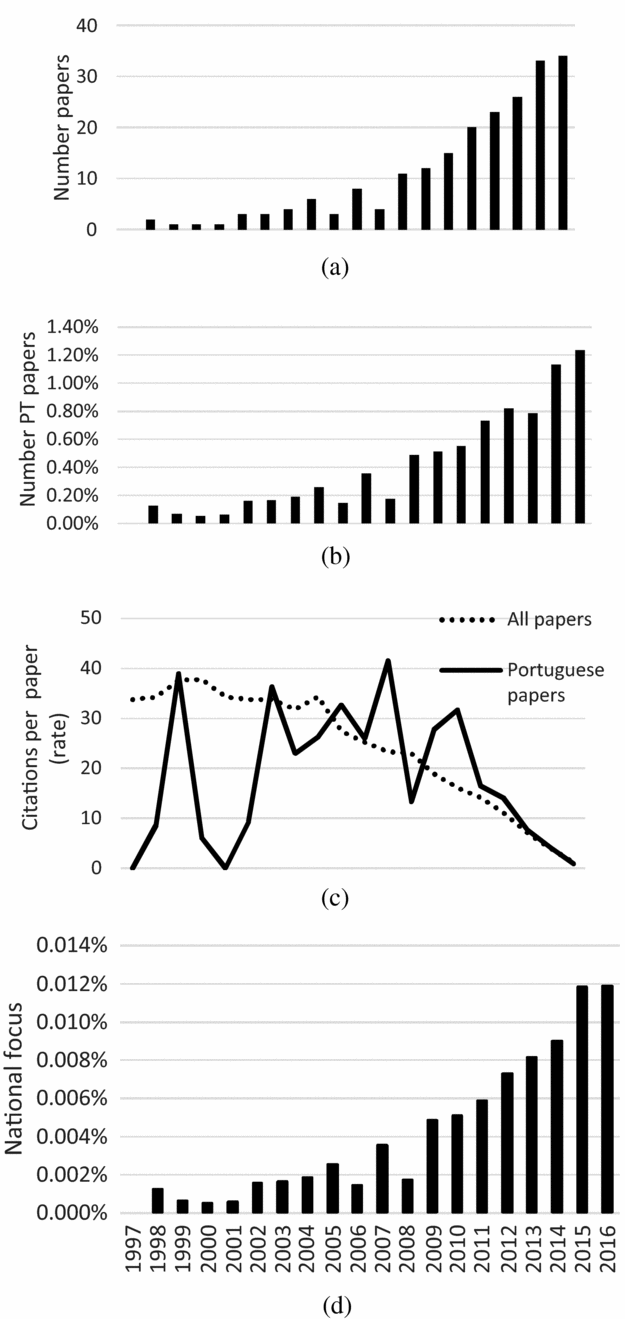
There has been a steady growth in Portuguese Antarctic scientific research output throughout the study period, rising from one or two papers per year in the late 1990s to 34 papers per year in 2016, a dramatic overall increase (Fig. 1a). This is a much higher rate than the growth in the field overall, which has approximately doubled from just over 1,500 papers to just under 3,000. Portugal was ranked 39th among countries by the number of Antarctic papers produced in 1997–2001, and rose to 28th for 2012–2016, when it was producing slightly under 1% of all Antarctic research papers.
Metrics assessing Portugal's Antarctic research activity based on scientific research publications generated 1997–2016. The earliest data should be interpreted with caution (see Methods). a. Number of papers by Portugal. b. Number of papers produced in relation to all papers published by the entire Antarctic scientific community. c. Mean citations per paper. d. National focus.

Citation rates of Portuguese papers were quite variable due to the small number of papers involved (Fig. 1c); for example, the single paper published in 1999 had more than six times the citations of the single paper published in 2000. However, once the annual number of papers published increased in the late 2000s, we can see a general trend whereby Portuguese papers generally get slightly more citations than other Antarctic papers published that year, suggesting that they are of comparable or slightly higher quality.
The relative significance of Antarctic research within Portugal has also increased. Antarctic papers made up only 0.03% of the country's published papers during the period 1997–2001, rising steadily to around 0.14% in 2016, indicating a growing national focus on Antarctic research (Fig. 1d).
Antarctic research activity of Portugal in relation to other Consultative and non-Consultative Parties, 2012–2016
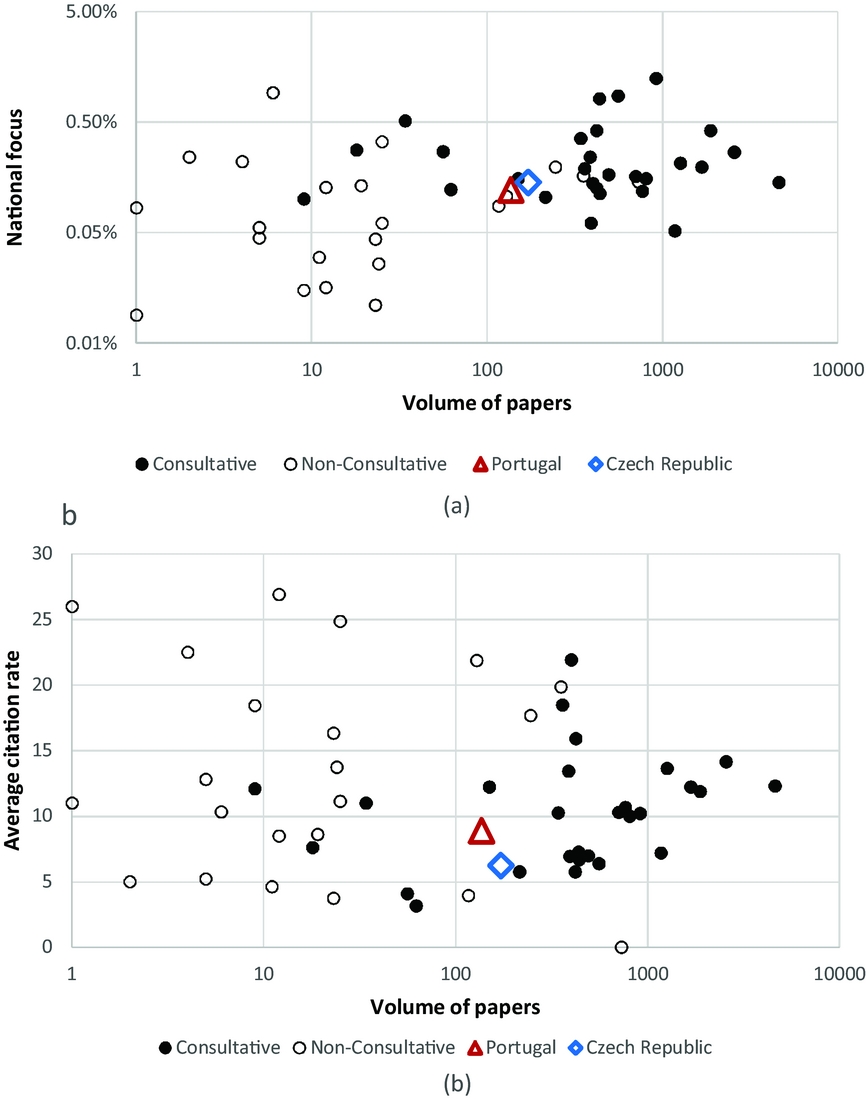
In recent years, Portugal's output has been predominantly in the middle of the range of Treaty nations (Fig. 2a). Over the 2012–2016 period, Portugal ranked 28th among the 53 Treaty Parties (that is, 29 Consultative and 24 non-Consultative) in terms of total papers published. This made them the fourth most productive of the non-Consultative parties, behind Canada, Switzerland and Denmark, and substantially more productive than five of the Consultative Parties.
Metrics comparing Portugal to other Antarctic Treaty nations over the 2012–2016 period in terms of a. national focus against overall volume of Antarctic papers from that country and b. average citation rate against overall volume of Antarctic papers from that country. Consultative and non-Consultative Parties are indicated by closed and open circles, respectively. Portugal and the Czech Republic (the most recent Consultative Party) are highlighted.

In terms of ‘national focus’ (Fig. 2a), Portugal was 33rd of the 53 Treaty Parties, with 0.121% of its scientific papers over the five years being on Antarctic topics. This is a higher level of national focus than six of the existing Consultative Parties, many of whom have long-established and well-developed Antarctic programmes. Portuguese papers from this period were cited an average of 8.9 times (Fig. 2b), placing them 32nd among the 53 Treaty Parties, and ahead of many Consultative Parties with larger scientific output. The average citation rate for all Antarctic papers was 8.5 cites per paper, suggesting that Portuguese papers are of comparable or slightly above average quality, as measured by this metric. However, it should be noted that Portuguese output continually increased over this period—a 70% increase in Portuguese Antarctic papers published between 2012 and 2016, as opposed to an overall increase of just 4% in total Antarctic papers—and an average citation-based measure is thus going to be skewed by a large number of newer papers, which have had less time to attract citations. The year by year data (Fig. 1c) suggest that if weighted by year Portugal would probably score more highly using this metric.
Bibliometric profile of Portuguese Antarctic research, 2012–2016
The majority of Portuguese papers are co-authored with researchers from other countries, a pattern common in modern Antarctic research (Dastidar, Reference Dastidar2007). Only 13 of 136 papers between 2012 and 2016 were solely authored by Portuguese researchers, with large numbers co-authored with researchers from the UK (45), Spain (41), the USA (36), Brazil (23) and Germany (22).
Published research was dominated by researchers from universities rather than independent research institutes; only five of the papers did not appear to have an author based at a Portuguese university. The largest number of papers (40% of the total) was from a group of researchers at the Universidade de Lisboa (55), with other groups at the Universidade de Coimbra (28), Universidade de Aveiro (21), Universidade de Porto (17) contributing significantly, and smaller numbers of papers from the Universidade de Algarve, Universidade Nova de Lisboa, Universidade de Évora and the Universidade dos Açores. These data suggest that, while there was a strong concentration of research output at a leading institution, there was a general distribution of interest in Antarctic topics around the country with eight of the 12 public universities in the country represented here.
Authorship was more widely distributed than affiliation; there were two Portuguese researchers with 21 and 17 papers each and another six researchers who were co-authors on five papers or more. However, more than 60% of papers (84) did not have any of these eight researchers among their authors, suggesting that there was a small group of highly active Antarctic researchers and a much larger number of scientists who have worked on Antarctic topics alongside other fields of interest. The research topics covered by the papers include the key research activities for the IPY (Xavier et al., Reference Xavier, Vieira and Canário2006); of which some research is being used to produce ATCM papers (see below).
Contribution of papers to ATCMs
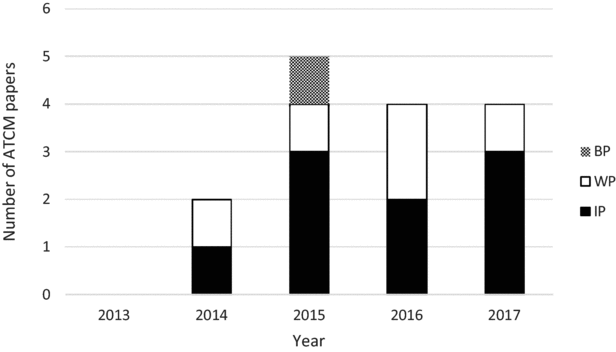
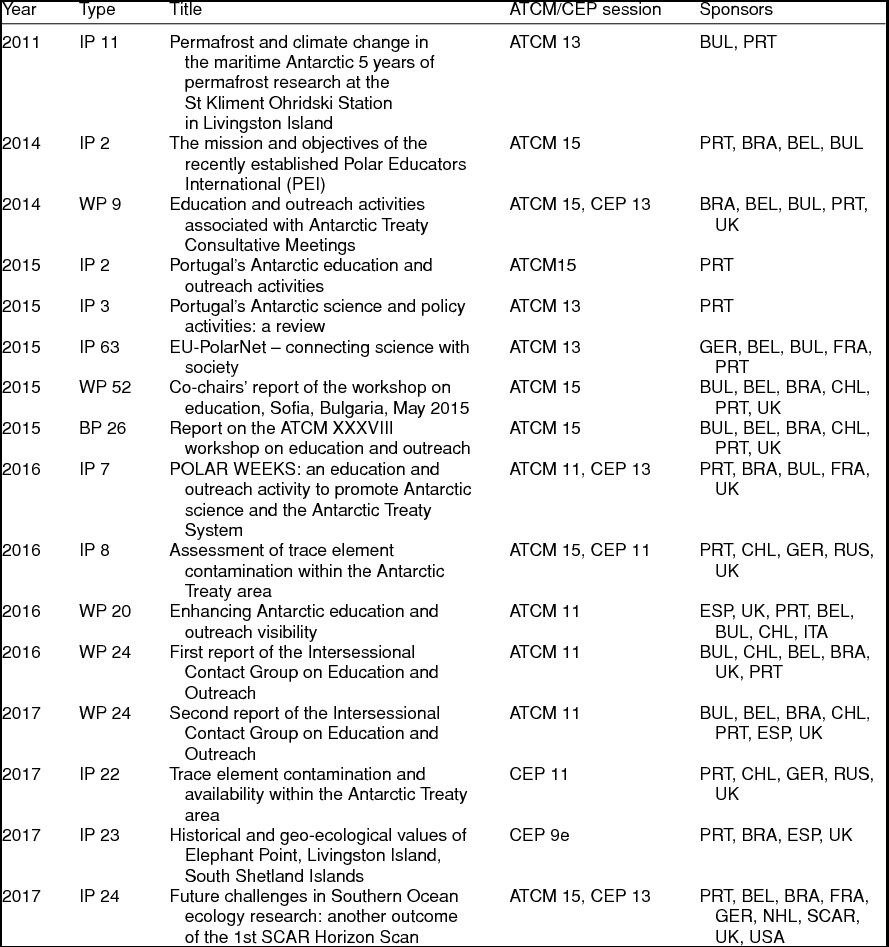
Portugal signed the Antarctic Treaty in 2010, with official presence at ATCMs since 2013. Since then, they have contributed a total of 15 policy papers to ATCMs, submitting four or five papers per year since 2014 (Fig. 3, Table 1). Only a minority of these papers were submitted by Portugal alone (3), most were submitted jointly with other Parties (13) as a joint submission with a Consultative Party is required if the paper is designated a Working Paper—non-Consultative Parties are only able to submit Information and Background Papers. Portugal made joint submissions with 11 other Parties, including the UK (11), Belgium (9), Brazil (9), Bulgaria (10) and Chile (7) (Table 1).
Number of papers submitted by Portugal at Antarctic Treaty Consultative Meetings since 2013 (ATCM's). IP = Information Paper; WP = Working paper; BP = Background Paper.

The ATCM working (WP), information (IP) and background papers (BP) (including CEP sessions) submitted by Portugal up to 2017.

BEL = Belgium; BRA = Brazil; BUL = Bulgaria; CHL = Chile; ESP = Spain; FRA = France; GER = Germany; UK = United Kingdom; ITA = Italy; NHL = the Netherlands; PRT = Portugal; RUS = Russian Federation; SCAR = Scientific Committee on Antarctic Research; USA = United States of America.
Discussion
Growth of Antarctic research activity of Portugal, 1997–2016
There has been a considerable growth in Antarctic research activity by Portugal in the past two decades, from fewer than five papers per year (1997–2004) to 34 papers per year in 2016 (Fig. 1). Such growth can be attributed to a number of factors. The IPY 2007–2008 provided an excellent opportunity to form a Portuguese committee for the IPY. This brought the Portuguese polar science community together providing opportunities to establish new international collaborations, while reinforcing ongoing relationships. Moreover, it brought the Portuguese polar science community into contact with the national funding body (Foundation for Science and Technology, Ministry of Science and Higher Education of Portugal), which had almost no polar funding available before the IPY (Schiermeier, Reference Schiermeier2009). As a legacy of the IPY work, PROPOLAR was developed and established (Xavier et al., Reference Xavier, Barbosa, Agusti, Alonso-Sáez, Alvito, Ameneiro and Viñeglay2013), while engaging with established polar organisations such as SCAR and CONMAP (the Council of Managers of National Antarctic Programs; see Introduction). Furthermore, an educational polar programme, named LATITUDE60!, supported by the national agency Ciência Viva, provided vital education and outreach activities within Portugal to link the scientific community with schools and the general public (Kaiser et al., Reference Kaiser, Zicus and Allen2010). Finally, support for early career scientists through research grants from a private bank facilitated a new generation of scientists to carry out polar research and develop their careers. Financial support for polar research groups, opportunities for early career scientists and the establishment of projects with strong educational links all provided a solid basis for the growth of research outputs and Portuguese engagement with Antarctic research activities.
Status of Antarctic research activity of Portugal today in relation to other Parties (Consultative and non-Consultative)
Portugal has been one of the most scientifically productive of the non-Consultative Parties to the Antarctic Treaty during the period of 2010–2015 and has even produced more research papers than some Consultative Parties. The data suggest that Portugal's rate of output is steadily increasing and that, if current trends continue, it is likely to be in an even stronger position in terms of scientific output and activity in future years. This is supported by PROPOLAR, which has only been in existence for less than 10 years and, therefore, is still within a phase of consolidation.
In 2014 the Czech Republic became the most recent nation to gain consultative status, and thus provides a useful benchmark as a nation whose scientific activity was considered adequate for the acquisition of consultative status by the Consultative Parties. Portuguese scientific output is broadly comparable to that of the Czech Republic. In 2015 and 2016 Portugal produced 33–34 papers per year; if this output was continued over a five-year period, it would be closely comparable to the five-year output of the Czech Republic (averaging 34.2 papers per year in 2012–2016). The recent ‘national focus’ level of Portugal on Antarctic research (0.14% in 2015–2016) is close to the average level of the Czech Republic (0.155% in 2012–2016), and ahead of almost all of the other non-Consultative Parties. Indeed, the citation levels of Portuguese papers are comparable to or slightly above the overall average in Antarctic research, substantially ahead of the level attained by the Czech Republic, and the papers are more highly cited than those from a large number of Consultative Parties. Both Portugal and the Czech Republic also recently became members of the Arctic Science Committee (IASC), in 2015 and 2012, respectively, and Portugal's Arctic research has also substantially increased in recent years, demonstrating the engagement of these two Parties in polar research.
Work carried out by Portugal at the ATCMs
The engagement of Portugal at the ATCMs has developed rapidly, as reflected by the number of papers submitted, the number of nations involved in the papers produced and the subjects addressed (Fig. 3) (see Dudeney & Walton Reference Dudeney and Walton2012 for a more comprehensive analysis). Moreover, Portugal has co-led with other nations on issues such as Antarctic education and outreach (Table 1), engaged in major international initiatives, such as the SCAR Horizon Scan and EU-POLARNET (Table 1) and, more recently, contributed to discussions relating to environmental conservation, such as on trace element contamination (Table 1). In the future, Portugal will continue to work within the Antarctic Treaty System to actively contribute to the environmental protection of the Antarctic and engage with the Committee for Environmental Protection (CEP), SCAR and other Parties, while simultaneously engaging (and informing) the Portuguese Antarctic science community on how their research can have policy implications (Hughes, Liggett, Roldan, Wilmotte, & Xavier, Reference Hughes, Liggett, Roldan, Wilmotte and Xavier2016). Indeed, Portuguese Antarctic science output is comparable in both volume and ‘national focus’ to the Czech Republic, who successfully attained consultative status in 2014. Both factors are increasing over time. In terms of quality, measured by citations, Portuguese research is slightly above average for the field as a whole. While these are purely overall bibliometric measurements, they do point towards a substantial interest and investment in polar science, generally consistent with that of the smaller Consultative Parties.
Put together, these factors suggest that should Portugal wish to put itself forward for consultative status in the future, it has already gone a substantial way to meeting the guidelines set out by the ATCM in 2017 (ATCM, 2017, Annex, Decision 2). For an application for consultative status, evidence of future strategic plans for the Antarctic region is required, which is now being developed under an strategic national agenda coordinated by the FCT. Although Portugal does not operate any dedicated Antarctic research facilities or support infrastructure, the ATCM has emphasised that doing so is not a formal requirement for consultative status. Indeed, one highly productive Consultative Party, the Netherlands, operated successfully on a purely collaborative basis for many years.
Acknowledgements
We thank the FCT and the Ministry of Foreign Affairs of Portugal for their work in the national delegation to the Antarctic Treaty since 2013. This work is an international effort under SCAR associated programmes, expert and action groups, namely SCAR AnT-ERA, SCAR Ant-ECO and ICED. JX was supported by the Investigator FCT programme (IF/00616/2013) and this study benefited from MARE's strategic programme, financed by FCT (MARE-UID/MAR/04292/2013). The work contributes to the British Antarctic Survey (BAS) Environment Office Long Term Monitoring and Survey project (EO-LTMS), and AG and KH are supported by NERC core funding to BAS.