Political parties are the gatekeepers to parliamentary positions, and party ideology has been identified as one of the factors explaining the variance in the share of women members of parliament (MPs) (Caul Reference Caul1999, Reference Caul2001; Murray Reference Murray2013; O'Neill and Stewart Reference O'Neill and Stewart2009; Rule Reference Rule1987; Studlar and Matland Reference Studlar and Matland1994). Ideology has nonetheless proven to be a rather elusive hypothesis (Cheng and Tavits Reference Cheng and Tavits2011; Murray Reference Murray2008; Norris and Lovenduski Reference Norris and Lovenduski1993; Rule Reference Rule1981). In trying to account for the increasing number of women MPs across the globe, recent studies have coincided in ascribing a more robust causal efficacy to (a) diffusion/emulation mechanisms, whereby the incorporation of women cuts across party lines (Escobar-Lemmon and Taylor-Robinson Reference Escobar-Lemmon and Taylor-Robinson2005; Lovenduski and Norris Reference Lovenduski and Norris1993; Matland and Studlar Reference Matland and Studlar1996), and (b) gender equality practices, as required by international organizations (Goetz Reference Goetz2002; Krook Reference Krook2010). Ideology has therefore been gradually pushed to the sidelines or come to be understood in terms of gender rather than partisan ideology—that is to say, the presence or absence of gender egalitarian attitudes (Arceneaux 2001; Inglehart and Norris Reference Inglehart and Norris2003; Paxton and Kunovich Reference Paxton and Kunovich2003; Sanbonmatsu and Dolan Reference Sanbonmatsu and Dolan2009).Footnote 1
Despite elusiveness, we bring party ideology back into the analysis of gender representation and test our hypotheses against the population of Spanish regional MPs in 138 elections (1980–2011).Footnote 2 Our endeavor is relevant for two reasons. First, from a theoretical perspective, the impact of ideology might have been obscured by the neglect of the time dimension in the electoral victories of left-wing and right-wing parties. Likewise, this study adds a distinction between two different mechanisms through which ideology can affect gender representation: parties can be gate openers, if they facilitate women gaining entry to parliament, or career promoters, if they keep their incumbent women MPs in parliament. Second, from a social and political perspective, this study contributes to the debate on gender representation, which has mainly focused on quotas and disregarded other mechanisms that can be put into practice by parties of different ideologies and improve the share of MPs.
POLITICAL PARTIES AND WOMEN MPs
Many scholars have conferred a privileged position to political parties in the study of gender representation (Erickson Reference Erickson, Lovenduski and Norris1993; Kunovich and Paxton Reference Kunovich and Paxton2005; Norris and Lovenduski Reference Norris and Lovenduski1993; Patzelt Reference Patzelt1999; Praud Reference Praud, Tremblay and Andrew1998; Ruedin Reference Ruedin2012). It has been stressed that parties are the crucial selectorate everywhere (Caul Reference Caul1999; Cheng and Tavits Reference Cheng and Tavits2011; Paxton, Kunovich, and Hughes Reference Paxton, Kunovich and Hughes2007), the gatekeepers to elected office (Caul Reference Caul2006), and the decisive actors regarding political representation (Cheng and Tavits Reference Cheng and Tavits2011, 467). “For an individual, man or woman, to run for political office, he or she must be selected and supported by a political party” (Paxton, Kunovich, and Hughes Reference Paxton, Kunovich and Hughes2007, 270). Even in candidate-oriented systems, such as the United States, parties are recognized as relevant actors in the process (Sanbonmatsu Reference Sanbonmatsu2002). The attainment of gender parity in parliamentary representation has repeatedly been said to depend mainly on the willingness of the political parties (Martínez and Calvo Reference Martínez and Calvo2010, 5; see also Field and Siavelis Reference Field and Siavelis2008; Kunovich and Paxton Reference Kunovich and Paxton2005; Patzelt Reference Patzelt1999).
Party ideology has traditionally been pinpointed as one of the key mechanisms explaining gender differences in politics, not only in terms of the number of women MPs but also in terms of their presence in ministerial positions (Escobar-Lemmon and Taylor-Robinson Reference Escobar-Lemmon and Taylor-Robinson2005), executive office at the state-level (Oxley and Fox 2004) and parliamentary committees (Heath, Schwindt-Bayer, and Taylor-Robinson Reference Heath, Schwindt-Bayer and Taylor-Robinson2005). Duverger (Reference Duverger1955, 82) stressed the importance of ideology more than half a century ago: “Two groups of parties appear to give women candidates a better chance, the parties of the Left (Communists and Socialists) and the Christian parties.” Since then, the idea that parties on the left are more gender-friendly has been advocated by different authors (Caul Reference Caul1999; Murray Reference Murray2013; O'Neill and Stewart Reference O'Neill and Stewart2009; Rule Reference Rule1987; Studlar and Matland Reference Studlar and Matland1994).
Various explanations justify the relevance of party ideology. First, right-wing parties have traditional views about women and endorse fewer female candidates (Rule Reference Rule1987). Left-wing parties, on the contrary, are sympathetic to women (Reynolds Reference Reynolds1999), are sensitive to those groups excluded from power (Matland and Studlar Reference Matland and Studlar1996), accept that gender underrepresentation is a problem (Caul Reference Caul1999, 83), and defend egalitarian principles (Lambert and Scribner Reference Lambert and Scribner2009). Second, the parties’ responses to gender inequalities are different: unlike right-wing parties that support gender-blind equal opportunities, left-wing parties believe that a hands-off approach will not solve the uneven distribution of power between women and men (Lovenduski and Norris Reference Lovenduski and Norris1993) and act to fix the problem (Caul Reference Caul1999). Third, left-wing parties have intervened more decisively in the recruitment process (Norris Reference Norris, Lovenduski and Norris1997): social democrats and green parties have pioneered the introduction of gender quotas (Bystydzienski Reference Bystydzienski1995), set the highest quotas, and complied better with them than right-wing parties (Davidson-Schmich Reference Davidson-Schmich2006, 228). Fourth, the women's movement has been linked to left-wing parties (Sainsbury Reference Sainsbury, Krook and Childs2010); thus, women activists have put pressure on their leaders to increase female presence in politics. Indeed, left-wing parties have been more inclined to incorporate women into their lists and promote them to positions of leadership in those countries with strong women's organizations (Bystydzienski Reference Bystydzienski1995).
Yet the relationship between ideology and gender representation is far from uncontroversial. Not only have a significant number of analyses been confined to case studies and specific elections, but also the evidence provided has been ambivalent. Moreover, cross-national analyses have frequently focused not on ideology but on institutional variables such as the district magnitude (Rule Reference Rule1987), the electoral system (Patzelt Reference Patzelt1999; Rule Reference Rule1987), the territorial distribution of power (Patzelt Reference Patzelt1999), the party list systems (Reynolds Reference Reynolds1999; Rule Reference Rule1987), and the electoral quotas (Martínez and Calvo Reference Martínez and Calvo2010; Mateo Reference Mateo2005; Paxton Reference Paxton1997). Different studies have also shifted the analytical focus to partisan variables other than ideology. Thus, the party magnitude (Vengroff, Nyri, and Fugiero Reference Vengroff, Nyri and Fugiero2003), the nomination process of candidates (Caul Reference Caul1999; Field and Siavelis Reference Field and Siavelis2008), the gender composition of gatekeepers (Cheng and Tavits Reference Cheng and Tavits2011; Kunovich and Paxton Reference Kunovich and Paxton2005), and the party's informal rules and quotas (Bjarnegard and Kenny Reference Bjarnegard and Kenny2015; Caul Reference Caul1999; Patzelt Reference Patzelt1999) have been analyzed. Since many of these studies simply consider party ideology as one among several control variables, adding a coefficient for it, they fail to investigate the ideology-representation relationship in depth and the instances in which it might be stronger or weaker.
DOES PARTY IDEOLOGY REALLY MATTER FOR WOMEN MPs?
What do we know so far? Several case studies have provided country-specific evidence, typically equating ideology and party labels. By focusing on Sweden in 1967–94, Sainsbury (Reference Sainsbury, Krook and Childs2010) found traces of a positive effect at the beginning of the period and none at the end. A study of the French 2007 and 2012 legislative elections registered a positive effect on the share of elected women (Murray Reference Murray2013), although the same scholar found no impact in the 2002 elections (Murray Reference Murray2008). Both studies incorporated tables with percentages of women, but they did not test the statistical significance of the differences among parties with different ideologies. The evidence for Canada is even more mixed: left-wing parties were more inclined to choose women as their leaders during 1980–2005 (O'Neill and Stewart Reference O'Neill and Stewart2009), but “it has not been the leftist parties that have taken the lead in bringing women in appreciable numbers” to the legislature, as a study of the 1980 and 1988 elections, which conducted probit and simulation analyses, demonstrated (Studlar and Matland Reference Studlar and Matland1994, 56). Moreover, Cheng and Tavits (Reference Cheng and Tavits2011), focusing on the 2004 and 2006 elections and using a probit regression and the percentage of votes for the two most left-wing parties as one of its controls, found no effect of this alternative measure of ideology on the likelihood of selecting women.
Party ideology has not often been analyzed in U.S. studies. Not only are U.S. parties more ideologically undefined than their Western counterparts, but also their role as gatekeepers is weaker. The evidence, in any case, is mixed: for instance, Rule (Reference Rule1981) failed to find a relationship between the percentage of women in the 1974 congressional delegations and the dominance of Democrats, but a study comparing the two parties’ gender share in the U.S. congressional primaries during 1958–2004 showed an advantage for the Democrats in all electoral cycles but 1982 (Lawless and Pearson Reference Lawless and Pearson2008). Some studies have provided indirect evidence via the incumbency factor: Gaddie and Bullock (Reference Gaddie and Bullock1997), using a multivariate model, concluded that Republican women competed under more restrictive conditions than Democratic ones in open seat and special U.S. House elections.
Positive evidence was reported for the 1997 election to the House of the Commons in the United Kingdom (Cowley and Childs Reference Cowley and Childs2003). However, a study of the 1992 elections failed to detect any clear-cut effects of ideology: Norris and Lovenduski (Reference Norris and Lovenduski1993, 393), using the percentage of women in parliaments as its key dependent variable and nonlinear regression models, discovered that, “contrary to popular assumptions, women seem to face greater problems from Labour than Conservative Party selectors.”
Regarding Spain, most studies have focused on the indirect effect of ideology through quotas. Martínez and Calvo (Reference Martínez and Calvo2010) highlighted how the Spanish Socialist Workers’ Party (Partido Socialista Obrero Español, PSOE) and the People's Party (Partido Popular, PP) applied the 2007 parity law differently in the national congressional elections. Similarly, Ortega and Trujillo (Reference Ortega and Trujillo2011) revealed that party quotas and the diffusion of gender recruitment practices were probably more important than electoral quotas in terms of increasing the feminization of the Congress and the Senate.
Other scholars have engaged in comparative studies at the subnational level. Focusing on the German Länder in 1990, 1995, and 2000, Davidson-Schmich (Reference Davidson-Schmich2006, 216) found mixed evidence on the impact of ideology, depending on whether the issue was the adoption of voluntary quotas or compliance with them. Studies of the U.S. state legislatures have usually been more concerned with institutional (such as the district magnitude), social (the percentage of women in the labor force and with college education), and contextual variables (the distribution of values) as potential determinants of cross-state variance in the share of women representatives. They have generally chosen the state legislature (instead of the individual MP or the parties in each state) as their unit of analysis, conducted regression analyses, and included the state share of Democratic or Republican seats as one of their independent variables. They all documented a negative coefficient for Democrats: for instance, Rule (Reference Rule1981) analyzed the 1974 elections and found the party to be significant and negative for women MPs at the state-level but not for the Congress. Likewise, covering 1963–64, 1971–72, and 1983–84, Nechemias (Reference Nechemias1987, 132–33) showed a strong relationship between the percentage of seats held by the Democrats and the women's share of state legislators, especially when southern states were considered. Another study (1974 and 1984) reached a similar conclusion: Democrats were an unfavorable factor over time (Rule Reference Rule1990, 442). Arceneaux (Reference Arceneaux2001, 154–56) analyzed the 1974–96 period and concluded that the Democrats retained a significantly negative effect, which nonetheless faded out when social values (traditionalism, moralism, and feminism) were brought into the picture.
Finally, several cross-national studies have also provided inconclusive evidence. In a comparison of Poland and the Czech Republic, Kunovich (Reference Kunovich2003) observed that women affiliated with special interest parties (representing minority groups and pensioners’ rights) were more likely to be placed in both the first and top positions on the open party lists than those affiliated with traditional left-wing parties. A study of the national and local representatives in five Scandinavian countries from 1945 to 1990 reported positive, although mainly discursive, effects for the left-wing–women MPs relationship in Norway (Bystydzienski Reference Bystydzienski1995). Rule (Reference Rule1987) found a positive impact of left-wing parties on the percentage of women in parliaments in a study of 23 countries in 1980–82, although party ideology was used rather as a control variable. An analysis of 180 nation states in 1998, which used the percentage of the left-wing vote as the measure for ideology, unveiled positive effects for the legislature but none for the executive (Reynolds Reference Reynolds1999). Focusing on the percentage of seats held by right-wing parties as its key ideological variable in 24 advanced democracies in 1980, 1990, and 1997, Matland (Reference Matland1998) found no effects. However, this study did not test the impact of ideology on 16 less developed democracies that were also included. Lastly, the evidence of a study of 68 parties in 12 advanced democracies was also mixed: not only did conservative and rural formations have more women on average than the socialists, but also the same label party could yield strikingly different results. For example, the Labor Party had 50% women MPs in Norway in 1989, while the Irish Labor Party had only 6% (Caul Reference Caul1999). To sum up, undisputed empirical evidence about the impact of party ideology on gender politics has not been obtained so far (Rule Reference Rule1987), and this has paved the way for a disregard of ideology in recent studies.
HYPOTHESES
First, we set out to test whether ideology matters and do so by analyzing whether parties of different ideologies have an impact on the gender distribution of MPs. Left-wing parties have tried to redress unequal gender representation by intervening in the electoral market, mainly through party and electoral quotas—for instance, the Catalan branch of the PSOE introduced voluntary gender quotas in 1982 (12%) and subsequently enlarged them to 40% to 60% in 2000. Right-wing parties have rejected intervention and repeatedly justified their gender-blind approach in terms of individual merits. Consequently, left-wing parties should be expected to give their women candidates better opportunities than right-wing parties, even under circumstances perceived as costly. However, the effect of ideology on gender representation may have been obscured by the timing of the electoral success of left-wing and right-wing parties. As has been extensively documented, left-wing parties in various countries have been in decline for some time (Guinan Reference Guinan2013; Kitschelt Reference Kitschelt1993): in a 2017 comparison of 13 Social Democratic parties in Western Europe since the early 1990s, the overall picture is of declining support.Footnote 3 Hence, it could well be that the left, from early on, included more women in its ranks than the right but that these differences were diluted by the different partisan composition of MPs overtime. Together, these considerations lead us to the following hypothesis:
H 1:
Party ideology matters, and left-wing parties elect more women than right-wing parties. However, the effect of ideology might be partly masked by the timing of the relative electoral fortunes of the left and the right. For this reason, we expect ideology to have a clearer effect when the electoral time is controlled for.
Our research is not confined (hopefully) to finding a statistically significant regression coefficient but rather aims at understanding how and why this coefficient takes place. Therefore, we refine our analysis by distinguishing three different mechanisms: (1) parties can facilitate (or hinder) the access of junior women (newcomers) to the parliament by selecting them as candidates and placing them in safe positions on the party list; (2) parties can endorse (or give up on) senior women (incumbents) so that they stand a good chance of staying on in parliament; and(3) parties can ease (or prevent) the return of women to the parliament. H 2 will deal with the first mechanism and H 3 with the second. We restrict our analyses to them, which occur more frequently than the third one.
The number of junior women MPs or newcomers in parliament during the first legislative terms was low. As a minority group, they were bound to attract disproportionate attention (Kanter Reference Kanter1977) and be perceived as liabilities because of their lack of political experience and/or electoral appeal. For ideological reasons, the left might have been more willing than the right to recruit junior women despite their associated potential costs. Together, these considerations lead us to the following hypothesis:
H 2:
Left-wing parties send more junior women to the parliament than right-wing parties.
As the number of women MPs increased, they ceased to be a minority group subject to scrutiny (Kanter Reference Kanter1977) but pressures to replace them by their male counterparts might still occur. For ideological reasons, the left should also be more willing than the right to keep their senior women MPs or incumbents. Since the left believes in the virtue of gender equality, political coherence should translate not only into having more women elected but also into keeping them in office:
H 3:
Left-wing parties keep their senior women MPs or incumbents to a greater extent than right-wing parties.
DATA AND METHODS
Empirically, our hypotheses are tested against a database (name deleted for anonymity) which, drawing on Best and Cotta (Reference Best and Cotta2000), contains comprehensive information on the population of Spanish regional MPs (N = 5,353) who have held any of the 9,664 seats open to electoral competition in the 17 subnational parliaments in 138 elections (1980–2011).Footnote 4 Longitudinal data are particularly relevant to test “whether the ideological composition of the legislature … influences women's electoral outcomes” (Kunovich and Paxton Reference Kunovich and Paxton2005, 542). Although the data do not stretch beyond 2011, this period best suits our research question because it was then that the total vote for the PSOE and the PP was dominant (more than 73% of the total number of parliamentary seats). Party ideology is measured by a dichotomous variable that distinguishes between MPs of the socialist PSOE and those of the conservative PP. Using the Chapel Hill Expert Survey (1999), Figure A1 in the supplementary appendix online shows that the ideological distance between the PSOE and the PP is smaller than that between the left-wing and right-wing parties with the most votes in most European countries. This suggests that the choice of Spain to test the ideology hypothesis will likely make it difficult to find a statistically significant effect.
The use of subnational data allows us to drastically increase the number of observations for a given party (Davidson-Schmich Reference Davidson-Schmich2006, 213) and to control for variables such as the party lists or the electoral system. It enables us to reap many of the benefits of cross-national research while avoiding many of the difficulties associated with it. There are 17 subnational parliaments in Spain: 13 belong to the common or general regime and hold elections at the same time, and the remaining four (Andalusia, Basque Country, Catalonia, and Galicia) can choose the timing of their elections. The combination of these two regimes leads to five different electoral cycles. As is also the case for Spanish national elections, seats are allocated following the D'Hondt method. Regions are made up of provinces, ranging from single-province regions (Asturias, Cantabria, La Rioja, Madrid, Murcia and Navarre) up to nine provinces (Castile-Leon). In national elections, provinces are the electoral districts (though the districts in the Balearic and Canary Islands are the islands themselves). A minor difference between national and regional elections is that two single-province regions have established several electoral districts for regional elections (Asturias has three and Murcia has five). All in all, the size of the electoral districts ranges from 1 (Formentera) to 129 seats (Madrid) and that of the parliaments from 33 (La Rioja) to 135 seats (Catalonia).
Table A1 in the online appendix shows the descriptive statistics for all variables. The dependent variable, woman, is binary and equals 1 if the seat is occupied by a female MP and 0 if it is not. This is not as straightforward as it might seem because some MPs leave off or are substituted before the end of the term. Out of the four possible ways to code this variable (to count all the MPs, the substitutes and the substituted; those who attend the constitutive session of the parliament; those who are present at the end of the term; and those who have spent most time), we have chosen the last one because it reflects best the gender distribution throughout the legislative term.Footnote 5 This might work against the odds of the left-wing party being a better gate opener, thus making it harder to find statistically significant coefficients.
The main independent variable is party ideology. By identifying the PSOE with the left and the PP with the right, we guarantee that our results are not contingent on the ascription of parties to specific ideologies, voters’ changing perception about them or to the researchers’ coding decisions. Thus, PSOE is coded as a binary variable, which equals 1 if the seat is occupied by a PSOE MP and 0 if by a PP MP. A minor methodological caveat concerns a small fraction of MPs (4.8% of them or 2.1% of the total of 5,353 MPs) who obtained their seats under different party labels in different terms. This party inconsistencyFootnote 6 affects barely 353 of the 9,664 seats (3.7%) and has gone down from 5% in the first two legislative terms to around 1% in the last one. Seats occupied by turncoats are coded as missing and excluded from all the analyses. Seats occupied by MPs of parties other than the PSOE or the PP are also coded as missing (but, as discussed later, all analyses are replicated for an alternative variable that distinguishes between left-wing and right-wing parties).
Our database allows us to control for several variables that may affect the share of women and which may confuse the relationship between it and party ideology.
• Years since the inauguration of subnational parliaments in Spain. This is our key control variable, especially with regard to H 1, because it allows us to control for the different timing of the success of left-wing and right-wing parties. As argued earlier, socialist parties have experienced an overall downward trend that may mask the effect of ideology on gender representation. We compute the exact number of days elapsed since the constitution of the first subnational parliament, the Basque one in March 1980, and divide it by 365 to express it in years. The legislative term would have been a much less precise measure of the time trend, not the least because the electoral cycles of four out of the 17 regions differ from the rest.
• The chamber's size. Larger chambers correlate positively with larger district magnitudes (the correlation is .31 and is statistically significant at the 5% level) which, all else being equal, should mitigate intraparty conflict and thereby facilitate the selection of women (Kunovich Reference Kunovich2003, 275). This expectation is consistent with the idea that single-member districts result in zero-sum contests that are less favorable for the selection of women (Kunovich and Paxton Reference Kunovich and Paxton2005, 515). In Spain, there is a statistically positive correlation between size and the share of socialist instead of conservative MPs (results available upon request). Chamber size is operationalized as a quantitative variable that measures the number of seats in each subnational parliament and legislative term. Each seat always adds one unit to the variable, even if there are substitutions and the seat remains empty for several days or weeks. Size oscillates between 33 (La Rioja) and 135 seats (Catalonia) and has been stable in six regions (Andalusia, Asturias, Canary Islands, Catalonia, Extremadura and Navarre) and mutable, once, in eight (Aragon, Balearic Islands, Cantabria, Galicia, La Rioja, Murcia, Basque Country, Valencia). Castile La Mancha went through two changes; Castile-Leon, four; and Madrid, as many as eight. The largest changes in size took place in Madrid (from 94 to 129 MPs), Basque Country (60 to 75), and Valencia (89 to 99). In the remaining regions, overall changes never exceeded five MPs.
• The degree of electoral competitiveness (also known as closeness) shall be expected to have a negative effect on the share of women insofar as the more competitive the election, the lesser the parties’ attention to equal gender representation. Electoral competitiveness is measured on a quantitative scale as the vote share difference between the two most voted parties: it takes the difference of vote shares, divides it by their sum, and multiplies it by 100 to express it as a percentage. It is measured in absolute terms, regardless of which party has more or less votes.
• The difference in the share of seats held by the PSOE and the PP. Given that women are often placed at the bottom of the party lists, the longer the share of a given party, the more likely it will be that women are included in relevant positions. So, all else being equal, we expect comparatively more women in the PSOE if the difference is positive and more in the PP if it is negative. All in all, it is unclear what the effects of this variable will be on the total number of women. We therefore include it as an interaction with the party variable and expect the interactive term psoe * difshare to have a positive effect. It is also a quantitative variable. In contrast with the former one, it refers only to the PSOE and the PP (the main parties in most regional elections except for Basque Country, Catalonia, and the Canary Islands) and to seats instead of votes. Moreover, it takes a negative value if the PP's share is larger. Thus, no problem of correlation between the two arises (the correlation is close to 0.13 in absolute value).
• The presence of electoral quotas, which were enacted by José Luis Rodríguez Zapatero's socialist government in 2007. In principle, its effect should be positive since the goal was to contribute to gender equality. It is measured by a binary variable that equals 1 if they are in place and 0 if not. In practice, it is 1 for all observations pertaining to the seventh or subsequent legislative terms.
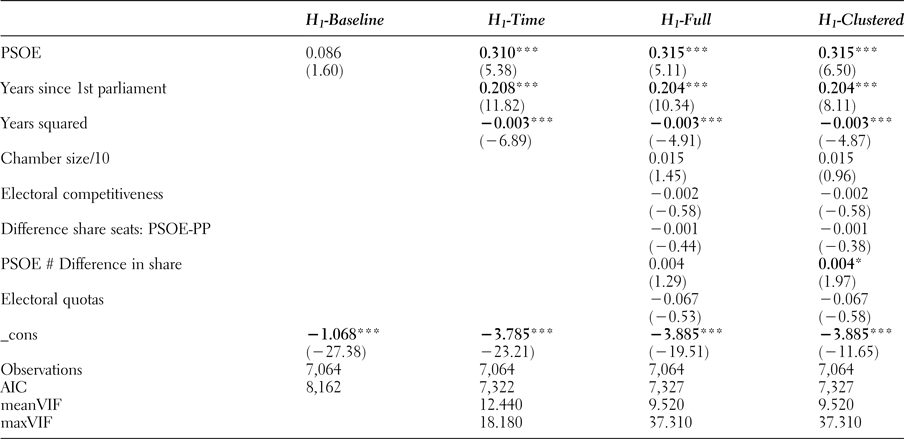
We use bivariate logit models to test the hypotheses given that the dependent variable is always binary. The unit of analysis in the first battery of models aimed at testing H 1 (Table 1) is the parliamentary seat. There are 9,664 parliamentary seats, although the models use the 7,064 seats of the PSOE and the PP (see the variable psoe). Even if a seat is occupied by several MPs (because the first MP was replaced before the term ended), it is counted as a single seat (see the discussion regarding the variable woman). We run the model twice, once without controlling for time and another one controlling for it. We also test a third model which includes the battery of controls that the literature on gender representation has identified as potentially relevant determinants of the women's share in parliaments, as well as a fourth model in which observations are clustered by region to take into account the hierarchical structure of the data.
Probability of a seat being held by a woman

Source: BAPOLAU. Z-statistics in parentheses. Leaving aside the years’ variables, the highest VIF of the third model is 4.95, well below the level that points to collinearity problems. The high VIFs of the time variables are normal given that time enters linearly and squared into the model and pose no collinearity problems.
+ p < .10; * p < .05; ** p < .01; *** p < .001.
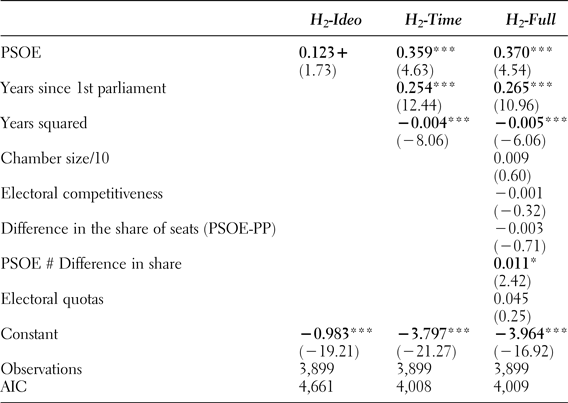
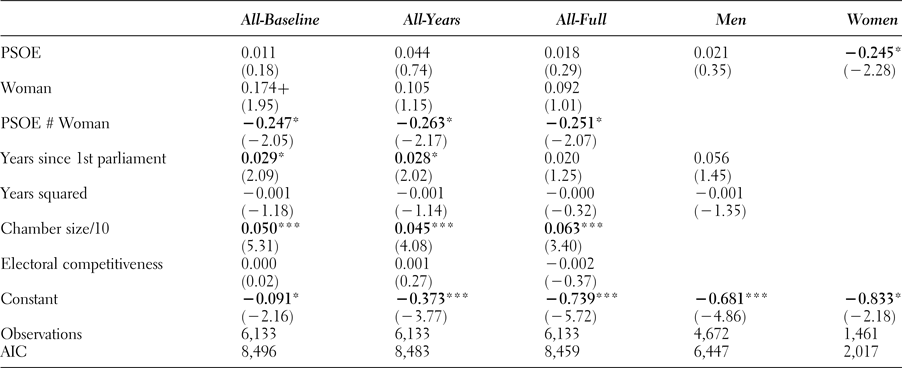
A similar battery of three models is used to test H 2 and H 3. The unit of analysis to test H 2 is the parliamentary seat held by junior MPs. As explained earlier, we define an MP as junior if and only if it is her or his first time ever in the subnational parliament. The models to test H 2 use 3,899 observations and are presented in Table 2. Finally, the unit of analysis to test H 3 is the parliamentary seat held by incumbent MPs. Obviously, information on the next legislative term is required, so models cannot include incumbents in the last period, and Table 3 uses 6,133 cases.
Probability of a seat being held by a woman (junior MPs)

Source: See Table 1. Z-statistics in parentheses.
+ p < .10; * p < .05; ** p < .01; *** p < .001.
Propensity to keep the seat in the next legislature (incumbents)

Source: See Table 1. Z-statistics in parentheses.
+ p < .10; * p < .05; ** p < .01; *** p < .001.
RESULTS
Table 1 presents the results of the regression models that test the effects of ideology on the overall gender distribution of seats in the Spanish subnational parliaments. The positive sign of the coefficient for the psoe variable in Model 1 reflects the higher percentage of women in the PSOE (27.3% out of 3,609 socialist seats compared with 25.6% of 3,455 conservative ones; see the upper panel of Figure A2 in the online appendix). However, this coefficient falls short of attaining conventional significance levels. Model 2 reveals that once time is controlled for, the coefficient for the PSOE increases and becomes significant beyond any reasonable doubt: it satisfies not only the 5% but also the 0.1% criterion. This confirms our first hypothesis, namely, that the different timing of the electoral success of the socialists and the conservatives masks the former's positive effect on the propensity that an MP is a woman.Footnote 7 In the Spanish regional elections, the PSOE largely outflanked the PP in the first electoral term (61.4% of the two-party seat share), when the percentage of women MPs was negligible (less than 6%), while the opposite was true at the end (the PSOE held only 42.3%), when this number had substantially grown everywhere: more than 40% (Santana, Coller, and Aguilar Reference Santana, Coller and Aguilar2015).
The positive and significant effect of the PSOE remains unaltered when other variables are included: the size of the chamber, the degree of electoral competitiveness, the difference in the share of seats obtained by the PSOE and the PP, and the presence of electoral quotas (Model 3). Although none attains statistical significance, their signs are consistent with our theoretical expectations, with one partial exception. The negative sign of the quotas’ coefficient may strike one as a surprise, but on closer examination, it simply tells us that once time is controlled for, quotas do not further contribute to the growth of the share of women. In fact, given that this share was already quite high when they were enacted, the scope for further increases was moderate. This result is consistent with previous studies that indicated how electoral quotas in Spain mainly rubberstamped a gender-equity process that was already taking place (Santana, Aguilar, and Coller Reference Santana, Aguilar and Coller2016). Finally, a model which clusters observations to consider that they are nested in regions is also considered. As Column 4 shows, results remain, once again, qualitatively unchanged.
To control properly for time, we include a linear and a quadratic term for the time variable. This allows us to consider nonlinear effects such as ceiling effects: for instance, mechanisms that have to do with egalitarian provisions may only work up to a certain threshold of women representatives, such as 45% or 50%. Both the linear and the quadratic terms are statistically significant. The positive sign of the former and the negative one of the latter indicate that the likelihood that an MP is a woman tends to increase over time, but less so in recent years. This makes sense since, as the percentage of women in the parliaments increases, the gender distribution becomes more egalitarian and the scope for further gains is reduced. All these results hold without qualification if the time elapsed since the inauguration of subnational parliaments in Spain is substituted by alternative measures, such as the time since the first parliament in the region (Column 2 of Table A2 in the online appendix) or the legislative term, a more obvious yet more imperfect measure of time (Column 3).
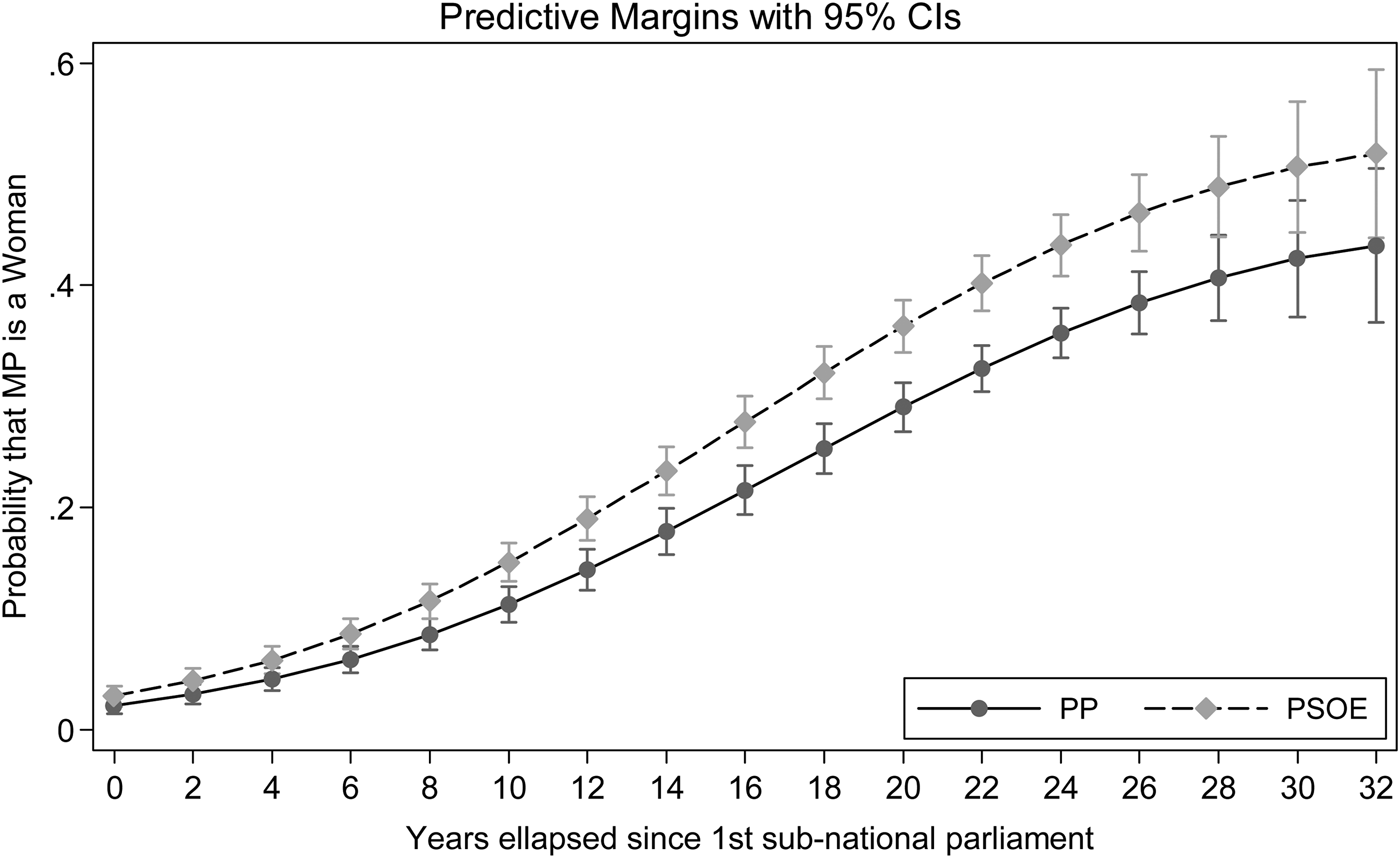
Figure 1 depicts the predictive margins by party label and year. It shows the predicted probability that an MP is a woman for each combination of party and years, controlling for all other variables of Model 3. The lines for the two parties never cross and the one for the PSOE is always above that for the PP, this meaning that the predicted probability is consistently higher for the former. Moreover, throughout most of the period the 95% confidence intervals of the predictive margins for the two parties do not overlap either, indicating that the difference in the probability of being a woman between the two parties is statistically significant. Confidence intervals only overlap at the beginning of the period, when the number of women was low for all parties, and the end, when it was high.
Adjusted prediction of a seat being held by a woman, by party and year. Source: See Table 1. A formal contrast (Table A3) shows that the differences between the PSOE and the PP are statistically significant at the 0.1% level for all the years on the horizontal axis. This also holds for years = 0, 2, 4, 6, 30, and 32, for which confidence intervals at the 95% overlap.

When the confidence intervals do overlap, the intuitive interpretation can be misleading, for differences may still be statistically significant. Thus, a formal test shows that the differences between the two parties are statistically significant at the 0.1% level throughout the period (Table A3).
The remaining analyses aim at uncovering the mechanisms behind the persistent pro-female bias of the socialists. Table 2 replicates the models for junior MPs and shows that the left has a larger gate-opening effect than the right. The marginally significant positive coefficient for the PSOE reflects that junior women MPs are indeed more frequent among the socialists: they add up to 29.7% out of the 1,971 socialist juniors compared with 27.2% out of the 1,928 conservative juniors (see the lower panel of Figure A2). In this case, the PSOE coefficient is statistically marginally significant (at the 10% criterion) even in the baseline model. Again, the positive effect of the socialists for women's first access into the parliament is stronger once the legislative term is controlled for (Model 2) and remains so in further models.
The effects of the legislative term, chamber size, and electoral competitiveness are analogous to those commented on for all MPs, with the only difference that the PSOE effect increases with the difference in the share of seats held by the PSOE and the PP, as captured by the interaction between the PSOE and the differential share terms. Figure A3 shows that the PSOE is more likely to place junior women than the PP in all years, and a formal test reveals that the differences between the two parties are always statistically significant. All these results confirm our second hypothesis, namely, that the socialists are better gate openers for women newcomers than the conservatives.
To our knowledge, the function that parties perform as career promoters of senior women has rarely been analyzed. This is most remarkable if we accept that “placing candidates in safe seats, possibly for a lifetime political career, has more significant consequences than getting conference resolutions adopted, or supporters nominated to internal party bodies” (Norris and Lovenduski Reference Norris, Lovenduski, Krook and Childs2010, 136). To determine which party favors women's parliamentary continuity, we test several models in which the dependent variable is the propensity of MPs to retain their seats (Table 3). In the first three models (Columns 1–3), the key independent variable is the interaction between the party label and gender: a positive coefficient for the PSOE # woman dummy would indicate that the PSOE is a better promoter of women's parliamentary careers. In H 3, we anticipated the left to have a larger career-promoting effect than the right. Contrary to our expectations, the PSOE has not fared better than the PP. The coefficient is negative and statistically significant, suggesting that the PP is indeed better as a career promoter of women incumbents.
The conservative advantage in promoting the careers of its women MPs can be further appreciated by examining the results of two separate models for women and men, presented in the two last columns. Here, the key independent variable is the party label variable. When attention is restricted to men (Column 4), no differences can be identified between the men in the two parties. In contrast, the negative and statistically significant coefficient for the PSOE in the last model indicates that socialist women are less prone to retain their seats than conservative ones. The propensity to keep their seats is 48% for men in both parties (0.3% higher for the PSOE), while it is higher for women in the PP (52%) than in the PSOE (46%; see Figure A4).
All the former results hold when all left-wing and right-wing parties are considered. To examine this, we have created a dummy variable, left, that equals 1 if the seat is occupied by an MP of any left-wing party and 0 if it is occupied by any right-wing one. We have assigned all the regional parties (N = 46) either to the left (26) or to the right (20). As Figure A5 clarifies, the relevance of the PSOE and the PP within each block is undeniable: the former has occupied 78% of the 4,619 left-wing seats, while the figure for the latter is 74% out of 4,692. Given the weight of the two main parties within each block, the conclusions drawn so far are not likely to differ much from those which would follow if the attention had been focused on comparing the two ideological blocks. This interpretation is reinforced by an analysis of the evolution of the share of women. Figure A6 shows that the evolution of women MPs in each ideological bloc is remarkably close to that in the main party over the whole period and that the percentage of women MPs is higher in the PSOE and the left-wing block. To eliminate the possibility that our conclusions may have been different had we analyzed all left-wing versus all right-wing parties, we reran the full models substituting the PSOE-PP for the left-right variable: Table A4 shows that all conclusions remain unchanged for H 1 and H 2, and Table A5 shows that, again, all conclusions remain unchanged for H 3.
CONCLUSIONS
This article has examined whether and how party ideology affects gender representation. As to the “whether,” we defend the idea that the effect of ideology on women MPs has been difficult to identify because the different timing of the electoral victories of left-wing and right-wing parties has not been properly considered. Our first finding is that when time is controlled for, the left enhances the share of women MPs. As to the “how,” we distinguish between two different mechanisms, gate opening and career promoting, through which ideology can affect gender representation. Our second finding is that the left is better at facilitating women their first access to the parliament, while the right turns out to be better at maintaining women MPs in the parliament.
Let us remember that left-wing parties have been forerunners because they initiated the move toward the incorporation of women MPs. However, the studies on party and gender seem to have overlooked that this took place under unfavorable circumstances, when the total number of female representatives was negligible and most parties saw them as liabilities. We contend that the neglect of the different timing of the electoral success of the left has contributed to mitigating the effect of ideology. Bearing this in mind, we test the ideology hypothesis, as embodied in the two main Spanish parties (the socialist PSOE and the conservative PP) against the population of regional MPs for the 138 elections that have been held from 1980 to 2011. Even the most parsimonious model shows that the PSOE has sent more women to the subnational parliaments than the PP. Further, we discover that, once the legislative term is controlled for, the partisan difference emerges as a robust and statistically significant result.
Next, we identify two mechanisms that parties of different ideologies can use to affect gender representation: parties can be gate openers and career promoters. These two mechanisms, which have not been sufficiently differentiated by the literature on party recruitment, render partially unexpected results: that is, ideology works differently for the access of women to subnational parliaments and for their prospects of staying on in them. While the socialists outperform the conservatives in opening the gates to junior female representatives, the PP provides their (slightly fewer) women MPs a better chance to remain in the parliaments. So, left-wing parties are better gate openers, but right-wing parties are, unexpectedly, better career promoters.
These results pose several puzzling questions. On the one hand, why is the PP better at promoting the careers of its women MPs? This result runs counter to our third hypothesis but also to the dominant view in which left-wing parties are more women-friendly. A possible solution might be to argue that the political experience and/or electoral appeal of incumbents vis-à-vis newcomers is an asset for all parties and that, regardless of their ideology, they perceive benefits in keeping the former in office. If this is the case, the fact that incumbents are women or men would be peripheral. Furthermore, in addition to experience, there are other factors, such as loyalty to the party leadership and the ability to ally with the predominant factions in intraparty politics, which might also help incumbents, no matter their gender, stay in the parliament. These arguments would help explain the absence of differences between the left and the right in terms of the career-promoting mechanism, but the fact is that the PP outperforms the PSOE. So, can the better performance of the PP be explained, for instance, by a dearth of female applicants? That is, do the conservatives see themselves as “forced” to keep their incumbents for fear of decreasing their total share of women MPs? Norris and Lovenduski (Reference Norris and Lovenduski1993) found that the low supply of women was an important problem for the Tories in Great Britain. Or is it rather that the conservatives are more genuinely concerned about having professional female MPs? Legislative professionalism (understood as the size of the staff, salary level and length of session) has been found to be negatively related to women's presence in the U.S. state legislatures and to have a stronger effect on Democratic women MPs (Sanbonmatsu Reference Sanbonmatsu2002).
On the other hand, if the conservatives pursue professionalism, can it be that the socialists value MPs renovation more? Does the PSOE want to enhance its profile as the “cleansers” of the ruling class (hence encouraging parliamentary turnover) and be perceived as the party of the underrepresented? Are the socialists better gate openers because their recruitment process is more decentralized (giving regional leaders more leeway in the making of the party lists) and inclusive (large size of the selectorate)? (Rahat and Hazan Reference Rahat and Hazan2001).
And finally, what about the debate on gender quotas? Right-wing parties defend their gender-blind approach by ascertaining that women who get into politics do so on their own merits. This might entail that their women MPs acquire a certain legitimacy or political capital than women who are helped by quotas lack. As it has been shown, women in the PP have not been aided by party quotas, and yet they have been more likely to stay on in the parliament than women in the PSOE. Therefore, the PP might have empowered their women MPs in a way that the literature has not yet sufficiently contemplated for right-wing parties. This finding opens up new avenues of research in comparative politics: are other conservative parties also more inclined to “protect” their female incumbents? Are they better on gender retention as well? Unexpectedly, party quotas might then work as a distorting mechanism in political recruitment, with a positive effect on initial enrolment but a negative effect on the subsequent continuity of women MPs. If this is so, left-wing parties’ quotas may not have translated into improving women's political representation as much as expected.
To conclude: what is best for political gender equality, preferential selection policies that benefit newcomers or the reduction of parliamentary turnout that benefits incumbents? Should it be true that “under certain conditions, the presence of women in the chamber could increase more by them staying longer, and less by new women being elected” (Darcy and Choike Reference Darcy and Choike1986, 52), the PP (and probably other right-wing parties) would have contributed to gender parity to a greater extent than expected—and, perhaps, planned for.
SUPPLEMENTARY MATERIAL
To view supplementary material for this article, please visit https://doi.org/10.1017/S1743923X1800048X