Introduction
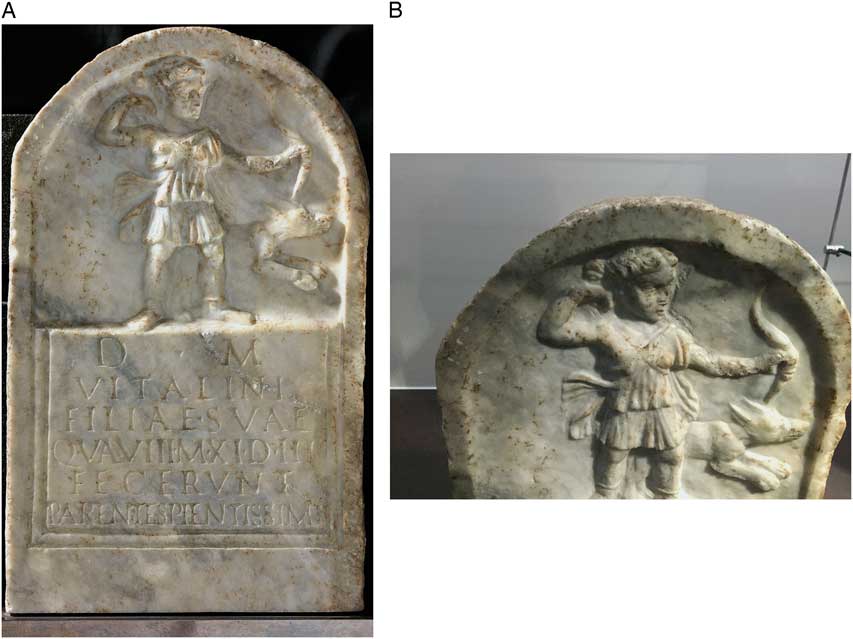
A Roman grave-marker, now in the R. D. Milns Antiquities Museum at the University of Queensland, is carved in white Italian marble and commemorates a young girl who died prematurely before reaching her ninth birthday (Fig. 1). The stele is one of the extant examples of a young girl with an individualised portrait represented in the guise of the goddess Diana. The stele, however, does not appear in any of the major collections of Latin inscriptions or discussions of young girls and women assocated with this type of iconography.Footnote 1 The purpose of this paper is threefold. Firstly, it suggests that the current date of manufacture previously assigned to the stele is too early. Secondly, it demonstrates that the name form of the young girl also needs revision. It has been argued previously that the nominative form of her name is Vitalinis, but it is more likely that this is the n-inflected genitive form of Vitalis.Footnote 2 In order to understand the form of the cognomen Vitalinis, this paper also examines the variations and derivatives of the cognomen Vitalis. To date, no study has examined the forms of the feminine cognomina in detail.Footnote 3 The cognomen is found primarily on Latin funerary, honorific, and votive memorials. Although it is impossible to address every example of Vitalis in this paper, it does examine all of the n-inflected forms found in the Epigraphic Database Clauss-Slaby (EDCS) in order to understand their uses.
Tombstone of child dressed in the guise of Diana. R. D. Milns Antiquities Museum, University of Queensland, Brisbane, Australia, Inv. No. 78-004.

The rectangular memorial, carved in white Italian marble and set up to commemorate the death of the young girl, has a curved top (451mm h x 276mm w x 35mm d) and was designed to cover a niche housing the ashes of the deceased child either inside a tomb or in one of the new integrated styles of tomb and columbarium. Footnote 4 Unfortunately, the exact provenance and context of the stele is now lost. The sale catalogue for the stele suggests that it comes from Rome, ‘as the name [Vitalinis] occurs in a number of published examples from the city.’Footnote 5 However, as demonstrated below, the use of Vitalinis as a cognomen was not restricted to Rome. To date, in addition to this stele in the R. D. Milns Antiquities Museum, ‘eleven portraits in sculpture and seven reliefs’ of young girls and young women in the guise of Diana have been identified, primarily from Rome and Ostia, but it is likely that many more were once extant.Footnote 6 Mander also notes that the majority of funerary memorials depicting children in the guise of gods and goddesses come from Rome.Footnote 7 Therefore, while it is likely that the stele was originally set up in or around Rome or Ostia, without further evidence, we cannot rule out that it came from a tomb somewhere else in Italy.
Diana was an important Italian goddess during both the Republican and Imperial periods. She was worshipped by both males and females of all social classes. During the Republican period, worship of Diana has so far been identified in fifteen areas in Italy, including Rome and Nemi, and she was also invoked by members of the Latin League.Footnote 8 Diana then became an important Imperial deity during the Augustan era.Footnote 9 Her presence was visible in Rome throughout the Imperial period on both official monuments and coinage.Footnote 10 Diana as huntress,Footnote 11 the form chosen for the depiction of the young girl on the stele from the R. D. Milns Antiquities Museum, was the image of Diana most commonly associated with male and female children and youths, probably due to her qualities of sexual purity and virtus. For example, the Augustan poet Grattius, in his Cynegetica, describes Roman male youths undergoing a purification ritual overseen by the goddess. He also describes their ‘mastery of the forest’; young Romans developed hunting/martial skills under the guidance of Diana. Therefore, she not only helped to prepare Roman youths for adulthood, but her protection also warded off the labes fatuorum. Footnote 12 Young girls are also identifiable in the cult of Diana. For example, at Tusculum, Flavia Vera was commemorated on her death as the priestess who was the leader of sacred dances for the cult.Footnote 13 Tertullian, writing towards the end of the second century ad, in criticising the Roman religious practices, tells us that ‘an old man’s representation is taken from Saturn, a youth from Apollo’s, a girl’s from Diana...’, suggesting that representations of girls as Diana were fairly common.Footnote 14 As the nineteen extant depictions of young girls and young women in the guise of Diana the Huntress attest, Romans commemorating the deaths of people of this age-group identified the goddess Diana as a particularly fitting figure for females who had died prematurely before reaching adulthood. By adding individualised portraits to the image of the goddess, those commemorating the deceased offered an important message about the lives of these girls. Although their potential remained unfulfilled, as they would never become wives and mothers, they were now under the protection of the goddess and thus were endowed with her virtus.Footnote 15
Set up by her parents, the epitaph on the Roman grave marker for the young girl in the guise of Diana in the R. D. Milns Antiquities Museum reads:
D(is) M(anibus) ǀ Vitalini ǀ filiae suae ǀ q(uae) v(ixit) a(nnos) VIII m(enses) XI d(ies) III ǀ fecerunt ǀ parentes pientissimi
To the Departed Spirits. For Vitalis/Vitalinis(?), our own daughter, who lived 8 years, 11 months, and three days. Her most devoted parents set up [this memorial].
To date, it has been accepted that the tombstone was either manufactured as early as the Augustan era or, alternatively, during the Claudian period. This dating was based on an interpretation of the letter forms of the inscription alone.Footnote 16 However, a more likely terminus ante quem is provided by the D.M., which indicates that it was probably not inscribed before ad 58-59, the date when D.M., Dis Manibus, began to be used on inscriptions.Footnote 17 The practice of using D.M. became much more common during the Flavian period and continued for several centuries. Moreover, the letter forms themselves are characteristic of those typical of the latter part of the first and also the second century ad; they were not used exclusively in the Augustan and Claudian periods.Footnote 18 Therefore, although it is impossible to date the tombstone precisely, it is unlikely that it was manufactured as early as the Augustan period. For this reason, it should be assigned a date ranging from the Neronian period to approximately the mid-second century ad, a period when both the iconographic style of such memorials featuring girls and women depicted in the guise of Diana and the use of the type of letter forms on the stele were popular.Footnote 19
It has also been argued previously that Vitalini, the substantive in the epitaph used to identify the young female recipient of the tombstone, is the dative singular form of a feminine name with the nominative singular form Vitalinis. Footnote 20 Thus, it has been accepted that Vitalinis is the nominative singular diminutive ‘of the fashionable name Vitalis’ and that the name form is ‘unusual and probably unique.’Footnote 21 However, a more thorough search has identified a further thirty-two examples on Latin funerary memorials, five using the form Vitalinis and twenty-seven Vitalini. Footnote 22 As will be demonstrated below, none of these examples support the claim that Vitalinis was used as a nominative singular name form in either Latin funerary, honorific, or votive inscriptions or in literary texts during the first to fifth centuries ad.
The form Vitalinis was used less commonly in Latin inscriptions than the dative form Vitalini. However, the examples below demonstrate that Vitalinis functioned as a possessive genitive, not as a nominative.Footnote 23 The earliest extant example found to date comes from the tomb purchased by Gnaeus Pomponius Hylas in the Flavian period. The dedicatory inscription honours Hylas himself while alive, along with his freedwoman:
Cn(aei) Pomponi Hylae v(ivit) Pomponiae Cn(aei) l(ibertae) Vitalinis.Footnote 24
[Tomb of] Gnaeus Pomponius Hylas [constructed] while alive [and] of Pomponia Vitalis, freedwoman of Gnaeus.
If Pomponiae was meant to be read as a dative, it would be qualified by Vitalini, not by Vitalinis. Nor can Vitalinis be nominative. In Rome, this use of the possessive genitive form Vitalinis continued into the fourth century ad, as demonstrated by the following two examples. The first commemorates a sixteen-year-old verna, the daughter of Imperial slaves:
Vitalinis dd(ominorum) / nn(ostrorum) vern(ae) quae / vixit ann(os) XVI m(enses) V / d(ies) XIII virgo def(uncta) Idib(us) / Oct(obribus) qu(a)e percep(it) diaria / stationi(s) hereditat(ium) / fecerunt parentes / b(ene) m(erenti).Footnote 25
[The memorial] of Vitalis, homeborn slave of our masters, who lived 16 years, 5 months and 13 days. She died unmarried on the 15th day of October. She was in the employment of the Inhertance Office. Her parents set up [this memorial] for their well-deserving [daughter].
A three-month-old was also commemorated with the possessive genitive form Vitalinis:
D(e)p(ositio) Vital[i]nis III Kal(endas) No<v=B>e<m=N>bre[s(!)] / Iul[i]ano IIII et Sallus[tio] conss(ulibus) vix(it) m(enses) IIII.Footnote 26
[The remains] of Vitalis, laid to rest on the 3rd day before the November Kalends (30th October) in the consulship of Iulianus IIII and Sallustius, lived 4 months.
When this usage is compared below to the possessive genitive forms of Vitalis, -is (both used for males and females), it will be confirmed that Vitalinis is a genitive rather than a nominative form.
Although a couple of the inscriptions using the substantive Vitalini are very brief,Footnote 27 an examination of examples on extant funerary inscriptions indicate that they are all dative singular forms. The majority follow a pattern similar to that of the epitaph in the R. D. Milns Antiquities Museum, with Vitalini functioning as a dative substantive qualified by a substantive/adjective combination: Vitalini filiae suae. This is also the form found on an epitaph composed in Latinised Greek, discussed below. Vitalini was therefore used in combination with single or multiple substantives and/or adjectives in the dative singular. For example, other memorials record: Atiliae Vitalini coniugi su(a)e;Footnote 28 Iuliae Vitalini…filiae dulcissimae;Footnote 29 Naeviae Vitalini matri;Footnote 30 Vitalini vernae suae carissimae;Footnote 31 Dominae filiae Vitalini;Footnote 32 and Aiae L(uci) l(ibertae) Vitalini.Footnote 33 Apart from McHugh and Puttock, the only other scholar who has suggested that Vitalinis is the nominative singular form with the dative form Vitalini is Leon. In his note on the Latinised Greek inscription Φλαβι[ε] Βιταλινι κονιουγι βενεμερεντι Σοσσιανους φηκιτ,Footnote 34 Leon argued that Vitalis is a masculine cognomen ‘hardly appropriate with a feminine gentilicium’ and that a Hellenised inflectional form Vitalini would not be expected from the nominative Vitalis.Footnote 35 However, a survey of funerary and honorific inscriptions of individuals who possessed the cognomen Vitalis was also undertaken. As discussed in more depth below, over one thousand examples of the cognomen Vitalis were found during this study. However, they are not all masculine:Footnote 36 feminine forms of the cognomen Vitalis certainly also exist on Latin funerary memorials. In fact, they number in the hundreds and were the cognomina of slaves, libertae, and females of freeborn status.Footnote 37 Moreover, Solin, who examined Hellenised forms of names in Latin inscriptions, notes that the inflection Vitalis, -inis, over time, also found its way into the repertoire of Greek and Latin names used on funerary memorials.Footnote 38 He thus identifies as name forms -os, -etis/-otis/-idis and -is, -enis/-onis/-inis.Footnote 39 This supports the finding of this study, demonstrated in more detail below, that the feminine nominative singular form of both Vitalinis (genitive singular) and Vitalini (dative singular) is Vitalis rather than Vitalinis.
First and Second-Declension Substantive Forms
Although not the central focus of this study, it is important to note that, during the early Imperial period, there was an interesting development in names related to the cognomen Vitalis.Footnote 40 First and second-declension forms related to Vitalis include Vitalius/Vitalia,Footnote 41 Vitalina,Footnote 42 Vitalianus Footnote 43 /Vitaliana, Footnote 44 Vitalicus/Vitalica, Footnote 45 the rare form Vitalinianus, Footnote 46 and the superlative forms Vitalissimus Footnote 47 /Vitalissima Footnote 48 /Vitalessima.Footnote 49 For example, Solin notes that both Vitalius and Vitalia were originally nomina,Footnote 50 but, towards the end of the second century ad, they also began to be used as the cognomina Vitalius Footnote 51 and Vitalia Footnote 52 and became particularly popular forms during the third century ad. The cognomina Vitalicus/Vitalica were favoured in the African provinces, especially for females,Footnote 53 and the superlative feminine form Vitalissima was used by members of the Christian communities of Rome between the mid-third and fifth centuries ad.Footnote 54
The n-Inflexion Third-Declension Name Form Vitalis, -is:
Vitalis as a Feminine Cognomen?
Before examining similar changes in cognomina of the third declension, it is important to address in more detail whether Vitalis was in fact a feminine cognomen. As mentioned at the beginning of this paper, Vitalis was used in the nominative, genitive (Vitalis), and dative singular (Vitali) as a feminine cognomen on approximately 305 inscriptions,Footnote 55 from the Republican period at least into the late fourth to mid-fifth century ad.Footnote 56 The number of females with this name was undoubtedly higher: numerous people with this cognomen cannot be assigned a gender on the basis of the information given in their inscriptions alone, as demonstrated by the following inscriptions: Dis Manibus Vitalis vixit m(enses) IIII h(ic) s(itus) e(st) Felix pater f(ecit);Footnote 57 Vitalis in pace q(ui) v(ixit) an(nos) IIII m(ensem) I d(ies) XIII;Footnote 58 Vitalis Gallici;Footnote 59 and the many instances of the cognomen Vitalis on other items, such as gemstones.Footnote 60 Therefore, a substantially higher number of this type of inscription may have belonged to females.Footnote 61 This certainly disproves the view that Vitalis was a cognomen given only to males, as stated by Leon.Footnote 62 The feminine cognomen Vitalis was found frequently in the nominative, predominantly on funerary memorials for women of all status levels:Footnote 63 freeborn women,Footnote 64 freedwomen,Footnote 65 and slaves.Footnote 66 Although they cannot be treated in detail in this study, it is importat to note that examples of Vitalis used as a feminine possessive genitiveFootnote 67 and dativeFootnote 68 cognomen are also found for women of all status levels. Thus, during the Imperial period, it is clear that the feminine name form Vitalis, -is was used for females of all status levels. Unfortunately, it is impossible to tell from these examples if the names of females with the cognomen Vitalis used only in the nominative would have considered the stem of their names Vital- or Vitalin-.
Vitalis or Vitalinis?
I now return to the feminine name form found on the tombstone in the R. D. Milns Antiquities Museum at the University of Queensland. As mentioned at the beginning of this paper, twenty-eight females were commemorated on funerary memorials with the dative cognomen Vitalini, the same name form of the eight-year-old girl commemorated by her parentes. Footnote 69 Of the twenty-seven other epitaphs using the dative form Vitalini, twenty-one of these come from Rome,Footnote 70 five from around Italy,Footnote 71 and one from the region of Noricum.Footnote 72 They range in date from the mid-first ad through to the fifth century ad.Footnote 73 In all cases, Vitalini was used as a cognomen. Eight of the cognomina were used in conjunction with a nomen but have no status indicators such as filiation or tribe.Footnote 74 Five are the cognomina of libertae, for instance Octavia Vitalis, Atia Vitalis, Valeria Vitalis, and Pisivana Vitalis. Footnote 75 On one memorial, no nomen is included due to space constraints; however, status is given.Footnote 76 Eight epitaphs name females with the cognomen Vitalini alone and four are fragmentary.Footnote 77 The majority of individuals with only a cognomen may have been of servile status.Footnote 78 Two were clearly children at time of death: a verna who died at age six years, eight months, and ten daysFootnote 79 and a child commemorated by her parentes on her death aged nine years, nine months, and seventeen days.Footnote 80 As suggested at the beginning of this paper, these should all be considered dative singular forms of the n-inflexion cognomen with a nominative singular form Vitalis and the genitive singular Vitalinis. There is no evidence to support the claim that the cognomen Vitalinis functioned as a nominative singular. The dative Vitalini and genitive Vitalinis thus function in the same way as the dative and genitive singular of other inflected name forms, including the third-declension masculine and feminine Vitalis, -is and of the masculine Vitalio Vitalionis. Footnote 81 Moreover, both the feminine name forms Vitalis, -is and Vitalis, -inis were in use from the the mid to latter part of the first century ad and continued into the Late Empire.
This paper has demonstrated that the memorial, now in the R. D. Milns Antiquities Museum at the University of Queensland (Inv. No. 78-004) and set up to commemorate the life of the young girl depicted in the guise of Diana, should be dated later than the Augustan or Claudian periods. It was most likely commissioned somewhere between the Neronian era and the second century ad by the parentes of the young girl. More importantly, after an examination of the many forms and variations of the cognomen Vitalis, it is also clear that, during the Imperial period, the n-inflexion cognomen Vitalis, -inis evolved from the traditional Vitalis, -is form for females. As there is no evidence that Vitalinis was used as a nominative, the name form of the young girl should also be changed from Vitalinis, -inis to Vitalis, -inis.