Introduction
Factors affecting pig lipid metabolism include diet and feeding regimen (Mersmann et al., Reference Mersmann, Allen, Chai, Brown and Fogg1981), sex (Mersmann, Reference Mersmann1984), age (Scott et al., Reference Scott, Cornelius and Mersmann1981) and breed (Mersmann et al., Reference Mersmann, Pond and Yen1984). The main sites for fat synthesis in animals are liver and adipose tissue, but important species differences exist. In rodents and birds, liver is the main organ for fatty acids (FA) synthesis, but in the pig, de novo fat synthesis largely occurs in the adipose tissues (O’Hea and Leveille, Reference O’Hea and Leveille1969; Bergen and Mersmann, Reference Bergen and Mersmann2005).
Peroxisome proliferator-activated receptors (PPARs) belong to the steroid hormone nuclear superfamily of ligand-activated transcription factors. Several isoforms of PPAR have been identified and their functions established. For example, PPARα is implicated in regulating genes involved in lipid oxidation. Natural ligands for PPARα include the n-3 and n-6 FA. Sterol regulatory element binding proteins (SREBPs) belong to the helix-loop-helix family of transcription factors. Several isoforms have been identified and SREBP-1c and SREBP-1a are important for the regulation of genes involved in lipid synthesis. Evidence from studies conducted in vitro (Worgall et al., Reference Worgall, Sturley, Seo, Osborne and Deckelbaum1998) and in vivo (Xu et al., Reference Xu, Nakamura, Cho and Clarke1999) show that polyunsaturated fatty acids (PUFA) have a role in inhibiting the maturation of SREBP at the post-translational level, thereby repressing lipogenic gene expression.
Interactions between diets and the genome are effected both via hormones and, directly, by diet components. For example, it is known that thyroid hormones and insulin both regulate lipogenesis but insulin may be less important in pigs than in other species (O’Hea et al., Reference O’Hea, Leveille and Sugahara1970). Thyroid hormones are important regulators of energy metabolism, and several mechanisms are involved in this activity, one of them is to promote the expression of some lipogenic genes and their encoded enzymes as shown in rat liver (Roncari and Murthy, Reference Roncari and Murthy1975; Dozin et al., Reference Dozin, Magnuson and Nikodem1986). Dietary fat inhibits the triiodothyronine (T3) promotion of rat liver lipogenic enzyme expression (Clarke and Hembree, Reference Clarke and Hembree1990) while PUFA increase total T3 levels compared with those in animals fed animal fat (Takeuchi et al., Reference Takeuchi, Matsuo, Tokuyama and Suzuki1995; G. Ferrini et al., unpublished data).
The current experiment was conducted to investigate the relationships between animal weight, tissues identity, dietary FA composition and level, thyroid hormones and the expression of genes involved in lipid metabolism.
Material and methods
Animals and diets
Sixty-one crossbred female pigs (Duroc ♂ × Landrace ♀) were fed a barley–corn–soybean meal-based diet during a 4-week pre-experimental period. Five pigs were slaughtered at the beginning of the trial (null animals), whereas 56 gilts (61.8 ± 5.2 kg BW) were randomly selected and assigned to one of seven dietary treatments (eight animals per treatment). Treatments were assigned randomly by animal weight and litter. The experiment comprised three periods with three, three and two pigs per treatment, respectively. Pigs had access to feed and water ad libitum and individual feed consumption was measured. Pigs were slaughtered at an average BW of 99.8 ± 8.5 kg. Samples from liver, neck backfat (adipose tissue) and semimembranosus tissues were taken after slaughter and immediately frozen in liquid nitrogen and then stored at −75°C until analysis. Experimental procedures were approved by IRTA’s (Institut de Recerca i Tecnologia Agroalimentàries) ethical committee.
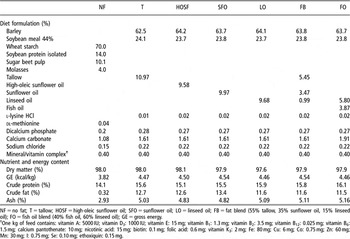
Seven diets were formulated to meet the National Research Council (NRC) (1998) requirements for energy (Table 1). Six fat-supplemented diets (containing 10% to 11% fat in total on a fresh weight basis) were based on barley and soybean meal. The remaining diet was a semi-synthetic diet, formulated to contain zero fat, in order to eliminate even the lower levels of fat that unavoidably exist in normal unsupplemented diets. Different fat sources were used to obtain different FA composition of the diets: tallow (T), high-oleic sunflower oil (HOSF), sunflower oil (SFO), linseed oil (LO), fat blend (55% tallow, 35% sunflower oil, 10% linseed oil) (FB) and a fish-oil blend (40% fish oil, 60% linseed oil) (FO). Diets T, HOSF, SFO and LO were formulated to contain high levels of saturated fatty acids (SFA), oleic acid, linoleic acid (an n-6 FA) and linolenic acid (an n-3 FA) respectively. Diet FB was designed to contain similar levels of each of the main FA (palmitic, stearic, oleic, linoleic and linolenic) while FO was designed to have a high content of long-chain PUFAs. Oils and fats were for food or feed quality grade. The fat-supplemented diets were formulated in order to supply equal amounts of digestible fat (as calculated by Duran-Montgé et al. (Reference Duran-Montgé, Lizardo, Torrallardona and Esteve-Garcia2007)).
Diet composition and nutrient content

NF = no fat; T = tallow; HOSF = high-oleic sunflower oil; SFO = sunflower oil; LO = linseed oil; FB = fat blend (55% tallow, 35% sunflower oil, 15% linseed oil); FO = fish oil blend (40% fish oil, 60% linseed oil); GE = gross energy.
†One kg of feed contains: vitamin A: 5000 IU; vitamin D3: 1000 IU; vitamin E: 15 mg; vitamin B1: 1.3 mg; vitamin B2: 3.5 mg; vitamin B12: 0.025 mg; vitamin B6: 1.5 mg; calcium pantothenate: 10 mg; nicotinic acid: 15 mg; biotin: 0.1 mg; folic acid: 0.6 mg; vitamin K3: 2 mg; Fe: 80 mg; Cu: 6 mg; Co: 0.75 mg; Zn: 60 mg; Mn: 30 mg; I: 0.75 mg; Se: 0.10 mg; ethoxiquin: 0.15 mg.
Composition of diets and tissues, and analyses of blood thyroid hormones
The determination of diet contents of dry matter (DM), crude protein, gross energy and fat were as described by Duran-Montgé et al. (Reference Duran-Montgé, Theil, Lauridsen and Esteve-Garcia2009). Tissue lipids were extracted by the Folch method (Folch et al., Reference Folch, Lees and Stanley1957), transmethylated with BF3 and methanolic KOH (Morrison and Smith, Reference Morrison and Smith1964) and FA contents determined using an automated GC (HP 6890; Hewlett Packard, Santa Clara, CA, USA) equipped with an automatic injector, using C19:0 as internal standard. Analysis of thyroid hormones was performed with Radio Immunoassay kits Coat-A-count total t3, Coat-A-count total t4, Coat-A-count free t4 from DPC Los Angeles, CA, USA.
mRNA abundance
The mRNA extraction and purification procedures, probes and details of primer/probe design and real-time reverse transcriptase (RT)-PCR conditions were as described by Duran-Montgé et al. (Reference Duran-Montgé, Theil, Lauridsen and Esteve-Garcia2009). The primers/probe design of stearoyl CoA desaturase (SCD) did not allow discrimination between SCD1 and SCD2 (transcription reported in rats and mice), the design of SREBP1 did not discriminate between isoform 1a and 1c, and the design of acetyl CoA carboxylase (ACACA) did not discriminate between isoforms 1 to 4 reported for humans. HPRT1 was used as endogenous control (housekeeping gene) and within a tissue, the housekeeping gene (HPRT1) was not affected by treatment (liver P = 0.59, adipose tissue P = 0.88, muscle P = 0.48). The housekeeping gene was considered suitable for the study of the different studied tissues.
The quantity of each mRNA was obtained as Ct values (the cycle number at which logarithmic plots cross a calculated threshold line) according to the manufacturer’s guidelines, and used to determine ΔCt values (ΔCt = Ct of the target gene − Ct of the identity gene). The ΔCt data of each target gene was analyzed separately for each tissue using the MIXED procedure of SAS (Littell et al., Reference Littell, Milliken, Stroup and Wolfinger1996). Data was expressed relative to that obtained for the low-level fat (NF) diet by calculating ΔΔCt values (ΔCt of treatment − ΔCt of NF diet) and converting results into expression levels according to Pfaffl (Reference Pfaffl2001) by taking into account the PCR efficiencies. The following statistical model was applied separately for each tissue:

,where X is the observation (e.g. ΔCt values) in the jth period from the kth litter, μ is the overall mean, αi is a fixed treatment effect, βj is a fixed effect of period, χij is the interaction of treatment × period, Ujk is the sow × period random effect and εijk the residual errors. Because there was no significant treatment × period interaction for any variable, only main effects are reported.
The model for comparisons of animals at different weights was:

,where Y is the observations (e.g. ΔCt values) at l = 60 or 100 kg live weight, μ is the overall mean, Ujk is the sow × period random effect and ε are the residual errors. This model was used in order to study the developmental changes in fat metabolism from 60 to 100 kg BW.
The model for comparisons between tissues was:

,where Z is the observations (e.g. ΔCt values) in the ith treatment, jth period from the kth litter, μ is the overall mean, γ m is a fixed tissue effect, αi is a fixed treatment effect, βj is a fixed effect of period, λ is log10 of the RNA sample content, Ujk is the sow × period random effect and ε are the residual errors. A treatment × period interaction was initially included in the model but it was found not to be significant for any of the variables, and therefore was removed from the model.
Significance levels for correlation coefficient were those of Fisher (Reference Fisher1925).
Results
Diet fatty acid contents
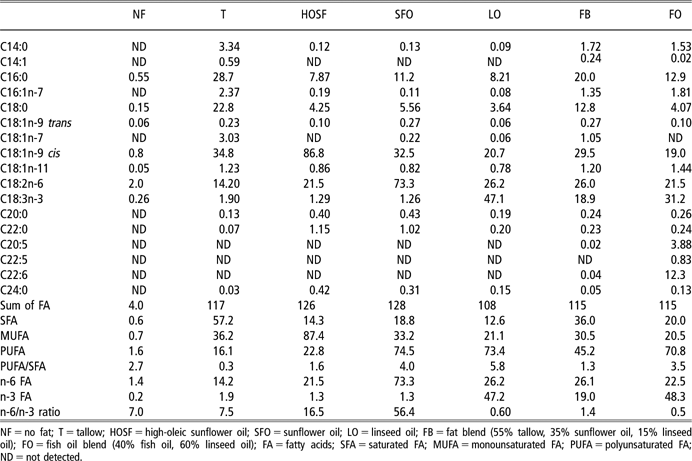
The NF diet had a low content of all FAs when compared with the fat-supplemented diets. The diet T had a high content of SFA (mostly palmitic and stearic acid). Diets HOSF, SFO and LO were rich in oleic, linoleic and linolenic acid respectively. Diet FB had similar contents of palmitic, stearic, linoleic and linolenic acids while diet FO was rich in long-chain PUFA. (Table 2).
Fatty acid content of experimental diets (mg/g)
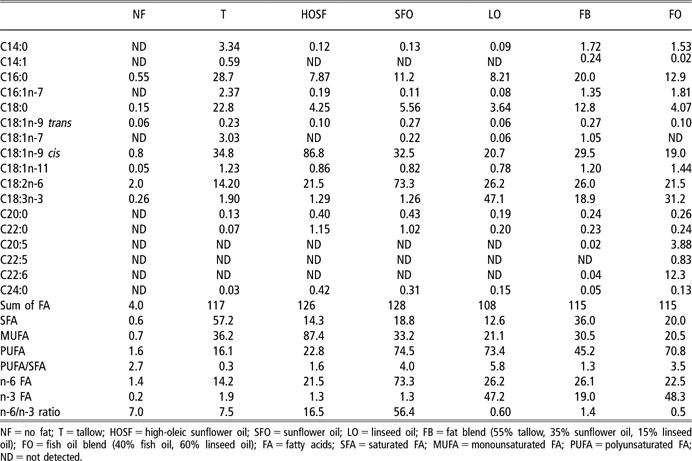
NF = no fat; T = tallow; HOSF = high-oleic sunflower oil; SFO = sunflower oil; LO = linseed oil; FB = fat blend (55% tallow, 35% sunflower oil, 15% linseed oil); FO = fish oil blend (40% fish oil, 60% linseed oil); FA = fatty acids; SFA = saturated FA; MUFA = monounsaturated FA; PUFA = polyunsaturated FA; ND = not detected.
Tissue fatty acid content
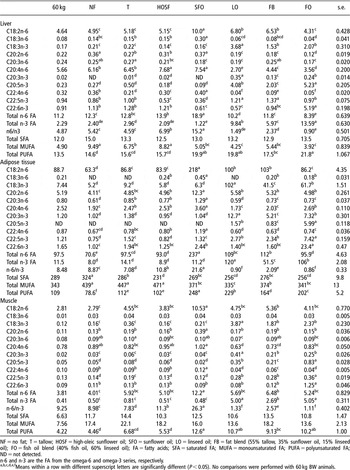
The FA (n-3, n-6, SFA, MUFA and PUFA) contents of target tissues (liver, adipose tissue and muscle) are presented in Table 3. Liver linoleic acid and all n-6 FA (18:3n-6, 20:2n-6, 20:4n-6 and 22:4n-6 FA) were high in pigs fed diet SFO relative to those fed the other diets. Linolenic acid was high in pigs fed diet LO while eicosapentaenoic acid (EPA) and docosahexaenoic acid (DHA) were high in pigs fed FO. The liver n-6/n-3 ratio ranged from 15.2 in pigs fed diet SFO to 0.90 in pigs fed FO. Liver SFA content was unaffected by diet but monounsaturated fatty acids (MUFA) content was high in HOSF while PUFA content was high in FO, SFO and LO but low in pigs fed NF.
Content (mg FA/g sample) of n-6 and n-3 FA, SFA, MUFA, PUFA in the liver, adipose tissue and muscle

NF = no fat; T = tallow; HOSF = high-oleic sunflower oil; SFO = sunflower oil; LO = linseed oil; FB = fat blend (55% tallow, 35% sunflower oil, 15% linseed oil); FO = fish oil blend (40% fish oil, 60% linseed oil); FA = fatty acids; SFA = saturated FA; MUFA = monounsaturated FA; PUFA = polyunsaturated FA; ND = not detected.
n-6 and n-3 are the FA from the omega-6 and omega-3 series, respectively.
a,b,c,d,e,fMeans within a row with different superscript letters are significantly different (P < 0.05). No comparisons were performed with 60 kg BW animals.
Adipose tissue n-6 FA contents were high in pigs fed SFO. The proportion of linolenic acid was high in pigs fed LO while EPA and DHA were high in pigs fed FO. The n-6/n-3 ratio in adipose tissue showed similar patterns to those in liver. However, the proportion of SFA was high in pigs fed NF but low in pigs fed HOSF. The proportion of MUFA was high in pigs fed NF, T and HOSF; and the PUFA were high in pigs fed SFO and low in pigs fed NF.
Muscle n-6 FA content was high in pigs fed diet SFO relative to those fed the other diets, linolenic acid was high in LO-fed animals, and EPA and DHA high in FO-fed animals. Furthermore, the n-6/n-3 ratio was high in SFO and low in LO- and FO-fed animals. No differences were observed in SFA and MUFA content in the muscle whereas PUFAs were higher in SFO-fed animals.
Gene expression related to treatments in different tissues
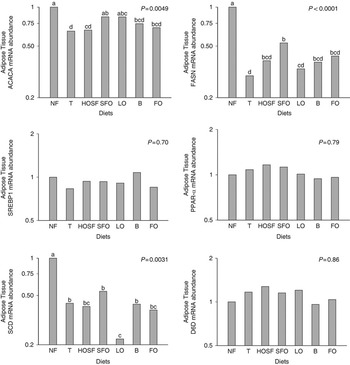
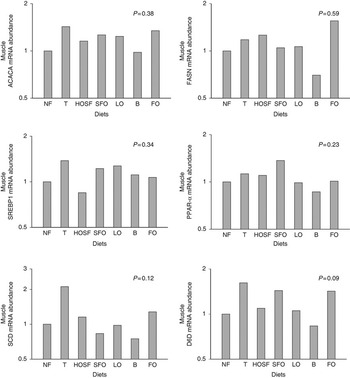
Diet affected the levels of mRNA for ACACA, SREBP1 and SCD in the liver (Figure 1) and those for fatty acid synthase (FASN), PPARα and delta-6-desaturase (D6D) in adipose tissue (Figure 2), but not in muscle (Figure 3).
Liver mRNA abundance of acetyl CoA carboxylase (ACACA), fatty acid synthase (FASN), sterol regulatory element binding protein-1 (SREBP1), peroxisome proliferator-activated receptor α (PPARα), stearoyl CoA desaturase (SCD), Δ6-desaturase (D6D), of pigs fed either a diet with no fat (NF) or a diet with 10% of fat from different sources: tallow (T), high-oleic sunflower oil (HOSF), sunflower oil (SFO), linseed oil (LO), fat blend (55% tallow, 35% sunflower oil, 10% linseed oil) (FB) or fish oil blend (40% fish oil, 60% linseed oil) (FO). The mRNA abundance is expressed relative to the NF diet.

Adipose tissue mRNA abundance of acetyl CoA carboxylase (ACACA), fatty acid synthase (FASN), sterol regulatory element binding protein-1 (SREBP1), peroxisome proliferator-activated receptor α (PPARα), stearoyl CoA desaturase (SCD), Δ6-desaturase (D6D), of pigs fed either a diet with no fat (NF) or a diet with 10% of fat from different sources: tallow (T), high-oleic sunflower oil (HOSF), sunflower oil (SFO), linseed oil (LO), fat blend (55% tallow, 35% sunflower oil, 10% linseed oil) (FB) or fish oil blend (40% fish oil, 60% linseed oil) (FO). The mRNA abundance is expressed relative to the NF diet.

Muscle (semimembranosus) mRNA abundance of acetyl CoA carboxylase (ACACA), fatty acid synthase (FASN), sterol regulatory element binding protein-1 (SREBP1), peroxisome proliferator-activated receptor α (PPARα), stearoyl CoA desaturase (SCD), Δ6-desaturase (D6D), of pigs fed either a diet with no fat (NF) or a diet with 10% of fat from different sources: tallow (T), high-oleic sunflower oil (HOSF), sunflower oil (SFO), linseed oil (LO), fat blend (55% tallow, 35% sunflower oil, 10% linseed oil) (FB) or fish oil blend (40% fish oil, 60% linseed oil) (FO). The mRNA abundance is expressed relative to the NF diet.

In adipose tissue, FASN mRNA abundance was correlated with those of ACACA (r = 0.84, P < 0.05) and SCD (r = 0.95, P < 0.05). A significant correlation was also observed between the mRNA abundance of PPARα and D6D (r = 0.83, P < 0.05).
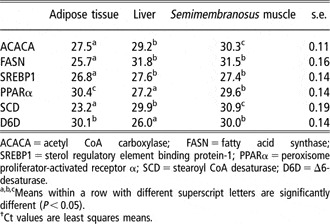
A comparison between tissues (Table 4) showed that FASN (P < 0.001), ACACA (P < 0.001), SCD (P < 0.0001) and SREBP1 (P = 0.0059) were more expressed in adipose tissue than in semimembranosus muscle and liver, while PPARα and D6D were more expressed in liver than in the other tissues (P < 0.001).
Gene Ct values in the studied tissuesFootnote †

ACACA = acetyl CoA carboxylase; FASN = fatty acid synthase; SREBP1 = sterol regulatory element binding protein-1; PPARα = peroxisome proliferator-activated receptor α; SCD = stearoyl CoA desaturase; D6D = Δ6-desaturase.
a,b,c Means within a row with different superscript letters are significantly different (P < 0.05).
† Ct values are least squares means.
Gene expression at different weights
In animals of 100 kg BW, the liver gene expression of target genes was higher for ACACA (P < 0.001), SREBP1 (P < 0.01), D6D (P < 0.01) and PPARα (P < 0.001), whereas SCD and FASN mRNA abundances were comparable (P>0.05) to those at 60 kg (Table 5). In adipose tissue, ACACA (P < 0.001), FASN (P < 0.001) and SCD (P>0.05) mRNA abundance was lower in pigs of 100 kg BW and not different for SREBP1, PPARα and D6D (P > 0.05). Similarly, transcriptions of ACACA (P < 0.01), FASN (P < 0.001) and SCD (P < 0.001) in muscle tissue were lower in 100 kg BW pigs, but also D6D (P = 0.054) and SREBP1 (P = 0.071) tended to be lower. In contrast, PPARα transcription in muscle was higher (P < 0.05) in 100 kg than in 60 kg pigs.
Relative mRNA abundance of genes related to lipid metabolism in 100 kg BW pigs compared to 60 kg BW (relative mRNA abundance = 1)

ACACA = acetyl CoA carboxylase; FASN = fatty acid synthase; SREBP1 = sterol regulatory element binding protein-1; PPARα = peroxisome proliferator-activated receptor α; SCD = stearoyl CoA desaturase; D6D = Δ6-desaturase in liver, adipose tissue and muscle (semimembranosus).
*P < 0.05; **P < 0.01; ***P < 0.001. The values in parentheses denote P-value.
Thyroid hormone concentrations
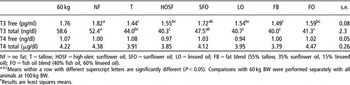
The NF diet showed the highest free and total T3 values followed by pigs fed SFO (Table 6). Animals fed diet T showed the lowest free T3 contents in blood. Animals of 60 kg BW showed higher total T3 hormone content than 100 kg BW. Free T3 correlated with FASN (r = 0.90, P < 0.05), ACACA (r = 0.83, P < 0.05) and SCD (r = 0.79, P < 0.05) and total T3 correlated with FASN (r = 0.88, P < 0.05), ACACA (r = 0.76, P < 0.05) and SCD (r = 0.90, P < 0.05) in adipose tissue. No correlations were observed between total T3 and free T3 hormones and gene expression in liver or muscle (P > 0.05). Plasma thyroxine (T4) levels were unaffected (P > 0.05) by diet and no correlations between T4 and transcription levels of any of the lipogenic enzymes were found.
Thyroid hormones values in bloodFootnote †

NF = no fat; T = tallow; HOSF = high-oleic sunflower oil; SFO = sunflower oil; LO = linseed oil; FB = fat blend (55% tallow, 35% sunflower oil, 15% linseed oil); FO = fish oil blend (40% fish oil, 60% linseed oil).
a,b,c Means within a row with different superscript letters are significantly different (P < 0.05). Comparisons with 60 kg BW were performed separately with all animals at 100 kg BW.
† Results are least squares means.
Discussion
Tissue fatty acid composition
Dietary FA are incorporated directly into tissues to a large extent (Leat et al., Reference Leat, Cuthbert, Howard and Gresham1964). A considerable proportion of energy originating from carbohydrates can be used for de novo synthesis of FA. Still, tissue FA composition largely reflected the dietary FA composition. Liver had a relatively high content of n-6 and n-3 derivates compared to other tissues meaning that liver was important for PUFA metabolism as supported by the high hepatic expression of D6D. When compared to the liver, adipose tissue reflected to greater extent of dietary modifications in terms of total tissue FA content as demonstrated by differences observed in SFA, MUFA and PUFA contents. Although influence of dietary treatment was observed in muscle FA composition, the differences between dietary treatments were not as wide as in liver or adipose tissue, and within treatment variability was higher. Interestingly, animals fed the NF diet showed high contents of two n-6 derivates (C20:2n-6 and C20:3n-6) in liver although this diet had the lowest content of this n-6 FA series. In agreement with other reports (Kouba et al., Reference Kouba, Enser, Whittington, Nute and Wood2003; Nuernberg et al., Reference Nuernberg, Fischer, Nuernberg, Kuechenmeister, Klosowska, Eliminowska-Wenda, Fiedler and Ender2005), pigs fed diets with high contents of linolenic acid (e.g. LO diet) did not increase DHA levels in the studied tissues, and had also low arachidonic acid contents. Nuernberg et al. (Reference Nuernberg, Fischer, Nuernberg, Kuechenmeister, Klosowska, Eliminowska-Wenda, Fiedler and Ender2005) suggested that the decrease in DHA and arachidonic acid could be a result of the competition for the same enzymes in their elongation and desaturation metabolism, and linolenic acid would have more affinity for these enzymes than linoleic acid.
Fat metabolism in different organs
Expression of lipogenic genes varied considerably among tissues, as indicated by the different Ct values (Table 4; one unit change on the Ct scale corresponds to a twofold change in gene expression when the PCR efficiency is 100%) and emphasizes that different tissues have varying functions related to fat metabolism which agrees with the results of O’Hea and Leveille (Reference O’Hea and Leveille1969). The high expression of lipogenic genes (SCD, ACACA, SREBP and FASN) in adipose tissue could be expected because in pigs this tissue is the main site for de novo FA synthesis. D6D enzyme is the main step in the desaturation of PUFA; this gene was preferentially expressed in liver as could be expected as the liver is the main organ synthesizing long PUFA, and is also confirmed by the high content of long PUFA and their intermediates in liver. PPARα acts as a transcription factor of enzymes related to FA oxidation; this gene was more expressed in liver than in adipose tissue and muscle meaning that the liver probably exerts a pivotal function in the oxidation of FA. The high hepatic expression of D6D can also explain the high level of EPA and arachidonic acid in this tissue, suggesting that this enzyme plays a key role in the synthesis of long-PUFA derivates (Brenner, Reference Brenner1971). It is interesting to note that PPARα and D6D genes were more expressed in the liver than in adipose tissue while the opposite was observed for FASN and SCD, suggesting that liver would be the preferential site for long-chain PUFA synthesis (Scott and Bazan, Reference Scott and Bazan1989), and pig adipose tissue would be the main site for de novo fat synthesis. Changes in adipose tissue lipogenesis are probably the main cause for the differences in body fat content observed in this study, as whole-body fat content of HOSF (26.7%) and SFO (26.7%) fed animals was higher than T (22.9%) fed animals (P Duran-Montgé et al., unpublished results)
Fat metabolism at different weights
Expression of lipogenic genes varied with weight in the present study. Scott et al. (Reference Scott, Cornelius and Mersmann1981) indicated a plateau in carbon flux and lipogenic enzyme activities in pig adipose tissue followed by a decline in activities with increased animal weight. In the report of Scott et al. (Reference Scott, Cornelius and Mersmann1981), the maximum lipogenic rates and ACACA activities corresponded to 60 kg BW which was then decreased at 85 and 100 kg BW. These findings are supported by the present study, since expression of lipogenic genes were greater at 60 kg BW compared to 100 kg BW. The greater expression of ACACA and SREBP1 found in the liver at 100 kg BW in the present study suggests that the liver could be responsible for increased lipogenesis during the fattening period. Chwalibog and Thorbek (Reference Chwalibog and Thorbek2000) also found that oxidation of fat decreased during the fattening period at high and low feeding levels, and that pigs fed at high feeding level did not oxidize fat from 60 to 100 kg BW.
Contrasting to muscle and adipose tissue, comparisons between body weights in the liver showed higher ACACA, SREBP1 and SCD mRNA abundance in 100 kg pigs, suggesting that adipose tissue lost lipogenic capacity on per gram of tissue basis. In addition, the results strongly suggest that lipogenesis is regulated differently in the liver and in adipose tissue and furthermore, that the contribution of these organs to fat metabolism changes over time.
Changes in dietary fat composition had different impacts on expression of genes related to lipid metabolism, depending on the tissues. The level of transcription of ACACA, SREBP1 and SCD was highest in liver for pigs fed HOSF, SFO and LO, intermediate in pigs fed NF, T and FB and lower in pigs fed the FO diet. This suggests increased biosynthesis of fat in pigs fed HOSF, SFO and LO, and probably FA elongation, as there was also a higher expression of ACACA in these treatments (indicative of synthesis of malonyl-CoA, essential in the elongation process). Furthermore, a high expression of D6D was observed in the liver, which may be indicative of unsaturation of long-chain PUFA. However, no modification of FASN expression was observed by dietary treatment in the liver, and its expression was generally low in the liver, indicating low de novo FA synthesis. In contrast, animals fed diet FO (rich in long-chain PUFA) showed low FA synthesis/conversion in the liver, probably because synthesis of more long-chain FA was not required.
In adipose tissue, transcription of ACACA, FASN and SCD was greatest for pigs fed NF diet, which may be explained by the greater need for de novo synthesis of FA. The lowest transcription of ACACA and FASN in adipose tissue observed in pigs fed T, suggests that saturated FA inhibit pig de novo fat synthesis. This was accompanied by lower whole body fat content in T-fed animals as observed in pigs from the present study (P Duran-Montgé et al., unpublished results). In other studies, lower carcass fat content was estimated in T-fed pigs compared to PUFA (Mourot et al., Reference Mourot, Chauvel, Le Denmat, Mounier and Peiniau1991; Mourot et al., Reference Mourot, Peiniau and Mounier1994). With regard to the expression of SREBP in adipose tissue, no dietary differences were found, which was in contrast to the observations for the liver.
Obviously, the above-mentioned differences between dietary treatments on the transcription variables are clearly tissue-dependent. In liver, SREBP is assumed to be the link for FA regulation of gene expression, whereas in adipose tissue other mechanisms than differential gene expression may be involved.
Polyunsaturated fatty acids (n-6 and n-3 FA), and especially long PUFA which are abundant in pigs fed FO, are known to be potent regulators of gene expression (Xu et al., Reference Xu, Cho, O’Malley, Park and Clarke2002; Jump et al., Reference Jump, Botolin, Wang, Xu, Christian and Demeure2005). The increase in D6D could be expected given its role in the synthesis of C18:3n-6 and long-chain PUFA like C20:4n-6, and may explain the positive correlation with the tissue content of these two FA. FASN correlation with EPA could be expected as EPA is known to reduce liver mRNA abundances of lipogenic genes in rodents (Iritani et al., Reference Iritani, Komiya, Fukuda and Sugimoto1998; Jump et al., Reference Jump, Botolin, Wang, Xu, Christian and Demeure2005). As previously reported (Theil and Lauridsen, Reference Theil and Lauridsen2007), the n-6/n-3 ratio may exert an effect on D6D gene expression in liver, as shown by their correlation in the present study in FO-fed animals, whose n-6/n-3 ratio in liver was very low due to the long-chain PUFA of dietary origin. This would suggest that pigs fed FO would have high tissue content of long PUFA, which makes synthesis of long PUFA unnecessary.
The correlation between SCD mRNA and SFA contents in adipose tissue can be explained by the fact that SFA are substrates for SCD enzyme (Bloomfield and Bloch, Reference Bloomfield and Bloch1960). Finally, we studied correlations between mRNA abundances of the different studied genes. Some of these correlations can be expected, because expression of the genes would be coordinated (Xu et al., Reference Xu, Nakamura, Cho and Clarke1999), and transcription factors as SREBP1 regulate the mRNA abundances of lipogenic genes. SCD can be regulated by SREBP-1c (Miyazaki et al., Reference Miyazaki, Kim and Ntambi2001) and FASN is known to be regulated by SREBP1 isoforms (Shimano et al., Reference Shimano, Horton, Hammer, Shimomura, Brown and Goldstein1996; Shimano et al., Reference Shimano, Horton, Shimomura, Hammer, Brown and Goldstein1997; Horton et al., Reference Horton, Shimomura, Brown, Hammer, Goldstein and Shimano1998). In the liver, genes that responded to dietary treatment seemed to be coordinated, as there were positive correlations between mRNA abundances for these genes (SREBP1, ACACA and SCD). Matsuzaka et al. (Reference Matsuzaka, Shimano, Yahagi, Amemiya-Kudo, Yoshikawa, Hasty, Tamura, Osuga, Okazaki, Iizuka, Takahashi, Sone, Gotoda, Ishibashi and Yamada2002) have described a so-called dual regulation of D6D in mouse liver by PPARα and SREBP. Although we have not observed statistically significant correlations in the liver between D6D and PPARα, or SREBP, it should be noted that a significant correlation was observed between PPARα and D6D in adipose tissue.
Thyroid hormone in blood
Thyroid hormones are known to increase expression and enzyme protein content of rat liver lipogenic genes (Roncari and Murthy, Reference Roncari and Murthy1975; Dozin et al., Reference Dozin, Magnuson and Nikodem1986) and nuclear response elements to thyroid hormones have been identified in the FASN gene in humans and chickens (Xiong et al., Reference Xiong, Chirala, Hsu and Wakil1998) which would be responsible for this action. Dietary fat inhibits T3 promotion of rat liver lipogenic enzymes (Clarke and Hembree, Reference Clarke and Hembree1990); specifically this action could be done by unesterified long PUFA inhibiting binding of thyroid hormone to the nuclear receptor (Inoue et al., Reference Inoue, Yamamoto, Morisawa, Uchimoto, Yukioka and Morisawa1989). In broiler chickens (G. Ferrini et al., unpublished data) and in rats (Takeuchi et al., Reference Takeuchi, Matsuo, Tokuyama and Suzuki1995), PUFA increase total T3 hormone while body fat deposition decreases when compared to animals fed animal fat; these reports also observed higher lipoprotein lipase activity in animals fed animal fat. According to our results, the higher free T3 hormone in blood is compatible with enhanced lipogenesis in adipose tissue. Thus, the higher total T3 content observed in 60 kg BW animals goes in parallel with the higher mRNA contents of lipogenic enzymes and that is also true for the high contents of free T3 observed in NF-fed animals followed by SFO-fed animals. We consider the present results to support the hypothesis that higher free T3 hormone in blood is compatible with enhanced lipogenesis, as ACACA (Zhang et al., Reference Zhang, Yin and Hillgartner2003) and FASN (Xiong et al., Reference Xiong, Chirala, Hsu and Wakil1998) DNA sequences contain T3 response elements that could explain the correlation observed in our study between mRNA abundances of ACACA and FASN, and T3 free hormone content in blood. The reasons for the differential effect of fat type on blood thyroid hormone are unknown. A possible explanation is a decline in the conversion rate of T4 to T3 hormone, rather than a decline in the secretion of the hormones from the thyroid gland (Chopra et al., Reference Chopra, Huang, Beredo, Solomon, Chua Teco and Mead1985).
Conclusions
The current study has shown that changes in mRNA abundances of genes were related to lipogenesis in liver and adipose tissue (but not muscle), and could be partly driven by T3 hormone signaling. The findings were based on the observed correlations between hormones and genes of fat synthesis (SCD, ACACA, FASN), and additionally also by the large differences observed between animals of different live weights (60 and 100 kg) and in the adipose tissue expression of lipogenic genes accompanied by differences in T3 hormone. Weight and tissue type were more clearly associated with differences in mRNA abundance of genes related to lipid metabolism than the FA contents of the diets or the tissues. The current work has confirmed that adipose tissue is the organ for de novo FA synthesis in pig and that the liver is the primary organ for the synthesis of long-chain PUFA. The relative role of the organs with regard to the FA synthesis changes as the animal grow as indicated by the changes in gene expression at different stages of the pigs.
Acknowledgements
This project has been supported by INIA (Instituto Nacional de Investigación Agraria of Spanish Government) Project number RTA03-060-C2-1. Also the support of Selecció Batallé S.A. (Spain) in providing semen for production of the animals used in the experiment is appreciated.