In the Turkish national elections on 12 June 2011 the ruling Adalet ve Kalkinma Partisi (AKP, Justice and Development Party) established its predominance in Turkey by increasing its share of the vote for three elections in a row. The AKP, which came to power in 2002 with 34 per cent of the votes, increased its votes to 47 per cent in 2007, and to 50 per cent in 2011. Considering that the Turkish party system in the 1990s was characterized by a high level of governmental instability, fragmentation, polarization, electoral volatility and frequent changes of party among parliamentarians, the emergence of a predominant party that controls the majority of the parliament, local governments and the presidency in an increasingly stable party system with reduced electoral volatility and party switching is striking. How can we explain the birth of a predominant party and the consequent dramatic change in the Turkish party system? The aim of this article is to display the causal mechanisms of the AKP's rise to predominance. Drawing on the literature on predominant party systems, it argues that the AKP conforms to the trend of predominant parties in more advanced democracies and follows a complex strategy that sustains the party's political dominance. Like the Christian Democrats in Italy, Liberal Democrats in Japan and Social Democrats in Sweden, the AKP has established ‘a virtuous cycle of dominance’ (Pempel Reference Pempel1990: 4) composed of an initial mobilization, delegitimization of the opposition and the selective use of ideological flexibility and rigidity.
The Change in the Turkish Party System
Sayari (Reference Sayari2007) characterizes the features of the party system between 1991 and 2002 as having a high level of fragmentation and polarization, governmental instability, dispersal of political power and short-lived coalitions. This trend was reversed in 2002, when only two parties won seats in the parliament. Likewise, electoral volatility dropped substantially from 50 per cent in 2002 to 19 per cent in 2007.Footnote 1 A dominant party, the AKP, emerged and established single-party governments with comfortable majorities after a decade of coalitions. As a result, governmental stability has increased significantly.
As these numbers indicate, the change in the Turkish party system since 2002 has been dramatic. When it comes to explaining change in party systems, electoral institutions are often the first factors to be studied. However, in this case, the electoral system is an inadequate explanation as there has been no change in the electoral institutions since 1982. Based on proportional representation with multi-member districts with a 10 per cent national threshold, this electoral system had produced single-party majority governments as well as coalition governments in the previous three decades. Although it is possible to suggest that a rather high electoral threshold allowed the AKP to establish a single-party government with 34 per cent of the votes by keeping several parties out of the parliament in 2002 elections (Sayari Reference Sayari2007), the electoral system alone cannot explain how the AKP quickly ascended to a predominant position in the aftermath of the election. This outcome becomes even more puzzling when we consider that in Turkey the cost of incumbency has historically been high.
Non-electoral sources of party system change observed in Turkish political history are also absent in this period. Such factors played a substantial role in party system change in the past; they include military interventions, accompanying institutional changes or party switching (Sayari Reference Sayari2008). These factors, however, were not present in this recent change in the party system. A third source of party system change in the Turkish context underlined by Sayari (Reference Sayari2008) – party closure – is indeed observed prior to this shift, when the Constitutional Court banned the Islamic Fazilet Partisi (Virtue Party) in 2001. This decision, though, led to a split in the political Islamic movement, increasing the number of the parties without having a direct impact on the emergence of a predominant system. In other words, in the past party closure had fed fragmentation and instability in the Turkish party system, not stability and institutionalization.
Similarly, explanations that underline the factors that contributed to the rise of the AKP in 2002 are only partially helpful in understanding this change. Scholars who study the 2002 elections contend that dissatisfaction with the existing parties and the economic crisis of 2001 led to the ascendance of the AKP (Carkoglu Reference Carkoglu2002; Sayari Reference Sayari2007). Although these factors explain why the party came to power in the 2002 elections, they do not account for how the AKP has turned into a predominant party. Likewise, others who focus on subsequent elections suggest that the success of the AKP in economic policy making and its struggle against the Kemalist establishment delivered the party major electoral victories (Carkoglu Reference Carkoglu2008; Cinar Reference Cinar2011). While acknowledging the importance of these factors, this article contends that in order to understand the AKP's rise to predominance it is necessary to look beyond elections as isolated incidents, and to display broader mechanisms of predominance. These mechanisms provide us with a more comprehensive picture of the AKP's rise since 2002.
The experiences of predominant parties elsewhere offer a comparative framework that improves our understanding of the recent transformation in the Turkish party system. Drawing upon existing experience, this article argues that in the Turkish context the AKP has consolidated itself as the representative of the right by appealing to the centre-right constituency without losing the support of the Islamic constituency – a task that many right-wing parties have failed at in the past. The AKP managed to hold onto this strong electoral alliance through a cycle of dominance that included initial mobilization, expansion of core support through material benefits, delegitimization of the opposition and selective use of ideological rigidity and flexibility.
The next section discusses the indicators of the AKP's predominance in the Turkish political party system by drawing out the parallels between the AKP and predominant parties elsewhere. Then the article analyses the factors that led to the consolidation of the AKP as a predominant party.
The AKP as a Predominant Party
Students of Turkish politics offered detailed analyses of the 2011 elections (Carkoglu Reference Carkoglu2011; Esen and Ciddi Reference Esen and Ciddi2011). While Esen and Ciddi (Reference Esen and Ciddi2011) hint at the birth of a predominant party system, Carkoglu (Reference Carkoglu2011) concludes that electorally the AKP has become a predominant party. Although these studies point at the changing nature of the party system in Turkey, they do not offer an analysis of the causes of this change. This article makes two specific contributions to these studies. First, it shows that the AKP is not only electorally but also governmentally dominant. Second, it lays down the causal mechanisms of the AKP's rise to predominance.
Sartori (Reference Sartori1976: 193) defines a predominant party system as one in which one party ‘outdistances all the others’. Pempel (Reference Pempel1990: 4) offers more specific criteria, suggesting that in a predominant party system a party must be dominant in number, must enjoy a dominant bargaining position (even if it does not have a majority, it can still form the government in coalition with others), must be dominant chronologically and must be dominant governmentally, that is, able to carry out a series of interrelated and mutually supportive public policies. In short, the dominant party must dominate the electorate, other political parties, the formation of governments and the public policy agenda.
Regardless of the definition one picks, the AKP is a predominant party, and the emerging party system in Turkey is increasingly approaching a predominant party system. First and foremost, the AKP has commanded clear support among the electorate in the last six elections. In three general elections, in 2002, 2007 and 2011, the party increased its share of the vote from 34 to 50 per cent.Footnote 2 Moreover, the party dominated local elections in 2004 and 2009 with 42 and 39 per cent, respectively. Finally, the two referendums organized by the AKP government passed with clear majorities.
When it comes to the formation of governments, having a majority in the parliament has enabled the party to establish single-party governments, which could not be produced in the fragmented parliaments of the 1990s (Sayari Reference Sayari2007). The high electoral threshold contributed to this outcome, keeping several parties with a share of the vote below 10 per cent out of the parliament, and giving a comfortable majority to the AKP. However, the electoral system does not tell us why the parties that previously operated under similar electoral rules failed to establish a predominant position in the 1980s and 1990s. The Anavatan Partisi (ANAP, Motherland Party) is an important case in point. The ANAP won two consecutive elections after transition to democratic politics in 1983 but the party lost its electoral support over the years. Given these failures, the AKP's success is worth exploring.
As a predominant party, the AKP not only dominates the electorate and government formation, but it dominates other political parties as well. Parties that participate in elections and gain seats in the parliament are distant followers of the AKP. The AKP passed its closest competitor, Cumhuriyet Halk Partisi (CHP, Republican People's Party) by 15 percentage points in 2002, 26 percentage points in 2007, and 24 percentage points in 2011. In the last two elections the AKP votes turned out to be well over the share of votes received by the two opposition parties combined. In all of these electoral contests, the AKP displays a powerful presence in all parts of the country, whereas other parties are turning increasingly into regional parties. The CHP gathers most of its support from western Turkey, while the MHP receives its support primarily from central Anatolia and parts of the western and southern coasts (Esen and Ciddi Reference Esen and Ciddi2011). Neither of the parties has an important presence in eastern and south-eastern Turkey, where the pro-Kurdish partyFootnote 3 receives substantial support. The AKP, in contrast, competes with all three parties and receives votes from all provinces in Turkey.
Finally, as well as the electoral arena, the AKP dominates the public policy agenda. The highly centralized nature of the state in Turkey and strong executive gives substantial power to the government (Carkoglu and Kalaycioglu Reference Carkoglu and Kalaycioglu2009a: 1). The subservience of the legislature to the executive is furthered by a high degree of party discipline, which gives the party leader almost an absolute control over its parliamentary group (Ozbudun Reference Ozbudun2009). As a result, the incumbent party with a clear majority controls the government and the parliament, and therefore public policy. Indeed, the governmental power of the AKP further increased after 2007 in a series of reforms that curtailed the power of the Kemalist establishment, represented by the military, judiciary and the president in the AKP's first term in office. With an innate distrust of the political elite – especially those with Islamic tendencies – the Kemalist establishment aimed to limit and control the AKP government between 2002 and 2007 (Cinar Reference Cinar2007). The AKP, however, in its second term, imposed greater control over these institutions.
In 2007 the AKP elected as president Abdullah Gul, a prominent leader of the party. Under the 1982 constitution, the presidency is an important part of the executive, entrusted with powers of administrative oversight to oversee the government, to provide checks and balances and to appoint members to critical positions in state bureaucracy, including the higher courts (Carkoglu and Kalaycioglu Reference Carkoglu and Kalaycioglu2009a: 1). With Gul elected president, the AKP had an opportunity to impose greater control over the bureaucratic appointments to the higher courts and a number of critical institutions such as the Council of Higher Education.
Again since 2007, the AKP has pursued an extensive revision of civil–military relations to consolidate its power. The Turkish military has historically perceived itself as the guardian of the Republic and intervened regularly in Turkish politics (Heper Reference Heper2011). After the AKP came to power in 2002 the party took three major steps to subordinate the military to civilian control. First, the party implemented a series of reforms as part of European Union harmonization to eliminate the seats reserved for the military in a number of key state institutions (Guney and Karatekelioglu Reference Guney and Karatekelioglu2005). Then, in its second term in office, a series of trials ensued (Ergenekon, Sledgehammer and Internet Memorandum) that brought many retired as well as active duty military personnel, including high-ranking generals, before the courts with allegations of planning a coup against the government (Aydinli Reference Aydinli2011). Third, in a referendum in 2010, the AKP established judicial oversight over the decisions of the Supreme Council of the Military.
Finally, the government restructured the higher courts and the Supreme Council of Public Prosecutors and Judges, and increased the number of members appointed by the president and elected by the parliament in the higher courts. Hence, the executive increased its control over the judiciary, thus imposing greater control over the final representative of the Kemalist establishment.
The AKP, with a clear majority in the parliament in the last three terms, completed its dominance in the executive with Gul's election, and consolidated its power by undercutting the power of the military and judiciary in Turkish politics. These developments gave the party substantial power in policy design and implementation. Indeed, using its predominant position in the political system, the AKP initiated a reform process in different policy areas from 2002, expanding from economy to health care, education to social security, judiciary to foreign policy. The party carried out a comprehensive harmonization process with the European Union Copenhagen criteria while restructuring the public sector through extensive privatization. A series of reforms in the health system and labour management also accompanied substantial change in housing policy. In addition, the party started working on a new constitution in its second term and initiated a debate on replacing the parliamentary system with a presidential system. The direction of foreign policy similarly changed dramatically, moving from a focus on the West to the immediate vicinity, with the doctrine of zero problems with neighbours (Fisher Onar Reference Fisher Onar2011). In this context, Turkey started to play a more proactive role in its region and emerged as a potential leader in the Middle East.
Explaining the AKP's Rise to Predominance
How has the AKP attained such unparalleled predominance, outperforming every other political party in Turkish history? Pempel (Reference Pempel1990: 16) argues that a dominant party is one that plays the game of politics well enough to maintain itself in power long enough that it can continue enacting and implementing policies that reinforce its powerbase. If it plays this complex game particularly cleverly, it may unleash what Pempel calls a virtuous cycle that will propel it into semi-permanent governance. Mapai in Israel, the Liberal Democratic Party in Japan, the Christian Democratic Party in Italy and the Socialist Party in Sweden managed to play this game successfully enough to remain in power for significant periods of time. Interestingly, the path through which the AKP rose to predominance shows striking similarities to these cases.
Turkey, like other countries with predominant party systems, has an electoral system that allows for multipartism through proportional representation and an electoral threshold that keeps a limit to the number of parties that can attain seats in the parliament. Proportional representation is more prone to the emergence of predominant parties because, in general, one-third of the votes is usually enough for a party to establish a government in such systems (Pempel Reference Pempel1990: 336). Indeed, in its first term in office, the AKP attained 34 per cent of the votes and two-thirds of the seats. However, as Esping-Andersen (Reference Esping-Andersen1990) points out, electoral systems do little to explain single-party dominance.
Needless to say, not all proportional representation systems generate predominant parties, as we observe in many countries with this system and in Turkey in the 1970s and 1990s. As indicated earlier, since 1983 this institutional feature has generated very different outcomes with respect to the general features of the Turkish party system. While single-party governments emerged in the 1980s, throughout the 1990s coalition governments became the norm, and the party system, despite having a 10 per cent electoral threshold, became increasingly fragmented and unstable, so that several parties had seats in the parliament but none of them could dominate the others. Therefore, to understand the emergence of the AKP's predominance we should look beyond the electoral system and instead focus on the way the party has used its position in government to build a cycle of dominance.
The Cycle of Dominance
Like its counterparts elsewhere, the AKP's cycle of dominance started with an initial mobilization in the midst of a political crisis. This initial mobilization is sustained and expanded through symbolic and material benefits that the party provides and is further reinforced by efforts to delegitimize the opposition. A final component that keeps a large basis of political support intact is a complex strategy based on the selective use of ideological rigidity and flexibility (Pempel Reference Pempel1990: 16). In conjunction, these components spiral into a loop that reinforces and feeds further dominance, rendering the AKP the only viable political option available to the electorate. Eventually, the rule of the party becomes natural, logical and inevitable (Pempel 1990: 16).
A Mobilizational Crisis and the Origins of Predominance
Predominant parties establish their predominance in the aftermath of a mobilization crisis that involves political and economic crises during which pre-existing patterns of politics are shattered, old solutions lose their appeal, old alliances break apart and new actors come to the fore (Pempel Reference Pempel1990: 341–2). The prospective predominant party emerges at this juncture as a novel political force that mobilizes constituencies in the middle of the crisis. The AKP, like the Liberal Democratic Party in Japan, Christian Democrats in Italy and Mapai in Israel, rose to its predominant position very soon after its establishment in the context of such a crisis.
The decade preceding the AKP's rise to predominance was one of crises in Turkey. The political crisis of the 1990s involved challenges to the regime on different fronts by Kurdish and Islamist political movements whose power increased substantially over the decade due to socioeconomic changes (Secor Reference Secor2001). Rural to urban migration and ongoing social mobilization in the provinces created an impetus for Kurdish and Islamist politics. Particularly important was the emergence of a provincial conservative bourgeoisie in the aftermath of the neoliberal economic transition in the 1980s. A struggle for the distribution of resources ensued between the pro-secular big bourgeoisie with close ties to the state elite and the emerging provincial conservative bourgeoisie that often felt marginalized by the state (Bugra Reference Bugra1998). The centre right, already fragmented, failed to offer political solutions to this power struggle and other challenges of identity politics (Cizre Reference Cizre1996) and further exacerbated the crisis by accepting the increasing involvement of the military in the handling of these movements. The postmodern coup in 1997 that forced the coalition of Islamic Refah Partisi (Welfare Party) and centre-right Dogru Yol Partisi (True Path Party) out of power took the crisis of the centre right to a peak.Footnote 4
Along with the political crisis, the 1990s was a period riddled with economic and financial troubles. Coalition governments, often led by one of the centre-right parties, showed poor performance in dealing with persistently high inflation and a balance of payments crisis. On top of ineptitude in economic governance, the centre-right parties lost further credibility through numerous corruption scandals. The final blow came in 2001 when the worst financial crisis in Turkish history led to the collapse of the financial sector and triggered a deep economic recession (Onis and Rubin Reference Onis and Rubin2003). This lost decade, marked by several failures on the part of the centre right and an overall weakness of the centre left, generated significant apathy and distrust among the public for the existing political parties. In short, throughout the 1990s the centre right gradually eroded and generated a mobilizational crisis as several social groups sought political options regarding their religious or ethnic identities as well as better representation of their class interests (Gumuscu Reference Gumuscu2010). It should be noted that not all mobilizational crises produce dominant parties, as several parties can benefit from such moments of crises while only a few are able to establish predominance (Pempel Reference Pempel1990: 341). Thus, it is important to understand how the predominant party moves beyond the initial mobilization and initiates a cycle of dominance.
Initial Mobilization and the Expansion of Support
What sets a predominant party apart is its success in maintaining and expanding its initial electoral alliance. An expansion of this alliance is possible through material benefits, including strong patronage ties and a wide array of assistance to numerous individual communities, particularly in the form of pork barrel programmes (Pempel Reference Pempel1990: 347). The AKP, like other predominant parties, established patronage ties with key constituencies. For the urban poor the government designed cheap housing projects, while municipalities reached out to disadvantaged groups by distributing consumer goods such as food, clothing and coal, and by providing income assistance on a regular basis (AKP 2011; Celik 2010). Health reform has also been a critical part of the ties that the AKP established with the urban poor, who received substantial benefits from the restructuring of the health system and improvements in public hospitals.
The emerging conservative bourgeoisie – the core support of the AKP – has also benefited handsomely from the AKP's incumbency. Once again, municipalities have played a central role in the distribution of construction permits and contracts for services needed by the municipality to businesses affiliated with the AKP (Gurek Reference Gurek2008). Moreover, these businesses have also been integrated into the patronage ties established with the low-income groups, whose needs have been met by companies with close ties to the party.Footnote 5 Meanwhile, the central government played a critical role in handing out contracts and providing credit on favourable terms to businesses with close connections to the party. An important example is developments in the media, as several media companies changed hands as a result of financial troubles. The new owners of these media channels were businesses with close ties to the AKP government. For one such company, two public banks provided credit on very favourable terms so that the owner could take over one of the largest media corporations in the country (Yilmaz Reference Yilmaz2008).
Another important channel of distributing material benefits has been pork barrel programmes, which have taken the form of investments in infrastructure. Celebratory discourses regarding its construction of roads, bridges and subways have constituted a major pillar of AKP propaganda, and the party has developed a powerful discourse about the services that the government provides for different communities (see AKP 2011). Needless to say, these infrastructural investments provided substantial opportunities for growth for the businesses that were close to the AKP. That said, patronage politics in Turkey is not an AKP invention; patronage and clientelism had been an integral part of Turkish political life since the transition to democracy in 1950 (Gunes-Ayata Reference Gunes-Ayata1994; Sayari Reference Sayari1978), and all centre-right parties in the past had based their discourses on pork barrel programmes. Nevertheless, it is striking that the AKP established its predominance while other centre-right parties failed.
What set the AKP apart from other centre-right parties, which resorted to patronage and eventually suffered from corruption scandals and mounting distrust on the part of the electorate, was the fine balance that the party established between responsible fiscal and monetary policies, successful macroeconomic governance and patronage. Low inflation, low budget deficits and stable exchange rates meant greater macroeconomic stability, improved living conditions for the lower and middle classes and a favourable environment for investment and growth for businesses. Like many incumbent parties, the AKP experienced corruption scandals, but its successful economic management sustained the support of the electorate. As a result, the AKP expanded its core support – comprising the urban poor and conservative provincial businessmen – to include parts of big business, liberal intellectuals and the middle classes in metropolitan areas.Footnote 6
Ideological Distancing and Delegitimization of the Opposition
If material benefits constitute one part of the strategy for the expansion of a predominant party, symbolic messages constitute the other. The predominant party communicates to the electorate that only it represents certain norms and acquires certain skills in the political scene. Like the Liberal Democratic Party in Japan or the Christian Democratic Party in Italy, the AKP sent symbolic messages to the people within a coherent ideological framework. This critical part of the symbolic battle not only builds an image of the party but also serves the purpose of delegitimization of the opposition. If the party succeeds in delegitimizing the opposition, it is able to further the cycle of predominance as joining the opposition becomes unreasonable for social groups (Pempel Reference Pempel1990: 346). The AKP, as a predominant party, has built a very strong discourse of delegitimization of the opposition and constructed a political ‘other’ out of these parties.
The AKP defines itself in four main areas: economic growth, service orientation, democratization and Islamic conservatism (AKP 2001; Yavuz Reference Yavuz2009). The economic stability and growth that the Turkish economy attained after 2002 is the most crucial part of the AKP's image, summarized in the party's 2011 electoral campaign slogan: ‘Let stability persist, let Turkey grow’. The AKP accordingly drew constant comparisons between pre- and post-2002 economic conditions. As the party emphasized the trend of growth in the Turkish economy, it also distanced itself from the opposition parties that the AKP represents as incapable and inexperienced.
The second critical part of the party's identity was its service orientation and is neatly summarized in the slogan: ‘Our love is our nation, our job is to serve’. Through this discourse and the actions that bolstered it, the AKP distinguished itself from the rest of the political parties by characterizing them as impotent service providers and uncaring, inexperienced decision makers. The party made this case by comparing its municipalities with those of the opposition parties to show that other parties were unfit for governance.
A third and related component of the party's identity was democracy, which was often presented as being respectful of the people and their choices. The AKP, like former centre-right parties, put itself on the side of the people in the dualism of the state and the people. Making frequent references to the early republican elite, which the AKP described as authoritarian and disrespectful of the people's will, the party claimed to be the voice of the silent masses against the powerful state elite (Fisher Onar Reference Fisher Onar2011). Accordingly, one of the early slogans of the party was: ‘Enough! It is time for the people to speak up!’ Needless to say, opposition parties, particularly the CHP as the founding party of the republic, were portrayed as authoritarian and dismissive of the preferences, norms and values of the Turkish people. This effort on the part of the AKP was most visible in prime minister and party chairman Tayyip Erdogan's speeches, which included frequent references to the one-party regime of the CHP between 1923 and 1946 and a desire to show the contemporary CHP as the continuation of that political tradition (Erdogan Reference Erdogan2009).
A final component of the AKP's identity was Islamic conservatism. Reverence for religious values, frequent references to Islamic symbols and public displays of religious practices made up the public image of the leaders of the party. In a manner that connected Islamic conservatism with service orientation, Erdogan frequently stated that serving the people is to serve God. Once again, this Islamic conservative identity of the party entailed an attack on the CHP, which was presented as anti-Islamic, disrespectful of Islamic norms, or at best ignorant of Islamic practices. In the 2011 election campaign, for example, Erdogan (Reference Erdogan2011a) often referred to the CHP as the party that used mosques as barns, changed the call to prayer from Arabic to Turkish and banned Islamic religious practices. Erdogan (Reference Erdogan2011b) also targeted a CHP candidate, Binnaz Toprak, for being disrespectful of Islam for her comment on a Quranic verse written in the entrance of a cemetery in the middle of Istanbul.Footnote 7 Furthermore, Erdogan sought to create a Sunni–Alevi cleavage during the 2011 electoral campaign by claiming a role as the ‘representative’ of Sunni Islam and making frequent references to the Alevi origins of the leader of the CHP.Footnote 8
Ideological Rigidity and Flexibility
A final component of the virtuous cycle of dominance is ideological rigidity and flexibility that allows the predominant party to maintain unity on the right or the left of the political spectrum (Pempel Reference Pempel1990: 24). Such flexibility involves attaining the support of the median voters without alienating the ideologically predisposed constituencies and allows the party to become a catch-all party and remain predominant as long as it maintains this balance.
Traditionally, the Turkish electorate has displayed clear rightist tendencies. In recurrent surveys conducted since the 1990s, at least two-thirds of respondents placed themselves on the centre or the right in the left–right ideological spectrum (Carkoglu and Kalaycioglu Reference Carkoglu and Kalaycioglu2009b: 116). This self-placement is critical because, as Carkoglu and Kalaycioglu (Reference Carkoglu and Kalaycioglu2009b: 204) show, the primary determinant of voting behaviour in Turkey is ideological position. The point where voters place themselves on the left–right spectrum determines their party preference most of the time. Religion comes second, after ideological position, in determining votes and reinforcing the impact of ideological position as the secular–religious cleavage parallels the left–right divide. As the studies show, the impact of religious attitudes on voting behaviour is not a temporary phenomenon. Rather, voters who vote for Islamic parties are motivated by religious sentiments and not by economic deprivation or the experience of economic crisis (Carkoglu and Kalaycioglu Reference Carkoglu and Kalaycioglu2009b; Esmer Reference Esmer2002).
Given the strength of right-wing support in Turkey, the primary obstacle to predominance for a right-wing party had previously been fragmentation. The AKP, unlike any other party in the past, accomplished the task of unifying the right-wing constituency to a significant extent. The party managed to consolidate itself on the right by making appeals from a clear ideological position while governing far more pragmatically from the political centre (Pempel Reference Pempel1990: 351). As a party with its roots in political Islam, it was easier for the AKP to display ideological rigidity than flexibility. Therefore, the party spent considerable efforts in its initial years in seeking to convince centre-right voters that it was not an Islamist party and that it would govern pragmatically from the political centre. To display its sensitivity to these concerns, the party included former centre-right politicians among its founders and invited several liberal and social democratic figures to join its ranks in 2007. In the meantime, in its first term in office, the AKP pursued a reformist and a pro-EU agenda and started accession talks with the EU in 2005. The party's attachment to democratic reforms and EU membership appealed strongly to liberal and centre-right constituencies.
To strengthen its hold on the centre right, the party leaders also claimed the legacy of the centre-right parties of Turkish political history, in particular the Democrat Party (DP) and ANAP.Footnote 9 As already mentioned, the way the party founded its identity on service provision, concern for economic growth and democratization was an important part of this effort to show the AKP as the latest and best representative of the centre-right tradition. This is why the party leaders made frequent references to the services provided by Ozal in the 1980s, building their propaganda on service provision and good economic performance (Erdogan Reference Erdogan2004, Reference Erdogan2007, Reference Erdogan2011d). With these constructed resemblances, the AKP was presented as another centre-right party devoted to economic growth, prosperity and democracy.
While appealing to centre-right voters as a result of economic success and a pro-EU and pro-reform agenda, the AKP sustained its attraction for Islamic constituencies primarily through symbols and secondarily through sociocultural policies. The fact that the leaders of the party were pious Muslims was one of the strongest symbols appealing to conservative voters. A prominent figure in the party, Huseyin Celik (Reference Celik2011), explained their success in the 2011 elections by the fact that the leaders of the party were of the same modest and conservative backgrounds as most of the people in Turkey. The leaders used a rhetoric heavily influenced by religious symbols and did not refrain from showing their religious beliefs and sensitivities in public, as already discussed above. The leaders of the party regularly attended the Friday prayers, feasts in Ramadan, and praised conservative and religious values in their speeches. For instance, before the 2007 presidential elections, Bulent Arinc, a prominent name in the party, claimed that the AKP would elect a religious president, referring to Abdullah Gul (quoted in Bulac Reference Bulac2007). Finally, more recently, Prime Minister Erdogan announced that the AKP's objective was to bring up devout generations (quoted in Hurriyet Daily News 2012).
The party was also aware that it could not count on its roots in political Islam to sustain the support of the Islamic groups nor compete successfully with the Islamist parties at the far right of the political spectrum. Therefore, the party sent occasional messages to the Islamic constituency and reminded them of the party's Islamic tendencies and ideological orientation. Accordingly, the party offered or passed legislation that kept the Islamic constituencies content. At different times, the party attempted to penalize adulteryFootnote 10 and regulate the sales of pornography by registering identity numbers of those citizens who buy adult magazines (see Radikal 2008). The party had to back down on these issues when it faced a public outcry, but it did succeed in changing the regulations on alcohol sales and consumption (see TAPDK 2011). Similarly, the party group in the parliament and bureaucrats appointed by the government spent considerable effort on lifting the ban on headscarves in the universities and increasing access for graduates of religious schools to higher education.Footnote 11 Similarly, foreign policy was an important venue for signalling ideological preferences. Increasing anti-Israeli rhetoric on the part of the government, gaining momentum after the Davos crisis and its implicit support for Islamic activists who wanted to penetrate the blockade of Gaza in 2010Footnote 12 were important symbolic gestures that the party used to appeal to its Islamic constituency.
In short, the AKP was an example of how a party can successfully combine ideological flexibility and rigidity. The party skilfully conveyed to the centre-right voter that its primary concern was service and good governance, while frequently sending messages to the Islamic constituencies that it cared about Islamic principles. The results of elections in 2007 and 2011 showed that this simultaneous flexibility and rigidity indeed worked effectively in expanding the voter support of the party. The upshot was that the AKP managed to attract the centre-right votes that had been cast for other parties in 2002. The share of votes cast for the centre-right parties other than the AKP dropped from 22 per cent in 2002 to 8 per cent in 2007 and 1 per cent in 2011. Likewise, the party successfully competed against the rival Islamic parties, which could only obtain 2.5 per cent of votes in 2007 and 1 per cent in 2011.Footnote 13
The fact that the AKP maintained a coalition of centre-right and Islamic constituencies and consolidated itself as the right-wing party is the key factor in its sustained predominance and is more important than institutional factors such as the electoral system. Indeed, a party becomes predominant in Turkey if it successfully appeals to both the centre-right and Islamic constituencies. At different points in Turkish political history other political parties came close to establishing predominance. Among these parties one can count the Democrat Party in the 1950s, the Adalet Partisi (AP, Justice Party) in the 1960s, and the ANAP in the 1980s. With the exception of the DP, whose rule ended with a military coup in 1960, the other parties lost their predominant position through elections. It is important to note, however, that a significant part of the DP's electoral appeal was due to its opposition to the CHP, whose militant secularism had alienated important segments of the society. The DP's attempts at rehabilitating Islam in public spaces played a central role in the party's propaganda (Reed Reference Reed1954). Nevertheless, the DP's attention to Islamic issues did not remove competition from more Islamic forces such as the Cumhuriyetci Millet Partisi (CMP, Republican Nation Party). After the closure of the DP, it was the AP that had to compete with the CMP in its bid to capture the DP legacy.
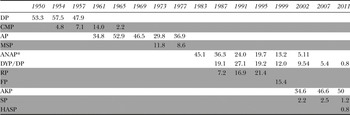
As Table 1 shows, once the AP consolidated its position as heir to the DP, it won clear electoral victories in the 1965 and 1969 elections. However, the party experienced sharp decline in its support in the 1970s when the Islamic MSP joined the electoral competition and appealed to Islamic constituencies. Similarly, the ANAP rose to prominence in the 1980s and monopolized the centre-right terrain. But like the AP, the ANAP lost its dominance with the emergence of the Islamic RP and other centre-right parties in 1987. By way of contrast, the AKP captured centre-right as well as Islamic votes, and unlike its predecessors the party monopolized the centre-right without losing the support of the Islamic constituency. This is visible in the fact that the Islamic parties could get only around 2 per cent of the votes in the last two elections.
The Electoral Performance of Centre-Right and Islamic Parties in Turkey

Notes: Islamic parties are indicated in shaded rows. Un-shaded rows denote centre-right parties. DP: Democrat Party; CMP: Republican Nation Party; AP: Justice Party; MSP: National Salvation Party; ANAP: Motherland Party; DYP: True Path Party; FP: Virtue Party; AKP: Justice and Development Party, SP: Felicity Party; HASP: Voice of the People Party.
*ANAP did not run in the 2007 and 2011 elections.
Conclusion
This article has shown the similarities between the AKP and predominant parties observed elsewhere. Parallels include the emergence of a cycle of dominance in the electoral system that turns the initial mobilization of party support into semi-permanent rule. The Turkish political party system has undergone substantial change since 2002 with the AKP's rise to predominance that was possible because of its ability to build a coalition of centre-right and Islamic constituencies through a virtuous cycle of predominance that involved mobilizational crisis, an expansion of initial support through material benefits and ideological distancing and selective use of ideological flexibility and rigidity.
Despite the similarities between the AKP and other predominant parties, a major difference concerns the systemic character of the AKP's dominance. Certainly, the AKP has established its dominance in Turkish politics. Yet, for Turkey's political system to become a fully fledged predominant party system, the AKP needs to pass two tests. The first is a turnover in leadership. The party must survive and continue winning elections even after Erdogan is replaced by another leader. Second, the party must survive a crisis. While there is still time for the AKP to pass the first test, the party has given signals of possible success with regard to the second test. The AKP survived an economic downturn in 2008 with the onset of the global financial crisis and ran in local elections in 2009. The effects of the crisis were felt to a certain degree as the vote share of the party dropped to 39 per cent in 2009 from the 42 per cent it had gained in the 2004 local elections. This result suggests that the electorate sees the AKP as the best option, and that they believe the party has the potential to improve situations which may not be optimal. Clearly, the AKP managed to build a credible image and a perception on the part of the voters that it is the only party that can effectively govern Turkey and improve the conditions of all, even if there are hurdles along the way. This test reveals that the party is likely to remain in power for years to come. The implications of this emerging predominance for democratic consolidation remain to be seen.
Acknowledgements
The author would like to thank Nora Fisher Onar, participants of Yale University Comparative Politics Workshop, and the two anonymous referees from this journal for their helpful comments.