1 Introduction
The last 15 years has been a period of rapid economic and social change in Ireland, with one of the most significant changes being the transition from a situation of net emigration to one of substantial net immigrations.Footnote 1 Over the period 1991–2006, net migration rose from −2000 per annum to 71,800 per annum (CSO, 2010a, 2010b), with the result that 10.1% of the population were non-Irish nationals in 2006 (CSO, 2007),Footnote 2 an immigrant share of the population that is comparable with other European countries.Footnote 3 Although research on the impact of immigration on Irish society, as well as the labour market and human capital characteristics and experiences of immigrants to Ireland has increased in recent years, comparatively little is known about the health status of immigrants to Ireland.
An extensive international literature has documented a ‘healthy immigrant’ effect for large immigrant-receiving countries such as the United States, Canada and Australia, whereby the health status of immigrants on arrival is better than comparable native-born individuals (for an overview of experience in the United States, United Kingdom, Canada and Australia, see Kennedy et al., Reference Kennedy, McDonald and Biddle2006). In addition, there is also evidence to suggest that this differential does not persist, with immigrants’ health status reverting over time to that of their native-born counterparts (Antecol and Bedard, Reference Antecol and Bedard2005). Possible explanations for the ‘healthy immigrant’ effect include self-selection of immigrants before immigration (whereby healthier potential immigrants are more likely to have the means, motivation and ability to migrate), health screening by immigration authorities before arrival in the host country and under-reporting of health conditions (McDonald and Kennedy, Reference McDonald and Kennedy2004). The possible reasons for the observed decline in health status among immigrants as length of time in the host country increases are just as diverse, and include acculturation (whereby immigrants adapt to unhealthier lifestyles and behaviour), exposure to common environmental factors, barriers to accessing health services due to language or cultural differences and increased diagnosis of existing under-reported conditions (McDonald and Kennedy, Reference McDonald and Kennedy2004). However, the evidence on the ‘healthy immigrant’ effect is far from conclusive; it is also true that poorer health status among immigrants has been observed for particular groups such as asylum seekers (Chiswick et al., Reference Chiswick, Liang Lee and Miller2006), and/or for particular diseases and conditions, in particular mental health (Kennedy and McDonald, Reference Kennedy and McDonald2006). In addition, there is some evidence that the United States, United Kingdom, Canada and Australia may be exceptional cases, with less evidence in favour of the ‘healthy immigrant’ effect for countries with more recent immigration flows (e.g. for Spain, see Hernández-Quevedo and Jiménez-Rubio, Reference Hernández-Quevedo and Jiménez-Rubio2009).
Although the data available here do not allow a full investigation of the ‘healthy immigrant’ hypothesis, we can analyse the extent to which the health status of immigrants to Ireland and natives differs at time of migration, and whether health status deteriorates with length of time since migration.Footnote 4 In the absence of longitudinal data, we cannot distinguish a ‘years since migration’ effect from a cohort effect (see Section 4 for further details). Using a nationally representative survey of the adult population in 2007, which focuses on health and lifestyle behaviours, the purpose of this paper is to examine whether there are significant differences in health status between immigrants and native-born individuals that remain when other influences on health status, such as age, gender and socio-economic status are taken into account, and if so, whether these differences remain with length of time since immigration. With non-Irish nationals now accounting for 10% of the population, the answers to these questions have important implications for the funding, planning and delivery of health service in Ireland.Footnote 5 The health status of immigrants also has wider economic impacts, particularly in terms of immigrants’ integration into the labour market and contribution to economic and social life in the host country.
Ireland differs in many regards from countries with long histories of immigration that are traditionally the focus of examination of the ‘healthy immigrant’ effect, and as such this paper provides a useful addition to the existing international literature, as well as providing the first systematic analysis of the health status of immigrants in Ireland. The following section briefly discusses recent Irish research on migration, before outlining previous international research on the ‘healthy immigrant’ effect. Section 3 introduces the data and presents some general descriptive patterns. Section 4 describes the econometric methods. Section 5 discusses the empirical results, while Section 6 concludes.
2 Previous literature
Given the significant changes in Irish migration experience over a relatively short period of time, research on the impact of immigration on Irish society, as well as the characteristics and experiences of immigrants to Ireland, has increased in recent years. The vast majority of this research has focused on the labour market and human capital characteristics and impacts of immigrants to Ireland (Minns, Reference Minns2005; Barrett et al., Reference Barrett, Bergin and Duffy2006, Reference Barrett, McGuinness and O'Brien2008; Barrett and Duffy, Reference Barrett and Duffy2007; Barrett and McCarthy, Reference Barrett and McCarthy2007a, Reference Barrett and McCarthy2007b; O'Connell and McGinnity, Reference O'Connell and McGinnity2008). Immigrants to Ireland are highly educated, but there are concerns over the extent to which the returns to education are lower for immigrants, in particular for those from non-English speaking countries. A related strand of research has examined the economic impact of immigrants to Ireland (Barrett et al., Reference Barrett, FitzGerald and Nolan2002; FitzGerald et al., Reference FitzGerald, Bergin, Kearney, Barrett, Duffy, Garrett and McCarthy2005; National Economic and Social Council, 2006; Barrell et al., Reference Barrell, FitzGerald and Riley2007), with immigration estimated to have contributed between 3.5% and 3.7% to GNP growth over the period 1993–2003 (Barrett et al., Reference Barrett, Bergin and Duffy2006). In addition, net immigration acted to ease pressure on the labour market in the early 2000s, and to delay population ageing (FitzGerald et al., Reference FitzGerald, Bergin, Kearney, Barrett, Duffy, Garrett and McCarthy2005). Additional research has analysed the social welfare dependence of Irish immigrants (Barrett and McCarthy, Reference Barrett and McCarthy2008), housing tenure (Duffy, Reference Duffy2007) and experiences with racism and discrimination (McGinnity et al., Reference McGinnity, O'Connell, Quinn and Williams2006; Russell et al., Reference Russell, Quinn, King O'Rian and McGinnity2008; McGinnity et al., Reference McGinnity, Nelson, Lunn and Quinn2009).
Despite this large body of research, little is known about the health status of immigrants to Ireland and the implications of immigration flows for the health and social care system. Previous discussion of the impact of immigration on the health sector in Ireland has concentrated mainly on immigrants as providers of health services, rather than as users, with non-Irish nationals found to account for 20% of doctors in 2005 and 8% of nurses in 2004 (Hughes et al., Reference Hughes, McGinnity, O'Connell and Quinn2007). Media attention in the early 2000s focused on non-Irish nationals, mainly asylum seekers, arriving in Ireland to give birth at short notice; a number of subsequent studies highlighted the large proportion of non-Irish nationals presenting at hospital for the first time in very late stages of pregnancy, with obvious consequences for the health of mother and child (Lalchandani et al., Reference Lalchandani, Sheil and MacQuillan2001; Treacy, Reference Treacy, Byrne, Collins and Geary2006). This focus on a small and declining proportion of the total immigrant population highlights the lack of knowledge available on the health characteristics and impacts of immigrants to Ireland.
In contrast, the health status and impacts of immigration in large immigrant-receiving countries such as the United States, Canada and Australia has been the subject of an extensive literature on the ‘healthy immigrant’ effect.Footnote 6 For Canada, see Dunn and Dyck (Reference Dunn and Dyck2000), Laroche (Reference Laroche2000), Perez (Reference Perez2002), Newbold and Danforth (Reference Newbold and Danforth2003), Gee et al. (Reference Gee, Kobayashi and Prus2004), McDonald and Kennedy (Reference McDonald and Kennedy2004, Reference McDonald and Kennedy2005), Newbold (Reference Newbold2005), Ng et al. (Reference Ng, Wilkins, Gendron and Berthelot2005) and McDonald (Reference McDonald2006); for Australia see Chiswick et al. (Reference Chiswick, Liang Lee and Miller2006); for the United States see Gordon-Larsen et al. (Reference Gordon-Larsen, Mullan Harris, Ward and Popkin2003), Jasso et al. (Reference Jasso, Massey, Rosenzweig and Smith2004) and Antecol and Bedard (Reference Antecol and Bedard2005); and for a comparison of the United States, United Kingdom, Canada and Australia see Kennedy et al. (Reference Kennedy, McDonald and Biddle2006). Although the majority of studies find some evidence in favour of the ‘healthy immigrant’ effect, the evidence is not conclusive, particularly when using longitudinal or repeated cross-sectional data when cohort effects can be identified separately (Laroche, Reference Laroche2000; Newbold and Danforth, Reference Newbold and Danforth2003). Indeed, the evidence is even less conclusive for countries with more recent immigration flows; for example, Hernández-Quevedo and Jiménez-Rubio (Reference Hernández-Quevedo and Jiménez-Rubio2009) find that while individuals from other European Union (EU) countries have significantly higher levels of self-assessed health, and those from Latin America have significantly worse levels of self-assessed health than the native Spanish population, they find no significant differences for immigrants from other regions, namely, non-EU Europe, Africa, Asia, North America or Oceania. Similarly, Carrasco-Garrido et al. (Reference Carrasco-Garrido, De Miguel, Hernandez-Barrera and Jimenez-Garcia2007) find little significant difference in the distribution of comorbidity, or in self-assessed health, across the immigrant and native populations in Spain, but do find that immigrants are significantly less likely to smoke, drink alcohol and be physically inactive.
Explanations for the healthy immigrant effect when it is observed include self-selection of immigrants before immigration (whereby healthier potential immigrants are more likely to have the means and ability to immigrate), health screening by immigration authorities in the host country and under-reporting of health conditions among recent immigrants (McDonald and Kennedy, Reference McDonald and Kennedy2004). Potentially more important for the health sector, and for the experiences of immigrants, is the empirical finding that health status tends to decline with length of time since immigration. Possible explanations include acculturation, whereby recent immigrants take on native ways of living, exposure to common environmental factors, barriers to accessing health services due to language or cultural factors or increased diagnosis of existing under-reported conditions (McDonald and Kennedy, Reference McDonald and Kennedy2004). Empirical studies tend to show a rapid decline in health status, which would suggest that perceived, rather than actual, health status changes over time, as health status is re-evaluated with reference to peers in the new country, rather than adoption of unhealthy lifestyles whose effects would take longer to filter through (Newbold and Danforth, Reference Newbold and Danforth2003; Newbold, Reference Newbold2005). In addition, McDonald and Kennedy (Reference McDonald and Kennedy2004) find that immigrants’ use of basic health-care services approaches native-born levels faster than health outcomes converge to native levels suggesting that declining health of immigrants over time is not due to persistent barriers in access to health care. Given the strong association between socio-economic status and health status, the decline in health status among immigrants also presents a paradox, as immigrants’ economic status tends to improve with length of time in the host country (Borjas, Reference Borjas1985; Jasso et al., Reference Jasso, Massey, Rosenzweig and Smith2004).Footnote 7
The Irish migration experience differs in many respects from that observed in the countries, which are the subject of the research outlined above. First, Ireland has a relatively short history of immigration, with substantial emigration the dominant feature of Irish migration experience up to the early 1990s. In addition, the composition of immigrants to Ireland is relatively homogeneous with over 80% originating from Europe, Australia, New Zealand, the United States and Canada. In this regard, we might expect countries with more diverse and established stocks of immigrants to display stronger evidence in favour of the ‘healthy immigrant’ effect. Indeed McDonald and Kennedy (Reference McDonald and Kennedy2005), Ng et al. (Reference Ng, Wilkins, Gendron and Berthelot2005) and Kennedy et al. (Reference Kennedy, McDonald and Biddle2006) find that the extent of health differences between immigrants and natives, and assimilation over time, differs by ethnicity, with those from more diverse ethnic backgrounds displaying much stronger effects. Second, health screening is not applicable in the Irish case. In any case, nearly 75% of all immigrants in Ireland are citizens of the EU (and are able to live and work without restriction in Ireland). In addition, even in Canada, which screens immigrants on the basis of health status, Laroche (Reference Laroche2000) reports that the percentage of applicants to Canada that are rejected on health grounds is very low. However, immigrants to Ireland are predominately young and highly educated (Barrett and Duffy, Reference Barrett and Duffy2007), features that support the notion of positive selection of immigrants in their countries of origin. In addition, most countries, including Ireland, select immigrants on grounds of age, education and skills, all of which are all highly correlated with health status. The extent to which the ‘healthy immigrant’ hypothesis could be expected to apply to Ireland's migration experience is therefore unclear.
3 Data and descriptive statistics
The data employed are from the 2007 Survey of Lifestyle, Attitudes and Nutrition (SLÁN), which was carried out between November 2006 and August 2007.Footnote 8 SLÁN collects information on health and lifestyle behaviours including alcohol consumption, smoking, physical exercise and nutrition, as well as key demographic and socio-economic characteristics. Over 10,000 individuals aged 18 years and older were surveyed in face-to-face interviews (see Morgan et al., Reference Morgan, McGee, Watson, Perry, Barry, Shelley, Harrington, Molcho, Layte, Tully, van Lente, Ward, Lutomski, Conroy and Brugha2008) for further details on survey design and methods. Earlier surveys were carried out in 1998 and 2002 but do not contain adequate information to identify immigrants. Excluding observations with missing values on variables of interest, the sample for estimation consists of 7731 individuals (7538 individuals when those who arrived as children are excluded; see below).Footnote 9
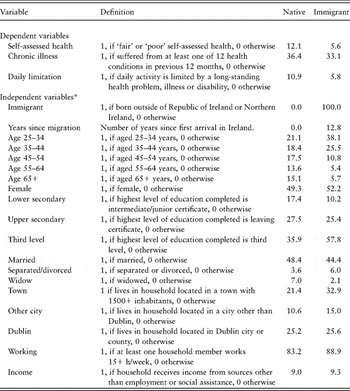
Our dependent variables consist of three measures of health status, all of which are frequently applied in empirical research.Footnote 10 Alternative approaches involve combining several measures to come up with an overall index of health (Layte, Reference Layte2007), but we follow convention and analyse the various measures separately. Table A1 in the Appendix contains further details on variable definitions. The first is an indicator of self-assessed health status, based on an individual's responses to the question ‘In general would you say your health is…’, with five possible responses ranging from excellent to poor. We construct a dichotomous indicator of self-assessed health, with those who rank themselves in fair or poor self-assessed health given the value 1. Self-assessed health has been found to be a good predictor of mortality and use of health care (Idler and Benyamini, Reference Idler and Benyamini1997; van Doorslaer et al., Reference van Doorslaer, Wagstaff, van der Berg, Christiansen, De Graeve, Duchesne, Gerdtham, Gerfin, Geurts, Gross, Hakkinen, John, Klavus, Leu, Nolan, O'Donnell, Propper, Puffer, Schellhorn, Sundberg and Winkelhake2000; Burstrom and Fredlund, Reference Burstrom and Fredlund2001), although there is evidence to show that perceptions of what constitutes good or bad health differ by socio-economic characteristics such as age or socio-economic status (Lindeboom and van Doorslaer, Reference Lindeboom and van Doorslaer2004). Our second measure asks about the incidence of one or more of 12 chronic conditions, such as depression, angina and diabetes (‘Have you had any of the following in the last 12 months?’). Individuals who answer ‘yes’ to one or more of the 12 conditions are considered to be in ill-health. The third measure asks about functional limitations ‘Is your daily activity limited by a long standing health problem, illness or disability?’. Individuals who answer ‘yes’ are considered to have a physical limitation.Footnote 11
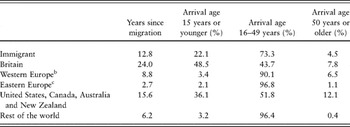
Our main independent variable of interest (immigrant) is defined on the basis of country of birth, with those born outside of the Republic or Northern Ireland taking the value 1.Footnote 12 We also employ a five-category indicator of country of birth. Immigrant terms are set to 0 for natives. The data reveal that 13.1% of the SLÁN samples are classified as immigrants (15.4% when re-weighted).Footnote 13 We also employ a ‘years since migration’ variable in an attempt to identify changes in immigrant health over time.Footnote 14 The average length of time spent in Ireland since migration is approximately 13 years, although this differs considerably across country of origin, with British-born individuals in Ireland for approximately 24 years in comparison with those born in Eastern Europe who average three years (see Table 1). A complication with using country of birth as the basis for defining immigrants concerns the treatment of those who came to live in Ireland as children; just over 20% of immigrants arrived before the age of 16 years, with nearly half of all British-born immigrants arriving as children. We would expect such individuals to have similar health experiences to the native-born, in terms of access to health services and exposure to common cultural and environmental factors, and in our subsequent analysis, we investigate the effect of excluding these individuals.
Average length of time since migration and arrival age by country of originFootnote a

a Observations are weighted to ensure the sample is representative of the adult population.
b Western Europe refers to the pre-2004 EU-13, Norway and Switzerland.
c Eastern Europe refers to the post-2004 new member states of the EU, Croatia, Kosovo, Belarus, Ukraine and Russian Federation.
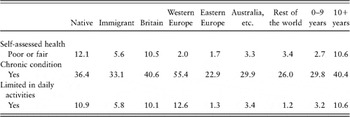
In general, immigrants report lower levels of ill-health than natives (see Table 2). However, reported health status differs considerably between immigrants on the basis of country of birth. Those born outside Britain and Western Europe report very low levels of ill-health on all three dimensions, whereas those born in Britain report similar levels of ill-health as natives. Although Western Europeans report low levels of self-assessed ill-health, they report similar or higher levels of chronic illness and daily limitations. This highlights the difficulty in making comparisons across individuals from diverse backgrounds; cultural, linguistic and institutional differences across countries may also impact on how individuals report their health status. Health status also differs considerably according to years since migration, with those in Ireland over 10 years reporting similar or higher levels of ill-health to natives. In contrast, more recent immigrants report substantially lower levels of ill-health. Years since migration is highly correlated with country of origin however, over 80% of those in Ireland over 10 years were born in Britain, while over one-third of those in Ireland <10 years are from Eastern Europe.
Health status characteristics of immigrant and native populations (%)Footnote a

a Observations are weighted to ensure the sample is representative of the adult population.
Immigrants differ considerably in terms of other characteristics, many of which are highly correlated with health status, such as age, gender and education level (e.g. immigrants are, on average, younger and better educated than natives). Table A1 in the Appendix contains further details on the construction of controls for age, gender, education level, marital status, region of residence, employment status and income. Although individual employment status and income are important predictors of individual health status, they are also potentially endogenous. In the absence of any indicator of permanent income, we use an indicator of whether the household received income from sources other than employment or social assistance. Such sources include private pensions, investments, savings, dividends, property or maintenance payments. In place of individual employment status, we include a binary variable representing households in which at least one member works 15+ h/week.Footnote 15 As illustrated in Table A1, immigrants are, on average, younger, more highly educated and concentrated in working households, all characteristics correlated with better health. In order to ascertain the independent effect of immigrant status on health, a multivariate analysis is therefore necessary (see Sections 4 and 5).
Examining the ‘healthy immigrant’ effect using cross-sectional data has a number of limitations. In particular, it is difficult to distinguish between a cohort and a ‘time since arrival’ effect; for labour market applications, see Borjas (Reference Borjas1985, Reference Borjas1994). With a single cross section it is not possible to disentangle true convergence in health status from unobserved characteristics related to health that differ across immigrants from different arrival periods. In the Irish case, long-term immigrants are most likely to be from culturally similar areas such as Britain and Western Europe, whereas more recent immigrants are from more diverse areas. Controlling for country of origin should pick up some of these differences, although it must be remembered that there may be unobserved differences in characteristics between different cohorts of immigrants that we cannot control for with the data available. A further complication, which is common to all studies, concerns the relevant counterfactual. Although identifying assimilation by comparing immigrants with natives may be the only option, some have questioned whether we should in fact compare immigrants with similar individuals in their origin countries, as it is possible that assimilation effects may simply reflect health status changes in the origin countries (Antecol and Bedard, Reference Antecol and Bedard2005). Finally, we cannot discount the importance of return migration, and the potential sample selection bias that might result. If healthier and more economically successful individuals are more likely to stay, then our estimates of the assimilation effects may be biased downwards. Finally, we do not have a reason for immigration, and such a variable would be potentially informative. Gee et al. (Reference Gee, Kobayashi and Prus2004) and Chiswick et al. (Reference Chiswick, Liang Lee and Miller2006) note that category of immigrant and type of visa can have a significant impact on immigrant health status and transitions over time.
4 Methods
We estimate the effect of immigrant status on individual health by estimating the following reduced form cross-sectional model (see also Borjas, Reference Borjas1994):

where yi is the health status of individual i, xi is a vector of individual socio-economic characteristics, immi is a dummy variable indicating whether the individual is an immigrant and ysmi is a variable indicating the number of years since arrival in Ireland (set to 0 for natives). The coefficient δ indicates the divergence in health status between immigrants and natives at time of arrival, whereas γ gives the rate at which the health status of immigrants deteriorates relative to that of natives. As all three indicators of health status are dichotomous, we estimate the model using Probit regression methods. Empirical results are presented in terms of average marginal effects, which are calculated for each observation and then averaged over the full sample.
We include squared values of ysm to include the possibility of a non-linear relationship between years since migration and the probability of ill-health. However, likelihood ratio tests favour the linear specification in all cases except for self-assessed health. We also investigate the possibility of allowing the effect of the individual socio-economic variables to vary across immigrants and natives; however, log-likelihood tests favour the restricted versions of all models (i.e. with common coefficients for immigrants and natives). We also examine the effect of country of origin, by including separate dummy variables for those born in Britain, Western Europe, Eastern Europe, Australia, New Zealand, Canada and the United States; and the rest of the world. However, while the restricted versions of all models are preferred (i.e. not distinguishing immigrants by country of birth),Footnote 16 we also discuss and present these results (in column (2) in Tables 3–5 below). Finally, we also estimate all models on a restricted sample excluding those who arrived in Ireland as children, to ascertain whether the effect of immigrant status is stronger for those who spent a significant proportion of their life outside Ireland (in columns (3) and (4) in Tables 3–5 below).Footnote 17
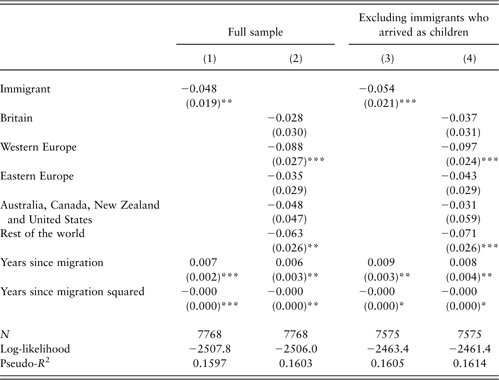
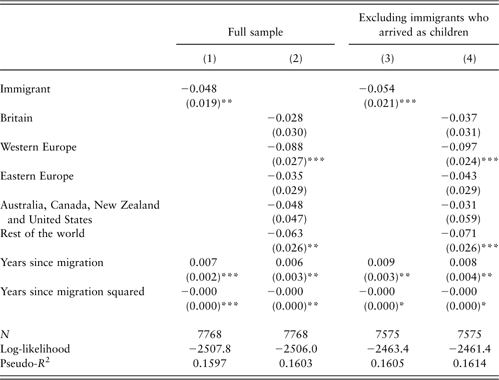
Average marginal effects for binary Probit models (fair or poor self-assessed health)
aStandard errors are presented in parentheses.
bResults for additional controls for age, gender, education level, marital status, household income, working status and location are not presented but are available on request from the author.
cMarginal effects for dummy variables are calculated as the difference in the predicted probability of the event when the variable takes the value 0 and when the variable takes the value 1.
***Significant at 1% level; **significant at 5% level; *significant at 10% level.
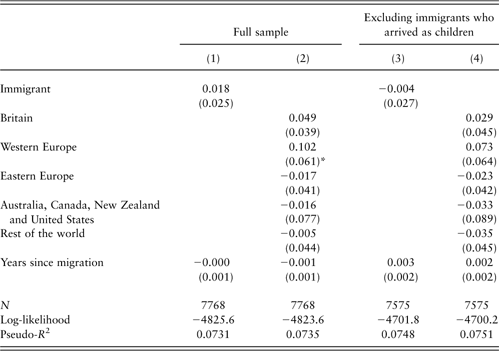
Average marginal effects for binary Probit models (at least one of 12 chronic health conditions)
aStandard errors are presented in parentheses.
bResults for additional controls for age, gender, education level, marital status, household income, working status and location are not presented but are available on request from the author.
cMarginal effects for dummy variables are calculated as the difference in the predicted probability of the event when the variable takes the value 0 and when the variable takes the value 1.
***Significant at 1% level; **significant at 5% level; *significant at 10% level.
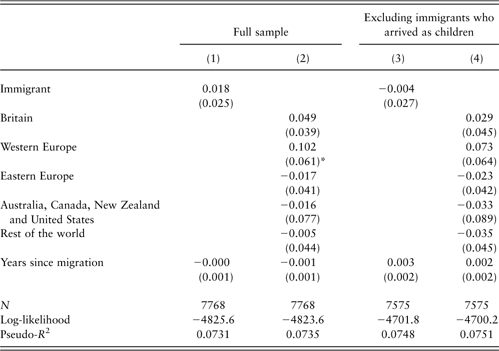
Marginal effects for binary Probit models (limitation in daily activities)
aStandard errors are presented in parentheses.
bResults for additional controls for age, gender, education level, marital status, household income, working status and location are not presented but are available on request from the author.
cMarginal effects for dummy variables are calculated as the difference in the predicted probability of the event when the variable takes the value 0 and when the variable takes the value 1.
***Significant at 1% level; **significant at 5% level; *significant at 10% level.
5 Results
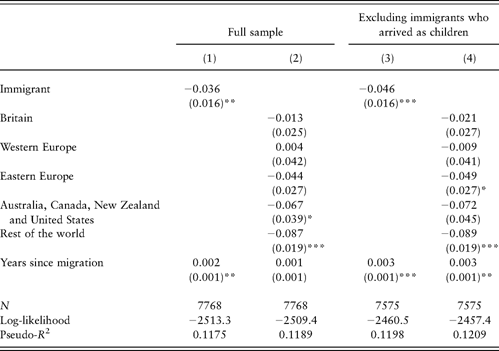
Tables 3–5 present the marginal effects for the probability of reporting ill-health, as described by our three indicators of health status. Beginning with self-assessed health status, the results in column (1) illustrate that immigrants are significantly less likely to report fair or poor self-assessed health (in percentage terms, immigrants are 4.9% less likely than natives to report fair or poor self-assessed health). However, the probability of reporting fair or poor health increases significantly with length of time in Ireland, and at a decreasing rate. These results are consistent with the healthy immigrant hypothesis, although in the absence of longitudinal information, it must be remembered that we cannot ascertain whether the result for years since migration is a true assimilation effect, a cohort effect, or some combination of both. However, the magnitude of the estimated ‘assimilation’ effect is very small, suggesting little change in self-assessed health status as length of time since migration increases. In column (2), we distinguish immigrants on the basis of country of origin, and find that while the signs of all marginal effects on country of origin are consistent with the healthy immigrant hypothesis, only the effects for those born in Western Europe or the rest of the world are significant. Repeating the analysis on a restricted sample excluding those who arrived in Ireland as children (columns (3) and (4)) increases slightly the magnitude of the significant effects, and years since arrival now exhibits a more linear effect.
Turning to the results for the probability of reporting at least one chronic condition in Table 4, all effects are insignificant, indicating that immigrants and natives do not differ significantly in their probability of reporting at least one chronic condition, either at arrival or with increasing time since migration. When we distinguish immigrants on the basis of country of origin (column (2)) and exclude those who arrived in Ireland as children (columns (3) and (4)), all results remain insignificant.Footnote 18.
Table 5 presents the results for the probability of reporting limitations in daily activities as a result of a long-standing health problem, illness or disability. Immigrants are significantly less likely to report a limitation in daily activity, with the probability of doing so increasing with the number of years since arrival in Ireland. Once again however, the magnitude of the ‘years since migration’ effect is particularly small (each additional year spent in Ireland increases the probability of reporting a daily limitation by just 0.2%). In column (2), we divide immigrants on the basis of country of origin, and find that the former effect is driven largely by the significantly lower probability for those born outside of Europe. Restricting the sample to those who arrived in Ireland as children makes little difference to the results, except to increase slightly the magnitude and significance of the significant effects.
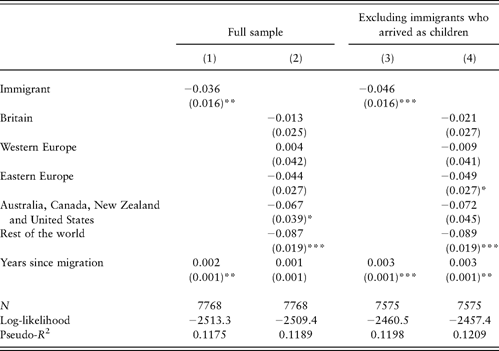
Overall, the results provide only very limited evidence in favour of a ‘healthy immigrant’ effect for Ireland. Although the results for self-assessed health status and limitations in daily activity are consistent with the ‘healthy immigrant’ effect hypothesis, the effects are small in absolute and relative terms; the effects of explanatory variables, such as age, gender, education and household income are larger and far more significant in determining individual health status. Excluding those who arrived as children generally results in more significant and accurate effects, which is not surprising given that this excludes individuals who would have experienced similar health influences (environment, institutional settings, diet, lifestyle, etc.) to natives. However, for chronic health status, no significant effects for the immigrant variables were found. Of course, while 13.1% of the sample are classified as immigrants, the fact that over 80% are from culturally similar countries in Europe, Australia, New Zealand, Canada and the United States, and that nearly 60% are in Ireland of <10 years, may mean that there simply is not enough variation in the immigrant sample in Ireland to identify the types of effects found in countries with long and diverse histories of immigration, such as the United States, Canada and Australia.
6 Summary and conclusions
The purpose of this paper was to investigate the case for a ‘healthy immigrant effect’ for Ireland. Over the past 15 years, the economic and social landscape of Ireland has changed considerably, with one of the most significant changes being the movement away from annual net emigration to substantial annual net immigration flows. Although research on the economic contribution of immigration to Ireland, as well as the labour market characteristics and impacts of immigrants to Ireland has increased greatly in recent years, little is known about the health status of immigrants to Ireland. The international literature has documented a ‘healthy immigrant’ effect for large immigrant-receiving countries, such as the United States, Canada and Australia, with immigrants’ health status significantly better than natives upon arrival, but deteriorating steadily with length of time since arrival.
Using data from a nationally representative survey of the adult population in 2007, this paper investigated the effect of country of birth, as well as length of time since migration, on the probability of reporting poor health using three broad indicators of health status. Some evidence in favour of the ‘healthy immigrant’ effect is found for two measures of health status (self-assessed health status and limitations in daily activities) with no evidence found for the remaining measure (chronic conditions). While ‘years since migration’ exhibits a significant effect on the probability of reporting poor self-assessed health, thus providing some evidence for the ‘unhealthy assimilation’ of Irish immigrants over time, the estimated effects are small in both absolute and relative terms, with factors, such as age, education and household income far more important in determining differences in health status across the population.
In summary, the results provide only limited evidence in favour of the ‘healthy immigrant’ hypothesis for Ireland. Although the results are largely in contrast to those found in studies of countries with long and diverse histories of immigration (such as Canada, Australia or the United States), our results are more consistent with the more recent analyses of the ‘healthy immigrant’ effect undertaken using European data (e.g. the studies by Carrasco-Garrido et al., Reference Carrasco-Garrido, De Miguel, Hernandez-Barrera and Jimenez-Garcia2007; Hernández-Quevedo and Jiménez-Rubio, Reference Hernández-Quevedo and Jiménez-Rubio2009). The Irish immigration experience is considerably different to that of those countries that are traditionally the focus of research on the ‘healthy immigrant’ effect; Irish immigration is a relatively recent phenomenon, and immigrants to Ireland are generally from the United Kingdom, or culturally similar countries in Europe. This means that there simply may not be enough variation in the Irish immigrant population to identify the types of effects that are identified in countries with a long tradition of immigration from a diverse range of source countries. Although this analysis would suggest that there is only limited evidence in favour of the ‘healthy immigrant’ effect for Ireland, the research has examined this in the context of the standard subjective and objective indicators of health status only; further study is needed to examine the ‘healthy immigrant’ effect using information on health behaviours.
In addition, using cross-section data limits the extent to which we can test the hypothesis of ‘unhealthy assimilation’. The positive effect of the ‘years since migration’ variable may be capturing both the ‘higher quality’ of earlier immigrant cohorts, as well as possible deterioration in health status as length of time since migration increases. The observed effect could also be simply due to increased detection of existing health conditions, rather than any deterioration in ‘true’ health status over time. Inferring implications for policy from these results is difficult, not least because of the methodological problem associated with the identification of the ‘healthy immigrant’ effect using cross-section data. Further research using longitudinal or repeated cross-section data is needed.
Acknowledgements
The author thanks participants at the Irish Economics Association Annual Conference and an ESRI seminar for helpful comments on an earlier draft. The author thanks the SLÁN consortium (Royal College of Surgeons in Ireland, National University of Ireland Galway, Economic and Social Research Institute, University College Cork and Department of Health and Children) for access to the 2007 SLÁN microdata and Emma Quinn (ESRI), Hannah McGee (RCSI), Emer Shelley (HSE) and participants at an ESRI seminar and the Irish Economics Association annual conference 2009 for comments.
Appendix
Variable definitions and summary statistics (%, unless otherwise stated)

*The reference categories are Irish-born, age 18–24 years, male, primary level education, never married, living in open country or a village with 1499 inhabitants or fewer, non-working household and household income from employment or social assistance only.