During the past three decades of rapid economic growth, China has suffered from devastating environmental degradation. Throughout this period, most scholarly and popular publications have painted a rather pessimistic picture of the trends and the likelihood of their reversal in the near future. However, more optimistic views on the prospect for reversal have emerged in the past few years owing to the Chinese government's increased commitment to fighting pollution and promoting renewable energy, the public's increased concerns regarding the adverse consequences of pollution, and domestic and international civil society's increased involvement in promoting environmental protection in China.Footnote 1
Among various perspectives for assessing these changing environmental governance landscapes in China, ecological modernization theory (EMT) has gained some currency both internationally and domestically.Footnote 2 European scholars, for example, have organized scholarly forums to examine the theory's applicability to China.Footnote 3 Within China itself, researchers at the prestigious Chinese Academy of Sciences have also utilized EMT to assess environmental reform in China.Footnote 4
In this paper, we compare key EMT arguments with the reality of recent environmental reform in China. In particular, we examine the changing roles of government, market, and civil society actors in the reform process, focusing on the various types of pressure they exert on business enterprises. Our assessment is based on data collected through a questionnaire survey and a series of semi-structured interviews, conducted in 2007 and 2010 respectively, with executives from Hong Kong-owned firms with manufacturing plants in the Pearl River Delta in Guangdong province. The data cover their perceptions of environmental demands made by various stakeholders, their strategic responses to these demands, and the environmental management practices they have adopted.
We found that while continuing to focus on the bottom line, some firms have begun gradually to integrate environmental considerations into their business decisions and management processes. Yet, similar to what Mol conjectured, the specific dynamics and relevant actors in China differ somehow from what EMT suggests to be the case in Western Europe. Specifically, local governments are assuming a more formalized relationship with firms in regulatory enforcement. Among market actors, organizational buyers along the supply chain have exerted more noticeable pressures on manufacturing firms than industrial associations and individual consumers. Civil society, while remaining less of an institutionalized actor in the environmental policy process, appears to pose a perceptible threat to at least some firms.
The paper continues with a review of the EMT and related literature on environmental governance in China. This is followed by a report on our findings from the survey and interviews linking corporate executives’ perceptions of stakeholder environmental demands and the adoption of corporate environmental management practices. Next, we compare our findings with the theoretical model of EMT.
EMT, Stakeholder Pressures, and Corporate Responses
Originally developed to assess the prospect for enhanced environmental governance in continental Europe, EMT stresses the self-healing ability of the capitalist economy and civil society in liberal, democratic settings.Footnote 5 It argues for a practical approach to integrating ecological concerns into existing social, economic, and political institutions, while retaining the general framework of modernity.Footnote 6 Presumably, this approach will lead to the “emancipation” of an “ecological rationality” from the dominating economic rationality in capitalism.Footnote 7 Against other more critical theories, such as neo-Marxism and deep ecology, which doubt the possibility of an environmentally sound capitalism, EMT maintains a moderate reformist approach, suggesting a scenario of “reflexive modernization” in which various social actors adjust their roles within the mode and relations of capitalist production.Footnote 8 This scenario is not characterized as a “top–down, centralized, hierarchical, command-and-control” process, but one moving towards “decentralized, flexible, and consensual styles.”Footnote 9 This trajectory of development corresponds to the governmental reform reality of continental Europe in the last few decades.
This reform-from-within model also calls for more environmentally conscious markets through the adoption of new industrial standards. It suggests that such market actors as “producers, customers, consumers, credit institutions, insurance companies, the utility sector, and business associations” are becoming “social carriers of ecological restructuring, innovation and reform,” utilizing “market, monetary and economic logics in pushing for environmental goals.”Footnote 10 Technological advancement will presumably be able gradually to convert a remedial approach to environmental challenges (e.g. “end-of-pipe” pollution mitigation) to a more proactive one (e.g. use of preventive, cleaner production techniques), ultimately transforming businesses’ means of production on the supply side.Footnote 11 On the demand side, meanwhile, EMT envisions greener living styles and consumption patterns from consumers.Footnote 12
Drawing on experiences in Western Europe, EMT scholars identify a growing array of non-state actors, and the institutionalization of their participation in environmental decision making.Footnote 13 From being purely confrontational, new civil society actors have evolved to monitoring and even collaborating with state and market actors.Footnote 14 These deepening interactions have led to the spillover of environment concerns across industries,Footnote 15 the creation of a vibrant civil society engaging in green advocacy,Footnote 16 and hence the “societalisation” of environmental politicsFootnote 17 in which environmentally-related norms and discourse spread beyond the “professionals and core supporters of environmental NGOs.”Footnote 18
Given its broad coverage, EMT has been criticized from multiple angles, leading some proponents to acknowledge the “Euro-centric” origin of their claims, and to search for variations across cultural and national settings.Footnote 19 Based on an extensive literature review, for example, Mol found that China's reform path differs in style from Europe's.Footnote 20 While highlighting the overall patterns of the process, Mol's analysis does not explore in detail the important theoretical–empirical linkage of how and to what extent firms, supposedly core “social carriers” of ecological modernization, are able and willing to integrate ecological concerns into their economic operations and embedded institutional contexts.Footnote 21
To build on Mol's analysis, we seek to assess the progression of ecological modernization in China by examining how business firm executives perceive green pressures from a variety of stakeholders including government, market, and civil society actors. Firms may adopt different strategies – ranging from acquiescence and compromise to avoidance, defiance, and manipulation – in response to institutional demands generated by external stakeholders.Footnote 22 Based on various internal and external factors, firms may respond to environmental demands from some stakeholders by improving their environmental management capacities, but they may also respond to others by evasive or resistant strategies. Thus, we ask specifically: 1) to what extent have Chinese firms adopted strategically effective environmental programmes in their production and business models in response to different arrays of stakeholder pressures; and 2) how have Chinese firms with an outstanding environmental performance managed to integrate ecological values into their economic operations. Answers to these firm-level questions provide a useful angle for assessing the possible progression of ecological modernization in China. Before presenting our findings on corporate responses, we review briefly the recent empirical literature on China's environmental reform process and how it informs our expectations on firm-level practices.
China's Environmental Reform
China has been relatively successful in developing a market economy with Chinese characteristics which has been further consolidated by recent constitutional change.Footnote 23 Along with the development of a comprehensive set of environmental laws and regulations,Footnote 24 China established its first Environmental Protection Office in 1974, which later evolved into the State Commission for Environmental Protection in 1984, to coordinate environmental affairs among ministries. The Commission was later upgraded to the State Environmental Protection Administration (SEPA) in 1988, and finally instituted in 2008 to become a fully fledged ministry, the Ministry of Environmental Protection.
Government actors
The current literature protrays a mixed picture of the patterns of interactions between government actors and business enterprises. On the one hand, some studies document a lack of strong incentives for local governments to monitor industrial pollution and enforce environmental regulations, given their vested interests in the local economy,Footnote 25 severe coordination problems among agencies,Footnote 26 and the pervasive effects of guanxi (关系, personal informal relationships) on government–business relations.Footnote 27 Especially in less economically developed areas, officials have often “disregarded” environmental standards while trying to attract external capital.Footnote 28 The persistent gap in the implementation of national laws and policies at the local levelFootnote 29 has led some scholars to recommend more flexible approaches such as national campaigns as possible means for promoting corporate environmental management.Footnote 30
On the other hand, more current literature has begun to identify areas of progress. As noted by Stalley, despite China's ongoing effort to attract foreign direct investment, it has not resulted in “a widespread race to the bottom nor a systemic regulatory chill.”Footnote 31 Instead, the Chinese government has legislated a comprehensive set of environmental laws and regulations,Footnote 32 and created more institutional incentives for local governments to promote environmental protection, for example the “environmental quality administrative leadership responsible system,”Footnote 33 the “two separate lines for revenues and expenses” budgeting system which discouraged local environmental protection bureaus (EPBs) from focusing on revenue generation at the expense of genuine efforts in pollution reduction,Footnote 34 and more recently, Green GDP, an appraisal/accounting system measuring the performance of local governments against various environmental indicators.Footnote 35 While still strongly motivated to support economic growth, local government officials (mayors and vice-mayors) now have increased incentives to pursue economic growth in a more ecologically sustainable way, pushing firms, especially those in more developed areas, to assume more responsibility for pollution prevention and mitigation. In some more economically developed provinces, such as Guangdong, local EPBs are reported to be adhering more rigidly to formal legal requirements.Footnote 36 However, independent confirmation is yet to be found in the current literature, particularly from the perspective of the regulated enterprises, on this change in enforcement styles.
Thus, viewed from the current literature, enterprises, and especially those in more economically developed areas, are likely to experience substantial pressures from local government entities to improve their environmental management practices. Yet precisely how these pressures are transmitted between the government entities and the enterprises remains to be explored.
Market actors
Earlier research has showed that enterprises in China had begun to go beyond remedial pollution treatments,Footnote 37 and that some may feel pressured to follow suit as their competitors go green.Footnote 38 Some studies have noted the potential impact of international buyersFootnote 39 and the emerging “consumer class”Footnote 40 on corporate environmental and supply chain management.Footnote 41 Others have also indicated that multinational corporations in China are more likely to adopt higher environmental standards and to push firms in their supply chain to do the same, although the extent of such influence on their local partnering firms is unknown.Footnote 42
Yet, many enterprises lack knowledge on how “cleaner production can be used as a factorywide management strategy for cutting costs and increasing profits.”Footnote 43 As many widely publicized enterprise-level environmental programmes, such as Upgrading Industrial Structures (chanye jiegou shengji 产业结构升级), Saving-Energy-Lowering-Emission (jieneng jianpai 节能减排), and Clean Production (qingjie shengchan 清洁生产), were initiated by the central government,Footnote 44 it is unclear how many enterprises actually know how to implement them. While featured prominently in the Western literature, the role of other market actors, such as industrial associations, competitors, shareholders, and employees, in shaping corporate environmental management has seldom been a focus of scholarly studies on China.
Thus, viewed from the current literature, some market actors, such as international buyers, are likely to have an influence on corporate environmental practices in China, but the relative influences of different actors and their specific patterns of interactions remain to be explored.
Civil society actors
In China, the number of environmental NGOs has grown dramatically in recent years,Footnote 45 but the vast majority of them have remained non-adversarial and non-confrontational, staying as “expert or awareness-raising organizations.”Footnote 46 While the Chinese media has been paying more attention to pollution problems in recent years,Footnote 47 it is often seen as cautiously self-censoring.Footnote 48 Local residents have increasingly utilized legal channels for complaints against polluting sources,Footnote 49 and protested collectively against environmental degradations.Footnote 50 Recent analyses, however, cast doubt on the complaint system,Footnote 51 and suggest that in China's “semiauthoritarian context a form of ‘embedded social activism’ which emphasizes the use of diffuse and informal networks to gain legitimacy and promote ‘graduate change’ is more likely to grow the Chinese civil society.”Footnote 52
Thus, seen from the current literature, enterprises are likely to face increasing pressures from civil society actors to improve their environmental management practices, but whether and how these pressures are translated into actual corporate practices remain issues to be explored.
Research Methods
Our analysis draws on data derived from a large-scale questionnaire survey and a series of semi-structured interviews, conducted in 2007 and 2010 respectively, with small and medium-sized manufacturing firms operating in the Pearl River Delta (PRD), Guangdong province. Dubbed the “World's Factory” for over two decades, the PRD is home to tens of thousands of manufacturing plants which differ widely in their environmental performance. The region also leads the nation in regard to environmental reform, in the same way that the state of California in the United States was the frontier of national environmental reform in the 1970s and 80s.Footnote 53 The region thus serves as a useful “extreme case”Footnote 54 for identifying the frontier of environmental modernization in China. Given the vastness and geographical diversity of China, experiences in Guangdong are not necessarily representative of the whole country, yet they provide useful clues for assessing China's developmental trajectory.
Hong Kong-based enterprises were chosen for the study in particular because of their intimate knowledge of Chinese culture and their presence since the establishment of Special Economic Zones (SEZs) in the late 1980s. Compared with multinational corporations, companies owned by Hong Kong investors are more rooted in the local community as their owners and executives are Chinese and most have spent a substantial amount of time residing in the mainland. Compared with their mainland counterparts, enterprise owners and executives from Hong Kong are likely to be more exposed to Western ideas; their opinions and practices are arguably at the forefront of ecological modernization in China as the Chinese economy becomes increasingly integrated with the rest of the world.
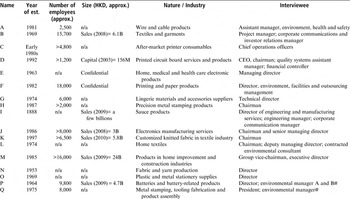
A large-scale survey was conducted in 2007 in cooperation with the Federation of Hong Kong Industry (FHKI). The survey questionnaire was sent by mail to the most senior corporate executive of each company listed in the FHKI's 2007 Members’ Directory. Among the selected 1,800 Hong Kong-owned firms with manufacturing operations in the region, 377 firms responded, representing a response rate of 21 per cent. Meanwhile, a semi-structured interview method was employed to investigate the strategies adopted by firms in reaction to various environmental demands. From the same population above, a total of 17 firms with outstanding environmental performance, as indicated by the environmental awards they received, were chosen for interview because this group of exemplary firms are arguably the pioneers of ecological modernization in China (see Table 1 for a list of the key characteristics of the interviewed firms). For the majority of the interviews, more than one senior executive or manager was present. Senior executives were interviewed because they are likely to be involved in their company's overall strategic decision making. All the interviewees were knowledgeable or directly in charge of the company's environmental management. When the most senior executive was not sure about how to answer specific technical questions, other company officials present in the interviews were able to answer them directly. The firms that participated in the survey and interviews were diverse in terms of size and the industries they represent (see Tables 1 and 2a).
Characteristics of the Interviewed Firms*

Notes:
* The dates of interviews available upon request. # Exact title missing.
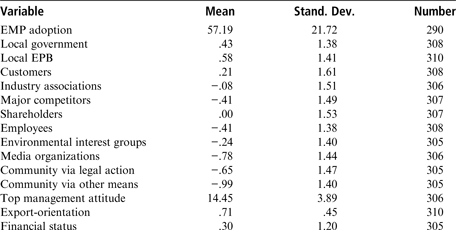
Descriptive Statistics
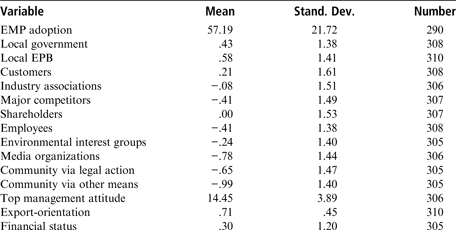
Notes:
Firm size (employees): <100 = 13.5%; 100–999 = 46.5%; 1000–4999 = 30.1%; >5000 = 9.9% . Industry: Plastics: 17.3%; Electronics: 18.9%; Textiles & Dyeing: 12.5%; Chemical, Paper, Electroplating, Cement: 7.1%; Others: 44.2%
How Do Firms Rate the Extent of Environmental Demands from Different Stakeholders?
In the survey conducted in 2007, firms were given a list of 11 stakeholder groups in three major categories: government, market, and civil society. Firms were asked to assess the extent to which they agreed or disagreed that these stakeholder groups had “made demands” on them to “develop better environmental protection measures.” Perceived demands were measured on a seven-point Likert scale ranging from “strongly disagree” to “strongly agree.” The answers were originally labelled from 1 to 7 and are now transformed correspondingly into −3 to +3 for intuitive presentation.
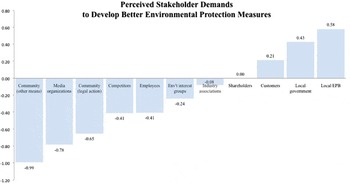
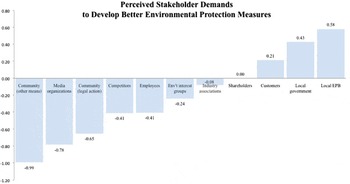
As shown in Table 2b, from the perspective of the surveyed firms, the two stakeholder groups from the government category (the “local EPB” in particular and “the local government” in general) were perceived to have exerted the greatest environmental demand on the firms. This is followed by the three key groups from the market category (“customers,” “shareholders,” and “industry associations”). Three key groups from the civil society category (“community via legal actions,” “media organizations,” and “community via other means”) rank the lowest. More tellingly, the average scores for all the civil society groups are below “0,” indicating that the surveyed firms generally disagreed with the statement that these groups had made demands on them to develop better environmental protection measures.
Graphical Representation of Perceived Stakeholder Demands (Mean)
Do Perceived Pressures from Different Stakeholders Lead to Better Environmental Management Programmes?
Perceived pressures may not automatically translate into actual environmental management practices. To understand the relationships between perceived stakeholder pressures and a firm's incorporation of environmental management programmes, we asked the surveyed firms to assess from a list of 16 environmental management practices (EMP) (see Appendix) to what extent these practices have been integrated within their business model. A seven-point scale was used (1 = Never considered; 2 = Considered, but no action taken; 3 = Experimented with, but did not adopt; 4 = Have adopted, but does not seem to be a priority; 5 = Adopted and emphasized; 6 = Fully integrated into all functions of the company; 7 = A way of life). By adding the reported scores of these practices together, we developed a composite index EMP adoption (Alpha = .949) that measures the extent to which a firm has integrated environmental protection into their operation.
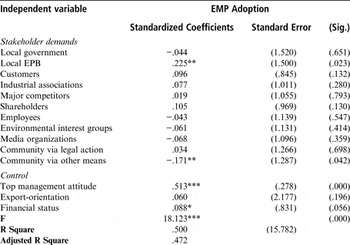
In the regression model, various stakeholders’ environmental demands (as discussed above) were regressed against the dependent variable EMP adoption using the Ordinary Least Square (OLS) method. In addition, three control variables were introduced: top management attitude, export-orientation and financial status (see Appendix). Given the decision-making authority of a firm's top management members, their attitude towards environmental protection is likely to influence the firm's decision to go green. Also, since international environmental standards, such as those from Western Europe and North America, tend to be higher than the corresponding standards in China, we suspect that an export-oriented firm is more likely to follow international standards and adopt various EMP. Finally, as returns on environmental investments usually take a long time to materialize, firms with a healthier financial status are likely to be more willing to invest in EMP. Thus, we account also for financial status in our model.
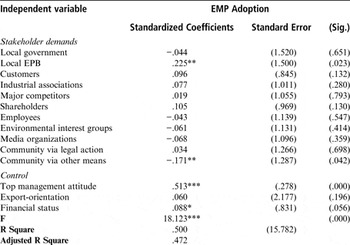
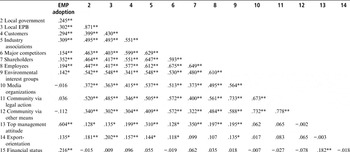
The returned regression model (see Table 3) showed reasonable explanatory power (F = 18.123 and adjusted R-square = .472). The problem of multicollinearity was suspected a priori. We checked the high variation inflation factors (VIF) for each independent variable, and all of them were less than five, indicating that the model is acceptable.Footnote 55
OLS Regression Analysis on EMP Adoption
Notes:
* p ≤ .10; ** p ≤ .05; *** p ≤ .01
Significant associations were found between EMP adoption and local Environmental Protection Bureau, community via other means, as well as the control variables top management attitude and financial status. The positive coefficient of local Environmental Protection Bureau indicates its effective demands on a firm's decision to adopt EMPs, a finding that echoes what was reported by our interviewees. The negative coefficient of community via other means indicates a negative relationship between demands from such sources and EMP adoption. Seemingly, firms adopting fewer environmental management practices tend to worry more about pressures from the community. This particular finding is compatible with what we learned from the interviews, namely that the community was more reactive than proactive in advocating for environmental protection. Notably, customer and shareholders were found marginally insignificant (p < .15 for both variables), indicating limited, but perhaps growing, influences from both of these market actors.
How Do Firms with Outstanding Environmental Performance Respond to Pressures from Different Stakeholder Groups?
We interviewed executives from a group of environmentally progressive firms, from whom we were able to identify a range of strategies adopted in response to different types of stakeholder pressures.
Government actors
Local government and local environmental protection bureaus
Government actors may apply pressure on firms in different ways, which in turn may trigger different types of responses. One type of pressure relates to the actions of government officials that have less to do with promoting environmental protection and more to do with promoting the officials’ own interests and agenda. As mentioned by one interviewee, this type of action has become less frequent in Guangdong province, but is still common in other regions. His company's factory in a large north-eastern city was often visited by local government officials who would raise various operational issues, such as suggesting the adoption of a certain ventilation system, but without explaining how these issues related to specific laws or regulations. Then they would ask his company to hire their affiliated consulting firms to address the issues, presumably as a way for them to make money on the side. When asked about how his company handled such situations, he said that they would just use various delaying tactics to fend off such unreasonable demands, and they would say that they already had many programmes such as ISO9001 and ISO14001 in place and would develop new programmes, such as OSHA18001, in the near future. According to this interviewee (A), his company was not the only one to have received such visits; many other companies in that jurisdiction have faced similar situations.Footnote 56
The other type of pressure relates to regularized (legitimate) enforcement by EPB officials. Several of our interviewees reported an increasingly impersonal and formalistic approach to enforcement by local EPBs in Guangdong. In the past it was possible to avoid compliance by paying relatively small bribes to officials (e.g. “serving a meal” or “giving a gift”) (K). More recently, enforcement in Guangdong (but not necessarily in other provinces) has become more rigid and standardized. Two interviewees mentioned that compared with those in other provinces in which they had manufacturing plants, the local EPBs in Guangdong had been stricter and more businesslike. EPB officials usually would not visit his factory unless specific regulatory issues arose, but that was not necessarily the case in other jurisdictions (A). Another interviewee (B) mentioned that environmental requirements in Guangdong are stricter and more stringent than those in eastern China, where his company has manufacturing plants. His factories in that part of the country have lower environmental management standards, but he planned to transfer the technology developed in the Guangdong plants to the plants there in the future.
More stringent enforcement has created, in some cases, substantial economic burdens on firms in terms of the sizable investments needed to meet the requirements. Some firms were reportedly required, but not assisted, by government officials to “increase productivity without increasing pollution;” firms that failed to meet the requirements would be punished by being refused further pollution emission permits. According to one interviewee (K), this “has eliminated a lot of small and medium-sized factories.”
Among firms that are more established and have a reputation for being more environmentally proactive, some have been selected by their local EPBs as “models” for showcasing to other firms and external constituencies (B, C, D, E, F, K). As local governments have been subject to increasing pressure from their political/administrative superiors to show off their work in environmental protection, local EPBs have put more pressure on some companies to partner them in being such models, while other firms are often invited to visit and learn from these “exemplary” firms (D, H).
Interviewees from two firms, one in electronics and one from the garment industry, mentioned that they had worked closely with local EPB officials in developing industry standards. One project (C) involved the development of a Chinese version of the Restriction of Hazardous Substances Directive (RoHS) which was originally developed in Europe; the other involved the dispatch of employees to the development of water and energy consumption standards for a specific type of weaving (K).
Some firms also reported being “invited” by the EPB to participate in the Clean Production Programme (K), in which the EPB works closely with participating firms to develop environmental management programmes together. As one interviewee reported, at times when the local government “launched some new regulations or really wanted to enforce some existing ones,” his company was identified as the “dragonhead” (longtou 龙头) enterprise and asked to be a model factory; in these situations, the EPB officials “participated,” “gave advice,” and “supported” the company (B).
Not all firms would enthusiastically welcome such opportunities as they create extra burdens, but some interviewees mentioned that such programmes can help them to cultivate good guanxi with the local government. One interviewee, for example, mentioned that they had less difficulty than other companies in obtaining a continuous supply of electricity after they had cultivated good guanxi with the government (A). In another case, the relationship had actually become formalized, with the company using money from the Capital Rebate (zijin fanhuan 资金返还) programme to set up a fund to help the district government to process domestic waste water. An interviewee (K) explained:
We may have polluted the neighbourhood but we also help them to improve it. This is a virtuous circle. And the government welcomes this very much. We hope that in return we will easily gain approval for more quotas and have the leaders’ support … It's a strategic plan so that we can increase our emission quotas and production amounts in the future.
Market actors
Customers
Customer demands do have a major influence on a firm's decision to go green, but there is a subtle but important distinction between demands from organizational buyers and from individual consumers.
Compared with individual consumers, organizational buyers have a much stronger influence on firms. Several interviewees mentioned being pressured by organizational buyers to “imitate” overseas firms which have adopted more advanced environmental management standards. One company, for example, mentioned that it was the Waste Electrical and Electronic Equipment Directive (WEEE) and RoHS requirement of the European Union – together with the potential penalty for not meeting the requirements and demands from its organizational clients – that initially drove it to go green in the early 2000s. Yet, as the company began to adopt more advanced green production technologies, it gradually discovered various economic benefits associated with lower emission and energy use, leading the company to become an environmentally outstanding company (J).
Another interviewee mentioned that some of their EU clients had their own brand names and were committed to “social responsibility.” As a result, his company has for years strived to achieve international standards, including ISO9000 and ISO14000. Hence, because of its environmental reputation, even though his company is not big, it compares favourably with large-scale contract manufacturers. Although price and quality remain important, the company's environmental reputation helps it to attract businesses from other brand name companies and to lower the barriers for entering new markets (C).
An interviewee (Q) reported that his company's Japanese buyers have been demanding higher environmental standards through annual audits. Since it has invested in green production, including supply chain management and other energy-saving measures, the company is prepared to meet these higher standards. Three other interviewees (F, G, N) also mentioned that going green could show their buyers that their products and production were “reliable,” and thereby create better client relationships and new business opportunities.
Some other firms reported that their decisions to go green were not because of specific pressures from organizational buyers, but as a result of anticipating increasing demand from overseas buyers. Thus, they developed environmental strategies at a very early stage when compared to their peers (C, H). One interviewee (H) reported that his company decided to go green in as early as 1998, and commented that other companies in Hong Kong and the mainland were “slow” in this regard. Another company (A) was eager to go green at a quicker pace than others in order to “capture the first wave of business,” even when the corresponding legal requirement was not yet in place. It is the business acumen of the management rather than demands from specific stakeholders that drives a company's initial environmental strategy.
Meanwhile, environmental demand from overseas organizational buyers has also triggered firms to manage their local supply chains to ensure compliance with international standards (C, E, G, Q). One company (E), for example, mentioned the huge challenge for disciplining its local suppliers to provide materials that meet the European standard of RoHS and Hazardous Substances Process Management (HSPM). The company spent a “non-trivial” amount of resources requesting its suppliers to attend their seminars, teaching them the standards, testing thousands of materials, monitoring more than 200 suppliers, and finally obtaining the necessary certification. Another company (C) also reported that some of its suppliers felt compelled to meet international standards. In response, the company set up “regular vendor qualification requirement meetings” with them, and threatened them with potential legal action if they failed to fulfil the agreed environmental standards.
When asked if they have perceived increasing demand from individual consumers in China for eco-friendly products, most interviewees indicated that the trend has barely begun. One (I), for example, commented that his company competes with others in terms of many product features – costs, beauty, appearance, etc. – and environmental protection, in his words, is still “virgin territory.” He did, however, anticipate that as society gets richer, people will consider others’ interests more, and environmental protection will become more important. Another example concerns a bedding company which had just designed its first eco-product line. However, owing to uncertainty about the potential consumer response, the company had decided to launch the product without using its own brand name (L).
No matter whether it comes from organizational buyers or individual consumers, customer demand acts as a major structural boundary that determines the extent of corporate commitment to environmental protection. As explained by an interviewee from a firm with a strong reputation for environmental management, even though his firm treats green technologies as a key element that can help to differentiate its products, when they have to choose between the environment and market share, the choice depends, in his words, on “how much room the market allows us to engage in environmental protection. After all, we are still a business operation. When there is room, we try our best to do it” (C). In short, although customer demand can motivate firms to go green, it also sets the ultimate limit on how far firms are willing to go.
Industrial associations
From the perspective of our interviewees, industrial associations are not a source of pressure for environmental protection per se, but they may serve as an information source through various award and information-sharing programmes for outstanding environmental performance (P). High performing firms may use industrial associations as a forum to show other firms their practices and experiences in dealing with international environmental standards, and to send a strong message on the importance of these standards (J). Hence, industrial associations seem to serve as knowledge-sharing platforms among some firms.
Major competitors
The perceived influence of competitors was noted by some of our interviewees. One (J), for example, noted in a circumscribed tone that his company believed its newly developed green technologies gave it an edge against its competitors. An interviewee in another company (K) stated explicitly that its self-developed technologies were a “business secret” which he would not share with others. Another interviewee (I) mentioned that they had discovered that many “by-products” in the production process could be reused, and that this had saved them lots of money. He also anticipated that his company's green technologies would put it steps ahead of its competitors as environmental protection becomes a bigger and bigger societal concern.
Employees
Environmental concerns related to employees were often linked to issues of turnover, and in some cases, broadened to include health, work conditions, and employees’ general well-being. One interviewee (D) opined that employees nowadays “care about happiness first and wages second.” Thus, the company had built “a better culture,” and provided the staff with a “more colourful life” and “better work and living environments,” which gave the company an edge in attracting new staff, even when turnover rates in general were quite high. Another company (A) mentioned that as training costs money, his company was more willing to invest in developing better work conditions in its chemical laboratory as a way to retain employees, thus indirectly improving the environmental impact of production.
Shareholders
Our interviewees did not mention specifically how shareholders have influenced their environmental management decisions, yet they mentioned the role of boards of directors (D, E, M, N). Two (D, N) mentioned that board members in their companies were not committed to environmental protection, making it difficult for them to make it a top priority. Another (M) reported that other directors on the board had rejected his proposal to increase investment in green technology, questioning whether his proposal reflected his personal interest rather than that of the company.
Finally, all interviewees from these “exemplar” firms mentioned that through adopting environmental management practices, their companies were able to save on production costs to some extent by lowering the use of resources and energy, including water, electricity, coal, chemicals, raw metals, and fabric, as well as manpower. To their surprise, some discovered this benefit during the process of going green (D, I, L); some saw it more as a justification or simply a fringe benefit of their commitment to environmental protection (A, C, E, F, G, L, N, P); some have even incorporated energy saving as the company's core business strategy (J, K, O). Many interviewees mentioned the importance of innovation in developing various cost-saving measures (A, C, D, E, F, G, H, I, J, K, N, P), and some were proud to share with the interviewers these measures (C, E, H, I, J, K, N, P). Yet, even among these “exemplar” firms, some complained about the relatively long time it takes for the economic benefits to materialize, and saw that as an obstacle for further investment in green technologies (G, K).
Civil society actors
Environmental interest groups
When asked about reasons for going green, none of the interviewees mentioned environmental interest groups. Two (C, F) did briefly mention their participation in educational/awareness-promotion activities organized by environmental NGOs as a way to show their commitment to environmental protection. Apparently, since the interviewees were from firms with outstanding environmental performance, they did not perceive as much demand from environmental interest groups as from government and market actors.
Media organizations
The growing importance of media organizations as environmental watchdogs was noted by some of our interviewees. One (K) commented that media organizations are quite eager to report on pollution incidents, often referred to them by residents in the local community. Reporters are increasingly motivated to report pollution incidents as their stories are likely to be picked up by other press and media outlets.
Firms differ in their concern over potential media exposure: specifically, firms that do not have their own brands appear to worry much less about environmental pressure from the media as interviewees from these companies never mentioned media pressure as a concern. However, firms that sell their own brand products directly to consumers, i.e. original design manufacturing (ODM) firms, tend to be more concerned about negative exposure. An interviewee (I) from one such company, for example, mentioned the recent drug-poisoning incident involving Po Cha Pills (保济丸),Footnote 57 an old Chinese medicine for easing abdominal pains, indicating that his company is very careful about anything that may tarnish the reputation of its products.
The community through legalized and other means
During our site visits, we found that not all manufacturing firms are equally susceptible to community pressure because many have been relocated to industrial areas equipped with centralized treatment plants and far away from residential areas. Those that stay close to residential areas (e.g. O) are more likely to be subject to tight government monitoring.
When asked about pressure from the community, some of our interviewees mentioned the increased number of formal complaints (through government hotlines) by local residents against individual firms. Although formal citizen complaints have increased dramatically in recent years, interviewees tended to dismiss them as efforts by residents to gain monetary compensation. In the words of one interviewee (K):
Citizens will complain, and the rewards can be quite high. The monitoring from the community … is good. After reporting an accident, they will further report it to the press, and every paper will cover it.
While acknowledging the monitoring role of citizens, many firms tend to view citizen complaints as opportunistic in nature rather than as a legitimate expression of societal concerns.
Overall, when our corporate interviewees mentioned “community” or “society” (shehui 社会), they tended to consider themselves, in line with traditional Confucian logic, as leaders of their respective communities. As such, they felt obliged to “pay back to society” (huikui shehui 回馈社会) and “be responsible” (you zeren 有责任) to the next generation and to improve the living standards of their own employees and the local community (A, C, D, F, G, K, I, M, N and P). These linkages seem to reflect the influence of the emerging national discourse on Confucianism.
Discussion
To assess the applicability of EMT to China, we have examined how the changing roles of government, market, and civil society actors have affected corporate environmental management practices in Guangdong province. Consistent largely with the core thesis of EMT, economic rationality is no longer the only organizing principle in the Chinese economy. Government, market, and, to a lesser extent, civil society actors have made more environmental demands on business enterprises and in some circumstances have led the latter to adopt more progressive environmental management practices.
Compatible with EMT, the environmental governance system in China has become highly decentralized. As our regression result shows, the perceived demand from the municipal EPB, rather than that from the local government, is more strongly correlated with a firm's decision to adopt better environmental management practices. Our interviews show similar results: municipal EPBs have become the key government actors that interact with enterprises on a regular basis.
Yet, regulatory enforcement has become more formalistic and impersonal. Requirements, punishments, and even rewards for regulatory compliance are formalized through new standards such as China RoHS, the control of pollution permit issuance, and threats of closure, as well as innovative programmes such as Capital Rebate. This emergent pattern of regulatory enforcement in China diverges greatly from the more flexible style in Western Europe.
Some new programmes have also helped EPBs to impose more stringent environmental standards on the private sector. Even for such a seemingly rewarding scheme as the Clean Production programme, leading firms in an industry could be requested to join and to work with government experts to develop operational solutions together. These interactions represent less a partnership than a cooperation-cum-supervision relationship, in which government officials also solicit industry-specific expertise for setting higher, but more operable, standards for individual industries. Such a new regulatory style, at least in Guangdong, does not seem to be following a consensual, negotiated policy-making style, as described in EMT.
There were reportedly considerable regional disparities in the progress of regulatory reforms. In many places outside of Guangdong, officials’ personal interests have continued to drive regulatory enforcement. If there is a frontier of ecological modernization among Chinese government actors, it is probably in terms of making enforcement stricter and more rigorous.
From an EMT perspective, the internal dynamics of capitalism could drive various market actors to become key “social carriers” of ecological modernization. We found strong evidence supporting EMT's claim that firms, at least among most of the “exemplar” firms we interviewed, are the key innovators in ecological modernization. They not only invested substantially in environmental management, but also managed to balance pragmatically such efforts with their business interests by introducing various innovative and cost-saving measures in the production process, or by incorporating green production as a major corporate straegy. This, however, is not a prevalent phenomenon in China because, as shown in our regression analysis, a firm's decision to develop environmental management practices is closely related to its strong management commitment to environmental protection (instead of pressures from various market actors). Thus, the entrepreneurial spirit, business accumen, and independent resolution of individual firms all play a key role in China's ecological modernization process.
In our survey, the perceived demand from market actors ranked below that from government actors, but above that from civil society actors. Although the overall effects of market actor demand may have been mild, our interviews revealed some emerging trends. Supply chains, for example, appear to be a major channel through which ecological rationality may spread in China. International organizational buyers from the West, prompted by laws, regulations, and consumer sentiments in their own countries, have begun to apply stricter environmental standards on their manufacturers in China, who in turn find it necessary to push their local suppliers to adopt stricter standards. These findings contribute to the existing literature by detailing the difficulties and the specific solutions undertaken by individual firms to meet the immense challenge presented to them. Largely consistent with what EMT suggests, capitalist forces are helping to advance, although very slowly and not without challenges, a tide of “ecological rationality” from international buyers to other smaller producers down the supply chain.
However, some fundamental dynamics of capitalism may potentially hinder the process of environmental modernization in China. For instance, pressure from competitors and the sceptical attitude of a firm's board of directors can slow down the adoption and diffusion of green production practices. Although industrial associations can potentially serve as platforms for sharing best environmental practices, they are not perceived – at least not at China's current stage of development – as exerting direct pressure on individual firms to go green. It will probably take some time for an ecological rationality to be widely shared among market actors in China.
More importantly, basic economic logic rather than any truly transformational ecological rationality remains the key driver for the adoption of environmental programmes by most companies in China. Even among executives of exemplar firms, their environmental actions are often justified by such economic factors as saving costs, lowering transaction risks, enhancing competitive advantages, and increasing market shares. Creating a healthy work and living environment for employees was framed as a means for reducing employee turnover; going green was conceived as a market strategy; green production techniques were carefully guarded as business secrets; customer demand remained the structural boundary of a firm's commitment to environmental protection.Footnote 58 Instead of “[using] market, monetary and economic logics in pushing for environmental goals”Footnote 59 as in EMT's European model, the trend in China has mostly been to use environmental means to achieve economic ends.
In the European model, civil society actors contributed proactively to ecological modernization. Firms in China perceived fewer direct environmental demands from civil society groups than from government and market actors. None of our interviewees mentioned demands from NGOs, media organizations or the community as the main reason for their companies’ decision to go green. Contrary to many recent speculations about its increasing importance, civil society has remained an insignificant source of environmental pressure on firms.
Although enterprises may not have developed better environmental management practices primarily because of perceived pressure from civil society groups, some of our interviewees did mention their awareness of increasing media reports and citizen complaints against pollution. Our survey shows a negative association between perceived demands from the community (through non-legal means) and EMP adoption. It is unlikely that perceived demand from the community leads to lower effort in corporate environmental management; rather it is likely that better managed firms have a lower chance of being a target of direct citizen protests and, as a result, perceive less direct pressure from the community. However, if a firm has poor environmental management practices, it may become an object of citizen complaints and protests.
In our interviews with EPB officials in Guangdong province in another research project, we were told by regulatory enforcement officials that they had been spending more and more time responding to citizen complaints in recent years.Footnote 60 Although citizen complaints against pollution may not be a direct motivational force for enterprises to improve their environmental practices, such complaints may prompt local EPBs to pressure enterprises to improve. In addition, recent large-scale demonstrations against the spread of unsafe consumer food (for example, the poisonous powdered milk incidentFootnote 61 ) have also prompted the central government to intervene on behalf of the consumer public and crack down on regulatory violations. All these signs point to the increasing importance of community engagement as part of ecological modernization in China.
Consistent with traditional Confucian ideas and their recent revival in national discourse, leaders of exemplar firms see themselves as leaders of their respective communities. For them, civil society is not an independent force to be reckoned with, but a recipient of their benevolence in the Confucian sense. Adding a new dimension to the existing civil society literature, these findings show that the cultural contexts of China's ecological modernization are fertile grounds for future research.
Conclusion
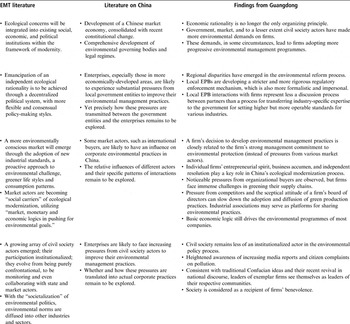
Table 5 provides a summary of the main arguments from EMT regarding the roles of government, market, and civil society actors in ecological modernization, and the extent to which these arguments apply to recent environmental reform in China. The table shows that, compatible with Mol's (Reference Mol2006) conjectures, ecological concerns have gradually gained a foothold in existing political, economic, and, to a lesser extent, social institutions, but that the relevant actors and their patterns of interactions differ from what EMT generalizes from Western European experiences.
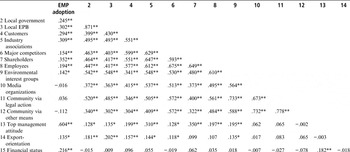
Correlations Table
Notes:
* Correlation is significant at the 0.05 level (2-tailed); ** correlation is significant at the 0.01 level (2-tailed).
Summary of the Changing Roles of Government, Market, and Civil Society Actors
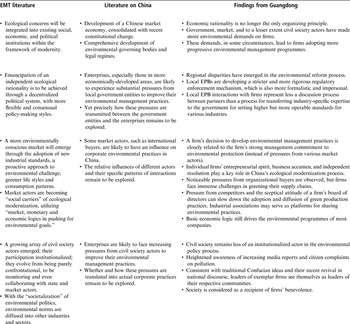
In terms of government reform, China has adopted a decentralized approach, parallel to the suggestion of EMT, by which regulatory enforcement responsibilities are vested with local EPBs. Considerable disparities exist across different regions in China, with Guangdong progressing faster towards higher environmental standards. Yet, unlike the EMT prescription for more negotiated, flexible, and consensual styles of regulatory enforcement, interactions between governments and enterprises in China have become stricter and more formalized, and related more to transferring industry-specific expertise to governments.
On the market front, most firms we surveyed decided to go green out of their own commitment to the environment, while evidence for the institutionalization of ecological values into China's economic structures remains weak. Organizational buyers, along with the supply chain, have exerted more noticeable pressure on manufacturing firms than industrial associations and individual consumers. International buyers have influenced the environmental practices of not just their direct manufacturers, but also smaller producers down the supply chain. However, it is still basic economic logic, rather than any truly transformational ecological rationality, that seems to drive most companies’ environmental programmes.
In contrast to EMT and many recent speculations, civil society actors have remained less of an institutionalized actor in the environmental policy process in China. Although there have been increasing media reports and citizen complaints about pollution, enterprise executives seldom see these societal pressures as the main reason for adopting better environmental practices. Instead, they appear to follow Confucian logic and view their environmental protection measures as a sign of their benevolence to society.
Our findings suggest that, at the current stage of environmental reform in China, the most direct and powerful way to foster better corporate environmental practices is to strengthen both the resolve of government actors and their ability to enforce environmental regulations across all regions of the country. The international community can play a role in promoting ecological modernization in China by leveraging its buying power to encourage responsible environmental practices by Chinese firms. It will probably take longer for domestic market actors to be a major force for promoting corporate environmental practices. Despite the high expectations of many China watchers, societal actors’ abilities to influence corporate environmental practices have remained limited. Nonetheless, their long-term potential should not be underestimated if political reform can gradually open up more space for civil society to play a more significant role in governance processes.
Appendix:
EMP Adoption
The items measuring EMP adoption (Alpha = .949) are:
1. Sponsorship of events about environmental protection
2. Company displays about environmental programmes
3. Incorporating ecological themes when marketing some of our products
4. Routine environmental audits
5. Recycling of waste streams
6. Environmental training for managers
7. Environmental training for operatives
8. Using filters and other emission controls in our production processes
9. Participation in government-sponsored environmental programmes
10. Setting environmental performance objectives as part of our annual business plans
11. Including environmental performance measures in our management evaluations
12. Preparation and release of environmental reports
13. Developing a certifiable environmental management system (e.g. ISO 14001)
14. Measuring key aspects of the environmental performance of our business
15. Scientifically assessing the life cycle impact of our products
16. Making investments in clean production technologies
Top Management Attitude
Firms were asked to rate, from 1–7, “to what extent does the following item affect your company's decision to adopt environmental management practices?” The score is aggregated by summation.
1. We recognize that the company has an ethical responsibility to adopt better environmental protection measures
2. We are personally interested in developing and implementing environmental protection measures within the company
3. We want to be viewed as leaders in environmental protection in our industry sector
4. Many top-level managers in my company are personally and actively involved in developing environmental policies and monitoring their implementation
5. In my company, business success is defined predominantly in terms of profits, sales growth, and market share (reverse)
6. In asking ourselves if we have been successful as a company, we usually think about whether we've made a positive contribution to society and to people's quality of life
7. Environmental protection is mainly the responsibility of the government – it is not really a business responsibility (reverse)
Export-orientation
Firms were asked to indicate “the percentage of [their] product sold to overseas markets.” We measure whether a firm is export-oriented using a dummy variable (1= export >50%).
Financial Status
Firms were asked about their yearly profit in 2006. Choices were given ranging from “making a serious loss” (denoted as −2) to “making a substantial profit” (denoted as 2). The higher the score, the more profit a firm made that year.