Introduction
Merodon Meigen (Diptera: Syrphidae) is the second largest hoverfly genus in Europe (Speight Reference Speight2010), and the most species-rich genus in the European Mediterranean region. It is distributed throughout the Palaearctic and Ethiopic regions with highest species diversity in Eastern Europe and Asia Minor (A. Vujićć, S. Radenkovićć, and J. Acanski, unpublished data). Adults mimic bees and bumble bees (Hymenoptera: Apidae) and feed on pollen and nectar from early spring to autumn (Hurkmans Reference Hurkmans1993; Speight Reference Speight2010). Larvae are phytophagous, tunnelling inside bulbs or rhizomes of monocotyledonous plants (Hurkmans Reference Hurkmans1993; Ricarte et al. Reference Ricarte, Marcos-García and Rotheray2008).
Merodon equestris (F.), the “large narcissus fly”, is well-known because of damage that larvae cause to daffodil (Narcissus L. (Liliaceae) and other ornamental bulbs in Europe and elsewhere (Conijn Reference Conijn1990; Barkemeyer Reference Barkemeyer1994; Speight Reference Speight2010). Adult M. equestris show high morphological variability expressed as several distinctive colour morphs. Other species of Merodon also show intraspecific morphological variability, for example, in characters such as the anterior lobe of the surstylus in male genitalia (Popov Reference Popov2000).
A revision of Iberian species of Merodon (Marcos–García et al. Reference Marcos-García, Vujić and Mengual2007) described intraspecific variability in nine species in different species groups. Morphological variability may hide cryptic species, as has been demonstrated using DNA sequences of the mitochondrial cytochrome c oxidase subunit I (COI) gene (Ståhls et al. Reference Ståhls, Vujić, Pérez-Bañón, Rojo and Petanidou2009; Radenkovićć et al. Reference Radenković, Vujić, Ståhls, Pérez-Bañón, Rojo, Petanidou and Šimić2011). Some Iberian specimens of M. equestris cannot be identified readily using external morphological characters in the keys and descriptions presented by Marcos–García et al. (Reference Marcos-García, Vujić and Mengual2007), suggesting the existence of a species complex within M. equestris.
Molecular data are useful for solving species level taxonomic problems. Through allozyme electrophoresis and mitochondrial DNA sequencing of COI, six diagnosable cryptic taxa have been identified within the Merodon aureus F. and Merodon cinereus (F.) species complexes (Milankov et al. Reference Milankov, Ståhls, Stamenkovic and Vujić2008). Moreover, an integrative taxonomic approach using morphological and molecular characters was informative for discerning Merodon species groups and detecting cryptic species in the Iberian Peninsula (Mengual et al. Reference Mengual, Ståhls, Vujić and Marcos-García2006). Also, COI barcodes generated for 22 species of Merodon species from Lesvos Island (Greece) revealed two cases of morphologically cryptic species (Ståhls et al. Reference Ståhls, Vujić, Pérez-Bañón, Rojo and Petanidou2009; Radenkovićć et al. Reference Radenković, Vujić, Ståhls, Pérez-Bañón, Rojo, Petanidou and Šimić2011). An integrative taxonomy approach has also revealed the existence of new species of Merodon species in southeastern Europe (A. Vujićć, S. Radenkovićć, G. Ståhls, and J. Acanski, unpublished data).
To analyse the status of morphologically atypical specimens of M. equestris, we used an integrated approach based on both morphology and genetics. Our work has resulted in new data on the Iberian Merodon fauna and has allowed various refinements to the revision of Iberian species of Merodon in Marcos–García et al. (Reference Marcos-García, Vujić and Mengual2007).
Material and methods
Material examined
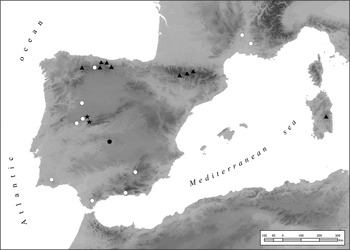
We examined specimens of Merodon collected in Finland, France, Italy, Portugal, and Spain (Fig. 1). Specimens determined to be Merodon confusus sp. nov. were collected at various French, Portuguese, and Spanish localities by hand net, Malaise traps, and occasionally yellow pan traps. Specimen label dates indicate capture technique: hand netting is indicated by a single date (e.g., 16.iv.2004) with localities coded as “Ma2” and “Pa1”; a date interval (e.g., 28.iii/15.iv.2004) indicates Malaise (“ma” followed by “F”, “M”, or “J” and “1” or “2”) or yellow pan trapping (“moF2”). Trapped specimens were preserved in ethanol and then dried and mounted on entomological pins.

Geographical distribution data follow Speight (Reference Speight2010). Biological and specimen deposition data are provided for each species. If deposition is not stated, material is in the Colección Entomológica Universidad de Alicante (CEUA), Spain. Collection acronyms are ASC, Dr. Axel Ssymank; IEE, former Instituto Español de Entomología, collection now in Museo Nacional de Ciencias Naturales, Madrid, Spain (MNCN); MZH, Finnish Museum of Natural History, Helsinki, Finland; NS, Department of Biology and Ecology, Entomological Collection, University of Novi Sad, Serbia; ZMUC, Zoological Museum, University of Copenhagen, Denmark; and ZMA, Zoological Museum Amsterdam, University of Amsterdam, the Netherlands.
Refinements to the key in Marcos–García et al. (Reference Marcos-García, Vujić and Mengual2007) were made to enable the identification of species of Merodon recently recorded in the Iberian Peninsula (Ricarte and Marcos–García Reference Ricarte and Marcos-García2008), as well as species newly described or recorded in this study.
Morphological study
A detailed description and diagnosis for M. confusus, as well as figures of various adult characters of this and other species of Merodon are provided.
Colour characteristics are described from dry-mounted specimens. To study the male genitalia, dry specimens were relaxed and genitalia were dissected with an entomological pin. Genitalia were cleared by boiling individually in tubes of water-diluted KOH pellets for 5–7 min. This was followed by brief immersion in acetic acid to neutralize the KOH, immersion in ethanol to remove the acid, and storage in microvials containing glycerine. Drawings were made with a FSA 25 PE drawing tube attached to a binocular dissecting microscope. Measurements were taken with an eyepiece graticule. The following abbreviations are used in the new species description: bc, relation between the basal line of cercus and its height; bf, relation between the distance from the basoflagellomere apex at the most prominent point of the pedicel and the basoflagellomere width at the level of the arista base; C, second costal cell; R1, cell R1; Sc, subcostal vein (for more details see figures in Marcos–García et al. Reference Marcos-García, Vujić and Mengual2007). Morphological terminology broadly follows Thompson (Reference Thompson1999), except for male genitalia, which follows Hurkmans (Reference Hurkmans1993) and Doczkal (Reference Doczkal1996).
Molecular study
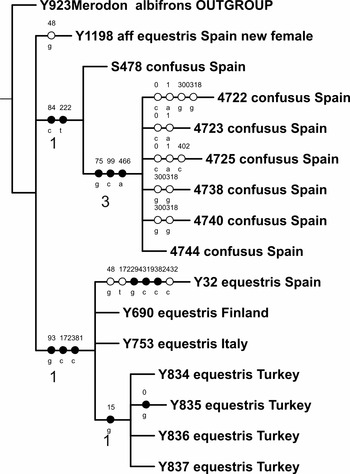
Six adult specimens from Cabañeros National Park, central Spain (39°23′47″N, 4°29′14″W), representing part of the type material for the new species, were used for molecular analysis. Additionally, DNA sequences for a specimen of the new species from Andalucía, seven specimens of M. equestris, and a specimen of an undetermined species similar to it (“M. aff. equestris”) from south and north Europe were included for comparison of levels of intra- and interspecific genetic divergences of the mitochondrial COI sequences.
DNA was extracted from two legs of each fly (sometimes also including part of the abdomen) using the Nucleospin Tissue DNA extraction kit (Machery-Nagel, Düren, Germany) following the manufacturer—s protocols and re-suspended in 50 μL of ultrapure water. The “small barcode fragment” of the 5′ region of COI was amplified using standard polymerase chain reaction protocols (annealing temperature 49°C) with forward primer C1-S-1718 (5′-GGAGGATTTGGAATTGATTAGTTCC-3′) (Simon et al. Reference Simon, Frati, Beckenbach, Crespi, Liu and Flook1994) and reverse primer HCO-2198 (5′-TAAACTTCAGGGTGACCAAAAAATCA-3′) (Folmer et al. Reference Folmer, Black, Hoeh, Lutz and Vrijenhoek1994). The fragments were sequenced using the same primers and the Big Dye Terminator version 1.1 cycle sequencing kit (Applied Biosystems, Foster City, California). With these primers, we obtained an almost completely overlapping sequence fragment of approximately 450 bp. All sequences were submitted to EMBL (EMBL accession Nos. FR717714-27). Alignment of COI sequences was trivial due to a lack of insertions or deletions and was determined visually. Merodon albifrons Meigen (tribe Eumerini) was used as an outgroup. The COI sequences were clustered using parsimony analysis performed with NONA (Goloboff Reference Goloboff1999) spawned with the aid of Winclada (Nixon Reference Nixon2002), using the heuristic search algorithm with 1000 random addition replicates (mult × 1000), holding 100 trees per round (hold/100), maxtrees set to 100000 and applying treebisection–reconnection branch swapping. Subsequently the Bremer support values (Bremer Reference Bremer1988, Reference Bremer1994) were calculated by successively increasing the number of trees held at each step for finding suboptimal trees to avoid an over estimation of the values. All base positions were treated as equally weighted characters (Kimura Reference Kimura1980).
Results
As a result of the present study, we describe a new cryptic species, M. confusus, belonging to the M. equestris group of species. Additionally, we report the first record of Merodon rufus Meigen from the Iberian Peninsula and propose Merodon aeneus fulvus Gil Collado as a new junior synonym of Merodon pumilus Macquart. Changes derived from these new data are provided for the key in the revision of the Iberian species of Merodon in Marcos–García et al. (Reference Marcos-García, Vujić and Mengual2007).
Genus Merodon Meigen, 1803 Merodon confusus sp. nov.
(Figs. 1–2, 7, 11–15, 23–27, 32–33, 38–42)


Type material (Fig. 1, black circle)
Holotype: SPAIN, Ciudad Real: 1♂, P.N. de Cabañeros, Ma2, 20.v.2005, Leg. A. Ricarte (Fig. 45, code 4738; EMBL accession number FR717721). Paratypes: SPAIN, Ciudad Real: 3♂, P.N. de Cabañeros, Ma2, 20.v.2005, Leg. A. Ricarte (two specimens for DNA analysis, Fig. 45, codes 4740 and 4744; EMBL accession numbers FR717722-23); 3♂, P.N. de Cabañeros, Pa1, 1.v.2005, Leg. A. Ricarte (Fig. 45, codes 4722, 4723 and 4725; EMBL accession numbers FR717718-20); 1♂, P.N. de Cabañeros, camino Valle de Santiago, 16.iv.2004, Leg. E. Galante (NS); 2♀, P.N. de Cabañeros, Pa1, 14.iv.2004, Leg. A. Ricarte (one female deposited in NS); 2♀ and 2♂, P.N. de Cabañeros, maF2, 28.iii–15.iv.2004, Leg. A. Ricarte; 2♀, P.N. de Cabañeros, moF2, 28.iii–15.iv.2004, Leg. A. Ricarte; 1♀ and 1♂, P.N. de Cabañeros, maM2, 26.iii/14.iv.2004, Leg. A. Ricarte; 1♂, P.N. de Cabañeros, camino Valle de Santiago, 14.v.2004, Leg. A. Ricarte; 2♂, P.N. de Cabañeros, camino Valle de Santiago, 14.iv.2004, Leg. A. Ricarte (one male deposited in NS); 2♂, P.N. de Cabañeros, maM1, 14.iv–8.v.2004, Leg. A. Ricarte; 1♀, P.N. de Cabañeros, maM2, 14.iv–8.v.2004, Leg. A. Ricarte; 3♀ and 1♂, P.N. de Cabañeros, maF2, 15.iv–7.v.2004, Leg. A. Ricarte; 2♀, P.N. de Cabañeros, maM1, 26.iii–14.iv.2004, Leg. A. Ricarte (one female deposited in NS); 1♀, P.N. de Cabañeros, maF1, 15.iv–7.v.2004, Leg. A. Ricarte; 1♀ and 1♂, P.N. de Cabañeros, maJ2, 18.iii–12.iv.2005, Leg. A. Ricarte; 2♀ and 4♂, P.N. de Cabañeros, maF1, 19.iii–13.iv.2005, Leg. A. Ricarte (1♀ and 1♂, deposited in MNCN); 1♀, P.N. de Cabañeros, maF2, 19.iii–13.iv.2005, Leg. A. Ricarte. All males with genitalia in a plastic micro-vial attached to the pin.


Additional material (Fig. 1, white circles)
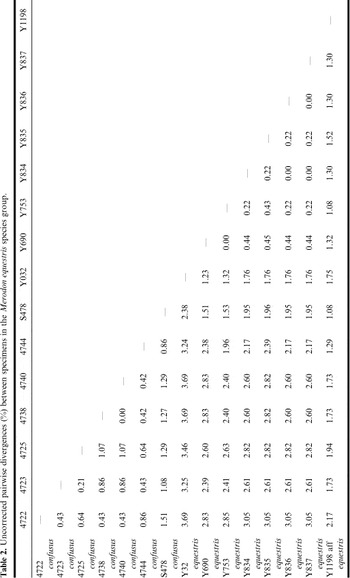
Non-Cabañeros specimens morphologically fitting to the type material of M. confusus but not genetically tested (genetic analysis was not performed because of the age of material) except for one specimen*. FRANCE: Dep. 07, 1♂, Ardèche, St. Remèze, 2.v.1981, Leg. R. Leys (NS); VSE, 1♂, Mt du Lubéron, W de Bonnieux, 350–600 m, 3.vi.1995, Leg. Merz & Eggenberger (ZMA). PORTUGAL: Algarve, 1♂, Doguena, 16.iv.1983, H.Teunissen (ZMA). SPAIN: Cáceres: 2♂, Gata, 19.iv.1981, Leg. M.aA. Marcos; León: 1♂, Cofiñal, 16.vi.1986, Leg. M.aA. Marcos-García; Cádiz: 1♂, Vent. l. Canillas, Hozgarganta-Talb. Jimena, 250 m, 14.iv.1985, Leg. W. Schacht; Granada: 1♂, Barranco de Miranda, 450 m, 6.iv.1974, Leg. J.A.W. Lucas; Salamanca: 1♂, Almendra, 28.iii.1982, Leg. L.J. García; 1♂, Valle Batuecas (Monasterio), 11.v.1980, Leg. M.A. Marcos. *SPAIN: Andalucía (Jaén), 1♀, Sierra Pozo, 1450 m, Mnt. Palomas, 11.vi.2003, Leg. M. Kafka (DNA voucher specimen, S478-2004, G. Ståhls, FMNH, Helsinki, Finland, EMBL accession no FR717714) (MZH). This specimen, morphologically fitting to M. confusus, was genetically tested. Analysis results showed a higher pairwise divergence between this specimen and the population from Cabañeros (five nucleotides difference) than among specimens from Cabañeros (Table 2). We consider this divergence to be within the range of intraspecific variability in M. confusus.
Etymology
The word “confusus” means “mixed” in Latin. This term is employed to refer to the combination of characters of typical M. equestris and Merodon flavus Sack in the new species.
Diagnosis
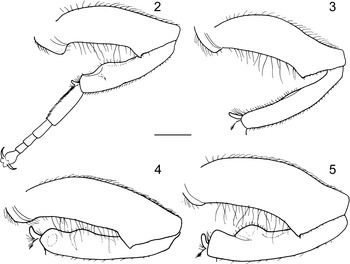
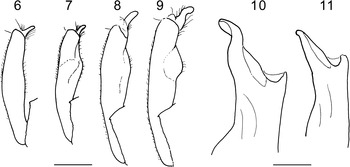
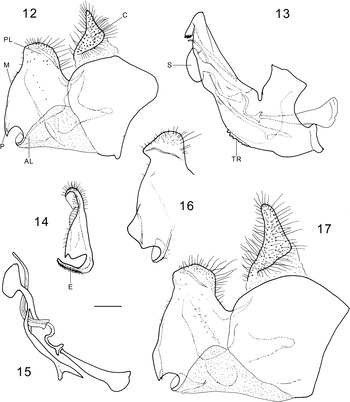
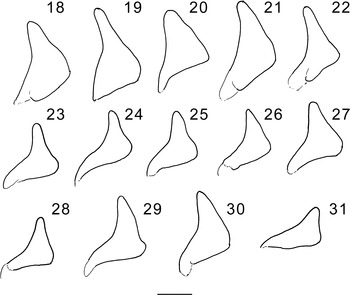
The species belongs to the M. equestris group, comprised of large adults (8–17 mm) with hairy posterior side of mid-coxa and reduced pilosity on anterior anepisternum below postpronotum (Marcos–García et al. Reference Marcos-García, Vujić and Mengual2007). Merodon confusus is a bumble bee mimic with long body hairs; male hind tibia with a conspicuous apical process (Figs. 2, 7, 11); male genitalia with anterior surstylar lobe curved internally (Fig. 14); lateral sclerite of aedeagus oval apically (Figs. 13, 15); cercus triangular-shaped (Figs. 12, 23–27).
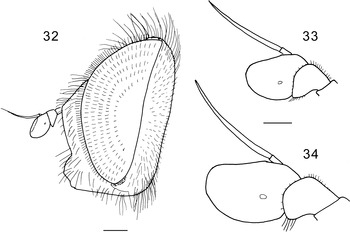
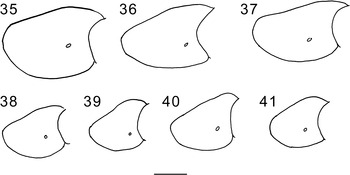
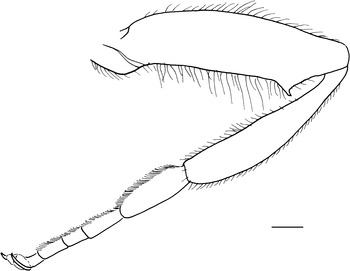
Merodon confusus is very similar to M. equestris and M. flavus. Adult M. confusus (10–12.5 mm) are typically smaller than adult M. equestris (13–17 mm). Males: apical process of hind tibia short and not strongly incurved in M. confusus (Fig. 11), longer and conspicuously incurved in M. equestris (Fig. 10); cercal triangle higher in M. equestris (bc = 0.66–0.96) (Figs. 18–22) than in M. confusus (bc = 1–1.23) (Figs. 23–27); M. confusus with a conspicuous central bulge on the hind tibia (Figs. 2, 7), lacking in M. flavus (Figs. 3, 6); margin of the anterior surstylar lobe flat in M. confusus (Fig. 14), convex in M. flavus (Fig. 16); cercus as long as high or slightly longer in M. confusus (bc = 1–1.23) (Figs. 23–27), conspicuously longer (up to 1.5× longer than high) in M. flavus (bc = 1.11–1.47) (Fig. 31). Females: basoflagellomere in M. confusus shorter (bf = 1.1) than that in M. equestris (bf = 1.3); M. confusus has long hairs on ventral side of hind femur (hairs as long as femur width) (Fig. 42) and long semi-adpressed and erect hairs on tergites III and IV, M. flavus has shorter hairs on ventral side of hind femur and hairs on tergites III and IV are mostly adpressed (with a few intermixed erect hairs).
Morphological species boundaries within the M. equestris group are partially unclear. Overlapping characters for M. confusus and M. equestris are: in males, cercus shape, body size, apical process of hind tibiae, central bulge in hind tibiae, and colour morphs. Merodon flavus can be separated morphologically; molecular confirmation is needed to distinguish M. confusus from M. equestris when morphology is not definitive.
Merodon confusus and M. equestris differ by an uncorrected pairwise genetic difference of 1.96%–3.69% for the COI barcode (Table 2); this is a typical percentage range of species level difference for closely related species of Merodon (e.g., Mengual et al. Reference Mengual, Ståhls, Vujić and Marcos-García2006; Ståhls et al. Reference Ståhls, Vujić, Pérez-Bañón, Rojo and Petanidou2009).
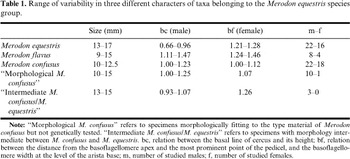
Table 1 shows variability ranges of body size, bc and bf for the studied taxa and populations; Table 2 shows the uncorrected pairwise percent divergences.

Note: “Morphological M. confusus” refers to specimens morphologically fitting to the type material of Merodon confusus but not genetically tested. “Intermediate M. confusus/M. equestris” refers to specimens with morphology intermediate between M. confusus and M. equestris. bc, relation between the basal line of cercus and its height; bf, relation between the distance from the basoflagellomere apex and the most prominent point of the pedicel, and the basoflagellomere width at the level of the arista base; m, number of studied males; f, number of studied females.

Male
Head
Dark antenna; basoflagellomere 1.3× longer than broad, with dorsal margin concave and apex acute; arista brown basally, dark brown towards apex, and 1.6× longer than basoflagellomere; face and frons shiny black, covered with whitish-yellow hairs and silver-grey pollinosity; oral margin bare, lustrous black; vertical triangle isosceles, 2–2.5× longer than eye contiguity, black with yellowish pollinosity, covered with long yellow hairs, and, occasionally, with a few black hairs intermixed with yellow hairs on ocellar triangle; eye contiguity long for 10–12 facets; ocellar triangle isosceles; eye hairs whitish-yellow, about as long as scape; occiput covered with dense whitish pollinosity and yellowish hairs.
Thorax
Mesonotum with dark-gold metallic reflections, covered with erect yellow to reddish-yellow hairs and, in some morphs, partly covered with black hairs; two colour morphs have been identified: one completely yellow-haired, another with black hairs on posterior half of scutellum and yellow hairs on some parts of postalar callus; posterior anepisternum, anepimeron, and katepisternum dorsally with long whitish yellow hairs; pale-greyish wing, extensively microtrichose except for some areas along sides of veins in the central part of wing; wing veins dark except basally and on most of length C, Sc and R1; dorsal and ventral calypters light brown; halter brownish; legs with tarsi brown to reddish-brown except black ventrally; hind trochanter with gently produced process (Fig. 2); hind tibia with a conspicuous central bulge ventrally (Figs. 2, 7) and apical process pointing forwards (Figs. 2, 7, 11); legs with black and yellow hairs; short hairs on legs predominately black, long hairs on femur ranging from mostly yellow to mostly black.
Abdomen
Black with bronze reflections, as long as mesonotum; tergites II–IV shiny, without bands of white pollinosity; tergite II with yellowish antero-lateral spots; hairs on terga erect and yellow to reddish-yellow; tergites III and IV sometimes with black hairs in different locations; sterna shiny, blackish-brown, with long light yellow hairs.
Female
Similar to male except for characters associated with typical sexual dimorphism. Key characters for female M. confusus: frons black with shiny central stripe, greyish pollinosity laterally; frons from completely pale haired to bearing many black hairs on central stripe; ocellar triangle always surrounded by black hairs; colour of scutellar hairs in two morphs similar to those in males; hind legs without conspicuous tubercles and prominences (Fig. 42); abdomen with pale and black hairs: tergites I and II pale-haired; tergites III–V with pale and black hairs intermixed and ranging from mostly pale to mostly black; sternites IV and V sometimes with a few black hairs.
Biology
The type material was collected in the following habitats: open areas with Fraxinus angustifolia Vahl (Oleaceae) and seasonal streams; Quercus pyrenaica Willd. (Fagaceae) forests; mixed forests of Q. pyrenaica and F. angustifolia; high Mediterranean scrubs; tracks and track verges in Mediterranean forests and scrubs. Period of flight: from March to June.
Distribution
Spain (Fig. 1). The species presumably extends to Portugal and France, where specimens with the same morphology have been found but were not molecularly analyzed.
Additional data for Iberian Merodon
Material examined belonging to M. equestris (Fig. 1, black triangle)
Spanish specimens diagnosed morphologically (genetic analysis not performed because of age of material). SPAIN, Asturias: 1♂, Santillán, 6.vii.1986, Leg.: M.A. Marcos-García; 1♂, Tielve, 21.vi.1987, Leg.: M.A. Marcos-García; Huesca: 1♂, Baños de Benasque, 12.viii.1991, Leg.: M.A. Marcos-García; 1♂, Valle de Añisclo, 15.vii.1981, Leg. E. Galante; León: 2♂, Caboalles de Abajo, 2.vi.1987, Leg.: M.A. Marcos-García; Lérida: 1♀, Bosque de Bonabé, Vall d—Arán, 4.vii.1997, Leg. Verdú; 1♀ and 1♂, Cofiñal, 3.vii.1987, Leg.: M.A. Marcos-García; Palencia: 1♀ and 1♂, Piedrasluengas, 1280 m, prado junto al río en hayedo, 21.vii.1985, Leg.: M.A. Marcos.
Specimens with COI barcodes from other localities: FINLAND: 1♀, Nylandia (N), Askola, emerged from Allium L. (Liliaceae) kept indoors 12.i.2007 (MZH); labcode MZH_Y690, EMBL accession number EU431486. ITALY: 1♀, Sardinia, Nuoro province: nr Aritzo, ca 1000 m, 23.v.2008, Leg. E. Rättel (MZH); labcode MZH_Y753 (this is the only non-Iberian specimen of M. equestris from a locality represented in Fig. 1, EMBL accession number FR717716); SPAIN: 1♂, Pyrenees, Aran Valley, nr. Arties, 1500 m, 1.viii.2003, G. Ståhls leg. (MZH); labcode MZH_Y32, EMBL accession number FR717715 (this is the only Spanish specimen diagnosed with morphological and genetic evidence; its locality nearly coincides with the most eastern black triangle in the Pyrenees in Fig. 1); FRANCE: 1♂, Jura mountains, Les Moulines, Cariche, 1290 m, 19.VII.2008, A. Ssymank leg. (ASC); labcode MZH_Y834. Also samples MZH_Y835, MZH_Y836, and MZH_Y837 (Fig. 45) from France, Jura mountains, Lajoux, Forêt du Massacre, 1270 m, 19.VII.2008, A. Ssymank leg, (ASC), EMBL accession numbers FR717724-27.
Material examined of uncertain status (Fig. 1, black star)
Specimens morphologically intermediate between M. confusus and M. equestris (genetic analysis not performed because of age of material). SPAIN, Cáceres: 1♂, La Garganta, 5.vi.1983, Leg. H. Teunissen; Salamanca: 1♂, La Honfría, 12.vi.1990, Leg. M.A. Marcos-García. A female of uncertain status (reared from larva collected from a bulb in Spain, Salamanca, Sierra de Béjar, 19.iii.2010 by M.A. Marcos-García) was used for DNA analysis (Fig. 45, labcode MZH_Y1198; EMBL accession no FR717717). This specimen is morphologically and genetically different from M. equestris and M. confusus. Because of the proximity and similarity of the collection localities of this female and the La Garganta and La Honfría males, and their apparently related morphology, we hypothesize that they could belong to another cryptic new taxon. Resolution of this issue requires the collection and study of additional material.
First records of M. rufus Meigen, 1838 in the Iberian Peninsula
Material examined
SPAIN, Gerona: 1♂, and 2♀, Caralps, 1200–1300m, 13–17.vi.1982, Leg.: S. Andersen, V. Michelsen & L. Lyneborg, Det.: A. Vujićć 2009 (male identified by Torp in 1986; one female identified by Torp in 1986 as M. avidus (Rossi) and by Hurkmans in 1987 as M. rufus; one female identified by Torp in 1986 and by Hurkmans in 1987) (ZMUC); 1♀, Ribas de Freser, 21.vii.1970, Det.: A. Vujićć 2008; 10 specimens, Setcasas, 3♂, and 2♀, 15.vii.1970, 1♂, and 1♀, 18.vii.1970 (male collected at 1400–1500 m and identified by Van der Goot), 3♂, and 2♀, 20.vii.1970 (one female collected at 1400–1500 m and identified by Van der Goot), Det.: A. Vujićć 2008 (ZMA); Teruel: 1♂, Sierra de Albarracín, 25.vii.1979, Leg.: Guerra, Det.: A. Vujićć 2008 (ZMA); Orense: Prada, 7.vii.1985, Leg. Veronese, Det.: A. Vujićć 2008 (ZMA).
Range
The Netherlands, south to the northern half of Spain, the Mediterranean, and North Africa and east through central and southern Europe into European parts of Russia and on to Kazakhstan.
Additions to the Iberian Merodon key
We provide refinements to couplets in the key to Iberian Merodon in Marcos–García et al. (Reference Marcos-García, Vujić and Mengual2007), based on our results and the record of Merodon distinctus Palma reported by Ricarte and Marcos–García (Reference Ricarte and Marcos-García2008).
Merodon confusus, M. equestris, and M. flavus
- Hind tibiae with large central bulge (Figs. 2, 4, 5); male genitalia as in Figs. 12–15, 17; body hairs may range from predominantly pale to wholly black on posterior half of scutum and on tergite III
34a
Females – change couplet 50:
- Hind femora with long hairs ventrally (hairs as long as femur width) (Fig. 42); tergites III and IV with long semi-adpressed and erect hairs
50a
- Hind femora without such long hairs ventrally; tergites III and IV predominantly with adpressed hairs intermixed with a few erect hairs
M. flavus
- Small species (10–12.5 mm); basoflagellomere short (bf = 1.1)
M. confusus
- Larger species (13–17 mm); basoflagellomere longer (bf = 1.3)
M. equestris
Males – change couplet 34:
Merodon distinctus
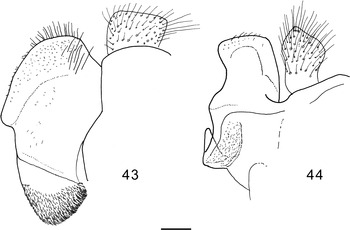
- Short body hairs; scutellar hairs 3× shorter than scutellum length; pale hairs on anterior half of scutum, on an oval to triangular area close to scutellum and on postalar callus; scutum with a band of short adpressed black hairs between wing bases; basoflagellomere short (bf = 1.0) and yellow; tibiae and tarsi wholly pale; surstylus of male genitalia as in Fig. 43.
M. distinctus
- Body hairs longer; longest hairs of scutellum as long as half of scutellum length; scutum with different arrangement of hairs
6
Females – change first step of couplet 10 to lead to 10a:
- Legs wholly yellowish red; body hairs extremely short
M. distinctus
- Legs with at least femora black
11
Males – change first step of couplet 5 to lead to 5a:
Merodon rufus
- Surstylus of male genitalia with extensions between anterior and posterior lobes (Fig. 44); all tergites shiny, without pollinose bands
M. rufus
- Surstylus without extensions between anterior and posterior lobes
43
Females – change first step of couplet 48 to lead to 48a:
- Frons shiny, without lateral pollinose markings
M. rufus
- Frons with broad lateral pollinose markings
49
Males – change second step of couplet 41 to lead to 41a:
New synonymy
Merodon pumilus Macquart in Lucas, 1849
M. pumilus Macquart in Lucas, 1849: 466
M. aeneus fulvus Gil Collado, 1930: 262 syn. n.
Marcos–García et al. (Reference Marcos-García, Vujić and Mengual2007) redefined M. pumilus and considered it a valid species. Merodon aeneus fulvus was described from a single female; in Gil Collado—s collection there is one specimen with its original name label and we accept this specimen as the holotype: female “fulvus / Type” (Arenas de San Pedro, Spain) (IEE). Identity: available name, a junior synonym of M. pumilus. Comparison between the holotype of M. aeneus fulvus and specimens of M. pumilus shows that they are conspecific.
Errata
We provide the following corrections to Marcos–García et al. (Reference Marcos-García, Vujić and Mengual2007): on the first step of couplet 55 on page 539, “trochanter” should be replaced with “femora”. When describing the variability of Merodon chalybeus Wiedemann (p. 547), “(Figs. 61, 62)” should be replaced with “(Figs. 47, 48)”; “(Figs. 63, 64)” with “(Figs. 51, 52)”; “(Figs. 65–68)” with “(Figs. 53–56)”; “(Fig. 65)” with “(Fig. 53)”; and “(Fig. 68)” with “(Fig. 56)”. In the description of the male genitalia of Merodon crypticus Marcos-García, Vujic and Mengual (p. 551) “(Fig. 154)” should be replaced with “(Fig. 162)”. In the diagnosis of Merodon legionensis Marcos-García, Vujic and Mengual (p. 559), the first and second citations of “M. pumilus” should each be replaced with “M. unicolor”.
Discussion
All M. confusus type specimens were collected in the Cabañeros National Park, central Spain. This protected area has nearly 41000 ha of Mediterranean ecosystems with an altitudinal range from 520 to 1448 m (Jiménez Reference Jiménez and Canseco2004). Merodon confusus is the fourth Merodon species described from Cabañeros (Marcos–García et al. Reference Marcos-García, Vujić and Mengual2007) and this genus is the most species rich among the hoverflies found there (Ricarte and Marcos–García Reference Ricarte and Marcos-García2008). Thirteen species of Merodon occur in Cabañeros (35% of the Iberian Merodon fauna).
Specimens of M. confusus were found in some of the primary woodlands of Cabañeros: F. angustifolia riparian forests, Q. pyrenaica forests, and mixed forests of F. angustifolia and Q. pyrenaica (Vaquero Reference Vaquero, García-Canseco and Alonso-Valero1997). However, there were also records in scrublands and open areas within forests. Merodon confusus uses open, often stony environments for thermoregulation, but also scrublands and forests because of the presence of potential hosts for larvae (bulbs and tubers of geophytic plants). Species of Merodon have close relationships with such plants and co-occur with their hosts in Cabañeros (Ricarte et al. Reference Ricarte, Marcos-García and Rotheray2008). Geophytes are diverse and widespread throughout Cabañeros and this probably explains the high diversity of Merodon there. For instance, geophytes are dominant herbaceous plants in the Cabañeros forests (Fernández–González and Pérez–Badía Reference Fernández-González and Pérez-Badía2004) where species of Merodon, including M. confusus, are frequently encountered.
Merodon confusus is expected to be widely distributed around the Mediterranean area of the Iberian Peninsula and southeastern France. Merodon equestris appears to be restricted to the mountainous Euro-Siberian region of the northern part of the Iberian Peninsula (Fig. 1). There is no evidence of damage to ornamental plant bulbs in Spain and M. equestris does not appear to be abundant there (Marcos–García Reference Marcos-García1990). This scenario could be similar across southwestern Europe, where damage produced by larvae of M. equestris to ornamental Narcissus bulbs is rare.
It will be important to discover the host plant of M. confusus in order to evaluate the economic importance of this hoverfly. Studies such as the present one ensure a precise taxonomic diagnosis of potential pest species; confident identification is of key importance for effective pest-control measures in a given study area. In addition, this study has helped to determine the biogeographical distribution of the species belonging to the M. equestris complex in Europe.
Adult M. confusus and M. equestris appear to fly at different times in the Iberian Peninsula. Collection evidence suggests that adult M. confusus and M. equestris fly from March to June and from June to August, respectively. Studies focusing on the life cycle of M. confusus and on its relationships with the host plants will help to clarify its geographical distribution and phenology.
Uncorrected interspecific pairwise divergences for species of Merodon occurring on Lesvos Island (Greece) ranged from 1.54% between the closely related species Merodon nigritarsis Rondani and Merodon femoratoides Paramonov to 12.77% between Merodon erivanicus Paramonov and Merodon spinitarsis Paramonov that are classified in different species groups (Ståhls et al. Reference Ståhls, Vujić, Pérez-Bañón, Rojo and Petanidou2009). The Cabañeros National Park specimens of M. confusus we sequenced showed different haplotypes, with variability at five nucleotide positions (Fig. 45). We interpret the 5–7 nucleotide differences (1.1%–1.5% divergence) between the Cabañeros specimens and the specimen from Sierra Pozo, Andalucía (Fig. 45, S478), to be an intraspecific difference. Overlap of intra- and interspecific divergence in Merodon hoverflies is relatively common (Mengual et al. Reference Mengual, Ståhls, Vujić and Marcos-García2006; Milankov et al. Reference Milankov, Ståhls, Stamenkovic and Vujić2008).
Acknowledgments
We kindly thank A. Sánchez-Pardo for producing the map. This research was partially financed by the Spanish Ministerio de Ciencia e Innovación (projects CGL2008-04472, CGL2009-09656-BOS), the Ministry of Science and Technological Development of Republic of Serbia (project number: 173002), the Provincial Ministry of Science and Technological Development, Autonomous Province of Vojvodina, Republic of Serbia (project: Genetic diversity of agricultural ecosystems), and the European Union (project Life/NAT/E/000762).