The terrorism events of September 11, 2001, and the subsequent anthrax attacks focused the nation's attention on the need to strengthen its public health infrastructure to guard against potential bioterrorism. In 2002, the US Congress passed the Public Health Security and Bioterrorism Preparedness and Response Act (HR3448.ENR), allocating approximately $1.6 billion in bioterrorism or emergency preparedness funds to enhance state and local preparedness for public health emergencies.1 In Maine, these funds helped create the Office of Public Health Emergency Preparedness (OPHEP) within the Maine Center for Disease Control and Prevention (Maine CDC, formerly Maine Bureau of Health).
As a rural state, Maine presents significant challenges to public health preparedness, including a shortage of trained public health workers, lack of a statewide public health infrastructure at the local level, large distances between communities, and fewer resources than urban areas possess. Bioterrorism funds enabled OPHEP to implement sweeping initiatives that addressed many of these challenges. Specific attention focused on expanding the public health infrastructure to support early detection and response, including developing a cohesive system for disease reporting and investigation; increasing laboratory capacity; expanding a workforce skilled in managing biological, chemical, and radiological agents; enhancing pharmaceutical caches and communications systems, and improving collaborative relationships among preparedness stakeholders.
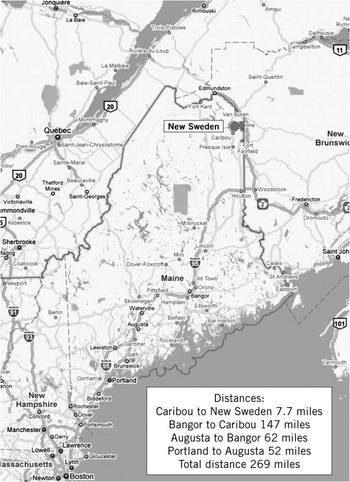
In late April 2003, these newly implemented initiatives were tested extensively when several members of the Gustav Adolph Lutheran Church in the remote northern community of New Sweden (population 621) presented to nearby Cary Medical Center (CMC) with gastrointestinal symptoms (Figure 1).2 The outbreak, reported to the Maine CDC and the Northern New England Poison Center (NNEPC), sparked a rapid public health investigation. Within 24 hours of patient presentation, arsenic was identified as the causative agent in this intentional poisoning, and antidotes from a recently assembled stockpile in Maine were rushed to CMC to treat patients. Rapid collaborative action facilitated by the expanded OPHEP infrastructure allowed for an efficient and effective response.
Map of Maine. The arsenic poisoning incident occurred in New Sweden. Cary Medical Center (CMC) located in Caribou; Eastern Maine Medical Center (EMMC) and Maine regional Centers for Disease Control and Prevention services located in Bangor; Health and Environmental Testing Laboratory (HETL) located in Augusta; British Anti-Lewisite (BAL) stockpiles located in Portland.

Arsenic is an important cause of both chronic and acute heavy metal poisoning. Chronic poisoning usually results from exposure to contaminated water, particularly affecting areas such as Bangladesh, Myanmar, and India. Natural sources of arsenic in sediment can wash into surface water or leach into groundwater supplies.Reference Mazumder3-Reference Ahsan, Perrin and Rahman5 Acute arsenic poisonings occur either as part of accidental ingestion of pesticides or herbicides, industrial accidents, suicide, or from criminal intent.Reference Lai, Boyer, Kleinman, Rodig and Ewald6-Reference Levin-Scherz, Patrick, Weber and Garabedian9 People with acute arsenic poisoning usually present with rapid onset of severe symptoms such as hematemesis and diarrhea within 1 to 4 hours of ingestion. Within 24 hours, severe clinical signs such as tachyarrhythmias, cerebral edema, microhemorrhage, and seizures may also arise. Because of the severity and rapidity with which poisoned patients develop arsenic toxicity, prompt treatment with the use of fluids and early chelation therapy is extremely important.
The New Sweden incident stands out as an incident in which early detection and response afforded by a new preparedness infrastructure appears to have prevented suffering and death. After a number of years, the criminal investigation regarding this mass poisoning in Maine was officially closed. Here, we present and analyze this important case study, the largest recent intentional arsenic poisoning recorded in the United States, to highlight the beneficial contributions of public health preparedness in rural America.Reference Banville and Kesseli10
Clinical Report
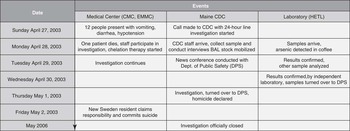
In a period of 12 hours on Sunday, April 27, 2003, 12 people arrived at the CMC emergency department in Caribou, complaining of nausea, vomiting, and diarrhea (Figure 2). Interviews by CMC's infection control practitioner (ICP) revealed that they had attended a church social hour that morning and consumed leftover sandwiches, breads, and cakes from a previous day's bake sale and freshly brewed coffee. Several patients reported becoming ill and vomiting during the social hour.
Timeline of events.

Patients were presumed to have foodborne disease. With only 37 beds and a small nursing staff, CMC discharged 5 seemingly well patients.Reference Alexander11 By design, a new 24-hour notification line had been established in January 2003 by the Maine CDC in conjunction with NNEPC in an effort to decrease response times to calls and to improve the initial collection of clinical information and call triage through the use of the NNEPC's clinical information specialists. The ICP at CMC used the line that Sunday evening to contact professionals at the Maine CDC. After a timely discussion with the epidemiologist on call, an investigation began. Established as part of OPHEP's efforts to improve early detection and communication statewide, this notification system, together with newly purchased personnel emergency pagers, allowed the Maine CDC to provide consultation within 60 minutes of receiving reports. (Before 2003, the Maine CDC had shared an after-hours telephone staffed by non-clinical operators employed by the state's Office of Child and Family Services.)
As the 7 remaining patients developed more severe symptoms and became hemodynamically unstable, requiring aggressive fluid resuscitation and cardiovascular support, the CMC medical staff reassessed their initial diagnosis. Four patients were admitted to the intensive care unit, and the 3 most critical patients who were experiencing severe hypotension were transferred from Sunday night and Monday morning to the nearest acute care facility, the Eastern Maine Medical Center (EMMC), located 170 miles away, in Bangor. Early Monday, 1 of the older adult patients died. The increasingly urgent situation prompted the ICP to update the patients’ status to the Maine CDC and NNEPC at approximately 3:30 AM. The severity of the symptoms prompted a medical toxicology consultation. Heavy metal poisoning was added to the differential diagnosis and clinical samples were collected for analysis and sent to the state Health and Environmental Testing Laboratory (HETL).
OPHEP's former medical director and the state health officer, who is also the director of the Maine CDC, documented their experiences and provided feedback as authors of the present article. Also, voluntary interviews with others involved in the incident were conducted by staff at the Harvard School of Public Health Center for Public Health Preparedness to describe and document the arsenic incident. Information about individuals or private information was not obtained; therefore, the descriptive case study was deemed not human subjects research and is institutional research board exempt by the Office of Human Research Administration at Harvard. We also extensively reviewed and conducted content analysis on pertinent scientific literature found in MEDLINE and Embase databases and media articles (local, state, and nationwide) searched in LexisNexis and Google. In addition, a variety of internal documents including laboratory reports and a detailed timeline of the incident were reviewed.
Coordination Between the Medical and Public Health Response
Properly investigating and treating poisonings, which can present with a broad and confusing spectrum of signs and symptoms, making differential diagnosis difficult, requires a robust epidemiology and laboratory infrastructure complemented by a dedicated preparedness workforce. To increase such capacity, in autumn 2002, the Maine CDC hired 5 OPHEP staff members, including the medical director, who was also an emergency physician and toxicologist with the NNEPC, and 4 field nurse epidemiologists. The Maine CDC also implemented a new strategy to regionalize epidemiology services through infectious disease surveillance units within Maine's 3 trauma centers instead of basing all of the state epidemiologists at CDC headquarters in Augusta. Four regional nurse epidemiologists (growing to 8 by 2008) were assigned to staff the units. Dispersed throughout the state, the nurse epidemiologists conducted educational and training initiatives at local hospitals and community health centers (including CMC) to enhance linkages between local health care providers and the Maine CDC and to provide both timely and expert outbreak investigation statewide. Hence, the field nurse epidemiologist located in Bangor was on site at CMC in Caribou and Gustav Adolph Lutheran Church in New Sweden by Monday morning.
Upon receiving the Monday morning report, the state health officer (CDC director), state epidemiologist, OPHEP medical director, Maine CDC field epidemiologist, and EMMC and CMC staff jointly reviewed the situation. Foodborne disease seemed increasingly unlikely, given the abrupt and simultaneous presentation of symptoms and severity of illness, particularly the cardiovascular complications of several patients and the death of 1.Reference Ledford4 Given the clinical status of the patients and awareness of the historical use of arsenic in the region's agriculture, the medical director suggested a heavy metal such as arsenic as the cause. Several other substances were considered, including paraquat. A truck containing this herbicide had recently been stolen in Maine, a fact relayed through the expanded emergency preparedness system.
The team recognized the symptoms experienced by the patients, including severe abdominal pain, nausea, vomiting, and diarrhea, followed by abrupt onset of severe hypotension, dehydration, and shock, to be consistent with arsenic poisoning. It was also possible that the patients could experience kidney damage, lung injury, convulsions, and respiratory failure if not treated properly.Reference Lai, Boyer, Kleinman, Rodig and Ewald6, Reference Pertel-Ashouwak12 The public health team knew that arsenic was once commonly used by Maine's agricultural communities and routinely sprayed on potato fields in a process known as “top killing” to stop growth, thicken potato skin, and thereby increase storage life. Although banned for agricultural purposes in the 1960s, arsenic products were still available in local barns.Reference Alexander11-Reference Young13
The team not only considered intentional mass poisoning but also discussed other scenarios, including accidental contamination of the church's well water. Indeed, arsenic occurs naturally within groundwater in regions of northern New England at relatively high levels, although never at concentrations large enough to cause such acute toxicity.Reference Ledford4
Epidemiology and Laboratory Investigation
On Monday afternoon, clinical samples (urine, stool, emesis, blood) from all of the patients were sent for analysis to the HETL in Augusta, the only laboratory in Maine approved for testing agents used in criminal acts. In light of concern about intentional poisoning, OPHEP's medical director suggested that forensic samples also be obtained and that chain of custody be maintained to legally document the evidence and prevent tampering.
Maine CDC staff interviewed church leaders, collecting names and contact information of social hour attendees, and the food and beverages that were served. Besides the field nurse epidemiologist, a Maine CDC health inspector was onsite at the church by 8 AM on Monday to collect food, beverage, and environmental samples to be sent to the state laboratory, including brewed coffee remains, dry grounds, unopened coffee packages, sugar, leftover sandwiches, and church well water. The church was locked to prevent the 46-person congregation from disturbing items involved in the investigation or using the well water until it could be tested.
The field nurse epidemiologist worked with both hospitals’ ICPs and CMC and EMMC nurses to collect additional information to be reported to the CDC, including a detailed listing of patient demographics and food consumption diaries for the 72 hours before the onset of symptoms. On-call epidemiologists assisted by developing and faxing a standardized questionnaire to the field epidemiologist and the CMC and EMMC ICPs. Nurses interviewed 26 of the 27 people who attended the social hour, revealing that every sick person had drunk the coffee, described as tasting bitter, metallic, or “simply terrible.” Many reported spitting it out, and symptoms started soon after ingestion.
Based on this evidence, the Maine CDC quickly focused laboratory investigation on the common source of exposure (coffee) and on arsenic as the potential agent. NNEPC staff were aware that no clinical laboratory in the state possessed the capability to perform analysis for heavy metals, and no clinical reference laboratory could provide adequate turnaround time, so the samples were referred to the state HETL. OPHEP had recently expanded the capacity of HETL to manage biological and chemical agents safely and to conduct all of the standard testing in Maine. Significant renovations and equipment improvements included upgrading the laboratory to biosafety level 3 and wiring for auxiliary power. OPHEP also ensured that HETL would be available 24 hours per day to assist local and regional hospital laboratories testing for bioterrorism agents and causes of infectious disease outbreaks by hiring additional personnel, including an on-call rapid response team, and conducting cross-training exercises. Furthermore, HETL expanded collaboration with the epidemiology units to standardize sample collection and with other states’ laboratories to enhance analysis and referral services. The clinical samples were run on instrumentation originally intended for environmental analysis with methods adapted to this clinical purpose.
By 6 PM Monday, the laboratory director had put in place a team and analytical methods for the samples provided by the state police. Although prepared for widescreen testing of more than 150 chemical agents, the laboratory first conducted a rapid test for arsenic in the coffee. Results within 2 hours indicated the presence of high arsenic levels in the brewed coffee sample: 6300 ppm, more than 600 000 times the Environmental Protection Agency's recommended maximum contaminant level.14 Chelation therapy ofpatients was initiated. The biological samples, dry grounds, unpackaged coffee, and drinking water were also analyzed. Both the drinking water and unbrewed coffee tested negative for arsenic. Chemical specimens sent to NMS Laboratories in Pennsylvania for independent analysis were reported to have concurrent findings 2 days later. All of the results were shared with the Maine State Police.
Consultation with CDC's environmental toxicologist on Monday evening confirmed that levels of arsenic in the brewed coffee were too high to result from a naturally occurring arsenic source and that the most likely cause was contaminated coffee. Legal investigation involving the state police quickly commenced. Five days later, another New Sweden resident was rushed to CMC with a self-inflicted gunshot wound. His suicide note claimed responsibility for the poisonings in anger over a church dispute;Reference Banville and Kesseli10 however, investigation of other suspects continued until May 2006, when the criminal case was officially closed.Reference Banville and Kesseli10, Reference Alexander11
Activating Maine's Bioterrorism Pharmaceutical Stockpiles
As CDC officials awaited the results of the epidemiology and laboratory investigations, they conferred about immediate care for the poisoned patients. Concerns centered on the fact that within 24 hours of acute poisoning, arsenic can cause multi-systemorgan failure, lifelong neurological problems, and death.Reference Lai, Boyer, Kleinman, Rodig and Ewald6, Reference Pertel-Ashouwak12 An agent used to treat acute arsenic poisoning is dimercaprol, also known as British anti-Lewisite (BAL), a chelating agent that must be injected intramuscularly every 4 to 12 hours for up to 2 weeks. Due to its infrequent use and high cost, BAL is generally unavailable in small hospital pharmacies; even larger hospitals rarely stock large quantities.Reference Pertel-Ashouwak12 Although sufficient antidote for 1 or 2 people existed in northern Maine, OPHEP, in collaboration with NNEPC and Maine Medical Center in Portland, had only 3 weeks earlier purchased and received more than 100 vials of BAL along with a stockpile of other antidotes to be distributed to hospitals statewide in an effort to close gaps in antidote supplies.
This action stemmed from a 1997 statewide poison center survey revealing inadequate antidote preparedness in the state's acute care hospitals (a common condition nationwide) and efforts to remedy shortfalls by the CDC and NNEPC following the events of September 11, 2001.Reference Skolfield, Lambert, Tomassoni and Wallace15, Reference Dart, Stark, Fulton, Koziol-McLain and Lowenstein16 In 2002, OPHEP, in conjunction with NNEPC, confirmed that insufficient amounts of antidotes were available through Maine's hospitals for mass casualty incidents involving chemical agents. Previously, in part through following prevailing federal preparedness guidance, Maine's CDC had minimized local stockpiles, forcing health care facilities to have access to most pharmaceuticals out of state and creating unacceptably long turnaround times for response to potential chemical weapons attacks. Department of Homeland Security funds had prompted collaboration with the Maine Emergency Management Agency and the NNEPC to create a stockpile of BAL and other agents, develop clinical use guidelines and patient information sheets, and perform active outreach to pharmacists and clinicians in preparation for an event such as this mass poisoning. These efforts were in addition to NNEPC's requirements under the American Association of Poison Control Centers certification, which required the center to assist in treatment of patients and locate available antidotes when a poisoning incident occurred in Maine.
Early on Monday it was agreed that the need for rapid treatment of arsenic toxicity warranted transferring enough antidotes for all of the patients to the medical centers in anticipation of the HETL's findings. All of the available BAL was immediately transferred from Maine Medical Center. Upon learning that arsenic was the definitive causative agent, CMC and EMMC staff immediately began administering BAL to all 7 hospitalized patients. The 5 individuals previously discharged and 4 others, who had not presented to the emergency department but had drunk the coffee, were also admitted to the hospital for treatment within 36 hours of exposure.
Two individuals who developed multisystem organ failure and persistent hypotension were given water-soluble dimercapto-propanesulfonate intravenously due to concerns about inadequate absorption of intramuscularly administered BAL. Although not fully approved by the US Food and Drug Administration, this drug, obtained from a California compounding pharmacy, was administered with informed consent. Blood cultures for those exposed tested negative at 6 days.
Interagency Coordination and Risk Communication
An early aim of OPHEP was to forge a unified response to potential disasters by solidifying partnerships with fellow emergency preparedness stakeholders, including the Maine State Police, hospitals, the Maine Emergency Management Agency, and the NNEPC. Collaborations were once rare, but in 2002 the Maine CDC convened a workgroup of relevant stakeholders to identify challenges and formally integrate plans jointly with OPHEP. OPHEP also took steps to establish equipment, systems, and processes to communicate and collaborate efficiently with partners, including developing the technical infrastructure to support both the Health Alert Network and conference call capability.
Throughout the acute phase of the arsenic crisis, relevant stakeholders participated in twice-daily conference calls convened by Maine CDC. The calls included clinical updates and reviewed roles, responsibilities, communication strategies, and action items.
On Monday evening, after receiving the state laboratory's results, CDC's director reviewed the possible methods of arsenic contamination with the attorney general's office, the state police, and the governor's office. The possibility that arsenic had been added at the processing plant seemed unlikely because the Toxic Exposure Surveillance System, a real-time database compiled through the American Association of Poison Control Centers, did not reveal other case clusters.Reference Wolkin, Patel and Watson17 Therefore, it appeared most likely that the arsenic was placed in the brewed, not the canned, coffee. Because the extent of the poisoning was unknown until April 30, the possibility of a continued public health threat remained. Furthermore, if the arsenic had been intentionally added, the perpetrator was still at large. Therefore, the Maine CDC and the state police felt an ethical obligation to notify the public while refraining from revealing any information that might have jeopardized the criminal investigation.
A media conference was held the following day, Tuesday, in Augusta. The Maine CDC and the Department of Public Safety developed a joint statement to provide information regarding signs and symptoms of arsenic poisoning and appropriate actions to take if the symptoms occurred. Only a few reporters attended, including the Associated Press. The joint statement was also issued via automatic fax and e-mail to health care providers, including all Maine hospital emergency departments, through the newly formed Health Alert Network.
When the death of a church member was declared a homicide on Thursday, May 1, state, national, and international media descended upon New Sweden. Because the investigation was now primarily criminal, the Maine Department of Public Safety and state police were designated the primary media agency. As noted earlier, the criminal investigation was finally closed in 2006.
Comment
This incident represents the largest recent criminal arsenic mass poisoning in the United States. Because of arsenic's strong toxicity, availability, and, until the 19th century, its inability to be detected readily, intentional mass arsenic poisonings have occurred throughout history.Reference Goldfrank and Flomenbaum18 In a study conducted in 2000, arsenic was implicated in 31% of 679 homicidal poisoning cases.Reference Trestrail19 The recent history of criminal arsenic poisonings has included a 1998 food poisoning incident in Japan that sickened 67 people and an intentional meat poisoning incident in Argentina that involved more than 700 people.Reference Roses, Garcia Fernandez and Villaamil20, Reference Uede and Furukawa21
Because of the rapid onset of life-threatening symptoms and difficulty in the differential diagnosis in the early phase of poisoning, arsenic is frequently identified as the source of poisoning as a late diagnosis. In the case of the New Sweden poisonings described here, however, the state was able to detect and respond quickly. According to this clinical report and expert review, Maine CDC's initiatives to improve illness reporting, epidemiology and laboratory investigations, collaboration with the NNEPC, rapid clinical assessment, antidote response, and statewide interagency cooperation appeared to have positively influenced the successful public health management of this mass poisoning. Moreover, the CDC's after-hours disease reporting line, the integration of NNEPC into the public health network, the newly centralized epidemiology system with 24 hour capacity and field nurse epidemiologists, laboratory enhancements resulting from increased focus on bioterrorism, and the close and ready availability of BAL, prompted by an earlier NNEPC and OPHEP statewide needs and vulnerability assessment, influenced expedited analysis and interagency communication capabilities.
OPHEP's preexisting efforts to solidify partnerships and communications with preparedness stakeholders facilitated a multifaceted, harmonized, and expeditious response, and laid the groundwork for future interagency coordination. Collaboration between the CDC, the state police, and the governor's office was appropriate in the development of joint risk communication strategies to convey public information judiciously. Most notably, conference calls enabled hospital clinicians and the Maine CDC and public safety officials to exchange pertinent information that assisted in both clinical management and public health and criminal investigations. In addition, the Maine Health Alert Network was integral in keeping statewide health care providers up to date. Nonetheless, the competing priorities and goals of public health noted here (determining the source of illness and extent of contamination, ensuring treatment, and limiting morbidity and mortality) vs criminal investigations (containing the crime scene, preserving evidence, and determining the parties involved) underscore the continued need to improve a framework of forensic epidemiology for coordinated collection of information and evidence suitable for both public health and law enforcement agencies.
Another lesson learned from this clinical study is the difficulty in conducting risk communication when a criminal investigation is ongoing. In issuing a joint press statement regarding the poisonings, the CDC and the state police were challenged to balance between providing detailed information to the public to enhance awareness and protective actions and the risk of disrupting the criminal investigation. Ultimately, it was decided that the statement should emphasize only the public health aspects, not the criminal aspects, of the investigation. Similar concerns also arose during multiperson conference calls regarding privileged medical information. It was determined that for future emergencies, calls should be designated either for general information or for making critical decisions based on sensitive clinical or confidential information.
In summary, this incident not only describes 1 of the largest recent intentional mass poisonings in the United States but it also highlights the value of a well-prepared public health infrastructure in offering a coordinated response to chemical terrorist events. Created in the wake of the events of September 11, Maine OPHEP's major reorganization of epidemiology and laboratory services and increased emphasis on building a stronger preparedness workforce and key relationships with essential partners and stakeholders appears to have positively affected the management of this unique mass poisoning event. This case report suggests that increased preparedness capacity and collaboration between key partners can contribute to the effective management of large-scale public health emergencies.
The work of the Harvard School of Public Health Center for Public Health Preparedness (HSPH-CPHP) is supported under a cooperative agreement with the US Centers for Disease Control and Prevention (CDC) grant number U90/ CCU124242-04/05. The discussion and conclusions in this article are those of the authors and do not necessarily represent the views of the CDC or the US Department of Health and Human Services.
Authors’ Disclosures
The authors report no conflicts of interest.
Acknowledgments
We are grateful to Josh Francis MPH, EMT-I, for sharing valuable insight and experience during the preparation of this article.