Introduction
The rich Lower to Middle Miocene marine fossiliferous deposits of the Cantaure Formation, Paraguaná Peninsula, northern Venezuela (e.g., Jung, Reference Jung1965; Gibson-Smith and Gibson-Smith, Reference Gibson-Smith and Gibson-Smith1974; Landau and Petit, Reference Landau and Petit1996; Landau et al., Reference Landau, Petit and da Silva2007) continue to astound us and to yield interesting results as well as surprising findings. In this paper, we report and discuss the unexpected presence of the buccinid genus Chauvetia Monterosato, Reference Monterosato1884 in the Cantaure assemblage, with the description of a new species.
Chauvetia encompasses a group of buccinid species with small shells, a few millimetres to one centimetre tall, usually slender fusiform in shape, with both axial and spiral sculpture, forming a reticulate pattern, often with small tubercles developed at the intersections. The protoconch in these gastropods is very characteristic, paucispiral with a large nucleus. Although traditionally placed within the Buccinidae, Chauvetia species are not particularly similar to any other buccinid genus. Unpublished preliminary molecular studies are not conclusive and do not exclude alternative relationships (e.g. Muricidae: personal communication, M. Oliverio, 2014).
The genus comprises a fairly large number of extant species (approximately 43) occurring in the southern North Sea, the English Channel, and along the Atlantic coasts of continental Europe (Graham, Reference Graham1988; Rolán, Reference Rolán1983) and West Africa, as far south as the Ivory Coast, the Macaronesian Islands, and also the Mediterranean (Rolán, Reference Rolán2005; Oliver and Rolán, Reference Oliver and Rolán2008; Wirtz, Reference Wirtz2011). The most southwestern Recent record seems to be that for Chauvetia helenae (E.A. Smith, Reference Smith1890), from the Island of Saint Helena in the eastern South Atlantic, although the validity of this taxon is unclear (Bouchet, Reference Bouchet2013). Recent species inhabiting the Mediterranean were reviewed by Micali (Reference Micali1999), those from the Canary Islands by Nordsieck and García-Talavera (Reference Nordsieck and Garcia-Talavera1979), and those from West Africa by Ardovini (Reference Ardovini2008), Oliver and Rolán (Reference Oliver and Rolán2008, Reference Oliver and Rolán2009) and Gofas and Oliver (Reference Gofas and Oliver2010).
The genus has sometimes been placed in the subfamily Donovaniinae Casey, Reference Casey1904. This subfamily was originally introduced as a “tribe” within the Pleurotomidae and Casey (Reference Casey1904) did not explicitly introduce Donovaniinae as replacement for Lachesinae Bellardi, 1877 (based on Lachesis Risso, Reference Risso1826, invalid, junior homonym of Lachesis Daudin, 1803 [Reptilia]), and therefore it was considered invalid by Bouchet and Rocroi (Reference Bouchet and Rocroi2005).
The oldest occurrence of the genus Chauvetia comes from the Old World fossil record, from the Atlantic Upper Miocene of southern Portugal, with one undescribed species present in the Tortonian of the Cacela Formation of the Algarve Basin (Cacela locality, BL collection, and personal observations).
This paper reports a new Miocene species of Chauvetia; the oldest record for the genus and, so far, the only one in the New World, in the Caribbean. This occurrence sheds new light on the geological history and the biogeography of the genus, challenging its accepted “European origin.”
Geologic and stratigraphic setting
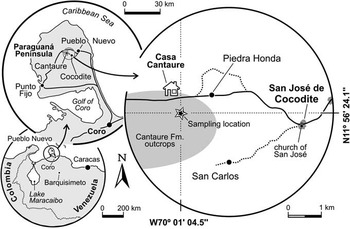
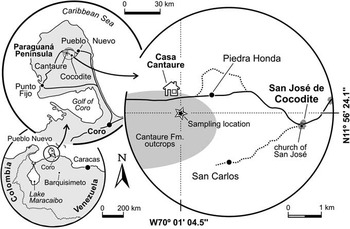
The Chauvetia material herein described and discussed comes from the San José de Cocodite region in the Paraguaná Peninsula of northern Venezuela (Falcon State). The collection site where it originates from is located in the Cantaure area, 3.4 km west of the church of the village of San José de Cocodite (as the crow flies), at an altitude of approximately 140 m above sea-level on an acacia and cactus covered area approximately 400 m South of Casa Cantaure with the approximate geographic coordinates: N11º 56' 24.1'' W70º 01' 04.5'' (Fig. 1; location of Casa Cantaure after Griffiths et al., Reference Griffiths, Müller, Johnson and Aguilera2013: N11º 56' 35.9'' W70º 01' 10.8'').
Geographic location of the study site South of Casa Cantaure, Paraguaná Peninsula, Falcón State, Venezuela, in which the specimens of Chauvetia inopinata nov. sp. species were collected.
The specimens were collected from a thick friable yellow fine sandstone bed containing an abundant and diversified molluscan assemblage (mostly gastropods and bivalves with rare fossils of Nautilus cephalopods), as well as other elements such as barnacles and corals. This bed is part of the Cantaure Formation (Jung, Reference Jung1965; Hunter and Bartok, Reference Hunter and Bartok1974) which as a whole, after Díaz de Gamero (Reference Díaz de Gamero1974), is correlated with the planktonic foraminiferal biozones Globigerinatella insueta and Praeorbulina glomerosa of Bolli (Reference Bolli1966), biozones N7 and N8 of Blow (Reference Blow1969), which in turn, according to the latest geologic time scale of Gradstein et al. (Reference Gradstein, Ogg, Schmitz and Ogg2012), correspond to the Lower to Middle Miocene transition, upper Burdigalian to lower Langhian. Rey (Reference Rey1996) corroborates this biostratigraphic correlation stating that the Cantaure calcareous nannofossil assemblage contains the Helicosphaera ampliaperta and Sphenolithus heteromorphus markers corresponding to the biozones NN4 and NN5 of Martini (Reference Martini1971), which broadly correlate with the above mentioned foraminiferal zones.
In several recent papers, however, the Cantaure Formation continues to be assigned to the Lower Miocene, Burdigalian, after the traditional correlation of Díaz de Gamero (Reference Díaz de Gamero1974) and Rey (Reference Rey1996). Aguilera and Rodrígues de Aguilera (Reference Aguilera and Rodrígues de Aguilera1999), based on planktonic foraminifera data from a personal communication by Collins, place the Cantaure Formation in the Lower Miocene, Burdigalian. Griffiths et al. (Reference Griffiths, Müller, Johnson and Aguilera2013), based on 87Sr/86Sr isotope data obtained from corals, assign an age of between 16.3 and 16.6 Ma to the fossils of Cantaure, placing them in the Burdigalian. These authors further comment that the isotopic results obtained are in good agreement with the traditional biostratigraphic age estimates for the Cantaure Formation based on the identification of the N7-N8 planktonic foraminiferal zones by Díaz de Gamero (Reference Díaz de Gamero1974) and the nannofossil biozones NN4-NN5 by Rey (Reference Rey1996). Anderson and Roopnarine (Reference Anderson and Roopnarine2005), on the other hand, in their Table 2, place the Cantaure Formation in the Burdigalian-Langhian, straddling the Lower-Middle Miocene boundary.
The Cantaure Formation consists of an approximately 75 m thick sedimentary sequence mainly composed of fossiliferous silts, silty sandstones and fine to medium sandstones interbedded with thin algal limestones (Hunter and Bartok Reference Hunter and Bartok1974; Léxico Estratigráfico de Venezuela, 1997; Aguilera et al., Reference Aguilera, Moraes-Santos, Costa, Ohe, Jaramillo and Nogueira2013). A diverse fossil assemblage, particularly rich in molluscs, but also featuring corals, decapods and cirripedian crustaceans, and fish remains, has been identified in the sediments of the Cantaure section, especially in its lower part (e.g. Jung Reference Jung1965; Nolf and Aguilera Reference Nolf and Aguilera1998; Aguilera and Rodrigues de Aguilera, Reference Aguilera and Rodrígues de Aguilera1999; Griffiths et al., Reference Griffiths, Müller, Johnson and Aguilera2013). Locally, decimetric boulders of limestone with in situ attached valves of the shallow marine bivalve Spondylus sp. may be observed within the friable fine sandstone beds. This fossil assemblage is indicative of a shallow, coastal tropical marine environment, with clear waters and marine euhaline salinity (Jung, Reference Jung1965; Díaz de Gamero, Reference Díaz de Gamero1974; Nolf and Aguilera, Reference Nolf and Aguilera1998; Aguilera et al., Reference Aguilera, Moraes-Santos, Costa, Ohe, Jaramillo and Nogueira2013; Griffiths et al., Reference Griffiths, Müller, Johnson and Aguilera2013).
Systematic paleontology
The material described here is from the Gibson-Smith collection, housed in the Naturhistorisches Museum Basel (NMB coll.), Switzerland. Abbreviations: NMB, Naturhistorisches Museum Basel, Switzerland.
Measurements taken with scanning electron microscopy photographs: dn=diameter first ½ protoconch whorl; dp=diameter protoconch; dp/hp=diameter of protoconch/height; dp1=diameter first protoconch whorl; hp=height protoconch.
Class Gastropoda Cuvier, 1797
Superfamily Buccinoidea Rafinsque, 1815
Family Buccinidae Rafinsque, 1815
Genus Chauvetia Monterosato, Reference Monterosato1884
Type species
Nesaea mamillata Risso, Reference Risso1826, by typification of replaced name, Recent, Mediterranean.
Chauvetia inopinata new species
Diagnosis
Shell small, fusiform, with a paucispiral protoconch bearing spiral cordlets, a teleoconch composed of strongly convex whorls, with predominant axial sculpture, without tubercles formed at the sculptural intersections and a small aperture without denticles.
Description
Shell small for genus, fusiform. Protoconch paucispiral, composed of 1.5 convex whorls, with large nucleus (dn=190 μm; dp=460 μm; hp=390 μm; dp/hp=1.18; dp1=330 μm). Protoconch bearing sculpture of fine, close-set spiral cordlets. Junction with teleoconch sharply delimited by line of protoconch outer lip and beginning of adult sculpture. Teleoconch of four strongly convex whorls, with periphery just below mid-whorl. Suture linear, impressed. Axial sculpture predominant, consisting of weakly opisthocline rounded ribs, slightly narrower than their interspaces, seven on first teleoconch whorl, increasing in number abapically to 12 on penultimate whorl and 15–16 on last whorl. Spiral cords roughly equal in width to their interspaces, five on the first teleoconch whorl, increasing in number abapically to 7–8 on the penultimate whorl and 12 on last whorl. Spiral cords override axial ribs, but not swollen at sculptural intersections. Last whorl short, convex, constricted at base. Aperture small, ovate; outer lip slightly thickened at edge, smooth within; anal canal not developed, siphonal canal short, wide, open. Columella excavated, smooth. Columellar callus poorly developed, narrow, hardly thickened. Siphonal fasciole short, bearing spiral cords.
Etymology
From Latin inopinatus, adjective, meaning unexpected, unforeseen, as we did not expect to find representatives of the genus in the Miocene Caribbean assemblages. Chauvetia gender feminine.
Types
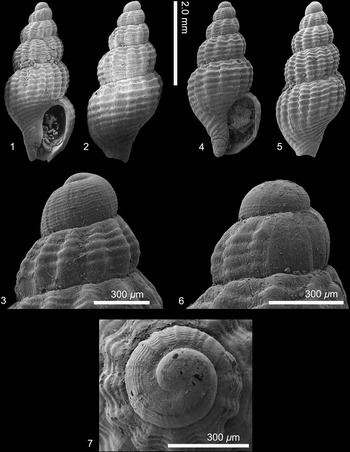
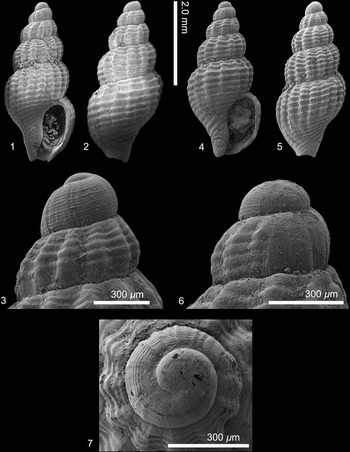
Holotype NMB H20317, height 3.9 mm (Figures 2.1–2.3, 2.7), paratype 1 NMB H20318, height 3.7 mm, paratype 2 NMB H20319, height 3.6 mm (Figures 1.4–1.6), paratype 3 NMB H20320, height 3.7 mm.
Specimens of Chauvetia inopinata nov. sp. from South of Casa Cantaure, Paraguaná Peninsula, Falcón State, Venezuela; Cantaure Formation, upper Burdigalian to lower Langhian, Miocene: (1–3, 7) Holotype NMB H20317, height 3.9 mm. (4–6) paratype 1 NMB H20318. NMB locality 17516.
Other material examined
Known only from type material.
Occurrence
NMB locality 17516. South of Casa Cantaure, Paraguaná Peninsula, Falcón State, Venezuela, Cantaure Formation, upper Burdigalian to lower Langhian, Lower to Middle Miocene transition.
Differentiation
This new Venezuelan Miocene material is very unlikely to be conspecific with any of the known Pliocene to Recent European or West African congeners. However, several of the Recent eastern Atlantic European species have shells with closely similar sculpture: i.e. Chauvetia mamillata (Risso, Reference Risso1826); C. procerula (Monterosato, Reference Monterosato1889); C. lamyi Knudsen, Reference Knudsen1956 among others. The shell of Chauvetia inopinata nov. sp. differs from most of its congeners in being smaller in size, about half the height of most modern European Chauvetia specimens, and in not having denticles developed within the aperture. The protoconch of the Cantaure specimens is also significantly smaller (dp=460 μm) than that of most Recent species with similar sculpture, which have a protoconch diameter of 600–900 μm, depending on the species (see Oliver and Rolán, Reference Oliver and Rolán2008, Reference Oliver and Rolán2009; Gofas and Oliver, Reference Gofas and Oliver2010).
Discussion and conclusion
In the present day, the genus Chauvetia has an eastern Atlantic and Mediterranean distribution. It spans several biogeographical provinces, from the cool temperate southern part of the Boreal-Celtic Province in the North, to the tropical Mauritanian-Senegalese molluscan province of Raffi et al. (Reference Raffi, Stanley and Marasti1985), in the South.
The genus Chauvetia makes its first appearance in the fossil record in the European Upper Miocene, with one undescribed species present in the Cacela creek outcrop of southern Portugal (BL collection, and personal observations), lower member of the Cacela Formation. According to Cachão (Reference Cachão1995) and Cachão and Silva (Reference Cachão and da Silva2000), the calcareous nannofossils assemblage from the fossiliferous beds of the Cacela creek outcrop correlate it with the lower part of the biozone NN11 of Martini (Reference Martini1971) or the biozone CN9a of Okada and Bukry (Reference Okada and Bukry1980), upper Tortonian, approximately 8.12–7.42 Ma (geochronology according to the latest geologic time scale of Gradstein et al., Reference Gradstein, Ogg, Schmitz and Ogg2012).
There are no published records for Chauvetia in the rich and diversified Miocene fossil record of Italy. In the European Lower Pliocene the genus is more speciose, with two species recorded by Chirli (Reference Chirli2000) from the Italian assemblages, two species from the Atlantic Lower Pliocene of the Guadalquivir Basin, southern Spain (Landau et al., Reference Landau, da Silva and Mayoral2011), and two in the uppermost Zanclean to lowermost Piacenzian of the Mondego Basin of central West Portugal (Silva, Reference Silva2001). However, for the Pliocene, by far the greatest diversity is seen in the Zanclean Mediterranean assemblages of the Estepona Basin of southern Spain, where at least ten species occur. This material awaits description as part of the Estepona series of monographs (e.g., Landau et al., Reference Landau, Beu and Marquet2004, Reference Landau, da Silva and Gili2009; Landau and Silva, Reference Landau and da Silva2006).
The genus Donovania Bucquoy, Dautzenberg, and Dollfus, Reference Bucquoy, Dautzenberg and Dollfus1883 is an invalid junior homonym of Donovania Leach, 1814 [Crustacea]), and considered a synonym of Chauvetia. The Middle Miocene species Donovania miocaenica Boettger, Reference Boettger1902 (figured by Zilch, Reference Zilch1934, pl. 18, fig. 31) from Kostej, Romania, seems to have a multispiral protoconch and a shallow anal sinus, and is not a Chauvetia but a turrid. Indeed Zilch (Reference Zilch1934, p. 261) placed the species in the genus Haedropleura Bucquoy, Dautzenberg and Dollfus, Reference Bucquoy, Dautzenberg and Dollfus1883, however, the shell has unusually strong spiral sculpture for this genus and may be closer to the horaiclavid Anacithara Hedley Reference Hedley1922 (personal communication, R. Janssen, 2014).
The pre-Late Miocene history of the genus in the eastern Atlantic and the Mediterranean is unknown. The hitherto known fossil record and the present day distribution of the genus would suggest an eastern Atlantic origin. Therefore, the presence of the genus Chauvetia in the Lower-Middle Miocene of the Caribbean is totally unexpected, and very interesting. Chauvetia inopinata nov. sp. from Cantaure is now not only the earliest occurrence for the genus, but also its only known Western Atlantic record, fossil or extant. This Caribbean Miocene species sheds new light on the geological history and the biogeography of Chauvetia, modifying all previous notions on the origin and history of the genus.
Are the origins of the genus in the western Atlantic, in the Caribbean, rather than in the eastern Atlantic? Certainly other typically western Atlantic genera with paucispiral protoconchs, and hence inferred to have non-planktotrophic development (even intracapsular in most cases), seem to have found their way across the Atlantic (Vermeij and Rosenberg, Reference Vermeij and Rosenberg1993; Silva et al., Reference Silva, Landau and La Perna2011).
For example, the extant marginelliforms Prunum and Persicula are abundant and diversified in the western Atlantic. Prunum is a prominent element of the Neogene fossil assemblages of tropical America (Nehm, Reference Nehm2001; Landau and Silva, Reference Landau and da Silva2010). Persicula is known from the fossil record of both the eastern and the western Atlantic since the Eocene (Nieulande, Reference Nieulande1981; Coovert and Coovert, Reference Coovert and Coovert1995, respectively). In Europe, however, the genus is absent in the Oligocene and Miocene, whereas the record is continuous on the other side of the Atlantic.
As shown by Silva et al. (Reference Silva, Landau and La Perna2011), it is plausible to assume that representatives of these genera emigrated from the western Atlantic. All marginelliform gastropods have paucispiral protoconchs and for those species in which development is known, they are direct developing and non-planktotrophic (Coovert and Coovert, Reference Coovert and Coovert1995; Penchaszadeh and Rincon, 1996). Such types of larval development would make the west-east Atlantic immigration more difficult, but not impossible.
Ávila (Reference Ávila2005) noted that numerous extant species found both on the western Atlantic and in the Azores also have non-planktotrophic development. Moreover, he demonstrated a correlation between bathymetric distribution of species and dispersal ability; those gastropods with non-planktotrophic development living in the tidal zone are most likely to disperse, namely by rafting, attached to algae and other floating materials, which are more common at shallower depths.
Almost all Chauvetia species have a shallow bathymetric distribution, subtidal, at not more than 20–30 m depth (Oliver and Rolán, Reference Oliver and Rolán2008, Reference Oliver and Rolán2009). The possibility of dispersal by rafting is further supported by the findings of Hergueta et al. (Reference Hergueta, Luque and Templado2002), who observed that, for example, C. mamillata (Risso, Reference Risso1826) in the Mediterranean coasts of Spain lives typically on sea grass blades and on algae, both substrates adequate for effective rafting. It is reasonable to assume that the Miocene western Atlantic representatives of these genera would live in similar habitats, and share similar modes of life, which would facilitate dispersal by rafting, especially taking into consideration the inferred shallow, coastal marine palaeoenvironments of Cantaure.
Vermeij and Rosenberg (Reference Vermeij and Rosenberg1993) suggest that eastward dispersal of marine gastropods across the Atlantic is a somewhat recent phenomenon, with no documented cases older than Middle Pliocene (Piacenzian). This eastward dispersal resulted from changes in northern Atlantic Ocean currents, following the final closure of the Central American Seaway (CAS) at around 3.5–3.0 Ma (Coates et al., Reference Coates, Collins, Aubry and Berggren2004; Coates and Stallard, Reference Coates and Stallard2013). Before the emersion of the Isthmus of Panama, westward flowing oceanic currents —the Circum-Tropical Current—normally prevailed (Vermeij and Rosenberg, Reference Vermeij and Rosenberg1993). After closure, the northward Intra-Caribbean Current was activated and the Gulf Stream became more vigorous (Cronin and Dowsett, Reference Cronin and Dowsett1996), thus facilitating eastward dispersal.
What is puzzling in the eastern dispersal of Chauvetia across the Atlantic is that, unlike the case of the early–mid Pliocene emigration of Prunum and Persicula, it must have occurred, at the latest, before the end of the Tortonian, Late Miocene, that is, well before the emergence of the Isthmus of Panama, and the consequent demise of the CAS.
The closure of the CAS was not a single, short-lived event. Coates et al. (Reference Coates, Jackson, Collins, Cronin, Dowsett, Bybell, Jung and Obando1992) dated the final closure at about 3.5 Ma. Coates and Obando (Reference Coates and Obando1996) at 3.1–2.8 Ma and Collins (Reference Collins2003) at about 4 Ma, and Tiedemann et al. (in Coates et al., Reference Coates, McNeill, Aubry, Berggren and Collins2005) at 2.8 Ma. Most recent consensus view is final closure of the last seaway about 3.5–3.0 Ma (Coates and Stallard, Reference Coates and Stallard2013; Jackson and O’Dea, Reference Jackson and O’Dea2013). However, the process leading to the emergence of the Isthmus of Panama started earlier, much earlier. As summarized by Molnar (Reference Molnar2008), the combination of the rise of the volcanic arc that now constitutes the southern part of Central America beginning at 25–15 Ma (late Chattian-Burdigalian) (Farris et al., Reference Farris, Jaramillo, Bayona, Restrepo-Moreno, Montes, Cardona, Mora, Speakman, Glascock and Valencia2011, Montes et al., Reference Montes, Cardona, McFadden, Morón, Silva, Restrepo-Moreno, Ramírez, Hoyos, Wilson, Farris, Bayona, Jaramillo, Valencia, Bryan and Flores2012), the emergence of an archipelago by ~12 Ma (Serravalian) (Coates el al., Reference Coates, Aubry, Berggren, Collins and Kunk2003), and their collision with northern South America by ~7 Ma (Tortonian-Messinian transition) implies that deep water passages connecting the western Atlantic, the Caribbean, and the Pacific had vanished by the end of the Tortonian, or even slightly earlier. Shallow water connections, however, could have continued until much later.
Kameo and Sato (Reference Kameo and Sato2000) based on nannofossil assemblages from the Caribbean Sea and the eastern equatorial Pacific Ocean inferred Neogene surface water circulation changes. According to them, in the time slab 15.83–10.71 Ma (Langhian–early Tortonian), and probably earlier, nannofossil distributions clearly show the existence of an East-West Circum-Tropical Current between the Caribbean and the eastern equatorial Pacific and no surface water communication between the northern and southern Caribbean, enhancing the Gulf Stream and the North Atlantic Current. On the other hand, during the 10.71–9.36 Ma interval (early-mid Tortonian), the Circum-Tropical Current weakened, and the northward Intra-Caribbean Current was initiated. Later, northern and southern Caribbean surface waters became separated at 8.35–3.65 Ma (late Tortonian-Zanclean) and the Circum-Tropical Current was restored. After 2.76 Ma (Gelasian-Recent), as a consequence of the rise of the Isthmus of Panama and the CAS closure, the northward Intra-Caribbean current was completely established and the Circum-Tropical Current vanished. Moreover, based on Pacific type foraminifera and the cool waters interpretation for the paleoenvironments recorded in the uppermost Miocene Chagres Formation on Panama’s Caribbean side, this eastward flow continued, at least intermittently, until the Early Pliocene (Collins et al., Reference Collins, Budd and Coates1996 a,Reference Collins, Coates, Berggren, Aubry and Zhangb; Leigh et al., Reference Leigh, O’Dea and Vermeij2014).
Based on the available data on the evolution of ocean circulation in the proto-Caribbean area it is therefore possible to formulate the hypothesis that the pre-late Tortonian (pre-8.12–7.42 Ma) dispersal of the tropical Gatunian west-Atlantic Chauvetia into the tropical East Atlantic European-West African Province most probably happened during the 10.71–9.36 Ma interval (early–mid Tortonian) during which the Circum-Tropical Current weakened, and the northward Intra-Caribbean Current had started, enhancing the Gulf Stream and the North Atlantic Current, as described by Kameo and Sato (Reference Kameo and Sato2000). This new data constitutes compelling evidence of a pre-Pliocene eastward dispersal of New World shallow marine organisms across the Atlantic.
The post early-mid Miocene fate of the genus in the Caribbean remains a mystery. We are aware of no other example of a species originating in tropical America that no longer lives there, but does occurs elsewhere. Furthermore, we cannot identify antecedents in either the eastern or western Atlantic or tropical American faunas for the genus. However, this may be due to us looking in the wrong place. If the taxonomic placement of Chauvetia were closer to the Muricidae as possibly suggested by preliminary molecular analysis (personal communication, M. Oliverio, 2014), it may be that its origins lie within groups such as the Muricopsinae or the Ergalataxinae. One can only hope that future research on the New World Miocene molluscan fossil assemblages, especially relating to microgastropods, a clearly under-researched group, might shed more on this subject.
Acknowledgments
To Emilio Rolán of the Museo de Historia Natural, Santiago de Compostela, Spain for his advice on generic placement. To Ronald Janssen of the Senckenberg Forschungsinstitut und Naturmuseum, Frankfurt am Main, Germany, for checking the type specimen of Donovania miocaenica Boettger, Reference Boettger1902. To Marco Oliverio, of the Department of Biology and Biotechnologies “Charles Darwin” Zoology, Rome, Italy for his advice.