INTRODUCTION
Becoming a fully competent speaker of a language involves numerous aspects: acquiring the phonology, developing a lexicon, learning how to inflect verbs and noun phrases, or learning how to build sentences. However, in order to communicate smoothly and efficiently with other speakers, children also have to learn how to organize the information they want to convey in such a way that the message will be well understood by their interlocutors. A central dimension of information structure is information status, that is, the marking of discourse referents as new or given. Studies on the acquisition of information status marking have mostly concentrated on morphosyntactic means, in particular the use of definite and indefinite noun phrases. Considerably less research has been concerned with the acquisition of intonational means. This is somewhat surprising in view of the attention the linguistic community has dedicated to the link between information status and intonation in adult language. Here, research suggests that there may be a direct mapping between information status and certain types of pitch accents. How and when children come to acquire this mapping has not yet been investigated. The present study investigates how German five- and seven-year-olds signal varying degrees of givenness intonationally in a story-telling task. It focuses on the use of different pitch accent types and compares their performance to that of an adult control group. By using a narrative context rather than an experiment, the study seeks to deliver ecologically valid data that is closer to children's actual production in everyday conversation and answer the question of how information status marking is integrated with other functions of intonation, such as the signalling of discourse structure.
The article is organized as follows: in the background section, first a brief introduction to the notion of information status and its manifestations in adult language will be given. This is followed by a short account of the theoretical framework of intonation that is used in this study, and a discussion of recent findings on the relationship between information status and intonation. The third subsection reviews previous developmental studies concerned with information status marking in child language. Following this, two main research questions are identified. The methodology of the study is then outlined. After a summary of the results, it is concluded that five-year-old children have already acquired the necessary pitch accent inventory and are adult-like in their marking of information status. It is furthermore suggested that interactional functions of intonation are acquired only later. Finally, it is argued that the original theory for information status marking in adult German needs to be reconsidered, and the case is made for using more natural data to establish target models for intonation.
Information status marking in adult language
An important factor that influences the linguistic form in which speakers refer to discourse referents is previous discourse history. Speakers tend to use less explicit forms such as pronouns for referents that were previously mentioned (e.g. Arnold, Reference Arnold1998; Chafe, Reference Chafe1994). Note that this holds for visual languages, too: In American Sign Language, previously introduced referents are referred to by using signs that are associated with specific locations in signing space (Emmory, Corina & Bellugi, Reference Emmory, Corina, Bellugi, Emmory and Snitzer1995). It has been suggested that this is because speakers assess the listener's mental state and choose an expression that enables the listener to identify the referent efficiently (e.g. Chafe, Reference Chafe1994; Prince, Reference Prince and Cole1981). A referent that has been mentioned previously can be assumed to be part of the listener's discourse model and its representation can be more easily accessed. There is a wealth of literature on other factors that may influence a referent's accessibility in discourse (for a review, see Arnold, Reference Arnold2008), but this section will focus on the effect of previous mention on linguistic form.
Information status (i.e. whether a referent is given or new in the discourse) is reflected not only in the lexical choice for a referring expression, but also in its intonational realization. The standard assumption for West-Germanic languages like English and German has been that new referents are accented, whereas given referents are unaccented (e.g. Chafe, Reference Chafe1974; Prince, Reference Prince and Cole1981). However, it has also been observed that given referents tend to be accented when they are re-introduced into the discourse at a later point (Brown, Reference Brown, Cutler and Ladd1983; Terken, Reference Terken1984). This has led some scholars to argue that viewing the pragmatic given/new distinction as a dichotomy is too simplistic (e.g. Chafe, Reference Chafe1974). Chafe (Reference Chafe1994), for instance, assumes that there is at least a third category between given and new, which he calls ‘accessible’. The precise nature of the intonational marking of accessible referents, however, is not agreed upon. Chafe himself hypothesizes that accessible information is treated in the same way as new information (Chafe, Reference Chafe1994: 75). Lambrecht (Reference Lambrecht1994), on the other hand, assumes that speakers can choose whether to accent an accessible referent or not, depending on several other discourse factors.
More recently, researchers have argued that the relationship between information status and intonation is more complex. It has been suggested that the type of accent also plays a role in signalling a referent's information status, and that there may even be a distinct accent which is used to mark accessible referents. These hypotheses will be discussed in the next section after an outline of the intonation model that was used in this study.
Intonation and information status marking
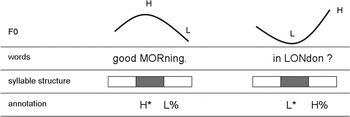
The term ‘intonation’ refers mostly to properties of the fundamental frequency (F0), or pitch, while prosody is more often used to also comprise other parameters such as loudness (intensity) and duration. Intonation serves a range of linguistic and paralinguistic functions, including the marking of sentence modality (question vs. statements), indicating utterance completion, or the expression of emotions and attitudes. The intonational structure of an utterance is organized on an abstract (phonological) level. In this paper, intonation is discussed within the autosegmental–metrical (AM) framework (Pierrehumbert, Reference Pierrehumbert1980), and annotated using the German Tones and Break Indices (GToBI) system (Grice & Baumann, Reference Grice and Baumann2002). In the AM framework, intonation patterns are described as sequences of high (H) and low tones (L). These tones are aligned with prominent (lexically stressed) syllables in the text and the edges of phrases. Tones that are associated with prominent syllables are called pitch accents, which can consist of one or two tones (connected with a ‘+’ sign). The diacritic ‘*’ indicates which tone bears the association with the lexically stressed syllable. Tones associated with phrase edges are referred to as boundary tones, symbolized with the ‘%’ sign. Both pitch accents and edge tones can be affected by two kinds of modifications: if a high tone (H) is considerably lower than a preceding high tone (without being a real low tone), it is said to be downstepped. If it is considerably higher in relation to the preceding high tone, it is said to be upstepped. Downstep is marked in transcriptions by inserting a ‘!’ before the affected tone; upstep is indicated by a ‘^’. An illustration of different pitch accent types and boundary tones is provided in Figure 1. Pitch accents are said to ‘convey information about the status of the individual discourse referents’ (Pierrehumbert & Hirschberg, Reference Pierrehumbert, Hirschberg, Cohen, Morgan and Pollack1990: 286), whereas the type of boundary tone indicates whether the current utterance should be interpreted together with the following utterance (high boundary tones), or not (low boundary tones; p. 305).
Schematic representation of an utterance with a high accent followed by a low boundary tone (left) and a low accent followed by a high boundary tone (right). The first line indicates the F0 movement. The second line provides the text, with capital letters signalling the accented syllable. The third line is a representation of the syllable structure. The grey-shaded areas indicate the lexically stressed syllable. The fourth line gives the symbolic representation of the tones in AM-notation.

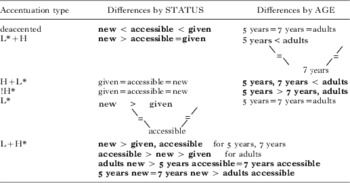
With respect to the meaning of pitch accents, Pierrehumbert and Hirschberg (Reference Pierrehumbert, Hirschberg, Cohen, Morgan and Pollack1990) postulate (for English) that H* pitch accents signal that a referent should be treated as new to the discourse (‘added to the mutual belief space’; p. 290), whereas L* accents convey that the referent is already part of the listener's discourse model. This hypothesis has received empirical support in eye-tracking experiments that have shown that the type of pitch accent listeners hear influences their interpretation of a referent's information status even before the entire target word has been heard (Chen, Den Os & De Ruiter, Reference Chen, Den Os and De Ruiter2007). Furthermore, off-line appropriateness judgments in German showed that listeners have preferences for certain pitch accent types as realizations for different information statuses (e.g. Baumann & Grice, Reference Baumann and Grice2006). Listeners were asked to rate the appropriateness of H*, H+L*, and unaccented as realizations for referents that were either new (unmentioned), given (mentioned in the previous sentence), or accessible (introduced several sentences before). Listeners considered H* most appropriate for signalling newness, whereas being unaccented was judged the preferred realization for given referents, paralleling the results for English (Chen et al., Reference Chen, Den Os and De Ruiter2007). This is in line with the general assumption that there are similarities between the intonation of West-Germanic languages such as English, German, and Dutch. For accessible referents, listeners preferred H+L* and deaccentuation over H*. In production, too, Baumann (Reference Baumann2006) observed that in a corpus of (German) read-out newspaper articles, accessible referents were predominantly realized with H+L*. On the basis of these findings, Baumann and Grice (Reference Baumann and Grice2006) suggest the mapping of information status and accentuation type for German shown in Figure 2.
Proposed mapping between information status and accentuation type in German (adapted from Baumann & Grice, Reference Baumann and Grice2006: 1655).

Information status marking in child language
Reference production is a major topic in language acquisition research, because it requires both knowledge of the linguistic forms and cognitive (pragmatic) skills in order to be able to use these forms in the right contexts. While the morphosyntactic marking of information status has received considerable attention (for an overview, see, e.g. Hickmann, Reference Hickmann2003), only very little is known about the way children learn to use of intonation to signal newness or givenness. There is no dedicated theory about the acquisition of the mapping between information status and pitch accent type, but findings from different strands of research may give some indication of what can be expected. The cognitive basis for distinguishing what is given and what is new for another person seems to be established by two years of age (e.g. Tomasello & Haberl, Reference Tomasello and Haberl2003). Despite this, young children's communication has often been described as being ‘egocentric’ (e.g. Piaget, Reference Piaget1926, 1955). It has been observed that children up to the age of seven have difficulty with the correct morphosyntactic marking of information status. They sometimes introduce new referents inappropriately with definite determiners and pronouns in the absence of mutual knowledge (e.g. Hickmann, Hendriks, Roland & Liang, Reference Hickmann, Hendriks, Roland and Liang1996; Kail & Hickmann, Reference Kail and Hickmann1992). Different hypotheses have been put forward to explain these ‘egocentric’ errors. Within functionalist approaches (see e.g. Hickmann et al., Reference Hickmann, Hendriks, Roland and Liang1996; Karmiloff-Smith, Reference Karmiloff-Smith1979) it has been assumed that children are only gradually becoming aware of the various functions that linguistic forms can have, such as the function of definite/indefinite forms to mark specific/non-specific reference as well as information status, and that certain markers (e.g. syntactic constructions) may be more difficult to acquire than others (e.g. definiteness). Other researchers (De Cat, Reference De Cat2011) assume that children's errors are not due to a lack of knowledge of the target grammar rules of information encoding, but that they occur because the children tend to assume a wider common ground with their interlocutor than is actually the case (p. 853). This seems to be in conflict with the above-reported ability of very young children to distinguish what is given and what is new for others. It needs to be pointed out, however, that the studies that observed this ability never required the children to use language, let alone tell a story. Typically, the children were asked to hand a toy from an array of toys that the experimenter had either previously seen or not seen. Monitoring the addressee's perspective while conversing or telling a story is arguably more complex than this.
In view of children's difficulty in getting the morphosyntactic marking right, one could expect comparable errors in the intonational domain. For instance, it may be the case that children fail to accent referents that they introduce to the discourse to mark them as new. What is more, intonation may be even more difficult to acquire than morphosyntax: According to the model introduced above (Baumann & Grice, Reference Baumann and Grice2006), three distinct markings have to be acquired (for new, given, and accessible referents), while morphosyntactically, only two markings have to be learned (definite and indefinite). The accessible category in particular may be hard to grasp; learning when a referent is deemed accessible and which pitch accent to use may take longer than learning that a given referent ought to be deaccented.
Only a few studies on children's use of intonation to signal pragmatic distinctions such as given and new have been conducted. Most of them have looked at the realization of focus (e.g. Hornby & Hass, Reference Hornby and Hass1970; MacWhinney & Bates, Reference MacWhinney and Bates1978; both for American English), where the ‘focus’ of an utterance was defined as the contrastive element in two consecutive utterances (e.g. a boy riding a bike vs. a girl riding a bike). These studies have found that preschool children use intonation to highlight focused constituents. Wieman (Reference Wiemann1976) reports deaccenting of repeated nouns in spontaneous two-word utterances of five American English-acquiring children around two years of age, suggesting that children use intonation to mark ‘givenness’. However, Wieman found six cases only, and her findings were based on auditory impressions, without specifying clear criteria for what counts as ‘accented’.
Wonnacott and Watson (Reference Wonnacott and Watson2008) investigated how American English-acquiring four-year-olds modulated acoustic prominence (as measured in pitch, intensity, and duration) on referents depending on their ‘accessibility’ (Wonnacott and Watson's term). They asked four-year-old children to describe events in a video clip. One trial consisted of two scenes, the second of which was the target scene. Both scenes displayed the same action (e.g. kissing), but the status of the agent in the second scene was manipulated: in the New condition, the agent had not occurred in the preceding scene at all. In the Given-Shift condition, the agent had been the object (theme) in the first scene. In the Given-NonShift condition, the agent had occupied the same role in the first scene (cf. Table 1).
Experimental conditions in the Wonnacott and Watson study (adapted from Wonnacott & Watson, Reference Wonnacott and Watson2008: 1097); target words are in bold

Children produced a significantly higher maximum pitch and a higher mean intensity in the Given-Shift and the New condition compared to the Given-NonShift condition, whereas duration was not used to discriminate between the conditions. Wonnacott and Watson's study thus provides evidence that children use intonation to mark newness and givenness of referents. The results indicate that children were not making egocentric errors of the type reported for morphosyntactic marking. Given the similarity of the closely related intonational systems of the West-Germanic languages, it is very likely that German-acquiring children do use intonation in a very similar way. However, there are some limitations with respect to the conclusions that can be drawn from their results regarding the aims of the present study. First, it is uncertain whether the succession of trials in their study creates a ‘continuing discourse’ (Wonnacott & Watson, Reference Wonnacott and Watson2008: 1096) to a sufficient degree. Eliciting isolated pairs of structurally identical sentences reduced the children's task to marking oppositions in a very restricted linguistic environment. Second, the children were watching the scenes together with the interlocutor, which means that there was mutual knowledge between the two. Given that it is differences in perspective/knowledge that make information status marking such a challenging task, one would like to know how they perform when perspectives diverge. Finally, the study did not analyze the types of pitch accents the children used. The only reported information about F0 was the maximum pitch, independent of where it occurred in the target word. But the maximum pitch in an utterance can occur at different positions, leading to different pitch accent types (cf. Figure 1). In view of the prominent role that pitch accent type is assumed to play in information status marking in adult language, the exact phonological patterns children use are relevant. For example, deaccenting accessible referents (rather than using a H+L* accent) could indicate that children are treating information status as a dichotomous dimension (a referent is either new or given), and that they have not yet acquired the accessibility marking.
To sum up: in adult language (West-Germanic), there is evidence for the use of particular types of pitch accents to signal the information status (new, given, accessible) of a discourse referent. Whilst the cognitive basis for distinguishing given and new is already established at a very young age (two years), even seven-year-olds make errors in information status marking in the morphosyntactic domain. In the prosodic domain, four-year-olds have been shown to highlight newly introduced referents in highly controlled contexts. To what extent the assumed mapping between information status and pitch accent type holds for children is not known.
Against this background, this study asks the following research questions:
1. Do five- and seven-year-old children adhere to the information status–pitch accent type mapping that has been proposed for adults in the literature?
2. If not, how do children differ from adults in this respect?
This study aims at answering these questions by investigating the pitch accents that five- and seven-year-old German children use for information status marking in narrative discourse, and comparing them with adult production. To this end, semi-spontaneous speech data was obtained by means of a picture story elicitation task.
METHOD
Participants
Twenty-nine five-year-olds (range=4;11–5;11, mean=5;05, 11 boys, 18 girls) and twenty-six seven-year-old children (range=6;11–7;08, mean=7;03, 9 boys, 17 girls) participated in the experiment. The children were recruited from kindergartens and primary schools in the Niederrhein area of Germany (northwest Germany). Informed written consent was obtained from caregivers/parents. Twenty-eight adult speakers (mean age 23 years, 5 male, 23 female) acted as controls. Most of them were undergraduate students of psychology or linguistics at the University of Potsdam. All participants were native speakers of German and had no reported history of speech/language or other developmental deficits. The children received stickers for their participation. The adult participants were given course credit or a financial reimbursement.
Materials and design
Coloured picture stories were constructed to elicit the production of four different referents with three distinct information statuses each: new, given, and accessible. Picture stories were used rather than animated films, as it has been observed that children tend to make more referential errors with movies than with static pictures (Pratt & MacKenzie-Keating, Reference Pratt and MacKenzie-Keating1985). The stories were presented using a touch screen (for details, see below). In the new condition, the target referent occurred for the first time. In the given condition, a referent was first introduced, and occurred again as target referent in the immediately following picture. In the accessible condition, a referent was introduced at the beginning of the story, and re-occurred only after four (in one story) or five (in three stories) other intervening pictures, respectively. Between the two occurrences of the target referent, two other referents, one animate and one inanimate, played a part in the plot of the story to ensure that the activation of the target referent's representation was reduced.
In the studies on German discussed in the ‘Introduction’ (Baumann, Reference Baumann2006; Baumann & Grice, Reference Baumann and Grice2006), the target referents were always in phrase-final position. In order to make the results of the present study comparable to previous research, the stimuli were therefore also created in such a way as to elicit referents in phrase-final position. The target pictures showed simple transitive events (e.g. hugging, drawing), in which the target referents had non-agentive semantic roles (e.g. recipient, beneficiary). All four target referents were animals, which were assumed to be known to five-year-old children on the basis of results from a pilot study conducted with eleven children (age five) before. The words (the names of the target referents) were disyllabic and contained mostly sonorant segments to facilitate pitch tracking: Kamel (/kaˈmeːl/ ‘camel’), Möwe (/ˈmøˈvə/ ‘seagull’), Biber (/ˈbiˈbɐ/ ‘beaver’), and Biene (/ˈbiˈnə]/ ‘bee’). Note that Kamel – unlike the other three words – has an iambic stress pattern.
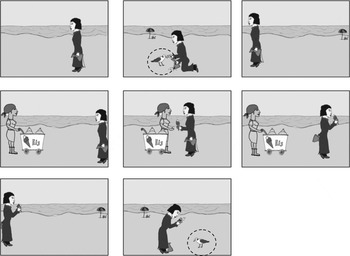
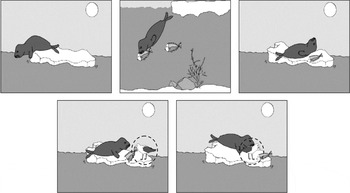
Since the intonational phenomena of interest can be best observed in full noun phrases, several measures were taken to reduce the likelihood of pronoun use for the target referents. It has been observed that in narration, young children pursue a ‘thematic subject strategy’: they seek to identify the main protagonist of a story, which they then tend to encode with a pronominal expression; this happens less often with more peripheral characters (e.g. Karmiloff-Smith, Reference Karmiloff-Smith1979). The stories were therefore constructed in such a way that the target referents played only a secondary role in the plot. In addition, the target referent and the agent shared the same grammatical gender so that pronoun use would lead to ambiguity and is therefore largely avoided (e.g. Arnold & Griffin, Reference Arnold and Griffin2007). Finally, the semantic role of the target referent switched from agentive to non-agentive in the given condition to discourage a ‘parallel role strategy’, whereby children use pronouns when co-referring expressions occur in the same role in consecutive events (Hickmann, Reference Hickmann2003). An example of a story containing a ‘new’ and an ‘accessible’ referent is provided in Figure 3, a ‘given’ story is provided in Figure 4.
Example of a picture story (order from top left to bottom right) for eliciting a referent with new and with accessible status. The target referent is the seagull (encircled) introduced in picture 2 (new condition), which occurs again in picture 8 (accessible condition).

Example of a picture story (order from top left to bottom right) for eliciting a referent with given status. The target referent is the seagull introduced in picture 4, which occurs again in picture 5 (the target picture).

Each referent appeared once in each condition. The new and the accessible condition occurred within the same story, that is, the introduction of the referent served for the new condition and its re-introduction as accessible. Referents in the given condition were presented in a separate story. Four additional stories (three pictures each) from another experiment served as fillers. In total, each participant told twelve stories. Four different lists were constructed by varying the order in which the stories appeared. Stories containing the same target referent (e.g. the ‘new/accessible’ story containing Kamel and the ‘given’ story containing Kamel) were always separated from each other by three other stories. Each time the story with the new and the accessible referent preceded the story with the given referent, but new/accessible stories and given stories were mixed (i.e. it is not the case that participants first told all new/accessible stories and then all given stories). Participants were randomly assigned to one of the four lists.
Procedure
Children
The children were tested individually by two female experimenters (Experimenter A and Experimenter B) in a quiet room at their kindergartens or schools. Each child participated in one 20–35-minute session. In the case of the five-year-olds, the experimenters spent some time before the actual session playing with the children in their playgroups to familiarize the children with their presence. The children were informed by Experimenter A that they were going to play a ‘story-telling game’. Experimenter A told the children that she wanted to test Experimenter B's memory, and that she would need the children's help for this. They were asked to tell Experimenter B several stories that Experimenter A had prepared in a ‘special picture book’. After the story telling, Experimenter A and the child would test Experimenter B by asking her questions about the stories. Children were seated at a comfortable distance in front of an Elotouch ET1525L touch screen, which served as the picture book. The screen was positioned in such a way that neither Experimenter A nor Experimenter B could see it, and Experimenter B made clear to the children that they had a privileged view by saying ‘Ah, this is unfair: You can now see the pictures and I can't!’
Sessions were sound-recorded using a 24-bit digital Wave recorder and an electret condenser microphone (ECM) at 44 kHz (16-bit format, stereo sound). The microphone was placed at about 25 cm distance from the child.
Upon pressing a button on the touch screen, the children saw the first picture of a story. After the children had described the action in the picture the button appeared again, and the children could press it to ‘turn over’ to the next picture when they felt ready to do so, allowing the children to go through the story at their own pace. A yellow circle in the centre of the screen indicated the end of a story. The screen presentation was controlled with the Nijmegen Experiment Set-up (NESU) software run on an IBM notebook. The appearance of the ‘turn-over button’ was under Experimenter A's control, to prevent children from inadvertently turning over too soon. The pictures were presented one after the other, because previous studies have found that with simultaneous presentation children tend to focus only on the last picture (Emslie & Stevenson, Reference Emslie and Stevenson1981: 317)
Children were asked to tell the events they saw and to explain everything ‘well’, so that Experimenter B could easily imagine what was happening in the stories and remember them. Care was taken not to use the instruction ‘describe what you see’, to avoid picture descriptions. The first story was a warm-up, in which Experimenter A explained to the children how the ‘special picture book’ worked.
In each trial, Experimenter B asked a broad-focus question (e.g. ‘And what happens then?’, ‘Oh, and what comes now?’, etc.) as a prompt before the picture, intended to elicit the target referent, but also at other points in the stories in order not to provide any cue that this picture was special. If the child's answer was unclear or ambiguous, Experimenter B indicated that she did not understand and asked the child again. This was repeated if necessary. If after two attempts the child still failed to provide a more informative answer, Experimenter B asked a more specific (narrow-focus) question (e.g. ‘Now, what is the seal biting?’), or gave the impression that she had misunderstood (e.g. ‘I see, the seagull is biting the seal’), which usually prompted the children to correct her. The purpose was to remind the children that Experimenter B did not see the pictures and to motivate them to provide more elaborate narrations next time, but these trials were later excluded from the analysis. The experimenter took care not to mention any of the target referents. There was a break of 3–5 minutes after half of the trials.
Adults
The participants sat in an anechoic chamber in the laboratory of the Linguistics Department of the University of Potsdam. The microphone was placed at about 25 cm distance from the speaker's mouth. The narrations were recorded using an ECM and a DAT recorder. The signals were digitized directly into the computer at a sampling rate of 44 kHz (16-bit format). The picture stories were presented on a computer screen using Microsoft PowerPoint. The screen was placed outside the recording booth and visible to the participants through a glass window in the recording booth.
The participants were instructed that they were going to see a number of short picture stories, which they should tell in such a way that another person listening to the recording would be able to retell the story without seeing the pictures. It was explained that the stories were simple because they had originally been constructed for children. In order to make the situation more natural, the experimenter acted as listener. This made it possible for the experimenter to ask a broad focus question before the target pictures, as done in the experiments with the children. A warm-up story similar to the experimental items preceded the first experimental story. Each recording session lasted about 15–20 minutes.
Data treatment
Item selection
Two recordings from adult subjects had to be excluded because of technical problems. All other recordings (children and adults) were fully transcribed using ELAN (version 3.4.0 <http://tla.mpi.nl/tools/tla-tools/elan/>). Speakers did not always produce the intended target referent. They sometimes used different words (e.g. Vogel ‘bird’ instead of Möwe ‘seagull’) or pronominal forms (i.e. personal and demonstrative pronouns), and sometimes failed to mention the referent at all (e.g. und jetzt macht die so ‘and now she is doing like this’, simulating the depicted action with gestures). As might be expected, the adults produced target referents more often than the children. While the adults produced the target words in 84·5% of the cases (265 target words, 31 non-target words), the seven-year-olds did so in 72·8% (236 target words, 63 non-target words), and the five-year-olds only in 51·7% (178 target words, 136 non-target words). Since especially the youngest age group often produced other nouns than the intended ones, the phonological analysis comprised both target and non-target words to arrive at an acceptable sample size. Pronominal forms (i.e. personal and demonstrative pronouns) were excluded. Four items had to be excluded because of experimenter error. The intonation of twenty-five items could not be analyzed because of creaky/breathy voice or laughter. Furthermore, utterances with disfluencies were discarded if the disfluency could be classified as a re-start or a filled pause (ähm ‘uhm’, etc.) and if it occurred directly before or in the target word (e.g. Und jetzt macht die ein Foto vom Kam-Kamel ‘and now she is taking a picture of the cam- camel’), but not if the disfluency occurred at the beginning of the utterance (e.g. Und…äh…ja, dann malt er eine Biene ‘And…uhm… ya, then he is drawing a bee’). If the disfluency was a hesitation (silent pause) which did not have a disruptive effect on the F0 contour if the pause was cut out, the utterance was included in the analysis, following a convention that has for instance been used in the Dutch ToDI System (Gussenhoven, Reference Gussenhoven and Jun2005). On the basis of these criteria, fifty-five further items were excluded, as were seventeen elliptical utterances, that is, utterances that consisted only of the target word, nineteen self-corrections (e.g. Jetzt macht sie ein Foto von der Krähe – nein, der Möwe ‘Now she is taking a picture of the crow – no, the seagull’), and eighteen utterances that had been produced as a response to a narrow focus question by the experimenter. In addition, referents in the new condition had in fourteen cases been realized with a definite article or a possessive pronoun (e.g. Und jetzt setzt er sich auf sein Kamel ‘and now he is sitting on his camel’). In twenty-two narrations of an accessible story, speakers did not produce the referent with the (expected) definite article. These cases of incorrect morphosyntactic marking were excluded so that the performance in morphosyntactic marking would be held constant. Sixteen cases in which speakers mentioned the target referent in the accessible condition before they were presented with the target picture (e.g. Er geht wahrscheinlich zurück zu seinem Kamel ‘He is probably going back to his camel’) were not included in the analysis, as in this case the activation of the target referent's representation was arguably higher than intended by the design. Finally, in forty cases a different label was used for a referent in the accessible condition than the one with which the referent had first been introduced (e.g. wasp – bee), so they were excluded as well.
As mentioned before, the stimuli in this study were designed to elicit referents in phrase-final position in order to make the findings comparable to previous research on information status marking in German. In about half of all utterances the speakers produced the word denoting the target referent indeed phrase-finally. In these cases, the end of the phrase was marked by a clearly perceptible pause. However, in the other half of the utterances, the target referent was followed by one or several words. These utterances were included in the analysis, if the target word was followed by either a verb particle (e.g. aus ‘out’, mit ‘with’) or a non-finite verb form (e.g. gemalt ‘painted’, machen ‘to make’). In these cases, the target referent is still the last referring expression in the sentence. The final data set contained 429 utterances, 145 from the five-year-old group, 159 from the seven-year-old group, and 125 from the adult group. This is equivalent to 43·6% of all possible items (982) that would have been available had all participants produced the intended referents in the intended structure fluently.
Prosodic annotation
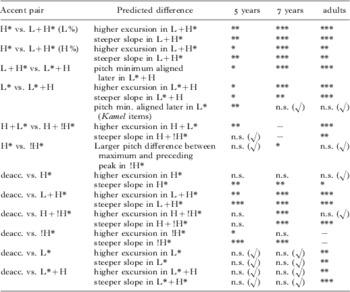
The utterances were annotated and analyzed using the speech-analysis tool Praat (Boersma & Weenink, 1992–Reference Boersma and Weenink2008) . Intonation of the target words, of the word following the target word (if there was one), and of the subsequent phrase boundary was labelled by a native speaker of German (the author) following the GToBI guidelines (Grice & Baumann, Reference Grice and Baumann2002). The ToBI system has been criticized by some researchers who argue for instance that the accents L+H* and H* do not constitute separate categories but are rather variants of the same category (see, e.g. Watson, Tanenhaus & Gunlogson, Reference Watson, Tanenhaus and Gunlogson2008, and references therein). Still, it is the most useful annotation system and most of the relevant work in the field of information status marking has been done within this framework. GToBI has therefore been used to ensure comparability with previous findings. The phonological annotation of intonation is, however, not easy. Even if several labellers code the data, they sometimes arrive at different category labels for a given accent. Given that further analyses depend on the accuracy of the labels, it is crucial to obtain additional support for the correct application of the GToBI system. In the present study, an instrumental method was used to check the labelling. In the labelling guidelines for GToBI, a number of distinguishing features are described to help identify the accent types. For instance, both the accents L+H* and L*+H are rising accents. They are said to differ, however, in the alignment of the tones with respect to the syllable structure. While in L+H* accents, the low tone (F0 minimum) is located before or at the beginning of the stressed syllable, and the rise occurs typically within the stressed syllable, and the high tone (F0 maximum) is reached in the stressed syllable. In L*+H, the low tone is supposed to be clearly within the accented syllable, with the rise beginning only very late in the syllable. From the defining features of the different pitch accent types given in the GToBI literature, testable predictions can be derived regarding phonetic differences between certain pairs of accents. Subsequently it can be tested whether the accents that had been assigned different accent labels (e.g. L+H* and L*+H) do differ from each other in the predicted way (e.g. in the position of the F0 minimum and F0 maximum with respect to the lexically stressed syllable). If this is the case, this can be seen as evidence that the accents have been labelled consistently. This procedure of systematic comparisons of the pitch accent types along a number of phonetic parameters is described in detail in De Ruiter (Reference De Ruiter2009) .
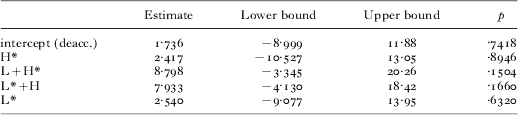
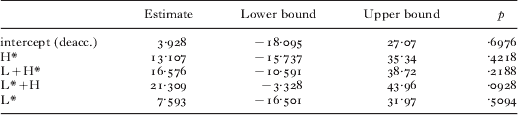
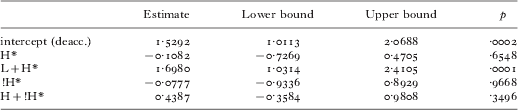
These analyses (see ‘Appendix’) confirmed that the phonetic properties of the accent types that were found in the data differed significantly from each other in the way predicted by the GToBI literature.Footnote 1 This provided substantial evidence that the accent types constitute distinct categories, and that the labels assigned to the items can be used for subsequent analyses.
Statistical analysis
All statistical analyses were performed using the statistical software R (R Development Core Team, 2008). The two research questions stated above were (1) whether five- and seven-year-old children adhere to the suggested information status–pitch accent mapping, and (2) if not, how the children differ from adults. We are thus interested in whether children show a clear mapping between information status and pitch accent type, and if this mapping is the one put forth in the literature. We also want to know if the age of a speaker has any influence on the choice of pitch accent. The statistical method used to address these questions was logistic regression. In other words, it was tested whether the outcome of a binary dependent variable was influenced by several predictor variables. The different pitch accent types were recoded as binary variables (e.g. ‘H* yes/no’). It was then tested whether the probability of a given accent (e.g. H*) occurring was influenced by the two (categorical) variables information STATUS (with the three levels new, given, and accessible) and AGE (with the three levels five years, seven years, and adults). The differences in the distribution of pitch accents across information statuses and age groups were analyzed using logit mixed-effects models (LME; Bates & Sarkar, Reference Bates and Sarkar2007). Mixed-effects models include both fixed effects (independent variables) that are repeatable (such as the experimental condition in an experiment, e.g. information status), and random effects (variables) that are randomly sampled from a much larger population (such as certain words or the particular speakers who took part in the experiment). In all subsequent analyses, the random effects WORD (i.e. the various animal terms used by the participants) and SUBJECT (i.e. the individual participants) were initially included in the regression model. They were removed from the model if the variance explained by them was effectively zero. If the explained variance was not zero, likelihood ratio tests were used to test whether the random effect parameters were justified in the model. Random slopes were initially also included in the models, but as in most cases the models did not converge, they were excluded in all models to achieve consistency across models. All reported p-values were obtained by Laplace approximation. (For reasons why Bonferroni correction and other p-value adjustments are inappropriate for this type of analysis, see Gelman & Hill, Reference Gelman and Hill2006.) However, mixed-effect models could not be used where there were too few cases in one of the categories: a rule of thumb for binomial models regarding the absolute upper limit for the number of parameters in the model is min(outcome A, outcome B)/10. Thus when there are only about twenty cases in one category, a model with three factors (two fixed, one random) would already be overfit. In these cases, Generalized Linear Models (GLM; the glm function in R) were employed, with only STATUS and AGE as factors instead. In the case of the accent H+L*, zero occurrences in some groups cause problems for both LME and GLM in R. To circumvent these problems, a z-test for two proportions was used instead, comparing the proportion of the accent type in each condition with its proportion in each of the other two. For this test, proportions are transformed into z-values (Fisher z-transformation) and then compared to each other (see Hinkle, Wiersma & Jurs, Reference Hinkle, Wiersma and Jurs2003).
RESULTS
When analyzing the data, it became clear that speakers used a variety of intonation patterns, far more than the three patterns that would be expected on the basis of previous research. Recall that the suggested mapping between information status and pitch accent type is that new referents are signalled with a H* accent, accessible referents are marked with the accent H+L*, and given referents are deaccented. The three most frequent accents and the alleged ‘accessibility accent’ H+L* are illustrated in Figure 5.
Shapes and GToBI labels of the three most frequent pitch accent types in the data, and the accent H+L*, followed by a low boundary tone. The grey-shaded box indicates the lexically stressed syllable.

However, results showed that – in addition to producing deaccented referents – speakers used seven different accent types. A second observation was that speakers produced not only falling contours (i.e. phrases that ended in a low boundary tone), but also rising contours (i.e. phrases that ended in a high boundary tone). This is both unexpected (the materials were not specifically designed to elicit high boundary tones) and interesting, as previous studies on the marking of information status have investigated only low-ending utterances. As discussed in the ‘Introduction’, it is assumed in autosegmental–metrical intonational theory that boundary tones are used to signal discourse structure. A high boundary tone means that the current phrase is to be interpreted together with the following phrase, whereas a low boundary tone indicates completion. The production of both high and low boundary tones draws our attention to the fact that speakers need to integrate the marking of the information status of (phrase-final) referents with how they choose to structure discourse. If only utterances with low boundary tones were analyzed, an important facet of intonational structure that children have to acquire, too, would be excluded.
The fact that speakers produced far more pitch accent types and both falling and rising contours suggests that the intonation patterns used in narrative discourse are more diverse than in scripted speech. We will first look at the types of pitch accents speakers of different ages used to mark new, given, and accessible referents. The second analysis will be concerned with the speakers' use of boundary tones.
Pitch accents
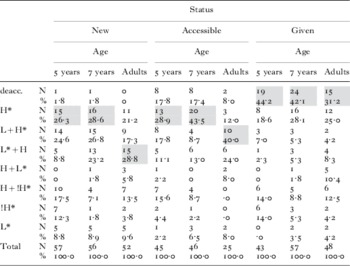
Table 2 shows the distribution of the accents (including unaccented) by information status and age. There were effects for six of the eight accentuation types, and only one significant interaction. Overall, there was a clear tendency for given referents to be deaccented, while new referents were accented. Accessible referents assumed an intermediate rank regarding the proportion of not carrying an accent. Further effects of information status emerged for L*+H accents, which were more frequent for new and accessible referents than for given ones. There was only one interaction between age and information status, which showed that five- and seven-year-olds used L+H* accents often to mark new referents, whereas adults used them more often to mark accessible referents. With respect to effects of age, the analyses revealed three main differences. First, five-year-olds produced fewer L*+H accents than adults. Second, five-year-olds used !H* accents more often than adults. Third, both five- and seven-year-olds realized referents with H+L* accents to a much lesser extent than adults. Below are the details of the analysis for the individual accentuation types.
Deaccented STATUS was a significant predictor for the proportion of deaccented referents, but age was not. Given referents were deaccented significantly more often than both new referents (β=−1·46, z=−4·46, p<·0001) and accessible referents (β=−4·24, z=−5·52, p<·0001). Furthermore, accessible referents were deaccented more often than new referents (β=2·75, z=1·59, p=·0004).
L* Only STATUS turned out to be a significant predictor for the proportion of L* accents, but not AGE. L* accents were used significantly more often in the new condition than in the given condition (β=1·35, z=1·99, p=·0456), but there was no difference between the new condition and the accessible condition (β=−0·70, z=−1·19, p=·2323), or the accessible condition and the given condition (β=0·65, z=0·83, p=·4042).
!H* AGE was a significant predictor for the proportion of !H* accents, but STATUS was not. The five-year-olds used this accent type significantly more often than both the adult group (β=−1·36, z=−2·35, p=·0185) and the seven-year-old group (β=−1·32, z=−2·474, p=·0134). However, there was no difference between the seven-year-olds and the adults (β=0·04, z=0·07, p=·9427).
L*+H Both STATUS and AGE turned out to be significant predictors for the proportion of L*+H accents. They occurred significantly more often in the new condition than in the given condition (β=1·80, z=3·67, p=·0002), and they were also used significantly more often in the accessible condition than in the given condition (β=1·59, z=3·00, p=·0027). No such difference was found between the new and the accessible condition (β=−0·21, z=−0·56, p=·5734). The five-year-olds used these accents significantly less often than the adult group (β=−1·44, z=−2·54, p=·0112), whereas the seven-year-olds did not differ from the adult group in this respect (β=−0·70, z=−1·38, p=·1660). There also was no difference between the five- and the seven-year-olds (β=0·73, z=1·29, p=·1966).
H+L* H+L* accents were rarely produced by the child groups, precluding the use of LME or GLM. A LME model with only STATUS as fixed factor showed that it was not a significant predictor for the proportion of H+L* accents. To test for differences across age groups, z-tests were used. These tests confirmed that the five-year-olds realized referents significantly less often with this type of accent than adults did (z=3·17, p=·0015). The seven-year-olds used H+L* only twice, so they also differed from the adult group (z=2·94, p=·0016). In contrast, the five- and the seven-year-olds did not differ from each other (z=0·50, p=·3083).
H+!H* Neither AGE nor STATUS had an effect on the proportion of H+!H* accents.
L+H* There was an interaction between AGE and STATUS regarding the proportion of L+H* accents. The five-year-olds used this accent more often in the new condition than in both the given condition (β=1·60, z=2·21, p=·0271) and the accessible condition (β=1·61, z=2·21, p=·0267). The same was true for the seven-year-olds (new vs. given: β=2·07, z=2·91 p=·0036; new vs. accessible: β=1·47, z=2·26, p=·0234). Compared to the other two conditions, adults used L+H* accents significantly more often in the accessible condition (accessible vs. new: β=1·28, z=2·18, p=·0288; accessible vs. given: β=2·96, z=3·27, p=·0011). They used L+H* accents marginally significantly more often in the new than in the given condition (β=1·70, z=1·92, p=·0549). Both child groups realized L+H* accents more often in the new condition than the adults in the accessible condition (five-year-olds vs. adults: β=1·74, z=2·20, p=·0274; seven-year-olds vs. adults: β=2·75, z=3·15, p=·0017), but the adults also used L+H* accents significantly more often in the new condition than both the five-year-olds in the accessible condition (β=1·73, z=2·19, p=·0279) and the seven-year-olds in the accessible condition (β=2·73, z=3·14, p=·0017).
Frequency distribution (absolute and relative) of pitch accent types by age and information status; the grey-shaded areas mark the most frequent realization for each age group in each condition

For the reader's convenience, the main results of the analyses are schematically represented Table 3, with significant differences highlighted in bold. Very similar results are obtained if only the target words are analyzed. Thus including non-target words in the present analysis increased the statistical power, but did not change the overall picture.
Differences of pitch accent type distribution by information status and age; statistically significant differences are highlighted in bold

Boundary tones
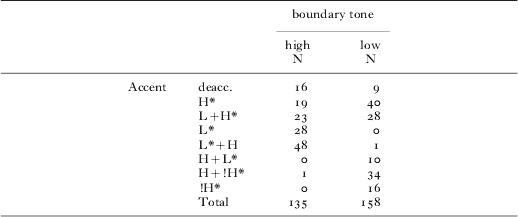
As mentioned above, speakers used both high and low boundary tones at the end of their utterances. Low accents (L*, L*+H) frequently occurred with high boundary tones, and high accents with low boundary tones. The frequency of the different pitch accent type + boundary combinations can be found in the Table 4.
Frequencies of pitch accent type+boundary tone combinations; note that boundary tones were only analyzed for those utterances in which the target referent was not followed by another pitch accent in the phrase
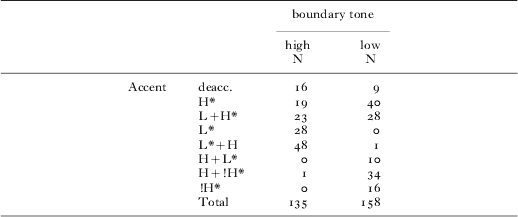
The age groups differed in how often they produced utterances with a high or a low boundary tone. In the adults' production, only 37·9% of the utterances ended in a low boundary tone. The seven-year-olds produced 50% of their utterances with a low boundary tone. The youngest age group produced nearly four times as many utterances ending in a low boundary tone than ending in a high boundary tone (73·6% and 26·4%, respectively). The differences were statistically tested using LME again, with the binary variable BOUNDARY (high/low) as dependent variable, and AGE as independent variable. Analyses showed that there was a clear effect of AGE. Five-year-olds produced significantly fewer utterances with high boundary tones than both adults (β=−1·75, z=−3·73, p=·0001) and seven-year-olds (β=−1·04, z=−2·35, p=·0184). The seven-year-olds, on the other hand, did not differ from the adults (p=·1134). The unequal distribution across age groups indicates that there is a developmental shift between five and seven years in the way intonation is used to structure discourse – we will return to this issue in the ‘General discussion’.
GENERAL DISCUSSION
This study set out to investigate whether five- and seven-year-old German children use dedicated pitch accent types to mark particular information statuses in the way this has been proposed to hold for adult German, and to see in what way they may differ from adults. Before we look at the children's performance and their differences with adults, however, it is necessary to first discuss the target model in more detail. What is the adult model that children are trying to attain? The adult data obtained in this study differ quite drastically from what has been reported in the literature, namely a clear mapping between the information status of a discourse referent and the type of pitch accent used. Specifically, it has been proposed that new referents are marked with a H* accent, accessible referents are marked with the accent H+L*, and given referents are deaccented.
What is the target model?
The present results call into question such a clear mapping, and more particularly the existence of a special accent for accessible referents. Speakers always accented new referents, which is consistent with claims in the literature (e.g. Chafe, Reference Chafe1974; Lambrecht, Reference Lambrecht1994) and previous production studies (e.g. Brown, Reference Brown, Cutler and Ladd1983; Terken & Hirschberg, Reference Terken and Hirschberg1994). However, no particular accent type emerged as the prototypical ‘newness accent’. The accent H*, which is assumed to be a marker for newness (Pierrehumbert & Hirschberg, Reference Pierrehumbert, Hirschberg, Cohen, Morgan and Pollack1990), and the related L+H* were used by adult speakers in about 40% of the cases, but about 30% of new referents were realized with L*+H accents. This finding is at odds with the suggestion that L* accents signal givenness (Chen et al., Reference Chen, Den Os and De Ruiter2007; Pierrehumbert & Hirschberg, Reference Pierrehumbert, Hirschberg, Cohen, Morgan and Pollack1990). In contrast to new referents, referents in the given condition were significantly more often deaccented, in accordance with previous reports (e.g. Brown, Reference Brown, Cutler and Ladd1983). On the other hand, almost 70% of the given referents still received an accent, in line with previous findings that mere repetition of a referent does not necessarily lead to deaccentuation (e.g. Terken & Hirschberg, Reference Terken and Hirschberg1994). Interestingly, the proportion of L* accents was even lower in the given condition than in the new condition, which further questions the status of L* as conveying givenness. There was also no evidence for the existence of a special accessibility accent H+L*, as suggested by Baumann and Grice (Reference Baumann and Grice2006). This accent type was used only twice in the accessible condition, and was rare in the data overall. In this study, accessible referents patterned more with new referents than with given ones – in their preference to be accented, and partly in the type of pitch accent used (e.g. L*+H), as claimed by Chafe (Reference Chafe1994: 75). Although adults used L+H* more often in the accessible condition than in the new condition, this accent was not used exclusively for accessible referents. The fact that accessible referents were not realized with a distinct accent and were sometimes also deaccented like many given referents supports Lambrecht's (Reference Lambrecht1994) view that there is no clear phonological correlate for accessible referents, and that speakers decide whether to treat accessible referents like given or like new referents.
In the light of these results, the hypothesis that particular accent types are used to signal distinct information states seems difficult to maintain, at least with respect to natural speech production. Rather, the findings back the basic assumption that accentuation of new referents is obligatory, whereas the realization of given (and accessible) referents is less constrained. This view has been expressed by several researchers, based on perception data: the absence of accentuation always signals givenness, whereas the presence of an accent does not constrain the interpretation in such a way (e.g. Lambrecht, Reference Lambrecht1994). This study completes the picture from the production side.
Why then did other studies find that pitch accent type plays such an important role (Baumann, Reference Baumann2006; Baumann & Grice, Reference Baumann and Grice2006; Chen et al., Reference Chen, Den Os and De Ruiter2007)? What seems crucial here is to make two distinctions: first, the distinction between perception and production, and second that between natural speech and read speech. As noted by Trueswell and Tanenhaus (Reference Trueswell, Tanenhaus, Trueswell and Tanenhaus2005), it is uncertain whether the visual world paradigm (as used by Chen et al., Reference Chen, Den Os and De Ruiter2007), with its restricted visual and linguistic environment, produces results that can be generalized to the processing of natural speech in a discourse context. A particular accent may lead listeners in an eye-tracking experiment to come up with an interpretation quickly, because the task requires them to figure out where to move the computer mouse next. It is not certain that they would do the same in a natural discourse situation, which provides a wealth of other cues that facilitate the identification of a referent (e.g. discourse context, syntactic construction). From a production perspective, this conversely means that speakers do not have to leave the burden of providing crucial referent information to the intonation (more specifically: the type of pitch accent); they offer their listeners other additional sources, and may use pitch accent type differentiation for other purposes, as long as they comply with the convention to mark new referents with an accent.
In the case of off-line judgment tasks (as employed by, e.g. Baumann & Grice, Reference Baumann and Grice2006), the reason for the emergent pitch accent type preferences seems of a different nature. Just as word choice is determined by the linguistic register, it has been established that there is also register-dependent prosodic variation (Yaeger-Dror, Hall-Lew & Deckert, Reference Yaeger-Dror, Hall-Lew, Deckert, Leistyna and Meyer2003). It has furthermore been observed that listeners are sensitive to ‘formal intonation’ as a cue to identify speech as read-out rather than spontaneous (e.g. Laan, Reference Laan1997). It seems plausible that people may hold (more or less) strong (prescriptive) views about what characterizes ‘good intonation’ when they listen to read-out stimuli (as in the Baumann & Grice, Reference Baumann and Grice2006, study), but that does not necessarily mean that they adhere to these ‘standards’ themselves in natural discourse. If speaking mode (i.e. read vs. spontaneous) were to have an impact on the intonational marking of information status, this could also explain the discrepancies between the present study and Baumann's (Reference Baumann2006) analysis of read-out newspaper texts. H+L* may be an appropriate marker for accessible referents in read speech, but may be used much less, or used in a different function (as discussed below) in spontaneous speech. Thus whether we find strong correlations between information status and pitch accent type may depend not only on modality (perception vs. production), but also on speaking mode (read vs. spontaneous).
The adults' narrations also differed from scripted speech in that they featured many high boundary tones, often in combination with L*+H accents (see Table 4). This rising pitch at the end of a clause typically indicates that there is ‘something more to come’, and is commonly referred to as ‘continuation intonation’ (e.g. Cruttenden, Reference Cruttenden1997). By using continuation intonation, the speakers signalled that the utterance was part of a larger structure, namely the story they were telling. This fact illustrates again the multi-functionality of intonation; it can be used to signal information status, but it is among others also a marker of discourse structure. Continuation intonation is not typically found in read-out speech, unless the text contains enumerations, for example. Written text, and in particular punctuation, superimposes strong restrictions on speakers' choice of boundary tones. This is different in spontaneous speaking, where speakers decide for themselves how to connect phrases with each other. Again, it becomes clear that speaking mode influences intonation. This point is particularly important for the study of child language acquisition, as the target model for children will be what their interlocutors produce spontaneously. Although being read to by an adult is probably part of many children's experience in Western societies, as in Germany, they are most of the time immersed in natural unscripted discourse. This means that one should be cautious in taking results from perception studies that employ highly controlled contexts, or results from reading studies, at face value when determining what the yardstick for children is in intonation.
The findings for the adult group mean that we have to recast the first research question (Do five- and seven-year-old children adhere to the information status–pitch accent mapping that has been suggested for adults?). Since the suggested information status–pitch accent type mapping does not even hold for adults (in unscripted speech), it is the wrong question to ask. We need to ask whether children mark the information status of discourse referents in the same way as adults do in unscripted speech, or if they diverge from adults in a systematic way that may tell us something about potential cognitive or linguistic developments between the ages of five and seven.
Adult-like marking of information status
In view of the complexity of intonation patterns found in unscripted speech, the findings regarding the children's production are remarkable. Children as young as five years old have learnt to use intonation to mark information status, and they do it in an adult-like fashion. Children signal newness by accenting. As there was only a single case of an unaccented new referent on both groups, the data strongly suggest that children know that new referents need to be accented. They do not seem to make ‘egocentric’ errors in intonation. Furthermore, five-year-olds (and seven-year-olds) know that givenness (previous mention) licenses deaccentuation. This is in line with what Wonnacott and Watson (Reference Wonnacott and Watson2008) reported for simple sentence pairs, and the results of the present study establish that this also extends to more complex discourse structures such as narrations, in which tracking of reference is more challenging. What is more, the results provide evidence that within such structures, children did not operate on a simple rule to treat every referent that has been mentioned as given. They realized accessible referents for the most part in the same way as new referents, just like the adult speakers. The differential treatment of given and accessible referents demonstrates that the children were sensitive to recency of mention, and used intonation to indicate this. The only difference between the children and the adults in information status marking concerns the use of L+H*. While the children used this accent more for new referents, adults used it more often as a marker for accessible referents. Given that L+H* is a perceptually more prominent accent than H*, it is possible that the adults wanted to draw the listener's attention more to the accessible referents than the children. Recall that the adults were instructed to tell the stories in a way that would enable the listener to retell them. The adults may have used L+H* to a greater extent to ‘remind’ the listener of the reappearing referent – to invest more activation cost, in Chafe's terms.
Importantly, the results show that five-year-old children have already acquired a sizeable inventory of different pitch accent types. While the Wonnacott and Watson (Reference Wonnacott and Watson2008) experiment provided global acoustic evidence that children manipulated pitch in nominal reference production, the present study reveals that this pitch manipulation is expressed in a number of different intonation patterns, and that these patterns are similar to the adult inventory.
This early intonational competence in information status marking is in contrast with the difficulty children of the same age have been found to experience in the morphosyntactic domain, where they tend to use definite articles and pronouns inappropriately to introduce new discourse referents (e.g. Kail & Hickmann, Reference Kail and Hickmann1992). When morphosyntactic marking is correct, children do not make errors in intonational marking. Children seem to have both the linguistic knowledge and the cognitive capacity to mark the information status of discourse referents correctly in narrative discourse. What may be the reason for the different trajectories in morphosyntactic and intonational marking? A possible explanation may be that intonation is generally earlier in place than morphosyntax. Numerous studies on infant perception have shown that children are very sensitive to the prosody of their native language (e.g. Jusczyk, Cutler & Redanz, Reference Jusczyk, Cutler and Redanz1993) and that they use prosody as a start to learn other aspects of grammar, like syntactic structure or the lexicon (e.g. Christophe, Gout, Peperkamp & Morgan, Reference Christophe, Gout, Peperkamp and Morgan2003). Already at the babbling stage, children's productions reflect the intonational patterns of their ambient language (e.g. Whalen, Levitt & Wang, Reference Whalen, Levitt and Wang1991), and there is mounting evidence that children seem to acquire most of their native language intonational inventory early, around the age of two (e.g. Prieto, Estrella, Thorson & Vanrell, Reference Prieto, Estrella, Thorson and Vanrell2012, for Catalan and Spanish). This means that at an age at which articles are typically omitted, children have already intonational means at their disposal to signal the givenness and newness of discourse referents. The present study shows that by the age of five, children have not only acquired the relevant intonation contours, but that they also use them appropriately. The study suggests also that there are no developmental changes between the age of five and seven in this respect.
Late emergence of other functions of intonation
Nevertheless, this study also revealed some age-related differences in the intonation patterns: first, five-year-olds did not use phrase-final rising intonation (L*+H/L* accents together with high boundary tones) as much as the seven-year-olds and the adults; second, five-year-olds produced more downstepped !H* accents; and third, both child groups used the accent type H+L* less often than adults did. These findings do not bear directly on the issue of information status marking, but they tell us something about how speakers integrate different functions of intonation when producing speech in a less restrictive setting, something that children have to learn in order to be a competent speaker of their acquired language. In what follows, the three age-related differences observed in the data will be discussed in turn.
As mentioned above, several researchers have suggested that high pitch at the end of the utterance (continuation intonation) is also a ‘turn-keeping’ device (e.g. Couper-Kuhlen & Selting, Reference Couper-Kuhlen, Selting, Couper-Kuhlen and Selting1996; Schegloff, Reference Schegloff, Ochs, Schegloff and Thompson1996), that is, a signal that the speaker is about to say more. The fact that the five-year-olds did not produce this pattern as often as the older speakers may be an indication that children learn this discourse-structuring or interactional function of intonation only later. This is in line with a study by Potamianos and Narayanan (Reference Potamianos and Narayanan1998), who found that compared to older speakers (eleven- to fourteen-year-olds), even eight- to ten-year-old children produce fewer filled pauses in dialogue, which are an important device to signal delays in responding, thinking, etc. in adult discourse (e.g. Clark & Fox Tree, Reference Clark and Fox Tree2002; Schegloff, Jefferson & Sacks, Reference Schegloff, Jefferson and Sacks1977). Potamianos and Narayanan's finding is corroborative evidence that the acquisition of certain interactional devices (including continuation intonation) may be a late development.
In this context, it is interesting to note that, during testing, the experimenters had the impression that five-year-olds often did not signal when they were thinking or searching for words, which sometimes resulted in cross-talk between child and experimenter. The seven-year-olds, on the other hand, appeared to produce signals such as ähm ‘uhm’ (filled pauses) much more often. In order to see whether this impression could be backed up by the data, an additional analysis looked at the number of utterances that had been transcribed as ‘mmh’, ‘äh’, and ‘ähm’ in the narrations of the three age groups (excluding utterances that were clearly intended as feedback to the interlocutor's talk in the sense of ‘I understand’). Although this was only a cursory investigation, interesting differences across age groups emerged: in the corpus of the five-year-olds, there were 324 such instances (on average 1·1 filled pauses per 100 words), compared to 613 in the seven-year-old group (on average 2·2 filled pauses per 100 words). Interestingly, the number of these markers dropped again in the adults, who produced 327 (on average 1·1 filled pauses per 100 words). A z-test for proportions showed that both the difference between five-year-olds and seven-year-olds and that between seven-year-olds and adults were significant (p=·0004). The decreasing trend in adults seems at first surprising. However, it was also clear that compared to the children, the adults were more fluent and had much less difficulty with verbalizing the events in the pictures as they were going along, so that there were fewer delays in speech production that needed to be signalled. It is also possible that the adults perceived the situation as more formal (after all, they were aware that their narrations were being recorded), and therefore made an effort to produce fewer disfluencies. Potamianos and Narayanan unfortunately do not provide information about the number of filled pauses in their adult group, so it is unclear whether they observed a similar decrease.
Returning to the subject of continuation intonation, it is also possible that five-year-old children do use it, but only in contexts in which they already know what the global structure of their contribution/discourse is going to be. In the present setting, the stories were presented picture-by-picture, which could have discouraged them from indicating they were about to say more, since they did not know what would happen next. Looking at children's intonation in stories they are familiar with could test this hypothesis. These could be achieved either by giving them the chance to work through the stories beforehand, or letting them narrate personal stories. Alternatively, the relative scarcity of final rising contours – in particular L*+H H% – in the youngest age group may have physiological reasons. Several studies have reported that younger children have difficulty producing rising patterns (e.g. Behrens & Gut, Reference Behrens and Gut2005; Snow, Reference Snow1998), and it has been suggested that this is due to increased physiological effort (Snow, Reference Snow1998). However, in the light of the increasing number of studies that have observed an early mastery of the intonational ‘lexicon’, it seems unlikely that the children were physically not able to produce this contour. It is more plausible that the children have either not yet acquired the use of the contour (L*+H H%) as a turn-holding cue or that they did not use it in this setting for the reasons discussed above.
Another interesting difference was that five-year-olds used the downstepped accent !H* significantly more often than the other two age groups. The phenomenon of downstep has been the topic of a number of investigations, but the majority of these are concerned with questions of speech production planning and phonetic realization (e.g. Liberman & Pierrehumbert, Reference Liberman, Pierrehumbert, Aronoff and Oehrle1984). The function and meaning of downstep, on the other hand, has not been discussed much. Ladd (Reference Ladd1996) states that ‘downstepping adds a nuance like finality or completeness, but does not otherwise seem to affect the meaning of the contour’ (p. 76). If we follow this interpretation, the five-year-olds' increased use of !H* – or rather, the other age groups' decreased use of it – fits in nicely with the pattern found for the boundary tones and rising contours in general. Rising contours (which were produced more often by the older speakers) indicate continuity. Finality and continuity are opposites and cannot be signalled at the same time. If the older speakers were more often stressing the continuative aspect of their narrations, it follows that they would not use intonation that indicates finality as much; the five-year-olds' patterns would be the mirror image of this.
The third difference between the child and the adult speakers was the frequency of H+L*, which occurred only three times in the child data. Although it was also relatively scarce in the adult data, this difference between age groups was significant. Recall that there was no indication that H+L* is used to signal accessibility of discourse referents. There appear to be two possible explanations for differences between adult speakers on the one hand and children on the other. First, adult speakers may use this accent type in spontaneous speech primarily to communicate a particular attitude (rather than a particular information status). As speculated above, it is conceivable that pitch accent types fulfil different functions in different contexts. Perception experiments have shown that H+L* has a ‘matter-of-fact’ flavour to it and conveys an impression of ‘knowingness’ (Kohler, Reference Kohler1991). Given the simplicity of the story plots, it is not implausible that some adult speakers used this accent type to indicate that the event they were describing was to be expected, or obvious. Note that H+L* occurred most often in the given condition (cf. Table 2), in which the main protagonist of the story performed an action on the target referent, as a consequence of the target referent's preceding action. For example, in the given story presented before (see Figure 4) the seal is biting the seagull after the seagull had stolen a fish from the seal. It is conceivable that adults used intonation to mark this consequence as being ‘obvious’. It is possible that some paralinguistic uses of intonation to convey certain attitudinal meanings may be another aspect that is acquired only later. Findings that even seven- to nine-year-old children are unsuccessful in using prosody to detect irony, for example, point in this direction (Filippova & Astington, Reference Filippova and Astington2008). However, it is also possible that children do use intonation to signal attitudes, but that the materials and the discourse situation were not conducive to eliciting such patterns. Investigations of intonation production under different conditions (e.g. having children communicate with peers instead of adults) could shed more light on this issue.
An alternative yet related hypothesis is that H+L* accents are part of a certain register, such as ‘narrating’, which some of the adults made use of in this task, but children may not yet have acquired. In fact, one could imagine that precisely because H+L* does convey knowingness on behalf of the speaker, it is also employed in narrations, since, in telling a story, the speaker often takes the position of an omniscient narrator. However, in view of the low numbers, the explanations offered here could only be speculative. More research is needed to determine the function of H+L* accents in different discourse situations, and, if it is register-specific, at which age children come to use this.
CONCLUSION
To summarize, this study set out to investigate if German children use particular pitch accent types to signal the information status of a discourse referent in the way it has been proposed for adult German. From investigating this relatively straightforward question, three rather surprising findings emerged: first, the investigation started with a wrong premise; there is no reliable one-to-one mapping between information status and pitch accent type in unscripted speech. Given referents have a tendency to be deaccented, but need not be. Both new and accessible referents are preferably accented, but the type of pitch accent is variable, and may be influenced by other pragmatic considerations, such as the signalling of wanting to continue speaking. An important message to be taken from the difference between scripted speech and unscripted speech is that we cannot use scripted speech as the target intonation model for children. The second finding, and the most relevant for this study, is that when their production is compared with adult unscripted speech, five- and seven-year-old children are already adult-like in their use of intonation to mark information status. They tend to indicate givenness by deaccenting, while realizing new referents with an accent, and re-accenting accessible referents, using by and large the same set of pitch accents as adults. The third and final unexpected finding was that adults and children seem to differ in the use of prosody for interactional purposes. Unlike the two older age groups, the five-year-olds did not produce many sentence-final rising contours, which serve as continuation and turn-holding devices. The youngest group also produced fewer filled pauses to indicate delays. An interesting question for future research is when and how children start to employ prosody as an interactional resource in order to control the flow of discourse in the same way as adults do.
Appendix
H* vs. L+H*
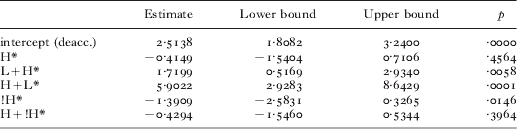
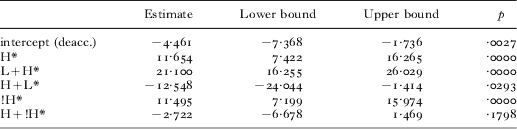
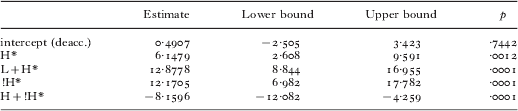
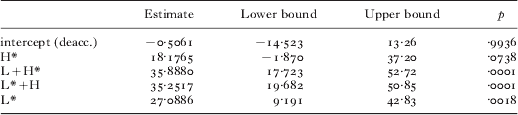
In low-ending phrases, L+H* accents had an excursion that was on average about 5 semitones (st) higher than that of H* accents (6·9 st vs. 1·9 st., p<·001; see Table 5).
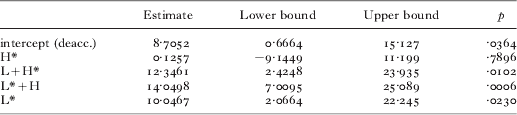
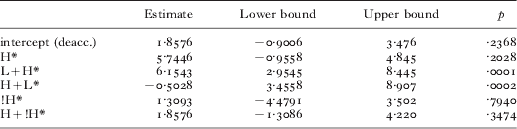
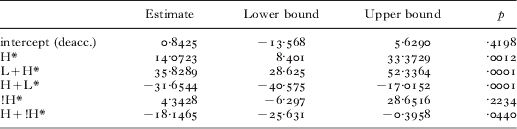
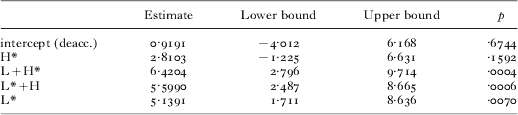
Excursion estimates (in st), lower and upper bounds, and probability levels for H* and L+H* accents followed by a low boundary tone; N=68

Similarly, L+H* had a slope that was about 12·7 st/sec steeper than that of H* accents (21·7 st/sec vs. 8·9 st/sec, p<·001; see Table 6).
Slope estimates (in st/sec), lower and upper bounds, and probability levels for H* and L+H* accents followed by a low boundary tone; N=68

The same differences were found in cases where these accents were followed by a high boundary tone. The excursion in L+H* accents was on average 6·1 st higher than in H* accents (8·91 vs. 2·74 st/sec, p<·001; see Table 7), and the slope was about 14·5 st/sec steeper than in H* accents (27·1 st/sec vs. 12·6 st/sec, p<·001; see Table 8).
Excursion estimates (in st), lower and upper bounds for H* and L+H* accents followed by a high boundary tone; N=42

Slope estimates (in st/sec), lower and upper bounds for H* and L+H* accents followed by a high boundary tone; N=42

L+H* vs. L*+H
There is only one occurrence of a L*+H accent with a low boundary tone, which makes a statistical comparison with L+H* accents impossible. In this one instance of L*+H, the pitch maximum occurs about 31% later (102·2% into the accented syllable) than in the average L+H* accent that is followed by a low boundary tone (72·4% into the accented syllable). The same holds for the pitch minimum, which occurs also later in this L*+H accent (11·2% vs. 1·4%).
When followed by a high boundary tone, the pitch minima in L+H* accents are aligned 27·9% earlier than in L*+H accents (0·1% before the accented syllable vs. 27·6% into the accented, p<·001; see Table9).
L* vs. L*+H
Estimates for the position of the pitch minimum, upper and lower bounds, for L+H* and L*+H accents, followed by a high boundary tone; N=71

Since there were no instances of L* occurring with a low boundary tone, the comparison with L*+H is done only for accents followed by a high boundary tone. L*+H accents have a significant higher excursion than L* accents (6·3 st/sec vs. 4·8 st/sec, p<·05; see Table 10), but the two accents do not differ significantly from each other in slope (see Table 11). However, there was a significant difference in temporal alignment: the pitch minimum occurred later in L* accents compared to L*+H accents (43·1% into the accented syllable vs. 28·6%, p<·001; see Table 12).
Excursion estimates, upper and lower bounds for L* and L*+H accents followed by a high boundary tone; N=76

Slope estimates, upper and lower bounds for L* and L*+H accents followed by a high boundary tone; N=76

Estimates for position of the pitch minimum, upper and lower bounds for L* and L*+H accents followed by a high boundary tone; N=76

The fact that the two accent types did not differ significantly from each other in terms of slope and only at p<·05 for EXCURSION seems at first surprising. However, it needs to be pointed out that the set of analyzed words also contained twenty-six Kamel (/kaˈme:l/) items. In these words, the accent falls on the final syllable, which means that pitch accent and boundary tone are aligned with the same syllable. Differences in EXCURSION or slope would not be expected in this case. The Kamel items could thus blur any differences between these two accent types. If the model is constructed again without these iambic items, both the excursion and the slope analysis turn out to be highly significant different for the two accent types. Excursion in L*+H accents was significantly higher than in L* accents (4·4 st vs. 1·9 st, p<·001; see Table 13), and slope in L*+H accents was significantly steeper than in L* accents (25·9 st/sec vs. 11·9 st/sec, p<·001; see Table 14).
Excursion estimates, upper and lower bounds for L* and L*+H accents followed by a high boundary tone, excluding Kamel items; N=50

Slope estimates, upper and lower bounds for L* and L*+H accents followed by a high boundary tone, excluding Kamel items; N=50

Excluding the Kamel items, however, leaves open the question as to whether there was a significant difference between the two accent types in these items. Since excursion and slope are not suitable to test this, I looked at the alignment of the F0 minimum instead. In L*+H accents, the trough is usually located in the stressed syllable, but it may be pushed to the left if there is tonal crowding. Tonal crowding occurs when several tones are associated with the same segmental material. This can lead to adjustments in the fine phonetic detail of the realization of an accent (Arvaniti, Ladd & Mennen, 2006: 670), such as small differences in alignment. In the Kamel items, three tones are associated with the final syllable: the nuclear tone (L*), the high trailing tone (+H), and the high boundary tone (H%). This should have the consequence that the F0 minimum occurs earlier. In contrast, in L* accents, there are only two tones associated with the final syllable (L* and H%), resulting in less tonal crowding, so that we would expect the F0 minimum to be located clearly within the stressed syllable. Indeed, the predictions are borne out by the data: The trough occurs significantly later in L* accents compared to L*+H accents (30·09% into the stressed syllable vs. 17·7% into the stressed syllable, p<·01; see Table 15).
Estimates for the position of the pitch minimum, upper and lower bounds for L* and L*+H accents followed by a high boundary tone, for Kamel items only; N=26

H+!H* vs. H+L*
There was only one case of a H+!H* accent that was followed by a high boundary (here the pitch did not fall significantly further after the stressed syllable, but stayed level), and there were no combinations of H+L* with a high boundary tone. The analysis therefore looks only at the low boundary tone cases. Here, the EXCURSION in H+!H* accents turned out to be on average 4 st lower than in H+L* accents (2·3 st vs. 6·8, p<·001; see Table 16).Footnote 2 H+!H* accents also had a slope which was on average 22·7 st/sec less steep than that in H+L* accents (−8·9 st/sec vs.−31·7 st/sec, p<·001; see Table 17).
Excursion estimates, upper and lower bounds for H+!H* and H+L* accents followed by a low boundary tone; N=44

Slope estimates, upper and lower bounds for H+!H* and H+L* accents followed by a low boundary tone; N=44

H* vs. !H*
Since there were no cases of !H* accents in combination with a high boundary tone, only cases of accents followed by a low boundary tone were analyzed. The analysis showed that the difference in peak height between the peak preceding the pitch accent and the maximum of the pitch accent itself was on average 7·2 st larger in !H* accents than in H* accents (10·8 st vs. 18·0 st, p<·05; see Table 18).
Estimates for peak height difference between preceding peak and pitch accent maximum, upper and lower bounds for !H* and H* accents followed by a low boundary tone; N=52

Consistency check of pitch accent labels by age groups
Table 19 gives an overview of the statistical differences between accent pairs by age group. The details of each individual analysis are provided after that.
Overview of statistical differences between accent pairs by age group

1 Five-year-olds
Excursion estimates (in st), lower and upper bounds, and probability levels for all accentuation types followed by a low boundary tone; N=58
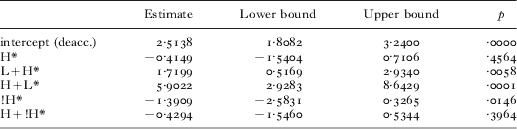
Slope estimates (in st/sec), lower and upper bounds, and probability levels for all accentuation types followed by a low boundary tone; N=58
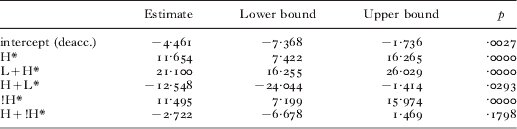
Excursion estimates (in st), lower and upper bounds, and probability levels for all accentuation types followed by a high boundary tone; N=22
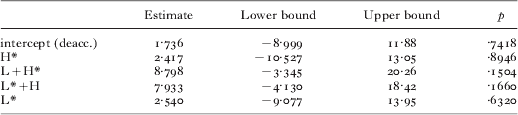
Slope estimates (in st), lower and upper bounds, and probability levels for all accentuation types followed by a high boundary tone; N=22
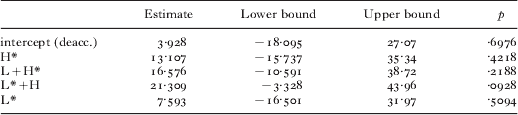
Excursion estimates (in st), lower and upper bounds, and probability levels for H* and L+H* accents followed by a low boundary tone, five years; N=18

Slope estimates (in st/sec), lower and upper bounds, and probability levels for H* and L+H* accents followed by a low boundary tone; N=18

Excursion estimates (in st), lower and upper bounds, and probability levels for H* and L+H* accents followed by a high boundary tone; N=8

Slope estimates (in st/sec), lower and upper bounds, and probability levels for H* and L+H* accents followed by a high boundary tone; N=8

Excursion estimates (in st), upper and lower bounds for H+L* and H+!H* accents followed by a low boundary tone; N=15

Slope estimates (in st/sec), upper and lower bounds for H+L* and H+!H* accents followed by a low boundary tone; N=15

Estimates for the position of the F0 minimum, lower and upper bounds, and probability levels for L+H* and L*+H accents followed by a high boundary tone; N=12

Excursion estimates (in st), lower and upper bounds, and probability levels for L* and L*+H accents followed by a high boundary tone, excluding Kamel items; N=5

Slope estimates (in st/sec), lower and upper bounds, and probability levels for L* and L*+H accents followed by a high boundary tone, excluding Kamel items; N=5

Estimates for the position of the F0 minimum, lower and upper bounds, and probability levels for L* and L*+H accents followed by a high boundary tone, Kamel items only; N=8

Estimates for peak height difference between preceding peak and pitch accent maximum, upper and lower bounds for !H* and H* accents followed by a low boundary tone; N=20

2 Seven-year-olds
Excursion estimates (in st), lower and upper bounds, and probability levels for all accentuation types followed by a low boundary tone; N=59
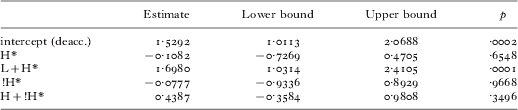
Slope estimates (in st/sec), lower and upper bounds, and probability levels for all accentuation types followed by a low boundary tone; N=59
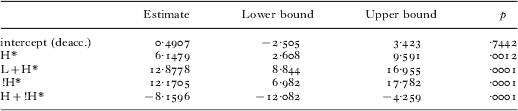
Slope estimates (in st/sec), lower and upper bounds, and probability levels for all accentuation types followed by a high boundary tone; N=54
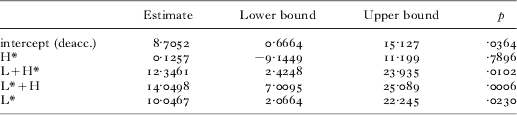
Excursion estimates (in st), lower and upper bounds, and probability levels for H* and L+H* accents followed by a low boundary tone, five years; N=34

Slope estimates (in st/sec), lower and upper bounds, and probability levels for H* and L+H* accents followed by a low boundary tone; N=34

Excursion estimates (in st), lower and upper bounds, and probability levels for H* and L+H* accents followed by a high boundary tone; N=17

Slope estimates (in st/sec), lower and upper bounds, and probability levels for H* and L+H* accents followed by a high boundary tone; N=17

Excursion estimates (in st), upper and lower bounds for H+L* and H+!H* accents followed by a low boundary tone; N=17

Slope estimates (in st/sec), upper and lower bounds for H+L* and H+!H* accents followed by a low boundary tone; N=17

Estimates for the position of the F0 minimum, lower and upper bounds, and probability levels for L+H* and L*+H accents followed by a high boundary tone; N=25

Excursion estimates (in st), lower and upper bounds, and probability levels for L* and L*+H accents followed by a high boundary tone, excluding Kamel items; N=20

Slope estimates (in st/sec), lower and upper bounds, and probability levels for L* and L*+H accents followed by a high boundary tone, excluding Kamel items; N=20

Estimates for the position of the F0 minimum, lower and upper bounds, and probability levels for L* and L*+H accents followed by a high boundary tone, Kamel items only; N=7

Estimates for peak height difference between preceding peak and pitch accent maximum, upper and lower bounds for !H* and H* accents followed by a low boundary tone; N=20

3 Adults
Excursion estimates (in st), lower and upper bounds, and probability levels for all accentuation types followed by a low boundary tone; N=41
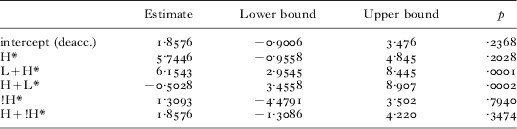
Slope estimates (in st/sec), lower and upper bounds, and probability levels for all accentuation types followed by a low boundary tone; N=41
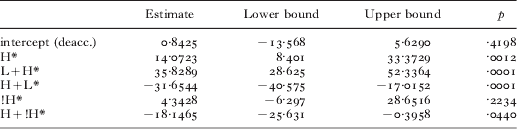
Excursion estimates (in st), lower and upper bounds, and probability levels for all accentuation types followed by a high boundary tone; N=59
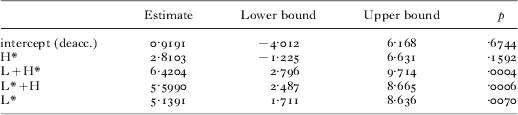
Slope estimates (in st/sec), lower and upper bounds, and probability levels for all accentuation types followed by a high boundary tone; N=59
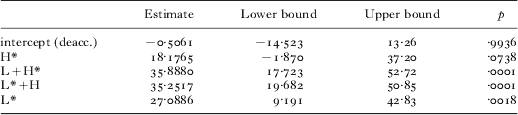
Excursion estimates (in st), lower and upper bounds, and probability levels for H* and L+H* accents followed by a low boundary tone; N=16

Slope estimates (in st/sec), lower and upper bounds, and probability levels for H* and L+H* accents followed by a low boundary tone; N=16

Excursion estimates (in st), lower and upper bounds, and probability levels for H* and L+H* accents followed by a high boundary tone; N=17

Slope estimates (in st/sec), lower and upper bounds, and probability levels for H* and L+H* accents followed by a high boundary tone; N=17

Estimates for the position of the F0 minimum, lower and upper bounds, and probability levels for L+H* and L*+H accents followed by a high boundary tone; N=34

Excursion estimates (in st), lower and upper bounds, and probability levels for L* and L*+H accents followed by a high boundary tone, excluding Kamel items; N=25

Slope estimates (in st/sec), lower and upper bounds, and probability levels for L* and L*+H accents followed by a high boundary tone, excluding Kamel items; N=25

Estimates for the position of the F0 minimum, standard error, t-values, and probability levels for L* and L*+H accents followed by a high boundary tone, Kamel items only; N=11