INTRODUCTION
Natural protected areas (NPAs) currently represent the core of conservation strategies in most nations. Mexico is regarded as a megadiversity country (Sarukhán & Dirzo Reference Sarukhán and Dirzo1992), containing 171 decreed NPAs covering c. 11% nationwide (see URL http://www.conanp.gob.mx). NPAs classified as biosphere reserves (BRs) are particularly important for conservation, as they embody the largest percentage of the federal protected area and allow local communities in their buffer zones to carry out sustainable management of natural resources (INE [Instituto Nacional de Ecología] 1995).
The magnitude of degradation processes in NPAs has raised international concern over their ability to accomplish their expected long-term conservation goals (Hockings Reference Hockings1998, Reference Hockings2003) and spurred the development of methodologies to assess NPAs effectiveness (Ervin Reference Ervin2003a). Some assessments have focused on the technical aspects of NPAs malfunction, including inefficient management and insufficient (or total lack of) personnel or financing, together with NPA size and the time since decreed (Bruner et al. Reference Bruner, Gullison, Rice and da Fonseca2001; Rao et al. Reference Rao, Rabinowitz and Khaing2002; Ervin Reference Ervin2003b; WWF [Worldwide Fund for Nature] 2004). Other studies have examined the degradation processes in NPAs in the light of their socioeconomic context, including social participation and the development of local institutions for resource use and control (Brooks et al. Reference Brooks, Franzen, Holmes, Grote and Borgerhoff-Mulder2006; Hayes Reference Hayes2006; Nepstad et al. Reference Nepstad, Schwartzman, Bamberger, Santilli, Ray, Schlesinger, Lefebvre, Alencar, Prinz, Fiske and Rolla2006).
Despite the relevance of NPAs for biological conservation, the impacts of human activities (such as land use/land cover change [LULC], pollution and overexploitation of hydrological resources) may occasionally lead to severe ecosystem transformation (Carey et al. Reference Carey, Dudley and Stolton2000). The decrease of vegetation cover is the main cause of degradation processes, including loss of biological diversity (Dale et al. Reference Dale, Pearson, Offerman and O'Neill1994; Lidlaw Reference Lidlaw2000; Kinnard et al. Reference Kinnard, Sanderson, O'Brien, Wibisono and Woolmer2003), climate change (Houghton et al. Reference Houghton, Hackler and Lawrence1999; Chase et al. Reference Chase, Pielke, Kittel, Nemani and Running2000), land degradation (Riezebos & Loerts Reference Riezebos and Loerts1998; Islam & Weil Reference Islam and Weil2000) and changes in the provision of ecosystem services (Vitousek et al. Reference Vitousek, Mooney, Lubchenco and Melillo1997). There is a scarcity of studies examining the effectiveness of Mexican NPAs (but see Mas Reference Mas2005, Román-Cuesta & Martínez-Vilalta Reference Román-Cuesta and Martínez-Vilalta2006 and Figueroa & Sánchez-Cordero Reference Figueroa and Sánchez-Cordero2008 for significant efforts) and none of these studies has so far investigated the causes of degradation processes such as LULC.
The factors influencing LULC are manifold, displaying complex synergies between them and operating at different spatial and temporal scales (Barbier & Burgess Reference Barbier and Burgess2001; Geist & Lambin Reference Geist and Lambin2002; Perz Reference Perz2002; Benhin Reference Benhin2006). They include social, economic, political, institutional, cultural and ecological forces and conditions (Pebley Reference Pebley1998; Carr et al. Reference Carr, Suter and Barbieri2005; de Sherbinin et al. Reference de Sherbinin, Carr, Cassels and Jiang2007). Geist and Lambin (Reference Geist and Lambin2002) distinguished between underlying and proximate factors, the former affecting the manner in which the latter exert their influence on LULC.
Some of the most widely recognized regional factors, both underlying and proximate, may be broadly classified as: (1) sociodemographic, such as population size/density, migration, population dispersion and social marginality (Pearce Reference Pearce1990; Barbier Reference Barbier1997; de Sherbinin & Freudenberger Reference de Sherbinin and Freudenberger1998; Deininger & Minten Reference Deininger and Minten2002; Carr Reference Carr2004b; Carr et al. Reference Carr, Suter and Barbieri2005), and (2) agroproductive, including production vulnerability, access to markets, dependence upon primary activities and cattle raising expansion (Bilsborrow & Okoth-Ogendo Reference Bilsborrow, Okoth-Ogendo, Arizpe, Stone and Major1992; Barbier & Burgess Reference Barbier and Burgess2001; Lambin et al. Reference Lambin, Turner, Helmut, Agbola, Angelsen, Bruce, Coomes, Dirzo, Fischer, Folke, George, Homewood, Imbernon, Leemans, Li, Moran, Mortimore, Ramakrishnan, Richards, Skanes, Steffen, Stone, Svedin, Veldkamp, Vogel and Xu2001; Mäki et al. Reference Mäki, Kalliola and Vuorinen2001; Benhin Reference Benhin2006). A further relevant, albeit less widely examined sociodemographic factor, is population ethnic composition, considering the implications of indigenous culture-based resource management and social organization (Gómez-Pompa & Kaus Reference Gómez-Pompa, Kaus, Callicot and Nelson1992; Carr Reference Carr2004a; Leff Reference Leff2004; Tucker Reference Tucker2004).
Here, we examine the magnitude of LULC processes in a selected set of Mexican biosphere reserves (BRs), along with the role of such prominent socioeconomic factors in driving these processes. Specifically, we address the question of which sociodemographic and agroproductive conditions are linked to BR capacity to deter LULC processes. Systematic knowledge on the socioenvironmental dynamics of BRs in Mexico is of utmost importance, given that Mexico is a megadiverse country with large cultural and social complexity, and a pioneering role in the establishment and international recognition of BRs (Halffter Reference Halffter, di Castri, Baker and Hadley1984). In Mexico and other countries sharing these conditions, BRs have become a fundamental conservation tool, but their long-term success clearly depends on a continuous examination of the human-environmental interplay developed in them.
METHODS
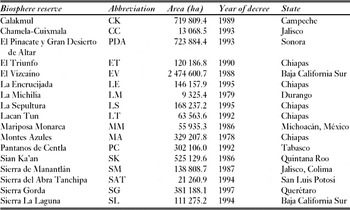
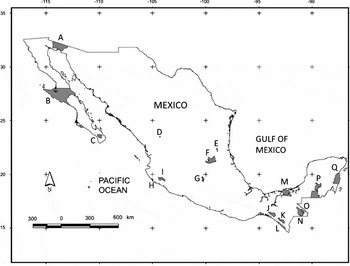
We selected 17 terrestrial BRs whose decree predated 1997 from the 39 existing Mexican BRs (Table 1 and Fig. 1; CONANP [Comisión Nacional de Áreas Naturales Protegidas] 2003). We estimated LULC within the selected BRs and in their geographical contexts (the latter being defined as the ecoregion(s) in which each BR occurs, according to INEGI [Instituto Nacional de Estadística, Geografía e Informática], CONABIO [Comisión Nacional para el Conocimiento y Uso de la Biodiversidad] & INE (2007); this was achieved by evaluating, in these two sets of such defined areas, the change in completely transformed areas owing to human activities, between 1993 and 2002. We used 1:250 000 land use/land cover maps produced by INEGI (1993, 2005) for these years and assessed the changes on a GIS platform (ArcView, version 3.2). Transformed areas were defined as those covered by agriculture, man-made pastures, forest plantations and human settlements. We used four LULC indicators, namely (1) percentage of transformed area within each BR (in 2002), (2) absolute extent of change (1993–2002), (3) rate of change (1993–2002) and (4) the difference between the rate of change in BRs and that of their corresponding ecoregion.
Area, date of decree and location by state for the 17 selected Mexican biosphere reserves.

Location of the 17 selected Mexican biosphere reserves (grey areas). (A) El Pinacate y Gran Desierto de Altar, (B) El Vizcaíno, (C) Sierra La Laguna, (D) La Michilía, (E) Sierra del Abra Tanchipa, (F) Sierra Gorda, (G) Mariposa Monarca, (H) Chamela-Cuixmala, (I) Sierra de Manantlán, (J) La Sepultura, (K) El Triunfo, (L) La Encrucijada, (M) Pantanos de Centla, (N) Montes Azules, (O) Lacan Tun, (P) Calakmul, (Q) Sian Ka'an.

We defined LULC rate as the mean annual change rate of transformed area, calculated as a percentage of total assessed area (Figueroa & Sánchez-Cordero Reference Figueroa and Sánchez-Cordero2008):

where LULC = land use/land cover change, S1 = initial transformed area, S2 = final transformed area, St = total assessed area, and T = time lag in years.
We compared LULC rates in BRs with those calculated for their ecoregions when at least 70% of the BR area formed part of a single ecoregion. When BR area was distributed more evenly among several ecoregions, a weighted rate was calculated based on the percentage of the BR area corresponding to each of the ecoregions (ecoregions occupying <10% of the BR were excluded).
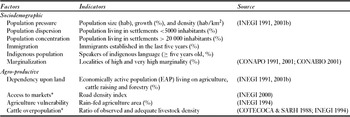
We selected socioeconomic factors based on their documented relevance and their availability at the municipio (county) level. We identified those municipios whose area included part of the selected BRs (INEGI 2001a; CONANP 2003; see URL http://www.conanp.gob.mx). For each factor, we selected one indicator corresponding to a date as close as possible to 1993 (Table 2) from the 1990–1991 national official census (CONAPO [Consejo Nacional de Población] 1991; INEGI 1991, 1994). We used global change rates for 1990–2000 when information was available from additional official sources (CONAPO 2001; INEGI 2001b).
Selected sociodemographic and agroproductive factors and indicators for their evaluation. *Constructed parameters; see Methods for details.
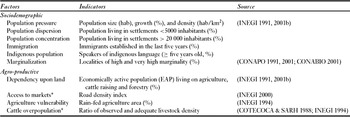
For Mexico, as for most other Latin American nations, there is ample evidence of the tremendous impact of cattle raising on LULC processes (Toledo Reference Toledo and Downing1991; Challenger Reference Challenger1998), which warrants the inclusion of this factor in the analysis. To identify cattle overpopulation (i.e. surpassing the land's cattle carrying capacity), we calculated a cattle overpopulation index by dividing the mean reported carrying capacity (hectares by cattle head) for each vegetation type (COTECOCA [Comisión Técnico Consultiva para la Determinación Regional de los Coeficientes de Agostadero] & SARH [Secretaría de Agricultura y Recursos Hidráulicos] 1988) over the area by cattle head reported in 1991. An index >1 indicates cattle overpopulation. We estimated access to markets by calculating total road density (km ha−1) in those municipios whose territories overlap with the selected BRs; considering the differential socioeconomic and environmental impacts that roads may have depending on number of lanes and quality (paved versus non-paved), we weighted their density differentially, based on the official road map of Mexico (INEGI 2000).
We made a general diagnosis of prevailing socioeconomic conditions in the studied BRs and tested correlations between analysed variables through Spearman non-parametric procedures (SPSS [Statistical Package for the Social Sciences] 2004); significance level was adjusted through the Bonferroni method (Gotelli & Ellison Reference Gotelli and Ellison2004). We performed a canonical correspondence analysis (CCA; ter Braak Reference ter Braak, Jongman, ter Braak and van Tongeren1996; MVSP [Multivariate Statistical Package] version 3.1) by using socioeconomic factors as independent variables and LULC indicators as response variables. To avoid multicolinearity, we excluded some variables from the CCA on the basis of the linear correlation test results. Percentages of highly marginalized localities and of rain-fed agriculture area were excluded, whilst the percentage of economically active population (EAP) dependent on agriculture and cattle raising was retained, given its strong correlation with these two excluded variables. The change rate of transformed area was also excluded, whereas the absolute extent of change was retained, as these two variables were highly correlated. For large BRs, a small change rate signifies a considerable loss of territory covered by primary or secondary vegetation (see Tables 1 and 3) and these changes may not be observable when comparing rates of change.
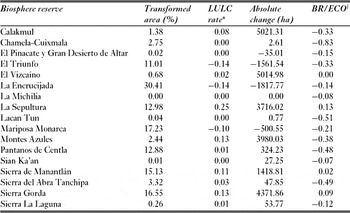
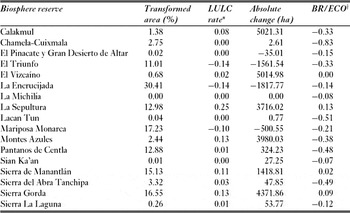
Land use/land cover change parameters for the 17 selected Mexican biosphere reserves. *LULC: Land use/land cover change. †BR/ECO =difference between LULC rate of biosphere reserves and their ecoregions.
RESULTS
Processes of land use/land cover change
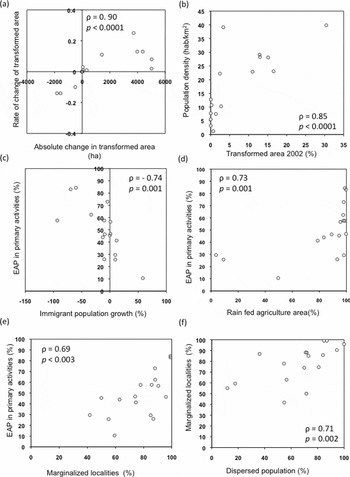
A large proportion of the selected BRs showed a good capacity to deter LULC processes, as indicated by their low percentages of transformed area in 2002; 60% of selected BRs showed <5% transformed area (Table 3). Some BRs exhibited relatively large rates of change during 1993–2002. Interestingly, the most strongly transformed BRs did not always have the largest LULC rates (Table 3). We observed the largest LULC rates for La Sepultura, Montes Azules, Sierra Gorda and Sierra de Manantlán. Conversely, rates of change were negative in La Encrucijada, El Triunfo, Mariposa Monarca and El Pinacate y Gran Desierto de Altar. BRs with the highest increase in absolute transformed area (>3500 ha) were Calakmul, El Vizcaíno, Sierra Gorda and Montes Azules (Table 3). As expected, we found absolute change of transformed area to be positively and significantly correlated with the rate of change (Fig. 2a). For most BRs, we recorded smaller LULC rates than in their respective ecoregions. This asymmetry was higher in Chamela-Cuixmala, Lacan Tun, Sierra del Abra Tanchipa and Pantanos de Centla. Contrastingly, in La Sepultura, Sierra Gorda and to a lesser extent in Sierra de Manantlán, the rate of change exceeded that of their ecoregions (Table 3).
Scatter-plot and Spearman's r correlation coefficient between (a) absolute amount of change and rate of change of transformed area (1993–2002); (b) percentage of transformed area and population density; (c) immigrant population growth and economically active population (EAP, %) dependent on primary activities; (d) percentage of rain-fed agriculture area and percentage of EAP devoted to primary activities; (e) percentage of localities of high and very high marginalization and percentage of EAP devoted to primary activities; and (f) percentage of population living in localities <5000 inhabitants and percentage of localities of high and very high marginalization. These are significant correlations (modified with Bonferroni correction and p <0.003).

We classified selected BRs into four categories according to LULC indicators. Firstly, BRs with zero or a very low percentage of transformed area in 2002, that did not show LULC processes during the study period (Chamela-Cuixmala, El Pinacate, El Triunfo, La Michilía, Lacan Tun, Pantanos de Centla, Sian Ka'an, Sierra del Abra Tanchipa and Sierra La Laguna). Secondly, BRs with a low percentage of transformed area in 2002, and a low rate of change between 1993 and 2002, but with a marked increase in its absolute extent (not reflected in the rate of change due to a large reserve size); in all these cases, the rate of change was lower than in their corresponding ecoregions (Calakmul, El Vizcaíno and Montes Azules). Thirdly, BRs showing a large percentage of transformed area in 2002, but in which this variable became smaller (La Encrucijada and Mariposa Monarca). Finally, the three remaining BRs formed a fourth heterogeneous group as each one displayed a different scenario: Sierra de Manantlán showed c. 15% of its area transformed and had a relatively low LULC rate, albeit slightly higher than its respective ecoregion; La Sepultura was also transformed in c. 15% of its area, had a very high LULC rate (well above its ecoregion) and a large increase in absolute transformed surface; Sierra Gorda showed the largest values for all three LULC indicators.
Socioeconomic characteristics of selected biosphere reserves
Population pressure in the selected BRs was low, with a mean population density of 18 habitants km−2 (excluding the extreme value for Mariposa Monarca of 130 habitants km−2), which is smaller than the mean value reported nationwide (50 habitants km−2). However, there was a significant positive correlation between population density and transformed area in 2002 (Fig. 2b). Population in BRs grew less than 20% during the 1990s, except in Lacan Tun, Mariposa Monarca, Pantanos de Centla, El Pinacate y Gran Desierto de Altar, Sierra La Laguna and Sian Ka'an; in the last BR population size doubled in the same period.
In 1990, migration to BRs was not an important factor in population growth, except in Sian Ka'an, Sierra La Laguna and La Encrucijada. The proportion of immigrant population had decreased in ten BRs by 2000, but it showed significant increases in La Laguna (58%) and Sian Ka'an (165%). Immigration grew mainly in BRs with low social marginality, low vulnerability of production and dependence on agriculture and cattle raising, all of which was reflected in the significant negative correlation between immigration rate of change and EAP dependent on agriculture and cattle raising, and the positive correlations between EAP dependent on agriculture and cattle raising, the percentage area of rain-fed agriculture and the proportion of localities with high marginality (Fig. 2c–e).
There was large population dispersion in the selected BRs. The mean proportion of population living in small localities (66%) was larger than nationwide (31%). Conversely, the mean proportion of population concentrated in medium-sized and large cities (10.6%) was smaller than the nationwide value (60%). BRs with a greater population dispersion showed higher marginality (Fig. 2f). Marginality was also higher in BRs than nationally, as most localities were classified as having high or very high marginality in 1990 (CONAPO 1991). In 12 BRs, the proportion of such localities exceeded the estimated value of 74% for the entire country. The proportion of indigenous population was greater than nationally only in Lacan Tun, Montes Azules, Sian Ka'an, La Michilía, Calakmul, Mariposa Monarca and Sierra del Abra Tanchipa.
The proportion of land devoted to rain-fed agriculture was >80% of total agricultural area, suggesting a high vulnerability for agriculture for most BRs. EAP was highly dependent on agriculture and cattle raising, exceeding national levels; EAP dependency on agriculture and cattle was positively correlated with the proportion of land area devoted to rain-fed agriculture and with socioeconomic marginality (Fig. 2d, e). Virtually all BRs suffered from cattle overpopulation, especially Mariposa Monarca, Sierra La Laguna, Pantanos de Centla and Sierra del Abra Tanchipa. All BRs had limited access to markets owing to their relative isolation, very low road density and a prevalence of dirt roads and two-lane highways.
Socioeconomic context and land use and vegetation change in biosphere reserves
Spearman correlations allowed us to distinguish two broad BR profiles. The first group comprised BRs characterized by relatively large population size, density and growth (with this population concentrated in medium-sized and large cities), higher immigration, road density and cattle overpopulation, together with relatively lower socioeconomic marginality, dependence on agriculture and cattle raising, vulnerability of agricultural production and percentage of indigenous population (but large growth in this population sector). In these BRs, which may be considered as ‘more developed’, a larger percentage of transformed area was generally observed for 2002. The second group may be considered as ‘less developed’, and included those BRs displaying the exact opposite trends and a lower percentage of transformed area for 2002.
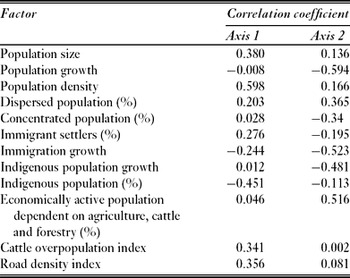
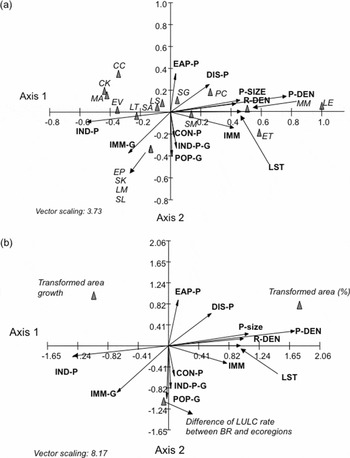
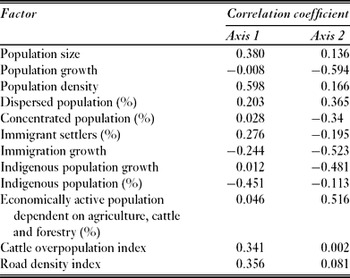
The analysed socioeconomic factors explained 86.9% of LULC indicators variance (Axis 1, 63.4%; Axis 2, 23.4%). The factors with the largest loadings on Axis 1 were population density (positive correlation) and the 1990 percentage of indigenous population (negative correlation; Table 4). The largest loadings for Axis 2 were population growth and increase in percentage of immigrant population (both positively correlated). In the case of Axis 1, population density was positively correlated with population size and density, road density and cattle overpopulation, and negatively correlated with percentage of indigenous population (Fig. 3a). Axis 2 was positively correlated to percentage of EAP dependent on agriculture and cattle raising, and negatively to population growth, indigenous population growth and population concentration (Fig. 3a).
Intraset correlation coefficients in the canonical correspondence analysis relating socioeconomic factors and land use/land cover change in 17 selected Mexican biosphere reserves.
Ordination of (a) biosphere reserves and (b) LULC parameters (triangles) in a canonical correspondence analysis (CCA), relating land use/land cover change parameters and socioeconomic factors. Abbreviations for biosphere reserves are in Table 1. EAP-P = percentage of economically active population devoted to primary activities; DIS-P = percentage of population living in localities <5000 inhabitants; P-SIZE = population size; R-DEN = road density index; P-DEN = population density; LST = cattle overpopulation index; IMM = percentage of immigrant population; CON-P = percentage of population living in localities > 20 000 inhabitants; IND-PG = indigenous population growth; P-G = population growth; IMM-G = immigrant population growth; IND-P = percentage of indigenous population.

The distribution of LULC indicators on the ordination space showed correlation trends with the ordination axes, and ultimately with the examined variables (Fig. 3b). Percentage of transformed area in 2002 corresponded to positive values on Axis 1 and, less strongly, on Axis 2. Therefore, those variables determining most strongly the existence of a large percentage of transformed area were population and road density, cattle overpopulation and, less importantly, population dispersion and EAP dependent on agriculture and cattle raising. This sector of the ordination space included BRs with the largest percentage of transformed area, such as La Encrucijada and Mariposa Monarca (Fig. 3a).
Absolute change in transformed area was associated with negative scores on Axis 1, and less strongly with positive scores of Axis 2; such change is therefore influenced by higher percentage of indigenous population, EAP dependent on agriculture and cattle raising, marginality and area of rain-fed agriculture. This section of the ordination space included BRs in which absolute transformed area increased considerably during 1993–2002, such as Calakmul, Montes Azules and El Vizcaíno.
The difference between the rate of change in BRs and their ecoregions (which is larger when the rate of change within the BRs exceeds that of its respective ecoregion), is mostly associated with negative scores on Axis 2 (Fig. 3b), i.e. with factors such as both overall and indigenous population growth, and population concentration in cities. However, those BRs having larger rates of change than their corresponding ecoregions were centrally located on the ordination space, probably because they had large values of percentage of, and absolute change in transformed area.
BRs with low percentage of transformed area and few internal changes (Sierra La Laguna, El Pinacate, Sian Ka'an and La Michilía) had negative scores on both axes, and were associated with high percentages of indigenous population and, less strongly, to increases in population growth and immigration (Fig. 3a).
DISCUSSION
The conservation of biological diversity is an international priority, especially for megadiverse countries. LULC processes may threaten conservation efforts in NPAs, as they undermine the structure and function of their ecosystems by triggering and intensifying other degradation processes (Dale et al. Reference Dale, Pearson, Offerman and O'Neill1994; Vitousek et al. Reference Vitousek, Mooney, Lubchenco and Melillo1997; Houghton et al. Reference Houghton, Hackler and Lawrence1999; Islam and Weil Reference Islam and Weil2000; Sánchez-Cordero et al. Reference Sánchez-Cordero, Illoldi-Rangel, Linaje, Sarkar and Peterson2005). Success in attaining conservation goals in NPAs depends mainly on maintaining native vegetation cover.
The majority of our selected BRs were capable of containing LULC processes during the 1990s, confirming their relevance for vegetation conservation (Figueroa & Sánchez-Cordero Reference Figueroa and Sánchez-Cordero2008). Nevertheless, some BRs require urgent attention if they are to reverse current LULC trends; Sierra Gorda and La Sepultura were both highly transformed and had suffered large changes in vegetation cover, outstripping their corresponding ecoregions. This disparate ability of BRs to conserve biodiversity calls for an urgent assessment of the underlying socioeconomic and political processes, together with a critical appraisal of management and development plans.
Socioeconomic conditions of biosphere reserves
Each BR has a unique historical, socioeconomic and political context, nevertheless all of them represent land subjected to particular environmental policies that promote the conservation of biological diversity and permit (ideally) sustainable development of local communities in buffer zones. Although this approach enables the coexistence of conservation and development goals, there are enormous challenges given the inadequate socioeconomic conditions prevailing in most BRs.
Demographic pressure in Mexican BRs is low, but population is highly dispersed throughout their territories. Unlike findings from other countries, where immigration is a relevant threat to BRs (de Sherbinin & Freudenberger Reference de Sherbinin and Freudenberger1998; Mwamfupe Reference Mwamfupe and de Sherbinin1998; Carr Reference Carr2004a, Reference Carr2006, Reference Carr2009; Stocks et al. Reference Stocks, McMahan and Taber2007), in Mexican BRs immigrant population has been declining. This result is unsurprising, as international migration to the USA has reduced rural population substantially in many Mexican regions. During 1995–2000, 1 470 000 people, mainly of rural origins, migrated to the USA, rendering Mexico the third country worldwide regarding population withdrawal, after China and the Democratic Republic of Congo; by 2003 c. 27 million Mexicans lived in the USA and remittances from migrant residents in the USA (US$ 25.1 billion in 2008) constitute the second largest revenue source for Mexico, after oil (Tuirán Reference Tuirán2004; Durand Reference Durand, Ariza and Portes2007; Roberts & Hamilton Reference Roberts, Hamilton, Ariza and Portes2007; see URL http://www.conapo.gob.mx).
Population is attracted to less isolated and marginalized BRs, with higher urban development. Higher waged labour availability may be a strong incentive for immigration, as waged labour income represents more than half of total income for rural households (de Janvry & Sadoulet Reference de Janvry and Sadoulet2001). High social marginalization is also common (see Nadal Reference Nadal2003). The percentage of indigenous population, although variable, was high in some BRs, reflecting the geographic coincidence of cultural and biological diversity (Toledo et al. Reference Toledo, Alarcón-Chaires, Moguel, Olivo, Cabrera, Leyequien and Rodríguez-Aldabe2002).
Despite the apparently low demographic pressure in BRs, survival of people living inside them depends directly upon local land and resources. In most Mexican NPAs conditions for agriculture are inadequate (Brandon et al. Reference Brandon, Gorenflo, Rodrigues and Waller2005; Mas Reference Mas2005), yet BR residents are dependent on agriculture and cattle raising in rain-fed land with high productive vulnerability and weak links to regional and national markets. To make this scenario worst, we also documented cattle overpopulation in most BRs.
Socioeconomic conditions and land use/land cover change
A complex interplay of factors affect LULC processes, which operate at different spatial and temporal scales and are highly context-dependent (Angelsen & Kaimowitz Reference Angelsen and Kaimowitz1999; de Sherbinin et al. Reference de Sherbinin, Carr, Cassels and Jiang2007). At the local level, some factors depend on household decision-making, and others are part of socioeconomic and political structures (Chowdury & Turner Reference Chowdhury and Turner2006). Critical local-scale factors include community institutions regulating natural resource use (Asbjornsen & Ashton Reference Asbjornsen and Ashton2002; Velázquez et al. Reference Velázquez, Torres and Bocco2003; Merino-Pérez & Bray Reference Merino-Pérez and Bray2004; Antinori & Bray Reference Antinori and Bray2005), social costs of conservation policies and level of social participation (Little Reference Little, Western, Wright and Strum1994; Chapela & Barkin Reference Chapela and Barkin1995; Ghimire & Pimbert Reference Ghimire and Pimbert1997; Haenn Reference Haenn2000). Among regional factors are specific environmental conditions (Pressey et al. Reference Pressey, Wish, Barret and Watts2002; Mas Reference Mas2005), the history of territorial occupation and use of natural resources, the type and intensity of economic activities, and development policies (Geist & Lambin Reference Geist and Lambin2002; Chowdhury & Turner Reference Chowdhury and Turner2006). Our results confirm some regional sociodemographic and agroproductive factors affect LULC processes in BRs. These factors were better able to explain long-term processes (percentage of transformed area in 2002) than short-term ones (rate of change 1993–2002). We did not investigate rural development policies (Chowdhury & Turner Reference Chowdhury and Turner2006) and local social conflicts (Ghimire & Pimbert Reference Ghimire and Pimbert1997), which may trigger short-term processes.
The BRs showing the highest long-term LULC shared traits that allowed us to regard them as more developed, in terms of an economic model that favours infrastructure development, population concentration and cattle expansion. There is ample evidence for the influence of population pressure, cattle expansion and market demand of natural resources on deforestation processes (Toledo Reference Toledo and Downing1991; Lambin et al. Reference Lambin, Turner, Helmut, Agbola, Angelsen, Bruce, Coomes, Dirzo, Fischer, Folke, George, Homewood, Imbernon, Leemans, Li, Moran, Mortimore, Ramakrishnan, Richards, Skanes, Steffen, Stone, Svedin, Veldkamp, Vogel and Xu2001; Carr et al. Reference Carr, Suter and Barbieri2005). Although population pressure is not particularly high in BRs relative to national values, it undoubtedly contributes to LULC under these socioeconomic conditions. Public development policies underlie all these factors and their effect on resource use, and are thus critical drivers of LULC processes.
The largest short-term LULC processes were recorded in BRs with variable socioeconomic conditions, but higher rates of change were observed mostly where population, albeit present at low densities, was highly dependent upon agriculture and cattle raising. These BRs shared high proportions of indigenous population, predominance of rain-fed agriculture and high social marginalization, along with less cattle overpopulation. The complex interaction of poverty, productive vulnerability and direct dependence on land, may induce short-term LULC processes (although see Carr Reference Carr2006 for different scenarios regarding the relationship of indigenous population, poverty and LULC in Guatemala). The interplay of socioeconomic variables characterizing these BRs conceals the role of indigenous population, although in areas of strong indigenous presence large long-term LULC processes were less important. This may be partly owing to adequate natural resource management and the social organization of indigenous communities (Gómez-Pompa & Kaus Reference Gómez-Pompa, Kaus, Callicot and Nelson1992; Bray et al. Reference Bray, Merino-Pérez, Negrero-Castillo, Segura-Warnholtz, Torres-Rojo and Vester2003; Tucker Reference Tucker2004; Alarcón-Chaires Reference Alarcón-Chaires, Cimadamore, Eversole and McNeish2006; Carr Reference Carr2006; Stocks et al. Reference Stocks, McMahan and Taber2007), although in some cases, productive practices may depend more upon site socioeconomical and agroecological characteristics than upon population ethnicity (Carr Reference Carr2004a). Future studies should address this question.
Our results apply within the spatial and temporal scale of the analysis. This mesoscale study was designed to detect the influences of factors acting (and measurable) at this specific space and timespan, and changing the scale of analysis might alter the observed importance of the analysed factors (de Sherbinin et al. Reference de Sherbinin, Carr, Cassels and Jiang2007). For example, it would not be possible to evaluate the importance of household dynamics on LULC at this scale, a relationship only measurable at the local scale.
Rural development and conservation
Is it possible to improve rural livelihoods in BRs and their surrounding areas without inducing large-scale LULC? To address this question, the concurrence of multidisciplinary approaches is obviously required. In short-term LULC, population pressure may not be as important as inadequate production conditions, poverty and high dependency on agriculture and cattle raising. The existence of viable and profitable economic opportunities may buffer the strong pressures on natural vegetation currently observed (Lambin et al. Reference Lambin, Turner, Helmut, Agbola, Angelsen, Bruce, Coomes, Dirzo, Fischer, Folke, George, Homewood, Imbernon, Leemans, Li, Moran, Mortimore, Ramakrishnan, Richards, Skanes, Steffen, Stone, Svedin, Veldkamp, Vogel and Xu2001).
Rural development policies have been shown to exert a strong influence on LULC (Angelsen & Kaimowitz Reference Angelsen and Kaimowitz1999; Geist & Lambin Reference Geist and Lambin2002; Chowdhury & Turner Reference Chowdhury and Turner2006). Since the 1980s, several policy changes have occurred in Mexico, diminishing peasants’ capacity to accumulate capital through primary economic activities (Calva Reference Calva and Calva1993). These changes have also had strong negative environmental consequences (Barbier Reference Barbier2000); in areas of high socioeconomic vulnerability, negative environmental impacts may increase as peasants face the need to produce under adverse circumstances, consequently becoming more impoverished. Some current policies promote large monocultures, along with intensive use of chemical inputs, with a strong emphasis towards a market-based production, a situation that is well documented in Calakmul (Reyes-Hernández et al. Reference Reyes-Hernández, Cortina, Perales, Kauffer and Pat2003; Chowdhury & Turner Reference Chowdhury and Turner2006).
If conservation is to coexist with rural development, a careful design of specific policies should be undertaken in order to induce forms of production consistent with conservation (Harvey et al. Reference Harvey, Komar, Chazdon, Ferguson, Finegan, Griffith, Martínez-Ramos, Morales, Nigh, Soto-Pinto, Van Breugel and Wishnie2008). An example of such strategies is the hampering of cattle expansion with simultaneous linking of production to fair-trade markets, and encouragement of lower impact agricultural practices. This is true not only for BR communities, but also for the remainder of rural Mexico, to avoid only preserving relatively well conserved isolated reserves within a completely transformed landscape (Vandermeer & Perfecto Reference Vandermeer and Perfecto2007). Viable alternative strategies must be at least equally, but preferably more profitable than current ones (Barbier & Burgess Reference Barbier and Burgess2001).
CONCLUSIONS
The concurrence of conservation and development, particularly in less developed countries, is an overwhelmingly complex issue. Despite obvious inherent limitations of the available data, our study highlights some of the challenges faced by the conservation-development binomial, given the prevailing socioeconomic conditions in BRs and their links to vegetation cover decline.
Successful conservation and development demands the simultaneous participation of different stakeholders, such as professionals from a range of disciplinary fields, governmental institutions, non-governmental organizations and local communities, among others. It also requires that decision-making processes regarding national public policies, especially related to rural development, acknowledge the relevant role of environmental concerns. A central implication of our results is that we must address the question of what kind of development should we seek in BRs. From our perspective, policies should focus on modifying socioeconomic structural factors if more environmentally friendly and economically viable production is to be promoted, including agricultural and cattle intensification, green markets and fair trade, diversified and organic production, and ecological restoration. BRs are one viable option for pursuing conservation and development in megadiversity nations worldwide, but important challenges still need to be addressed.
ACKNOWLEDGEMENTS
We conducted the research while F. Figueroa was enrolled in the Ph.D. Program in Biological Sciences (Universidad Nacional Autónoma de México [UNAM]). F. Figueroa thanks the Consejo Nacional de Ciencia y Tecnología for funding (CONACyT, no. 186217). We are grateful to Josefina Hernández-Lozano and Raúl Aguirre-Gómez (Remote Sensing Laboratory, Instituto de Geografía, UNAM) for their help with the geographic analyses. The Mexican National Commission for Natural Protected Areas (CONANP) provided maps for protected areas. Yiang-Qing Estrada and Patricia Totolhua Delgado assisted in gathering of sociodemographic and agroproductive information. This paper was greatly improved thanks to the constructive comments of three anonymous reviewers.