INTRODUCTION
Ruminants fed forage-based diets usually need to receive supplementation with concentrates to achieve acceptable performance levels (weight gain or milk production). However, supplementation with starch-rich or soluble sugar sources usually reduces fibre digestibility and forage intake (Tamminga Reference Tamminga, Jung, Buxton, Hatfield and Ralph1993; Paterson et al. Reference Paterson, Belyea, Bowman, Kerley, Williams, Fahey, Collins, Mertens and Moser1994). Decreased ruminal pH has been consistently reported among the factors involved in such effects (Russell & Dombrowski Reference Russell and Dombrowski1980; Haddad & Grant Reference Haddad and Grant2000; Mouriño et al. Reference Mouriño, Akkarawongsa and Weimer2001). Additionally, several studies have also shown that supplementation with starch-rich sources depresses ruminal fibre degradation even in situations where there is no significant reduction in ruminal pH (Mould & Ørskov Reference Mould and Ørskov1983; Mould et al. Reference Mould, Ørskov and Mann1983; Grant & Mertens Reference Grant and Mertens1992). However, the mechanisms explaining this negative impact on forage fermentation are not clearly established. Polysaccharide hydrolysis is catalysed by enzymes closely associated with bacterial cell walls, since such forage degradation depends primarily on microbial adherence to feed particles (McAllister et al. Reference Mcallister, Bae, Jones and Cheng1994). Thus, the effect of non-fibre carbohydrates on fibre degradation probably involves direct or indirect inhibition of bacterial adherence or of fibrolytic activity. Moreover, the nutritive value of C4 grasses is often lower than that of C3 grasses and it is not clear whether dietary factors affect their fermentation to the same extent. In a previous study, Kozloski et al. (Reference Kozloski, Lima, Cadorin, Bonnecarrère Sanchez, Senger, Fiorentini and Härter2008) reported that the differences in the in vitro degradability between samples of temperate and tropical forage grasses were related directly to differences in the rate of microbial adherence on those forages; moreover, they also observed a negative linear effect of reduced pH on in vitro forage degradability. However, bacterial enzyme activity was not measured and, because Kozloski et al. (Reference Kozloski, Lima, Cadorin, Bonnecarrère Sanchez, Senger, Fiorentini and Härter2008) used a gravimetric method, it was not clearly determined whether the pH affected the extent of bacterial adherence on either forage sample.
The present study was conducted to assess the in vitro effects of either pH or glucose concentration on degradation, bacterial adherence and fibrolytic enzyme activity on residue of incubation of temperate and tropical forage samples.
MATERIALS AND METHODS
Forage samples and chemical analysis
Samples of ryegrass (Lolium multiflorum containing 44 g nitrogen (N) and 472 g neutral detergent fibre (NDF)/kg dry matter (DM)) and bermudagrass (Cynodon dactylon containing 25 g N and 702 g NDF/kg DM) cut from swards at the initial vegetative stage and at a height of c. 10 cm above ground level were used as substrate in the in vitro and in situ assays. For incubation and chemical analysis, these samples were dried at 55 °C in a forced-air oven and ground to pass a 2 mm sieve. The content of DM was determined by drying in an oven at 105 °C for at least 18 h. The NDF analysis (assayed without heat stable α-amylase and expressed with residual ash) was based on the procedures described by Mertens (Reference Mertens2002), except that the samples were weighed into polyester filter bags (porosity of 25 μm) and treated with neutral detergent in an autoclave at 110 °C for 40 min (Senger et al. Reference Senger, Kozloski, Bonnecarrère Sanchez, Mesquita, Alves and Castagnino2008). Total N content was determined by the Kjeldahl method (Method 984.13, AOAC 1997).
Assay 1: In vitro batch culture for measuring the effect of pH on forage degradation and microbial adherence
Approximately 1 g of dried and ground forage samples were weighed in polyester bags (5×5 cm, porosity of 50 μm), which were sealed and incubated in vitro for 24 h in media with initial pH adjusted to 5·5, 6·0, 6·5 or 7·0. In vitro fermentations were conducted anaerobically in a slow-stir water bath at 39 °C, in 2-litre glass flasks equipped with Bunsen valves. Flasks contained 800 ml of a buffer solution (Tilley & Terry Reference Tilley and Terry1963), 200 ml of strained rumen fluid, and six bags of each forage species (i.e. ryegrass and bermudagrass). The pH of the incubation medium of each flask was adjusted by adding a mineral acid solution (a mixture of 0·5 m each of sulphuric acid (H2SO4), hydrochloric acid (HCl) and phosphoric acid (H3PO4)) or a solution of sodium bicarbonate (10 g/l). Two independent runs, with an interval of c. 45 days in between, were carried out for testing each pH treatment. The rumen fluid was obtained from a cannulated steer grazing a Cynodon pasture, collected using a vacuum pump, filtered through two layers of cheesecloth, and kept under continuous flushing of carbon dioxide (CO2) in a water bath at 39 °C until incubation. After 24 h, fermentation was stopped, pH was measured in the incubation medium, and bags were removed from the glass flasks and washed in tap water. Thereafter, two bags of each forage species from each flask were treated with neutral detergent in an autoclave (Senger et al. Reference Senger, Kozloski, Bonnecarrère Sanchez, Mesquita, Alves and Castagnino2008) for determining NDF degradation. The remaining bags were soaked in a 9 g/l sodium chloride (NaCl) solution for 10 min to extract the non-adhered bacteria, washed again with distilled water, dried at 55 °C in a forced-air oven and weighed. An aliquot of the residue of each bag, including those treated with neutral detergent, was taken for phosphorus (P) analysis and the remaining material was oven-dried at 105 °C for DM determination. Phosphorus was analysed using a colorimetric method adapted from Fiske & Subbarow (Reference Fiske and Subbarow1925) as follows: c. 0·2 g of the residue of each bag was placed in a 20 ml beaker and burned in a muffle oven at 550 °C for 3 h. Thereafter, 10 ml of a solution containing three parts of 2·76 Normal HCl and one part of 1·59 N nitric acid (HNO3) was added and placed over a heating plate set at 200 °C, until a residual volume of c. 2 ml remained. This content was transferred, by washing the beaker with distilled water, to a 50 ml volumetric flask. The volume was made up to 50 ml with distilled water before filtering the contents through a fast filtration paper. The filtrate was stored at −20 °C for subsequent colorimetric determination of P as follows: 1000 μl of the filtrate, 1000 μl of a complexing solution (i.e. a solution containing 3·8 g/l of ammonium molybdate ((NH4)6Mo7O24 0·4H2O), 71 ml/l of 1 m HCl and 5 g/l of boric acid (H3BO3) in distilled water) and 100 μl of a reducing solution (i.e. a solution containing 0·5 g/l of amino-naphtholsulphonic acid (NH2C10H5(OH)SO3H), 1·0 g/l of sodium sulphite (Na2SO3), and 29·2 g/l of sodium metabisulphite (Na2S2O5) in distilled water) were sequentially added to a test tube. This reaction medium was maintained for 20 min at room temperature and absorbance was read at 660 nm against a blank which included 0·1 Normal HCl instead of filtrate. The standard curve included test tubes containing 2–10 μg of P from a standard solution (1 g/l) of monobasic potassium phosphate (KH2 PO4) diluted in distilled water. It was assumed that after 24 h of incubation, all P in the residue that was insoluble in neutral detergent is from forage and all soluble P was from adhered bacterial cell. Thus, microbial adherence was calculated as the difference between the P content in residual DM minus the P content in residual NDF.
Assay 2: In vitro batch culture for measuring the effect of glucose concentration on forage degradation and adhered bacterial cells
Two independent runs with a 30-day interval in between were conducted using the same procedures as described above, except that instead of altering pH, the incubation medium was modified by the addition of glucose such that its concentration was 0, 1000, 2000 or 3000 mg/l, and ruminal fluid was obtained from a steer grazing ryegrass instead of Cynodon pasture. In contrast to Assay 1, a more concentrated phosphate buffer solution (Piwonka & Firkins Reference Piwonka and Firkins1996) was used in Assay 2 to ensure that the pH of the incubation medium was not reduced to values below 6·2. At the beginning and end of incubation (i.e. 24 h) the pH was measured and a sample (5 ml) of the incubation medium was collected and stored at −20 °C for later analysis of reducing sugars content.
Assay 3: In situ incubation and in vitro assay for analysing the effect of pH on microbial carboxymethylcellulase (CMCase) and xylanase activities
Two independent incubation runs were carried out, 45 days apart. In each run, ten nylon bags (10×10 cm, porosity of 50 μm) containing c. 5 g of dried and ground samples of each forage (i.e. bermudagrass or ryegrass) were incubated for 24 h in the rumen of a cannulated steer grazing a Cynodon sp. pasture. At the end of incubation the bags were washed in tap water, soaked in a 9 g/l NaCl solution for c. 10 min and washed again with distilled water. Approximately 12 g of wet residue from each bag was placed in a beaker to which was added 240 ml of a pH 6·8 phosphate buffer (Coleman Reference Coleman1985) and 1·2 ml of mercaptoethanol. The content was then subjected to five 30-s sonication cycles, with the beaker kept in cold water in an ultrasonic bath (UNIQUE, Model 1450A, 25 kHz frequency, Indaiatuba, SP, Brazil), and filtered through a nylon fabric (porosity of 50 μm). The filtrate was stored at −20 °C for later analysis of enzymatic activity. The solid residue was dried in an oven at 105 °C for at least 18 h and weighed for DM determination.
Enzyme activity in filtrate was determined using xylan (Sigma X0627, Sigma-Aldrich, São Paulo, SP, Brazil) or carboxymethylcellulose (CMC, Sigma C5678, Sigma-Aldrich, São Paulo, SP, Brazil) as substrates, which were diluted (20 g/l) in phosphate buffer solution. For analysis of the pH effect, the buffer pH was adjusted by adding a mineral acid solution or a solution of sodium bicarbonate as described for Assay 1, so that the pH of the enzyme–substrate reaction medium was c. 5·5, 6·0, 6·5 or 7·0; then 2 ml of the filtrate and 4 ml of either substrate solution were added to duplicate test tubes and incubated in a water bath at 39 °C for 240 min. Additional tubes (triplicates) containing 2 ml of filtrate and 4 ml of phosphate buffer without substrate (Control 1) or 2 ml of phosphate buffer (i.e. without enzyme) and 4 ml of each solution with substrate (Control 2) were also included. At the end of incubation all tubes were placed in boiling water for 6 min to stop the enzymatic reaction. Release of reducing sugars was measured using the 3,5-dinitritrosalycylic acid method of Miller et al. (Reference Miller, Blum, Glennon and Burton1960) using glucose as standard. Enzyme activity was expressed as mmol of reducing sugars released per g of residual DM per min of incubation, corrected for reducing sugar concentrations in control tubes (i.e. Controls 1 and 2). The sum of reducing sugar concentrations in both controls were subtracted from the treatment values.
Assay 4: In situ incubation and in vitro assay for analysing the effect of glucose concentration on microbial carboxymethylcellulase and xylanase activities
Two independent runs were performed, 30 days apart, using the same procedures described for Assay 3, except that substrates (i.e. xylan and CMC) were diluted in phosphate buffer at pH 6·8 either without the addition of glucose or with glucose concentrations of c. 0, 1000, 2000 or 3000 mg/l. Moreover, the rumen inoculum was collected from a steer grazing a ryegrass (L. multiflorum) instead of a Cynodon pasture.
Statistical analysis
The experimental data of forage degradation and bacterial adherence consisted of two forage species, four pH or glucose concentrations, six replicate bags (i.e. four for DM degradation and bacterial adherence and two for NDF degradation) and two replicate runs, making a total of 64 observations (32 observations for NDF degradation). Enzyme activity evaluation included two forage species, four pH or glucose concentrations, ten replicate bags and two replicate runs, making a total of 160 observations. Data were averaged within each run and 16 observations were subjected to analysis of variance using the MIXED procedure of SAS (2002). Data were analysed as a factorial design where the model included the effects of forage species, treatment (i.e. either pH or glucose addition), treatment×forage species interaction, and residual error. Linear and quadratic orthogonal polynomial contrasts were established using a polyanova routine. Significance was declared at P<0·05 unless otherwise noted.
RESULTS
Effect of pH on forage degradability, microbial adherence and enzyme activity (Assays 1 and 3)
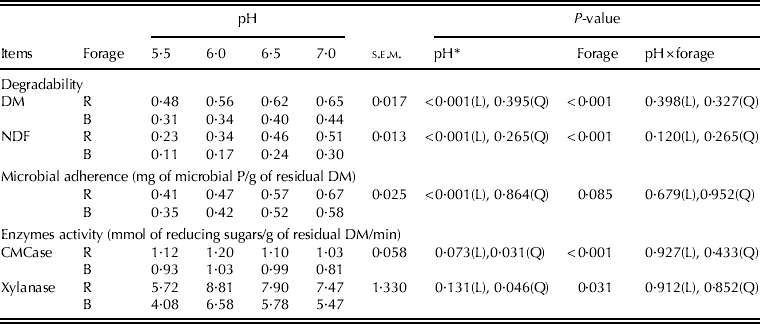
There was no pH×forage species interaction for any variable studied (Table 1). After 24 h of incubation, the final pH in Assay 1 was 5·8±0·06, 6·4±0·12, 6·7±0·06 and 6·79±0·17 for initial pH values of 5·5, 6·0, 6·5 and 7·0, respectively. The amount of adhered bacteria on sample residue, as well as the DM and NDF degradabilities, were higher for ryegrass than for bermudagrass (P≤0·08) and were linearly and positively affected (P<0·05) by increased pH. For both forage species, the quadratic effect of pH on CMCase and xylanase activities was significant (P<0·05). Maximum activity of both enzymes was observed at pH 6·0. On average, CMCase and xylanase activities were higher for ryegrass than for bermudagrass (P<0·05).
Dry matter (DM) and neutral detergent fibre (NDF) degradation, level of microbial adherence (Assay 1), and carboxymethylcellulase (CMCase) and xylanase activity (Assay 3) on residue of ryegrass (R) or bermudagrass (B) samples after 24 h of fermentation in response to increased pH of the incubation medium

* L, linear effect; Q, quadratic effect.
Effect of glucose concentration on microbial adherence and enzyme activity (Assays 2 and 4)
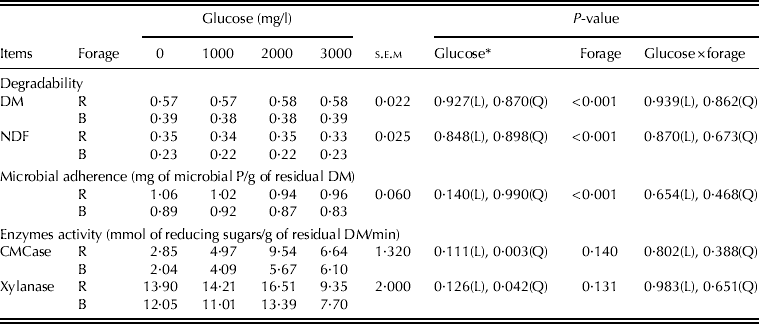
There was no glucose×forage species interaction for any variable studied (Table 2). The initial reducing sugar concentrations in the in vitro incubation medium were 140±5, 1067±30, 2237±45 and 3247±72 mg/l for the 0, 1000, 2000 and 3000 glucose treatments, respectively. After 24 h of fermentation, the final concentration of reducing sugars in all flasks was low and similar for all treatments (mean of 150±10 mg/l). The average initial and final pH in Assay 2 were 7·2±0·03 and 7·1±0·06, respectively. The DM and NDF degradabilities, as well as the amount of adhered bacteria on forage residue were not affected by glucose concentration but were higher (P<0·05) for ryegrass than for bermudagrass (Table 2). For both forage species, the quadratic effect of glucose concentration on CMCase and xylanase activities was significant (P<0·05). Maximum activity of both enzymes was observed at glucose concentration of 2000 mg/l. On average, CMCase and xylanase activities were similar for both forage species.
Dry matter (DM) and neutral detergent fibre (NDF) degradation, level of microbial adherence (Assay 2), and carboxymethylcellulase (CMCase) and xylanase activity (Assay 4) on residue of ryegrass (R) or bermudagrass (B) samples after 24 h of fermentation in response to levels of glucose addition in the incubation medium
* L, linear effect; Q, quadratic effect.
DISCUSSION
Effect of pH
The results of the present study, as well as from other in vitro studies (Mouriño et al. Reference Mouriño, Akkarawongsa and Weimer2001; Hu et al. Reference Hu, Wang and Yu2004; Kozloski et al. Reference Kozloski, Lima, Cadorin, Bonnecarrère Sanchez, Senger, Fiorentini and Härter2008), indicate that fibre degradation is gradually and directly affected by increased pH within the physiological range. This observation is relevant when most quantitative predictive models assume that at values above 6.0 the pH variation shows minor impact on fibre degradation (Dijkstra et al. Reference Dijkstra, Ellis, Kebreab, Strathe, López, France and Bannink2012).
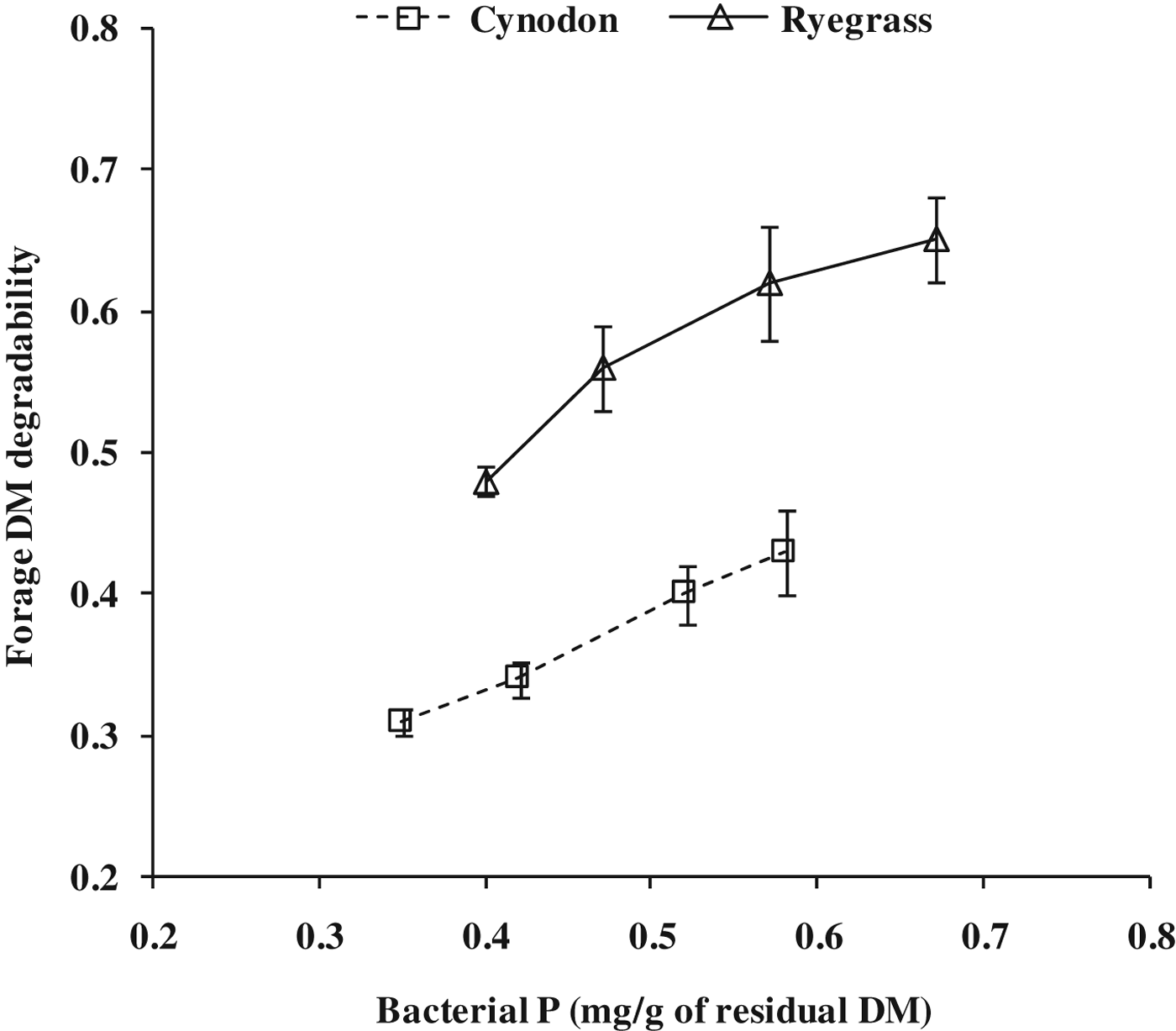
Microbial colonization of particles is a critical initial step in forage degradation. There is no standard method for measuring bacterial adherence on feed samples and several different methodologies or markers have been used to assess this parameter. None of the commonly used markers (i.e. isotopes (14C or 15N), purine basis or diaminopimelic acid) has proved to be completely satisfactory and most of them are expensive or require special and expensive equipment (Carro & Miller Reference Carro and Miller2002). However, regardless of their accuracy or whether they are comparable, the use of either marker may be valid when the objective is to compare treatments within experiments (Firkins et al. Reference Firkins, Bowman, Weiss and Naderer1991). Phosphorus, most of it present as soluble molecules, is a key element for cell metabolism and its concentration in rumen microbial cells varies from 6 to 19 g/kg DM (Komisarczuk et al. Reference Komisarczuk, Merry and Mcallan1987; Ramírez-Pérez et al. Reference Ramírez-Pérez, Sauvant and Meschy2009). Galdámez-Cabrera et al. (Reference Galdámez-Cabrera, Coffey, Coblentz, Scarbrough, Turner, Kegley, Johnson, Kellogg, Gunsaulis and Daniels2004) observed that most (i.e. c. 0·75) P in bermudagrass was soluble, with a high disappearance rate (i.e. overall mean rate of 0·42/h) and large proportion of in situ disappearance (i.e. >0·83). Moreover, microbial mass production has been estimated as the neutral detergent soluble components of the solid residue after 16 h of incubation in in vitro/gas assays (Blümmel & Lebzien Reference Blümmel and Lebzien2001). Based on these reports, it was assumed in the present study that after 24 h of incubation, all P in residue that was insoluble in neutral detergent is from forage and all soluble P was from adhered bacterial cells. The mean P concentration in residues varied from 0·35 to 1·06 mg/g DM, equivalent to an average of 55 mg of adhered bacterial DM/g residual DM. This value is in agreement with that reported by Firkins et al. (Reference Firkins, Bowman, Weiss and Naderer1991), who used 15N and purines to assess microbial adherence on pure cellulose. Using P as a bacterial marker in the present study, it was possible to observe a direct relationship between pH and either bacterial adhesion or forage degradability, as well as between bacterial adhesion and forage degradability (Fig. 1). Other studies have also reported that when pH is lower than 6·0, cells usually detach from particles and growth of fibre-degrading bacteria is impaired (Russell et al. Reference Russell, Sharp and Baldwin1979; Morris Reference Morris1988; Mouriño et al. Reference Mouriño, Akkarawongsa and Weimer2001; Hu et al. Reference Hu, Wang and Yu2004). Decreasing pH negatively affects bacterial adherence to feed particles, probably because it changes ionic interactions between the outer surface of the bacteria and the surface of feed particles (McAllister et al. Reference Mcallister, Bae, Jones and Cheng1994). In addition, hydrogen ions could displace cations associated with the surface of feed particles, reducing the number of sites available for adhesion (McBurney et al. Reference Mcburney, Allen and Van Soest1986).
Relationship between rate of bacterial adhesion (mg of neutral detergent soluble P/g of residual DM) and forage DM degradability after 24 h of in vitro incubation. Ryegrass: Y=0·36+0·41X, R 2=0·44, n=8, P<0·05; Cynodon: Y=0·27+0·21X, R 2=0·49, n=8, P<0·05.
In vitro and in situ studies have clearly shown that fibrolytic activity, regardless of whether it was measured with mixed or pure ruminal micro-organisms, is pH-dependent. As described above, several previous studies have identified that pH values <6·0 impair bacterial growth or adherence. However, a few studies have considered the effect of pH on rumen microbial enzyme activity. Russell & Wilson (Reference Russell and Wilson1988) reported that cellulase activity from Bacteroides succinogenes seemed to be the maximum at pH of 5·5. Morgavi et al. (Reference Morgavi, Beauchemin, Nsereko, Rode, Iwaasa, Yang, Mcallister and Wang2000) observed that hydrolysis of CMC and maize silage samples incubated with rumen filtrate enzyme extracts was highest at pH 6·0, whereas xylanase activity in the extract was similar within a range of pH from 5·5 to 6·5. In the present study, regardless of the forage type, both CMCase and xylanase activities were quadratically related to pH, showing maximum activity at pH 6·0.
Effect of glucose concentration
To evaluate the pH-independent effect of non-fibre carbohydrates on fibre degradation, Piwonka & Firkins (Reference Piwonka and Firkins1993) conducted an in vitro study using the strongly buffered incubation medium that kept pH values above 6·2; they incubated wheat bran samples and observed that increasing glucose concentrations in the medium affected cellulose and NDF degradation rates negatively, apparently by reducing microbial colonization on feed particles. Bacterial colonization, in that study (Piwonka & Firkins Reference Piwonka and Firkins1993), was estimated based on the CMCase activity in the residue of incubation. It was later found that this negative effect was mediated by a peptide (bacteriocin) that is produced by bacteria in situations of high sugar availability (Piwonka & Firkins Reference Piwonka and Firkins1996). In the present study, for testing the pH-independent effect, the same strong buffer described by Piwonka & Firkins (Reference Piwonka and Firkins1993) was used, which was able to maintain the pH of the incubation medium close to 7·0 through the 24 h of incubation. However, increased glucose concentration neither affected degradation nor bacterial adherence to forage samples. Moreover, because a static incubation system was used, reducing sugar concentration was substantially decreased in all treatments. Thus, although an increase in reducing sugar concentration would be expected to have a negative effect on bacterial adherence during the first hours of incubation, such a negative effect was not so clear after 24 h of incubation. Piwonka & Firkins (Reference Piwonka and Firkins1996) also reported that increased glucose concentration decreased the fibre digestion rate, but did not affect the extent of fibre digestion after 96 h of in vitro fermentation.
Huhtanen & Khalili (Reference Huhtanen and Khalili1992) observed that sucrose supplementation decreased xylanase and CMCase activities in ruminal digesta particles of a steer fed a grass silage-based diet, and concluded that this effect was pH-dependent and associated with a reduction of both the adhesion of fibrolytic micro-organisms to feed particles and a reduction of extracellular enzyme synthesis by adhered bacteria. In the present study, the effect of glucose concentration on the activity of enzymes from microbes closely associated with forage particles incubated in the rumen of a steer-fed ryegrass was tested; as such only the enzyme–substrate reaction medium was modified. Xylanase and CMCase activities were stimulated by increased glucose concentrations up to c. 2000 mg/l. This result indicates that one or more of the microbial enzymes involved in fibre hydrolysis works under allosteric-type regulation.
Regardless of forage species, xylanase activity was five- to sixfold greater than CMCase activity. Huhtanen & Khalili (Reference Huhtanen and Khalili1992) observed that CMCase activity in grass silage residue incubated in situ was twofold lower than xylanase activity.
Effect of assay procedures
Although not always reaching statistical significance, both bacterial adherence and enzyme activity on residues were higher for ryegrass than for bermudagrass samples, being closely related to differences in degradation of these forages within assays. However, when the forage samples and experimental procedures were similar, the results of bacterial adherence and enzyme activities were, on average, lower for the pH than for the glucose assays. Although this difference does not invalidate treatment comparisons within assays, it precludes comparison of the results of bacterial adherence or enzyme activity between assays or studies. The explanation for this discrepancy is not apparent. However, the buffer solution used for in vitro incubation was stronger in the glucose than in the pH assay. Moreover, the steer used for the glucose assays was grazing a ryegrass pasture, whereas that used for the pH assays was grazing a Cynodon pasture. It is well established that gas production in in vitro assays is affected by dietary conditions of the inoculum donor animal (Rymer et al. Reference Rymer, Huntington, Williams and Givens2005). However, further studies are required to investigate whether the pH effect on in vitro variables observed in the present study is dependent on the inoculum source.
CONCLUSIONS
Forage degradation was negatively affected by decreased ruminal pH due to reduced bacterial adherence. In turn, the pH or glucose effect on fibrolytic enzyme activity was not related to their effects on bacterial adherence or forage degradation, indicating that forage degradation is more dependent on the degree of microbial colonization than on the specific activity of bacterial enzymes. However, further in vitro studies should be carried out to evaluate whether these effects are dependent on inoculum source.