North Carolina ranks in the top three states nationally for pickling cucumber, with 2,550 ha harvested in 2012 and an estimated crop value of $12.3 million (Wells et al. Reference Wells, Thornsbury and Bond2014). Pickling cucumber has a prostrate, vining growth habit, and controlling weeds in cucumber improves fruit yield and quality (Berry et al. Reference Berry, Stall, Rathinasabapathi, Macdonald and Charudattan2006; Friesen Reference Friesen1978) and harvesting efficiency (Trader et al. Reference Trader, Wilson and Hines2007). Pickling cucumber is typically produced on bare ground without plastic mulch, and standard weed control practices include herbicides, between-row cultivation (three times per season), and hand weeding (once or twice per season) (Holmes et al. Reference Holmes, Monks, Schultheis, Sorensen, Thornton and Toth2005).
Palmer amaranth is the most common and troublesome weed in North Carolina pickling cucumber (Webster Reference Webster2010). It has been observed to grow as fast as 21 mm per growing degree day (GDD) and to heights greater than 2 m under natural growing conditions (Horak and Loughin Reference Horak and Loughin2000). Where water and nutrients were provided through drip tape in a bell pepper (Capsicum annuum L.) production system, Palmer amaranth grew at a maximum rate of 42 mm per GDD and reached 4 m tall (Norsworthy et al. Reference Norsworthy, Buckelew, Jennings, Monks, Oliveira, Jha and Malik2008). The tall growth habit of Palmer amaranth allows it to intercept light that would otherwise reach the cucumber canopy. In sweet potato, which has a growth habit similar to that of cucumber, Meyers et al. (Reference Meyers, Monks, Schultheis and Jennings2010) reported that storage root yield exhibited an inverse relationship with Palmer amaranth light interception.
Berry et al. (Reference Berry, Stall, Rathinasabapathi, Macdonald and Charudattan2006) reported that season-long interference by livid amaranth (Amaranthus lividus L.) and smooth pigweed (Amaranthus hybridus L.) reduced cucumber yield by as much as 70%. Palmer amaranth grows faster and to a greater height than livid amaranth and smooth pigweed (Horak and Loughin Reference Horak and Loughin2000) and therefore may exhibit greater interference with cucumber. Season-long interference of cucumber by a mixed population of common ragweed (Ambrosia artemisiifolia L.), common lambsquarters (Chenopodium album L.), and longspine sandbur [Cenchrus longispinus (Hack.) Fernald] reduced cucumber yield 46% and 92% with weed densities of 9 and 209 plants m–2, respectively (Friesen Reference Friesen1978). However, weeds emerging 36 d after planting or later did not decrease pickling cucumber yield (Friesen Reference Friesen1978). Weaver (Reference Weaver1984) determined that cucumber maintained weed-free for as little as 2 wk following seeding produced yield similar to the season-long weed-free treatment.
The critical period for weed control (CPWC) is defined as the period during which weeds must be controlled to prevent yield or quality loss (Friesen Reference Friesen1978; Knezevic et al. Reference Knezevic, Evans, Blankenship, Van Acker and Lindquist2002). It represents the time interval between two separately measured competition components: (1) maximum duration of time that a weed can grow and interfere with the crop before unacceptable yield loss is incurred, and (2) minimum length of time that weed emergence must be prevented to ensure weed growth does not diminish crop yield (Knezevic et al. Reference Knezevic, Evans, Blankenship, Van Acker and Lindquist2002). The CPWC varies with the crop or crop varieties, row spacing, planting density, location, type and density of weed species, environmental conditions, and crop management practices (Knezevic et al. Reference Knezevic, Evans, Blankenship, Van Acker and Lindquist2002; Swanton et al. Reference Swanton, O’Sullivan and Robinson2010; Williams Reference Williams2006). The critical weed-free period for carrot planted in late April extended up to 930 GDD, but the critical weed-free period was short and lasted 414 to 444 GDD for carrot planted in mid- to late May (Swanton et al. Reference Swanton, O’Sullivan and Robinson2010).
The CPWC has been determined for cucumbers under different conditions with varying results. In Canada, the CPWC for ‘Salty’ pickling cucumber was determined to be 12 to 36 d after seeding (DAS) with a mixed population of common ragweed, common lambsquarters, and longspine sandbur (Friesen Reference Friesen1978). Weaver (Reference Weaver1984) found that a single weeding either 3 or 4 wk after seeding (WAS) was sufficient to prevent yield loss for hand-picked cucumber with density 55,550 plants ha–1 planted on 1.2-m row spacing, and concluded that no CPWC existed for natural mixed annual weeds. Conversely, they found that once-over machine-harvest cucumber with density 184,450 plants ha–1 planted on a four-row bed with 2.13-m spacing between centers had a CPWC for 3 to 4 WAS (Weaver Reference Weaver1984). However, there has been no research conducted in pickling cucumber to study the effects of Palmer amaranth on cucumber yield.
Previous studies have found that the CPWC in cucumber varied by year (Friesen Reference Friesen1978; Weaver Reference Weaver1984). The use of GDD or heat units (HU) as a parameter to predict CPWC rather than calendar days can be useful in reducing variation between years and has a more direct connection to crop growth stage (Knezevic et al. Reference Knezevic, Evans, Blankenship, Van Acker and Lindquist2002). An HU model for cucumber has been developed by Perry et al. (Reference Perry, Wehner and Johnson1986) to predict harvest timing. Therefore, the objective of this study was to determine the critical period for Palmer amaranth control (CPPAC) in pickling cucumber measured by both accumulated HU and time period.
Materials and Methods
Research was conducted at the Horticultural Crops Research Station in Clinton, NC (35.02°N, 78.28°W) in 2014 and 2015 to determine the CPPAC in pickling cucumber. Soil was a Norfolk loamy sand (fine-loamy, kaolinitic, thermic Typic Kandiudults) with 1.2% organic matter and pH 6.2. ‘Journey’ pickling cucumber was seeded onto raised beds spaced 1.5 m apart using a tractor-mounted vacuum planter. ‘Journey’ is a commonly used commercial variety in North Carolina (PJ Denlinger, Mt. Olive Pickle Co., personal communication). Cucumber plants were thinned at 2 WAS to an in-row spacing of 15 to 20 cm. Spacing between rows was greater than that recommended by Schultheis et al. (Reference Schultheis, Averre, Boyette, Estes, Holmes, Monks and Sorensen2000) because of equipment availability and in an attempt to avoid shading by Palmer amaranth in neighboring plots. Cucumber was seeded on May 7 and 21, 2014 and April 24 and May 4, 2015. These planting dates were chosen within the recommended planting time (April 20 to May 20) for pickling cucumber in eastern North Carolina (Kemble Reference Kemble2017). Palmer amaranth removal and establishment studies were initiated on each planting date. Treatment plots consisted of cucumber planted on a single ridged row (1.5 m wide by 6.1 m long) with a weed-free cucumber row between each plot. Treatments were arranged in a randomized complete block with four replications for each planting date.
Study sites had historically high Palmer amaranth densities ranging from 50 to 100 plants m–2. Plots were free of emerged Palmer amaranth at the time of cucumber seeding as a result of recent tillage and bed shaping. In removal treatments (REM), cucumber was planted and then Palmer amaranth emerged and was allowed to compete with cucumber for 14, 21, 28, or 35 DAS in 2014 and for 14, 21, 35, or 42 DAS in 2015. Plots were then kept weed-free for the remainder of the season. In the establishment treatments (EST), cucumber was planted and then the plots were maintained free of Palmer amaranth by hand removal until 14, 21, 28, or 35 DAS in 2014 and until 14, 21, 35, or 42 DAS in 2015; after which Palmer amaranth were allowed to establish and compete with the cucumber for the remainder of the season through harvest. Additionally, season-long weedy and weed-free controls were included. At the time of removal, small (approximately 2 cm or less in diameter) Palmer amaranth was uprooted by hand, whereas large (greater than 2 cm in diameter) Palmer amaranth were cut at the soil surface to avoid disturbing cucumber roots. The delay in timing of treatments in 2015 was due to slow early-season growth.
Annual grasses including large crabgrass [Digitaria sanguinalis (L.) Scop.] and goosegrass [Eleusine indica (L.) Gaertn.] were controlled POST with clethodim (Select Max, Valent USA Corp. Walnut Creek, CA) at 70 g ai ha–1 plus NIS (0.25% vol/vol) as needed. Except for Palmer amaranth–specific for a treatment, all broadleaf weeds were controlled by hand weeding. Between-row weeds were controlled with a tractor-mounted rolling basket cultivator until lay-by (five- to seven-leaf cucumber), and controlled after lay-by as necessary by hand hoeing. Overhead irrigation (1.3 cm) was applied twice per week as needed.
Cucumber yield data were collected beginning 33 to 41 DAS. Fruit were harvested by hand two to three times per week for 3 wk and graded according to Schultheis et al. (Reference Schultheis, Averre, Boyette, Estes, Holmes, Monks and Sorensen2000). Marketable fruit yield was the sum of grades 1 through 3. Relative marketable yield as a percentage of weed-free control was calculated for each treatment.
Heat units (HU) were calculated for each day of the growing season using equations developed by Perry et al. (Reference Perry, Wehner and Johnson1986). Equation 1 was used for days when maximum daily temperature was less than 90 F (32.2 C), and Equation 2 was used for days when maximum daily temperature was greater than 90 F (32.2 C):
 $${\rm HU}{\equals}{\rm Max}-60{\rm F}$$
 $${\rm HU}{\equals}[90-({\rm Max}-90)-60]$$
where Max is daily maximum temperature and all temperatures are in degrees F. Accumulated HU were calculated as the sum of daily HU for all previous days since cucumber seeding. Due to differences in HU, which was used as an explanatory variable in regression analyses, statistical analysis was performed separately for each year.
Nonlinear models were best fit to describe relative marketable yield as a function of REM and EST treatments using PROC NLIN in SAS (V. 9.3, SAS Institute, Cary, NC) (Chaudhari et al. Reference Chaudhari, Jennings, Monks, Jordan, Gunter, McGowen and Louws2016; Knezevic et al. Reference Knezevic, Evans, Blankenship, Van Acker and Lindquist2002; Williams Reference Williams2006). A three-parameter log-logistic equation was used to determine the effect of increasing duration of weed interference (REM) on relative marketable yield and the beginning of the CPWC:
 $${\rm Y}{\equals}\left[ {1\,/\,\{ {\rm exp}} \right[{\rm k}({\rm t}-{\rm d})] {\plus}{\rm f}\} {\plus}[({\rm f}-1)\,/\,{\rm f}]]{\times}100$$
where Y is relative marketable yield of cucumber as a percent of the weed-free, t is HU after crop emergence, d is the point of inflection (expressed in HU), and k and f are constants. The three-parameter Gompertz equation was used to determine the effect of increasing duration of weed-free period (EST) on relative marketable yield and the end of the CPWC:
 $${\rm Y}{\equals}{\rm a}{\times}{\rm exp}\left\{ {-{\rm exp}\left[ {-\left( {{\rm t}-{\rm c}} \right)\,/\,{\rm b}} \right]} \right\}$$
Where Y is the yield as a percent of the weed-free treatment, a is the yield asymptote, t is HU after crop emergence, and b and c are constants.
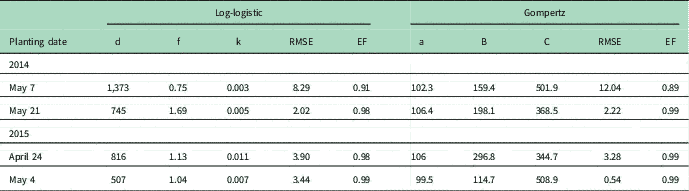
SigmaPlot 12.0 was used to make all graphs. Root mean square error (RMSE) and modeling efficiency coefficient (EF) were used to determine the goodness of fit for the model (Chaudhari et al. Reference Chaudhari, Jordan, York, Jennings, Cahoon, Chandi and Inman2017). Model parameter estimates from Equations 3 and 4 were used to determine HU corresponding to the beginning and end, respectively, of the CPWC at 5% level of yield loss. The parameter estimates of log-logistic and Gompertz models are listed in Table 1.
Parameter estimates for the three-parameter log-logistic model and Gompertz model for relative (% weed-free check) marketable cucumber yield.Footnote a

Log-logistic equation: Y=[1/{exp[k×(t – d)]+f}+[(f – 1)/f]]×100, where Y is relative marketable yield of cucumber as a percent of the weed-free, t is heat units (HU) after crop emergence, d is the point of inflection (expressed in HU), and k and f are constants. Gompertz equation: Y=a×exp {– exp [– (t – c)/b]}, where Y is the yield as a percent of the weed-free treatment, a is the yield asymptote, t is HU after crop emergence, and b and c are constants.
a Abbreviations: RMSE, root mean square error; EF, modeling efficiency coefficient.
Results and Discussion
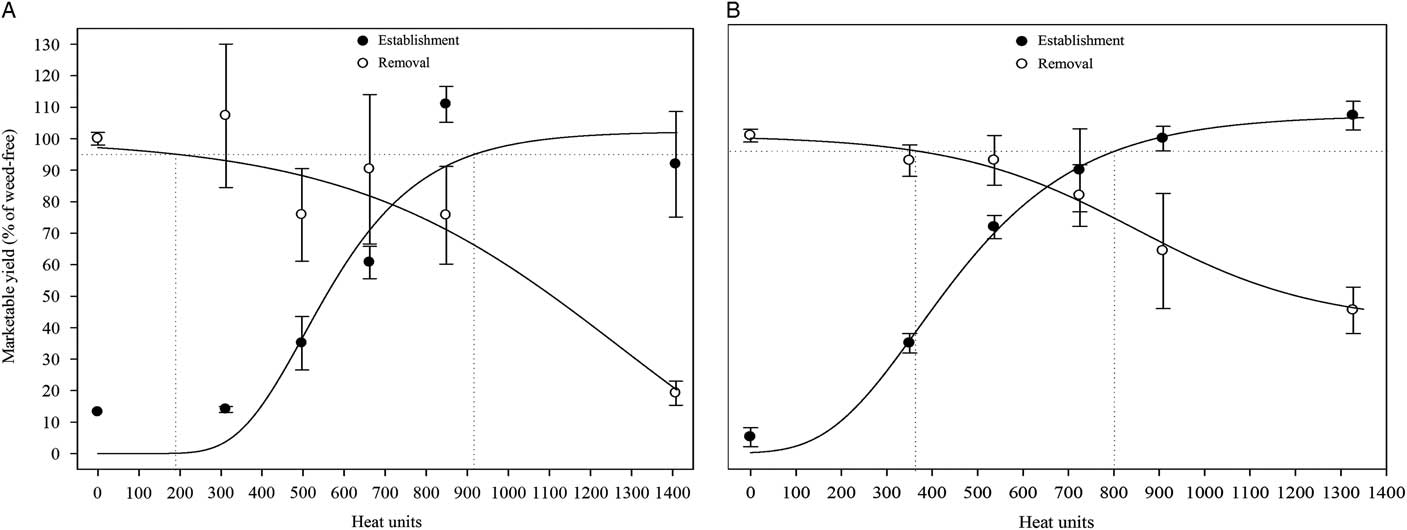
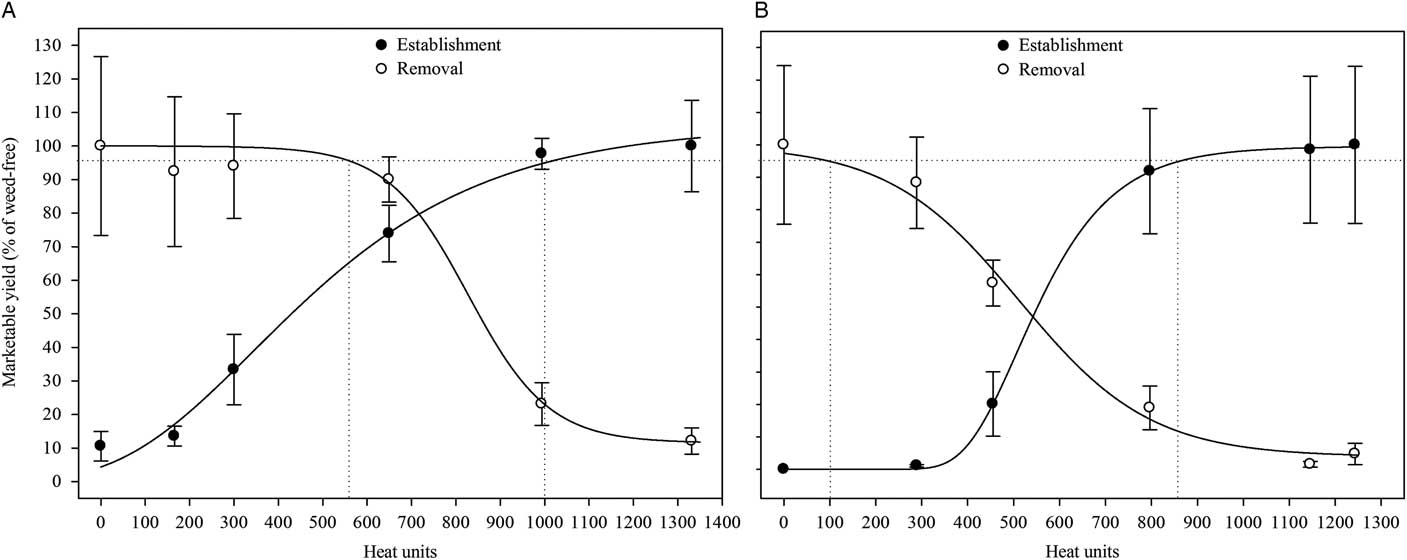
Increasing periods of weed interference markedly reduced cucumber yields in both years. Season-long competition by Palmer amaranth reduced pickling cucumber yield by 45% to 98% and 88% to 98% during 2014 and 2015, respectively (Figures 1 and 2). These results were similar to those of Friesen (Reference Friesen1978), who reported that season-long competition by common lambsquarters, common ragweed, and longspine sandbur reduced pickling cucumber yield by 46% to 92% compared to weed-free. A significant yield reduction from season-long weed competition had been also observed in other crops (Chaudhari et al. Reference Chaudhari, Jennings, Monks, Jordan, Gunter, McGowen and Louws2016; Williams Reference Williams2006).
Effect of Palmer amaranth establishment and removal timings on marketable yield of pickling cucumber planted May 7 (A) and May 21 (B), 2014, in Clinton, NC. Points represent observed mean±SE. Solid lines represent predicted values.

Effect of Palmer amaranth establishment and removal timings on marketable yield of pickling cucumber planted April 24 (A) and May 4 (B), 2015 in Clinton, NC. Points represent observed mean±SE. Solid lines represent predicted values.

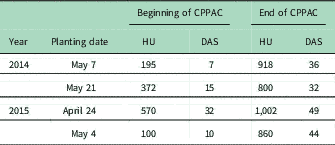
The CPPAC required to maintained yield losses less than 5% varied among planting dates and years. The choice of 5% is an arbitrary measurement of yield loss, and the range of percentage of yield loss depends on the economics of weed management or the risk that the farmer is willing to take (Knezevic et al. Reference Knezevic, Evans, Blankenship, Van Acker and Lindquist2002). In previous studies, a 5% acceptable level of yield loss was used to measure the CPWC in different crops such as peanut (Arachis hypogaea L.), field and sweet corn (Zea mays L.), and tomato (Chaudhari et al. Reference Chaudhari, Jennings, Monks, Jordan, Gunter, McGowen and Louws2016; Everman et al. Reference Everman, Clewis, Thomas, Burke and Wilcut2008; Williams Reference Williams2006). Thus, we assumed that a 5% yield loss would be acceptable to cucumber growers and therefore used it for the calculations in this study. When cucumber was planted on April 24, 2015, the CPPAC ranged from 570 to 1,002 HU, which corresponded to 32 to 49 DAS (Figure 2A; Table 2). However, when cucumber planting was delayed 2 (May 7, 2014 and May 4, 2015) to 4 wk (May 21, 2014), the CPPAC lasted from 100 to 918 HU, which corresponded to 7 to 44 DAS (Figure 1A, B; Figure 2B; Table 2). When HUs were converted to days to compare findings with previous research, the length of CPPAC was 17 to 34 d, depending upon cucumber planting date. Similarly, Friesen (Reference Friesen1978) reported a CPWC of 24 d in cucumber for control of common lambsquarters, common ragweed, and longspine sandbur. However, Weaver (Reference Weaver1984) reported a CPWC in pickling cucumber of 7 d, which was shorter than reported in this research. Differing CPWC results by year are common in the literature and should not invalidate data from differing years. Martin et al. (Reference Martin, Friesen and Van Acker2001) reported only one of nine trials to have a CPWC for spring canola (Brassica napus L.). The variability in CPWC was mainly due to the effect of different locations and weed densities.
The critical period of Palmer amaranth control (CPPAC) for cucumber represented in heat units (HU) and d after sowing (DAS) at Clinton, NC, 2014 and 2015.Footnote a

a Based on a 5% acceptable yield loss level.
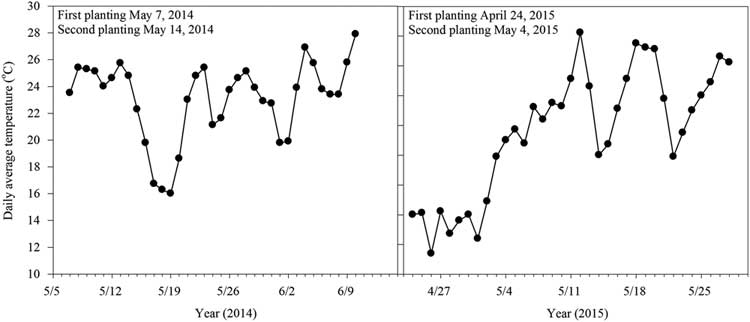
We hypothesize that the lower daily average temperature (15 C or lower) from April 24 to May 2, 2015 delayed Palmer amaranth emergence, growth, and interference (Figure 3). As a result, the beginning of CPPAC was delayed when cucumber was planted on April 24, 2015 compared to May 7 and 21, 2014 and May 4, 2015. Guo and Al-Khatib (Reference Guo and Al-Khatib2003) reported peak germination of Palmer amaranth with a day/night temperature regime of 35 C/30 C and no germination at 15 C/10 C. Jha and Norsworthy (Reference Jha and Norsworthy2009) reported that the peak emergence period for Palmer amaranth ranges from early May to mid-July, a period that merits greater attention in terms of weed management.
Daily average temperature after cucumber planting at Clinton in 2014 and 2015. Temperature data were provided by the State Climate Office of North Carolina.

Other researchers have also shown that planting date may affect the duration of critical period for weed control (Motis et al. Reference Motis, JPSJ and Gilreath2004; Seem et al. Reference Seem, Creamer and Monks2003; Swanton et al. Reference Swanton, O’Sullivan and Robinson2010; Williams Reference Williams2006). Seem et al. (Reference Seem, Creamer and Monks2003) reported that the CPWC in organic sweet potato was longer for a later planting date, and that competition by a mixed population including redroot pigweed was greater at a later planting date. Motis et al. (Reference Motis, JPSJ and Gilreath2004) reported that yellow nutsedge interference in bell pepper was longer in the fall (1 to 7 wk after planting) as compared to spring (3 to 5 wk after planting) because of the fast early-season growth of nutsedge in fall. The early-season high temperature in fall (21 C) as compared to spring (10 C) favored rapid growth of yellow nutsedge that resulted in stronger competitiveness of nutsedge with pepper in the fall.
This research confirms that pickling cucumber is highly susceptible to competition by Palmer amaranth. The CPPAC varied with planting date, suggesting the utility of using a CPPAC based on HU, as suggested by Knezevic et al. (Reference Knezevic, Evans, Blankenship, Van Acker and Lindquist2002), rather than days or weeks. Because the CPWC can vary with planting date and environment, weed management practitioners should use the CPWC as a guideline for recommendations (Everman et al. Reference Everman, Clewis, Thomas, Burke and Wilcut2008; Knezevic et al. Reference Knezevic, Evans, Blankenship, Van Acker and Lindquist2002). On average, weed management in cucumber should be initiated by 100 HU after emergence or 7 DAS and maintained until 1,002 HU after emergence or 49 DAS to avoid yield loss.
The CPWC is a key component of strategies for an integrated weed management system, and the results of this experiment contribute to the development of such a system for pickling cucumber growers. The practical implication of this study helps to determine the most effective time to target hand weeding during the CPPAC. This will help growers to save on labor costs and prevent yield and quality losses due to Palmer amaranth competition. This research also suggests that planting cucumber as early as possible during the season may help to reduce competition by Palmer amaranth and reduce the length of the CPPAC. Although critical periods and weed thresholds provide valuable information to producers, it should be noted that at present more emphasis is on controlling all weed seed production as a means of preventing and/or managing weed resistance. That may mean implementing weed control practices outside the critical period required to avoid any crop yield loss and spread of resistant weeds. Currently, one of the best management practice for growers is to remove all Palmer amaranth plants from the field before they reach reproductive maturity, so as to mitigate the spread of herbicide-resistance traits.
Acknowledgments
The authors express appreciation to Dr. Cavell Brownie for statistical advising and to Nick Basinger, Shawn Beam, Matthew Bertucci, Matthew Waldschmidt, Hailey McCleneghen, Lauren Deans, Andrea Genna, and the staff of NC Department of Agriculture and Consumer Services, Horticultural Crops Research Station in Clinton, NC, for field assistance. The authors also wish to thank the NC Agricultural Foundation, NC Agriculture Research Service, and NC State University Department of Horticultural Science for funding this research. No conflicts of interest have been declared.