Introduction
The greyish green coverings of tree bark, acid stone and timber structures by the crustose lichen Lecanora conizaeoides Nyl. ex Cromb. were a familiar sight in industrialized regions of Britain and western Europe until the closing years of the twentieth century. Lecanora conizaeoides was evidently very rare or absent in Britain before the middle of the nineteenth century (Laundon Reference Laundon, Ferry, Baddeley and Hawksworth1973); it was first described in 1885 by Nylander but was probably already frequent to the north of London by 1878 (Hawksworth et al. Reference Hawksworth, Rose, Coppins, Ferry, Baddeley and Hawksworth1973). By 1913 it was forming a monotonous crust on tree bark in Epping Forest, north-east London (Paulson & Thompson Reference Paulson and Thompson1913; Hawksworth et al. Reference Hawksworth, Rose, Coppins, Ferry, Baddeley and Hawksworth1973) and was soon equally abundant in many other industrialized regions of Britain and north-west Europe (Hawksworth & Rose Reference Hawksworth and Rose1976). Wirth (Reference Wirth1985) has suggested that the original habitat of L. conizaeoides was the naturally acid bark of Pinus mugo in central European bogs.
Laundon (Reference Laundon1967) described the Conizaeoidion federation (a mixture of Lecanora conizaeoides and the green alga cf. Pleurococcus viridis) and its continuing spread across London's urban and suburban rings, and out into the green belt areas beyond. He also noted that L. conizaeoides was absent from the centre of the capital, probably because of the intolerably high SO2 levels then prevailing. Similarly, Gilbert (Reference Gilbert1969) showed that L. conizaeoides increased in both abundance and vigour on approaching the heavily SO2-polluted centre of Newcastle-upon-Tyne, but it declined in the city centre where SO2 concentrations were highest. Gilbert (Reference Gilbert1970) speculated that L. conizaeoides was a recently introduced, acidophytic and toxitolerant lichen that was still extending its distribution in urban areas, and that it had some unidentified nutritional requirement that was being satisfied by urban air pollution. These and other studies led Hawksworth & Rose (Reference Hawksworth and Rose1970) to use L. conizaeoides as one of the key indicator species in their zone scale for estimating mean winter sulphur dioxide levels from the assemblages of epiphytes present on tree trunks. The invasion of coastal regions of North America by L. conizaeoides has been much slower than in Europe although it appears that the species is now poised to increase markedly if for any reason acidic air pollution in the region should increase (LaGreca & Stutzman Reference LaGreca and Stutzman2006).
Studies of lichen physiology in response to experimental applications of pollutants have largely confirmed the exceptional toxitolerance of L. conizaeoides, especially to SO2 (Hill Reference Hill1971, Reference Hill1974; Baddeley et al. Reference Baddeley, Ferry and Finegan1972; Turk et al. Reference Turk, Wirth and Lange1974). Several writers have speculated that the high tolerance to SO2 by L. conizaeoides may be a function of its thick, crustose and markedly water-repellent thallus resisting the absorption of both gaseous and dissolved forms of the pollutant (e.g. Turk et al. Reference Turk, Wirth and Lange1974). The apparent unwettability of the thallus, however, does not appear to prevent strong accumulation of heavy metals by this lichen (Pilegaard Reference Pilegaard1978). Our own studies indicate that the high SO2 tolerance of L. conizaeoides depends, at least partly, on possession of an effective detoxification mechanism for the dissolved pollutant (Massara Reference Massara2004). This would not preclude the operation of an unusually elevated nutrient (e.g. sulphur) requirement. This was suggested by the results of the Liphook Forest Fumigation Experiment (Bates et al. Reference Bates, McNee and McLeod1996) in which L. conizaeoides achieved maximum coverage on young conifers at mean atmospheric concentrations of 32 and 52 μg m−3 SO2.
In London, atmospheric SO2 concentrations began to fall noticeably from the late 1960s and publications describing lichen recolonization of formerly polluted areas subsequently appeared (Rose & Hawksworth Reference Rose and Hawksworth1981; Hawksworth & McManus Reference Hawksworth and McManus1992). In 1993, a long-term study by Wirth in Baden-Würtemberg (Germany) showed very clearly that the once dominant epiphyte L. conizaeoides was declining rapidly in its former strongholds. Bates et al. (Reference Bates, Bell and Massara2001) recorded a similar decline and a retreat towards the city centre on oak in London which started around 1995. The decline in Germany appeared to be linked to infestation by the lichenicolous fungus, Athelia arachnoidea (also see Gilbert Reference Gilbert1988), acting in concert with a reduction in SO2 emissions. However, it remained uncertain whether the fungal pathogen, the reduction in sulphur supply, increasing bark pH or some combination of these was ultimately responsible for the demise of L. conizaeoides. Recently, working in the Harz Mountains (Germany), Hauck et al. (Reference Hauck, Hesse, Jung, Zoller and Runge2001) reported that the cover of L. conizaeoides on Norway spruce was positively correlated with the sulphur concentration of bark stem-flow. Fungal attack by Athelia was not mentioned as a significant factor in this instance. In Britain, convincing evidence of recent overall reductions in acidity, linked to reduced SO2 emissions and/or increased N deposition, has been obtained in studies of river chemistry (e.g. Monteith & Evans Reference Monteith and Evans2005) and of epiphytic lichens (Wolseley et al. Reference Wolseley, James, Theobald and Sutton2006, Larsen Vilsholm et al. Reference Larsen Vilsholm, Wolseley, Søchting and Chimonides2009).
To distinguish between some of the alternative hypotheses that have been advanced to account for the decline of L. conizaeoides and faced with a rapidly declining subject, we carried out a long-term field experiment using a relict population of the lichen. By early 2000, L. conizaeoides had already largely disappeared from Quercus robur trunks in East Berkshire, but residual populations were still frequent on the bark of mature Fagus sylvatica, Betula pendula and on some weathered timber (‘lignum’) structures. A population on Fagus bark was selected for a ‘nutrient application’ experiment in which sulphur and nitrogen were applied in solution at frequent intervals and the lichen's cover was monitored over 25 months. The rationale was that if the lichen's survival depended on elevated sulphur, either in reduced or oxidized form, it should prosper where the appropriate form was added. Nitrogen was applied in the form of nitrate to simulate the elevated supply of this element from motor traffic in the contemporary city environment. We later replicated and refined the experiment under laboratory conditions to lessen potential interference from ambient pollutants present in the field.
Materials and Methods
Field experiment
The field experiment was carried out in a relatively open beech (Fagus sylvatica L.) plantation on Crown Estate property at Woodend, Windsor Forest, Berkshire, U.K. (grid reference SU936713; elevation 85 m). Here, relict populations of L. conizaeoides have persisted on the mature beech trunks although the lichen had largely vanished from oak bark, on which it had previously been dominant, in the same area. Thirty beech trees supporting significant coverages of healthy-looking L. conizaeoides were selected for study.
Five permanent plots (10 × 10 cm) were marked on each tree. The plots were positioned on the trunks in the zone of greatest lichen cover, randomly at points 50 – 200 cm from the tree base. This was done to even-out any effects of height-related microclimatic variation and to avoid the potentially more nutrient-rich trunk bases. Stainless steel pins were used to mark each plot and to attach a metal quadrat (10 × 10 cm) for cover estimation (see below).
As the crustose thalli of L. conizaeoides frequently coalesce or have indistinct boundaries, direct growth measurements are difficult to achieve (Boreham 1993). Instead, before and after determinations of percentage cover were used to assess the effects of the experimental treatments on the lichen. To assist in determining the cover, the quadrat was subdivided into 100 units of 1 × 1 cm and cover of the lichen was assessed visually to the nearest 0·1 cm2 within each unit and the results summed for the whole quadrat.
The five aqueous pollutant treatments, applied to individual plots by spraying, were as follows: 1) control, distilled water; 2) nitrate, 2·0 mM sodium nitrate; 3)sulphate, 2 mM sodium sulphate; 4) low bisulphite, 0·2 mM sodium bisulphite; 5) high bisulphite, 2 mM sodium bisulphite. Sodium bisulphite solution was used to simulate dissolved SO2 (e.g. Ferguson & Lee Reference Ferguson and Lee1979; Bharali & Bates Reference Bharali and Bates2002). There are considerable difficulties in equating short spray applications of pollutants on the vertical and relatively non-absorbent bark surface of a tree to pollutant concentrations in air and rainfall or depositions to a flat and highly permeable soil surface. Further, Cape (Reference Cape1984) has provided a critique pointing out some of the pitfalls in using sulphite as a dissolved analogue of SO2. We have taken the view that magnified concentrations are justifiable to compensate for the short duration of each application compared with the much greater volumes and longer exposures typical with polluted air and precipitation. Based on previous studies (e.g. Hill Reference Hill1971, Reference Hill1974; Baddeley et al. Reference Baddeley, Ferry and Finegan1972), it was hypothesized that 0·2 mM bisulphite would be only mildly injurious to L. conizaeoides and might even stimulate its growth (e.g. by satisfying a sulphur requirement). It was predicted that 2·0 mM bisulphite would provide a more severe challenge to the lichen's physiology. Sodium sulphate solution (2·0 mM) was included to provide a relatively harmless source of sulphur whereas sodium nitrate solution (2·0 mM) simulated increased wet deposition of nitrogen. Small volumes (10 ml per plot) of solution were applied by calibrated hand-sprayer on a relatively still day every two weeks. During wet weather, the application was repeated after one week to compensate for probable leaching losses.
Because of limitations imposed by the trunk girth (average 178 cm) and the extent of lichen spread (usually concentrated on the south-facing or unshaded sector), overlap of quadrats was unavoidable. It was therefore necessary to position some plots partly below others. Owing to the potentially highly toxic nature of bisulphite solution, it was decided not to place the high bisulphite treatment directly above other treatments. Thus, the high bisulphite treatment was always placed at the lowest position, and the distilled water control at the highest position despite potential confounding with other positional effects. Other treatments were allocated at random. In a preliminary assessment, no significant differences were found between the mean percentage cover values of L. conizaeoides at three heights (50, 100, 150 cm) on the beech trunks based on a random sample of 15 of the trees (Massara Reference Massara2004).
It was intended that the field experiment should run from January 2000 until September 2002; however, the outbreak of Foot and Mouth disease in 2001 led to the unexpected closure of Windsor Forest for 7 months. Thus the pollutant applications were suspended in 2001 from February until September. Once access had been restored, percentage cover of L. conizaeoides in the individual plots was scored and the pollutant applications resumed until September 2002.
Bark surface pH was determined in six randomly-selected plots from each treatment at the end of the study following the method of Farmer et al. (Reference Bates, Bell and Farmer1990). An area within each plot was wetted with 25 mM KCl solution, allowed to equilibrate for 5 min and then the pH reading taken with a Gelplas flat-tip double junction electrode (BDH, Lutterworth, U.K.).
Laboratory experiment 1
The aim of this experiment was to exclude the effects of any ambient atmospheric pollution that might have been present in the field experiment. Contemporary data available for atmospheric pollutant concentrations in rural Berkshire (www.airquality.co.uk/archive) showed that average daily SO2 rarely exceeded 6 μg m−3 between January 2000 and January 2003. No data were available for NO2 levels in rural Berkshire, but concentrations up to 40 μg m−3 were recorded over the same period in the neighbouring built-up area of Slough. Therefore, N deposition could have affected the field experiment. The treatments of the field experiment were thus repeated on L. conizaeoides thalli maintained in a controlled environment.
As the crustose thalli of L. conizaeoides cannot be removed from their substrata without causing injury, we used thalli attached to their natural substratum. A number of recently-felled silver birch (Betula pendula) trunks with healthy coverings of the lichen were supplied from Frost Farm Plantation, Windsor Great Park (SU 9371). These were sawn to yield lichen-covered surface segments of approximately 10 × 10 cm. The cut ends were coated in paraffin gel to prevent fungal colonization of the newly cut wood surfaces. After randomization, they were placed bark surface upwards in propagator trays lined with capillary matting to retain moisture and provide elevated humidity. Each segment was placed on an upturned square plant pot (5 × 5 cm) to raise it above the wet capillary matting to reduce fungal attack. Seven replicate trays, each containing seven birch segments were used.
Following earlier reports about experimental cultivation of lichens (e.g. Ahmadjian Reference Ahmadjian, Ahmadjian and Hale1973a, Reference Ahmadjian, Ahmadjian and Haleb; Hill Reference Hill1974), the bark segments were maintained in a controlled environment room at 15°C and received 100 μmol m−2 s−1 PPFD during a day-length of 16 hours. Ambient relative humidity of 50% was maintained within the room, although propagator lids were fitted periodically to the trays to increase humidity over the blocks to reduce rapid drying-out after moistening. The blocks were sprayed gently with a fine mist of distilled water every three to four days to replicate dewfall.
The pollutant applications in this experiment were identical to those in the field experiment. Pollutant applications were started after an acclimatisation period of three weeks. The trays were re-randomized each week to average out variations in the amount of light received. Pollutants were applied weekly to give a total of 20 applications to each sample.
A colour photograph of each block was taken prior to the first treatment application, and at the end of the experiment, using a digital camera. The picture files were downloaded onto a computer and analysed using a software package (PC_Image, version 2.2.05; Foster Findlay Associates Ltd). The area of healthy (grey-green to green) lichen thalli in each photograph was assessed in terms of pixel numbers within a 7 × 7 cm ‘region of interest’ (ROI). Unhealthy (green-brown) or bleached (cream) areas of thallus were rejected. The results were expressed as the percentage of ‘healthy’ pixels over the ROI.
Laboratory experiment 2
A second laboratory experiment employing the same five treatment solutions as in the previous work (distilled water, 2·0 mM sodium sulphate, 2·0 mM sodium nitrate, 0·2 mM and 2·0 mM bisulphite) was performed to corroborate the results of the first and with the additional aim of investigating the effect of surface orientation (vertical versus horizontal) on survival of Lecanora conizaeoides. A small number of in situ round, larch fence posts with healthy relict populations of L. conizaeoides were gathered from semi-natural habitats around Silwood Park. Each fence post was cut into lichen-covered lengths of 9 cm and then divided into quarters. The arc of each quarter was approximately 5 cm. A ROI, 4 × 6 cm, was marked onto the lichen-encrusted surface with a permanent marker for the photography and image analysis. The set-up of the blocks in trays within the controlled environment facility and the treatments were identical to those in the first laboratory experiment except that half the blocks were placed with the lichen facing upwards and the other half with the lichen orientated vertically. After the acclimatization period of three weeks, 15 weekly pollutant applications were made between May and September 2001.
Statistical analysis
The results of the field experiment and the two laboratory experiments were subjected to a nested analysis of variance using S-Plus. An error term was incorporated for each tree or propagator in the analysis to account for the unavoidable spatial pseudoreplication. Post hoc tests were performed on pairs of treatments to ascertain which had caused significant changes in percentage cover. Prior to statistical analysis, the percentage cover data were transformed to arcsine values to normalize variances.
Results
Field experiment
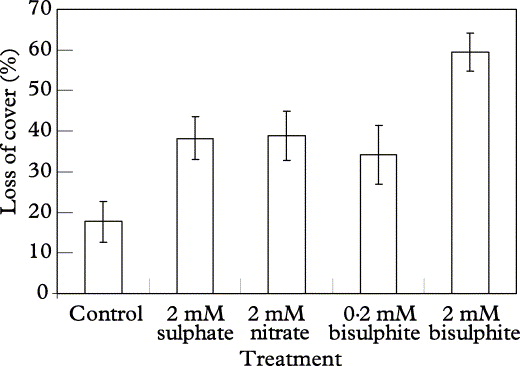
Results from the 25(+7)-month field experiment in Windsor Forest are summarized in Fig. 1. As we were unable to gain access to the site from the start of the Foot and Mouth Disease outbreak, it is not possible to estimate the effect of the 7-month withdrawal of treatments. It is likely that some recovery or reversion of L. conizaeoides occurred in this period. At the start of the experiment, percentage cover of L. conizaeoides exceeded 50% in all plots. By the end, the lichen had suffered a highly significant decrease in cover (F=7·02, P<0·0001) across all treatments. All the chemical applications caused greater losses of cover than the distilled water control. The sulphate, nitrate and low bisulphite applications all produced similar declines (approximately double that in the control) in L. conizaeoides. The high bisulphite treatment (2·0 mM) resulted in the greatest mean loss in cover (nearly 60%) and post hoc analyses revealed this to be significant when compared to both the control and low bisulphite treatments.
Reduction in cover of Lecanora conizaeoides as a result of simulated pollutant applications (February 2000 – September 2002) to plots on Fagus trunks in Windsor Forest, U.K. Data are means (n = 30) ± 1 SEM.

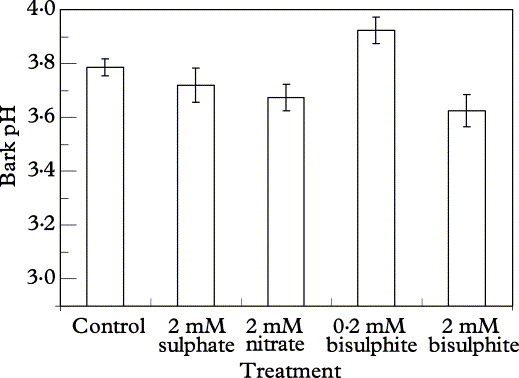
At the end of the experimental applications (Fig. 2), an ANOVA revealed a significant treatment effect (F=3·88, P<0·05) on surface bark pH of Fagus. The lowest mean pH occurred under high bisulphite applications and the highest mean pH under low bisulphite. As we used a smaller sample size for the pH estimates compared to the percentage cover, it was not possible to carry out covariance analysis to test if there had been a statistically significant pH effect on percentage cover of Lecanora conizaeoides.
Mean pH of bark surface (± 1 SEM) in a random selection of treatment plots (n = 6) at the end of the pollutant application experiment on Fagus trunks in Windsor Forest, U.K.

Laboratory experiment 1
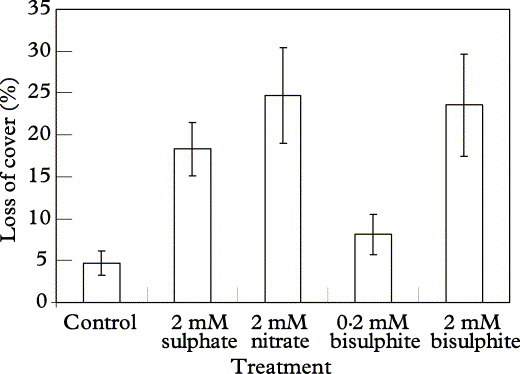
As in the field experiment, all the experimental treatments resulted in mean losses of healthy thallus cover of L. conizaeoides, although this time assessed photographically (Fig. 3). The pattern of mean losses across the treatments closely resembled the results of the field experiment, being least in the control and greatest with high bisulphite application. The overall treatment effects were statistically significant in an ANOVA (F = 3·5, P<0·01); however, post hoc analyses revealed that only the high bisulphite treatment accounted for this significance.
Reduction in cover of Lecanora conizaeoides on Betula branch segments as a result of simulated pollutant applications under controlled conditions (laboratory experiment 1). The experiment was conducted from July to December 2000. Data are means ± 1 SEM (n = 7).

Laboratory experiment 2
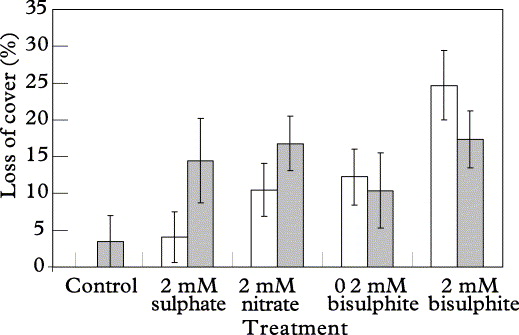
Once again there was a decrease in mean percentage cover of healthy L. conizaeoides across all treatments, except for the control with horizontal orientation, which showed negligible net change over the five months (Fig. 4). A factorial ANOVA confirmed that the pollutant treatments had a highly significant main effect on percentage cover of L. conizaeoides (F=6·84, P<0·001) but, despite some marked variations, substratum orientation did not influence percentage cover significantly (F=0·99, P=0·32). There was also no significant interaction of substratum orientation with the pollutant treatments (F=1·54, P=0·2). Post hoc analysis revealed that, as before, high bisulphite treatment caused the greatest loss of L. conizaeoides cover for both vertical and horizontal orientations. Interestingly, the horizontal orientation combined with bisulphite caused the largest mean cover reduction, although in the sulphate and nitrate treatments, losses were greatest with vertical orientation. At 15 weeks, many of the bark segments in vertical orientation exhibited surface mould growth that smothered some lichen thalli and may have increased the loss of percentage cover as detected by pixel analysis.
Reduction in cover of Lecanora conizaeoides on cut larch posts in response to pollutant applications and surface orientation under controlled conditions (laboratory experiment 2). The experiment was conducted from May to September 2001. Data are means ± 1 SEM (n = 7). Orientation: empty bars = surface horizontal; shaded bars = surface vertical.

Discussion
The field study and the two laboratory experiments produced remarkably consistent results that lead us to reject the hypothesis that survival of Lecanora conizaeoides is enhanced by an elevated sulphur input. In all three cases the results were obtained against a background of declining thallus cover in the controls. This decline was greatest in the field, where external factors may have exerted a profound influence, and least in the second laboratory study. Potential causes of the decline observed in the field include high concentrations of one or more contemporary atmospheric pollutants (e.g. NOx, NH3 and O3), rising bark pH, a pathogen or climate change. The distinctive creamy patches caused by Athelia arachnoidea infection of L. conizaeoides (Gilbert Reference Gilbert1988; Wirth Reference Wirth1993) were not observed on the study trees but the lichen may have been degraded by a less conspicuous fungal pathogen. In the laboratory, influences of ambient pollutants, changes in substratum pH and climate are all likely to have been minimized, though it is quite possible that a fungal pathogen was imported along with the lichen and its substratum. Indeed, laboratory experiment 2 was ultimately terminated owing to conspicuous growth of an unidentified mould. It is also likely that the moisture relations of the lichen achieved under the controlled environment were not optimal for survival of L. conizaeoides. There is evidence for this in the absence of decline in the horizontally-orientated controls of laboratory experiment 2 (Fig. 4) where longer periods of hydration would probably have been experienced than in the vertical thalli.
Among the chemical treatments, the low (0·2 mM) bisulphite application consistently yielded the smallest loss of mean thallus cover whereas high (2 mM) bisulphite addition caused the greatest reduction of mean cover of L. conizaeoides. In short-term laboratory experiments, Hill (Reference Hill1971, Reference Hill1974) found that metabolic activity of L. conizaeoides fell to zero at sulphite concentrations above 0·6 mM. Cape (Reference Cape1984) points out that in many early studies using dissolved sulphite in ‘closed’ incubations, locally high concentrations of SO2 will have accumulated through ionic dissociation and accentuated apparent toxicities of the solutions. Work both with SO2-tolerant lichens and bryophytes has shown that the initial cessation of photosynthetic activity is often reversed after several hours owing to metabolic or passive detoxification of the pollutant by oxidation or reduction (Puckett et al. Reference Puckett, Richardson, Flora and Nieboer1974; Richardson et al. Reference Richardson, Nieboer, Lavoie and Padovan1979; Baxter et al. Reference Baxter, Emes and Lee1989; Bharali & Bates Reference Bharali and Bates2002). Massara (Reference Massara2004) presents evidence for metabolic detoxification of dissolved SO2 by L. conizaeoides. There is no suggestion from the present experiments that the bisulphite treatments directly benefited the growth or survival of the lichen.
It had been hypothesized that the two nutrient treatments, sulphate and nitrate, would cause contrasted responses. Sulphate was expected to increase cover or at least slow the decrease of L. conizaeoides, whereas it was anticipated that nitrate would be neutral or accelerate its decline. However, although these treatments caused reductions in lichen cover, the decreases were not significantly different from the controls in the field and laboratory experiments. Hill (Reference Hill1971) found no effect of short-term incubations with 0·5 mM sulphate on carbon fixation of L. conizaeoides and concluded that it was harmless. Brown & Tomlinson (Reference Brown, Tomlinson, Feige and Lumbsch1993) applied nitrogen compounds to Parmelia sulcata and discovered that a concentration of 0·1 M nitrate (50 times the concentration employed in the present study) caused a short-term decrease in photosynthesis, but stimulated respiration. They also concluded that ammonium compounds were more damaging to P. saxatilis than nitrate ions.
Pollutants may act indirectly by altering the pH of the bark surface as well as having directly toxic effects on lichens (e.g. van Herk Reference Van Herk2001). Measurements of the unbuffered treatment solutions revealed that bisulphite was the most acidic of these (2·0 mM, pH 3·9; 0·2 mM, pH 4·0) and that the sulphate and nitrate solutions (2 mM) were also relatively acidic (both pH 4·6). Bark pH in the field experiment was significantly depressed (P < 0·05) in the high bisulphite treatment compared to the controls and low bisulphite. The decline of Lecanora conizaeoides was also greatest in the high bisulphite treatment, a result that would appear to oppose the hypothesis that the lichen is an extreme acidophyte. In fact, the bark pH variation among the treatments at the end of the field experiment was slight (Fig. 2), and even the lowest bark pH values on the treated Fagus were above those formerly recorded onQuercus in south-east England when it supported healthy populations of L. conizaeoides (Bates et al. Reference Bates, Bell and Farmer1990; Batty et al. Reference Batty, Bates and Bell2003). In Eastern Massachusetts, LaGreca & Stutzman(Reference LaGreca and Stutzman2006) noted that L. conizaeoides is primarily associated with naturally acidic tree bark, especially that of Atlantic White Cedar (Chamaecyparis thyoides), and not noticeably with elevated atmospheric pollution.
Although Fagus sylvatica has a relatively acidic bark and stem-flow among common European trees (e.g. Falkengren-Grerup, Reference Falkengren-Grerup1989), Wirth (Reference Wirth1993) commented that owing to declining acidic emissions beech trees were no longer acidic enough to support L. conizaeoides. In the Netherlands the loss of acidophytes such as L. conizaeoides has been attributed to neutralization of bark acidity by ammonia released by intensive farming (van Dobben & de Bakker Reference van Dobben and de Bakker1996; van Herk Reference van Herk1999, Reference Van Herk2001). This may also apply to some formerly SO2-polluted rural situations in Britain. However, a probable explanation for rising bark pH in more urban situations in the south-east is the increasing use of catalytic converters in motor cars. These reduce a proportion of the NOx formed during combustion to the alkaline gas ammonia (rather than to N2, e.g., Sutton et al. Reference Sutton, Dragosits, Tang and Fowler2000; Cape et al. Reference Cape, Tang, van Dijk, Love, Sutton and Palmer2004) and together with greatly reduced acidic emissions have transformed the environment for acidophytic lichens. Nevertheless, the most recent catalytic converters have a higher efficiency and atmospheric ammonia concentrations are now decreasing progressively in the UK (National Atmospheric Emissions Inventory website: http://www.naei.org.uk/emissions/emissions_2006/summary_tables.php?action=unece&page_name=NH306.html/). Massara (Reference Massara2004) re-sampled oak trees along a transect into Central London originally studied by Bates et al. (Reference Bates, Bell and Farmer1990, Reference Bates, Bell and Massara2001) and Batty et al. (Reference Batty, Bates and Bell2003). Bark pH was found to have increased most noticeably at Putney Heath and Epsom Common where the decline of L. conizaeoides had also been greatest. We therefore concur tentatively with Wirth (Reference Wirth1993), that it is rising bark pH, in this case an indirect result of declining sulphur emissions and (transport-derived) ammonia deposition, that is the probable cause of the dramatic decline of L. conizaeoides in south-east England.
We thank the Crown Estate for permission to work in Windsor Forest and for kindly supplying timber samples with Lecanora conizaeoides. ACM gratefully acknowledges the award of a research studentship from the Natural Environment Research Council. Two anonymous reviewers are thanked for valuable suggestions leading to improvements of our original manuscript.