Introduction
Kardashev in his well-known work (Kardashev Reference Kardashev1964), has classified the extraterrestrial civilization by a technological level they have achieved. In particular, he introduced three different types of civilization distinguishing them by means of the ability to consume energy. According to this classification the level-I is a civilization similar to ours, thus the one consuming the energy of the order of 4 × 10¹⁹ ergs s−1. Level-II corresponds to a civilization consuming almost the total energy of their host star – 4 × 1033 ergs s−1 and Level-III is a civilization harnessing almost the total energy of its own galaxy: 4 × 1044 ergs s−1.
A couple of years earlier before publishing the paper of Kardashev, the prominent physicist Freeman Dyson has suggested that if such superadvanced (in the terminology of Kardashev, Level-II) extraterrestrials exist, for increasing efficiency of energy consumption they can construct a thin spherical shell with radius ~ 1 AU surrounding a host star (Dyson Reference Dyson1960). It has been argued that for such distances the sphere will be in the so-called habitable zone (HZ) and therefore the sphere will have the temperature of the order of (200 − 300) K, making this object visible in the infrared (IR) spectrum.
An interest to the search for the IR Dyson-like sources has been increased after the detection of an enigmatic object, KIC8462852, discovered by the Keppler mission (Boyajian et al. Reference Boyajian2016). It has been shown that the flux of the mentioned object has been characterized by aperiodic dips of the order of 20%. On the other hand the authors have confirmed that the irregularities might have not been caused by any instrumental or data processing factors. To investigate the hypothesis that strange behavior of KIC 8462852 (and some other objects: KIC 12557548, CoRoT-29) is caused by artificial Dyson-like cosmic structures a series of works has been performed (Harp et al. Reference Harp, Richards, Shostak, Tarter, Vakoch and Munson2016; Schuetz et al. Reference Schuetz, Vakoch, Shostak and Richards2016; Wright et al. Reference Wright, Cartie, Zhao, Jontof-Hunter and Ford2016), but the main question concerning the origin of the unrealistically high level of flux dip still remains open. Whatever this origin is the discovery of KIC 8462852 has revived a search for artificial cosmic megastructures, which has been started in the first decade of this century (Slish Reference Slish and Papagiannis1985; Timofeev et al. Reference Timofeev, Kardashev and Promyslov2000; Jugaku & Nishimura Reference Jugaku, Nishimura, Norris and Stootman2002; Carrigan Reference Carrigan2009).
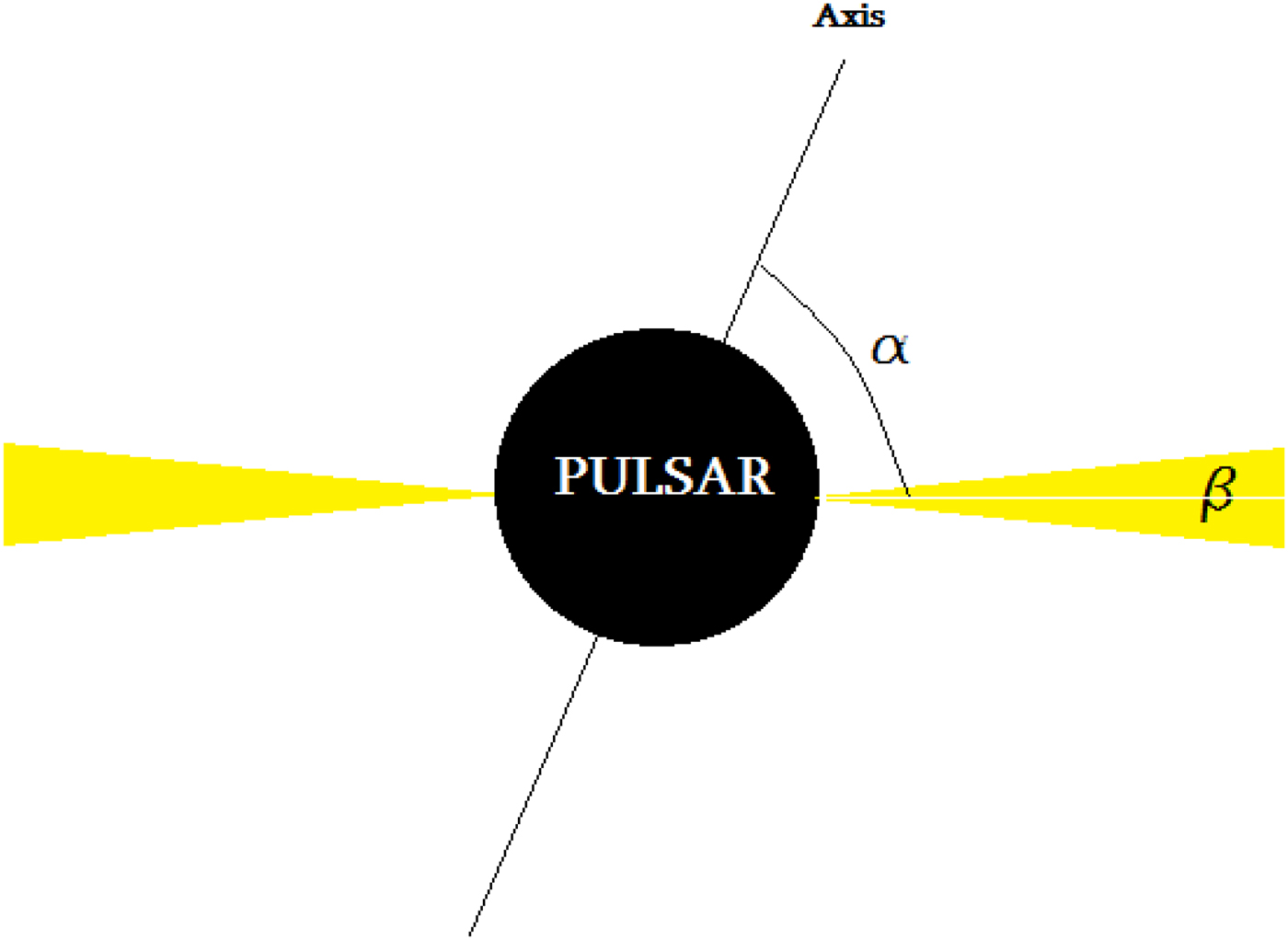
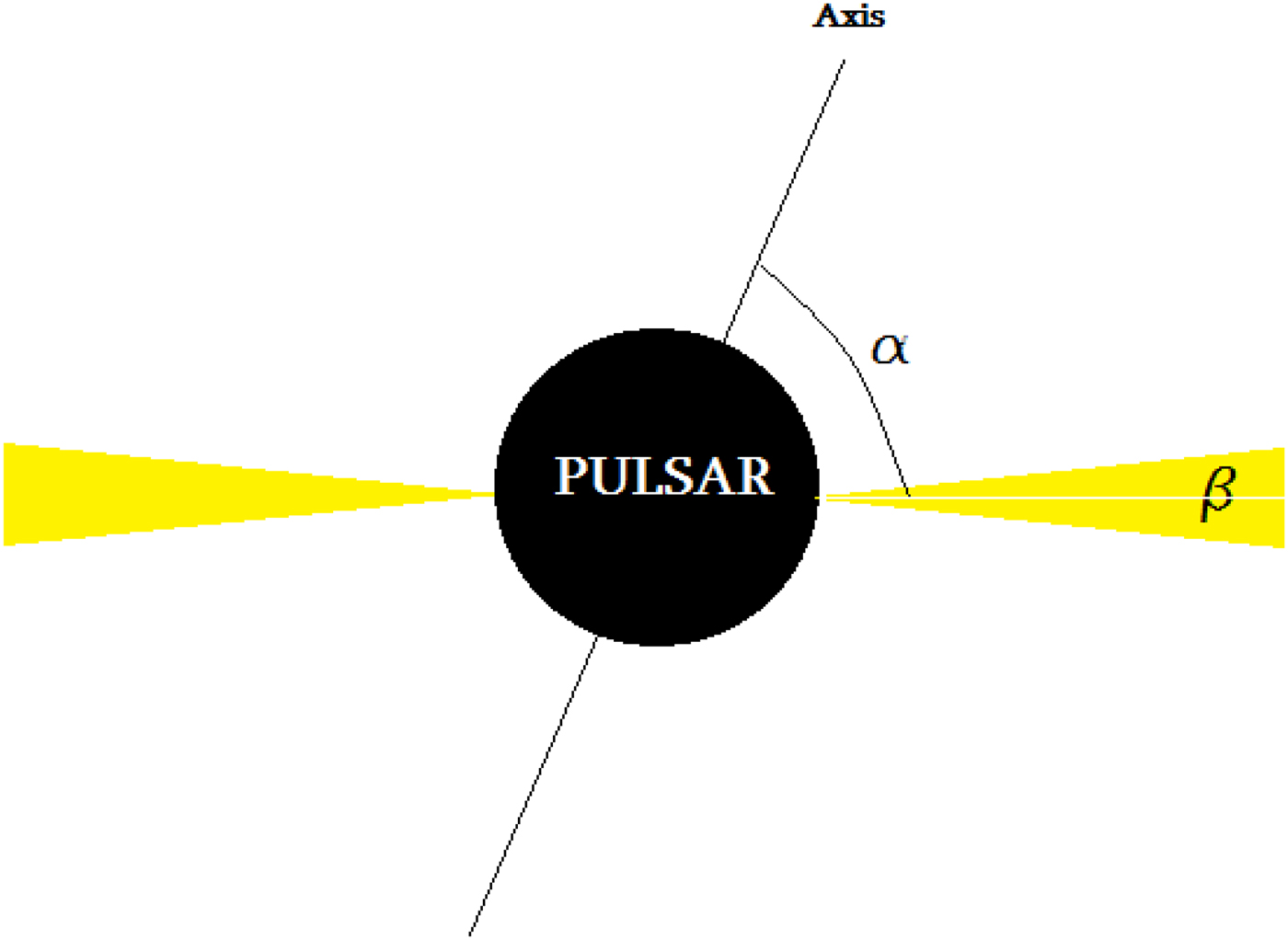
On the other hand, it is clear that such cosmic megastructures require enormous material to construct them. For avoiding this difficulty, recently we have proposed a certain extension of Dyson's idea. In particular, in Paper-I we have examined the Level-II civilization, which colonized a nearby area of a pulsar emitting electromagnetic radiation in narrow channels (see Fig. 1). Therefore, it means that the considered scenario should be examined as a probable one. Then, unlike the Dyson spheres one has to construct ring-like structures. In particular, if the inclination angle, α, between the axis of rotation and the emission channels is close to 90°, the ring should be located in the equatorial plane and as it has been shown (Osmanov Reference Osmanov2016) for relatively slowly rotating neutron stars the sizes of the rings could vary from 10−4 to 10−1 AU, respectively. As a result, such a megastructure would require less material than in case of spheres. It is clear that such rings might be significantly perturbed by tidal stresses in terms of strong centrifugal outflows and radiation (Gudavadze et al. Reference Gudavadze, Osmanov and Rogava2015). Therefore, they cannot be stable and sooner or later gravitation will inevitably destabilize the construction. We have analysed dynamics of destabilization and found that power required to restore stability is much less than power received from the pulsar. Therefore, the search for the ring-like megastructures around slowly spinning pulsars seen in the IR spectrum might be quite promising. As to the rapidly rotating pulsars, they are very powerful and harvesting their energy would be quite profitable, but a HZ would be much farther and mass of a material required for construction the mega-ring would exceed the total mass of all planets, asteroids, comets, centaurs and interplanetary dust in a typical planetary system by several orders of magnitude. Therefore in this paper we focus on the megastructures around normal pulsars and study the possibility of detecting such cosmic constructions in a relatively nearby zone of the solar system. For this purpose we discuss the possible requirements telescopes have to satisfy.
Here we schematically show the pulsar, its axis of rotation and two emission channels with an opening angle β.
The organization of this paper is as follows: after outlining the major results of Paper-I, we consider the observational features of the Dyson rings and make necessary calculations in the section Previous results and discussion and in the section Conclusion we summarize our results.
Previous results and discussion
In this section we outline the results obtained in Paper-I, estimate characteristic parameters of the cosmic megastructures and study the possibility of their detection by means of a set of observations.
Outline of the results of paper-I
It is well known that pulsars, having enormous energy accumulated in rotation gradually slow down their rotation rate and as a result loose energy, with a certain fraction, κ, going to emission with the following luminosity (Osmanov Reference Osmanov2016)
 $$\eqalign{& L \approx 3.8 \times 10^{31} \times \left( {\displaystyle{\kappa \over {0.1}}} \right) \times \left( {\displaystyle{{0.5s} \over P}} \right)^3 \times \left( {\displaystyle{{\dot P} \over {10^{ - 15} {\rm ss}^{ - 1}}}} \right) \cr & \;\;\;\;\;\; \times \left( {\displaystyle{M \over {1.5M_{\rm \odot}}}} \right){\rm ergs}\;{\rm s}^{ - 1},} $$
where P is the rotation period of the pulsar,
 $\dot P \equiv {\rm d}P{\rm /d}t \gt 0$
,
 $M \approx 1.5 \times M_{\rm \odot} $
and
 $M_{\rm \odot} \approx 2 \times 10^{33} $
g are the pulsar's mass and the solar mass, respectively, and we normalize the period on an average value of the most probable one (Manchester et al.
Reference Manchester, Hobbs, Teoh and Hobbs2005).
In Paper-I we have implied the definition of the HZ as a region irradiated by the same energy flux as the Earth (Hanslmeier Reference Hanslmeier2009). Then, it is straightforward to show that radius of the HZ is given by
 $$\eqalign{& R_{_{{\rm HZ}}} \approx 0.1 \times \left( {\displaystyle{\kappa \over {0.1}}} \right)^{1/2} \times \left( {\displaystyle{{0.5s} \over P}} \right)^{3/2} \times \left( {\displaystyle{{\dot P} \over {10^{ - 15} {\rm ss}^{ - 1}}}} \right)^{1/2} \cr & \;\;\;\;\;\;\;\;\;\,\times \left( {\displaystyle{M \over {1.5M_{\rm \odot}}}} \right)^{1/2} {\rm AU}.} $$
For estimating the effective area of the construction one has to take into account the opening angle of the emission channel (Ruderman & Sutherland Reference Ruderman and Sutherland1975)
 $$\beta \approx \displaystyle{\pi \over 3} \times \left( {\displaystyle{{0.5} \over P}} \right)^{13/21} \times \left( {\displaystyle{{\dot P} \over {10^{ - 15} {\rm ss}^{ - 1}}}} \right)^{1/14}, $$
automatically defining the effective area of the ring having the shape of the spherical segment (Osmanov Reference Osmanov2016)
 $$A_{{\rm ef}} \approx 8\pi R_{_{{\rm HZ}}} ^{\rm 2} \sin (\beta /2),$$
where for simplicity we have assumed that α ≈ π/2. In the Paper-I we have obtained an expression of the ring's temperature
 $$T = \left( {\displaystyle{L \over {A_{_{{\rm ef}}} \sigma}}} \right)^{1/4} \approx 390\;{\rm K},$$
where σ ≈ 5.67 × 10⁻⁵ erg/(cm2K4) is the Stefan-Boltzmann constant.
Observational features of Dyson-rings
By combining equation (5) with the Wien's law
 $$\lambda _{\rm m} = \displaystyle{b \over T} \approx 7.4 \times 10^3 \;{\rm nm},$$
it is evident that the cosmic megastructure around a pulsar will be visible in the IR spectrum. The Very Large Telescope Interferometer (VLTI) could be a quite promising instrument for observing the rings. In particular, the VLTI's angular sensitivity is 0.001 mas (milliarcsecond) (see the technical characteristics of the VLTIFootnote
1
). By implying the latter, one can straightforwardly show that the maximum distance, where the ring with the diameter
 $2R_{_{{\rm HZ}}} $
still will be observable by the VLTI is expressed as
 $$r_{{\rm max}} \approx \displaystyle{{2R_{_{{\rm HZ}}}} \over \theta} \approx 0.2\;{\rm kpc}.$$
On this distance the IR spectral flux density (power per unit of area for the unit interval of frequency) is approximately given by
 $$\eqalign{F_{\rm \nu} ^{_{{\rm IR}}} \equiv \;& \displaystyle{{{\rm d}E} \over {{\rm d}t{\rm d}A{\rm d}\nu}} \approx \displaystyle{L \over {4\pi r^2 \nu _{_{{\rm IR}}}}} \approx 7.4 \times 10^{ - 26} \left( {\displaystyle{{0.2\;{\rm kpc}} \over r}} \right)^2 \cr & {\rm ergs}\;{\rm s}^{ - 1} \;{\rm cm}^{ - 2} \;{\rm Hz}^{ - 1} = 7.4\left( {\displaystyle{{0.2\;{\rm kpc}} \over r}} \right)^2 {\rm mJy},} $$
where
 $\nu _{_{{\rm IR}}} = c/\lambda $
and we have assumed that almost the total energy of a pulsar is radiated by the Dyson ring in the IR spectrum. The derived spectral flux density can be detected by the VLTI. It is worth noting that the pulsars are distributed mostly in the galactic plane and their surface density, ρ, in the local area of galaxy is of the order of [520 ± 170] kpc−2 (Manchester Reference Manchester1979). Therefore, it is expected that when monitoring cylindrical volume in the galactic plane corresponding to the circular area with radius r
max one can expect in total the following number of pulsars
 $$N_{0.2} \approx \rho \pi r_{{\rm max}}^{\rm 2} \approx 64 \mp 21,$$
where the subscript 0.2 means that the number is calculated for the distance 0.2 kpc. At this moment this is the maximum number of pulsars, among which one can search for the potential IR sources in the nearby zone of the solar system. It is clear that the most distant objects observed by the VLTI will not be seen in detail.
The Wide-field Infrared Survey Explorer (WISE) might be very useful, although, since the angular resolution is not very high, one can use this instrument for searching the point like sources, because the sensitivity might be better than 0.1 mJy Footnote 2 . The IR Dyson-rings observed from the distance r = 1 kpc will have the flux density of the order of 0.3 mJy (see equation (8)). This in turn means that the number of expected pulsars is much higher than for 0.2 kpc
 $$N \approx \rho \pi r^2 \approx 1600 \pm 530.$$
The IR Dyson-rings probably might have another interesting observational feature. In particular, it has been shown by Zhang & Harding (Reference Zhang and Harding2000) that for the normal pulsars with P ~ 0.5 s and
 $\dot P{\rm \sim} 10^{ - 15} $
ss−1, having the age of the order of
 $\tau \equiv P/2\dot P{\rm \sim} 1.6 \times 10^7 $
year, the surface temperature is given by
 $$T(\tau ) \approx 2.8 \times 10^5 \;{\rm K}\left( {\displaystyle{{10^6 \;{\rm yr}} \over \tau}} \right)^{0.5} \approx 7 \times 10^4 \;{\rm K},$$
which corresponds to the ultraviolet (UV) spectral band, 6 eV. This means, that the pulsar encircled by the ring seen in the IR spectrum potentially might be detected in the UV as well. This additional observation might be useful for distances less than 0.2 kpc, but for higher distances it will be even more significant, because since the IR source is point like one needs another confirmation (may be not necessarily enough) that in the same location there is a neutron star.
The corresponding UV total luminosity writes as
 $$L_{_{{\rm UV}}} \approx 4\pi \sigma R_{_{{\rm NS}}} ^{\rm 2} T_{_{{\rm UV}}} ^{\rm 4} \approx 1.7 \times 10^{28} \;{\rm ergs}\;{\rm s}^{ - 1}, $$
where T
UV ≈ 7 × 10⁴ K is the neutron star's surface temperature and
 $R_{_{{\rm NS}}} \approx 10$
km is the radius of the star. The spectral flux density, for the distance 0.2 kpc then can be estimated as
 $$\eqalign{& F_{\rm \nu} ^{_{_{{\rm UV}}}} \equiv \displaystyle{{{\rm d}E} \over {{\rm d}t{\rm d}A{\rm d}\nu}} \approx \displaystyle{{L_{_{{\rm UV}}}} \over {4\pi r^2 \nu _{_{{\rm UV}}}}} \approx 2.5 \times 10^{ - 30} \left( {\displaystyle{{0.2\;{\rm kpc}} \over r}} \right)^2 \cr & \;\;\;\;\;\;\;\;\;\;\,{\rm ergs}\;{\rm s}^{ - 1} \;{\rm cm}^{ - 2} \;{\rm Hz}^{ - 1},} $$
where
 $\nu _{_{{\rm UV}}} \approx 1.5 \times 10^{15} $
Hz is the leading frequency of emission. As it is clear from this estimate, the flux is quite low for distances of the order of 0.2 kpc and will be even less for larger values of r.
Conclusion
We outlined the main results of Paper-I where the extension of the idea of Freeman Dyson has been considered and it has been shown that for relatively slowly rotating pulsars with P = 0.5 s and
 $\dot P = 10^{ - 15} $
ss−1 the HZ will be on distances of the order of 0.1 AU. By examining the ring in the HZ, we have found that the temperature of this megastructure will be of the order 390 K, indicating that the Dyson megastructure will be visible in the IR band.
We have considered the sensitivity of VLTI and by taking into account its higher possible angular resolution, 0.001 mas, it has been shown that the maximum distance ~ 0.2 kpc leads to the IR spectral density of the order of 7.4 mJy, which in turn, can be detected by the VLTI. We have argued that by monitoring the nearby zone of the solar system approximately 64 pulsars are expected to be located inside it.
It has been shown that in order to observe the IR sources up to the distances of the order of ~kpc, the IR flux density is of the order of 3 × 10⁻²⁷ ergs s−1 cm−2 Hz−1, which can be detected by the IR telescope WISE. On the other hand, the angular resolution is not enough to see the structure of the ring. Therefore, it is necessary to find another feature of the distant IR ring.
By implying the model developed in (Zhang & Harding Reference Zhang and Harding2000) we have found that the temperature of the neutron star's surface is 7000 K, which in the electromagnetic spectrum corresponds to the UV band. The corresponding spectral energy flux density for the distance ~ 1 kpc, 10−31 ergs s−1 cm−2 Hz−1 is so small that at this moment no UV instrument has such a high sensitivity.
As we see, the search of IR rings is quite promising for distances up to ~ 0.2 kpc, where one will be able to monitor potentially 64 ± 21 pulsars by using the IR instruments. Observation of distant pulsars (up to ~ 1 kpc), although will significantly increase the total number of potential objects – to 1600 ± 530, but at this moment the UV instruments cannot provide such a level of sensitivity.
Acknowledgements
The author would like to thank a referee for valuable comments. The research was supported by the Shota Rustaveli National Science Foundation grant (DI-2016-14).