Introduction
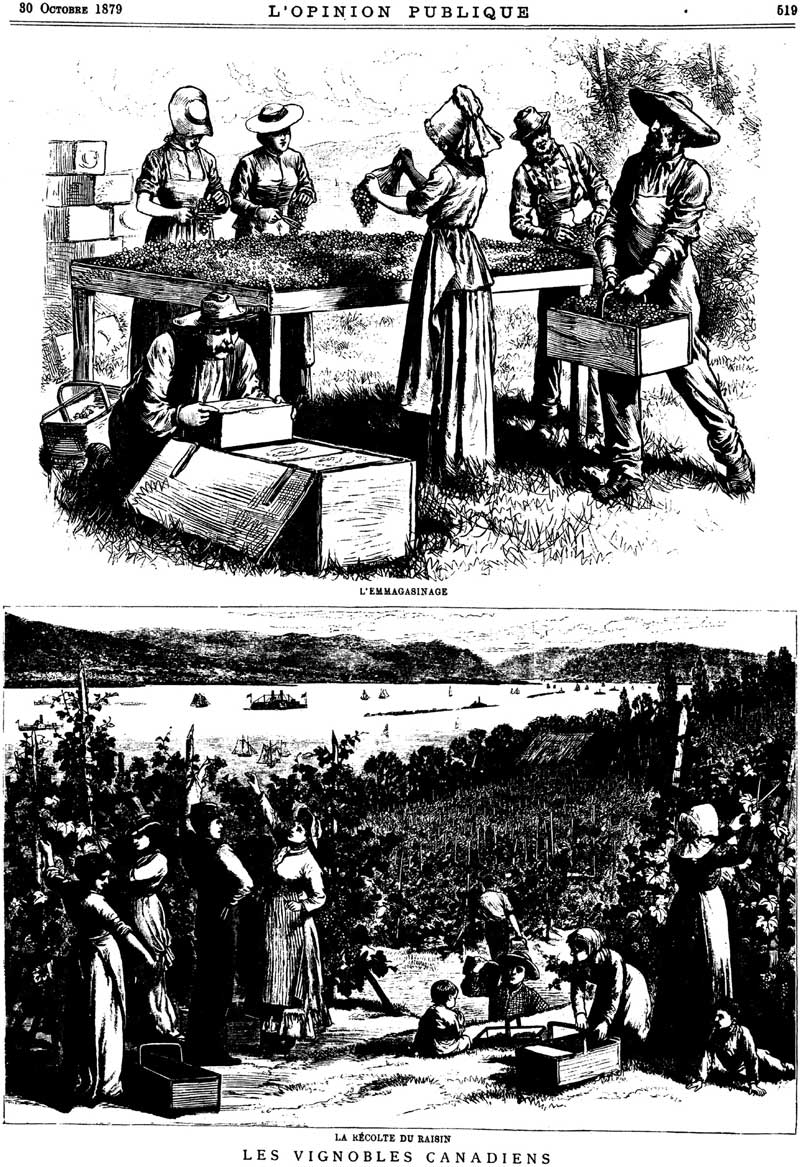
Canada has been a wine-making country longer than most people realise. In his article “The beginning of winemaking in Canada,” Bells (Reference Bells2017a) stated that the Vikings made wine in Newfoundland as early as the year 1001. The French explorer Jacques Cartier mentioned the presence of wild grapes growing in abundance on the shores of the Saint Lawrence River in 1535 and Champlain attempted to practice viticulture in Ville de Québec in 1608. The first commercial vineyard in Canada was established in 1866 in Point Pelee, Ontario (Bells Reference Bells2017a). By the 19th century, viticulture (i.e., growing and protecting grapes (Vitis Linnaeus; Vitaceae)) and oenology (i.e., processing grapes into wine) were well established, notably in Ontario and Québec where they were popular activities (Fig. 1). Several booklets, such as Defossès (Reference Defossès1889), were published to inform people interested in viticulture. In the early 20th century, the North American temperance movement affected production and sales of all alcohol-based products and, consequently, viticulture was a low profile agricultural activity in the United States of America and Canada until the mid-1970s (Bells Reference Bells2017a, Reference Bells2017b).
Grape harvesting in Beaconsfield, a municipality located in the west part of the Island of Montréal, Québec. From l’Opinion Publique (30 October 1879).

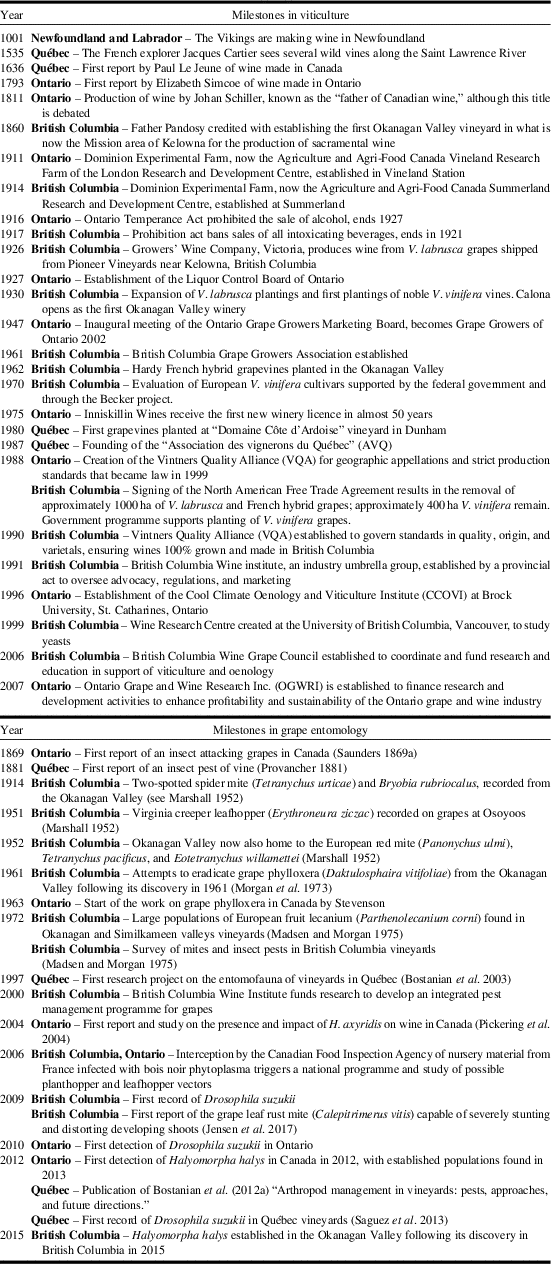
In 1975, the Ontario winery Inniskillin (Niagara-on-the-Lake) obtained the first permit to operate a commercial winery in Canada in almost 50 years (Table 1). From this date followed a strong and steady increase in cultivated vineyard areas in Canada. For example, from 2000 to 2010 the cultivated area and production of grapes increased by 30% and farm gate value doubled. In 2015, more than 12 545 ha of wine grapes worth in excess of CAD$6.2 billion were produced in Canada and 37 300 full-time equivalent jobs were involved (Frank, Rimerman, and Company 2017), the total economic value of viticulture and related agrotourism being CAD$9 billion. Worldwide, it is a multi-billion dollar and ever-increasing business (Brostrom and Brostrom Reference Brostrom and Brostrom2009).
Selected milestones of viticulture and grape entomology in Canada.

Notes: A more detailed timeline of the beginning of wine making in Canada is provided by Bells (Reference Bells2017a) and a timeline on the history of Ontario wine is provided in (Anonymous 2018). Québec milestones were selected from Vincent et al. (Reference Vincent, Bostanian and Lasnier2009) and Lasnier et al. (Reference Lasnier, Vincent and de Coussergues2016).
In Canada, grape production has mostly expanded into specific regions of five provinces. In British Columbia, most vineyards are located in the Okanagan, Similkameen, and Fraser River valleys and on Vancouver and Gulf Islands. In Ontario, the main grape-growing regions are the Niagara Peninsula, the north shore of Lake Erie, Pelee Island, and Prince Edward County. Viticulture in Ontario is well developed from an industry perspective (Ontario Vintners Quality Alliance and Deloitte 2017). In Québec, most vineyards are in the southern part of the province, notably the Eastern Townships, Montérégie, Lower Laurentians, and Ville de Québec area. In Nova Scotia, vineyards are located on the Malagash Peninsula and in the Annapolis, LaHave River, and Bear River valleys. In New Brunswick, most of the wineries are located in the southern part of the province between Saint John and Moncton and between the Bay of Fundy and the Atlantic coast.
Prior to the cultivation of grapevines in Canada, wild vine species grew in Ontario, Québec, and Nova Scotia, while British Columbia had no wild vines of Vitaceae (Brouillet et al. Reference Brouillet, Coursol, Meades, Favreau, Anions, Bélisle and Desmet2010). As a consequence, several native insects were already feeding on wild vines before the establishment of cultivated vines in the eastern provinces. For example, the grape berry moth, Paralobesia viteana (Clemens) (Lepidoptera: Tortricidae), is a native and major vineyard pest in Ontario and Québec. In British Columbia, generalist herbivores fed on cultivated vines as a new host. Other insects came through various means and established themselves as pests.
Several species of wild vines now grow in eastern Canada. Three species are known to occur in Québec, of which Parthenocissus vitacea (Kneer) Hitchcock (Vitaceae) and Vitis riparia Michaux, are native and Virginia creeper, Parthenocissus quinquefolia (Linnaeus) Planchon, is introduced (Brouillet et al. Reference Brouillet, Coursol, Meades, Favreau, Anions, Bélisle and Desmet2010). In Ontario, in addition to the two above-mentioned indigenous species, three indigenous wild vines (Vitis aestivalis Michaux, Vitis labrusca Linnaeus, and Vitis vulpina Linnaeus) and two introduced Vitaceae species (Parthenocissus tricuspidata (Siebold and Zuccarini) Planchon and Ampelopsis glandulosa (Wallich) Momiyama), are present.
Vitis vinifera Linnaeus (Vitaceae) is a perennial plant that, like fruit trees, has phenological stages that may be used as cues for the timing of pesticide treatments or other interventions (Vincent et al. Reference Vincent, Isaacs, Bostanian and Lasnier2012). In contrast to most tree crops, vine plants have indeterminate growth such that tender tissues are continuously available, which may favour some insects and diseases. The provinces produce mixtures of different cultivars depending on locality, target product (e.g., red, white, or sparkling wines) and consumer preferences. This situation offers hosts of different qualities, and hence poses different entomological challenges. In Canada, grapes are grown mainly for wine making. Table grapes are mostly grown in Ontario and British Columbia.
The recent dramatic growth of the wine grape industry is not limited to Canada: it is a worldwide phenomenon involving the New World (United States of America, Australia, New Zealand), South America (e.g., Chile, Argentina), South Africa, and recently China (Daane et al. Reference Daane, Vincent, Isaacs and Ioriatti2018). Although grape production in Canada is considered cool-climate viticulture, its economic impact is such that a significant amount of entomological research is needed to service an ever-growing industry. Few scientific papers related to the entomology of vineyards of Canada were published until the mid-1970s. In this paper, we review the grape entomology of Canada (Table 1). This was achieved by searching major bibliographic databases. Owing to the limited space allotted to this review, we selected key documents and milestones (Table 1). Short biographies of selected entomologists who made significant contributions to viticultural entomology in Canada are produced as supplemental material.
Insects
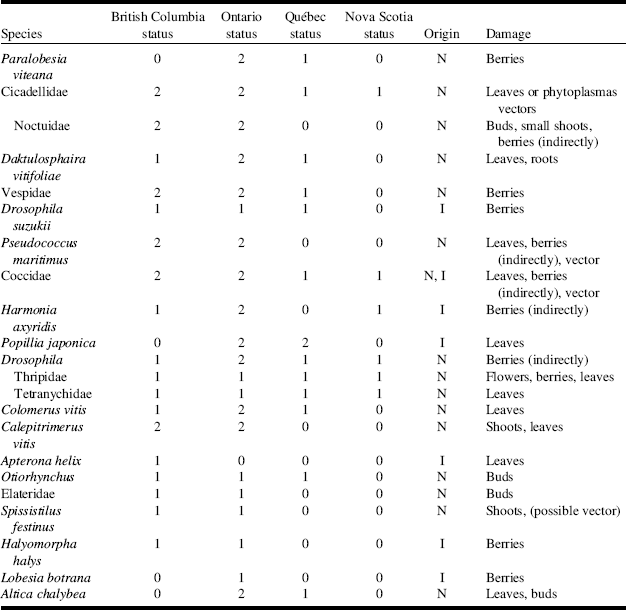
The occurrence and economic status of insect and mite pests of grapevines cultivated in the various regions of Canada are influenced by a number of factors (Table 2). Chief among these are biotic and abiotic environmental conditions (mostly temperature), differing agronomic practices and the maturity of the industry. For example, most hybrid grape cultivars are less susceptible to leafhopper (Erythroneura Fitch (Hemiptera: Cicadellidae)) feeding compared to the severe damage often caused to European grapevine varieties, particularly as occurs often in the Okanagan and Similkameen valleys of British Columbia where these species are invasive. Some grape pests have a limited distribution, while others occur across the country and are studied at the national or international level.
Main insect pests of vineyards: their status, origin, and damage in major grape-producing provinces of Canada.

Notes: Status: 0, absent; 1, insect is present and an occasional pest; 2, insect has reached pest status. Origin: N, native insect; I, invasive insect.
Feeding by insects and mites is often restricted to a particular part of the vine, i.e., leaves, buds, shoots, roots, or woody tissue (Table 2). Damage may occur during a certain stage of growth, as caused to developing buds in spring by climbing cutworm larvae (Lepidoptera: Noctuidae), or it may be continuous as happens with feeding of nymphs and adult grape phylloxera (Daktulosphaira vitifoliae (Fitch) (Hemiptera: Phylloxeridae)), on roots. Scale (Hemiptera: Coccoidea) and mealybug (Hemiptera: Pseudococcidae) species foul fruit with their honeydew and promote the growth of sooty mould, and they also act as vectors for the transmission of grapevine leafroll virus (Ampelovirus; Closteroviridae). Feeding by other species allows entry of fungal pathogens that harm the ripening berries.
Following is a brief history of entomological research that has been conducted in the different provinces of Canada. Taxonomic experts, mostly involved with the Canadian National Collection for Insects, Arachnids, and Nematodes (Agriculture and Agri-Food Canada, Ottawa, Ontario, Canada), often contributed significantly to the development of successful grape pest management programmes.
British Columbia
Commercial production of wine based on the noble European V. vinifera cultivars predominated only recently in British Columbia. Native North American V. labrusca grapes were first planted in the Okanagan Valley in 1859 to produce sacramental wine for the Oblate mission at what is now the Mission area of Kelowna. Growth of the industry faced some hurdles. However, signing of the North America Free Trade Agreement in 1989 resulted in increased imports of higher value wines from California produced from V. vinifera cultivars. Wholesale changes and rapid growth of the British Columbia industry occurred as a result of a subsequent replant programme and a switch to high-value wines produced almost entirely from V. vinifera cultivars. Marking the start of the modern production era for British Columbia wines, the value of the industry increased from CAD$6.8 million in 1990 to CAD$360.9 million in wine sales for 2015 (Frank, Rimerman, and Company 2017). Reflecting an emphasis on quality, increased market value, and greater susceptibility of V. vinifera grapes to many pests, development of integrated pest management programmes for grapes has received a substantial level of support from industry and government over recent decades.
In the absence of native vines, grapes in British Columbia would have been attacked initially by native polyphagous species such as western flower thrips, Frankliniella occidentalis (Pergande) (Thysanoptera: Thripidae), which causes lesser amounts of damage (Lowery Reference Lowery2015). The exception is a complex of climbing cutworm (Lepidoptera: Noctuidae) species that feed on the developing buds of grapevines in spring, resulting in reduced yields and uneven ripening of fruit that affects wine quality (Lowery and Mostafa Reference Lowery and Mostafa2010; Lowery Reference Lowery2015). Brittain (Reference Brittain1914) reported that “climbing cutworm could hardly be found in the Okanagan in 1914 following a near plague the previous year.” There was no mention, however, if these undetermined species of cutworm were affecting grapevines. Cutworm damage was initially of little concern when production was based on vigorously growing and high-yielding hybrid grapes that produced low-value wine. These economically important pests continue to plague grape production in the southern interior of British Columbia and there has been a considerable research effort of late to develop sustainable methods of control. This includes improvements to monitoring and forecasting (Landolt et al. Reference Landolt, Lowery, Wright, Smithhisler, Guedot and James2009), evaluation of the efficacy of novel insecticides (Smirle et al. Reference Smirle, Zurowski, Lowery and Mostafa2013), and nonchemical approaches. The presence in spring of Capsella bursa-pastoris (Linnaeus) Medikus, and some other species of the Brassicaceae is correlated with a reduction in cutworm damage to grape buds (Mostafa et al. Reference Mostafa, Lowery, Jensen and Deglow2011). Eighteen species of cutworm, mostly belonging to the genus Abagrotis Smith (Lepidoptera: Noctuidae), have now been identified feeding on grapevines in British Columbia (Lowery and Mostafa Reference Lowery and Mostafa2010), with additional species soon to be added to the list (T.L., personal observation).
Treherne (Reference Treherne1914) mentioned that few economically important pests affecting agricultural crops elsewhere in North America occur in British Columbia because of inspection and quarantine restrictions. Introduction of grape pests to the interior was also limited during the beginning of the industry due to its isolation and local propagation of much of the new planting material. This beneficial situation could not last. Rapid expansion of the wine grape industry and increased international trade, including importation of large volumes of nursery material, resulted in a surge in numbers of invasive pest species. One of the most important was outbreak numbers of an Erythroneura species, undoubtedly the Virginia creeper leafhopper, E. ziczac Walsh, recorded on grapes at Osoyoos in 1951 (Marshall Reference Marshall1952). It was later found throughout all areas of the Okanagan and Similkameen valleys (Madsen and Morgan Reference Madsen and Morgan1975). Virginia creeper leafhopper and its most important natural control agent, the egg parasitoid Anagrus daanei Triapitsyn (Hymenoptera: Mymaridae) (originally misnamed A. epos Girault) were subsequently studied by McKenzie and Beirne (Reference McKenzie and Beirne1972) and McKenzie (Reference McKenzie1973). Further research into methods to preserve and enhance Anagrus daanei populations in vineyards resulted in the discovery for the first time in Canada of Erythroneura elegantula Osborn (Hemiptera: Cicadellidae), infesting grapevines in high numbers in the south end of the Okanagan Valley (Lowery and Judd Reference Lowery and Judd2007). That study clarified the species of Anagrus daanei that were parasitising eggs of the two leafhopper pest species and determined new leafhopper–host plant associations used by overwintering Anagrus parasitoids (Lowery et al. Reference Lowery, Triapitsyn and Judd2007).
Grape phylloxera is native to eastern North America and a serious pest of grapes wherever European V. vinifera cultivars are grown (Stevenson Reference Stevenson1963). Feeding on the roots of grapevines causes lesions on larger roots (tuberosities) and galls on smaller roots (nodosities) that restrict uptake of water and nutrients and provide entry of pathogens. Severe damage to the roots results in eventual death of V. vinifera cultivars. Attempts were made to eradicate grape phylloxera from the Okanagan Valley (Morgan et al. Reference Morgan, Procter and Vielvoye1973) following its discovery there in 1961, but numerous introductions of infested nursery material defeated the effort. Morgan et al. (Reference Morgan, Procter and Vielvoye1973) reported; “It is of interest to note here that between 1952 and 1961, 65 shipments containing 64 100 vines were imported into British Columbia from the United States of America. Eight of these shipments were infested with the grape phylloxera and were fumigated. Unfortunately, inspection or dipping of vine nursery stock from Ontario was not required until 1962 and fumigation not until 1967. The number of vines imported into British Columbia from Ontario between 1952 and 1961 is not known.” A survey of insect and mite pests conducted in 1972 (Madsen and Morgan Reference Madsen and Morgan1975) found grape phylloxera distributed throughout the Okanagan Valley. Management of grape phylloxera is currently achieved by grafting susceptible V. vinifera cultivars onto resistant rootstocks of North American Vitis species or hybrids (Lowery Reference Lowery2015). Grape phylloxera is unable to form galls on the leaves of V. vinifera grapes and it performs poorly on vines grown on dry, sandy soils (Stevenson Reference Stevenson1963) common to the southern part of the valley where most wine grape production is centred. Light to moderate levels of leaf gall formation are reported to occur on V. vinifera in Ontario (Leuty and Ker Reference Leuty and Ker1988).
Owing to their natural history (i.e., overwintering of dormant stages on the vine) and small size, several other economically important Hemiptera pests of grapes have also been introduced to the southern interior of British Columbia. The European fruit lecanium (Parthenolecanium corni (Bouché) (Hemiptera: Coccidae)), arrived in southwestern British Columbia around 1903 (Graham and Prebble Reference Graham and Prebble1953) and was well established by 1910. Outbreak levels were recorded on ornamental and shade trees in Vancouver and surrounding areas in 1924 (Glendenning Reference Glendenning1925) and several times thereafter before 1975 (Rubin and Beirne Reference Rubin and Beirne1975a). In their 1972 survey of mites and insects in vineyards of the Okanagan and Similkameen Valleys, Madsen and Morgan (Reference Madsen and Morgan1975) recorded large numbers of scales that they thought was probably European fruit lecanium. Acting in concert with other natural enemies, successful introduction of the parasitic encyrtid wasp Blastothrix sericea (Dalman) (Hymenoptera: Encyrtidae) from the United Kingdom in 1928 and 1929 was thought to have helped regulate its populations (Graham and Prebble Reference Graham and Prebble1953). Rubin and Beirne (Reference Rubin and Beirne1975b) found 18 species of predators and three parasite species attacking European fruit lecanium. Parasitism averaged only 30%, however, and the introduction of B. sericeae was deemed to have been a failure.
Spider mites (Acari: Tetranychidae) and rust mites (Acari: Eriophyidae) are pests of grapes wherever they are grown (Duso et al. Reference Duso, Pozzebon, Kreiter, Tixier and Candolfi2012), damaging outbreaks being particularly common during the era when broad-spectrum insecticides were commonly used. In his paper outlining 50 years of applied entomology research in the orchards of British Columbia, Marshall (Reference Marshall1952) provides an account of spider and rust mites in the Okanagan Valley. In addition to the two-spotted spider mite, Tetranychus urticae (Koch) (Acari: Tetranychidae) (then named T. bimaculatus Harvey) and Bryobia rubriocalus Scheuten (Acari: Tetranychidae), which had been reported previously (Marshall Reference Marshall1952), the Okanagan Valley was now home to the European red mite (Panonychus ulmi (Koch)) (Acari: Tetranychidae), T. pacificus McGregor (Acari: Tetranychidae), and Eotetranychus willamettei (McGregor) (Acari: Tetranychidae). It was not known when many of the invasive species had arrived, but the European red mite was common in the 1930s and caused significant injury to orchard fruits in the 1950s. The 1972 survey of insects and mites in Okanagan Valley vineyards (Madsen and Morgan Reference Madsen and Morgan1975) reported only two-spotted spider mite and European red mite on the leaves of grapes. A result of altered insecticide use, damage to grapes by spider mites has lately been of little concern for British Columbia producers. The grape leaf rust mite (Calepitrimerus vitis Nalepa (Acari: Eriophyidae)), whose feeding in early spring can cause severe stunting and distortion of developing shoots, was recently reported by Lowery (Reference Lowery2015) and Jensen et al. (Reference Jensen, Lowery and DeLury2017).
Ontario
Native grape species (V. labrusca, V. riparia, and V. aestivalis) and P. quinquefolia are common throughout southern Ontario (Rahemi et al. Reference Rahemi, Dale, Fisher, Taghavi, Bonnycastle and Kelly2016). Vineyards initially planted with the native V. labrusca grapes were first established by settlers in the 17th century, with the first European cultivars arriving 100 years later. In the late 1800s, the number of winemaking enterprises reached 35 (Grape Growers of Ontario 2017). Following the repeal of prohibition in 1927, the Ontario government placed a moratorium on new winery licences; the number fell to only six by 1974. In 1975, Inniskillin Wines received the first new winery licence in almost 50 years (Table 1). Beginning in the 1960s, consumer preference evolved and propelled a change to higher quality wines. The Ontario Government provided various programmes for viticulturists, notably a licensing system to support of local wines. This change led to removal of 3240 ha of V. labrusca and hybrid vines and planting of Vitis vinifera vines between 1989 and 1991 (Grape Growers of Ontario 2017). A mix of V. vinifera and French hybrid cultivars generating CAD$734 million in retail sales are now produced on approximately 6880 ha (Grape Growers of Ontario 2017).
Native grapes host a number of economically important endemic specialist pests (Table 2), including grape phylloxera; grape berry moth; grape flea beetle (Altica chalybea Illiger (Coleoptera: Chrysomelidae)), Ampeloglypter sesostris (LaConte) (Coleoptera: Curculionidae), Aphis illinoisensis Shimer (Hemiptera: Aphididae), grape rootworm (Fidia viticida Walsh (Coleoptera: Chrysomelidae)), and several species of leafhopper (Hemiptera: Cicadellidae). Articles about insect pests of grapes in Ontario appeared frequently in early issues of The Canadian Entomologist. Saunders (Reference Saunders1869a) described a larva found infesting grape seeds that he named Isosoma vitis Saunders (Saunders Reference Saunders1869b). Saunders (see Biography in Supplementary material) continued to publish numerous notes and articles on various grape pests, including “Choerocampa pampinatrix” (Lepidoptera: Sphingidae) (Saunders Reference Saunders1871) (most likely the Virginia creeper sphinx, Darapsa myron (Cramer) (Lepidoptera: Sphingidae)); Geina periscelidactylus (Fitch) (Lepidoptera: Pterophoridae) (Saunders Reference Saunders1873); and a detailed account on the natural history of the grape phylloxera (Saunders Reference Saunders1882b). He also listed numerous species of pests in his book Insects injurious to the grape (Saunders Reference Saunders1871).
A survey conducted in Ontario between 1959 and 1961 found the grape phylloxera to be abundant and widely distributed throughout the main production area of Niagara on V. vinifera cultivars highly susceptible to damage by the root-feeding (radicicole) forms (Stevenson Reference Stevenson1963). The radicicole form was found in 72 of 73 vineyards. Stevenson (see Biography in Supplementary material) evaluated the significance and seasonal history of grape phylloxera in Ontario and the susceptibility of French hybrid cultivars to the radicicoles (Stevenson Reference Stevenson1964a, Reference Stevenson1964b, Reference Stevenson1966) and studied the seasonal development of leaf galls and the interaction of grape phylloxera strains with different French hybrid cultivars (Stevenson Reference Stevenson1966). Although serious crop losses from foliar injury by the galling forms (gallicoles) were not observed, dispersal of grape phylloxera was enhanced by movement of the crawler stages from the leaf galls to the soil (Stevenson Reference Stevenson1975). In addition to a study of predation on grape phylloxera within the leaf galls (Stevenson Reference Stevenson1967), he evaluated insecticides for the control of the root and leaf forms (Stevenson Reference Stevenson1968, Reference Stevenson1970) and insecticide dips for disinfesting roots of nursery stock (Stevenson Reference Stevenson1962). Management of damage to the susceptible vinifera cultivars is now largely achieved with the use of resistant rootstocks, but research on this economically important grape pest continues. The Canadian Food Inspection Agency regulates the movement of grapevine nursery material and requires hot water treatment to prevent importation of grape phylloxera biotypes better able to survive on resistant rootstocks (Canadian Food Inspection Agency 2017). In the end, the impact of grape phylloxera pushed the Canadian viticultural industry to grow higher quality wine cultivars (Stevenson Reference Stevenson1963).
Saunders (Reference Saunders1882a) first reported on the occurrence of the grape berry moth and its considerable damage. In his description of the pest, he referred to it erroneously as an imported species that had long been injurious to grape culture in Europe (Isaacs et al. Reference Isaacs, Vincent and Bostanian2012). Native to eastern North America, the grape berry moth is an economically important pest of grapes in Ontario that usually requires multiple applications of insecticides per season. Insecticides applied against grape berry moth and other damaging pests frequently resulted in outbreaks of secondary pests such as spider mites. For example, Lester et al. (Reference Lester, Thistlewood and Ball1997) reported that European red mite was an emerging problem in southern Ontario vineyards, with leaf bronzing from mite feeding occurring in some locations. Their survey found densities consistently above the threshold of five/leaf recommended in Europe; the highest count for one vineyard averaged 320 mites/leaf. Several species of predatory mites, primarily Typhlodromus pyri Scheuten (Acari: Phytoseiidae), were recorded from all but two vineyards, but it was thought that pesticide applications had a negative impact on their abundance and ability to regulate populations of European red mite (Lester et al. Reference Lester, Thistlewood and Ball1997).
As an alternative to insecticides for the control of grape berry moth, a mating disruption strategy against the grape berry moth was developed. Trimble (Reference Trimble1993, Reference Trimble1997) (see Biography in Supplementary material) demonstrated that impregnated ties or sprayable formulations of the grape berry moth female sex pheromone provided a level of control comparable to that achieved with insecticide applications (Trimble et al. Reference Trimble, Pree, Vickers and Ker1991, Reference Trimble, Vickers, Nielsen and Barinshteyn2003). Feeding injury to grape clusters did not differ among plots when grape berry moth was controlled using a sprayable pheromone formulation, hand applied pheromone dispensers, or a conventional insecticide spray programme (Trimble Reference Trimble2007). Mating disruption has been used successfully in many vineyards with careful management. Although such formulations were registered in Canada, mating disruption has unfortunately not been widely adopted by Ontario viticulturists, notably because of the need for chemical sprays for other pests and because it is more costly than insecticides and it requires the labour for application.
Québec
Vititiculture has been practiced in Quebec since the 17th century by early French settlers in Ville de Québec. In the late 19th century, viticulture was practiced in various localities of southern Québec and Ontario and it was enjoyed by upper class people (Fig. 1). In 2015, Québec’s 115 wineries generated approximately CAD$161 million in sales from nearly 688 ha of predominantly hybrid cultivars (Frank, Rimerman, and Company 2017). The major challenge for Québec viticulture is survival of vines through the harsh winter conditions (Lasserre Reference Lasserre2001; Lasnier et al. Reference Lasnier, Vincent and de Coussergues2016). From a protection point of view, diseases are much more important than entomological problems, as reflected in the number of fungicide sprays applied each year against downy mildew, Plasmopara viticola (Berkeley and Curtis) Berlese and De Toni (Peronosporaceae), powdery mildew, Uncinula necator (Schweinitz) Burrill (Erysiphaceae), and bunch rot, Botrytis cinerea Persoon (Sclerotiniaceae) (Carisse and Lasnier Reference Carisse and Lasnier2016).
Tettigona vitis (Hemiptera: Cicadellidae) is the first insect pest of vines mentioned in Québec (Provancher Reference Provancher1881). The first viticulture research project formally funded in Quebec in 1997 concerned the entomofauna of vineyards (Bostanian et al. Reference Bostanian, Vincent, Goulet, Lesage, Lasnier, Bellemare and Mauffette2003) (see Biography in Supplementary material). It was followed by several research projects in entomology, phytopathology, and agricultural engineering. In order to determine what arthropod species were present in vineyards, scientific publications documented the biodiversity of Carabidae (Coleoptera) (Goulet et al. Reference Goulet, LeSage, Bostanian, Vincent and Lasnier2004), Curculionidae (Coleoptera) (Bouchard et al. Reference Bouchard, Lesage, Goulet, Bostanian, Vincent, Zmudzinska and Lasnier2005), spiders (Araneae) (Bolduc et al. Reference Bolduc, Buddle, Bostanian and Vincent2005), Chrysomelidae (Coleoptera) (LeSage Reference Lesage2002; LeSage et al. Reference Lesage, Bouchard and Goulet2008), and Cicadellidae (Saguez et al. Reference Saguez, Olivier, Hamilton, Lowery, Stobbs and Lasnier2014). Vincent et al. (Reference Vincent, Bostanian and Lasnier2009), Vincent and Lasnier (Reference Vincent and Lasnier2016), and Lasnier et al. (Reference Lasnier, Vincent and de Coussergues2016) published the reviews of entomological research and milestones.
In a general article about phytophagous insects, Bostanian et al. (Reference Bostanian, Vincent, Goulet, Lesage, Lasnier, Bellemare and Mauffette2003) showed a quantitative and qualitative difference in pests in vineyards of New York State, United States of America and Ontario. The lower number of pests was attributed to the Québec colder winters and need to cover the vines with soil (hilling up) to protect lower parts of the vines, including roots, scion and graft union, from freezing. Sporadic damage recorded for grape berry moth and the potato leafhopper, Empoasca fabae (Harris) (Hemiptera: Cicadellidae) required monitoring and control as required. Cicadellids are monitored on a routine basis and they rarely require control measures. For a majority of vineyards that implement integrated pest management programmes, cicadellid populations are naturally regulated by the predatory mites Anystis baccarum (Linnaeus) (Acari: Anystidae), Typhlodromus, Scheuten and Neoseiulus Hughes (Acari: Phytoseiidae). Native to Ontario, the grape rootworm (Fidia viticida Walsh (Coleoptera: Chrysomelidae)) was first found in Québec in 2016 (Vincent et al. Reference Vincent, Dumont and de Tonnancour2017).
A significant amount of research was conducted at the request of growers on the tarnished plant bug, Lygus lineolaris (Palisot de Beauvois) (Hemiptera: Miridae), a highly polyphagous pest thought to cause appreciable damage at the beginning of the season. Feeding behaviour of nymphs and adults and resulting damage to the vine (Fleury et al. Reference Fleury, Paré and Vincent2003, Reference Fleury, Paré, Vincent and Mauffette2006) was researched, as well as movement of adults within and at the edge of vineyards (Fleury et al. Reference Fleury, Mauffette, Méthot and Vincent2010). Toxicological studies were conducted to assess the lethality of insecticides against nymphs and adults of the tarnished plant bug (Fleury et al. Reference Fleury, Bostanian, Vincent and Mauffette2007). Optimal choice of least disruptive chemicals was researched, notably to conserve the generalist mite predator Anystis baccarum (Laurin and Bostanian Reference Laurin and Bostanian2007; Bostanian et al. Reference Bostanian, Wise and Isaacs2012b). Flowering strips (Bostanian et al. Reference Bostanian, Goulet, O’Hara, Masner and Racette2004; Lasnier et al. Reference Lasnier, McFadden-Smith, Moreau and Vincent2018) and ground covers are also used to conserve and enhance the populations of beneficial arthropods.
Nova Scotia
Nova Scotia wines are currently being produced by 20 wineries from approximately 283 ha (Debra Moreau, Agriculture and Agri-Food Canada, Kentville, Nova Scotia, Canada, personal communication) of a mixture of mostly hybrid grapes and some V. vinifera cultivars. It is an emerging Canadian wine region that has so far conducted limited entomological research. Using pheromone traps, Hillier and Lefebvre (Reference Hillier and Lefebvre2012) caught fruitree leafroller (Archips argyrospila (Walker) (Lepidoptera: Tortricidae)), red-banded leafroller (Argyrotaenia velutinana (Walker) (Lepidoptera: Tortricidae)), and Platynota flavedana (Clemens) (Lepidoptera: Tortricidae), in Annapolis Valley vineyards, particularly in the Gaspereau Valley region. Other means of population census (i.e., visual inspection of vines and fruit by technicians and growers, rearing collected specimens and sweeping) yielded no evidence of pest species.
Recent insect issues
With the tremendous development of world trade in vines and wines (Daane et al. Reference Daane, Vincent, Isaacs and Ioriatti2018), new entomological problems appeared worldwide such that the list of grape insects outlined by Bournier (Reference Bournier1976) needs major updating. Likewise, new entomological problems arose in Canadian vineyards (Table 2), notably four insect species native to Asia: since 2001, the multicoloured Asian lady beetle (Harmonia axyridis (Pallas) (Coleoptera: Coccinellidae)), and since 2009, three highly polyphagous invasive species: Drosophila suzukii Matsumura (Diptera: Drosophilidae), Halyomorpha halys (Stål) (Hemiptera: Pentatomidae), and Japanese beetle, Popillia japonica Newman (Coleoptera: Scarabaeidae). The latter species threatens hundreds of horticultural crops in North America, including cultivated grapes. Fortunately, as grapes are not their preferred hosts, they are not as yet the major drivers of insect pest management programmes in Canadian vineyards. In addition, vectors of phytoplasma and virus diseases became new entomological concerns for Canadian viticulturists.
The multi-coloured Asian lady beetle was introduced into the United States of America as a biocontrol agent (Koch and Galvan Reference Koch and Galvan2008). Ten years after its first detection in Canada (Québec in 1994) (Coderre et al. Reference Coderre, Lucas and Gagné1995), this highly voracious predator had displaced several native coccinellid predators in Québec vineyards (Lucas et al. Reference Lucas, Labrie, Vincent and Kovach2007a, Reference Lucas, Vincent, Labrie, Chouinard, Fournier and Pelletier2007b). It is now widely found across Canada (Hicks et al. Reference Hicks, Majka and Moores2010) and adults often find refuge in houses in large numbers to overwinter. In 2001, the multicoloured Asian lady beetle became a serious pest of grapes in Ontario (Pree et al. Reference Pree, Pogoda, Bittner and Walker2004; Galvan et al. Reference Galvan, Koch and Hutchison2008). In 2001, outbreak levels of the soybean aphid (Aphis glycines Matsumura (Hemiptera: Aphidae)) on soybean in the Ohio Valley, United States of America and the Niagara Peninsula were correlated with very high numbers of the multicoloured Asian lady beetle in vineyards at harvest the same year. At harvest, adult multicoloured Asian lady beetle feed on wine and juice grapes prior to harvest (Koch and Galvan Reference Koch and Galvan2008), reaching numbers as high as 20–50 individuals on a single cluster (Martinson Reference Martinson2002). The main problem for the wine industry stems from the involuntary incorporation of the adults with the grapes at harvest. When fruit is crushed into must, adults release a distasteful defensive chemical, 2-isopropyl-3-methoxypyrazine (Pickering et al. Reference Pickering, Lin, Riesen, Reynolds, Brindle and Soleas2004) leading to what is often referred as “multicoloured Asian lady beetle taint” or “ladybug taint” that is detectable at a very low concentration (Allen and Lacey Reference Allen and Lacey1998). Management of the multicoloured Asian lady beetle relies largely on late season applications of insecticides with short residual activity, but there is interest in alternate approaches (Vincent and Pickering Reference Vincent and Pickering2013) such as the use of potassium metabisulphite, which has been shown to be an efficient repellent (Glemser et al. Reference Glemser, Dowling, Inglis, Pickering, McFadden-Smith, Sears and Hallett2012). Research has also been conducted to determine the methods to remediate juice or wine by removing the chemical compounds responsible for the taint (Pickering et al. Reference Pickering, Lin, Reynolds, Soleas and Riesen2006).
First detected in North America (California, United States of America) in 2008, D. suzukii is an invasive pest originating from Asia. After its detection in British Columbia in 2009, this polyphagous pest was progressively found in eastern Canada and first reported in Québec vineyards in 2012 (Saguez et al. Reference Saguez, Lasnier and Vincent2013). Females lay their eggs in a very wide range of both cultivated and wild soft-skinned fruits, including cultivated grapes (Wendy McFadden-Smith, Ontario Ministry of Agriculture, Food and Rural Affairs, Vineland, Ontario, personal communication; Jacques Lasnier, Co-Lab R&D, Granby, Québec, personal communication).
Native to East Asia, Halyomorpha halys was first collected in North America (Pennsylvania, United States of America) in 1996 (Leskey and Nielsen Reference Leskey and Nielsen2018). In Canada, Fogain and Graff (Reference Fogain and Graff2011) reported interceptions in 2010 in British Columbia, Ontario, and Québec. Populations of H. halys have been established in grape growing regions of Ontario and have been collected in and near vineyards in the Niagara peninsula (Fraser Reference Fraser2018; Jean-Philippe Parent, Agriculture and Agri-Food Canada, Vineland, Ontario, personal communication). As of 2017, it has been found in several locations in the region of Montréal, Québec, but not in vineyards (Jean-Philippe Légaré, Ministère de l’Agriculture des Pêcheries et de l’Alimentation du Québec, Ville de Québec, Québec, personal communication), and is well established within the city of Kelowna, British Columbia. To date, insecticidal treatments have not been warranted for Canadian vineyards (Wendy McFadden-Smith, personal communication; Jacques Lasnier, personal communication), but H. halys is expected to expand its range, and potentially its population size (Zhu et al. Reference Zhu, Bu, Gao and Liu2012; Haye et al. Reference Haye, Gariepy, Hoelmer, Rossi, Streito, Tassus and Desneux2015), posing a greater future economic threat to grape production in Canada. Even if their density remains low, they could have an important impact: the main damage to the wine industry could come not from direct feeding on the grapes, but rather from involuntary incorporation during harvest as occurs with the multicoloured Asian lady beetle. Indeed, when stressed or crushed, H. halys release trans-2-decenal, leading to what is now referred to as “Brown marmorated stink bug taint” (Mohekar et al. Reference Mohekar, Lapis, Wiman, Lim and Tomasino2017).
Native to Asia, the Japanese beetle was first discovered in 1916 in New Jersey (Potter and Held Reference Potter and Held2002). Adults feed on leaves, flowers, or fruits of more than 300 plant species (Pfeiffer Reference Pfeiffer2012). A significant amount of research, mostly focussed on monitoring methods and chemical controls, has been conducted in Ontario as a result of the sporadically high-feeding pressure and occasional need for insecticide sprays. Since 2010, it is increasingly observed in vineyards of Québec and sporadically requires insecticidal treatments in some vineyards (Jacques Lasnier, personal communication).
The discovery in 2006 of the phytoplasma bois noir (Candidatus Phytoplasma solani Quaglino et al.; Acholeplasmataceae) in grapevine nursery material imported from France and grown in British Columbia (Rott et al. Reference Rott, Johnson, Masters and Green2007) caused considerable concern. A national grapevine phytoplasma task force initiated by the Canadian Food Inspection Agency required removal of planted vines imported from the affected nurseries and a mandatory monitoring and testing programme for the disease, as well as a study of the distribution and abundance of potential leafhopper vectors. This proved to be the first national collaborative viticulture project in Canada, as Chrystel Olivier (Agriculture Agri-Food Canada, Saskatoon, Saskatchewan, Canada) provided molecular analysis of phytoplasmas found in vines and cicadellid samples were collected in vineyards from British Columbia, Ontario, and Québec (Olivier et al. Reference Olivier, Galka, Saguez, Vincent, Lowery and Stobbs2010, Reference Olivier, Saguez, Stobbs, Lowery, Galka and Whybourne2014). Phytoplasma DNA was detected in 37 leafhopper species, of which 11 are known vectors (Olivier et al. Reference Olivier, Saguez, Stobbs, Lowery, Galka and Whybourne2014). Fortunately, two quarantine phytoplasma diseases, namely bois noir and flavescence dorée, were absent from Canada, while five new sequences of phytoplasma were found in grapevines and 11 in leafhoppers (Olivier et al. Reference Olivier, Saguez, Stobbs, Lowery, Galka and Whybourne2014). This project also generated knowledge of the diversity and abundance of leafhoppers in Canadian vineyards (Saguez et al. Reference Saguez, Olivier, Hamilton, Lowery, Stobbs and Lasnier2014), and helped to develop a science-based expertise and original knowledge to address phytoplasma-related diseases in Canadian vineyards (e.g., Olivier et al. Reference Olivier, Vincent, Saguez, Galka, Weintraub and Maixner2012). To streamline sampling efforts, Bostanian et al. (Reference Bostanian, Bourgeois, Vincent, Plouffe, Trudeau and Lasnier2006) developed a model to predict the appearance and peaks of nymphs and adults. Saguez and Vincent (Reference Saguez and Vincent2011) developed a method to rear three Erythroneura species in the laboratory. A technical bulletin on the natural history and management of leafhoppers and phytoplasmas in vineyards of eastern Canada (Saguez et al. Reference Saguez, Olivier, Lasnier, Hamilton, Stobbs and Vincent2015) as well as extension papers (e.g., Saguez et al. Reference Saguez, Olivier, Lasnier and Vincent2009, Reference Saguez, Olivier, Lasnier and Vincent2010; Vincent et al. Reference Vincent, Olivier, Lasnier and Saguez2015) were published to help disseminate this newly acquired knowledge.
Species of mealybug and soft scale are vectors of economically important grape virus diseases such as the grapevine leafroll-associated viruses that have become a major concern for wine grape production across North America (Naidu et al. Reference Naidu, Maree and Burger2015). The grape mealybug (Pseudococcus maritimus (Ehrhorn) (Hemiptera: Pseudococcidae)), Neopulvinaria innumerabilis (Rathvon) (Coccidae), and European fruit lecanium were previously thought to cause little damage to grapes other than to table grapes where the cottony egg masses and honeydew foul the fruit (Lowery Reference Lowery2015). Concern has increased of late due to their rising numbers, possibly resulting from the introduction of insecticides belonging to new chemical classes, and their recognised role as vectors of grapevine leafroll-associated viruses. Higher numbers of soft scale and mealybug vectors have resulted in a very high incidence of virus in some regions of the Okanagan Valley (Poojari et al. Reference Poojari, Boulé, DeLury, Lowery, Rott, Schmidt and Urbez-Torres2017a) and the Niagara Peninsula (Wendy McFadden-Smith, personal communication).
Transfer of research results
Throughout the years, considerable knowledge was accumulated on insect pests and their management in vineyards of Canada, and this knowledge needed to be transferred to the growers. Although the current delivery models vary according to provinces, a common feature is that they all rely on web-based platforms to reach end users. Information about the management of insect pests of grapes is available on the website of the British Columbia Wine Grape Council (2018).
In 1916, a short publication published by the Ontario Department of Agriculture titled “The grape in Ontario” contained a section on insects attacking grapes written by L. Caesar of the Ontario Agricultural College in Guelph (Clement Reference Clement1916). Many years later Thomas Armstrong from the entomology laboratory in Vineland Station, Ontario, published “Control of grape insects in Ontario,” providing basic information on a wide variety of pests and the associated control methods (Armstrong Reference Armstrong1958). Since then, the Ontario Ministry of Agriculture, Food, and Rural Affairs has been spearheading the extension and knowledge transfer regarding grape pests and their management through factsheets, publications, and their website (Ontario Ministry of Agriculture, Food, and Rural Affairs 2018).
In Québec, efforts have focussed on the transfer of information to viticulturists, as outlined in Vincent et al. (Reference Vincent, Bostanian and Lasnier2009), Dixon et al. (Reference Dixon, Cass, Vincent and Olfert2014), and Lasnier et al. (Reference Lasnier, Vincent and de Coussergues2016). Hence, a number of documents were published (e.g., Vincent et al. Reference Vincent, Lasnier and Bostanian2002, Reference Vincent, Bostanian and Lasnier2005; Bostanian et al. Reference Bostanian, Vincent and Isaacs2012a). A guide to the key arthropods of vineyards of Eastern Canada (Lasnier et al. Reference Lasnier, McFadden-Smith, Moreau and Vincent2018) will allow growers to implement sustainable measures in their vineyards. Recently, a biovigilance approach has been envisaged to address protection problems before they arise in vineyards (Carisse et al. Reference Carisse, Fall and Vincent2017). Information about management of insects of grapes is available on the website of the Ministère de l’Agriculture, des Pêcheries et de l’Alimentation du Québec (2018). In Nova Scotia, a guide to the management of grape insects authored by Craig et al. (Reference Craig, Cheverie and Wood2018) is available through the website of the consulting firm Perennia.
Future directions: invasive pests, new tactics, and changing culture
In the near future, Canadian viticulture is likely to face many challenges. Under a climate change scenario, it will be possible to grow in regions of Canada grapevine cultivars that produce wines of higher value. However, as Jones et al. (Reference Jones, White, Cooper and Storchmann2005) argue, the impacts of climate change are not likely to be uniform across all cultivars and all regions of the world. It is likely that these new climatic conditions will bring new agronomic and entomological challenges, as well as opportunities.
Although Canadian viticulture is practiced under cool-climate conditions and therefore relatively low pest pressure, insecticides with new properties and belonging to new chemical classes must be assessed for efficacy and for their effects on beneficial organisms. With the review of currently registered chemical insecticides, some pests that were previously controlled might become problematic again, as is perhaps happening with soft scales and mealybugs. Consideration must now also be given to alternative production systems. The British Columbia Wine Grape Council, for example, funds research in support of their sustainable production systems programme for vineyards that include a desire for nonchemical approaches to pest management and a better understanding of the ecology of vineyards. Invasion of foreign arthropod pests into Canadian vineyards threatens established integrated pest management programmes and hampers the future development of sustainable and organic production systems.
In the future, it is likely that new pests and vectors (both new vectors of existing diseases and vectors of new diseases) will emerge in Canada. In recent years, grapevine red blotch virus has become a serious concern for grape growers, especially in British Columbia and Ontario, and efforts have been focussed on identifying the vectors and methods to control them (Poojari et al. Reference Poojari, Lowery, Rott, Schmidt and Urbez-Torres2017b).
The recent tremendous worldwide growth of viticulture has been accompanied by an increase in commercial exchange as well as the exchange of plant material (Daane et al. Reference Daane, Vincent, Isaacs and Ioriatti2018). The pace of introductions is unlikely to slow down (Simberloff et al. Reference Simberloff, Martin, Genovesi, Maris, Wardle and Aronson2013). In that context, the advent of invasive pests such as the D. suzukii and H. halys, even if they have yet to cause significant damage, could very well become of high-economic importance. In addition to these species, the southern interior of British Columbia has witnessed over the past dozen or so years the arrival of Noctua comes (Hübner) (Lepidoptera: Noctuidae) and Polistes dominula (Christ) (Hymenoptera: Vespidae). An unidentified new flea beetle, Altica Geoffroy (Coleoptera: Chrysomelidae), found to be causing a significant amount of feeding damage to grapes in vineyards of the southern Okanagan Valley (T.L., personal observation) is awaiting identification by taxonomic experts. Descriptions and a taxonomic key for flea beetles of the genus Altica occurring on grapes in northeastern North America (LeSage Reference Lesage2002) and current research in western Canada will help determine the species identification. Another potentially damaging pest is the spotted lanternfly, Lycorma delicatula (White) (Hemiptera: Fulgoridae), a species originally from China that was found in eastern Pennsylvania in 2014 (Barringer et al. Reference Barringer, Donovall, Spichiger, Lynch and Henry2015). This species is a pest of grapes in both Japan and South Korea (Han et al. Reference Han, Kim, Lim, Lee, Kwon and Cho2008; Kim et al. Reference Kim, Kim, Kwon, Park, Lee, Huang and Lee2013). Now occurring in close proximity to Ontario, it could be a matter of a few years before this new invasive pest establishes in Canada. Coupled with climate change (Jones et al. Reference Jones, White, Cooper and Storchmann2005; Jones and Alves Reference Jones and Alves2012; van Leeuwen and Darriet Reference van Leeuwen and Darriet2016), new invasive pests could expand their ranges in Canada or experience increased levels of fitness (Deutsch et al. Reference Deutsch, Tewksbury, Huey, Sheldon, Ghalambor, Haak and Martin2008). Many of these species, and others, pose a threat to grapes across the country.
Entomological research in Canadian vineyards has a long history, and some of the very first articles to appear in The Canadian Entomologist a century ago were devoted to the subject. Reflecting the ups and downs of the wine grape industry that occurred as a result of government legislation and international trade agreements, there are lengthy gaps in the publication record. The amount of research devoted to grape pest management and the entomofauna of vineyards has increased of late due to the rising value of the Canadian wine industry, the arrival of new invasive grape pests, and a desire to produce wines using alternative production practices. The future for entomological research in the vineyards of Canada is secure, and there is little doubt that a great many more articles on the topic will appear in The Canadian Entomologist over the next 100 years.
Acknowledgements
We thank Jacques Lasnier, Wendy McFadden-Smith, and Debra Moreau for revising passages related, respectively, to Québec, Ontario, and Nova Scotia. We thank Jérémie Côté for technical comments on an early draft of the manuscript.
Supplementary material
To view supplementary material for this article, please visit http://dx.doi.org/10.4039/tce.2018.55