Introduction
An unprecedented number of more than 84 million persons were estimated to be forcibly displaced by conflict and violence, of which 86% were resettled in developing countries (United Nations High Commissioner for Refugees, 2021). The mental health needs of refugee and forcibly displaced populations are substantial, with one in five persons having mild to moderate symptoms of common mental disorders (CMD), including depression, anxiety, and posttraumatic stress disorder (PTSD) (Charlson et al., Reference Charlson, van Ommeren, Flaxman, Cornett, Whiteford and Saxena2019). Task-shifting psychological and psychosocial treatments by lay providers are now a widely established practice in low, middle, and high-income countries, with evidence supporting their efficacy for CMDs in primary care and community-based settings (Bolton et al., Reference Bolton, Lee, Haroz, Murray, Dorsey, Robinson and Bass2014; Meffert et al., Reference Meffert, Abdo, Alla, Elmakki, Omer, Yousif and Marmar2014; Neuner et al., Reference Neuner, Onyut, Ertl, Odenwald, Schauer and Elbert2008). Questions remain about the long-term treatment effects of brief interventions on CMD outcomes in refugee populations, considering most current studies primarily rely on short-term results and are often limited to PTSD symptoms (Kip, Priebe, Holling, & Morina, Reference Kip, Priebe, Holling and Morina2020). Furthermore, many of these interventions are symptom-focused and are agnostic to the unique refugee experience and the chronic psychosocial stressors they experience (Miller & Rasmussen, Reference Miller and Rasmussen2010). We previously reported the short-term efficacy results from a randomized trial comparing six sessions of culturally adapted integrative adapt therapy (IAT) and cognitive behavioral therapy (CBT) delivered by trained lay counselors with refugees in Malaysia (Tay et al., Reference Tay, Miah, Khan, Badrudduza, Morgan, Balasundaram and Silove2020a). In the current study, we examined the long-term effects of these interventions on symptoms of depression, anxiety, PTSD, and complicated bereavement among refugees over 12 months.
CBT, our comparator intervention, is the first-line treatment for CMD in the general population and refugee populations (Kip et al., Reference Kip, Priebe, Holling and Morina2020). Within the refugee mental health field, there are concerns that CBTs, when applied in their de-contextualized forms, may not capture the social and cultural complexities and lived experiences of refugees (Nickerson, Bryant, Silove, & Steel, Reference Nickerson, Bryant, Silove and Steel2011). In addition, many of the tested CBT interventions have been trauma-focused with reductions in PTSD symptoms as the primary treatment outcome, thus neglecting the diverse mental health needs and high rates of other CMD in refugees (Charlson et al., Reference Charlson, van Ommeren, Flaxman, Cornett, Whiteford and Saxena2019). In fact, refugees exposed to extensive traumatic losses are likely to manifest symptoms of complicated bereavement or prolonged grief (Tay, Rees, Chen, Kareth, & Silove, Reference Tay, Rees, Chen, Kareth and Silove2016). Given the relevance of this condition to refugee mental health, we included assessment of symptoms of persistent complex bereavement disorder (PCBD) as one of the CMD outcomes, and functional impairment as a secondary outcome.
A detailed account of IAT has been published elsewhere (Tay et al., Reference Tay, Miah, Khan, Badrudduza, Morgan, Balasundaram and Silove2020a). In brief, IAT is a novel evidence-based psychosocial intervention that focuses on addressing five critical psychosocial systems that support mental health in stable societies but which are undermined in the refugee experience. As identified in the Adaptation and Development after Persecution and Trauma (ADAPT) model, these psychosocial pillars include: (I) Safety and Security, (II) Interpersonal Bonds and Networks, (III) Justice, (IV) Identities and Roles, and (V) Existential Meaning (Silove, Reference Silove1999). The IAT model and intervention aim to improve mental health symptoms and strengthen the adaptive capacity and resilience of individuals to withstand the challenges of the refugee experience.
The critical distinction between CBT and IAT is that the latter explicitly contextualizes psychological and behavioral problems within an informing framework of interrelated psychosocial systems that are salient to the forced migration experience. By linking forced migration and refugee experience to mental health symptoms, IAT allows refugees to better understand their emotional and behavioral reactions and strengthen their adaptive strategies. IAT incorporates evidence-based strategies that are also common treatment elements in CBT, such as psychoeducation, stress management skills, behavioral activation, cognitive reappraisal, and in vivo exposure. With operationalized training and treatment procedures adapted to the target population's culture and context, IAT has been effectively disseminated and scaled up for several refugee populations in low and middle-income countries, including humanitarian settings (Mahmuda et al., Reference Mahmuda, Miah, Elshazly, Khan, Tay and Ventevogel2019; Tay et al., Reference Tay, Miah, Khan, Badrudduza, Alam, Balasundaram and Silove2019a). As demonstrated in randomized and pragmatic trials undertaken with refugees living in diverse settings of protracted displacement and acute emergency, IAT is effective in reducing adaptive stress and CMD symptoms when assessed at post-treatment and three-month follow-up (Tay et al., Reference Tay, Mung, Miah, Balasundaram, Ventevogel, Badrudduza and Silove2020b, Reference Tay, Miah, Khan, Mohsin, Alam, Ozen and Ventevogel2021).
Despite the promising findings for both IAT and CBT as evidence-based and scalable interventions for refugee populations, little is known about their treatment effects on CMD outcomes for 12 months or longer. Particularly for refugee populations exposed to ongoing post-migration stressors, it is crucial to determine if treatment gains and improvements in psychosocial functioning can be sustained over the long term, and if so, how can they be translated into clinical practice of global mental healthcare for vulnerable populations.
This is the first study to compare the long-term effects of two culturally-adapted, brief, transdiagnostic psychotherapies delivered by lay counselors in a cohort of refugees from Myanmar in Malaysia. We examined: (1) whether compared with the CBT arm, participants in the IAT arm would achieve clinically significant reductions in CMD symptoms (depression, anxiety, PTSD), bereavement, and impaired functioning at 12-month follow-up; (2) to what extent the effect sizes (magnitude of change) associated with the treatment effects would differ between the two treatment arms; (3) and if IAT would show a consistent pattern of superiority in CMD outcomes and functional impairment compared with CBT.
Similar to recent meta-analyses (Kip et al., Reference Kip, Priebe, Holling and Morina2020; Weber et al., Reference Weber, Schumacher, Hannig, Barth, Lotzin, Schafer and Kleim2021), we expect to find moderate to large treatment effects for CMD outcomes in the CBT arm. As IAT utilizes common CBT-based strategies, but those skills are theoretically grounded within a meaning-making framework that is commensurate with the refugee experience, we expect similar, if not superior, treatment effects from IAT compared to CBT. Furthermore, as the overarching treatment goals for IAT are to foster adaptive skills, capacity, and resilience that can be generalized to and reinforced in daily life after treatment, we expect maintained treatment gains at 12-month follow-up.
Methods
Study design
The follow-up data are drawn from a single-blind, two-armed, parallel RCT conducted between 30 October 2017, and 31 August 2019, amongst refugees from Chin, Kachin, and Rohingya communities who fled persecution from Myanmar to Malaysia (online Supplemental File S1). This study was approved by the Human Research Ethics Committee of the University of New South Wales (UNSW) and the Institutional Review Board, Perdana University-Royal College of Surgeons in Ireland School of Medicine, Perdana University, Malaysia. The trial is registered under the Australian New Zealand Clinical Trials Registry, ACTRN 12617001452381, with protocol accessible here: https://www.anzctr.org.au/Trial/Registration/TrialReview.aspx?id=370667.
Participants
All participants were registered as refugees with the United Nations High Commissioner for Refugees in Malaysia. Participants meeting inclusion criteria were recruited serially from a clustered, multistage epidemiological study conducted amongst the three ethnic groups of refugees concentrated in and around Kuala Lumpur, the capital of Malaysia. Inclusion criteria were: (a) presence of at least one of the designated CMD (i.e. current PTSD, MDD, GAD, PCBD); (b) witnessed or experienced at least one traumatic event related to mass conflict; and (c) endorsed at least one ADAPT related stressor on the Adaptive Stress Index (Tay, Rees, Tam, Kareth, & Silove, Reference Tay, Rees, Tam, Kareth and Silove2019c). Excluded were those aged less than 18 years, with intellectual disability, or exhibited overt cognitive impairment or psychosis, as assessed using the World Health Organization mental health Gap Action Programme for humanitarian emergencies protocol (mhGAP-HIG; World Health Organization, 2016).
Randomization and masking
Refugees who met inclusion criteria and provided written informed consent to participate were randomly assigned to either IAT or CBT according to a 1:1 ratio determined by a computer-generated randomization sequence managed by an off-site research assistant. Participants were assigned to their allocated arm by a research assistant who received a sealed envelope containing the randomization sequence. Masking was applied to the assessment team, data manager, and statistician for treatment arm allocation. A modified Blinding Index was used to assess whether masking was maintained throughout the study (Bang, Ni, & Davis, Reference Bang, Ni and Davis2004). Each assessor guessed the treatment arm allocation (IAT, CBT, or do not know) they assessed before and after the intervention.
Procedures
Interventions
A detailed description of the theoretical foundation, cultural adaptation, and distinctive features of IAT compared to other CBT-derived treatments has been published elsewhere (Tay et al., Reference Tay, Miah, Khan, Badrudduza, Alam, Balasundaram and Silove2019a; online Supplemental File S2). In brief, the IAT program involved six weekly 45-min sessions grounded in the five psychosocial pillars of the ADAPT model (I: Safety and Security; II: Interpersonal Bonds and Networks; III: Justice; IV: Identities and Roles; V: Existential Meaning). Refugees participating in IAT are encouraged to reflect on past and ongoing experiences related to the disruptions of the psychosocial foundations of their societies, their families, and their personal lives as they transitioned through the trajectory of the mass conflict, upheaval, displacement, flight, and resettlement. Connections are made between these experiences, the meaning to the person, and symptoms and maladaptive behaviors that may be causing personal or interpersonal difficulties. The strategies then offered for dealing with these issues are framed to ensure their integration within the broader ADAPT model. The therapeutic process involves seven treatment strategies: psychoeducation, trauma narrative/in-vivo exposure, problem-solving, stress management, emotion regulation, cognitive reappraisal, and meaning-making.
The CBT condition involved six weekly 45-minute sessions. It included six core treatment strategies: psychoeducation, stress management, problem-solving, behavioral activation, cognitive reappraisal, and strengthening social support, based on existing evidence of the effectiveness of these common elements transdiagnostically for multiple mental health conditions, and their suitability for application by lay counselors (Murray et al., Reference Murray, Dorsey, Haroz, Lee, Alsiary, Haydary and Bolton2014). Each strategy was introduced sequentially throughout six sessions, and each session was designed to build on the previously learned techniques. Participants were given homework practice to enhance their mastery of the skills taught. Although the same techniques were used in both therapies, the major difference was that the overarching ADAPT framework was not included in the CBT arm. Instead, the treatment was presented as an intervention to manage stress, current problems, and interactions with others. Where appropriate, consideration of past traumatic events was incorporated into the procedure.
Development, adaptation, and piloting of interventions and manuals
We have previously documented the systematic process of developing, adapting, and piloting IAT amongst refugees in other settings (Mahmuda et al., Reference Mahmuda, Miah, Elshazly, Khan, Tay and Ventevogel2019; Tay et al., Reference Tay, Miah, Khan, Badrudduza, Morgan, Balasundaram and Silove2020a).
Lay counselor selection and competency-based training
Details of training, supervision, and competency benchmarking of lay counselors in Malaysia have been reported elsewhere (Tay et al., Reference Tay, Miah, Khan, Badrudduza, Alam, Balasundaram and Silove2019a).
Assessment
Participants were assessed at baseline (T1), at six-week post-treatment (T2), and at 12-month post-treatment follow-up (T3) using the Refugee Mental Health Assessment Package (RMHAP) by five trained independent assessors (Tay et al., Reference Tay, Rees, Chen, Kareth, Mohsin and Silove2015). The RMHAP includes a comprehensive set of indices assessing major depressive disorder (MDD), generalized anxiety disorder (GAD), PTSD, and PCBD symptoms based on Diagnostic and Statistical Manual for Mental Disorders 5th edition (DSM-5) criteria and has been tested extensively in culturally diverse populations, including refugees and asylum seekers. National census items were adopted to collect sociodemographic characteristics of age, marital status, level of education, employment status, and length of residence in Malaysia.
Primary outcomes
MDD Symptoms. MDD symptoms in the past two-week period were rated on a 4-point Likert scale based on how frequently they were experienced (‘1’ = Not at all, ‘2’ = A little, ‘3’ = Quite a lot, ‘4’ = Extremely). The 10-item pool (range: 10 to 32) based on this sample showed high levels of internal consistency and reliability measured by Cronbach's alpha (α) at baseline (α = 0.90), post-treatment (α = 0.70), and 12-month follow-up (α = 0.79).
PTSD Symptoms. PTSD symptoms were rated on a 4-point Likert scale based on how frequently they were experienced (‘1’ = Not at all, ‘2’ = A little, ‘3’ = Quite a lot, ‘4’ = Extremely). The 21-item pool (range: 21 to 65) based on this sample showed very high internal consistency and reliability at baseline (α = 0.95), post-treatment (α = 0.91), and 12-month follow-up (α = 0.95).
GAD Symptoms. GAD symptoms were rated on a 4-point Likert scale based on how frequently they were experienced (‘1’ = Not at all, ‘2’ = A little, ‘3’ = Quite a lot, ‘4’ = Extremely). The 12-item pool (range: 12 to 41) in this sample showed sound internal consistency and reliability at baseline (α = 0.89), post-treatment (α = 0.77), and 12-month follow-up (α = 0.90).
Persistent Complicated Bereavement Disorder (PCBD) Symptoms. We used a 19-item interview-based questionnaire to assess PCBD symptoms as defined in the DSM-5 and ICD-11. Each item was scored on a four-point frequency-based scale (‘1’ = not at all, ‘2’ = a little, ‘3’ = quite a lot, ‘4’ = extremely). The questionnaire inquired into the onset (since the loss(es) occurred), course and duration of symptoms (12 months or longer), and the degree of dysfunction specified in the DSM-5 criteria for PCBD. The item pool (range: 19 to 76) based on this sample showed very high internal consistency and reliability at baseline (α = 0.97), post-treatment (α = 0.96), and 12-month follow-up (α = 0.90).
Secondary outcome
Functional Impairment. The 12-item version of the WHODAS 2.0 comprises six core domains relating to cognition, mobility, self-care, interpersonal interactions, life activities, and participation in society (Von Korff et al., Reference Von Korff, Crane, Alonso, Vilagut, Angermeyer, Bruffaerts and Ormel2008). Each item was rated on a five-point scale ranging from ‘1’ = no impairment to ‘5’ = extreme impairment. The item pool (range: 12 to 60) based on this sample showed high levels of internal consistency and reliability at baseline (α = 0.92), post-treatment (α = 0.95), and 12-month follow-up (α = 0.97).
Assessment of safety and adverse events
Suicide risk was assessed using the screening item of the RMHAP depression module, supplemented by the modified suicide module of the mhGAP Humanitarian Intervention Guide (mhGAP-HIG). Participants were categorized as ‘1 = no risk’, ‘2 = low risk’, ‘3 = moderate risk’, or ‘4 = high risk’. The management plan for low-risk persons involved weekly monitoring, a safety plan, and removal of access to harmful or lethal methods. For moderate-risk, referrals were made to local psychiatric services, and a family member or a trusted person was informed of a safety plan. For high-risk persons, in addition to the required steps outlined above, an emergency protocol was implemented with 24/7 monitoring with possible hospital admission. High-risk participants would be excluded from the trial. Counselors were trained in the safety protocol and were required to consult their clinical supervisors (clinical psychologists) when such cases arose before implementing an action plan.
Statistical analyses
Based on The International Society for Traumatic Stress Studies' (ISTSS, 2019) recommendation for clinically meaningful outcome differences for active-controlled trials in the trauma field, we estimated that a minimum of 150 participants were needed in each arm to achieve a moderate effect size of 0.50 and a design effect of 1.5, based on 80% power and a two-tailed 5% significance level. This calculation assumed an attrition rate of 50%, given the pattern of substantial resettlement to third countries that could occur based on recent precedence over the period of follow-up. Out of 327 baseline (T1) cohort, 313 followed-up at T2 and 282 at T3; the achieved sample sizes indicates that our cohort analyses were sufficiently powered to detect broad differences in all outcome measures across the three time points (online Supplemental File S3, Fig. S1).
Descriptive analyses of sociodemographic characteristics for IAT and CBT groups were conducted based on the baseline sample, including age, gender, employment status, educational attainment, marital status, and time of residency or displacement. Using non-matched samples for all three assessment points, we compared mean total scores with 95% confidence intervals (CIs) for all outcome measures (MDD, post-traumatic stress disorder, GAD, persistent complicated bereavement disorder, functional impairment) between IAT and CBT groups across three assessment points of time (noting that the sample size changed for each of the outcome and comparison based on those completing each of the relevant assessments). In the next step, we applied ‘2 (therapy type: IAT, CBT) by 3 s(assessment time: T1, T2, T3)’ factorial analysis of variance (ANOVA) for repeated measures to examine the statistical significance for main effect of therapy type and assessment periods; and as well interaction between assessment time and therapy type. Factorial ANOVA shows that for all measures except functional impairment, the main effect assessment time was statistically significant; and interaction between therapy type and assessment time was not found to be statistically significant for any of the outcome measures (online Supplemental File S4). Although main effect of assessment time was significant for most outcome measures, however it does not explain which assessment times are different to one another and for what therapy group. To further explore, multiple group comparison tests between ‘T1 v. T2’, T1 v. T3’, and ‘T2 v. T3’ were conducted through ANOVA for repeated measures. To refine analyses, we also examined the significant differences in all outcomes in a series of two-way comparisons between the three time points (i.e. T1 v. T2, T1 v. T3, and T2 v. T3) based on matched samples controlling for IAT and CBT participants. Each matched sample comprised participants who completed assessments for the two time points under comparison. Based on two-way comparisons with matched samples, we computed effect sizes (Cohen's d; Cohen, Reference Cohen1990) for each outcome to indicate the magnitude of change in treatment outcomes from T1 to T2, T1 to T3, and T2 to T3. We applied the established thresholds for interpreting the effect sizes, with a Cohen's d of 0.2 denoting a small effect, 0.5 a medium effect, 0.8 and above a large effect. All statistical analyses were performed in SPSS version 27 (IBM Corp, 2020).
Results
Trial profile
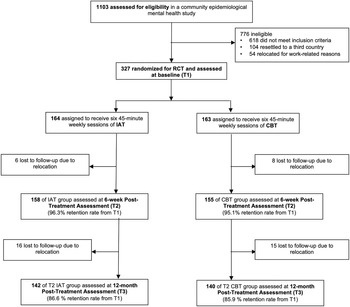
Flow diagram of participants included in enrollment, allocation, assessment, and analysis is illustrated in online Supplementary Fig. S1 (online Supplemental File S3). Following three parallel epidemiological studies, a randomly selected subsample of 1103 refugees from three ethnic communities (Chin, Kachin, and Rohingya) were assessed at baseline for eligibility. Participants were recruited for the RCT from 30 October 2017, to 30 June 2018. A total of 327 refugees met inclusion criteria and consented to participate in the study. 164 were randomized to IAT and 163 to CBT, completing baseline assessment before intervention. At T2 assessment, 313 (IAT: 158; CBT: 155) participants were assessed (retention rate: 95.7%); six participants in the IAT arm and eight in the CBT arm were lost to follow-up due to relocation. At T3 assessment, 16 participants in the IAT arm and 15 in the CBT arm were lost to follow-up due to participant relocation. Overall, 282 participants (IAT: 142; CBT: 140) out of 327 from the baseline cohort were assessed at T3 (retention rate: 86.2%). Enrolled participants, completers, and non-completers (less than 5%) at post-treatment and follow-up assessments were included in intention-to-treat analyses for T1, T2, and T3, respectively.
Trial Profile of Randomized Controlled Trial comparing Integrative Adaptive Therapy (IAT) versus Cognitive Behavioural Therapy (CBT) amongst refugees from Myanmar living in Malaysia.

Baseline characteristics
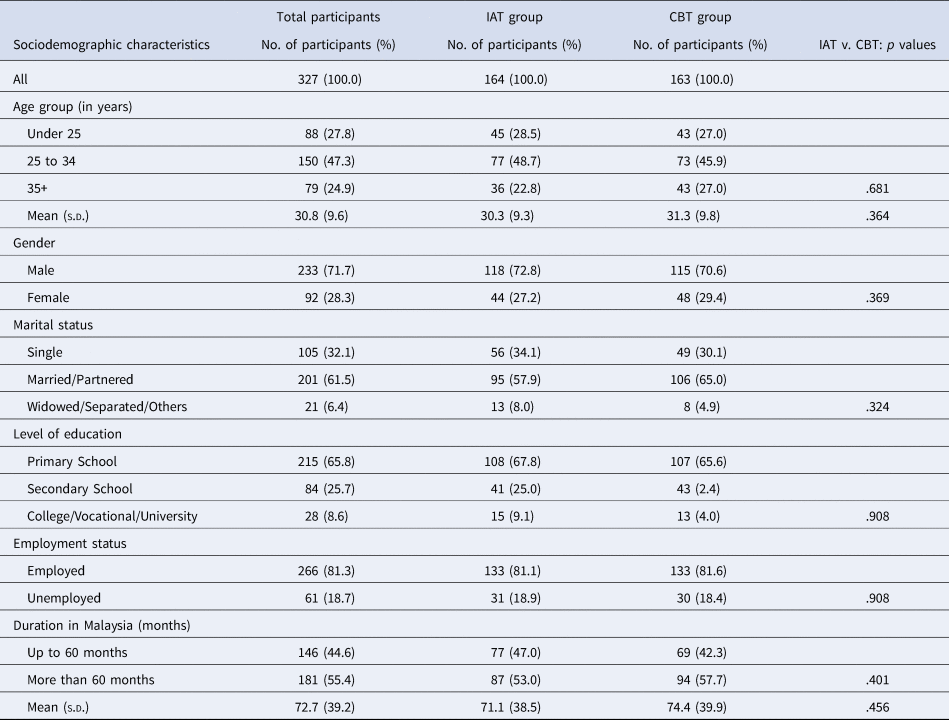
The sociodemographic characteristics of participants at baseline are reported in Table 1. There were no significant differences in any of the sociodemographic characteristics between participants in the two treatment arms at baseline. The mean age of participants was 30.8 years (s.d. = 9.6). Almost three-quarters were men (71.7%), and over half were married (61.5%). Two-thirds of all participants had completed primary school education (65.8%), a quarter had graduated from secondary school (25.7%), and a minority (8.6%) had post-secondary level education. Most were employed (81.3%) in a range of settings, including restaurants, construction sites, factories, and rubber plantations. The mean duration of residency in Malaysia was six years (72.7 months; s.d. = 39.2), with more than half (55.4%) having lived in Malaysia for more than five years.
Sociodemographic characteristics at baseline for IAT and CBT participants

Note. The total number of participants do not always add up to n = 327 due to exclusion of not stated/ inadequate or missing data.
Comparison of outcomes at baseline, post-treatment, and 12-month follow-up
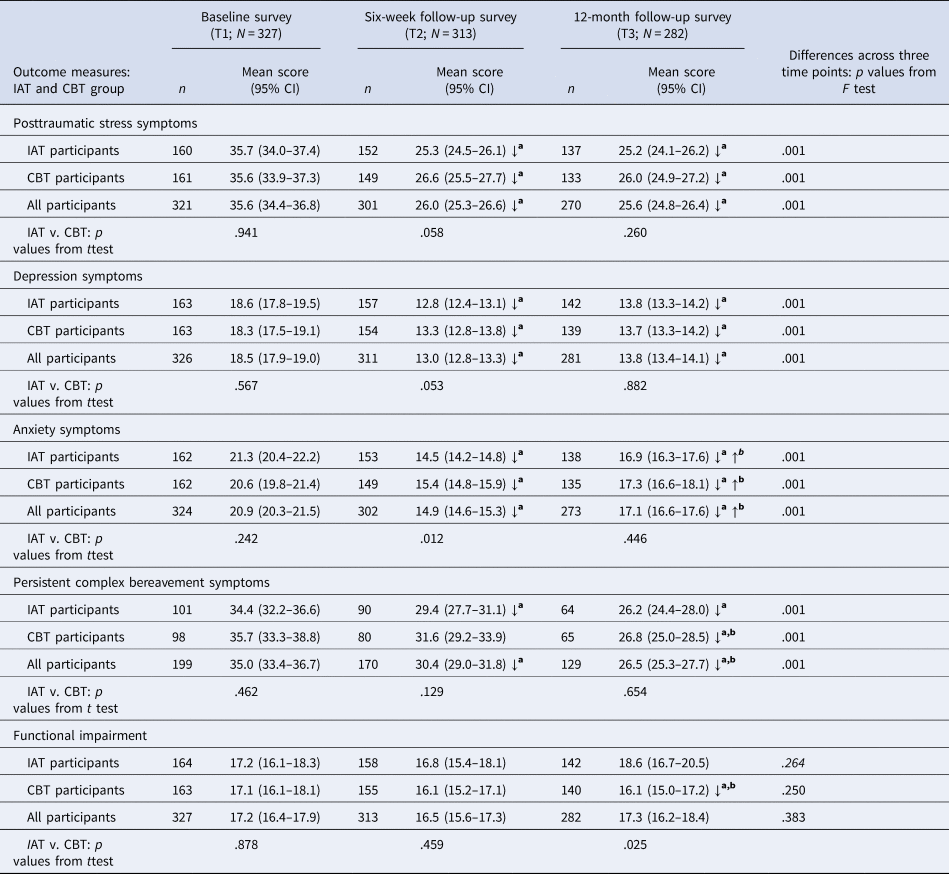
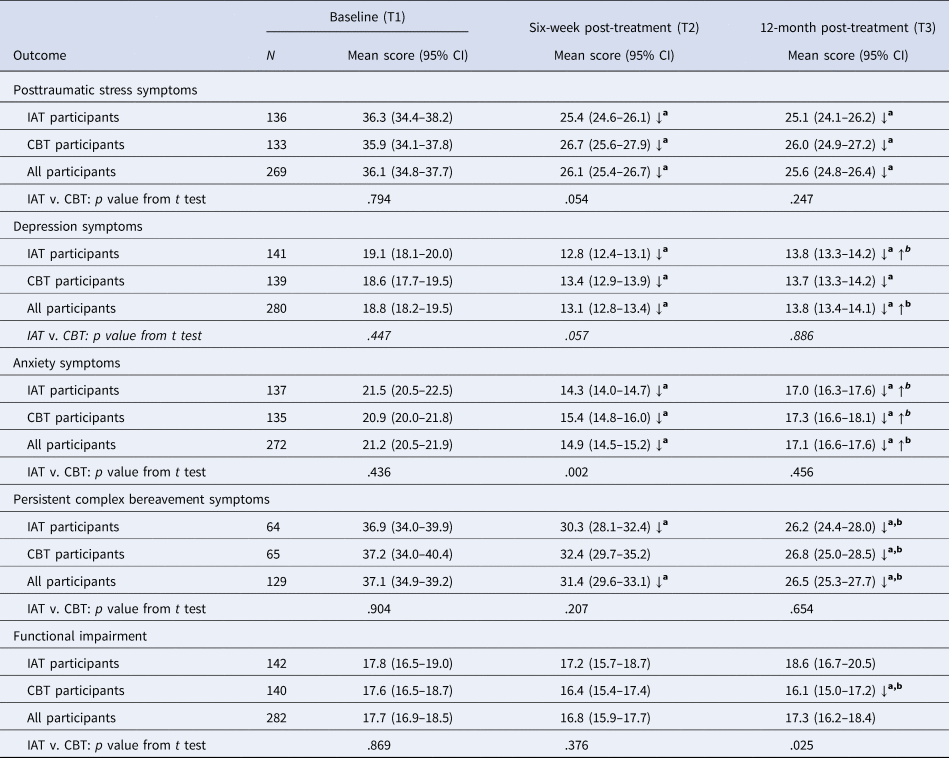
Table 2 reports the mean total scores with 95% CIs for all outcome measures by IAT and CBT participants based on non-matched samples at baseline (T1; n = 327), six-week post-treatment follow-up (T2; n = 313), and at 12-month follow-up (T3; n = 282) respectively. Except for anxiety score at T2 irrespective of assessment period, the mean scores for none of the mental disorder symptoms significantly differ by IAT and CBT group participants (all ps > 0.05). For both IAT and CBT participants, scores at T2 and T3 showed significant reductions as compared to T1 in symptoms of all mental disorders including, PTSD, depression, anxiety, and complex bereavement (all p < 0.05). Irrespective of IAT and CBT participants, except for functional impairment, the mean scores for all primary outcome measures significantly (all p < 0.05) differ by assessments periods (Table 2). Results from factorial ANOVA for repeated measures also re-confirm that except functional impairment, for all other measures the main effect assessment time was statistically significant; and interaction between therapy type and assessment time was not found to be statistically significant for any of the outcome measures (online Supplemental File S4, Table S2a). Post-treatment (T2) short-term outcomes are reported in a previous paper (Tay et al., Reference Tay, Mung, Miah, Balasundaram, Ventevogel, Badrudduza and Silove2020b).
Mean total score with 95% CI for mental health measures from non-matched sample at baseline (T1), six-week post-treatment follow-up (T2) and 12-month follow-up (T3) survey by IAT and CBT group among Myanmar refugees living in Malaysia

Note: IAT, integrated adapt therapy; CBT, cognitive behavioral therapy; CI, confidence intervals.
↓a,b Indicates that mean score is significantly (p < .05) lower than baseline and first follow-up score respectively.
↑b Indicates that mean score is significantly (p < .05) higher than first follow-up score.
↓a,b : mean score is significantly (p < .05) lower than baseline and six-week post-treatment respectively.
Multiple group comparison test (Bonferroni test) between T1 v. T2, T1 v. T3 and T2 v. T3 were conducted through ANOVA for repeated measures (T1, T2, T3); t test was used to examine the significant differences of mean scores between IAT and CBT group.
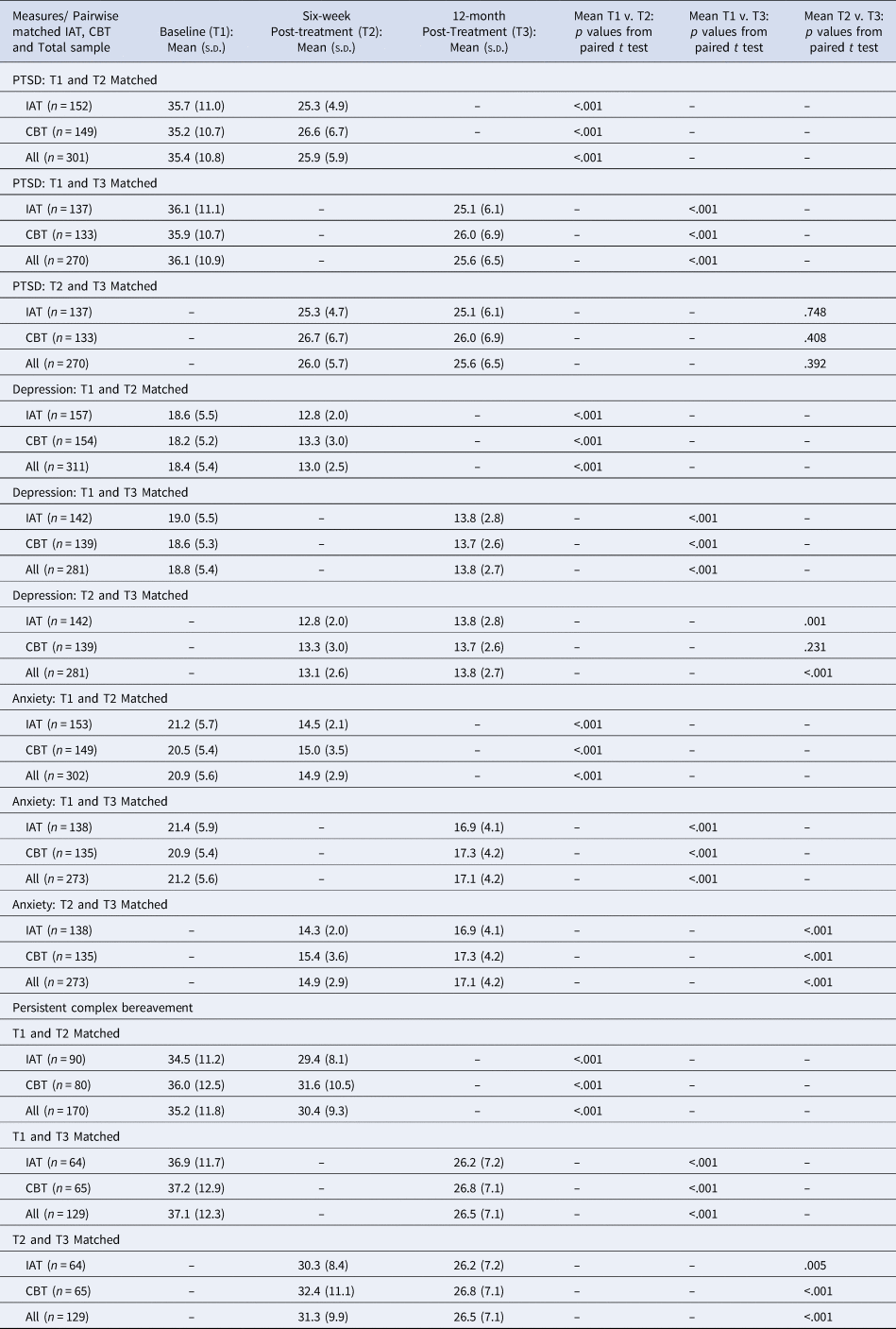
Table 3 shows the mean differences for two-way comparisons based on matched samples who completed assessments for comparison time points, controlled for IAT and CBT participants. Table 4 presents the mean scores of all outcome measures with 95% CIs for matched samples those who participated in all three assessment points by IAT and CBT arms respectively. Results from both the non-matched (Table 2) and matched samples (Table 4) showed similar patterns; results from matched samples are described further below.
Pairwise comparisons for mental health outcomes in matched sample at baseline, post-treatment and 12-month follow-up for IAT and CBT treatment arms

Note. IAT, integrative adapt therapy; CBT, cognitive behavioral therapy; T1, baseline; T2, 6-week post-treatment; T3, 12-month post-treatment; s.d., standard deviation.
Results from Table 2 and factorial ANOVA revealed that functional impairment score does not significantly differ by assessment time; and thus it has been excluded from two-way multiple comparison tests.
Mean scores for mental health outcomes in matched samples those who participated in three assessment periods at baseline, post-treatment and 12-month follow-up for IAT and CBT treatment arms (n = 282)

Note. IAT, integrative adapt therapy; CBT, cognitive behavioral therapy; CI, confidence intervals.
↓a : mean score is significantly (p < .05) lower than baseline.
↑b : mean score is significantly (p < .05) higher than six-week post-treatment score.
↓a,b : mean score is significantly (p < .05) lower than baseline and six-week post-treatment respectively.
Multiple group comparison test (Bonferroni test) between T1 v. T2, T1 v. T3 and T2 v. T3 were conducted through ANOVA for repeated measures (T1, T2, T3); t test was used to examine the significant differences of mean scores between IAT and CBT group.
Primary outcomes
Both IAT and CBT participants reported significantly lower scores on all primary mental health outcomes at 12-month follow-up, compared to baseline, but treatment arms did not differ significantly from each other (Table 4). From T2 to T3, for both treatment groups, PTSD symptoms maintained treatment gains [IAT T1 v. T2: −10.4, 95% CI (−12.0 to −8.8), p < .001; IAT T1 v. T3: −11.1, 95% CI (−13.0 to −9.3), p < .001; CBT T1 v. T2: −8.6, 95% CI (−10.1 to −7.0), p < 0.001; CBT T1 v. T3: −9.9, 95% CI (−12.0 to −8.5), p < .001]. PCBD symptoms further reduced from T2 to T3 [IAT T2 v. T3: −3.4, 95% CI (−6.0 to −0.8), p = 0.01; CBT T2 v. T3: −5.6, 95% CI (−8.7 to −3.1 (p < .001]. Depression symptoms worsened slightly from T2 to T3 [IAT T2 v. T3: 1.0, 95% CI (0.6–1.4), p = .001; CBT T2 v. T3: 0.4, 95% CI (−0.2 to 1.0), p = .23], but were still significantly lower than scores at baseline [IAT T1 v. T3: −5.2, 95% CI (−5.9 to −4.4), p < .001; CBT T1 v. T3: −4.6, 95% CI (−5.3 to −3.9), p < .001]. Similarly, anxiety scores worsened from T2 to T3 [IAT T2 v. T3: 2.6, 95% CI (1.9–3.3), p < .001; CBT T2 v. T3: 1.9, 95% CI (1.0–2.8), p < .001], but were still significantly lower than scores at baseline [IAT T1 v. T3: −4.5, 95% CI (−5.3 to −3.5), p < .001; CBT T1 v. T3: −3.6, 95% CI (−4.1 to −2.5), p < .001]. Mean differences in 12-month post-treatment scores between IAT and CBT for: PTSD was −0.9 [95% CI (−2.5 to 0.6), p = .25], depression was 0.1 [95% CI (−0.6 to 0.7), p = 0.89, anxiety was −0.4 [95% CI (−1.4 to 0.6), p = .46], and PCBD was −0.6 [95% CI (−3.1 to 1.9), p = .65].
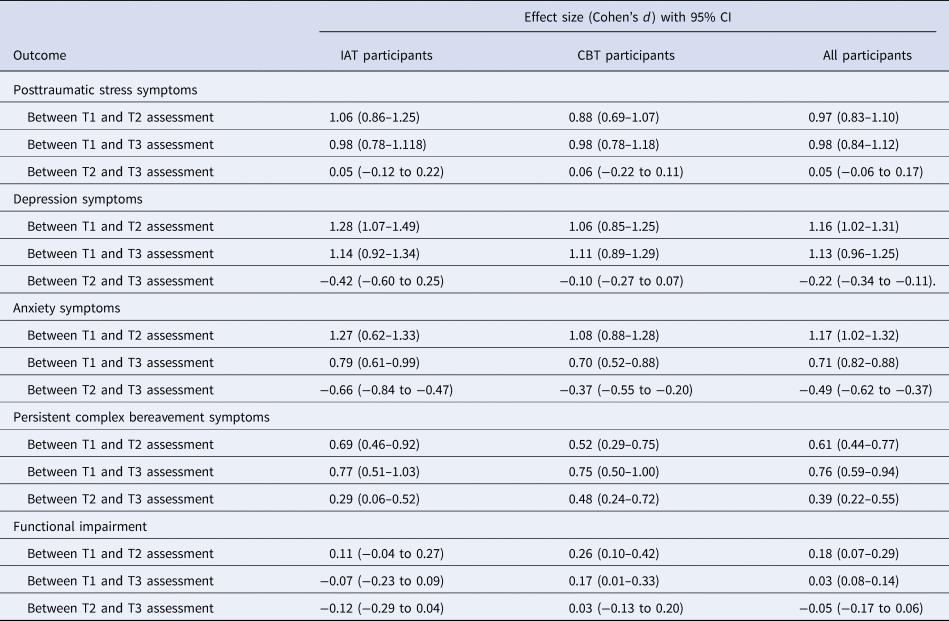
Comparing effect sizes for each outcome by treatment arm (Table 5), the effect sizes for T1 to T2 assessments showed that within-group effect sizes for IAT were consistently larger than CBT group for all mental health indices including PTSD [IAT: d = 1.06 (0.86–1.25), CBT: d = 0.88 (0.69–1.07)], depression [IAT: d = 1.28 (1.07–1.49), CBT: d = 1.06 (0.85–1.25)], anxiety [IAT: d = 1.27 (0.62–1.33), CBT: d = 1.08 (0.88, 1.28)], and complicated bereavement [IAT: d = 0.69 (0.46–0.92), CBT: d = 0.52 (0.29–0.75)]. The pattern was the same for T1 to T3 assessments, although between-group effect sizes were smaller than in T1 to T2 assessments. The results for overall samples showed that from baseline to 6-week follow-up, anxiety [d = 1.17 (1.02–1.32)], depression [d = 1.16 (1.02–1.31)], and PTSD [d = 0.97 (0.83–1.10)] exhibited the largest decreases, followed by complicated bereavement [d = 0.61 (0.44–0.77)]. From baseline to 12-month follow-up, depression exhibited the largest improvement [d = 1.13 (0.96–1.25)] followed in descending order by PTSD [d = 0.98 (0.84–1.12)], anxiety [d = 0.71 (0.82–0.88)], and complicated bereavement symptoms [d = 0.76 (0.59–0.94)].
Effect size estimates for treatment outcomes between baseline, post-treatment, and 12-month follow-up in matched samples for IAT, CBT, and all participants

Note. IAT, integrative adapt therapy; CBT, cognitive behavioral therapy; T1, Baseline; T2, 6-week post-treatment; T3, 12-month post-treatment; CI, confidence interval.
The effect size (Cohen's d) for individual measures was calculated by comparing the T1 v. T2; T1 v. T3; T2 v. T3. Cohen's d indicates small effect = 0.20, medium effect = 0.50, large effect = 0.80.
Secondary outcome
Functioning was less impaired for participants in the CBT arm [T1 v. T2: −1.1, 95% CI (−1.8 to −0.4), p < .001; T1 v. T3: −1.5, 95% CI (−2.7 to −0.1), p = 0.03] than for participants in the IAT arm, where no significant differences were observed across assessment periods [T1 v. T2: −0.5, 95% CI (−1.3 to 0.2), p = .16; T1 v. T3: 0.8, 95% CI (−1.2 to 2.8), p = .43]. At T3, CBT participants reported significantly lower functional impairment than IAT participants [CBT v. IAT: −2.5, 95% CI (−4.7 to −0.3), p = .03]. The improvement in functioning scores in the CBT arm at 12-month post-treatment compared to baseline was of a small effect size (d = .18).
Discussion
This study is the first to examine the long-term efficacy and safety of brief (six-session), lay-counselor-delivered IAT in direct comparison with CBT for CMD symptoms in a cohort of refugees from Myanmar living in Malaysia. Compared to baseline, participants reported statistically significant reductions in CMD symptoms following treatment termination and at 12-month post-treatment for both IAT and CBT groups, indicating enduring long-term moderate to large treatment effects. Contrary to expectations, IAT did not affect participants' functional impairment, while CBT maintained improvement in participants' functioning by a small effect size from baseline to 12-month follow-up.
Treatment gains for CMD symptoms were broadly maintained at post-treatment and 12-month follow-up for both IAT and CBT participants, suggesting the longer-term efficacy and safety of both psychological interventions implemented in community settings with culturally diverse refugee communities. Effect sizes for symptom reduction for both IAT and CBT groups were large across all CMD outcomes when comparing post-treatment and follow-up to baseline. This result corroborates the well-established evidence-base for the efficacy of CBT for PTSD and depression in refugee populations (Kip et al., Reference Kip, Priebe, Holling and Morina2020; Turrini et al., Reference Turrini, Purgato, Acarturk, Anttila, Au, Ballette and Barbui2019) and extends further to show that both interventions are efficacious for other comorbid conditions such as anxiety and complex bereavement. Specifically, we found that improved PTSD symptoms remained stable, and PCBD symptoms had further reductions from treatment end to 12-month follow-up, a pattern that is consistent with trends in the extant literature (Rosner, Bartl, Pfoh, Kotoucova, & Hagl, Reference Rosner, Bartl, Pfoh, Kotoucova and Hagl2015; Tay et al., Reference Tay, Miah, Khan, Badrudduza, Morgan, Balasundaram and Silove2020a, Reference Tay, Mung, Miah, Balasundaram, Ventevogel, Badrudduza and Silove2020b; Weber et al., Reference Weber, Schumacher, Hannig, Barth, Lotzin, Schafer and Kleim2021). For PTSD and PCBD symptoms, there may be greater opportunity for natural symptom remission over time, especially after psychological treatment (Doering & Eisma, Reference Doering and Eisma2016; Galatzer-Levy et al., Reference Galatzer-Levy, Ankri, Freedman, Israeli-Shalev, Roitman, Gilad and Shalev2013). On the other hand, we found slight increases in depression and anxiety symptom scores from treatment end to follow-up. As fluctuations in depressive and anxiety symptoms were also found in previous studies with refugee populations (Buhmann, Nordentoft, Ekstroem, Carlsson, & Mortensen, Reference Buhmann, Nordentoft, Ekstroem, Carlsson and Mortensen2018), it is likely that stressful life events and ongoing psychosocial stressors commonly experienced by this vulnerable population (e.g. political insecurity, poverty, and financial hardship, interpersonal and family worries) can evoke symptom increases in mood disorders. Future studies can include assessing stressful life events between post-treatment and follow-up. Booster sessions may also be required to maintain treatment gains in the longer term, as they provide greater opportunity for skills to be practiced and reinforced. Nonetheless, all CMD symptoms were significantly lower than baseline, indicating that treatment benefits were maintained over the long-term in this population experiencing long-term displacement and ongoing post-migration stressors.
Comparing IAT and CBT, effect sizes for IAT were slightly larger than that of CBT at post-treatment for all CMD outcomes, with between-group effect sizes ranging from d = 0.17 to 0.22. This is within the range of between-group effect sizes for trials with active controls (Kip et al., Reference Kip, Priebe, Holling and Morina2020). We acknowledge that our effect sizes are slightly smaller than the ISTSS recommended 0.25 effect size threshold when comparing two active psychotherapies in the trauma-related mental health field (ISTSS, 2019). At 12-month follow-up, effect sizes broadly evened out between IAT and CBT, with IAT having a greater effect size of d = 0.03 than CBT for depression, anxiety, and PCBD symptoms and no difference in effect sizes for PTSD symptoms. As indicated, the generic effects of therapy limit the size of the differences shown in head-to-head trials of this type, even when one treatment is superior to the other. Therapeutic factors common to all active therapies include the placebo effect, empathic engagement with a counselor, cross-over of strategies used to overcome symptoms, and ceiling effects caused by those who are unresponsive to any therapy – constraints recognized in both the general trauma and refugee mental health fields (Carlsson, Olsen, Kastrup, & Mortensen, Reference Carlsson, Olsen, Kastrup and Mortensen2010). The similar effect sizes for IAT and CBT at 12-month follow-up may be because of overlapping treatment components since IAT incorporates some CBT strategies and techniques within its contextualized conceptualization and linking of symptoms to the refugee narrative. While these results of enduring, large treatment effects for IAT and CBT 12-months after treatment are promising, more trials and statistical evidence are required to determine IAT's non-inferiority to the current first-line treatment recommendation of CBT.
Notably, participants who received IAT showed no improvement in functional impairment compared to those who received CBT. It is well-established that functional outcomes tend to be less responsive to treatment than symptom outcomes, and that changes in functioning lag behind symptom changes (McKnight & Kashdan, Reference McKnight and Kashdan2009). Especially in a context of chronic stress and insecurity, it is unrealistic to expect refugees to regain functioning spontaneously after acute treatment and when there are no changes to their psychosocial environment in the 12 months after. In addition, based on the categorization of the level of impairment in an epidemiological study with a similar population (Tay et al., Reference Tay, Rees, Miah, Khan, Badrudduza, Morgan and Silove2019b), this study's sample had a relatively low level of functional impairment at baseline (M = 17.2). Hence, there may be less opportunity to detect clinically significant improvements in functioning than in a more severely impaired population, where treatment gains may be greater. Furthermore, given that changes in functioning can be domain-specific and dependent upon changes in specific symptoms (Tweed, Reference Tweed1993), finer-grained analyses may help to explain what domains of functioning improved in the CBT condition. Future trials can also consider the treatment effects on functioning beyond 12-months and with stratified populations who may have more severe functional impairment.
Strengths and limitations
Strengths of the study include the process of systematic recruitment from a representative sample of refugees from three community-based epidemiological studies, yielding a pool of participants that reflected the demographic profile of Chin, Kachin, and Rohingya refugees fleeing Myanmar and resettling in Malaysia. A systematic process of translation and adaptation of intervention manuals was conducted before the RCT to ensure the interventions' cultural, contextual, and linguistic appropriateness. All interventions were conducted by lay counselors from the respective communities, consistent with the principles of task-shifting and allowing for translation of findings into real-life service settings. Counselors completed rigorous competency-based training and demonstrated a high level of fidelity in implementing treatments under the supervision of bilingual clinical supervisors. There was a high retention rate (> 90%) in both intervention arms. We also included a range of primary outcomes, which demonstrated a consistent pattern of superiority for IAT outcomes across a range of comorbid indices.
This study extends the results from our previous RCT and establishes the long-term efficacy and safety of IAT – a scalable, low-intensity, and culturally-adapted psychosocial treatment – for CMDs in refugees that can be viably delivered by trained non-specialists and implemented in poorly resourced settings. Existing psychotherapies for this vulnerable population tend to be focused on symptom reduction, with little emphasis on linking symptoms to the specific experiences and psychosocial difficulties specific to life as a refugee. Therefore, the conceptualization and approach of IAT are distinct in that, unlike conventional interventions, the therapy helps refugees trace their emotional and behavioral problems to the underlying psychosocial difficulties they have experienced during their trajectory of flight from violence and insecurity and search for a secure location of residence.
Limitations of the study include the risk of cross-over effects (i.e. the inadvertent use of techniques of one therapy when applying the other). Strategies to detect and correct this effect included regular supervision and case reviews, in vivo session observations, and random checks of recorded sessions throughout implementation. We note that any cross-over effects that might have occurred would have acted to attenuate rather than accentuate differences in outcomes between the two therapies. An allegiance effect must also be considered, as originators of IAT who initiated and oversaw the study may have inadvertently conveyed a preference for IAT during training. Active efforts were made to avert this bias in training, but the extent to which it influenced the results cannot be assessed. This consideration makes it imperative that independent research teams evaluate IAT in future studies. Another limitation of this study is that findings were not adjusted for confounding factors such as sociodemographic and clinical factors. The value of internal reliability coefficient Cronbach's alpha (α) for MDD declined at follow-up as compared to baseline (baseline α = 0.90; post-treatment α = 0.70; 12-month follow-up α = 0.79). Although these values of alpha (α) at follow-up reached the reliability threshold level (α > = 0.70), further research needed on this kind of refugee specific traumatic population to explore the reasons for this decline.
Conclusions
The promising evidence of long-term efficacy, safety, and scalability of IAT can inform treatment recommendations for evidence-based mental health and psychosocial interventions and implementation packages for refugee populations experiencing long-term displacement. Our 12-month follow-up study of IAT demonstrated robust, sustained treatment gains comparable to CBT for PTSD, depression, and anxiety and showed further reduction in PCBD symptoms in 12 months following 6-week treatment. Further studies with longer follow-up period controlling for confounding sociodemographic and clinical factors will be needed to confirm sustained IAT treatment benefits on symptom reduction and subsequent improvement in functioning over time.
Supplementary material
The supplementary material for this article can be found at https://doi.org/10.1017/S0033291722003245
Acknowledgments
We thank all our field personnel from Alliance Community for Chin Refugees, Kachin Refugee Community, and Rohingya Society Malaysia for their invaluable contributions to this project.
Financial support
The study was funded by the National Health and Medical Research Council, Australia (Grant No.: 08333).
Conflict of interests
None.