Introduction
The string quartet was a much-discussed genre at the beginning of the nineteenth century, in part because it embodied the newly salient issues of canonicity (quartets by Haydn, Mozart and Beethoven and a few others were regularly distinguished from the pack by such adjectives as ‘true’ or ‘classical’Footnote 2), and in part because its four independent but timbrally homogenous voices – considered analogous to, but musically ‘purer’ than (sacred) vocal polyphony – represented a kind of abstract ideal of rigorous compositional discipline that went along with ideas about seriousness and emerging canonicity.Footnote 3 Echoes of those values still inhere in some discussions of the string quartet to this day. But inextricably attached to notions of the uniqueness of the string quartet were also ideas common to discussions of multiple forms of chamber music; in particular the bedrock assumption that these genres were foundationally about performance. Routine comments on playability in reviews of chamber-music publications embedded an idea of performance into the evaluation of what we might now call ‘the works themselves’Footnote 4 Performance as the first approach to the chamber music was also evidenced in the exclusive publication of all chamber music in parts.Footnote 5 The string quartet, however, was singled out for a particular combination of attitudes, which combined abstract or idealizing commentary with strikingly embodied discourse. There seems, for example, to have been an irresistible temptation to map the four parts onto the persons of the performers – whether actual or idealized, which to my knowledge is not replicated in discussions of other forms of chamber music.Footnote 6 There was also in discussions of the quartet, and this seems to have been connected with the genre's emerging canonicity, a kind of slippage between the rhetoric of listening and the rhetoric of performance, whereby the performers were described as exemplifying a particular kind of attentive listening, and listeners were described as so close personally, physically and/or musically to the players that they ‘performed’ their engagement with the music in a conversation with the more literally audible performers.Footnote 7 In other words, elements both compositional (the relations of the four parts) and social (listening practices) were typically understood through the lens of performance, or at least in association with it. In the first part of this essay I detail some of the ways in which early nineteenth-century writers – explicitly and not – based their evaluation of the string quartet on notions of performance, and how the ideologies of performance they articulated relate to broader aesthetic and social questions. My study is limited largely to journalism from Vienna, Berlin, and Paris, where concerts devoted to performances by a single string quartet – chiefly the Schuppanzigh and Böhm quartets in Vienna, the Möser quartet in Berlin, and the Baillot quartet in Paris – were a regular feature of musical life in those cities, and where concerts featuring either only string quartets, or quartets and quintets, were becoming normal. And although in practice the performative ideals and social modelling attributed to the string quartet surely inhered in other forms of chamber music, with and without piano, the discourse that discusses these topics focuses on the quartet, both relying on, and further establishing the canonical status of this genre within the world of chamber music.
Both Beethoven and Haydn made use of the materiality of the string sound that arises only in performance.Footnote 8 Haydn's meticulous performance markings, as well as his close association with the string players of the Esterhazy establishment, who seem to have acted as a kind of laboratory for his explorations of the genre, testify to his embodied sense of the genre. And Beethoven had his ‘Leibquartett’ (Schuppanzigh and his various associates) as an indispensable, if not always respected, resource. John Gingerich, for example, notes that ‘Beethoven apparently never attempted to compose a quartet without Schuppanzigh's collaboration’.Footnote 9 But in addition to the timbral/sonic traces of an engagement with performers, both composers wrote into their music moments where the internal social dynamics of the ensemble – that is to say, the roles both of the parts in the abstract and of the human beings playing those parts – are called into question.Footnote 10 As we shall see, the nature of quartet social dynamics was a significant topic of discussion in the literature surrounding the genre; it is therefore not particularly surprising to find contributions to the debate in the music itself. I thus devote the latter part of this essay to a single measure in the slow movement of Beethoven's op. 59, no. 2, which seems to me, despite its extreme brevity, to embody and crystallize some of the performance-related issues in the discourse.
§
The complicated mix of issues involved in the discussions of string quartets at this period is exemplified in a passage from an invaluably rich essay ‘Ueber Quartettmusik’ in the Allgemeine musikalische Zeitung of 1810.Footnote 11 Here, the author, Johann Conrad Wilhelm Petiscus, identified in AMZ only as ‘P.’,Footnote 12 first jogs through the history of the string quartet, starting with ‘Vater Haydn’, presenting it as a German invention that has conquered the world ‘from the Tagus to the Neva’, and describing its progress from simple violin solos with accompaniment to its current elevated condition. He then continues:
Not only in big cities but also in small ones, even in villages, if there are friends of music who play string instruments, then they will find themselves playing quartets together. The magic of the music makes everyone equal, and in a friendly way binds together what rank and station would otherwise have divided forever. One plays, and in the pleasure provided by the power of the music's calm and elevated feelings one forgets or ceases to care about the burdens or sorrows or deficiencies of life and is fortified for new activities and cares. Drinking with one another used to make friends: [now] the quartet-stand will soon supersede the bar.Footnote 13
One issue raised here that involves both performativity and a larger social frame is the intermixing of public and private social spheres in the quartet. Petiscus describes the quartet on the one hand as a genre given validity by its association with a great composer (Haydn), whose works occupied a prominent place in public life and consciousness, but on the other hand, as a genre fundamentally about participatory performance, and thus designed to stimulate – and in performance simulate – healthy private relationships.
The idea of the quartet as simultaneously a metaphor for, a model of and a stimulus to admirable social relations is as old as the genre itself. For example, the metaphor of conversation, used to describe both the way the parts (and their players) interact in the moment and what is modelled synchronically for the audience, has been endemic to descriptions of quartets since their origins, and continues today.Footnote 14 However, although some elements of the idea of conversation can be assumed in many early-nineteenth-century descriptions of both internal quartet processes and staged social modeling, the mostly-anonymous authors of the journalistic commentary in the early nineteenth century also describe both public and private group dynamics that have little to do with a conversational model, but rather invoke a different kind of worthy sociability.
This new kind of sociability is underpinned by an aesthetics of seriousness and elevation which, as it relates to the quartet, has been amply studied beforeFootnote 15 and need not detain us here. However, with respect to performance, the seriousness of the string quartet was often understood to be literally staged in the persons of the most celebrated public purveyors of quartets, who were all praised not only for their technical virtuosity, but for their capacity to subordinate themselves to the expression and style of the music: a quality of performance increasingly being opposed to ‘mere’ virtuosity and associated with seriousness and spirituality. Ignaz Schuppanzigh and Joseph Böhm in Vienna, Karl Möser in Berlin, and Pierre Baillot in Paris, were all violinists known for their unusually refined understanding of music, which matched the prevailing ethos of the ‘true’ quartet. For example, in 1824 AMÖ notes that Schuppanzigh
dedicated his virtuosity to the recognition and promotion of truly classical creations and appeared in the performance of quartets chiefly as a singing orator (Deklamator) and declaiming singer; and as a spiritual and feeling-ful performer [he] maintains his striking pre-eminence over other virtuosi.Footnote 16
On Karl Möser, an 1826 report in BamZ reads:
That music-director Möser understands how to grasp the spirit of a composition and to interpret it with his violin playing is so well known as to be inarguable. Haydn's humour, Mozart's feeling, Beethoven's sublime genius are all truly felt by this brilliant virtuoso and clearly presented to the listener.Footnote 17
And of Pierre Baillot, François Fétis wrote in La Revue musicale in 1828:
Baillot suffices to perpetuate, among true music-lovers, the taste for beautiful things. … no one has this soul, this fire, this expression, this variety [all of which] border on prodigious. No one knows like him how to give each composer his own particular physiognomy, and to create beauties in things which, played by anyone else would be common.Footnote 18
As Fétis's reference to ‘true music lovers’ suggests, seriousness or elevation was as important a characteristic of the audience as of the music and the players. This reputation often translated to exclusivity, despite Petiscus's universalist social claims.Footnote 19 John Gingerich has, for example, recently expanded our understanding of the highly selective gatherings in which Schuppanzigh's group played Beethoven's quartets (among other works).Footnote 20 One consequence of such exclusivity, or at least of a small, dedicated and educated audience was that, as noted above, listening and performing could count as part of the same overall activity. An 1823 report from Berlin in AMÖ, for example, describes such fluidity:
When, in addition, there is between the artists and their listeners an unmistakeable interaction, we can even consider the public for Möser's quartets a participant in [their] efforts, especially as this audience normally consists of the most educated and sensitive people, who have a stimulating and rewarding influence on the players.Footnote 21
This engaged audience may very well have been made up of the kinds of people who formed Beethoven quartet clubs of the sort that Christian Friedrich Michaelis (‘M.’) described in BamZ in 1829:
For some time musicians and friends of music have founded numerous quartet clubs [Quartettvereine], whose primary, or exclusive exercise is the study of Beethoven's quartets. It could be called more than a ‘club’ when some of the latest and most difficult masterworks are gone through fifty or a hundred or more times in order fully to enter into the spirit of the master, and to play him worthily. No effort is spared, the score is consulted, [with respect to] the intention of the master, the meaning of individual spots, or of the whole is earnestly discussed, every good suggestion put to a practical test and the satisfied listener is surprised by the explanations of the players that they still are not satisfied with themselves. These high-minded strivings do not, of course, lead directly to fully-fledged performance of those works, but to the higher education of the learners, and increasingly establish within us a truly artistic spirit.Footnote 22
Private but non-familial quartet occasions went back to the mid-eighteenth century,Footnote 23 but the intensity of focus described here is quite striking. If this excerpt is to be believed, these highly serious clubs not only demanded of their members a willingness to use scores as part of their study of the music, but modelled an extraordinary seamlessness between listening and playing towards the higher aim of aesthetic and moral education, and probably also towards engaged listening in larger venues; indeed, who played and who listened is not at all clear from this excerpt.
In a slightly different twist on the idea that quartet-ideology encouraged a close connection between reading/listening and playing, Petiscus warns his enthusiastic amateurs:
To play a quartet well, that is, completely with its sense and character, is no easy task. We [the author] are so unwilling to deny [that difficulty] that we would much rather ask the opposite of the enthusiasts of this music: namely, for the sake of their own enjoyment, not to take it too lightly.Footnote 24
In other words, quartet players should be music readers and (imaginary) listeners before they engaged with the music as instrumentalists. This intertwining of notions of seriousness with ideologies of performance is evident in a review of Andreas Romberg's op. 2 quartets. Having started with a comparison to Haydn, to whom the works are dedicated, and whose name is clearly intended to be a guarantee of the worth of these new pieces, the reviewer comments that they are good pieces when played at the right tempi, with the right delivery, ‘to which end… an unusually careful study of the whole as much as of the individual parts, will be very necessary.’Footnote 25
Performance is, then, embedded in notions of elevation and serious work attached to the quartet. But there is also in the discourse about quartets a fascination with the notion of ensemble in general. This may be a by-product of the emphasis on four-part writing, but in any case brings performance to the fore. Präcision is a common word in reviews of quartet performances, referring especially to ensemble issues; and in some reviews of symphony performances, the presumed precision of quartet performances is sometimes taken as a benchmark.Footnote 26 But the more particular question of the internal dynamics of the four parts and/or players comprises the most frequent, and certainly the most interesting performance question in these writings. A fundamental part of the rhetoric about quartets – especially ‘true’ or ‘good’ works – was the notion of equal participation by all four parts. Interest in the relations between the four lines was obviously technical, but the writing on this topic also has a strong social, even political, cast, with ‘freedom’ a not uncommon term; and it is sometimes even described in quasi-religious, or mystical terms. The seriousness of the abstract idea of four-partness is thus transferred to the four people playing this music, and directly affects the discourse about how they should relate to each other. Petiscus, for example, writes:
the essence of the quartet [is] a four-in-one-ness [ViereinigkeitFootnote 27] in which the unity of the whole and the independence of the four voices set mutual limits on each other. Each instrument then presents as independent when it has the principal part, whether melody or passage work; in these places it is allowed to play out with the art and rights of a soloist, and to stand out from the other instruments with a strong tone. All the nuances of a soloist are permissible here ([though] ornamentation is, here, as everywhere, misplaced); yet everything that does not correspond to the whole is forbidden.Footnote 28
The quasi-religious mystery of Viereinigkeit is extended to the paradoxical balance between soloistic playing and attention to the whole. Closer to the ground, but still presenting a paradox between ensemble precision and individual freedom is an 1829 review of the Möser quartet:
Whether it is the public's special preference, or the long collaboration of Herr Möser with the other players, Herrn Kammermusiker Ganz, Lenz and Kelz, people were generally of the opinion that they had never heard such precise and thus free-seeming ensemble, such a unity of spirit.Footnote 29
Although the ethos of equal collaboration, complete with quasi-mystical paradoxes, was widely subscribed-to and powerful, the reality of quartet performance was often somewhat different. In particular the role of the first violinist was typically far more prominent than ‘Viereinigkeit’ might deem ideal. Indeed, the just-cited 1829 review of the Möser quartet continues ‘Music Director Möser demonstrated a grace, delicacy and witty conception of the music that, especially with Haydn and Mozart, left nothing to be desired.’Footnote 30 The attention to the first violinist may well have had to do with the rarity of professional quartets with consistent membership, ensembles (like the Möser quartet) thus tending to be known by the name of the first violinist, and attention thus inevitably drawn to that person. It may also have had to do with orchestral practice at the time, in which the concertmaster continued to serve as director. It may also have had to do with a frequent lack of sustained rehearsal, which would make it convenient for all the players to agree to follow a single leader.
There are not a few reviews of quartet concerts where only the first violinist is named. These tend to be concerts by eminent players, so one might think that the repertory in such concerts was of the quatuor brillant sort, with three ‘accompanists’ more or less dragged in from the street. But even reports of concerts with the most impeccably classical repertory sometimes read as though the first violinist played this repertory quite by himself, or at least as a solo with a very discreet accompaniment. Reviews of the famous French violinist Pierre Baillot are often of this sort. An example stunning in part because of the repertory – a Boccherini quintet, an Onslow quintet, Haydn op. 20, no. 5, an air by Pierre Rode, and Beethoven's op. 130, no less – reads as follows:
[These works] gave to our great violinist the occasion to develop his talent with such a colossal number of such varied and delicate nuances that for nearly two and a half hours, the admiration and rapture never ceased to echo from all quarters of the hall, and, on leaving, one heard nothing but the words ‘perfect’, ‘admirable’ …. we believe that if Haydn, Mozart and Beethoven had heard their works in the rendering of Mr. Baillot and his able accompanists, they would swear that their effect was [even] greater than they had intended to produce.Footnote 31
The quatuor brillant tradition was stronger in France than in German-speaking countries, and in the absence of an overwhelming French critical tradition condemning virtuoso display, it may not be surprising that the chamber music séances of Baillot – one of France's most celebrated virtuosi – were described in this way. But in fact, as we have seen above, Fétis compared Baillot favourably to Paganini for precisely the qualities that made the former a good chamber player and the latter a ‘mere’ virtuoso, so he did not evidently see a contradiction between the ethos of quartet playing and that of a strong first violin. And Baillot himself – France's greatest proponent of the ‘classical’ quartet literature – also recommended that the first violin be much more prominent than the other players:
For chamber music … it is proper for the first violinist, more than the others, to be in a position to be heard in all details. In order for the quartet to be followed with interest, the first violinist should have to his right the greatest number of listeners, and nobody should be to his left or behind him. This arrangement is indispensable for whoever wants to hear well; it is no less necessary for the performer, who needs to be in a good relationship with the audience … In general the sense of sight seems to come to the aid of the sense of hearing in conveying to the listener more completely the expression of the accent through that of the physical motions … It is only by the continuous exchange of feelings that he feels born in himself new feelings resulting from the effect of those he has conveyed: these new inspirations give him new means to move the audience.Footnote 32
It is striking that the ‘exchange of feelings’ happens between the first violinist and the audience rather than between the members of the ensemble. Of course the German press was not above pointing out failures of high-mindedness in French practice: an anonymous report from Berlin in the April 1830 volume of BamZ praised the Bohrer quartet for not exhibiting the first-violin-centric behaviour that had characterized Baillot's quartet concerts:
Indeed, Baillot has in past years established similar soirées; yet in these gatherings he tried to shine by himself, and let the first violin predominate all by itself, so that everything else was repressed.Footnote 33
It should be noted, however, that the German-language press also on occasion described quartet concerts as if they were violin solos.
The ideal of equal participation shows up throughout the literature, whether as description or prescription, but is regularly tempered with the acknowledgement of the superior importance of the first violin, either as a problem or as a necessity. An interesting comment on this subject comes from a review of the generally praiseworthy Karl Möser:
According to this reviewer, who has had the pleasure of hearing Messrs. Rode, Spohr, Schuppanzigh, Mazas and Maurer, Herr Möser ranks high above them all in the performance of these quartets, and it remains only to wish that Herr Möser could bring his collaborators along with him – not to play their parts so modestly, that he rather gave each one the opportunity to let his part contribute to the pleasure of the whole, to bring it to the greatest perfection. Herr Krautz [cellist] seems to be able to notice that quartets are incomplete when the players are not all sufficiently independent. He alone gives his material the appropriate meaning, and precisely distinguishes accompaniment from the harmonic masses that must serve as completion of a strongly speaking painting. The second violin, however, and also the viola, imagining themselves too unimportant, stay throughout too much in the background, thus leaving too much to Herr Möser and denying the whole that fiery and spirited life, the freshness and blooming lift that such classical works carry.Footnote 34
Even when the full collaboration of all four players was fully acknowledged, it was more often than not still understood to be the first violinist's responsibility to lead the others to a satisfactory reading of the music. In July 1823, for instance, AMÖ described a Schuppanzigh quartet concert as follows:
With truly poetic enchantment the [above]-named masterly performers followed the composer's flight of ideas under Schuppanzigh's sensitive leadership and showed remarkable results in execution, with the greatest velocity and, moreover, the greatest precision and clarity, in the not-unusual fast tempos.Footnote 35
In addition, as John Gingerich notes, Karl Holz, one of Beethoven's amanuenses and Schuppanzigh's second violin (who continued in that position when Schuppanzigh himself went on a multi-year visit to St. Petersburg) commented in Beethoven's conversation books when the topic of a first violinist to play op. 127 was raised: ‘I think Mayseder would play it best. He conducts the other three, while [Josef] Böhm lets himself be conducted.’Footnote 36 These excerpts obviously have some basis in the practicalities of quartet playing. But one gets the sense that first-violin centricity was not simply a pragmatic accommodation or compromise; indeed, these writers took great and obvious pleasure in witnessing skilful musical leadership.
One non-practical reason why the first violin often remained the centre of attention, both within the quartet itself and for listeners, may have been the currency of the idea of the ‘genius of performance’.Footnote 37 The writers who most strikingly use the words ‘genius’ and ‘performance’ together are violinist Pierre Baillot and philosopher Georg Friedrich Wilhelm Hegel. Baillot's violin treatise has a long description of the genius of performance, which begins:
It is genius of performance that allows the artist to seize at a glance the different characters of music and by a sudden inspiration identify himself with the genius of the composer, follow him in all his intentions, and interpret these intentions with both facility and precision … It is genius of performance that allows the artist to transmit to the soul of the listener the feeling that the composer had in his soul.Footnote 38 (Italics mine)
Hegel, too, describes the workings of genius in performance, in his Aesthetics:
In the matter not of technique but of the spirit, genius can consist solely in actually reaching in the reproduction the spiritual height of the composer and then bringing it to life.Footnote 39 (Italics mine)
Although Baillot and Hegel are the writers who most explicitly invoke genius and performance in the same breath, they were not alone in believing that performance involved not only a spiritual connection to the composer as well as the audience, but also investigation of the origins rather than the evident surface of the musical work (‘the feeling the composer had in his soul’, ‘the spiritual height of the composer’). Unlike the quintessentially rational/Enlightened model whereby the performer reads the legible surface of the music to the best of his ability and conveys its contents to an audience primed to understand the character, affects and topoi being communicated, the ‘genius of performance’ model presumes a quasi-psychological or spiritual connection between the performer and the composer. It thus suggests that a set of personal rather than communal associations and interpretations is brought into play as a way of understanding the music.Footnote 40 To presume a set of personal associations and psychological connections between composer and performer implies that it is a single individual who possesses and exercises the genius of performance; and, indeed, the early romantic rhetoric about what we would now call musical interpretation is always phrased in terms of a single individual. There is an element of linguistic convenience in this, of course, but accounts of quartet performances that concentrate on the first violin quite often use language commensurate with the genius of performance model. The reviews and reports of this sort, if they do mention the other players, seem, like the above-quoted description of the Schuppanzigh group, to suggest that they receive the spirit of the composer from their leader.
In contrast to both the high-flown rhetoric and the individual focus of the ‘genius of performance’ ideology of quartet playing, two accounts of the interpretative work of quite different quartets emphasize the practicalities of coming to agreement about how the music goes. The first such account is from a set of rules for non-professional players in Petiscus's ‘Ueber Quartettmusik’:
It is the duty of the quartet player to be thoroughly at one with the character of the music, and to communicate about it with his assistants. That, however, is a matter of his musical sense, about which no detailed advice can be given. Once [the players] are agreed about the character, then each one should strive selflessly only to listen to the whole. Each one should moderate his tone, so as not to scream out above the others, for the whole has to maintain a medium level of volume, in order that the means for Fortes, Pianos and Sforzandi do not fail. All changes in expression, all colourings made by forte, piano, crescendo and diminuendo must be observed with the most exact agreement; all sforzandos are especially to be noted. (Italics mine)Footnote 41
It is striking that the ‘quartet player’ is not identified as the first violin (or any particular part), although one might assume that that is what is meant. There is, of course, some element of leadership insofar as someone (again, presumably the first violin) proposes the character of this or that passage, but the implication is that it is in principle possible to disagree, so that the process not only of physically producing the music, but also of deciding what it is ‘about’, is presented as highly collaborative, very much in line with the ethos of equality. One might attribute the matter-of-fact tone, especially the advice about dynamics, to its intended non-professional readers, who were in any case unlikely to attain the heights of performance-rapture imagined certainly by Baillot and perhaps by Hegel.
But an enormous and tortured review by Friedrich Rochlitz of op. 131 in particular, and of late Beethoven in general, ends with a description of a quartet getting to grips with this late work, and the terms of the description are comparably matter of fact, if less flat-footedly didactic. In abbreviated form this reads:
Once the group has played it through it can begin properly to rehearse it … The score is shared among the players, which makes rehearsal hugely easier … The host points out a third issue, which lies in between conquering the mechanical difficulties and the truly spiritual, and makes perfect performance much more difficult. This issue is that the Master has fragmented, hidden and varied the basic melodic ideas, which are in any case characteristic of him in being sometimes odd and not easy to grasp. Nevertheless, the performance must have sequence, coherence and clarity, the performers must give each idea-fragment sufficient weight and the listener must be able to follow them. In the end the performance was successful, and each player had salvaged his honour as a virtuoso, in knowing that he could bring off the most difficult music.Footnote 42
Just as the rules for amateurs acknowledge that a ‘musical sense’ is both necessary and beyond the powers of description or instruction, Rochlitz here acknowledges the end-goal of spiritual interpretation. But the description of the process of working (reading, rehearsing, using the score, performing) and the details of figuring out what and where the main ideas are seem very far from a notion of the genius of performance. And in both passages, the collaborative discussion needed to come to an understanding of the music supports the idea of an ethos of equality.
Although one may correctly conclude that the dialogue about string quartet sociability was complex, there were connections between the ‘democratic’ ideal (compromised by the need for leadership), the ideal of the ‘genius of performance’ residing in and communicated by the individual violinist (compromised by the back and forth of actual rehearsal) and the ‘mere’ practicalities of fourfold discussion. One extraordinary passage about Beethoven's late quartets combines the ‘spiritual heights’ in the descriptions of the genius of performance with a full appreciation (or imagining) of the equal participation of all quartet members. It is Adolph Bernhard Marx's first synoptic evaluation of the late quartets, written in the 1828 issue of BamZ, his own journal, relatively soon after Beethoven's death, and perhaps significantly, not tied to any particular performance. He first of all starts by saying that it is rare to hear these well played, and that he hasn't had a lot of time to think about them. He points out that the contrapuntal writing is Bachian in its complexity and in the independence of the voices:
No more do we have four jolly brothers-in-art who make music for their own, and our, pleasure; we have four deeply stirred creative spirits, who soar in glorious freedom and wonderful sympathy in a quadruple brotherly embrace … If practitioners do not make an equal band of noble, equal, free and brotherly spirits, no complete appearance of the artwork is possible, and even full satisfaction of the players cannot be hoped for. [To achieve this] it does not suffice for each player to become technical master of his part, and to be able to play it with the required sound, strength, delicacy and lightness; a more profound sensibility is necessary to grasp it with deepest feeling in the innerness of its soul, and more profoundly than [its] external circumstances might suggest; true artistic knowledge is necessary, and [even] for the best trained and most gifted it takes long practice until one voice follows another freely and flexibly, seeming to give up none of its own content, [even] as it makes every effort not to disturb the free progress of the others. With better artistic education the younger generation will make light of the particulars of this kind of playing, just as our contemporaries no longer find the particularities of Haydn's style difficult.Footnote 43
One of the remarkable things about this essay is that even in the absence of actual performances to review, and even when the overall point is to evaluate ‘the music itself’, the genre itself is so tied to performance that Marx immediately understands the quartets as embodied by human players. Another remarkable thing is the overtly political language of freedom and brotherly embraces: in this reading, quartets, both as compositions and as performance, model a polity where voluntarily discharging mutual obligations on a basis of equality and respect results in freedom.Footnote 44 But from the narrower perspective of the present essay, Marx is not only notable in acknowledging the work necessary to come to a persuasive reading of this music – the work described by Rochlitz and in the ‘Ueber Quartettmusik’ essay, but he also suggests that each player needs a quality remarkably like the genius of performance, which both kindles his own spirit and links him to a completely collaborative, utterly democratic group super-consciousness.
Another remarkable aspect of this essay, which brings us back to the larger aesthetic issues raised by the complex relation between an ethos of equality and the practicalities and aesthetics of first-violin leadership, is that the notion of conversation, often taken to be the essence of quartet texture, is completely absent.Footnote 45 Indeed, a ‘quadruple brotherly embrace’ pretty definitively excludes even the possibility of conversation. Rather, what Marx describes is a more complex, arguably more heartfelt, sociability. The essence of conversation is that the discourse proceeds turn and turn about, each interlocutor taking a clear lead - however briefly – while the others drop back, all having agreed both on the identity of the leader and the topic to be “discussed”. The process described in ‘Ueber Quartettmusik’ for the amateur quartet is exactly of this sort: figure out who has the main idea at any given moment and let them shine forth with it until it's someone else's turn. Even Rochlitz's description of what a quartet needs to do with the fragmented and varied ideas in op. 131 implies the notion of turn-taking. What Marx has, more or less nebulously to be sure, perceived in Beethoven's late works, is precisely not the echoes of rational conversation, as Goethe might have had it, but rather a dynamic where everyone is important all the time, where the genius of performance does not simply inhere in the person with the lead, but in every player, each one ‘giving up none of [his] own content’ while still allowing for the individual subjectivity of the others.
I have suggested a rather stark contrast between the idea of conversation and that of a more pervasively democratic sociability, but of course that does not reflect the truth of the matter, either musically or group-dynamically, any more than does a stark opposition between equal participation and leader-centred behaviour. Although Petiscus and Rochlitz both assume some kind of turn-taking in quartet-playing, they do not use the word conversation, and indeed the word is extremely rare in the journal literature from this period. And interestingly, despite his emphasis on musical turn taking, Petiscus's description of the social benefits of quartet playing (quoted on p. 56 above) are much more like what we might term Marx's ‘spiritual democracy’ than like a conversation, especially of one of the structured types that is now sometimes adduced to explain late-eighteenth-century works.Footnote 46
A December 1824 description of Schuppanzigh's group, after a successful season of performances, may suggest a similarly ‘anti-conversational’ model:
We have already a few times mentioned the storied names of the gentlemen who contribute their talents and skill to these performances. Once again this year they are Messrs. Holz, Weiss and Linke. The discreet but powerful manner of delivery that Herr Holz demonstrates in his performance of the second violin part, the beautiful viola playing that Herr Weiss, already famous as a composer, develops, and the style with which Herr Linke treats his cello – serious, yet tastefully decked with all his nuances and shadings – these marks of excellence are always to be found united with Herr Schuppanzigh's insuperable performance of the quartets.Footnote 47
It is extremely unusual in the literature to find such fulsome and musically particular descriptions of the lower three strings, though mention of the names of the players and perhaps a generalized compliment, is not that unusual. In this case we might read the qualities of the different players – ‘discreet but strong’; ‘beautiful’; ‘serious and nuanced’ – as, in Marx's terms, the individual ‘content’ which the players never give up; and thus understand the group as a ‘brotherly embrace’ of equal and beneficially diverse members. At the same time, especially for regular readers of AMÖ, it would be clear that Schuppanzigh was still very much considered the leader of the group, that it was his playing that would draw the most attention, and that his ‘genius of performance’ would be the most appreciated.
§
The music for the autumn 1824 season that generated the description of the three other members of the Schuppanzigh quartet included six quartets by Haydn, three by Mozart plus the D-major quintet; four Beethoven quartets, and a single work each by Spohr, Weiss, Ries and Onslow. The works by Haydn, Mozart and Beethoven are not further identified, but they will not have included any of the late Beethoven quartets, since the first performance of the first of these (op. 127) was not until the next year.Footnote 48 There is no reason to think that any particular work stimulated the writer's attention to the players of the three lower parts in the way that Beethoven's late quartets stimulated A.B. Marx's imagination, but it would be simplistic to assume that when quartets were understood so profoundly as a performative genre, and when listening to them was so often construed as a participatory activity, the qualities of the music and the qualities of the interactions among the players would not be understood as mutually influential.
It is into this fascinatingly unstable, various and messy stew of ideology and practicality, professionalism and amateurism in writing, listening and performance that I wish to inject a telling moment of music, which both illuminates and is illuminated by, its context.
The second movement of Beethoven's op. 59, no. 2, composed, like its siblings, in 1806, has been described as anticipating the sublimity of his later slow movements (especially that of op. 132), with its chorale-like opening material and its expansive use of musical space.Footnote 49 Czerny's oft-cited remark (repeated and amplified by Holz) that Beethoven conceived it while ‘looking at the stars and thinking of the music of the spheres’Footnote 50 is sometimes introduced to account for the contrast between the extraordinary Innigkeit of the chorale tune (presumably standing for the subjective experience of the overawed observer) and the cool exactitude of the dotted or long–short rhythms that pervade the movement (presumably standing for the eternal and immovable order of the heavens). Beethoven's much later (1820) misquotation of Kant in one of his notebooks – ‘The moral law within us and the starry sky above us – Kant!!’Footnote 51 – is also adduced to support the notion of a sense of two realities in this movement. Indeed, in his 1947 monograph on the quartets, Daniel Gregory Mason asks:
Is it over fanciful to compare these [long–short rhythms], in their steady spreading of minute detail across wide spaces, with the individually inconspicuous stars that measure and magnify for us the vault of Heaven?Footnote 52
This dualistic reading of the movement is by no means the only one; indeed a number of modern critics have described the movement as projecting an overall aura of a ‘hushed timeless ecstasy of contemplation’,Footnote 53 ‘tranquility’Footnote 54 or, more interestingly but equally monolithically, ‘alienation’.Footnote 55 I cannot hear it in any of these ways, and the reading below depends entirely on a sense that the chorale tune is in some tension with the long–short (dotted or triplet) rhythms until the very end of the movement. Rather than looking outwards to the cosmos for one pole of this duality, however, I make sense of it in terms of the musical and human relations intimately embedded in the sounds.
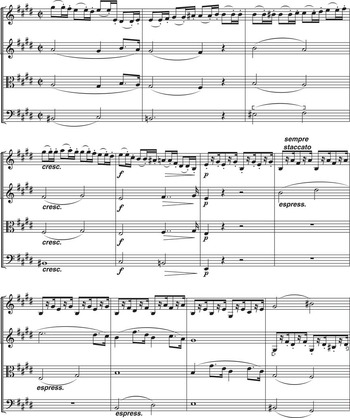
The crucial moment in my reading is the introduction of the dotted figure in bar 16. Although this moment is not much noticed in the literature about this quartet, the context of contemporary discourse allows us to see this measure, despite its quietness and unassuming quality, as one of the many revolutionary features of op. 59.Footnote 56 On the face of it, ‘all’ that happens is that after the first iteration of the chorale tune, it is repeated in varied form with a new accompaniment, which plays for a bar before the new version of the chorale tune enters. But several sets of related issues contribute to enriching and complexifying this juncture. The first set of issues involves the way the accompaniment figure draws what feels like disproportionate attention to itself. This is partly because it is presented quite naked, and partly because it is so different from the previous two phrases: rhythmically, it appears to be anticipated by the first violin's descant in bars. 9–16, but Beethoven goes to extraordinary lengths to show that the dotted-quaver–semiquaver figure of bar 16 is to be heard as new, not only by virtue of being arpeggiated rather than mostly stepwise, generally static rather than mobile, and ineluctably instrumental rather than vocal,Footnote 57 but also in being articulated with a very short initial quaver, unlike the descant figure which Beethoven has notated in such a way as to make sure the player holds the dotted quaver out for almost its entire length. It also insists on the  meter, in contrast to the alla breve-like movement of the chorale-like tune.
Beethoven, String Quartet op. 59, no. 2, mvt. ii, bars 11–21

The second set of complicating issues involves the contradiction between the way this figure asserts itself and its frankly accompanimental character. Although it is often noted that in classic quartet texture thematische Arbeit can expeditiously turn an ‘accompaniment’ into the principal motive, and vice versa,Footnote 58 this moment is not that, even though the dotted motive does get assimilated into the texture as the movement proceeds. Despite its striking lack of melodic content, it is also no mere harmonic filler; nor does it function, at least to begin with, simply as the atmospheric background to the chorale tune when it comes in a bar later. Rather, at least to my ears (and different performances can give somewhat different impressions here), it seems to exist in another dimension from the tune; it is as if an abstracted representation of ‘accompaniment’ has been emancipated from the normal obligations of that function, and has become, as it were, a character in its own right. Thirdly, as regards the practical group dynamics of the quartet, this figure is unusually powerful for an accompaniment. Unlike running quavers or semiquavers, whose precise speed can be adjusted slightly to meet the needs of the person playing the tune – even though in practice the tune of course also has to take account of a running accompaniment – this accompanimental figure completely rules the roost; it acts as a rigid timekeeper even as the tune in the second violin becomes more lyrical. The silence in the middle of each crotchet beat denies the other parts any warning that the tempo might be changing, so the semiquaver pickup is the only indication to those playing the long notes of when the next beat will arrive. And when the tune does begin to include dotted figures, the already-established rhythmic rigidity of the accompaniment figure means that the tune has to adjust to it. Finally, although this is classic ‘second fiddle’ material, it is played by the first violin.
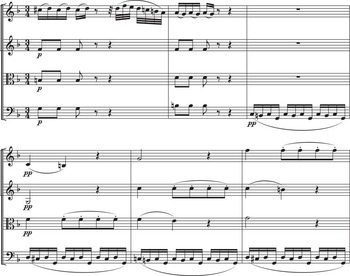
I would argue for ‘revolutionary’ as a description of this moment, because I cannot think of a precedent for it, despite a number of apparently similar moments or strategies in earlier works.Footnote 59 Because the dotted idea is accompanimental in character and also played by the first violin, it is not like the many places in quartets by all three classical masters where the second violin introduces new thematic material in order to allow the first violin to make the ‘definitive’ entry with the same material a little later. It is too minimal to be a countersubject despite the fact that the opening white-note cantus-firmus-like tune might invite such a thing.Footnote 60 It is also different, in an admittedly nebulous way, from the places in the slow movements of Haydn and Mozart quartets where an accompanimental figure with a faster surface rhythm than the main tune is introduced alone for a bar or two before its melody joins in. The closest analogue to this moment in the Mozart quartets is bar 26 of k465, where the cello has a whole bar of accompanimental semiquavers alone before the other lines come in; but the falling second at the beginning of this figure echoes the falling second semiquavers in the first violin immediately before this, and this figure not only makes room for, but – with its repeated top notes – also motivically anticipates, the new material in bar 27. It is not, in other words, a palpably separate phenomenon from what surrounds it.
Mozart, String Quartet k465, mvt. ii, bars 24–29

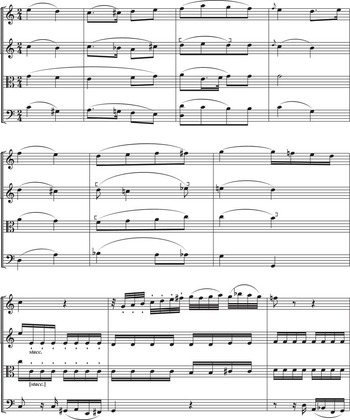
In a more general way, this Beethoven movement may be closest to two late Haydn slow movements from op. 76, no. 1 and no. 5. Both are based on hymn-like opening themes, though neither is quite as starkly Fuxian as Beethoven's. And both, like Beethoven's, move away from the hymnic to something more mobile and flexible. In op. 76, no. 1 the almost completely plain crotchet-and-quaver hymn tune is succeeded by a faster repeated-note accompanimental motive played by second violin and viola, while the cello introduces a newly sinuous motive, to which the first violin replies in thirty-second notes. (For the rest of the movement long passages of semiquaver and semidemiquaver motion alternate with the hymn tune, which is never rhythmically elaborated.) The first junction between hymn and dialogue is an obvious analogue to the introduction of the dotted figure in the Adagio of op. 59, no. 2, particularly in the jarring contrast between the slower-than-heartbeat pulse of the hymn and the faster-than-walking pace of the semiquavers.
Haydn, String Quartet op. 76, no. 1, mvt. ii, bars 9–18

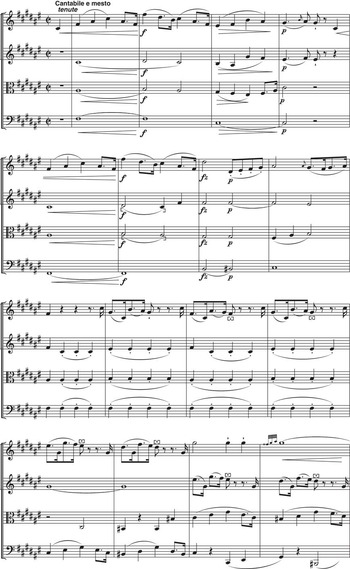
But when two, indeed, almost immediately three, lines introduce the new rhythmic regime, it has a very different effect than a solo voice, because by sheer force of numbers it defines ‘the new normal’ rather than being an interruption to a continuing norm. In addition, the Haydn example means something different when it introduces completely new material than it would if it ‘intruded’ into a version of already-heard melodic material. In the slow movement of op. 76, no. 5 the hymn-like tune is more rhythmically varied and galant from the beginning, but the homophonic accompaniment and the steady quarter-note pace of the main notes of the tune retain a hymn-like quality. After the first phrase, over another repeated-note accompaniment, the dotted figure becomes the primary thematic material, soon pervades the whole texture and, indeed, ends the movement.
Haydn, String Quartet op. 76, no. 5, mvt. ii, bars 1–13 and 18–21

The connection with op. 59, no. 2 is obviously the conjunction of the hymn-like tune with the dotted motive; equally obviously, in the Haydn the principal theme features this rhythmic idea both more prominently and in a way that more closely resembles the way the figure is used when it takes the stage, so it does not have the shocking effect that it does in the Beethoven.
In the context of the journal literature about quartets, what this moment in op. 59, no. 2 suggests to me is precisely the nexus of issues I have discussed at length above. Given the embeddedness of performance considerations in the discourse about string quartets, it is inconceivable that Beethoven did not have a concept of how this moment would literally play out. That is, even if he (as is highly probable) would not have laden the moment with the baggage I am giving it, it is plausible that he would have understood it as a moment in which quartet group dynamics and their larger implications were at issue. On the one hand, in the music itself, the intrusion of an independent ‘personality’, actively asserting his right to control the discourse from the striking position of an accompanimental motive, but being accommodated and eventually integrated into the texture and the thematic web of the movement invokes exactly the equalizing social activity among amateurs of different ranks described in Petiscus's ‘Ueber Quartettmusik’ (see above, p. 56). Elsewhere in his essay Petiscus describes both a conversational (turn-taking) texture, and, more importantly, a texture where all voices are simultaneously of equal interest, as the essence of the ‘true’ quartet:
It seems to us the essence of true quartet music that all four voices, by means of equal participation in the melodic foundation of the piece, unite into an indivisible whole. This happens in the double manner that on the one hand the main melodic ideas of the work (perhaps in different variants) are taken up and performed by the various voices – alterna amant CamoenaeFootnote 61 – and on the other hand, alternately with this, a polyphonic chorus in which all voices proceed melodically. Mainly it is the latter that determines the character of the true quartet.Footnote 62 (Italics mine.)
It is impossible to know what music Petiscus really had in mind, if any. But the model of all voices ‘proceeding melodically’ is relevant to this moment in the Beethoven because it so vividly suggests a kind of human diversity, multiple subjectivity and accommodation that offers a social model different from (and in practice additional to) conversation, and that is also implicit in Marx's ecstatic description of free, democratic interactions.
On the other hand, the actual humans making the music in this moment of op. 59, no. 2, retain the traditional power structure of the quartet. The new ‘personality’ is presented not by the second violin, which might map one aspect of the musical dynamics onto the human ones more neatly, but by the first violin, with the second carrying the version of the chorale tune that will eventually move the movement into the new key, but that at this moment has to calibrate the rhythm of the tune to this accompaniment. This is not a Haydnesque sight gag about who gets to play the tune;Footnote 63 the music (let alone its purported inspiration) is too elevated for that. Rather, the rich interface between the human and the musical meanings of this moment mirror – or better, construct – the complexity, messiness and potentially political import of the discourse about this ‘most interesting’ genre. In that connection one might note that these implications can easily be lost when our primary experience of the music is disembodied and purely aural. Finally, perhaps the very brevity and ‘insignificance’ of this moment, the apparently unforced and natural way in which it embodies both the heard experience of equality and the performed experience of control is the most serious, telling, and effective aspect of all; issues crucial not only to the definition of the ‘true’ quartet, but also to the nature of ideal social relations, are raised, embodied, experienced, and left to make their profound mark by indirection.