Political scientists long ignored the phenomenon of religion. We have tended to accept the secularization thesis without question and thus assumed that the influence of religion was in ineluctable decline. No need to study something that will not be around much longer. In addition, we tended to think of religion as something totally separate, and as something that should be kept totally separate, from politics. Religion is otherworldly. Politics is this worldly. The two spheres occupy different worlds, and there is no need for those who live in one world to study those who live in the other.
For several reasons, however, we are no longer able to ignore the impact of religion on politics. Most obviously, ‘Religion is the source of some of the most remarkable political mobilizations of our time’ (Jelen and Wilcox, Reference Jelen, Wilcox, Gerard Jelen and Wilcox2002: 1; see also Kalyvas, Reference Kalyvas, Kselman and Buttigieg2003). The Iranian revolution was the trigger that forced political scientists, and many others, to recognize the power of religion in politics (Lapidus, Reference Lapidus2002: 482ff), but the success of the Bharathya Janatha Party (BJP), the Hindu nationalist party, in India (Jaffrelot, Reference Jaffrelot1996) and the rise of the religious right in the United States also surprised most political scientists. Religious revivals are occurring in China and successor states of the Soviet Union (Casanova, Reference Casanova1994: 27). In the 1970s and 1980s, revivalist and reformist movements swept across the Muslim world in response to urbanization, the spread of literacy, and economic development, precisely the conditions in which secularization theory would lead us to expect a decline in religiosity (Hefner, Reference Hefner and Hefner2005). Fundamentalist movements from each of the major religious traditions have risen up in opposition to the secular world (Almond, Appleby, and Sivan, 2003: 2). Religious groups and movements perform political acts and make political statements that make headline news virtually every day. It is difficult to avoid the conclusion that traditional secularization theory is fundamentally mistaken, and that ‘What is needed is not a simple-minded theory of inevitable religious decline, but a theory to explain variation’ (Starke and Finke, Reference Starke and Finke2000: 33; see also Douglas, Reference Douglas, Douglas and Tipton1983).
Less obvious, but no less important, is that religion has continued to play important roles in the politics of Western Europe and North America. Political scientists studied labor and socialist parties because they were seen as the wave of the future. Until recently, we tended to ignore religious parties as relics of the past. Yet a review of the historical record shows that religious parties have been generally more successful than socialist parties (Kalyvas, Reference Kalyvas1996; Kselman and Buttigieg, Reference Kselman and Buttigieg2003). Moreover, religious identification continues to have a significant impact on voting behavior in the industrialized democracies, often greater than class identification (Lijphart, Reference Lijphart1979; Knutsen, Reference Knutsen2004). Interest in the religious right in the United States may appear to be a new phenomenon, but religious mobilization has long been central to American politics. The most notable and most overlooked example is the civil rights movement led by the Reverend Martin Luther King. Churches were the base from which the civil rights movement was built. Today, one can go to many cities in the United States and find many different religious groups, each running soup kitchens for the poor. Some are run by evangelical Protestants, close to the religious right, and others are run by black pastors in the tradition of Reverend King (Ryden and Polet, Reference Ryden and Polet2005).
Political science might be excused for not being prepared for the new religious movements, but religious politics has prospered in Western Europe and North America, right under our very noses, as it were, and yet has gone unstudied. When we compare religious parties with other mass parties, or when we compare voting on the basis of religious identification with voting based on other kinds of identification, we find that the theories that work for secular parties and secular voting also work for religious parties and religious voting. In fact, the concept of party identification, so central to the study of voting behavior, is best considered a social identity analogous to religious or ethnic identities (Greene, Reference Greene2004). The same can be said of religious violence: it is a type of ethnic violence. Religious violence has some distinctive characteristics but is also clearly recognizable as a member of the broader category of ethnic violence (for unfortunate reasons, India provides us with the best data on religious violence and thus many of the best studies: see, for example, Brass, Reference Brass2003; Varshney, Reference Varshney2002). The lesson is clear: religion and politics do not occupy two different worlds; both occupy the world in which all of us live.
Currently, the study of religion and politics is a growth industry in political science. The landmark study of Pippa Norris and Roanald Inglehart (2004) use the World Values Survey to draw a broad brush overview of religious belief and political values around the world. In this article, I follow in that tradition, but focus on Asia and use the 2005 and 2006 AsiaBarometer surveys. Asia is both important and understudied. If one wishes to study secularized societies, the two most prominent examples are Western Europe and East Asia. And if one wants to study religious societies, no region of the world is more appropriate than South Asia.
East Asia is defined here as the countries of China, Hong Kong, Taiwan, Singapore, Japan, and South Korea. Mongolia was not included in the 2006 AsiaBarometer Survey, but was in the 2005 survey and can thus be included in some analyses. East Asia might conveniently be labeled ‘Confucian’, and often is, but it is more clearly and less controversially called ‘the Chinese cultural sphere’. Chinese speakers form the majority in four of the countries. Japan, South Korea, and Mongolia have their own languages, but China greatly influenced each of these cultures throughout their respective histories. South Asia is defined as India, Pakistan, Bangladesh, Nepal, and Bhutan. South Asia thus might be called ‘the Indian cultural sphere’.
I first demonstrate the vast differences that separate East and South Asia with respect to religiosity. East Asia is near the secular extreme, whereas South Asia is at the religious extreme of the spectrum. Next, I examine spirituality and the demand for religious services in secular East Asia and find surprisingly high levels of both. Secularization need not mean a decline in the demand for religious services or a decline in spirituality. I then turn to an analysis of what explains variations in the levels of religiosity at the individual level and the consequences of religiosity for politically relevant political attitudes. I find that we do not understand very much about the causes of religiosity, nor does religiosity, however measured, explain much about the political attitudes of respondents. Surprisingly, religious people are not much different from secular people. This finding echoes similar findings from Western Europe. Finally, I discuss the implications of these findings for the broader study of religion and politics.
Secular East Asia and religious South Asia
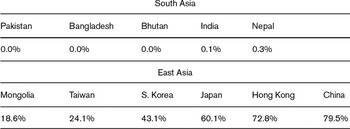
Oddbjorn Knutsen (Reference Knutsen2004) argues, correctly I believe, that the most reliable measure of social secularization is the percentage of the population who answer the question concerning religious affiliation with ‘none’. Jeffrey Cox further argues that, ‘One of the great stories of modern European history is the emergence of openly declared and publicly sanctioned irreligion and indifference’ (Cox, Reference Cox, McLeod and Ustorf2003: 204). We find a tremendous gap between South and East Asia when we compare the percentages of people who, when asked their religious affiliation, answer that they have none. In Table 1, the percentage of the population of South Asia who profess no religious identity is essentially zero. In East Asia, the percentage of people with no religious affiliation ranges from 18.6 per cent in Mongolia to over 70 per cent in China and Hong Kong.
The percentage of respondents who report no religious identification

Source: 2005 and 2006 AsiaBarometer Surveys.
In South Asia, a religious affiliation makes one normal, like everyone else. One's religious affiliation is simply part of one's identity, perhaps even a necessary part. The idea of having no religious affiliation is difficult to imagine. In broad strokes and ignoring the many possible exceptions, one can say that, in South Asia, religious identification is an ascriptive characteristic. One is born into a religion and the idea of either denying one's religious identity or changing through conversion to another religion is extremely controversial (see, for example, Schmalz, Reference Schmalz, Christopher Manuel, Reardon and Wilcox2006). In East Asia, as in Western Europe, however, identifying with a religion is much more of a voluntary decision, though one may, of course, be born into a religious community. Declaring any religious affiliation at all is a decision that involves a willingness to declare oneself different from the societal norm, thus displaying a significant degree of religious commitment. The options of either conversion to a different religion or abandoning religious belief altogether are omnipresent. Religious people may not be directly persecuted or discriminated against, but ‘In large areas of modern Europe, religious men and women who attempt to create new religious institutions or promote religious ideas run into a brick wall of resistance and indifference’ (Cox, Reference Cox, McLeod and Ustorf2003: 204). In Japan, I am sure, religious activists would recognize this ‘brick wall of resistance and indifference’ as part of their own experience. In several other countries in East Asia, one could add yet another brick wall of official animosity. We should expect, therefore, that being religious would have different meanings in such secularized social environments as opposed to environments permeated by religiosity.
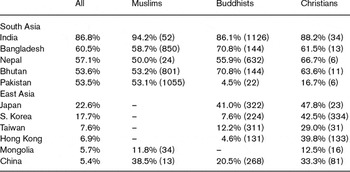
A second question that has proven reliable in eliciting levels of religiosity across cultures and religious traditions is, ‘How often do you pray or meditate?’ Again, we find a stark contrast between East and South Asia. In Table 2, we see that over one-half of South Asians answered that they pray daily. The percentage ranges from 53.5 per cent in Pakistan to 86.8 per cent in India, but never drops below one-half of the population. In East Asia, however, the percentage never rises above one-quarter for those who pray daily. In this category, Japan tops the list of East Asians with 22.6 per cent and South Korea comes in second with 17.7 per cent, but all the other East Asian countries fall below the 10 per cent mark. Conversely, the percentage of respondents who answered that they never pray or meditate (analysis not shown) never rises above 4 per cent in South Asia and never falls much below 25 per cent in East Asia. In China and Hong Kong, over two-thirds of the population say that they never pray or meditate.
Percentage of respondents who report praying daily

Source: 2005 and 2006 AsiaBarometer Surveys.
One obvious explanation for the differences between East and South Asia is the different religious traditions that predominate in each region. One might argue, for example, that South Asians seem more religious than East Asians because more South Asians are Muslim and Muslims are ‘required’ to pray five times a day. Yet the percentage of Muslims who claim to pray daily varies widely across countries. A high percentage of Indians pray daily, whether they are Muslim, Buddhist, Christian, or even Hindu, although in our sample, the latter group cannot be included in a cross-national comparison. Over one-half of Muslims in South Asia but much less than one-half of Muslims in East Asia pray daily. Country effects are evident and are often more powerful than the effect of religious tradition. If you want to predict whether someone prays daily, you are usually better to ask about where they live than which religion they profess. This finding is echoed in Pierre Brechon's conclusions on Western Europe: ‘while differences between Catholics and Protestants appear in the sample's average . . . a detailed analysis of the tables reveals that these differences almost always have more to do with the national context than with religious affiliation’ (Brechon, Reference Brechon, Halman and Riis2003: 138).
Table 2 contains only two clear exceptions to this generalization. In South Korea and Taiwan, Christians are much more likely to pray daily than are Buddhists. Do Christians pray more often than Buddhists? In South Korea and Taiwan, the answer is clearly affirmative, but we do not see the same pattern in other countries. Do Muslims pray more often than Buddhists? In India, Pakistan, and China, Muslims do, but in Bangladesh, Nepal, and Bhutan, it is the Buddhists who are more likely to pray every day. Obviously, we face a problem of complex interactions between the effects of national culture and religious tradition. To understand the religiosity of any particular group, it is important to understand both the national context and the religious tradition. In some sense, Muslims share a common religious heritage regardless of where they live. In other equally important senses, however, Indians, Chinese, or members of any other national culture share a common religious heritage whether they are Hindu, Muslim, Christian, or Buddhist.
For present purposes, however, the most important points are: (1) East Asia is a very secularized environment, whereas South Asia is a very religious environment, and (2) it makes some sense to analyze the phenomenon of religiosity in Asia separate from the religious traditions.
Religion in secular East Asia
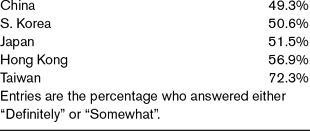
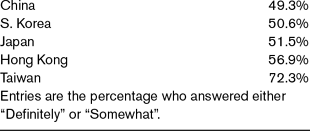
Using the standard measures of secularization, we find that the societies of East Asia are highly secularized. Traditional secularization theory, based on the experience of Western Europe (or at least the classic theorizing of European sociologists), would lead us to make conjectures that East Asians will have replaced ‘enchanted’ religious-style thinking with more modern, rational, and scientific modes of thought. That does not turn out to be, however, the case. We asked, ‘Do you believe in an unseen spiritual world that can influence events in the world we see around us?’ Though this question was designed to distinguish those with a clear affirmation of an ‘unscientific’ belief in spirits, as Table 3 shows, around one-half of our East Asian respondents answered in the affirmative, with the proportion rising to 70 per cent in Taiwan. These findings clearly show that high levels of secularization are compatible with relatively high levels of spirituality. In secular East Asia, over one-half of the population (nearly one-half in the case of China) believes in a spiritual world. Secularization can happen without the widespread adoption of the presumably ‘scientific’ beliefs of a world ruled by knowable natural laws and random chance.
Belief in an unseen spiritual world
Source: 2005 and 2006 AsiaBarometer Surveys.
This finding echoes those of Norris and Inglehart. They find, first, that ‘there is no direct correlation at the individual level between faith in science and religiosity’ (Norris and Inglehart, 2004: 64). At the societal level, they find that ‘publics in many Muslim societies see not apparent contradictions between believing that scientific advances hold great promise for human progress and that they have faith in common tenets of spiritual beliefs . . . Indeed, the more secular postindustrial societies . . . prove most skeptical toward the impact of science and technology’ (Norris and Inglehart, 2004: 67). Secularization does not necessarily reduce the belief in a spiritual world, and religiosity need not preclude a belief in science.
High levels of secularization are also compatible with high levels of consumption of religious services. For example, Jytte Klausen argues that in, Western Europe, ‘The consumption of essential religious services – baptisms, confirmations, weddings, and funerals – has been remarkably resistant to change’ (Klausen, Reference Klausen2005: 139). He points out that in Scandinavia, usually considered one of the most secularized regions in Europe, 61 per cent of Swedes and 43 per cent of Danes have church weddings and about 90 per cent of the population of both countries has a religious burial. In France, however, the process of secularization also produced a reduced role for religious ceremonies. Hugh McLeod notes that ‘between 1958 and 1990 the proportion of babies receiving Catholic baptism fell from 91 per cent to 51 per cent and the proportion of weddings with a Catholic ceremony fell from 79 per cent to 51 per cent. This reflected the emergence of a substantial section of the population rejecting any kind of Christian identity, however tenuous, whether they belonged to another faith or, more often, because they had no religion’ (McLeod, Reference McLeod, McLeod and Ustorf2003: 3).
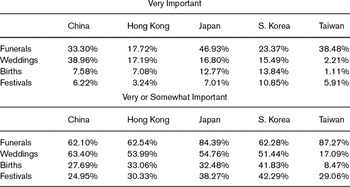
Is secular East Asia more like secular Scandinavia or secular France? We asked, ‘For each of the following events, please rate the importance of having a religious institution (such as mosque, church, temple, and shrine) or a religious professional (such as imam, priest, and monk) involved.’ Table 4 shows the results. Surprisingly, we found high levels of support for the participation of religious professionals and institutions.
The importance of religious services in East Asia

Source: 2005 and 2006 AsiaBarometer Surveys.
Over one-third of Chinese want a religious wedding and a religious funeral despite the low levels of belief. Over 60 per cent of Chinese find it at least somewhat important to have a religious ceremony for both occasions. Approximately 40 per cent of Japanese and Taiwanese agree on the importance of a religious funeral, but are less concerned with other ceremonies. Except for Taiwan, over one-half of East Asians find religion at least somewhat important for funerals and weddings and over one-quarter also want religious participation in ceremonies celebrating the birth of a child and in festivals. Taiwanese disagree with their counterparts in East Asia on the topics of weddings and births. Most of secular East Asia looks like secular Scandinavia: religious ceremonies retain their respective roles in both regions, even with high levels of secularization. Only Hong Kong looks more like France, with religion playing a less important role, even in the case of funerals.
Is East Asia secular? If we ask about religious identification or personal piety, the answer is definitely affirmative. If we ask about spirituality or the importance of religious ceremonies, however, we get more ambiguous results. Is Western Europe secular? If we use all four of these measures of secularity, we get clear results on some measures and ambiguous results on others. Secularization is clearly neither a unidimensional nor a unidirectional process, and the results of a process of secularization vary across countries and regions of the world.
The causes and consequences of religiosity
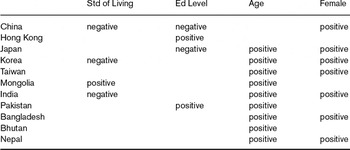
Why are some people more religious than others? I performed a simple logistic regression analysis on a dummy variable that takes the value of ‘1’ when the respondent indicates that she prays daily and ‘0’ when she does not. The independent variables include four socioeconomic characteristics: standard of living (self-reported), level of education, age, and gender. The first, and most important, finding is that the variance explained by these regressions is small, seldom reaching 10 per cent. Socioeconomic characteristics do not reliably explain religiosity. It is, nevertheless, worth the effort to examine the significant correlations that do exist, remembering that all of the relationships are weak. Table 5 summarizes the relationships that meet the conventional 0.05 level of significance.
The demographic determinants of daily prayer

Source: 2005 and 2006 AsiaBarometer Surveys.
We see first that women and older people tend to be more religious. This is a common finding, but there are exceptions to both generalizations. We find no consistent relationship between standard of living or level of education and praying daily. Not only do we find a significant relationship in less than one-half of the countries analyzed, the direction varies by country. In Mongolia, it is people with higher standards of living who are more likely to pray daily. In China and Japan, the less educated are more likely to pray every day, but in Hong Kong and Pakistan, it is the better educated who are more religious.
Are religious people different from secular people? We tend to assume that there are many clear and obvious contrasts but, in truth, we find few consistent differences. The AsiaBarometer contains many questions, the answers to which might be expected to differ between religious and secular respondents. I analyzed over 30 of these variables and found that religiosity, whether measured by frequency of prayer, religious identification, or spirituality, seldom has a statistically significant effect on any of them. Even the importance attached to religious services is not reliably explained by levels of religiosity, however measured. I did find one partial exception, albeit a theoretically important one.
Norris and Inglehart argue that ‘One of the most central injunctions of virtually all traditional religions is to strengthen the family, to encourage people to have children, to encourage women to stay home and raise children, and to forbid abortion, divorce, or anything that interferes with high rates of reproduction’ (Norris and Inglehart, 2004: 23). We should, therefore, expect to find that religious people are opposed to abortion and homosexuality. I was encouraged when I found that, in secular East Asia at least, a regression explaining opposition to homosexuality did, indeed, explain more variance than any of the other analyses. However, the relationship between religiosity and opposition to homosexuality is neither clear nor consistent. I did find that, as predicted by Norris and Ingelhart, those respondents with a religious identification are more likely to oppose homosexuality, but the relationship is strong only in Hong Kong and Japan, and is absent elsewhere. The relationship with daily prayer is also significant in only two countries. In Hong Kong, those who pray daily are more likely to oppose homosexuality, whereas in Taiwan they are less likely to do so. The most consistent finding is that those respondents who believe in a spiritual world are less likely to oppose homosexuality. Are religious people more likely than secular people to oppose homosexuality? It depends on the national culture and how religiosity is measured. In East Asia, there is no consistent relationship between religiosity and attitudes toward homosexuality.
In addition, I found no support at all for the hypothesis that religious people in secular East Asia are more likely to oppose abortion. This finding, however, does not necessarily refute the Norris and Inglehart hypothesis because, in East Asia, abortion is a traditional family value. In a Chinese-style family system, having too many daughters leads directly to financial ruin. In order to protect the family, the practice of ‘culling’ excess children developed. This practice was considered perfectly natural: ‘the culling of humans, like that of rice seedlings, is so much in keeping with natural processes that it is all but necessitated’ (LaFleur, Reference LaFleur1992: 100; see also Norgren, Reference Norgren2001). The East Asian cultural context is thus so different from that of Western Europe that one should not expect the same factors to determine attitudes toward abortion.
In sum, the message of these analyses, when combined with many other analyses, including analyses of other data sets by other researchers, is clear: we do not understand the causes of individual variation in religiosity and we do not understand how religious people systematically differ from secular people. Much work remains to be done.
Discussion
To recap my major findings: First, South Asia is a very religious region, whereas East Asia is an extremely secularized region of the world. This generalization holds with respect to the proportion of the population who claim a religious identity and the proportion that pray daily. Second, however, there are clearly many ways for a society to be either religious or secular. The highly secular societies of East Asia still have relatively high levels of spirituality and a strong demand for religious ceremonies. Third, we find that women are more likely to be religious than men and that religiosity tends to be correlated with age.
The primary findings, however, are that levels of religiosity cannot be explained very well by socioeconomic characteristics and that levels of religiosity predict very little about other attitudes. What kinds of people are religious? It turns out that, on average, religious people do not differ much from secular people. If one cannot find many differences between religious and secular individuals in secular East Asia, where being religious involves a choice to set oneself apart from the norm, there is little reason to expect that we will ever find any major differences anywhere. Moreover, clear and robust relationships between religiosity and any other characteristic or attitude are rare (Halman and Riis, 2003; Carlson and Listhaug, Reference Carlson and Listhaug2006). These ‘non-findings’ are both common and deeply surprising. When ‘normality’ is surprising, it is time to stop and re-think our fundamental concepts and framing of the problem.
When we view religion through the lens of the mass media, religious people appear strikingly different from non-religious people and people from different religious traditions are strikingly different from one another. Though reporting varies widely by country, one common theme in the western media since September 11 is that Muslims are all potential terrorists and suicide bombers. The mass media is not in the business of collecting scientifically reliable data. It is in the business of attracting readers, listeners, and viewers. The mass media reports on things that interest large numbers of people and the idea that religious people are much like everyone else does not fit this approach. Stories of religious people doing things most people would find difficult or unimaginable sell newspapers. Stories of religious people acting just like everyone else are not newsworthy. Information provided by the mass media, therefore, suffer from serious selection biases.
When we view religion through the lens of academic case studies, religious people and institutions also look fairly different from secular people and institutions. Here again, however, there is a selection bias in the religious institutions and people chosen for study. Academics may not be interested in the same topics as the average newspaper reader or television viewer, but scholars are equally uninterested in religious people and institutions that do not deviate from the norm. Political scientists are particularly interested in extreme religious groups (see, for example, Almond, Appleby, and Sivan, 2003). Until recently, political scientists accepted the idea that secularization would soon reduce religion to insignificance and, therefore, did not study the subject. Interest was renewed only when religious groups found their way onto the front pages of newspapers, as we tend to study the groups that make headlines, reproducing, to a large degree, the selection bias of the mass media.
Based on these atypical cases, then, we formulate hypotheses that make perfect sense and then conduct surveys to demonstrate the accuracy of those predictions only to find no or, at best, tepid support for those hypotheses. When viewed through the lens of scientifically collected survey data that includes several countries and several regions of the world, religious people and religious groups do not look much different from secular people and secular groups. The lens of survey research thus shows us a picture that looks completely different from pictures seen through the lens of the mass media or academic case studies. The reason for this divergence, I believe, lies in the internal diversity of the categories being analyzed.
Are Christians different from Muslims? By Christian do we mean Catholics or Protestants? By Protestant, do we mean liberal, conservative, or evangelical Protestants? Are we thinking of Englishmen who belong to the Anglican Church or evangelical Southern Baptists in the United States? By Catholics are we referring to practicing or non-practicing Catholics? In Western Europe, the distinction between practicing and non-practicing often makes more difference than the difference between Catholics and Protestants (Brechon, Reference Brechon, Halman and Riis2003: 119). Are Protestants different from Catholics? If we were in Belfast, Northern Ireland, the distinction would be extremely important and instantly recognized by all who live there. If, however, we lump all Protestants across Europe together in one group and all Catholics in another, then we find few significant differences regardless of where we look (Halman and Riis, 2003).
Reading the newspapers makes the category of ‘Muslim’ seem like a particularly meaningful category of people, but Muslims also vary widely among themselves. In Western Europe, Muslims have not been able to organize effectively because most Muslims are also immigrants who remain deeply divided by country of origin. Muslim immigrants from the same country also often have trouble acting together because they bring conflicts from the home country to their new homes. Many now argue that the decentralized structure of Islam may preclude the effective political mobilization of Muslims in democratic politics (Pfaff and Gill, Reference Pfaff and Gill2006; Warner and Wenner, Reference Warner and Wenner2006). Nevertheless, in response to the Western European governments’ tendency to lump all Muslims together as a single ‘problem’, ‘a new collectivity of Dutch, Danish, or French Muslims is being forged from what were previously identified as ethnic groups of various national origins’ (Klausen, Reference Klausen2005: 75). In Western Europe, a common Muslim identity did not exist until non-Muslims began treating Muslims as if they were all the same. Currently, that Muslim identity is still under construction. Muslims living in Western Europe may develop a set of common political attitudes, but whatever commonalities develop will be the result of experiences shared after emigrating to Europe, not the result of common religious beliefs or a common Muslim cultural heritage.
In any given neighborhood, and therefore in most people's personal experience, people from different faiths may well form meaningful social and political categories and religious people may well differ from secular people in socially and politically significant ways. Based on their own experience, therefore, any given individual tends to have a perfectly clear idea of how the religious differs from the secular. Yet when we aggregate ‘religious people’, no matter how defined, across many neighborhoods, and especially when our data cross national and regional boundaries, the homogeneity of the category disappears. The characteristics that distinguish the religious from the secular vary by neighborhood, by regions within nations, and most clearly across nations. Distinctions that seem clear in any given neighborhood thus melt away in larger samples. The political relevance of religiosity depends on the social and political context of the locality in which it is studied. We should not expect to find many generalizations that hold up across national and regional boundaries.