Introduction
The Hell Gap National Historic Landmark (Goshen County, Wyoming, USA) contains four post-Clovis Paleoindian period archaeological localities. At least two Paleoindian components occur in a stratified sequence at each locality. The sequence is most complete at Locality 1, where the original investigators identified nine components containing classic Paleoindian diagnostic artifacts (Irwin-Williams et al., Reference Irwin-Williams, Irwin, Agogino and Haynes1973). The Locality 1 Paleoindian sequence contains a greater diversity of superimposed Paleoindian projectile point styles than any other site in North America. Accordingly, this stratified sequence has served for a half a century as a basis for understanding Great Plains and Rocky Mountain Paleoindian chronology and, to some extent, American Paleoindian chronology in general (Kornfeld and Larson, Reference Bradley2009). Primarily, this understanding is based on relative temporal sequencing of projectile point types based on stratigraphic superposition. The results of the 1960s investigation of Locality 1 showed that Goshen points preceded Folsom points, which preceded Midland points, and so on. Recent field investigations largely support the Irwin-Williams et al. (Reference Irwin-Williams, Irwin, Agogino and Haynes1973) interpretation of the Locality 1 chronology.
Although Locality 1 has been informative of the relative temporal sequence of diagnostic Paleoindian projectile points, it has been difficult to consistently assign each component radiometric ages. Locality 1 has a stratified sequence of cultural components and a large number of radiocarbon dates, but the relationship between the two is presently unclear. Hence, there exists the potential to selectively choose radiocarbon assays from the Locality 1 sequence that best fit one’s research objectives or based on pre-existing notions regarding component ages. Our study resolves this problem by providing standardized age estimates for the Locality 1 components.
In the process, we develop a simple method for correcting the vertical positions of radiocarbon assays from different places of sloping and undulating strata for incorporation into chronostratigraphic models. Assigning ages to horizontally expansive, open sites with complicated stratigraphic sequences is sometimes problematic because sediments of comparable age can be at different elevations due to topographic variation of buried surfaces across the site. Our method corrects for age-depth inconsistencies due to sloping and undulating strata and then uses the Bayesian age-depth modeling procedures in Bchron (Haslett and Parnell, Reference Haslett and Parnell2008) to construct a chronostratigraphic model. Our method may be of use to archaeologists or other Quaternary scientists struggling to assign age estimates to stratigraphically complicated sites or sites in which radiometric age estimates are imprecise and/or conflicting.
This study begins with a detailed description of the methods we used to construct our chronostratigraphic model and identify the stratigraphic locations of cultural components for the Hell Gap site. We then use our chronostratigraphic model to estimate the ages of 11 identified components and build an occupational chronology for Locality 1. The study continues with a discussion of how our chronology furthers studies of American Paleoindian chronology. We conclude by summarizing our findings, describing future data needs, and explaining the larger significance of our study, which establishes a novel chronometric method for use in stratified open sites.
METHODS
This study’s primary methodological contribution is developing a simple procedure for correcting age-depth relationships from stratified open sites with sloping and undulating buried strata. Sloping strata can cause problems when comparing radiocarbon assays from across a site on the basis of elevation alone. Samples of comparable age from different locations of the same sloping surface may differ greatly in elevation. For example, at Hell Gap the transition between strata E and F is around 1 m lower in elevation on the east side of Locality 1 than the west side, even though it is comparably aged because the Locality 1 strata slope toward the east. Moreover, strata often undulate in thickness between different areas of horizontally extensive sites. For example, substratum E1 at Hell Gap varies between 14 and 55 cm thick through Locality 1. Our method assumes that a date’s relative position within a stratum is more accurate than its absolute depth below the top of that stratum. Thus, for example, a date located 10 cm below the top of a 20-cm-thick portion of a stratum is relatively equivalent to 5 cm below the top of a 10-cm-thick portion of that same stratum.
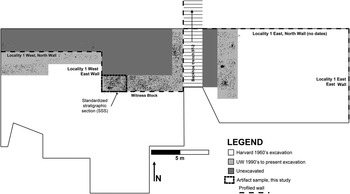
Because of sloping and undulating strata at Hell Gap, site datum elevations do not accurately reflect the age-depth relationships between dates from one end of the site to the other. To account for sloping and undulating strata, we developed a simple age-depth correction procedure that expresses all date elevations relative to their stratigraphic positions and standardizes them to a standard stratigraphic section (herein referred to as SSS; Fig. 1) using a simple formula:
 $${\rm Z}_{{{\rm st}}} {\equals}\,{\rm Th}_{{\rm t}} \left( {{{{\rm D}_{{\rm s}} } \over {{\rm Th}_{{\rm s}} }}} \right){\plus}{\rm D}_{{\rm t}} $$
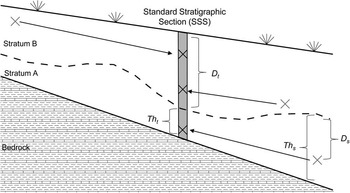
Where Zst is the standardized elevation of a radiocarbon date below ground surface, D s is a date’s depth (cm) below the stratum in which it is plotted, Th s is the thickness (cm) of that stratum from its top to bottom bisecting a date, Th t is the thickness of that stratum where it is present at SSS, and D t is the depth below ground surface of that stratum at SSS. Our age-depth correction procedure is depicted graphically in Figure 2.
Plan map of Hell Gap Locality 1. Small black dots are piece-plotted artifact locations recorded by the University of Wyoming (UW) during recent investigations. The UW Witness Block excavations contain the entire stratigraphic sequence present at Locality 1, while those UW excavations to the west and east of the Witness Block contained only the lower-most deposits left by Harvard after their 1960s investigations.

Schematic profile summarizing the age-depth correction procedure used during this analysis.

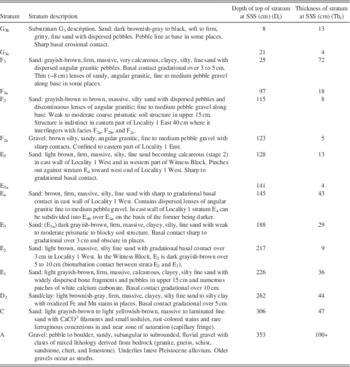
We determined Zst for Hell Gap by digitally scanning and measuring stratigraphic illustrations of Locality 1 and backhoe trench 97-2 presented by Haynes (Reference Haynes2009a). We established SSS near the southwest corner of the Locality 1 witness block (Figure 1), from which we determined Th t and D t for each stratum (Table 1). We chose this location because it is located near the center of Locality 1 and contains most of the strata identified for the Locality. Ground surface (Zst=0) is located at a datum grid elevation of 99.62 m at SSS.
Summary of strata located at the standard stratigraphic section (SSS) used in this study located near the southwest corner of the Hell Gap Locality 1 Witness Block. Stratigraphic descriptions from Haynes (Reference Haynes2009d).

Haynes (Reference Haynes2009a) plotted 36 radiocarbon assays on the Hell Gap Locality 1 stratigraphic illustrations (Supplementary Table 1). Radiocarbon assays were determined on a mix of charcoal, organic residue, and humates taken from the exposed Locality 1 profiles and mapped in place. We did not vet dates on the basis of preexisting conceptions regarding the accuracy of charcoal versus humate dates. Both materials have their respective problems in dating target events. Rather than imposing an additional prior assumption on our model, we chose to let the Bayesian procedures inherent to Bchron find the best solution for all dates (see below).
We determined Th s and D s for each radiocarbon date by measuring spatial relationships between each plotted date and the stratum in which it is located. Nine dates are plotted in strata not present at SSS and we dealt with assigning Zst to these dates on a case-by-case basis with the goal of best approximating their elevations relative to other dates. For example, substratum F1 is not present at SSS, so we placed a single date from F1 at the bottom of substratum F2a because F1 is stratigraphically between F2a and E5. Explanations of each of these cases are provided in the comment field of Supplementary Table 1.
After correcting for age-depth relationships, we processed the dates with the statistical computing program R version 3.0.2 using the age-depth model Bchron version 4.1.1 (Haslett and Parnell, Reference Haslett and Parnell2008; Parnell et al., Reference Parnell, Haslett, Allen, Buck and Huntley2008; R Core Team, Reference Core Team2013). Bchron calibrates all radiocarbon determinations as part of its age-depth modeling procedure, and we used the Intcal13 calibration curve (Reimer et al., Reference Reimer, Bard, Bayliss, Beck, Blackwell, Bronk Ramsey and Buck2013). Parnell et al. (Reference Parnell, Haslett, Allen, Buck and Huntley2008) provide an explanation of Bchron’s functionality and explain distinctions between Bchron and other age-depth modeling programs, so we will not systematically compare the methods here. In short, Bchron uses Monte Carlo methods to create a large number of randomly generated linear interpolations between dates based on the locations of calibrated radiocarbon probability regions and then builds confidence intervals around these many thousands of possible age-depth relationships to produce age estimates. Bchron uses a Bayesian approach to analysis that draws from a combination of prior distributions, which collectively assume only that younger things are located stratigraphically equal to or higher than older things, thus approximating typical sedimentary depositional processes. As a result, Bchron easily and accurately deals well with complicated sedimentary records with frequent shifts in depositional rate, such as the sedimentary record present at Hell Gap and many stratified open sites in general. Perhaps the greatest of Bchron’s strengths are its simplicity and replicability. There are few decisions to be made in Bchron, so there is little room for subjectively biasing chronostratigraphic relationships by imposing unnecessary prior assumptions into the model. Thus, other researchers can easily replicate this model from the data we provide in Tables 1 and 2.
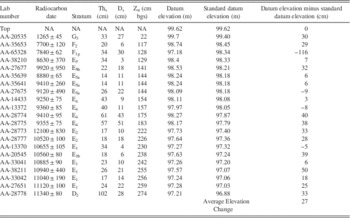
Radiocarbon determinations included in the final chronostratigraphic model, the variables used to standardize their elevations, and the differences between their datum elevations and corrected datum elevations based on our age-depth correction procedure. Ths, Stratum thickness at date (cm); Ds, Depth of date below top of stratum (cm); Zst, Standardized elevation (cm below ground surface [bgs]).

After running an initial model, we performed the “outlier” function provided with the Bchron package. As Parnell et al. (Reference Parnell, Haslett, Allen, Buck and Huntley2008, p. 1875) recognize, most stratigraphic records “very typically contain outliers” and any program designed to interpolate ages between dates should have a means of identifying them. Since Bchron uses a Monte Carlo method that combines many thousands of possible model solutions, the Bchron outlier probability value is simply the percentage of times a date randomly fails to be incorporated into the age-depth relationship. For instance, if random linear interpolation misses a given date during 80% of model runs, its outlier probability is equal to 0.80. Following statistical convention, we included only those dates with less than a 5% probability of being a chronostratigraphic outlier, which means that there is a 95% probability that included dates are accurate reflections of the Hell Gap age-depth relationship. Omission of model outliers reduced our date sample from 36 to 21 (58% of total dates). One problem that emerged from this procedure is that greatly conflicting radiocarbon assays from the lowest (oldest) deposits made it so that all dates from stratum C were omitted from the analysis. While this is unfortunate, it is telling of a problem that needs to be addressed by future research at the site. The radiocarbon dates used for the final model are listed in Table 2 and outlier probabilities associated with omitted dates are listed in the comment field of Supplementary Table 1.
After finalizing the model, we converted each of the 21 finalized dates’ standardized positions back to the site datum elevation (m) by subtracting Zst from 99.62 m (the elevation of ground surface at SSS; Table 2). We then subtracted each date’s standardized datum elevation from its actual datum elevation (in cm) as a means of expressing the amount that each date’s elevation changed as a result of our age-depth correction procedure. Our correction procedure changed date depths by as much as 116 cm, or around 42% of the 275 cm spanned by Zst elevation values in the finalized model. On average, our correction procedure changed date depth by 27 cm, or around 10% of Zst values in the finalized model. In other words, our age-depth correction procedure was crucial for producing an accurate chronostratigraphic model of the Hell Gap site.
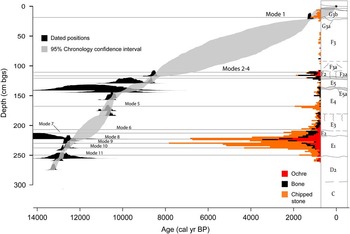
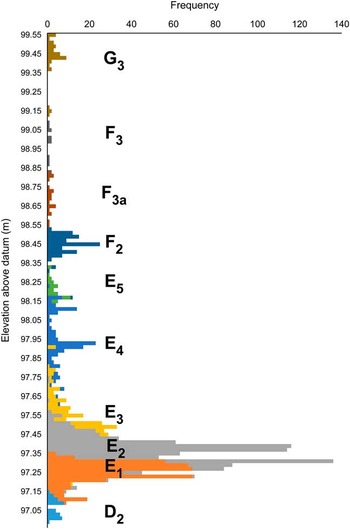
Assigning Hell Gap artifacts to specific components has been persistently difficult because occupations are spaced closely in stratigraphic space, which has resulted in artifacts vertically dispersing between occupations, and has created a more or less continuous distribution of artifacts in the stratigraphic column (Fig. 3). We were nonetheless able to identify the most likely stratigraphic positions of cultural components by using several lines of evidence. First, we defined component positions to the nearest cm by visually identifying modes in the elevations of piece-plotted lithic, bone, and ocher frequency in a 1.5 x 1.5 m block excavated by the University of Wyoming (UW) through the southwest corner of the Locality 1 Witness Wall adjacent to SSS, thus making our artifact sample directly related to SSS (Fig. 1). Like radiocarbon determinations, Locality 1 artifacts are also distributed on sloping surfaces, and by using only a small, dense sample of artifacts we were able to largely control for this effect to precisely define component elevations. We did not include plotted pieces of charcoal in our artifact frequency counts for two reasons. First, charcoal may potentially be of natural origin, and, thus, an inaccurate means of establishing cultural components. We did not want to identify accumulations of charcoal that may represent natural wildfires as cultural components. Second, charcoal has a much greater potential than bone, ocher, or chipped stone to fragment into many small pieces, which would serve to over-represent artifact counts and potentially overwhelm our modal analysis.
(color online) A graphical summary of the chronostratigraphic model created for this study. Age-depth plot created using Bchron version 4.1.1. Artifact frequencies are binned in 2 cm intervals. Stratigraphic profile is redrawn from the standard stratigraphic section used to construct the model.

The Locality 1 artifact distributions appear to behave in a manner expected of the “dissipation stage” of “symmetrical local mixing” of multiple occupations (Surovell et al., Reference Surovell, Waguespack, Mayer, Kornfeld and Frison2005; Brantingham et al., Reference Brantingham, Surovell and Waguespack2007, p. 535). Despite being mixed to some extent, modes in artifact frequency should still accurately depict the stratigraphic locations of individual occupations or periods of intensified site use in the continuous distribution of artifacts. Dissipation causes artifacts to disperse up and down from occupation surfaces in a more or less symmetrical fashion, which forms a classically Gaussian (or “normal”) distribution of artifact frequencies above and below a given occupation surface. At Hell Gap, symmetrical local mixing has caused artifacts from multiple occupations to vertically disperse into one another. Although all Locality 1 artifacts have likely been subjected to post-depositional mixing, red ocher most obviously exhibits the pattern expected of symmetrical local mixing, owing to its distinctiveness in an assemblage dominated by chipped stone and bone (Fig. 3).
Despite the difficulty symmetrical local mixing poses toward isolating artifacts from individual cultural components, it should not impact one’s ability to identify occupation surfaces or periods of intensified site use because stratigraphic modes in artifact frequency should still represent places of intensified artifact discard. Thus, we view artifact frequency modes as a suitable means of identifying the stratigraphic locations and of cultural components. Once we defined artifact frequency modes, we estimated mode ages by using the “predictAges” function in the Bchron package, including the range, first and third quartiles, mean, and median age estimates. We defined each age estimate with 1 cm vertical precision.
Once we defined component elevations, we were faced with assigning each an associated cultural complex (i.e., projectile point types). To do so, we first compared descriptions of the stratigraphic positioning of the Locality 1 components in Irwin et al. (1973) and Haynes (Reference Haynes2009b) to our component locations by strata (Fig. 4). We were also able to trace our artifact modes in backplots to other excavated portions of Locality 1 where recent excavations have recovered diagnostic artifacts in situ to confirm our cultural designations. Finally, two Folsom preforms were recovered directly from our sample of artifacts, which provided a valuable baseline for orienting the stratigraphic locations of cultural components.
(color online) The relationship between artifact frequency and stratigraphic position for the sample of artifacts used in this study, binned in 2 cm intervals. This distribution includes all mapped items coded as located in a definite stratum, including charcoal. Artifacts coded as located at strata transitions (e.g., “E1/E2 transition”) are not included. Several “out of place” artifacts are due to field coding errors.

RESULTS
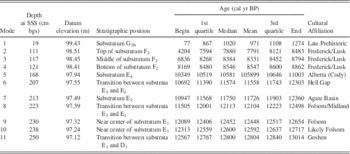
We identified 11 artifact frequency modes from our sample of artifacts at the Witness Block of Hell Gap Locality 1 (Fig. 3; Table 3). We numbered each mode from 1 through 11 sequentially from the top to the bottom of the deposits. All depth estimates are below ground surface (bgs) and stratigraphic associations are derived from SSS. All age range estimates discussed in the following section refer to the first and third quartiles and all “most likely” ages refer to median age estimates in calibrated years BP. All ages are rounded to the nearest decade from the actual age estimates presented in Table 3. Irwin-Williams et al. (Reference Irwin-Williams, Irwin, Agogino and Haynes1973) identified all cultural complexes at Locality 1 and we use their cultural sequence terminology.
Summary of prehistoric components defined for Hell Gap Locality 1.

Mode 1, 19 cm bgs, is associated with the near-surface archaeological deposits at Locality 1 within substratum G3. The mode consists only of chipped stone artifacts. Mode 1 dates from between 1110 and 870 cal yr BP, with a most likely age of ca. 1020 cal yr BP (Table 3). The G3 stratum artifacts were identified by Irwin-Williams et al. (Reference Irwin-Williams, Irwin, Agogino and Haynes1973) as Sudbury (nearest surface) or Patten Creek type diagnostics. Today we correlate Sudbury with the Late Prehistoric period and Patten Creek broadly with the Archaic (Kornfeld et al., Reference Kornfeld, Frison and Larson2010)
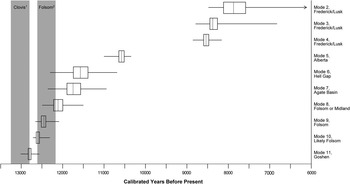
Modes 2 through 4 represent a 12-cm-thick diffuse archaeological deposit between 109 and 121 cm bgs. Each mode consists predominantly of bone, but modes 2 and 3 also each contain ocher and one chipped stone artifact. Modes 2 through 4 are at 111, 117, and 121 cm bgs, respectively. All three are located in substratum F2. These modes either represent the same, vertically dispersed component or multiple components vertically separated by minimal sedimentation. Mode 2 dates from between 8120 and 7590 cal yr BP, with a most likely age of ca. 7880 cal yr BP. Mode 3 dates from between 8450 and 8270 cal yr BP, with a most likely age of ca. 8380 cal yr BP. Mode 4 dates from between 8600 and 8480 cal yr BP, with a most likely age of ca. 8550 cal yr BP (Table 3; Fig. 5). Considering their stratigraphic positions, the modes most likely represent the Frederick/Lusk components at Locality 1. Potentially, two of the modes correspond with the Upper and Lower Frederick components identified by Irwin-Williams et al. (Reference Irwin-Williams, Irwin, Agogino and Haynes1973; cf. Byrnes, Reference Byrnes2003 regarding an evaluation of the Upper and Lower Frederick components).
Age estimates for the Paleoindian occupations at Locality 1. Vertical lines depict median age estimates, boxes depict the first and third quartiles, and whiskers depict the total range of age estimates for each occupation. 1From Waters and Stafford (Reference Waters and Stafford2007), 2From Surovell et al. (Reference Surovell, Boyd, Haynes and Hodgins2016)

Mode 5 is the best defined archaeological component in this portion of Locality 1. The mode is located 168 cm bgs near the center of substratum E4 and consists only of chipped stone artifacts. Because artifacts are so uniformly distributed above and below Mode 5, it may represent a single occupation event. Mode 5 dates to between 10,650 and 10,520 cal yr BP, with a most likely age of ca. 10,580 cal yr BP (Table 3; Fig. 5). Mode 5 most likely represents the Alberta complex since its stratigraphic position corresponds to Haynes’ (Reference Haynes2009b) description and the vertically well-defined nature of Mode 5 matches Irwin-Williams and colleagues’ (1973, p. 45) description of the Alberta component having a “very restricted vertical distribution.” Moreover, Mode 5 is located stratigraphically just below a Scottsbluff projectile point noted in BHT 97-2 by Haynes (Reference Haynes2009a) that represents the stratigraphic location of the Eden/Scottsbluff component.
Mode 6 is a diffuse artifact distribution at 207 cm bgs, near the center of substratum E3. It consists of chipped stone with small amounts of ocher and bone. Mode 6 dates to between 11,740 and 10,390 cal yr BP, with a most likely age of ca. 11,570 cal yr BP (Table 3; Fig. 5). Mode 6 is not a prominent mode in the frequency data, but most likely represents the Hell Gap complex. Irwin-Williams et al. (Reference Irwin-Williams, Irwin, Agogino and Haynes1973, p. 44) note that the Hell Gap component at Locality 1 is a thick “diffuse zone,” and our Hell Gap mode may be comparably characterized as diffuse. Moreover, recent excavations recovered a Hell Gap point from around three meters west of our artifact sample, and this artifact can be traced in backplot to Mode 6.
Mode 7 is also a diffuse artifact distribution located 213 cm bgs at the transition between substrata E3 and E2. The mode consists of chipped stone and small amounts of ocher and bone. Mode 7 dates from between 11,900 and 11,570 cal yr BP, with a most likely age of ca. 11,750 cal yr BP (Table 3; Fig. 5). Mode 7 most likely represents the Agate Basin complex. Given the location of the Folsom complex (see below), this mode agrees with Irwin-Williams et al.’s (1973, p. 44) description of the Agate Basin component being “separated from the earlier occupations by only a slight vertical distance.” Moreover, recent excavation have recovered two Agate Basin points from around 10 m east of our artifact sample located in the same stratigraphic position as mode 7.
Modes 8 through 11 are the densest archaeological components in our artifact sample. Beginning at around 220 cm bgs and continuing into sterile deposits at around 260 m bgs, there exists a dense, continuous accumulation of artifacts that likely represents many sequential occupations that occurred in the middle of the Younger Dryas cold event (ca. 12,900 to 11,600 cal yr BP; Fig. 3). Despite artifacts having been continuously deposited through these 40 cm, we were able to identify four distinct modes within the larger artifact frequency distribution, and in the following provide details on each one.
Mode 8 is located 223 cm bgs near the center of substratum E2. It is comprised of a large amount of chipped stone, a small amount of bone, and the largest amount of ocher in this sample. Mode 8 dates from between 12,220 and 12,000 cal yr BP, with a most likely age of ca. 12,110 cal yr BP (Table 3; Fig. 5). Based on the presence of two fluted preforms recovered during the 2015 excavations, this artifact mode is securely affiliated with the Folsom cultural complex. Alternatively, artifact Mode 8 may be part of the small Midland component that Irwin-Williams et al. (Reference Irwin-Williams, Irwin, Agogino and Haynes1973, p. 44) identified at Locality 1, which was found “very slightly above” their Folsom component. Since Irwin-Williams et al. (Reference Irwin-Williams, Irwin, Agogino and Haynes1973) published their initial interpretations of the Hell Gap site, it has become apparent that Folsom and Midland points often occur in the same archaeological assemblages and are more or less contemporaneous (Hofman et al., Reference Hofman, Amick and Rose1990; Meltzer et al., Reference Meltzer, Seebach and Byerly2006; Jennings, Reference Jennings2016; Pelton et al., Reference Pelton, Boyd, Rockwell and Newton2016). Indeed, Bradley (Reference Bradley2009) identified a Folsom point in the Midland complex assemblage from Irwin et al.’s (1973) investigations. Continuing work at Locality 1 may resolve this matter, but for now we ascribe a Folsom/Midland designation to Mode 8.
Mode 9 is the densest mode identified in this study. It is comprised of a large amount of chipped stone and ocher and a small amount of bone. It is located 230 cm bgs at the transition between substrata E1 and E2. Mode 9 dates from between 12,520 and 12,410 cal yr BP, with a most likely age of ca. 12,450 cal yr BP (Table 3; Fig. 5). It is almost certainly a Folsom component, and this age estimate is comparable to a newly submitted bone date “from the Folsom component of Locality 1 at Hell Gap” by Surovell et al. (Reference Surovell, Boyd, Haynes and Hodgins2016, p. 3).
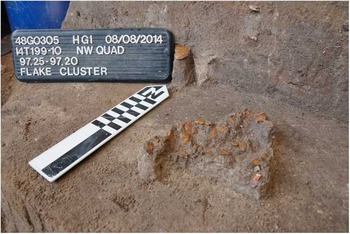
Mode 10 is not as well-defined as modes 8 and 9, but it is distinct enough of a peak in artifact frequency to justify discussion. Mode 10 is located 238 cm bgs near the center of substratum E1. It is predominantly comprised of chipped stone but contains a small amount of bone and ocher. Much of Mode 10 is comprised of a large “pile” of flakes encountered during the 2014 excavation, perhaps a knapping or clean-out episode (Fig. 6). Mode 10 dates from between 12,640 and 12,560 cal yr BP, with a most likely age of ca. 12,600 cal yr BP (Table 3; Fig. 5). It is likely another Folsom component, but recent investigations have yet to recover any diagnostic artifacts from this artifact concentration.
(color online) Photograph of a dense flake cluster mapped in artifact frequency Mode 10.

Mode 11 is the earliest cultural component at Locality 1. Compared with the other Younger Dryas-aged components, it is a small peak in artifact frequency more comparable in size to modes 1 through 6. It is located 250 cm bgs at the transition between substrata D2 and E1. It is comprised solely of chipped stone. Mode 11 dates from between 12,840 and 12,770 cal yr BP, with a most likely age of ca. 12,800 cal yr BP (Table 3; Fig. 5). Mode 11 is likely the Goshen component referred to by Irwin-Williams et al. (Reference Irwin-Williams, Irwin, Agogino and Haynes1973), based on its location at the bottom of stratum E below a known Folsom component.
The only component that Irwin-Williams et al. (Reference Irwin-Williams, Irwin, Agogino and Haynes1973) identified that we did not is the Eden/Scottsbluff component. The Eden/Scottsbluff component is visible in plotted artifact distributions from other portions of recent Witness Wall excavations, but it is poorly expressed in the sample of artifacts we used for this analysis. Had we included charcoal in our definition of artifact modes, we would have identified the likely Eden/Scottsbluff component at an elevation of either 144 or 150 cm bgs near the transition between substrata E4 and E5. These concentrations date to ca. 9960 and 10,246 cal yr BP, respectively, according to our model. Further, Haynes (Reference Haynes2009a, p. 352) identified a Scottsbluff projectile point from backhoe trench 97-2 directly associated with a date of 9120 ±490 14C yr BP ([AA27675]; 11,835–9122 cal yr BP, 2-sigma calibrated age range; 10,367 cal yr BP median age estimate), which is incorporated into our model. Both our informal age estimate and Hayne’s (2009a) age estimate for the Eden/Scottsbluff complex at Locality 1 are consistent with each other and with previous age estimates for the Eden/Scottsbluff complex (Knell and Muñiz, Reference Knell and Muñiz2013).
DISCUSSION: AGE ESTIMATE COMPARISONS
In the following, we contextualize our results with relation to previous age estimates for the Hell Gap site components and age estimates for American Paleoindian chronology in general. The material culture present at Hell Gap is comparable to much of the Great Plains and Rocky Mountains, and other American regions, including the Great Basin and the eastern woodlands. For this reason, our study may serve as a valuable, baseline chronology with relevance to much of the American Paleoindian record.
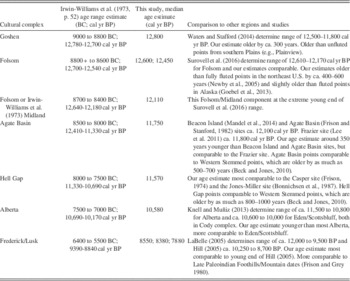
Irwin-Williams et al. (Reference Irwin-Williams, Irwin, Agogino and Haynes1973) estimate that the Goshen complex persisted for a brief time between ca. 12,780 and 12,700 cal yr BP and our age estimate of ca. 12,800 cal yr BP is consistent with this estimate, if a little older (Table 4). Stylistically, Goshen points are comparable to Plainview points, a fact that has not escaped archaeologists working on the southern Plains (Holliday et al., Reference Holliday, Johnson and Stafford1999). Plainview points are, like Goshen points, unfluted lanceolate projectile points with concave bases. On the central and southern Plains, Plainview is unambiguously younger than our age estimate for Goshen by at least 1,000 years and perhaps more. In agreement with a younger age estimate for unfluted points on the Plains, Waters and Stafford (Reference Waters and Stafford2014) estimate Goshen’s age range at ca. 12,500 to 11,800 cal yr BP, which is at least ca. 300 years younger than our age estimate. Addressing the Hell Gap site specifically, Waters and Stafford (Reference Waters and Stafford2014) discard a date of ca. 12,860 cal yr BP (cited as [AA-33671A]) on the basis of possible contamination, sediment mixing, and the fact that it was collected well below the Goshen component. Because Waters and Stafford’s (Reference Waters and Stafford2014) study is currently the standard age estimate for the Goshen complex, we would like to clarify here some confusion regarding the radiocarbon sample they discarded from Hell Gap, which would have made their age estimate considerably older.
Comparison of this study’s age estimates to those proposed by Irwin-Williams et al. (Reference Irwin-Williams, Irwin, Agogino and Haynes1973) and other North American Paleoindian sites.

First, the lab number for Waters and Stafford’s (Reference Waters and Stafford2014) discarded date is AA-14434, not AA-33671A, which Waters and Stafford (Reference Waters and Stafford2014) clarify later in their discussion, but not when they initially “reevaluate the single radiocarbon date of 10,955±135 (AA-33671A) reported for the Goshen horizon at the Hell Gap site” (Waters and Stafford, Reference Waters and Stafford2014, p. 543). Radiocarbon date AA-14434 is the alkali-insoluble charcoal fraction of sample 6HG93, while the alkali-soluble fraction produced a date of 11,440±120 14C yr BP (AA-33671) (Haynes, Reference Haynes2009c). Adding to the confusion, radiocarbon sample AA-14434 is erroneously plotted twice in Haynes (Reference Haynes2009a), once with its correctly paired humate date (AA-33671) and another time incorrectly around 3 m northwest of its actual place of recovery. Judging from Waters and Stafford’s (Reference Waters and Stafford2014) description of sample 6HG93 coming from 30 cm below substratum E1, it appears as though they are referring to the incorrectly plotted date, while the actual position of sample 6HG93 is stratigraphically lower, at the margin between strata D and C. Regardless, Waters and Stafford (Reference Waters and Stafford2014) are correct in stating that the date came from well below the Goshen level at Locality 1.
We initially incorporated both radiocarbon dates from sample 6HG93 into our chronostratigraphic model, but both were omitted as outliers in our final model due to the large amount of uncertainty regarding the ages of strata C and D. Despite their omission, we still produced an older age for Goshen than Waters and Stafford (Reference Waters and Stafford2014) because there are four dates in our model stratigraphically lower than the Goshen level that date from between ca. 12,780 and 13,180 cal yr BP (Supplementary Table 1). We maintain that Goshen temporally precedes Folsom at Hell Gap, and is late Clovis or is aged between Clovis and Folsom. Given the large temporal span of unfluted, lanceolate projectile points in the Great Plains and Rocky Mountains, they are perhaps best conceptualized as a persistent stylistic variant throughout the Paleoindian period, rather than a stylistic horizon (see discussion of Midland points below).
Irwin-Williams et al. (Reference Irwin-Williams, Irwin, Agogino and Haynes1973) estimate that the Folsom complex persisted from ca. 12,700 to 12,540 cal yr BP, and the oldest two of our three identified Folsom components are comparable to their estimate, if slightly younger at ca. 12,600 and 12,450 cal yr BP (Table 4). Our oldest two age estimates are also comparable to the age range presented by Surovell et al. (Reference Surovell, Boyd, Haynes and Hodgins2016) for Folsom sites, which they date from between ca. 12,610 and 12,170 cal yr BP. Fully fluted projectile points comparable to Folsom points are common in a large portion of North America during the Middle Paleoindian Period, but are well-dated outside of the Great Plains and Rocky Mountains only in the northeastern U.S. and Alaska. In the northeastern U.S., fully fluted points do not appear until ca. 12,000 cal yr BP, around 600 years after they appear at the Hell Gap site (Newby et al., Reference Newby, Bradley, Spiess, Schuman and Leduc2005). Fully fluted points appear in Alaska at ca. 12,400 cal yr BP, around 200 years after they appear at the Hell Gap site (Goebel et al., Reference Goebel, Hockett, Adams, Rhode and Graf2013). Hence, perhaps Collard et al. (Reference Collard, Buchanan, Hamilton and O’Brien2010) and others (Surovell et al., Reference Surovell, Boyd, Haynes and Hodgins2016) are correct in suggesting fully fluted points first appeared on the High Plains and intermountain basins of Wyoming and Colorado.
Irwin-Williams et al. (Reference Irwin-Williams, Irwin, Agogino and Haynes1973) viewed Midland points as a non-fluted successor to Folsom points that lasted from ca. 12,640 to 12,180 cal yr BP (Table 4). As previously mentioned, the archaeological community now knows that fluted and non-fluted forms often occur in the same archaeological components and are more or less contemporaneous (Hofman et al., Reference Hofman, Amick and Rose1990; Meltzer et al., Reference Meltzer, Seebach and Byerly2006). Our youngest Folsom/Midland component age estimate, at ca. 12,110 cal yr BP, is likely an example of fluted and non-fluted projectile points occurring in the same component. Our age estimate agrees well with the terminal date for Folsom proposed by Surovell et al. (Reference Surovell, Boyd, Haynes and Hodgins2016), if slightly younger. As previously mentioned for Goshen, it is perhaps best to conceptualize fluting not as related to a categorical “type” or “complex” with defined start and end dates, but as a behavioral variant that varied in spatiotemporal frequency throughout the Paleoindian period (Pelton et al., Reference Pelton, Boyd, Rockwell and Newton2016). By the time of our youngest Folsom/Midland component, fluting may have simply been waning as a behavior.
Irwin-Williams et al. (Reference Irwin-Williams, Irwin, Agogino and Haynes1973) estimate that the Agate Basin complex persisted from ca. 12,410 to 11,330 cal yr BP, which perfectly subsumes our age estimate of ca. 11,750 cal yr BP (Table 4). Despite the fact that Agate Basin points are relatively common, the age of the Agate Basin complex is still poorly understood. The most precisely dated Agate Basin components on the Great Plains are the Beacon Island and Frazier sites (Lee et al., Reference Lee, Lee and Turnbull2011; Mandel et al., Reference Mandel, Murphy and Mitchell2014). The Beacon Island site (North Dakota) is older than our age estimate by around 350 years, at ca. 12,100 cal yr BP (Mandel et al., Reference Mandel, Murphy and Mitchell2014). Age estimates for the Frazier site (Colorado) are comparable to our age estimate, at ca. 11,800 cal yr BP (Lee et al., Reference Lee, Lee and Turnbull2011). The Agate Basin type site, in eastern Wyoming, is imprecisely dated (standard error of 570 years), but its median calibrated age estimate is almost identical to that from the Beacon Island site, at ca. 12,100 cal yr BP (Frison and Stanford, Reference Frison and Stanford1982).
Irwin-Williams et al. (Reference Irwin-Williams, Irwin, Agogino and Haynes1973) estimate that the Hell Gap complex persisted from ca. 11,330 to 10,690 cal yr BP, and our age estimate of ca. 11,570 cal yr BP is older than theirs by about 250 years (Table 4). Perhaps even more so than the Agate Basin complex, Hell Gap points are poorly dated, and present estimates for the age of Hell Gap span close to 2,000 years (Holliday, Reference Holliday2000). Our age estimate is comparable to the Casper site, dated from between ca. 11,650 and 11,350 cal yr BP (Frison, Reference Frison1974), and the Jones-Miller site, dated to ca. 11,640 cal yr BP (Bonnichsen et al., Reference Bonnichsen, Stanford and Fastook1987). Our estimate is over 500 years older than the Sisters Hill site, dated to ca. 11,000 cal yr BP (Agogino and Galloway, Reference Agogino and Galloway1965) and almost 800 years younger than the Hell Gap component at the Agate Basin site (Frison and Stanford, 1980).
Researchers have for some time recognized similarities between the Agate Basin and Hell Gap complexes, both in stylistic attributes and temporal association. First, both Agate Basin and Hell Gap are constricting stem points, which is notable because Paleoindian projectile points on the northern Plains are without exception lanceolate, concaved base points until Agate Basin. This fact combined with the superposition of Hell Gap points above Agate Basin at multiple sites has led archaeologists to suggest that Hell Gap points developed from the Agate Basin complex in an evolutionary sense (Kornfeld et al., Reference Kornfeld, Frison and Larson2010). As further evidence for their close affinities, Hell Gap and Agate Basin points are associated with comparable radiocarbon date ranges (Holliday, Reference Holliday2000) and sometimes occur in the same components, most notably at the Carter/Kerr-McGee site, though it could not be determined at Carter/Kerr-McGee if the points accumulated on the same stable surface or were deposited during the same occupation (Frison, Reference Frison1984).
In the Great Basin and surrounding regions, archaeologists have dealt differently with projectile types of comparable morphology, subsuming them all under the designation of “Western Stemmed” projectile points (Beck and Jones, Reference Beck and Jones2010). Agate Basin and Hell Gap points are undeniably comparable to Haskett and Cougar Mountain varieties of Western Stemmed points, respectively. In general, Western Stemmed points are unambiguously older than both Hell Gap and Agate Basin points, and are more comparable in age to Folsom sites on the Great Plains (ca. 12,500 cal yr BP; Goebel et al., Reference Goebel, Hockett, Adams, Rhode and Graf2013). If Agate Basin and Hell Gap points are indeed a Great Basin phenomenon, then our age estimate for both components at Locality 1 are as much as 800 to 1,000 years younger than comparable stemmed points in the Great Basin. In sum, Agate Basin and Hell Gap points were produced closely in time on the Great Plains, our results reflect this close temporal association, and they seem to show up several hundred years after comparable points in the Great Basin
Irwin-Williams et al. (Reference Irwin-Williams, Irwin, Agogino and Haynes1973) estimate that the Alberta complex persisted from ca. 10,690 to 10,170 cal yr BP, and our age estimate of ca. 10,580 cal yr BP falls within their estimated age range (Table 4). Alberta points are now recognized to be part of the larger Cody complex, alongside Eden and Scottsbluff projectile points and Cody knives. Although all Cody artifacts occur alongside each other in some sites, there exists a degree of temporal separation between some sites with single point types. Our age estimate is a little over 200 years younger than sites with only Alberta points, which Knell and Muñiz (Reference Knell and Muñiz2013) place between ca. 11,500 and 10,800 cal yr BP. Our age estimate is more comparable in age to sites with only Eden/Scottsbluff points, which Knell and Muñiz (Reference Knell and Muñiz2013) place between ca. 10,600 and 10,000 cal yr BP. In general, the Alberta component at Locality 1 is slightly young for Alberta sites, but comparable in age to Cody complex sites in general.
Irwin-Williams et al. (Reference Irwin-Williams, Irwin, Agogino and Haynes1973) estimate that the Frederick/Lusk complex persisted from ca. 9390 to 8840 cal yr BP (Table 4). Our age estimates of ca. 8550 to 7880 cal yr BP post-date their age range estimate by at least 300 years. LaBelle (Reference LaBelle2005) estimates that the majority of Late Paleoindian complexes (including parallel/oblique points such as Frederick) range in age between ca. 12,000 and 9500 cal yr BP while Hill (Reference Hill2005) estimates they range in age between ca. 10,250 and 8670 cal yr BP. Our age estimates are younger than LaBelle’s (Reference LaBelle2005) age estimates by at least 1000 years, but are comparable to the extreme young end of Hill’s (Reference Hill2005) age range estimate.
Our three age estimates for the Frederick/Lusk components are relatively poorly constrained due to a paucity of dates for the upper-most portion of our age-depth model (<125 cm bgs) compared to lower portions and diffuse artifact frequency modes. Possibly because of this, our age estimates for the Frederick/Lusk components are young compared to other Late Paleoindian sites in which projectile points with parallel/oblique flaking have been recovered (e.g., Hill, Reference Hill2005; LaBelle, Reference LaBelle2005, p. 141). We omitted from our analysis an outlier date (8820 ± 60 14C yr BP [AA28776]; 10,166-9670 cal yr BP 2-sigma calibrated age range; 9880 cal yr BP median age estimate) that would have made our Frederick/Lusk age estimates much older, but it was soundly excluded from the dominant age-depth relationship by Bchron (outlier P = 1.000). This analysis calls to attention a need to more thoroughly date this portion of the Locality 1 sequence. For now, we consider the Frederick/Lusk component at Locality 1 to be relatively young for a component containing parallel/obliquely flaked projectile points, and more comparable in age to dates on Foothills/Mountain Paleoindian sites, which date as young as ca. 8500 cal yr BP (Frison and Grey, Reference Frison and Grey1980).
CONCLUSION
We created a chronostratigraphic model for Locality 1 of the Hell Gap site by standardizing the elevations of plotted radiocarbon dates to a standard stratigraphic section located near the southwest corner of the Locality 1 Witness Block. We undertook this modeling exercise in order to resolve a number of chronostratigraphic issues with the site, such as conflicting radiometric age estimates for individual strata and stratigraphic age reversals. We used the distribution of piece-plotted artifact elevations from the southwest corner of the Witness Block to identify 11 archaeological components and assigned them each a cultural affiliation based on diagnostic projectile points, descriptions of their stratigraphic locations, and general component constituents. Finally, we used our age-depth model to estimate the age of each archaeological component, thereby providing a standardized means of incorporating the Hell Gap site into discussions of Paleoindian chronology.
Our chronology is largely comparable to pre-existing chronologies for the Hell Gap site and for the North American Paleoindian Period in general, but diverges from existing chronologies in several notable ways. In keeping with Irwin-Williams et al.’s (1973) original interpretation, we found that the Goshen complex is indeed intermediate in age between Clovis and Folsom, and is around 300 years older (ca. 12,800 cal yr BP) than the age range estimate provided by Waters and Stafford (Reference Waters and Stafford2014). We identified at least three fluted point components; the earliest is one of the oldest age estimates for the Folsom complex (ca. 12,600 cal yr BP) and the latest, a likely Folsom/Midland component, is one of the youngest (ca. 12,110 cal yr BP). Folsom foragers appear to have occupied the Hell Gap site from the beginning of the complex to its end. Our age estimate of ca. 11,750 cal yr BP for the Agate Basin component aligns well with existing age estimates, especially for Agate Basin sites in more southern parts of the point type’s range. Our Hell Gap age estimate (ca. 11,570 cal yr BP) is comparable to other Hell Gap components, but is younger than comparable projectile points in the Great Basin. The Alberta component (ca. 10,10,580 cal yr BP) is comparable in age to Irwin-Williams et al.’s (1973) chronology and Cody sites in general, but young for single component Alberta sites. Finally, our age estimates for the Locality 1 Frederick/Lusk components are young compared to most previously recognized age estimates for parallel/obliquely flaked points by as much as 1000 years (ca. 8550–7880 cal yr BP). Either our estimates are too young due to poor model constraint or the Locality 1 Frederick/Lusk components are at the extreme young end of terminal Paleoindian sites.
Although we refined the Locality 1 occupational chronology considerably, some unanswered questions regarding the Locality 1 deposits remain. First, future excavation should confirm that we assigned cultural affiliations to each component accurately. We directly included only two diagnostic Folsom artifacts in our analysis because these were the only diagnostic artifacts recovered from our artifact sample. We assigned other cultural affiliations primarily by matching descriptions of each cultural component’s stratigraphic position to our piece-plotted artifact distributions and by tracing our artifact modes in backplots to other portions of the excavated Witness Wall where diagnostic artifacts were found in situ. Future research will undoubtedly uncover additional diagnostic artifacts, and these should be used to confirm our cultural complex assignments. Second, certain portions of our age-depth model are in need of further dating. This is especially true of substratum F2 and strata D and C, for which there remains uncertainty regarding their ages. Future dating efforts should be directed toward determining the age of sterile deposits in strata D and C below the cultural horizon in order to better constrain this model and inform when foragers were not camping at Hell Gap (i.e., pre-colonization), in addition to when they were. Further, future research should determine the age(s) of archaeological remains in substratum F2, perhaps through direct dating of culturally modified bone (Surovell et al., Reference Surovell, Boyd, Haynes and Hodgins2016). In general, a project focused on direct bone dating at Locality 1 would be a valuable means of testing our occupational chronology independent of our age-depth model.
To conclude, although our study provides a much-needed occupational chronology for an important Paleoindian site, perhaps its greater contribution is providing a method for building chronostratigraphic models for stratified open sites, be they archaeological or otherwise. Sloping and undulating buried surfaces can complicate modeling age-depth relationships by creating contradictory age relationships and stratigraphic age reversals. Our study provides a simple procedure for correcting age-depth relationships, and this should be useful to a wide range of Quaternary sciences. Beyond accounting for stratigraphic complications, our method enables a degree of chronometric precision rarely possible with most stand-alone dating methods. Such precision is possible due to stratigraphic superposition. Despite efforts to refine the ages of Paleoindian cultural complexes based on high-precision radiocarbon dating (e.g., Holliday et al., Reference Holliday, Johnson and Stafford1999; Waters and Stafford, Reference Waters and Stafford2007, Reference Waters and Stafford2014), all such efforts suffer from radiocarbon date uncertainty. Stratigraphic superposition ameliorates some of the imprecision inherent to radiocarbon dating by eliminating “tails” in probability regions, as our study has shown (Fig. 3). Superposition also provides a quantitatively grounded means of justifying the elimination of radiocarbon determinations as outliers in dominant age-depth relationships. We foresee our procedure being especially useful for creating more precise, accurate chronologies for stratified open sites with well-documented and dated stratigraphy, but deposits that push the limits of radiocarbon dating (e.g., Holliday et al., Reference Holliday, Hoffecker, Goldberg, Macphail, Forman, Anikovich and Sinitsyn2007; Nigst et al., Reference Nigst, Haesaerts, Damblon, Frank-Fellner, Mallol, Viola, Gotzinger, Niven, Gerhard and Hublin2014). Open stratified sites like Hell Gap are extremely rare (Holliday and Meltzer, Reference Holliday and Meltzer2010) and stratigraphically complex, but they provide an indispensable resource for creating more precise chronologies, and our method provides a means of doing so.
ACKNOWLEDGMENTS
We would first like to recognize C. Vance Haynes for his contributions to understanding the Hell Gap site chronology. We would also like to recognize the Wyoming Archaeological Foundation for providing access to the Hell Gap site property and for financial support of the project. Several private donors contributed research funding, including Mike McGonigal, Elmer Guerri, Mike Toft, Terry and Jim Wilson, Robert and Judy Thompson, Elizabeth Wilder, and Rick Miller. Forest Fenn and Mark Mullins provided funding for the structure that protects Locality 1 from weather related erosion and vandalism; they also funded some excavations yielding data used in this paper. The Paleoindian Research Laboratory (PiRL) at the University of Wyoming provided funds to support this study. Finally, Derek Booth, Vance Holliday, Curtis Marean, and three anonymous reviewers all provided extremely valuable comments and edits that considerably improved this study. We are grateful for their attentiveness in seeing this study through to completion.
SUPPLEMENTARY MATERIAL
To view supplementary material for this article, please visit https://doi.org/10.1017/qua.2017.41