INTRODUCTION
One of the most important topics in criminology involves understanding the relationships between race, ethnicity, and violent crime. Research shows that social and economic disadvantages help explain the relationship between violent crime rates and the racial and ethnic composition of communities (see, e.g., Peterson and Krivo, Reference Peterson and Krivo2005; Sampson and Wilson, 1995). While we now know a great deal about the link between characteristics of communities and high rates of violence, we do not have a good understanding of the ways that individual characteristics and life experiences (such as age, living in a poor household, and being unemployed) help account for race and ethnic differences in the risk for violent victimization. Part of the reason for this knowledge gap is that available data have not allowed for detailed examinations of whether certain characteristics and life experiences, such as living in poverty, increase the risk for violent victimization differently (or similarly) across racial and ethnic groups. Moreover, we do not know whether the association between race, ethnicity, and victimization has changed over time, once we take into account changes in other individual level characteristics like age and unemployment. This is important because aggregate trends in group rates of violence are a product of both changes in macrolevel factors and changes in compositional factors within groups. This paper has three foci: 1) to assess the sources of racial and ethnic disparities in males’ risk for serious violent victimization; 2) to examine potential variation in the characteristics and life experiences that place different racial and ethnic groups at risk for serious violent victimization; and 3) to assess whether race and ethnic disparities in serious violent victimization have changed over time.
We examine racial and ethnic disparities in serious violent victimization over time by developing individual level (or micro) data from the National Crime Survey (NCS, 1973–1992) and its successor, the National Crime Victimization Survey (NCVS, 1993–2010), hereafter referred to together as the NCVS. This analysis represents the first attempt to exploit the historical NCVS microdata to assess changes over time in racial and ethnic differences in violent victimization net of other sociodemographic influences at the individual level. The use of these microdata also demonstrate how national survey data can go beyond findings derived from police-based crime data (such as the Uniform Crime Reports [UCR]) by deepening our understanding of how race, ethnicity and other sociodemographic characteristics intersect in ways that have shaped individuals’ victimization experiences over the past four decades. This analysis thus moves toward a more thorough social demography of violence in the United States, and thereby, begins to fill an important gap in our empirical understanding of crime disparities and their trends (South and Messner, Reference South and Messner2000).
PRIOR RESEARCH
Racial and ethnic differences in violent victimization are well documented. Rates of violent victimization among non-Latino Blacks (hereafter referred to as Blacks) exceed Latino and non-Latino White rates (hereafter referred to as Whites), and Latino rates surpass White rates (e.g., Hawkins Reference Hawkins1995; LaFree et al., Reference LaFree, Baumer and O’Brien2010; Lauritsen and Heimer, Reference Lauritsen and Heimer2010; Light and Ulmer, Reference Light and Ulmer2016; Peterson and Krivo, Reference Peterson and Krivo1999; Phillips Reference Phillips2002; Sampson and Lauritsen, Reference Sampson, Lauritsen, Reiss and Roth1994). Most of the research on race and ethnic differences in rates focuses on homicide victimization and reveals large disparities in risk across these three population groups. For example, in 1990, 2000, and 2010, Black homicide rates were 11.9, 10.5, and 10.5 times greater than those for Whites, while Latino rates during these same years were 5.5, 3.7, and 2.9 times greater than those for Whites (Centers for Disease Control and Prevention n.d.).
When more commonly occurring forms of serious nonlethal violent victimization (here defined as rape and sexual assault, robbery, and aggravated assault)Footnote 1 are considered, racial and ethnic differences in risk are much smaller (Lauritsen and Heimer, Reference Lauritsen and Heimer2010). According to 2010 data from the UCR and the NCVS, there were roughly 1.2 to 1.4 million serious violent victimizations, respectively, which suggests that there were approximately eighty-five to ninety-five serious non-lethal victimizations for every homicide occurrence. The 2010 NCVS data show that Black males experienced nonlethal serious violence at a rate that was 2.1 times (or 110%) greater than that of White males, while Latino rates were about 42% greater than those for White males (Bureau of Justice Statistics 2016). The sizeable differences between nonlethal violence and homicide statistics suggest that drawing conclusions about racial and ethnic differences based only on homicide data is problematic. Indeed, explaining racial differences in lethal violence and non-lethal violence may require different kinds of explanations, such as differences in firearm use and other situational and contextual correlates.
Moreover, unlike homicide data, the use of NCVS non-lethal violence data provides a unique opportunity to examine whether individual level characteristics may help account for group disparities in risk. This is because the NCVS contains more information about victims, as well as nonvictims, than homicide data, which contain only limited demographic information on victims. Most of what we know about the sources of group disparities in violent victimization comes from macrolevel research, and much less is known about how sociodemographic characteristics and life circumstances (e.g., individuals’ own experiences of poverty and unemployment) affect victimization. We know that Blacks and Latinos are more likely than Whites to be poor and to live in areas with higher rates of poverty (U.S. Census Bureau 2015). Criminologists very often point to these facts to explain the associations between race, ethnicity, and violence (Peterson and Krivo, Reference Peterson and Krivo2005; Sampson and Wilson, Reference Sampson, Wilson, Hagan and Peterson1995). Just as macrolevel research shows that racial and ethnic subgroup rates of violence vary across ecological and geographic areas, individual level research can help uncover important variations in risk within racial and ethnic groups. Further, undertaking such work would signal “that blacks [and Latinos] are not a homogeneous group any more than whites are” (Sampson and Wilson, Reference Sampson, Wilson, Hagan and Peterson1995, p. 39). Importantly, individual level data can reveal whether the factors that increase the risk of violence vary across racial and ethnic groups. The racial “invariance” hypothesis, tested primarily with race-specific rates of homicide victimization for neighborhoods or other geographical areas, posits that race differences in violence are mostly due to socioeconomic dissimilarities in the lives of Blacks, Whites, and Latinos. Yet, the hypothesis also implies that the factors influencing risk for violence are similar within racial and ethnic groups. To our knowledge, the racial invariance hypothesis has not been tested with nationally representative, individual level data on serious violent victimization.Footnote 2
Historical Hypotheses about Racial and Ethnic Disparities in Violence
William Julius Wilson’s seminal book, The Declining Significance of Race: Blacks and Changing American Institutions (1978), illuminates historical patterns of social and economic disparities among Blacks in the United States and offers a basis for hypotheses about changes in patterns of violence over time among racial and ethnic minorities. Wilson (Reference Wilson1978, Reference Wilson2011) argued that as Blacks gained access to economic and political resources, “economic class gradually became more important than race in determining the life chances of individual African Americans” (2011, p. 56). Importantly, Wilson maintained that it is not that race lost its significance, but rather that it is “no longer the primary determinant of life chances for blacks (in the way it had been historically)” (2011. p. 57). Instead, within-race differences in economic resources became increasingly important for Black lives in ways that were impossible decades earlier, when laws and overt discrimination prevented Black Americans from living in middle-class neighborhoods and restricted their access to middle-class jobs, even when they had the requisite skills. Despite the importance of The Declining Significance of Race and important theoretical arguments (e.g., Sampson and Wilson, Reference Sampson, Wilson, Hagan and Peterson1995; Wilson Reference Wilson1987) informing community-level studies of race and crime, it has been impossible to test hypotheses about historical changes in race, class, and exposure to violence over time at the individual level because of a paucity of national survey data that includes the necessary information over long periods.
Data over time on poverty and wealth differences between racial and ethnic groups, as well as residential segregation patterns, generally are consistent with the hypothesis that racial and ethnic differences in violent victimization may have changed over time, although the changes in these indicators have been relatively small. For example, during the 1970s and 1980s, the proportion of persons living below the federal poverty line was roughly 3.5 to four times higher among Blacks than Whites, yet that ratio declined to about three times or less beginning around 2000 (U.S. Census Bureau 2015). Similarly, during the late 1980s, the household wealth of Whites was approximately seventeen times greater than that of Blacks, but had decreased to about six to ten times greater than that of Blacks in the time just prior to the Great Recession of 2007–2009 (Kochhar and Fry, Reference Kochhar and Fry2014). In addition, there were also small declines in residential segregation among Blacks and Whites between 1980 and 2010 (Logan and Stults, Reference Logan and Stults2011).
Wilson’s (1987) thesis also suggests that broader increases in economic inequality may affect rates of victimization within groups. Although residential segregation by race and ethnicity declined some between 1980 and 2010, segregation by income increased and changed the character of metropolitan areas as both affluent and poor families became more isolated from other families (Bischoff and Reardon, Reference Bischoff and Reardon2014). Widespread increases in U.S. inequality have affected all groups and as a result, economic disparities have increased within groups. Jennifer Hochschild and Vesla Weaver (2015) report that between 1968 and 2013, the Gini coefficient for income inequality increased from .38 to .47 for Whites, from .41 to .49 for Blacks, and from .37 to .45 for Hispanics.Footnote 3 If Wilson’s thesis and related hypotheses about the role of concentrated disadvantage are correct (Sampson and Wilson, Reference Sampson, Wilson, Hagan and Peterson1995), these types of change should have resulted in increases over time in the magnitude of the relationship between poverty status and violence risk within each of these populations.
In addition to changes in poverty, wealth, segregation, and inequality, other correlates of violence have changed over time in dissimilar ways across racial and ethnic groups. Age, for example, is strongly associated with violent victimization, and youth comprise a greater proportion of Blacks and Latinos than Whites (Vogel and Porter, Reference Vogel and Porter2016).Footnote 4 Furthermore, the age distributions of each group have changed over time at different rates, with Whites becoming increasingly older, on average, compared to Blacks and Latinos. Yet, age-standardized group rates of nonlethal violent victimization are not available, making it difficult to know whether observed changes in violence overstate the role of race and ethnicity, particularly when more recent periods are compared to the past.
A recent study of Black, Latino, and White homicide victimization rates in U.S. metropolitan areas also is consistent with the hypothesis that racial disparities in nonlethal violence may have changed over time. Michael Light and Jeffrey Ulmer (2016) found that the gap between Black and White homicide rates decreased 40% between 1990 and 2010, and the gap between Black and Latino rates decreased 35% during this period. The difference between Latino and White homicide rates decreased more (55%) during this period. The study also found that changes in metropolitan-area levels of disadvantage had the greatest impact on levels and changes in racial and ethnic rate disparities over these two decades. If homicide findings are generalizable to nonlethal violence, we should expect to see similar changes in the disparities in the NCVS victimization data.
In sum, despite the large and important literature on racial and ethnic differences in violence, we still have little evidence about how race, ethnicity, age, and economic status affect individuals’ risk for serious violence and how this may have changed over time. Our research targets this gap by assessing the following three questions. First, to what extent can racial and ethnic disparities in serious violence against males be explained by individual level characteristics and life experiences, including age, location of residence, household poverty, and employment? Second, do the key factors predicting exposure to nonlethal violent victimization differ for Blacks, Latinos, and Whites? Third, has the net effect of race and ethnicity on males’ risks for nonlethal violence decreased over time, and has poverty status become more important for explaining the risk of violence?
THE CURRENT STUDY
Data and Measures
To examine these issues, we use data from males interviewed in the NCVS from 1973 to 2010. Though women’s risk for violence is an equally important issue, preliminary analyses of the women’s data indicate that their trends in violence and related factors differ from those of males, and warrant special consideration of victim-offender relationships in violence.Footnote 5 NCVS microdata are used in our analysis because they offer a unique opportunity to answer the questions we pose, as they are the only source of individual-level information covering the past four decades and they contain information on ethnicity. Failing to distinguish Latinos from Whites, which has often been the case in studies using homicide data, produces rates that appear more similar across race than is true. Equally important, the NCVS microdata allow researchers to examine the independent effects of race and ethnicity above and beyond the effects of other sociodemographic factors, and unlike police-based crime data, they include information on crimes not reported to the police.
The NCVS contains self-reported information about individuals’ experiences with violence and other forms of victimization beginning in 1973. Collected by the U.S. Census Bureau under the sponsorship of the Bureau of Justice Statistics, the survey uses a nationally representative sampling frame and interviews all persons aged twelve years and older in each sampled household. Sample size ranged from approximately 275,000 interviews per year in the early 1970s to about 167,000 in 2010. The large annual sample size allows for the estimation of reliable rates of statistically rare events, and for multivariate analyses of risk. Response rates for the NCVS are much higher than those of other victimization surveys, ranging from 97% in 1973 to 88% in 2010. The total number of cases in our analysis of male serious violent victimization for 1973–2010 is 2,911,017.
Participants remain in the NCVS sample for up to 3.5 years and are interviewed once every six months about their victimization experiences over the previous six months. Victimization experiences are measured through a series of cues and common language questions and are coded into crime types after the data are collected. Respondents self report information about their age, race, ethnicity, sex, household income, the number of persons in the household, and employment status. Information about residential areas also is recorded in the data. We use these key sociodemographic measures in our analyses.
We first constructed a series of standardized measures of the sociodemographic variables for each year of data in our series.Footnote 6 Our outcome is serious violent victimization, defined as attempted or completed robberies and aggravated assaults (which are attacks involving the use of a weapon or resulting in serious injury to the victim). We excluded rape and sexual assault victimization because, in each case, the incidence is so low among males that including it does not change the analysis. We coded serious violent victimization as “1” if the person reported one or more incidents in the past six months (versus “0” for no victimization).
The items measuring race and ethnicity in the NCVS (and Census) have changed some over time. We created consistent categories by combining the “race” and “ethnicity” responses and coding for the three largest groups: Blacks, Whites, and Latinos (persons of Hispanic origin or descent who may report being of any race).Footnote 7 There were insufficient numbers of interviews with persons of other racial and ethnic groups to permit further analyses beyond these three largest groups.
We measured household poverty status using respondents’ reports of family income, number of persons living in the household, and the U.S. Census Bureau’s federal definitions of poverty for each year. We coded persons as living at or below poverty if their household income category was at or below the federal poverty threshold amount for a household of their particular size. We coded persons as living in near poverty if their household income was between the poverty threshold and 150% of the threshold, and as above poverty if their household income category was higher than 150% of the federal threshold amount.Footnote 8 Generally, there is minimal missing data in the NCVS; however, the household income measure is missing for 13.1% of cases in the male sample. To address this problem, we used data imputation in our analyses (see below).
Age is strongly associated with victimization. We coded age of the respondent in years, and included age-squared and age-cubed terms to address the nonlinear relationship between age and victimization.Footnote 9 Type of residential area also is linked to victimization. Our models include an indicator of whether persons live in urban, suburban, or rural areas.Footnote 10 We also include a measure of employment in which males currently employed or in the military are coded “1” (versus “0”).Footnote 11
To control for unknown factors that might vary in their effects over time, our model includes time (linear), decade (categorical), and a time-by-decade interaction. This strategy accommodates a decade-specific linear time trend, and also allows us to examine how race, ethnicity, and poverty effects might vary over time and by decade. Finally, we include several methodological control variables in our analysis to address factors associated with survey administration, including whether the survey was conducted using the NCS versus the NCVS instrument, and whether it was conducted by telephone or in person.Footnote 12 We controlled for these factors because our preliminary analyses suggested that the methodological effects vary across groups and over time.
Data Limitations
Though unique in its ability to permit multivariate analyses of individuals’ risk for violence over time, the NCVS data also have limitations. Self-reported data are subject to concerns that affect all survey data, such as recall error and under- and over-reporting (e.g., Groves and Cork, Reference Groves and Cork2008). The NCVS sample design excludes persons who are not living in households or group quarters, such as homeless persons and those in institutionalized settings such as jails and prisons. Thus the generalizability of the findings beyond the household-based population of males in the United States is unknown. Also, if there have been changes in respondents’ willingness to report serious violence to interviewers among some groups but not others, the contribution of those changes cannot be distinguished from victimization risk. However, we are unaware of any research to suggest that such systematic patterns exist across different race and ethnic groups.Footnote 13
Importantly, the measures available for analysis in the NCVS limit the scope of our inquiry to key sociodemographic variables. The NCVS data do not include urban neighborhood indicators, nor do they contain measures of persons’ involvement in offending—key factors known to have an influence on violent victimization risk. This means that the measures that remain significant in our models must be interpreted carefully as they may reflect some combination of individual level and contextual level influences.
Descriptive Statistics
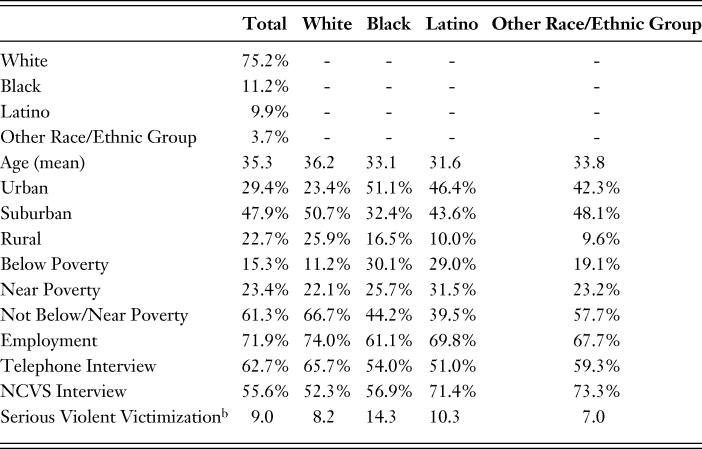
Table 1 presents the descriptive statistics for the full male sample and for the racial and ethnic groups and shows the average conditions of these groups from 1973 to 2010. Blacks and Latinos are younger on average than Whites. The proportion of males twelve to thirty-five years of age (the highest risk group) declined over time but at different rates for each group (not shown in table).Footnote 14 Comparing the 1975–1980 period to the 2005–2010 period, the proportion of males ages twelve to thirty five declined 26% among Black males (from 55.1% to 43.6%), 30% among White males (from 46.8% to 32.9%), and only 10% among Latino males (from 58.9% to 53.6%). Thus, Black and Latino rates of victimization are expected to be higher than those of Whites due to differences in age composition alone, and race and ethnic differences over time in victimization may be masked or overstated if we do not take into account group changes in age composition.
Descriptive Statistics of NCVS 1973–2010 Microdata (Males Age 12 and Older).a

a Sample-weighted estimates.
b Six-month prevalence rates per 1,000.
Also important are the large differences in poverty across groups. Blacks (30.1%) and Latinos (29.0%) are more than 2.5 times as likely as Whites (11.2%) to be living below the federal poverty threshold during 1973 to 2010. A larger percentage of minority males also live in near poverty households. Indeed, 56% of Black males and 60% of Latinos live below 150% of the poverty threshold, whereas about 33% of White males live below 150% of the threshold. Thus, the majority of Black and Latino males in the United States lived in or near poverty levels during the 1973 to 2010 period, while the majority of White males did not.
Minority males are roughly twice as likely as Whites to live in urban areas, while Whites are more likely to live in suburban and rural places. White males have the highest employment percentages followed by Latinos and Blacks. Finally, the Latino population grew more rapidly over time and therefore a greater proportion of Latinos were interviewed with the NCVS (rather than the NCS) instrument. Telephone interviews (rather than in person interviews) are somewhat more prevalent among Whites in large part because of greater residential, and hence sample, turnover among minorities.Footnote 15
The differences in risk across the groups can be seen in the six-month prevalence rates for serious violent victimization. During the 1973 to 2010 period, Black males experience an average rate of serious violence that is about 74% higher than that for White males (14.3 versus 8.2 per 1,000), while Latinos are victims of serious violence at a rate that is 26% higher (10.3 per 1,000) than that of White males.
ANALYTIC STRATEGY
To see how racial and ethnic disparities in serious violence among males are accounted for in part by other differences between the groups (e.g., poverty, unemployment, and age), we examined the influence of the sociodemographic variables separately, and together, using logistic regression models (e.g., as in Peterson and Krivo, Reference Peterson and Krivo2012). We included a subject-specific sampling weight in our analyses to safeguard against sampling biases related to the multistage complex sampling of the NCVS, which involved both stratification (e.g., by year, location) and clustering (e.g., household and repeated interviews), as well as nonresponse.Footnote 16 Our models included some factors that varied only across respondents (e.g., race and ethnicity) and some that varied both within and across respondents (e.g., employment status). Missing data on the covariates was minimal, however household income was an exception and, therefore, we compared the results of our analyses based on three different approaches for handling missing data: complete-case only, single imputation, and multiple imputation analysis. All three approaches gave similar results. Single and multiple imputation resulted in nearly identical results, essentially the same after rounding. For these reasons, we used single imputation for the analyses presented here. To estimate the logistic regression models, we used a generalized estimating equation (GEE) approach. Our procedure accommodates within-subject clustering and includes inverse probability sampling weights.
FINDINGS
Racial and Ethnic Disparities in Victimization
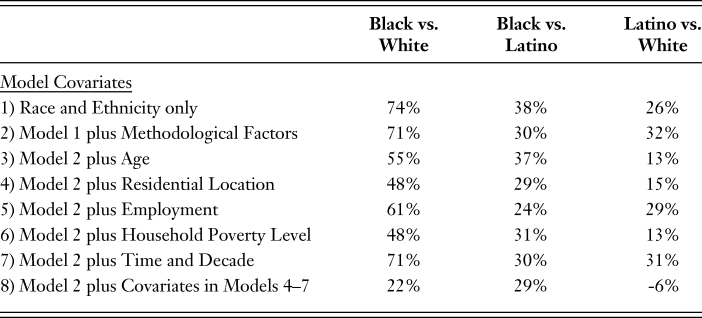
To assess how age, place of residence, household poverty level, and employment status account for race and ethnic disparities in violent victimization, we use a series of multivariate models. For ease of interpretation, we summarize the results from the regression models (available on request) in Table 2 as the percentage difference in the risk for serious violence after each of the factors is taken into account, and in the final model, when all of the factors are included.
Summary of Percentage Disparities in Male Serious Violent Victimization Risk Between Racial and Ethnic Groups by Model Specification: NCVS 1973–2010 Microdata.

The first row of Table 2 displays the percentage differences in the prevalence of serious violence across race and ethnicity when no other factors are considered. As expected from the descriptive statistics, the prevalence of serious violence against Black males is 74% higher than violence against White males, and 38% higher than violence against Latinos. Latino levels of serious violence are 26% higher than those of Whites. When we control for the survey administration variables (row 2), the difference in risk between Blacks and Whites decreases only slightly from 74% to 71%. Greater changes are found for the Latino versus Black and the Latino versus White disparities (from 38% to 30%, and from 26% to 32%, respectively) because the Latino population grew more rapidly over time, and therefore was more likely to participate in the NCVS survey during the later time periods.
We next add age to the model that retains the methodological factors (row three).Footnote 17 Controlling for age produces a notable reduction in the Black versus White disparity estimate (from 71% to 55%), and also in the Latino versus White estimate (from 32% to 13%). However, it also increases the Black versus Latino disparity estimate (from 30% to 37%). Such findings suggest that if Black, Latino, and Whites were similar in their age distributions, White males would have risks for serious violence that are more similar in magnitude to those experienced by Blacks and Latinos, while differences between Black and Latino risks would increase by about 20%.
Residential location differences across the groups also have large effects on the Black versus White and the Latino versus White disparities (row four). The Black versus White disparity declines from 71% to 48%, and the White versus Latino disparity declines from 32% to 15%, once residential location is controlled. However, residential location has little impact on the disparities between Blacks and Latinos because these two groups live in broadly similar types of areas. Differences in employment status also explain some of the disparities in victimization (row five). Black versus White disparity in victimization declines from 71% to 61%, and Black versus Latino disparity declines from 30% to 24%. Nevertheless, the explanatory power of employment status is less than that of age and residential location.
Like age and residential location, household poverty explains a substantial amount of the race and ethnic disparity in violence (row six). Including household poverty in our model reduces the Black versus White disparity in serious violence from 71% to 48%, and the Latino versus White disparity from 32% to 13%. Differences across groups in poverty therefore account for more of the Black versus White disparity in violence than age. Poverty and age have comparable effects on the Latino versus White disparity in risk. Household poverty levels do not account for differences in violent victimization between Latino and Black males, given their similarity in household poverty levels.
When the full set of factors is taken into account, each of the factors remains statistically significant. Importantly, much of the Black versus White disparity in risk (nearly 70%) is accounted for by this set of factors (i.e., a decline in disparity from 71% to 22%). Furthermore, the Latino versus White disparity in risk becomes negative once these factors are taken into account, suggesting that if Latinos were equal to White males in sociodemographic circumstances, they would have slightly lower rates of violent victimization than White males. Nevertheless, this set of sociodemographic factors explains little of the roughly 30% difference in serious violent victimization between Black and Latino males. Moreover, 22% of the disparity between Black and White victimization remains even after these factors are included in the model. The residual differences in victimization risk between Blacks versus Latinos and for Blacks versus Whites must be associated with factors other than age, residential location, household poverty, and employment status. Local contextual factors that we are unable to assess with the data are likely to be critical to understanding these residual differences.
It is also important to note that the model including the full set of factors indicates that the net effects of poverty status on risk for violence are larger in magnitude than those found for race or ethnicity. While risk for Blacks remains 22% greater than that for Whites in this model, males living below poverty, and in near poverty, have risks for violence that are 54% and 16% higher, respectively, than those living above these poverty thresholds. Thus, poverty status contributes more to violent victimization risk than does race or ethnicity.
Racial and Ethnic Differences in Factors Associated with Victimization
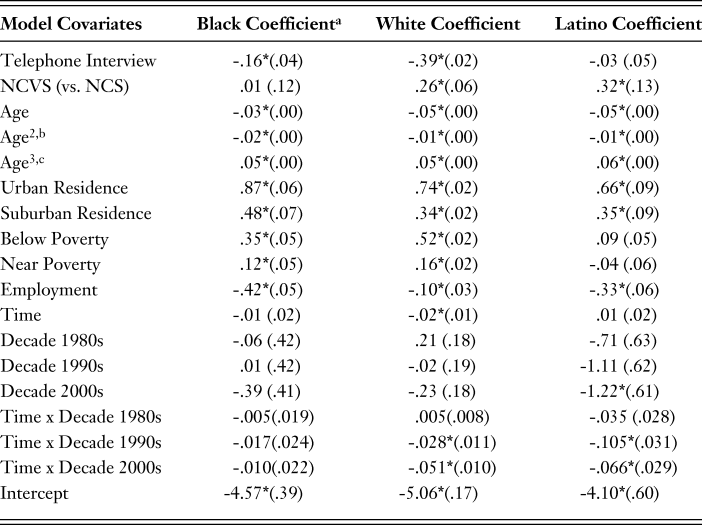
To assess whether there are differences between racial and ethnic groups in the association between sociodemographic factors and victimization, we estimated group-specific models, presented in Table 3. These results show that some of these factors effect violence similarly for Black, Latino, and White males. For example, violence risk is found to increase during adolescence, peak in the early 20s, and decline thereafter for males in each of these groups. However, we note a somewhat slower rate of decline in risk for Black males than among Whites and Latinos that is statistically significant.
Logit Regression Results of Male Serious Violent Victimization by Racial and Ethnic Group: NCVS 1973–2010 Microdata

a Standard error in parentheses.
b Coefficient and standard error multiplied by 10.
c Coefficient and standard error multiplied by 1000.
* p < 0.05, two-tail test.
Living in an urban or a suburban environment compared to a rural area is associated with higher risks of violence for members of all three groups. However, the impact of living in an urban area on Black males is somewhat greater than for White males. Similarly, while employment significantly reduces victimization in all three groups, the effect is smaller for Whites than for Black and Latinos.
In contrast to the small group differences noted above, household poverty has almost no effect on violence risk among Latinos. However, living in a household that is at, or below, the poverty threshold significantly increases the risk for serious violence for Black and White males, once other factors in the model are taken into account.Footnote 18 The coefficient for White males living in poverty is significantly larger than that for Black males. Living in a household that is near the poverty threshold also increases risk of violence among Black and White males, though this increase is less than the increase that comes from living at, or below, the poverty threshold.
The finding that Latinos’ violence risk is not affected by poverty is the only result that is inconsistent with this individual level consideration of the invariance hypothesis. Although poverty is important for understanding the difference between Latinos’ and Whites’ risk for violence, it does not significantly distinguish low- from high-risk Latinos after age, residential location, and employment status are taken into account.
Racial and Ethnic Disparities in Victimization Over Time
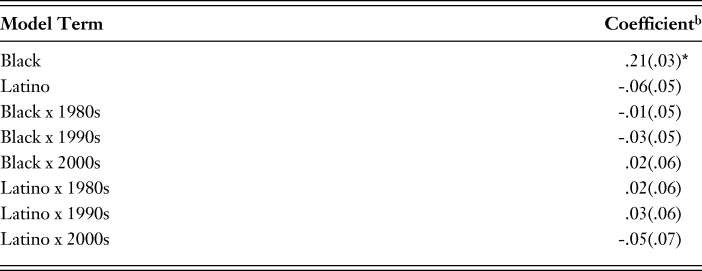
Next we examine whether race and ethnic differences in risks of violent victimization have changed over time, once we take into account the set of sociodemographic factors associated with violence. To assess changes over time, we add to our model interaction terms between the time and decade variables and race and ethnicity. We examined other ways to assess change over time, but this approach is the most parsimonious and offers the most statistical power to detect effects, which is important when studying changes in the prevalence of statistically rare events. These models, presented in Table 4, assess whether the race and ethnic disparities in victimization were significantly greater during the 1970s when compared to the 1980s, 1990s, or 2000s.
Logit Regression Results of Male Serious Violent Victimization on Temporal Changes in Race/Ethnicity Over Time: NCVS 1973–2010 Microdata.a

a Coefficients for other variables in the model not displayed.
b Standard error in parentheses.
* p < 0.05, two-tail test.
These tests clearly reveal that the magnitude of race and ethnic differences in serious violent victimization have not changed much over time. None of the temporal interaction terms are statistically significant for the groups, indicating that the disparities in risk between White and minority males were no different in the 1980s, 1990s, or 2000s compared to the 1970s. For example, the net Black versus White difference in serious violence risk during the decade of the 2000s was not significantly different from the Black versus White difference during the 1970s (b = .02, ns). The results suggest that there were no other significant temporal differences across the four decades (e.g., the 1990s vs. the 2000s). Thus, despite the fact that there have been substantial declines in rates of male serious violence, and some small declines in racial and ethnic differences in residential segregation, poverty, and wealth, we find no statistical evidence that racial/ethnic victimization disparities have changed over the past four decades.Footnote 19 Therefore, our findings for serious violence differ from research on homicide in U.S. metropolitan areas, which reports that racial and ethnic disparities decreased from 1990 to 2010 (Light and Ulmer, Reference Light and Ulmer2016).
Poverty Effects Over Time Among Blacks, Whites, and Latinos
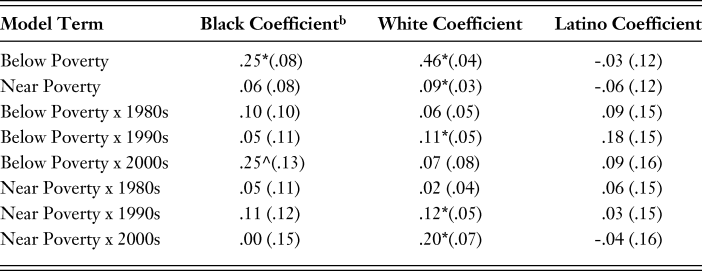
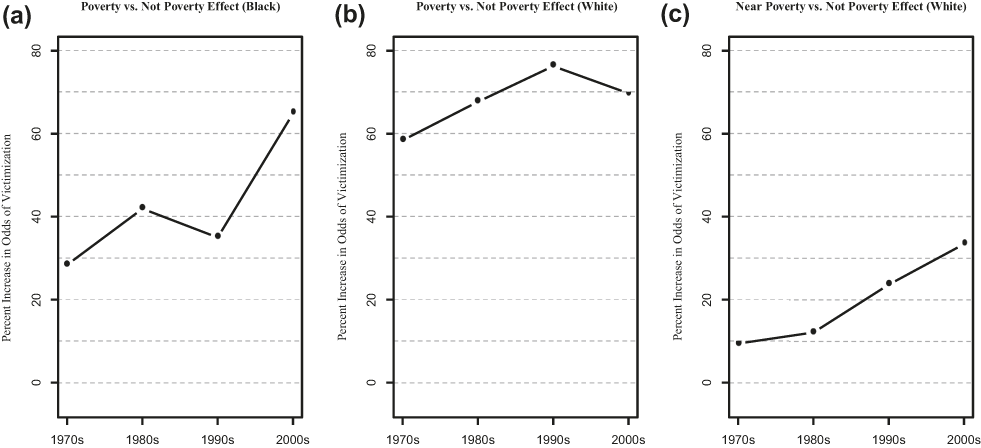
Finally, in Table 5 we examine the influence of poverty on the risk for violence over time among Blacks, to assess Wilson’s hypothesis that economic class has become increasingly important in the lives of Black Americans. For comparability, we also consider whether poverty disparities in violence have changed among Whites and Latinos. We graphically depict the significant changes over time in poverty effects in Figure 1.
Logit Regression Results of Male Serious Violent Victimization on Temporal Changes in Poverty Status Over Time by Racial and Ethnic Group: NCVS 1973–2010 Microdataa

a Coefficients for other variables in the model not displayed.
b Standard error in parentheses.
* p < 0.05, two-tail test.
^ p = 0.06, two-tail test.
Effects of Poverty on Odds of Violent Victimization Over Decades.

Table 5 (column 1) indicates that poverty has become more important for understanding Black violent victimization over time (see also Figure 1, panel a). All of the decade-by-poverty interaction terms are positive, with estimates going from .1 to .25, suggesting some increase in the impact of poverty on victimization over time, consistent with Wilson’s hypothesis. Among Black males, the odds of serious violence were about 28% higher for males living in households at or below poverty than for those not living in poverty during the 1970s. During the decade of the 2000s, the odds of victimization were about 65% higher for Black males living at or below poverty compared to those not living in poverty (p = 0.06 for significance of difference from 1970s). Though the change over time in these odds is not linear, and not all of the differences between decades are statistically significant, there is evidence in these data to suggest that the effect of household poverty on violence risk has increased over time for Black males.
For White males the differences in risk associated with poverty are somewhat larger than those found for Black males (see column 2), and the effect of household poverty has increased some among Whites over the decades, as it has for Blacks. Figure 1 (panel b) shows that the odds of victimization during the 1970s were about 58% higher for White males living at or below poverty than for those not living in poverty. During the decade of the 2000s, the odds of victimization associated with living at or below poverty were somewhat higher, at about 70% higher than for other Whites. In Figure 1 (panel c), the change in the odds of violence associated with near poverty status among White males is shown to be about 9% higher than those of White males not living in poverty during the 1970s, but by the 2000s, the differences in odds had grown to 33%. As was the case for Black males, these findings suggest that being poor has had an increasing effect over time on White male victimization.
The results for the same model for Latinos are shown in column 3 of Table 5, and for this group of males the effects of poverty on violence risk continue to be notably different from those for Blacks and Whites. Household poverty has relatively little association with Latinos’ victimization risk, and we find no significant changes in the influence of poverty on their likelihood of serious victimization over the past four decades.
DISCUSSION
This paper examines three important questions, which have not been explored fully in the literature. We first ask whether individual level characteristics and life experiences can explain racial and ethnic disparities in the risk of serious violence victimization among males. We next ask whether there are race and ethnic differences in the characteristics and experiences that increase the risk of violence. Finally, we examine whether the net effect of race and ethnicity on males’ risks for nonlethal violence changed over time, and whether poverty has become more important for explaining the risk of violence, consistent with Wilson’s (Reference Wilson1987) thesis about the greater importance over time of economic class than race in determining life experiences.
Rather than relying on UCR arrest or homicide data, which do not permit individual level analyses of risk, we used information from nearly three million self-reported interviews with males available in the 1973–2010 NCVS. This strategy allowed us to consider not only between group differences in violent victimization, but also to examine the heterogeneity within racial and ethnic groups and over time.
We found that much of the difference in risk between White, Black, and Latino males can be accounted for by sociodemographic factors. Group differences in poverty status account for large proportions of racial and ethnic disparities in violence, as do group differences in age and urban residence. As well, poverty status has a strong independent effect on violence risks. Males’ employment status also accounts for a meaningful, albeit smaller proportion of the disparity between Blacks and other groups.
Importantly, these findings predict that should life experiences become more similar across race and ethnic groups, males’ nonlethal violent victimization also would become more similar across groups. Indeed, our set of sociodemographic variables fully account for the Latino versus White gap in risk of violence. Moreover, when poverty, employment status, age, and residential location are taken into account, about 70% of the Black versus White disparity in exposure to violent victimization is explained. Specifically, the Black versus White disparity in victimization is reduced from 71% to 22% when these basic features of social life are taken into account. The remaining Black versus White disparity is likely explained in part by variables not available in the NCVS, such as residential segregation, social isolation, and other community level factors. This thinking is consistent with Wilson’s thesis and macrolevel research on homicide (e.g., Light and Ulmer, Reference Light and Ulmer2016; Peterson and Krivo, Reference Peterson and Krivo2012).
In addition, we find that Latino and Black males are similar to each other in terms of household poverty and residential location, and these individual level factors do not account for the higher risk that Black males face compared to Latinos. Our analyses reveal that age and unemployment status account for some, but not all of the Black versus Latino disparities. Again, it is quite possible that factors like residential segregation and social isolation play a more significant role among Blacks, and may explain their greater exposure to violence.
Our group-specific analyses revealed that nearly all of the factors that are significantly related to between group differences in risk are also associated with heterogeneity in risk within racial and ethnic groups. Black and White males who are younger, living in poverty and urban areas, and not employed are most likely to become victims of serious violence. Among Latinos, the risk is greatest for those who are younger, living in urban areas, and not employed; poverty status does not provide an additional contribution to the explanation of Latinos’ serious violent victimization. However, this within group difference is inconsistent with a broadened invariance hypothesis that differences in violence are mostly due to socioeconomic dissimilarities in the lives of Blacks, Whites, and Latinos. Nevertheless, this finding is consistent with prior macrolevel research on the “Latino paradox” (see, e.g., Martinez Reference Martinez2002; Sampson Reference Sampson2008) and the negative relationship between immigration and crime (Ousey and Kubrin, Reference Ousey and Kubrin2018). Indeed, the negligible influence of poverty among Latinos may be a function of a range of social processes, including both community (e.g., informal social control mechanisms), and other individual level factors (e.g., immigration selection processes). Though our analysis confirms that the Latino paradox also exists at the individual level in nationally representative data over four decades, the NCVS do not contain data on additional group or community factors to allow us to assess their possible effects and better understand the lack of an independent effect of poverty on victimization among Latinos.
Importantly, we also find that enduring disparities in violent victimization between Black males and other males persisted over the period 1973 to 2010, and are not explained by the sociodemographic variables that we examine. This finding departs from recent analyses of the racial and ethnic gap in homicide victimization rates and suggests that homicide disparities, which are much larger than those found for nonlethal violence, are unique from those found for other much more common forms of violent victimization. This suggests that homicide findings about race and ethnic disparities should not be generalized to other more prevalent forms of violence without careful consideration of the conditions that are more predominant in homicide incidents, such as firearm usage and its correlates. However, regardless of the sources of the differences in findings between homicide and other forms of serious violent victimization, it appears that the changes over time in race and ethnic disparities in poverty, wealth, and segregation have been both too slow and too small in magnitude to significantly reduce race and ethnic differences in males’ risk for serious nonlethal violence.
Wilson’s (Reference Wilson2009) more recent writings offer a framework for examining how broad scale social forces reinforce the persistent inequalities between Black males and the other groups. He argues that greater research attention should be paid to “political actions that have an impact on racial group outcomes, even though they are not explicitly designed or publicly discussed as matters involving race, as well as impersonal economic forces that reinforce long-standing forms of racial inequality” (2009, p. 4). These broader forces include macroeconomic trends as well as policy decisions that have important effects on Blacks because they occupy more vulnerable positions in society. Wilson (as well as others) argues that the effects of broader economic forces—such as deindustrialization, the increasing internationalization of national economies, and low wage growth especially among unskilled workers—have worked to restrict many Blacks to precarious positions in the economy and to perpetuate their higher poverty rates. Policy decisions—including residential redlining and mortgage exploitation, school segregation, reduced public investments in education, lack of investment in public transportation, increasingly regressive tax structures, and federal resistance to minimum wage increases—also reinforce inequality and disproportionately affect Blacks.
We also found that the impact of poverty on Black males’ risk for serious violence increased, particularly after 2000 when the economy slowed considerably and increases in the federal minimum wage were denied. As such, our finding is consistent with Wilson’s thesis that economic class has become increasingly important over time among Blacks. The changes we observed in the association between poverty and violence were not large or continuous throughout the 1970s to 1990s, which would be needed to fully support Wilson’s hypothesis about the declining significance of race, however, our data provide some consistent evidence by showing that poverty was more closely associated with violence during the 2000s than during the 1970s.
Our results also indicate that living at or below poverty among White males is a sizeable predictor of risk, significantly increasing their likelihood of victimization by approximately 60% or more since the 1970s. Moreover, the effect of poverty on violence risk was greater among White males than it was among Black males until the 2000s. However, our results cannot tell us what accounts for this large poverty effect among White males, and additional research on poverty and White male victimization is scarce. Thus, while poverty status helps account for differences in violence risk between Black and White males, as well as differences in risk within these two groups, further research is necessary to determine whether similar theoretical mechanisms underlie the relationships between poverty and violent victimization for these two groups.
Finally, though there were increases from 1973 to 2010 in macrolevels of income inequality, it is also the case that violence rates declined substantially since the early 1970s (particularly during the 1990s). If there were simple relationships between macroeconomic forces and violence rates, we would not have seen large declines in victimization rates during this period. Our findings reveal which groups (such as the poor) are most likely to experience victimization during different historical periods, but they cannot tell us why poverty effects increased some among Blacks and Whites during an era when violence rates declined. Nor can they reveal why Latinos’ risks are not affected by poverty in similar ways. These issues point toward the need for further and detailed unpacking of the sources of the declines in violence and the enduring importance of race, ethnicity, and poverty on victimization over time. Indeed, this discussion suggests that in the future, research needs to take seriously how broader historical conditions and shifts in macrosocial and economic forces shape the unequal distribution of violent victimization across race, ethnicity, and poverty status.
ACKNOWLEDGMENT
This research was supported in part by a grant from the National Science Foundation (NSF Award 1059955). The authors would like to thank Jennifer Gatewood Owens, Ryne VanKrevelen, and Philip Levchak for their research assistance with data development, management, and modeling.