INTRODUCTION
Trypanosomes of different species undergo cycles of development of varying complexity within the tsetse fly; few trypanosomes complete this cycle, the first hurdle being the fly midgut where incoming bloodstream-form trypanosomes ingested with the tsetse bloodmeal are subject to temperature shock (from 37°C to 25°C) and must survive in a medium of digesting blood over a period of 2–3 days. During this period trypanosomes are subject both to tsetse digestive enzymes and immune responses, providing the potential for the production of free radicals (Souza et al. Reference Souza, Petretski, Demasi, Bechara and Oliveira1997). There is a growing consensus that oxidative stress and the redox state of the cell play a central role in the regulation of apoptosis (Curtin et al. Reference Curtin, Donovan and Cotter2002) and evidence is accumulating to suggest that trypanosomatids and other unicellular organisms possess the machinery to carry out a form of programmed cell death (Ameisen, Reference Ameisen2002; Chose et al. Reference Chose, Sarde, Gerbod, Viscogliosi and Roseto2003; Debrabant et al. Reference Debrabant, Lee, Bertholet, Duncan and Nakhasi2003; Hurd and Carter, Reference Hurd and Carter2004). African trypanosomes die in the fly midgut (Welburn et al. Reference Welburn, Maudlin and Ellis1989) and in vitro display characteristics of apoptotic cells, and cellular markers of this process have been identified (Duszenko et al. Reference Duszenko, Figarella, Macleod and Welburn2006). Cell death in Leishmania can be induced by nitric oxide (Zangger et al. Reference Zangger, Mottram and Fasel2002) or hydrogen peroxide (Das et al. Reference Das, Mukherjee and Shaha2001) while reactive oxygen species (ROS) activate a cell death pathway in Trypanosoma brucei brucei (Ridgley et al. Reference Ridgley, Xiong and Ruben1999). In mammalian cells, the redox state is controlled by thioredoxin and glutathione (GSH) systems which regulate cell growth and cell death by activation of transcription factors (Kwon et al. Reference Kwon, Masutani, Nakamura, Ishii and Yodoi2003). However, in kinetoplastids the glutathione-glutathione reductase system found in most other organisms is replaced by trypanothione and trypanothione reductase which provide the intracellular reducing environment (Fairlamb et al. Reference Fairlamb, Blackburn, Ulrich, Chait and Cerami1985). Free radicals have been shown to limit the development of a range of parasites in their invertebrate hosts (Ascenzi and Gradoni, Reference Ascenzi and Gradoni2002); for example, nitric oxide (NO) limits development of malarial parasites in the mosquito Anopheles stephensi (Luckhart et al. Reference Luckhart, Vodovotz, Cui and Rosenberg1998). Here we describe the effects of antioxidants on the survival or death of T. b. brucei in the midgut of tsetse flies.
MATERIALS AND METHODS
Fly infections
Glossina morsitans morsitans were infected on the day following the day of emergence from the puparium with bloodstream form T. b. brucei (stock Buteba 135) isolated from a cow in Uganda in 1990 and passaged in mice as required. Infective feeds were given in vitro using thawed stabilates of trypanosomes suspended in defibrinated ovine blood. Flies which did not feed were removed from the experiment. Following infection, flies were maintained at 25°C and 70% relative humidity and fed on defibrinated ovine blood through an artificial membrane. Flies were dissected 10 days post-infection (or 10 days post-treatment with test compound) and midguts examined for the presence of trypanosomes by phase-contrast microscopy (X400).
Injection of test compounds
GSH equivalent to a 15 mm bloodmeal feed (150 μg/fly) was dissolved in saline and 2 μl were micro-injected under the scutellum of newly emerged G. m. morsitans and flies were then infected 8 h later.
Test compounds
GSH, N-acetyl-cysteine (NAC), L- or D-cysteine, uric acid, ascorbic acid, superoxide dismutase, catalase, serotonin, ornithine, glutamate, cystine (all supplied by Sigma, UK) were made up in sterile saline and added in differing concentrations to infective bloodmeals as described above.
Statistical analysis
To examine if test compounds had a significant effect on midgut infection rates, generalised linear models with binomial errors were used on the proportion of flies infected, with the effects of replicates taken into account by entering replicates into the model first. Analyses were carried out in a two-stage process: first, overall differences between controls and treatments were considered and, if these were significant, then each compound was compared with its control in post-hoc testing. All analyses were carried out in R version 1.9.1 ((c) R project) and P<0·05 was taken to indicate significance.
RESULTS
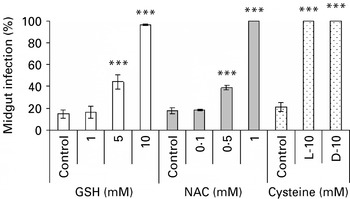
The effects of GSH, NAC and cysteine on trypanosome midgut infection rates in male G. m. morsitans, are compared in Fig. 1 which shows a clear dose response for each compound. Addition of GSH to the bloodmeal at 5 or 10 mm concentrations significantly (P<0·001) increased midgut infection rates from 15% control (number of flies dissected, n=88) to 44% (n=91) and 97% (n=92) respectively. Addition of 0·5 or 1 mm NAC also significantly (P<0·001) increased midgut infections from 17% control (n=103) to 39% (n=98) and 100% (n=106) respectively. Addition of 1 mm GSH or 0·1 mm NAC resulted in midgut infection rates of 16% (n=92; P=0·817) and 18% (n=98; P=0·882) respectively, not significantly different from controls. There were no significant differences in midgut infection rates between male and female G. m. morsitans fed GSH (data not shown). The effects of 10 mm L- or D-cysteine on trypanosome midgut infection rates in male G. m. morsitans are also shown in Fig. 1. Addition of either L- (n=117) or D-cysteine (n=113) to the infective feed significantly (P<0·001) increased midgut infections from 21% control (n=119) to 100%.
Effect of GSH, NAC and L- or D-cysteine on midgut infections of Trypanosoma brucei brucei in male Glossina morsitans morsitans. Flies were infected at their first feed, the bloodmeal containing GSH, NAC or cysteine (L- or D-), dissected 10 days later and midguts examined for trypanosome presence by microscopy. Control flies were untreated. Data presented as the mean±s.e.m. from 3 experiments. Significance: *** P<0·001 versus the corresponding control values.

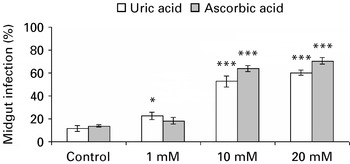
The effects of uric and ascorbic acids on midgut infections of T. b. brucei in male G. m. morsitans are shown in Fig. 2 which shows a dose response for both compounds. The addition of 1 mm, 10 mm or 20 mm uric acid significantly increased (1 mm: P=0·043; 10 mm and 20 mm: P<0·001) midgut infection rates in G. m. morsitans from 12% control (n=136) to 22%, (n=125), 52% (n=122) and 61% (n=119) respectively. The addition of 10 mm or 20 mm ascorbic acid significantly increased (P<0·001) midgut infection rates from 14% control (n=95) to 64% (n=94) and 71% (n=89) respectively. Addition of 1 mm ascorbic acid resulted in infection rates of 18% (n=100), not significantly greater (P=0·413) than controls. Doses of uric acid above 20 mm could not be tested as flies refused to take an infective feed, while doses of 30 mm ascorbic acid were toxic to tsetse flies (data not shown).
Effect of uric and ascorbic acids on midgut infections of Trypanosoma brucei brucei in male Glossina morsitans morsitans. Flies were infected at their first feed, the bloodmeal containing uric acid or ascorbic acid, dissected 10 days later and midguts examined for trypanosome presence by microscopy. Control flies were untreated. Data presented as the mean±s.e.m. from 3 experiments. Significance: *** P<0·001; * P<0·05 versus the corresponding control values.

Addition of 15 mm GSH to the bloodmeal 48 h post-infection significantly (P<0·001) raised midgut infection rates from a control value of 6% (n=106) to 50% (n=101). There was no significant difference (P=0·759) in midgut infection rates when 15 mm GSH was added to the bloodmeal 72 h post-infection (control=14% (n=99), treated=16% (n=102)).
Injection of 150 μg of GSH into the haemolymph of G. m. morsitans (equivalent of a bloodmeal dose of 15 mm) had no significant (P=0·803) effect on midgut infection rates which were 8% (n=74) compared to the control value of 11% (n=71).
Catalase, superoxide dismutase, glutamate, cystine, ornithine and serotonin had no significant effect on midgut infection rates (data not shown).
DISCUSSION
We have shown here that the addition of the antioxidants GSH, NAC, cysteine, ascorbic acid and uric acid to the bloodmeal significantly increased trypanosome midgut infection rates in G. m. morsitans suggesting that ROS promote trypanosome death in the fly midgut. Trypanothione, the main intracellular reducing agent in trypanosomes (Fairlamb et al. Reference Fairlamb, Blackburn, Ulrich, Chait and Cerami1985), comprises 2 molecules of GSH (composed of amino acids: glutamic acid, L-cysteine and glycine) linked by 1 molecule of spermidine. Both L- and D-cysteine possess the same reducing power and in the present work both promoted 100% midgut infection rates in G. m. morsitans suggesting that thiols detoxify the tsetse midgut environment. Since L-cysteine but not D-cysteine is used in protein synthesis, it is unlikely that these effects result from the synthesis of trypanothione or other proteins by the trypanosome itself (Duszenko et al. Reference Duszenko, Muhlstadt and Broder1992). NAC, which is able to cross cell membranes, was more effective in preventing trypanosome death in tsetse at lower concentrations than GSH, which is not cell permeable (Laragione et al. Reference Laragione, Bonetto, Casoni, Massignan, Bianchi, Gianazza and Ghezzi2003), suggesting that protection of the trypanosome intracellular environment is important. GSH, when injected into the haemolymph of G. m. morsitans, failed to affect infection rates suggesting that haemolymph factors are not involved in clearance of trypanosomes from the gut.
Figarella et al. (Reference Figarella, Uzcategui, Beck, Schoenfeld, Kubata, Lang and Duszenko2006) have recently shown that ROS are involved in programmed cell death induced by prostaglandins in bloodstream form T. brucei and found that the GSH or NAC inhibited this process. Prostaglandin synthesis is a common feature of insect midguts (Buyukguzel et al. Reference Buyukguzel, Tunaz, Putnam and Stanley2002) but the ability of prostaglandins to induce cell death in bloodstream-form trypanosomes suggests a role in tsetse midgut immune responses.
Uric acid is the end product of nitrogen metabolism in most insects including tsetse (Moloo, Reference Moloo1978); Drosophila mutants unable to synthesize uric acid are more susceptible to oxidative stress than wild type flies (Hilliker et al. Reference Hilliker, Duyf, Evans and Phillips1992). Trypanosomes cannot transport nor synthesize uric acid (De Koning and Diallinas, Reference De Koning and Diallinas2000) and it is doubtful that uric acid affects trypanosome survival in tsetse via direct trypanosome metabolism. Rather, it appears that the effect of uric acid is to detoxify free radicals within the tsetse gut thereby promoting trypanosome survival.
Ascorbic acid may act in a similar manner to uric acid and reduce oxidative stress in insects; ascorbic acid content in Drosophila is quite high, even when not provided in the diet (Massie et al. Reference Massie, Shumway, Whitney, Sternick and Aiello1991). Mosquitoes in a chronic state of oxidative stress show increased refractoriness to malarial infection, exhibiting high levels of parasite melanization; however, pre-exposure of mosquitoes to ascorbic acid (by addition of ascorbic acid to larval and adults pre-infective bloodmeal) resulted in a 6-fold reduction in parasite melanotic encapsulation (Kumar et al. Reference Kumar, Christophides, Cantera, Charles, Han, Meister, Dimopoulos, Kafatos and Barillas-Mury2003). Significant levels of ascorbic acid have been detected in T. cruzi (Clark et al. Reference Clark, Albrecht and Arevalo1994) and bloodstream-form T. brucei can synthesize and transport ascorbic acid (Wilkinson et al. Reference Wilkinson, Prathalingam, Taylor, Horn and Kelly2005). In the current work higher doses of ascorbic acid (30 mm) were toxic to tsetse flies which could explain the failure to achieve 100% infection rates experimentally; this may also apply to results with flies fed uric acid amongst which higher doses had an anti-feedant effect.
Expression analysis has shown that a catalase gene is up-regulated in the posterior midgut of tsetse where bloodmeal digestion occurs while a superoxide dismutase gene is up-regulated in the midgut when compared to the flight muscle (Munks et al. Reference Munks, Sant'Anna, Grail, Gibson, Igglesden, Yoshiyama, Lehane and Lehane2005). During the current work neither catalase nor superoxide dismutase, when added to the infective bloodmeal, had any effect on trypanosome infection rates. This suggests that either these enzymes are not important in inhibition of trypanosome death, or that they are denatured in the tsetse midgut; one of the superoxide dismutases found by Munks et al. (Reference Munks, Sant'Anna, Grail, Gibson, Igglesden, Yoshiyama, Lehane and Lehane2005) may be an extracellular enzyme and therefore should be adapted to function in the tsetse gut.
Previous work had shown that D-glucosamine and N-acetylglucosamine could promote trypanosome midgut infections in tsetse and it was hypothesized that the bloodmeal activated specific trypanocidal lectins that were inhibited by these sugars (Maudlin and Welburn, Reference Maudlin and Welburn1987). Recently it has been shown that glucosamine can scavenge ROS (Xing et al. Reference Xing, Liu, Guo, Yu, Li, Ji, Feng and Li2005) suggesting an alternative explanation for the observed increases in midgut infection rates previously thought to be linked to inhibition of trypanocidal lectins by glucosamine (Maudlin and Welburn, Reference Maudlin and Welburn1987).
In conclusion, the work presented here shows that trypanosome cell death is normally induced in the fly midgut by ROS but trypanosomes can be protected from this process by the addition of antioxidants to the bloodmeal. Adding GSH to the bloodmeal 48 h post-infection resulted in only 50% midgut infection, suggesting that activation of the death process begins within 48 h of trypanosomes entering the fly. Since trypanosomes cannot transport uric acid, most of the free radicals involved are likely to have been produced by the midgut environment although results obtained with cell permeable NAC point to some trypanosome intracellular involvement.
ROS have been implicated in mammalian immune responses to T. brucei spp. (Wang et al. Reference Wang, Van Praagh, Hamilton, Wang, Zou, Muranjan, Murphy and Black2002) and given the many similarities between vertebrate and invertebrate immunity (Hoffmann and Reichhart, Reference Hoffmann and Reichhart2002) it is not surprising that tsetse also possess defences based on ROS.
The financial support of the Wellcome Trust is gratefully acknowledged. We thank Darren Shaw and Ian Megson for valuable discussions.