


INTRODUCTION
Estimating population parameters, such as reproductive success and survival, are first steps towards understanding population dynamics. In tropical and subtropical America, while reproductive success has been measured in some bird species (Martin Reference MARTIN1995, Morton & Stutchbury Reference MORTON and STUTCHBURY2000, Robinson et al. Reference ROBINSON, ROBINSON, ROBINSON and BRAWN2000a, Roper Reference ROPER2006), population dynamics of most species are completely unknown (but see Rangel-Salazar et al. Reference RANGEL-SALAZAR, MARTIN, MARSHALL and ELNER2008). Some regions, such as the Brazilian cerrado (savanna) (Duca & Marini Reference DUCA and MARINI2005a, Reference DUCA and MARINIb; Lopes & Marini Reference LOPES and MARINI2006, Marini & Garcia Reference MARINI and GARCIA2005) and northern Argentina (Auer et al. Reference AUER, BASSAR, FONTAINE and MARTIN2007), are gradually becoming better known with respect to breeding biology, but much is yet to be done (Lyon et al. Reference LYON, CHAINE and WINKLER2008, Martin Reference MARTIN1995). Typically, few attempts are made to infer population trends in these studies, however, those trends are what we need to better understand, considering the ever increasing threats from habitat loss and other anthropic environmental changes (Aleixo Reference ALEIXO1999, Brooks & Balmford Reference BROOKS and BALMFORD1996, Christiansen & Pitter Reference CHRISTIANSEN and PITTER1997). Apparently, data are considered insufficient to adequately estimate population trends and therefore estimates of population parameters are often not forthcoming.
Evolution of avian life histories has a long history of debate, much of which was instigated from observations of birds in tropical America (Ricklefs Reference RICKLEFS2000). Nonetheless, today tropical, subtropical and southern temperate regions are poorly studied and consequently, poorly understood in terms of life histories that may inform that debate. The Atlantic Forest of south-eastern Brazil is rich in species in a wide variety of taxa, including many endemic species of plant and animal (Machado & da Fonseca Reference MACHADO and DA FONSECA2000, Morellato & Haddad Reference MORELLATO and HADDAD2000). Climatically, the region is a transition between tropical and southern temperate realms, thus understanding life histories of species here may provide important information for understanding avian life-history evolution.
Gnateaters, in the family Conopophagidae, are in this group of poorly studied southern birds, including eight species in the genus Conopophaga and two in the genus Pittasoma (Rice Reference RICE2005, Ridgely & Tudor Reference RIDGELY and TUDOR1994). They comprise relatively small, stocky and plump birds of the forest understorey. Exclusively South American, these birds are poorly known because they are relatively quiet and forage on the forest floor, much like typical antpittas.
Here, in a first attempt at estimating population parameters, we describe the annual cycle of reproduction and survival of the black-cheeked gnateater (Conopophaga melanops, Vieillot 1818), a species endemic to the Atlantic Coastal Forest of eastern Brazil. We use these data to estimate population growth rates and examine the possibility that testable hypotheses may be developed with even short-term data and which may direct future research.
METHODS
Study site and species
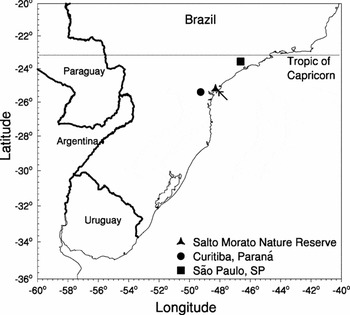
The black-cheeked gnateater was studied in the Salto Morato Nature Reserve (SMNR, 25°13′S, 48°17′W), in coastal lowland tropical forest, in the state of Paraná, Brazil (Figure 1). The reserve, comprising approximately 2300 ha, is in a larger matrix of mixed successional stages of Atlantic Forest (> 400 000 ha), contiguous with the largest area of well-preserved Atlantic Forest in South America (FBPN 2001). While technically subtropical due to latitude, the forest is tropical humid, with an annual average temperature of ~22°C and precipitation of 2000 mm (Maack Reference MAACK2002). The annual cycle may be divided into two seasons. May–September is cooler and drier, with temperatures varying between 2–35°C and 10% of the annual rainfall. October–April is warmer and wetter and temperature varies from 8–38°C with 90% of the annual rainfall (SIMEPAR, data provided on request, http://www.simepar.br/). The study area comprised ~20 ha within the reserve, near a river and with varying topography (30–100 m elevation) and a mix of vegetation from relatively young floodplain to mature forest.
Study area at Salto Morato Nature Reserve, in coastal Paraná, in southern Brazil.
We wished to attempt an examination of any association of breeding season with climate. Thus, climate data from the local weather station (SIMEPAR, the nearest station ~40 km, in Paranaguá) were used. Day-length, however, is an astronomical phenomenon, and so we used tabulated data found on-line (http://aa.usno.navy.mil/data/docs/RS_OneYear.php). Rainfall is quite variable and so we used crude weekly rainfall and smoothed rainfall (the average rainfall of the week in question plus the preceding and following week). Rainfall and temperature were examined over time to determine whether either provides cues that birds might use to indicate the breeding season.
The black-cheeked gnateater is relatively common and is the only species in the family that is endemic to Atlantic Forests, found from the northern coastal half of the state of Santa Catarina in the south, almost to the state of Rio Grande do Norte in the north, where suitable habitat still remains (Ridgely & Tudor Reference RIDGELY and TUDOR1994, Sick Reference SICK1997). Past or present fragmentation of its Atlantic Forest habitat has resulted in genetic divergence of local populations, suggesting that this relatively sedentary species may further suffer from continued deforestation (Lunardi et al. Reference LUNARDI, FRANCISCO and GALLETI2008). As is typical of the family, this gnateater is insectivorous and forages mostly on the ground (Alves & Duarte Reference ALVES and DUARTE1996). The nest is a low platform built near the ground on a horizontal palm leaf or branches and the clutch size is invariably two eggs (Hillman & Hogan Reference HILLMAN and HOGAN2002, Hilty Reference HILTY1975, Sánchez & Aponte Reference SÁNCHEZ and APONTE2006, Willis et al. Reference WILLIS, ONIKI and SILVA1983). This species is sexually dimorphic: males have a black mask and rufous cap that are lacking in the more uniformly coloured females. Nests are cared for by both sexes (Alves et al. Reference ALVES, ROCHA, VAN SLUYS and VECCHI2002), as is typical of this and the sister families Formicariidae and Thamnophilidae (Ridgely & Tudor Reference RIDGELY and TUDOR1994).
Adult gnateaters were captured using mist-nets (2.5 × 12 m, 30 mm mesh size) placed at convenient locations anywhere in the study area. Recordings of gnateater songs were used to attract the birds to the nets (Lima & Roper Reference LIMA and ROPER2009). When nets were placed near nests, they were continuously monitored and removed immediately after capture. Captured birds were uniquely colour-banded and banded with permanent metal bands (provided by CEMAVE, the Brazilian governmental branch that oversees bird banding). Banding, measurement and release of birds were all at the site of capture. Young gnateaters were banded prior to fledging when possible. Young birds were taken from the nest, measured, uniquely colour-banded and returned to the nest several days prior to fledging, to attempt to ensure that they did not leave the nest prematurely.
Nests searches and monitoring
From July 2006–April 2007, to find nests, adults were followed when carrying nesting material or while feeding young and some nests were found when searching the appropriate locations. Date and status (construction, presence of eggs or young) were noted for all nests, after which they were checked every 3–5 d. Nests were monitored more frequently during egg laying and hatching to allow better estimation of the associated time intervals. Nests were observed from the greatest distance possible to reduce possible observer influences.
Nest fate was determined by the evidence at the nest. Successful nests were those that fledged young. Nest failure due to predation was assumed if eggs disappeared prior to hatching, or the young disappeared prior to the minimum date possible for fledging and adults were never found with fledged young. Other forms of nest failure were noted when possible. Daily nest survival rate was estimated using the program MARK (version 5.1, G. C. White, http://www.cnr.colostate.edu/~gwhite/mark/mark.html) (Dinsmore & Dinsmore Reference DINSMORE and DINSMORE2007).
Survival of adults and young
To estimate survival, monthly censuses were carried out from October 2006 to September 2007. During these censuses, all territories were visited within an interval of 1–2 d, pairs and young birds were located and individuals with colour-bands were noted. Monthly encounters with marked individuals were used to estimate monthly survival rates using the program MARK (version 5.1), which were then converted to annual survival rate.
Territory mapping
Territories were mapped by modifying a map of the reserve that includes trails in and near the study area on which reference points were established by a combination of GPS reference points and triangulation. When marked birds or nests were found, the distance and compass angle to the nearest reference point was measured, allowing the estimation of XY coordinates for each sighting and nest. Territory size was estimated with these XY coordinates and the program Kernelhr (Version 4.28 1998; Worton Reference WORTON1989), using fixed kernels and least squares cross validation.
Population growth (r)
We wished to infer population trends in this study. Thus, we used the values we estimated from nesting success, adult and young survival, to estimate the population growth rate, r, following Odum (Reference ODUM2004) and Stahl & Oli (Reference STAHL and OLI2006). At its simplest (Odum Reference ODUM2004), r is calculated by arrivals and departures of individuals in the population. Thus, r = a – d. Arrivals, a, are merely calculated as fledglings produced plus new individuals that appear in the population through immigration. Departures, d, are those individuals that disappear from the population (d = 1 – P; where P is survival rate). In practice, departures may occur through mortality or emigration.
To estimate r following Stahl & Oli (Reference STAHL and OLI2006), the following equation is used:

where P a is adult survival, α is age at maturity in years, P j is juvenile survival, F = mP j, where F is average fertility per female, m is fecundity (fledglings per monitored female). Substituting the appropriate values we arrive at λ, from which we may calculate r (as λ = er). We examined several values estimated from the data to better understand population growth and stability and which parameters should be most influential in population dynamics.
RESULTS
Pairs
A total of 18 gnateaters were caught (10 males, 8 females), 16 of which were captured prior to the end of October 2006. Only males were seen building nests based on six observations of four pairs at four nests observed during construction. Both adults carried out parental activities (incubating, feeding young, removing faeces; n = 4 nests of different pairs). Gnateaters are apparently permanently monogamous although pair bonds may break. From July to September, when any individual was encountered it was invariably accompanied by the other member of the pair (n = 39). From September to December, one or the other individual of a pair was often found (n = 106) when the other was occupied with nest care in some way (incubating, feeding young, or otherwise near the nest). Once fledging occurred, pairs were again found foraging in pairs, sometimes with young birds from the most recent nest (n = 8 observations of three pairs with successful nests). After failed nesting attempts due to predation (not inclement weather), one (n = 2, one male and one female), or both (n = 1) members of the pair disappeared from their territories with no sign of predation of the adults at the nest. Since there was no evidence of predation of the adult birds at nests, we interpret this as territory and mate abandonment subsequent to nest predation.
Breeding season
The first nest was found under construction on 12 October 2006 and was probably the first nest of the year in the study area because no other evidence (such as young birds) was found that indicated any prior attempt by any other pair. The last nest, found under construction on 12 January 2007, was abandoned a few days later, apparently prior to egg-laying. The last date of an active nest was 20 January when the young fledged from the nest. This interval, 12 October–20 January, is 100 d (Figure 2).
Climate at Salto Morato Nature Reserve for 1 y, bracketed around the study season and beginning near the southern winter solstice (21 June). On all graphs, the right ordinate axis is day-length (h) shown as the dashed line: weekly total rainfall and smoothed rainfall (a), weekly minimum (b) and weekly maximum temperatures (c). The first vertical line indicates the date of the first nesting attempt while the second vertical (dashed) line indicates the date of the last active nest.

If climate influences the breeding season, how it does so is not obvious. There are no clear climatic trends that might be associated with nesting, or precede nesting and thus may act as a trigger (Figure 2). Both rainfall and variation in rainfall increase during the beginning of the breeding season (Figure 2a). Smoothed rainfall is greater during the breeding season (mean = 66.6 mm wk−1) than the non-breeding season (45.6 mm wk−1). However, neither rainfall nor smoothed rainfall change in any consistent way that might indicate a cue preceding the onset of breeding (Figure 2a). Temperatures are somewhat greater during the breeding period than prior to breeding (Figure 2b, c). Yet, only minimum temperature is lower during the non-breeding season (13.9°C) than the breeding season (17.1°C). High temperatures do not differ between breeding and non-breeding seasons (both means ~ 32°C). The only other climatic variable that is always consistent is photoperiod.
Nest construction lasted 14 and 20 d in the two nests for which the interval between initiation and egg laying was observed. The interval between egg-laying and fledging was 38, 41 and 44 d (n = 3 nests that were followed for the entire interval). Two fledglings were seen more than twice in their natal territory and the interval from fledging to the last sighting was 65 d. At 40 d, coloration of the young was already sexually dimorphic. By 60 d, the plumage of the juvenile birds was very similar to that of the adults (n = 2 marked juveniles from one nest).
Nest and reproductive success
Fifteen nests were well-monitored, but partial information (including success) was available for 18 nests. Clutch size was two in 17 nests, one in the other. Of 10 pairs, one pair attempted three nests, three pairs attempted two nests and six pairs nested only once. Also, all renesting occurred after failed nesting attempts, and no pair successfully nested more than once.
Nest survival rate was 0.966 d−1 (SE = 0.0115), with 4 successes in 18 attempts (22%, or 1:4.5 attempts). Nine nests failed due to predation, four failed during torrential rains and one nest was abandoned for unknown reasons. Of the nests that were preyed on, six appeared undisturbed. Total production of young was 0.36 per adult, based on eight young of the 22 adults.
Adult and fledgling survival
Eight of the original 18 previously captured and marked adults were seen in the area at the end of the study, approximately 1 y after first capture, for an apparent annual survival rate of 44% y−1. Adult survival based on monthly observations during a 9-mo interval was estimated using MARK at 0.945 mo−1 (SE = 0.024, using sine function, constant survival, constant recapture probability). We used the constant survival and recapture as the most parsimonious and it was statistically similar to the other possible models. Thus, over a 12-mo period the annual survival rate would be 0.94512 = 0.505 y−1. A total of eight nestlings were banded just before fledging. Of the eight young that were banded before fledging, six survived until they apparently left their natal territories of their own volition (32, 33, 42, 44, 64 and 65 d after fledging), and the fate of the other two was unknown.
Arrivals and departures from the population
A total of eight young were produced, 10 adults disappeared from the population and six adults arrived to take their place in the population. Thus, for the Odum (Reference ODUM2004) model a – d = 16 – 8 = 4. For the Stahl & Oli (Reference STAHL and OLI2006) model, adult survival, Pa = 0.44. Juvenile survival, Pj was given two values: first, we assumed Pj = Pa because apparently all young survived to become independent. Second, Pj = 1/2 × Pa as an extreme lower estimate following Ricklefs & Bloom (Reference RICKLEFS and BLOOM1977). Fecundity, m = 0.8 since 10 females were monitored and a total of eight young were produced. Average fertility, F = mPj = 0.8 × 0.44, or 0.8 × 0.22, for high (0.352) and low (0.176) estimates. Thus, we combined the possible values of P a, P j and F to estimate the range of likely values of r (Table 1).
Estimating population growth rate (λ) and the intrinsic rate of increase (r) following Stahl & Oli (1996) with four possible combinations of adult (Pa is constant at 0.44 y−1), juvenile survival (Pj), m (production rate of females per female) and fertility rate (F), followed by a hypothetical value of adult and juvenile survival rates that would result in a stable population. Observed values all suggest rapid population decline. For a stable population (λ ≈ 1, r ≈ 0), the last two rows illustrate adult survival rates that would be required given the values of the other parameters.

Estimating r
With N = 0.36, I = 0.16 and S (and also Pa,) = 0.44, then a = 0.52, d = 0.56 and r is approximately zero (0.52 – 0.56 = –0.04). Alternatively, following Stahl & Oli (Reference STAHL and OLI2006):

Which, in this one generation study works out to be, since α = 1, then P α-1j=1 and the equation reduces to:

and if P a = P j, then the last two terms cancel out and the equation is reduced to:

Thus, with P a = 0.44, P j = P a or 1/2 P a, and m = 0.4 (apparent fledging success of female offspring) or m = 0.3 (apparent survival to independence of female offspring), F = 0.176, 0.088, 0.132, 0.036 (Table 1). Population growth (λ) rate with these values varies from a maximum of 0.616 to a minimum of 0.475 (Table 1).
Population size and spatial distribution
A total of 18 adults (11 males, 7 females) and eight nestlings were banded in 10 territories. During the study, these individuals were sighted (recaptured) another 212 times (n = 14 for young birds, 144 for males, 61 for females). One individual was encountered 25 times, nine were encountered 11 times and two individuals were only seen at the time of capture.
Territory size was estimated for eight pairs based on sighting coordinates. Sightings (10–38 per pair) were temporally independent. Territory size was correlated with the number of observations used in estimating size (r = 0.78, df = 8, P < 0.05). Controlling for the number of observations with regression, territory size varied from 2.14–3.74 ha (SE = 0.166 ha). This gives a density estimate of 0.27–0.47 pairs ha−1 (Figure 3).
Map showing sighting locations of the nine different pairs (each symbol indicates a different pair) and their nests during 2006–2007.

Territories may not be permanent. All pairs that attempted more than one attempt (n = 4) did so within the limits of their territory. Also, pairs that were in the area when reproduction began in 2007 (60%) were still within their territories of 2006, as well as individuals that lost a partner from the previous year (n = 3). However, four pairs abandoned their territories following nest failure due to predation prior to the beginning of the 2007–2008 breeding season. Thus territories and pairs seem to be stable when reproduction is successful.
DISCUSSION
The black-cheeked gnateater appears to have a life history atypical of tropical species. Relatively high reproductive success, a short breeding season and low adult survival are more typical of temperate birds (Karr et al. Reference KARR, NICHOLS, KLIMKIEWICZ and BRAWN1990, Ricklefs Reference RICKLEFS1969, Skutch Reference SKUTCH1985). While adult survival rate was calculated at only 0.44 y−1 we suspect that this underestimates the true value, since it would imply a very rapidly declining population. This low survival rate suggests that territories may not be permanent and that pairs may move to new territories following nest failure. Thus, based on these data, the simple estimate (Odum Reference ODUM2004) of r = −0.04 (λ = 0.961) suggests a stable population. However, estimates following Stahl & Oli (Reference STAHL and OLI2006) suggest a rapidly declining population (Table 1). Indeed, if these rates were correct, then the population would quickly disappear. Yet, our personal observations beginning in 2003 show that these birds are consistently found in this area. Thus, we suspect that we underestimate adult survival, perhaps due to emigration following unsuccessful nesting attempts.
If we assume that the reproduction rate is a correct estimate for this population, simple substitution in the equations allows us to calculate the adult and juvenile survival rates that would lead to a stable population. Thus, we see that if adult survival varies between 80–90% y−1, and juvenile survival varies from half that of adults to the same as adults, the population would be stable (Table 1). We will return to this question below.
Breeding season
Understanding the proximate factors, or cues, that might be associated with the initiation of breeding is complex at this subtropical location. Determining whether climate is important would require several years of breeding data for the variation in the timing of breeding and that of temperature or rainfall to show an association. At this latitude, rainfall is quite variable throughout the year and does not seem to provide a regular and predictable stimulus that might initiate breeding. Temperature and photoperiod are very strongly correlated and so either or both might be important (Marques et al. Reference MARQUES, ROPER and SALVALAGGIO2004). During this year of study, climate was quite variable, hence it is difficult to identify cues for breeding. If food abundance is important, then presumably climate may play a role due to its influence on insect abundance patterns (Wolda Reference WOLDA1992). Day-length, shown to be important for some species in the southern hemisphere (Sick Reference SICK1997, Stutchbury & Morton Reference STUTCHBURY and MORTON2001), and the closely correlated temperature, are the only climatic variables consistent and predictable enough to be important for tropical species (Hau et al. Reference HAU, WIKELSKI and WINGFIELD1998, Wikelski et al. Reference WIKELSKI, HAU and WINGFIELD2000). Regardless, long-term or experimental data are necessary to tease apart the potential cues for initiating and ending the breeding season.
Interestingly, breeding season length (about 100 d) of the gnateater is somewhat shorter than most insectivorous species of the region for which records exist. For example, Elaenia chiriquensis (5 mo, Medeiros & Marini Reference MEDEIROS and MARINI2007), Macropsalis forcipata (5 mo, Pichorim Reference PICHORIM2002), Augastes scutatus (6 mo, Costa & Rodrigues Reference COSTA and RODRIGUES2007) and the commonly accepted 6 mo for Atlantic Forest species (Maia-Gouvêa et al. Reference MAIA-GOUVÊA, GOUVÊA and PIRATELLI2005, Sick Reference SICK1997) are all much longer than that of the gnateater. Some other tropical species have similar breeding-season lengths (Cacicus haemorrhous, 3.5 mo, Duca & Marini Reference DUCA and MARINI2004, Lathrotriccus euleri, 4 mo, Aguilar et al. Reference AGUILAR, LEITE and MARINI1999) as well as subtropical species (Ricklefs & Bloom Reference RICKLEFS and BLOOM1977).
Territoriality
Territory size for the gnateater varies around an average of 2.94 ha, or 34 pairs per 100 ha. This is similar to that of other, closely related, tropical species, such as the thamnophilids or formicariids (Table 4 in Robinson et al. Reference ROBINSON, ROBINSON, ROBINSON and BRAWN2000a, Reference ROBINSON, BRAWN and ROBINSONb). While the family Conopophagidae is poorly studied, the two other species for which data are available had much larger territories. In the Brazilian Amazon, C. aurita had large territories (mean ± SE = 6.25 ± 3.55, or 16 pairs per 100 ha, Stouffer Reference STOUFFER2007), while in Peru, C. peruviana had even larger territories, with only three pairs per 100 ha (Terborgh et al. Reference TERBORGH, ROBINSON, PARKER, MUNN and PIERPONT1990). Here we found nine territories in somewhat less than 25 ha and we believe that this is typical of this region. While small, the territory size of C. melanops is more similar to that of other Atlantic Forest species, such as Thamnophilus caerulescens, Dysithamnus mentalis and Pyriglena leucoptera (Duca et al. Reference DUCA, GUERRA and MARINI2006) than to congeneric Amazonian species.
Monogamous and insectivorous, C. melanops is typical of understorey insectivores in the tropics (Stutchbury & Morton Reference STUTCHBURY and MORTON2001). However, monogamy may not be permanent, especially following nest predation when one or both individuals in the pair apparently abandoned the territory. In one territory, soon after abandonment by one member of the pair, that individual was replaced. When both members of the pair left the territory after nest predation, the territory remained unused for the remainder of the breeding season. We suspect that this may be a reproductive strategy in which, after nest predation, one or both members seek new, perhaps better, territories. If so, birds may gradually disappear and be counted as deaths in capture–recapture studies. Therefore, assuming territory permanence should be avoided.
Reproductive success and offspring survival
High nest predation rates are common in tropical systems (Martin Reference MARTIN1995, Ricklefs Reference RICKLEFS1969, Robinson et al. Reference ROBINSON, ROBINSON, ROBINSON and BRAWN2000a, Reference ROBINSON, BRAWN and ROBINSONb, Roper Reference ROPER2005) and in Atlantic Forests (Duca & Marini Reference DUCA and MARINI2005a). Thus, it is no surprise to find that predation here is also the main cause of nest loss, although a daily survival rate of 0.966 is relatively high. With 0.35 young produced per adult per year, it is unclear whether reproduction is sufficient for the population to replace itself. In comparison, the abundant E. chiriquensis in central Brazil had a rate of 0.48 young per nest rather than per adult (Medeiros & Marini Reference MEDEIROS and MARINI2007). Interestingly and perhaps due to the short breeding season, persistence in renesting was apparently not a useful strategy for insuring successful reproduction (Roper Reference ROPER2005).
Annual survival, adults and young
Survival rates for C. melanops are low, at 0.44 y−1. Adult Vireo latimeri survival is 0.74 y−1 and juvenile 0.40 y−1 (Woodworth et al. Reference WOODWORTH, FAABORG and ARENDT1999). Survival rate for the neotropical migrant Catharus ustulatus is 0.56 y−1 for adults and 0.25 y−1 for the first year birds (Gardali et al. Reference GARDALI, BARTON, WHITE and GEUPEL2003) and 0.50 y−1 for Wilsonia pusilla, another migrant (Chase et al. Reference CHASE, NUR and GEUPEL1997). Survival rates in a variety of birds vary between 0.51–0.58 y−1 (based on mist-net captures, Karr et al. Reference KARR, NICHOLS, KLIMKIEWICZ and BRAWN1990). Greater survival rates were found in Catharus frantzii in Mexico, averaging 79% y−1 (Rangel-Salazar et al. Reference RANGEL-SALAZAR, MARTIN, MARSHALL and ELNER2008), In this study, due to the possible occasional movement of pairs after failed territories, this low survival rate may be an artefact. While Karr et al. (Reference KARR, NICHOLS, KLIMKIEWICZ and BRAWN1990) estimated relatively low survival rates for tropical birds, that study was possibly biased due to the nature of the estimation and the likelihood of dispersal, or even by effects like body size or foraging guild (Brawn et al. Reference BRAWN, KARR and NICHOLS1995). Thus, if this survival rate is underestimated, then estimates of population growth rates will also be underestimated.
The nesting cycle is long in this species. From the beginning of nest construction to fledging may take more than 2 mo, with another 2 mo for post-fledging care. In the western slaty antshrike (Thamnophilus atrinucha) the nesting interval is much shorter, while post-fledging care may be similar (Roper Reference ROPER2005). An important difference is that in the antshrike, rapid renesting is possible and so each breeding season may include multiple nesting attempts, while in the gnateater, fewer nesting attempts will be possible each season. Also, the breeding season is longer in the antshrike. Thus, these results suggest that some breeding parameters are underestimated in the gnateater, or perhaps extended parental care is an adaptive strategy to increase offspring survival (Russell Reference RUSSELL2000).
Population dynamics
We recognize that population parameter estimates may be difficult to estimate with small sample sizes. Nonetheless, with these data and in context, several hypotheses and avenues for future study are indicated. First, adult survival rates (0.44 or 0.51 y−1) are low (Stahl & Oli Reference STAHL and OLI2006), even by comparison with rates in Karr et al. (Reference KARR, NICHOLS, KLIMKIEWICZ and BRAWN1990), and we believe that they are underestimated. Second, production of young does not replace those adults that disappear in any given year. Yet, the population appears to be more or less stable, despite the numbers. If stable, then this implies that adult survival is underestimated (and thus emigration is important). Perhaps this species, and others in the genus Conopophaga, use a-species strategy heretofore not observed in apparently territorial neotropical birds in which unsuccessful territories are abandoned. Subsequent absence from these territories would appear as mortality in capture–resighting studies.
We suggest that short-term studies, such as this, attempt to estimate population dynamic parameters. From these analyses we can generate useful hypotheses for future study and become more efficient and theory driven in our data gathering. We show the difficulty of discovering a causal link between climate and the reproductive period at this location. Thus, searching for that link over the short term will be unproductive. Second, some tendencies may be suggested due to the nature of these data. For example, when reproduction rates are high, population growth rates are most strongly influenced by changes in reproduction. On the other hand, when reproduction rates are low, population growth rates are most influenced by survival (Sæther & Bakke Reference SÆTHER and BAKKE2000, Sæther et al. Reference SÆTHER, ENGEN, MOLLER, WEIMERSKIRCH, VISSER, FIEDLER, MATTHYSEN, LAMBRECHTS, BADYAEV, BECKER, BROMMER, BUKACINSKI, BUKACINSKA, CHRISTENSEN, DICKINSON, DU FEU, GEHLBACH, HEG, HOTKER, NIELSEN, MERILÄ, RENDELL, ROBERTSON, THOMSON, TÖRÖK and VAN HECKE2004, Sibly et al. Reference SIBLY, BARKER, DENHAM, HONE and PAGEL2005, Stahl & Oli Reference STAHL and OLI2006). Therefore, once we recognize that adult survival (and perhaps juvenile) was underestimated, we must conclude that territories are not permanent. Thus, greater effort should be spent in capture–recapture (or capture–resighting) studies, since survival, rather than reproduction, provides more information with which to understand population dynamics. Similarly, in a long-term study of the ruddy-capped nightingale thrush (Catharus frantzii), survival was also shown to be most important in determining population dynamics (Rangel-Salazar et al. Reference RANGEL-SALAZAR, MARTIN, MARSHALL and ELNER2008) Nesting should be followed as much as possible, but more information (for understanding population dynamics) will come from increasing the number of individuals captured rather than the number of nests found.
Thus, by using values derived even from somewhat limited data, we have developed testable hypotheses for future work. First, we suggest that climate per se should not provide the proximate cues for the nesting cycle in Conopophaga and that to better understand the reproductive cycle researchers should look towards day length as a cue. Next, by using nesting success and adult survival data, we find an inconsistency that, if correct, would suggest rapid population decline, which is clearly not the case. Hence, survival and territory dynamics, rather than reproduction, should be more intensely studied. Therefore, short-term data may be used to estimate population parameters and can direct research to test specific hypotheses, by which further advances in understanding population dynamics in tropical birds will be more forthcoming.
ACKNOWLEDGEMENTS
Thanks to the very helpful field assistants: Flora H. de Mello-Leitão and Arthur G. Nobre. Also, for the help of the personnel of the Salto Morato Nature Reserve, especially Paulo C. Chaves, Alan Y. Mocochinsky and Bruno Xavier. Thanks to Cíntia Cornelius and Miguel A. Marini for their constructive criticisms of earlier versions of this manuscript. And, thanks to the Fundação O Boticário de Proteção à Natureza for the financial support as well as infrastructure in the field and CAPES for their financial support. We thank Susan K. Willson and an anonymous reviewer for their constructive suggestions and observations.



