





Introduction
Rice (Oryza sativa L.) is one of the most important cereal crops globally and plays an important role in maintaining food security. In Asia, rice accounts for approximately 90% of global production and is a staple food for a large proportion of the population (Bautista and Counce Reference Bautista and Counce2020). Traditionally, manual transplanting has been the primary method of rice establishment in many Asian countries. However, water shortages and a shrinking rural agricultural workforce have reduced the feasibility of this practice (Chauhan Reference Chauhan2013). Therefore, there is an increasing need to adopt sustainable rice production systems that require less labor and water.
Dry direct-seeded rice (DDSR) is an alternative establishment method that offers a more sustainable and cost-effective approach by reducing labor requirements, water use, and production costs (Liu et al. Reference Liu, Hussain, Zheng and Sun2014). China is one of the largest rice producers in the world, contributing approximately 28% of global output (Li et al. Reference Li, Lai, Gu, Wang and Zhang2025). Since the 1990s, there has been a gradual shift from traditional transplanting to DDSR systems (Zhang et al. Reference Zhang, Liu, Guo, Zhang, Sheng, Chen, Luo and Zheng2018). By 2020, DSR (including both dry- and wet-seeded systems) accounted for 30% of the total area planted to rice in China (Dai et al. Reference Dai, Luo, Zhang, Lan, Zhou and Wang2020). Specifically for DDSR, the annual planted area exceeded 400,000 ha in Anhui, Jiangxi, and Jiangsu provinces and surpassed 100,000 ha in Guangdong (Fu et al. Reference Fu, Huang, Zhong, Mai, Pan, Xu, Liu, Liang, Pan, Xiao, Hu, Hu, Li and Ye2023; Ma et al. Reference Ma, Zhang and Zhao2021; Wang et al. Reference Wang, Du, Zhou, Zeng, Tan, Pan, Shi, Wu and Zeng2021). However, weed infestation remains the main biotic challenge in DDSR due to the absence of stagnating water and reduced early crop competition (Shekhawat et al. Reference Shekhawat, Rathore and Chauhan2020). Consequently, weed infestations often result in severe crop yield losses in the DDSR system (Rao et al. Reference Rao, Johnson, Sivaprasad, Ladha and Mortimer2007; Singh et al. Reference Singh, Bhullar and Chauhan2014).
Asiatic dayflower (Commelina communis L.), an annual C3 weed in the family Commelinaceae, is widely distributed from northeast Asia to other parts of the world (Aulakh, Reference Aulakh2022; Brashier Reference Brashier1966; Faden Reference Faden1993). Seed production is the primary mode of reproduction in C. communis, with a single plant producing 5 to 80 flowers through bisexual reproduction (Li et al. Reference Li, Xu, Song, Tang, Gong, Yu, Shen, Wu, Liu and Zeng2016), and each capsule contains one to two elliptic seeds or two to four semi-elliptic seeds (Hong and DeFilipps Reference Hong, DeFilipps, Wu and Raven2000).
In China, C. communis has been reported to cause significant yield losses in soybean [Glycine max (L.) Merr.] and corn (Zea mays L.) (Yang et al. Reference Yang, Yu, Li and Dong2018, Reference Yang, Yu, Li and Dong2019), and to infest horticultural crops such as grape (Vitis vinifera L.) (Isaac et al. Reference Isaac, Gao, Li, Price and Kelton2013). Recent field observations confirm that this weed has emerged in DDSR systems in China. Indeed, weed community surveys have identified C. communis as a dominant species in paddy fields in Guangdong Province (Yue et al. Reference Yue, Feng, Tian and Liang2013) and as one of the dominant weeds in DSR fields in the Huaibei region of China (Li et al. Reference Li, Zhao and Fu2013). In South Asia, C. communis is also a major weed in zero-till and dry-seeded irrigated rice. In one study, it caused a 27% loss in grain yield in zero-till systems and comprised 18% of the total weed community in dry-seeded irrigated systems (Mishra and Singh Reference Mishra and Singh2008). The C. communis seedbank is characterized by opportunistic germination in response to favorable conditions, while seeds can remain dormant under unfavorable environments (Gómez-Vargas Reference Gómez-Vargas2012; Santiago and Micheal Reference Santiago and Micheal2009), a strategy that may favor its establishment in DDSR, where intermittent irrigation and soil disturbance create periodic germination opportunities.
In DDSR systems, effective weed management depends on predicting emergence timing, as postemergence herbicides are most efficacious against small, early-stage seedlings, and cultural tactics such as stale seedbed preparation must be timed to deplete the seedbank before crop sowing (Chauhan and Opena Reference Chauhan and Opeña2012). However, such predictions require species-specific knowledge of germination responses to temperature, moisture, and burial depth; information that is currently unavailable for C. communis in the context of Chinese DDSR.
Chemical control is currently the most efficient and cheapest weed management approach (Ramesha et al. Reference Ramesha, Anand, Krishnamurthy and Bhanuvally2019). However, due to overreliance on herbicides, C. communis has evolved resistance to glyphosate and atrazine in soybean crops (Yang et al. Reference Yang, Yu, Cui, Chen and Li2021). Therefore, integrated weed management (IWM) is considered a more sustainable method for weed control, as it combines multiple control strategies to achieve effective weed suppression (Riemens et al. Reference Riemens, Sønderskov, Moonen, Storkey and Kudsk2022). Successful implementation of IWM requires a thorough understanding of weed biology and ecology, particularly the factors that influence seed germination and seedling emergence. Knowledge of weed germination ecology can be used to guide the timing of field scouting (by predicting peak emergence flushes based on soil temperature and moisture), the timing of postemergence herbicide applications (when seedlings are most vulnerable, i.e., at the cotyledon to early–leaf stage), and cultivation practices (by adjusting tillage depth to bury seeds below the depth that does not permit emergence). These explicit linkages between ecological thresholds and management actions are essential for translating research findings into practical IWM decision–making.
Given the increasing importance of C. communis in DDSR systems, a quantitative understanding of its germination ecology is a critical prerequisite for designing evidence–based IWM programs in Chinese DDSR systems. This study was conducted to evaluate the effects of alternating day/night temperature, light, water stress, salinity, heat exposure, burial depth, and wheat residue cover on the germination and seedling emergence of C. communis.
Materials and Methods
Seed Description
A series of experiments was conducted from March to August 2025 at the Institute of Plant Protection, Jiangsu Academy of Agricultural Sciences (JAAS), Nanjing, China (33.40°N, 120.07°E). Mature seeds of C. communis. were collected in October 2024 from DDSR fields located in Yancheng (33.21°N, 120.02°E), Jiangsu Province. Seeds were sampled from approximately 1,000 randomly selected plants across about 60 ha of DDSR fields, cleaned, air-dried, and stored in sealed plastic containers at room temperature (25 C) until further use. The seeds were carefully separated from the enclosing glumes by hand, leaving the seed coats intact. The average dry weight of 1,000 seeds was 7.52 g. No scarification or testa removal was performed for any treatment.
General Germination Test
For germination tests, 25 seeds were evenly placed in each 9-cm-diameter plastic petri dish lined with two layers of Whatman No. 1 filter paper (Whatman International, Maidstone, Kent, UK). The dishes were sealed with Parafilm® and incubated under a 12-h light/12-h dark photoperiod at 30/20 C, which corresponds to the average temperature during June and July (early rice growth stage) in Jiangsu Province. Preliminary tests indicated that no additional germination occurred after 21 d; therefore, germination was assessed at 21 d and defined as radicle emergence. Except for the temperature and light treatments. Each treatment was replicated four times per run, and all experiments were conducted in two independent runs.
Temperature and Light
To evaluate the effects of temperature and light, seeds of C. communis were incubated under five alternating temperature regimes: 20/10, 25/15, 30/20, 35/25, and 40/30 C. Crucially, all five temperature regimes were factorially combined with each of the two light conditions: a 12-h light/12-h dark photoperiod and continuous darkness (24-h dark; achieved by wrapping petri dishes in four layers of aluminum foil). These temperature regimes were selected to simulate seasonal variability in DDSR environments in Jiangsu Province. The experiments were laid out in a randomized complete block design with four replications per treatment, and the experiment was repeated in two independent runs over time.
Osmotic Potential
To assess the effect of water stress on germination of C. communis, 25 seeds were placed in each 9-cm-diameter petri dish containing solutions with osmotic potentials of 0, −0.1, −0.2, −0.4, −0.6, −0.8, and −1.6 MPa. These solutions were prepared using 0.0, 93.6, 132.4, 187.2, 264.7, and 366.5 g of polyethylene glycol 8000 L−1 of distilled water (Michel and Radcliffe Reference Michel and Radcliffe1995). Petri dishes were incubated at 30/20 C under a 12-h light/12-h dark photoperiod for 21 d. The experiment was conducted in two independent runs, with four replications per treatment in each run.
Salt Stress
To assess the response to salt stress, sodium chloride (NaCl) solutions at eight concentrations (0, 50, 100, 150, 200, 250, 300, and 350 mM) were used. Each petri dish contained 5 ml of its respective solution, and incubation conditions were the same as those used in the osmotic stress experiment. Germination was recorded after 21 d. The experiment was conducted in two independent runs, with four replications per treatment in each run.
High-Temperature Exposure
To evaluate heat tolerance, 700 seeds were divided into 28 paper bags, each containing 25 seeds. The bags were assigned to seven temperature treatments (40, 60, 80, 100, 120, 140, and 160 C), with four replicates per treatment. This experiment was conducted in two independent runs. Seeds were exposed to the target temperature in an oven for 5 min to evaluate the thermal threshold required for seed mortality. Posttreatment, seeds were transferred to petri dishes and incubated at 30/20 C with a 12-h light/12-h dark photoperiod for 21 d. The experiment was conducted in two independent runs, with four replications per treatment in each run.
Burial Depth
To investigate the effect of burial depth on seedling emergence, seeds were sown at depths of 0, 1, 3, 5, 7, 9, 11, and 13 cm in plastic pots (9-cm diameter, 18-cm height). The soil (clay loam) was mixed with perlite and coarse sand to improve soil permeability and water retention. It contained 2.0% organic matter and had a pH of 6.9. Pots were subirrigated to maintain sufficient soil moisture. All pots were placed in an incubator set to 30/20 C with a 12-h photoperiod. Emergence was recorded daily for 30 d. The experiment was conducted in two independent runs, with four replications per treatment in each run.
Crop Residues
To evaluate the effect of crop residue on seedling emergence, 25 seeds of C. communis were placed on the soil surface in each plastic pot (9-cm diameter, 18-cm height). The soil mixture was the same as that used in the burial depth experiment. Wheat (Triticum aestivum L.) straw from the locally cultivated variety ‘Yangmai 34’ was used as mulch. After being oven-dried and cut into 3- to 5-cm fragments, straw was applied at six rates: 0, 2, 4, 6, 8, and 10 Mg ha−1. Pots were maintained in an incubator at 30/20 C (day/night) with a 12-h photoperiod. Subirrigation was employed to use adequate soil moisture via capillary action. Seedling emergence was recorded 30 d after sowing, and aboveground fresh biomass was measured. The experiment was conducted in two independent runs, with four replications per treatment in each run.
Statistical Analysis
All experiments were conducted in two runs from March to September 2025. Experiments were arranged in a randomized complete block design with four replicates. The arcsine square-root transformation did not improve the homogeneity of variance according to Bartlett’s test. Although this transformation was ineffective, we retained the untransformed data for ANOVA, because the experimental design was balanced, residual diagnostics revealed no severe heteroscedasticity, and nonparametric tests (Kruskal–Wallis) produced significance patterns identical to those of ANOVA, supporting the robustness of the parametric results. As no significant differences (P > 0.05) were observed between experimental runs, data were pooled and analyzed using ANOVA. Graphs were plotted using SigmaPlot v. 12.0 (Systat Software, San Jose, CA, USA).
A three-parameter sigmoid model was fit to germination or emergence data using SigmaPlot v. 10.0 (Systat Software). The fitted equation was:
 $G = {G_{\rm max}}/\left\{ {1 + {\rm exp}\left[ { - \left( {x - {x_{50}}} \right)/{b_{rate}}} \right]} \right\}$
where G is the predicted germination (%) at the environmental factor level x, G max is the maximum germination (%), x 50 is the environmental factor level causing 50% inhibition of germination, and b rate is the slope. For the emergence parameter, the equation was:
 $E = {E_{\rm max}}/\left\{ {1 + {\rm exp}\left[ { - \left( {x - {T_{50}}} \right)/{E_{\rm rate}}} \right]} \right\}$
where E is the predicted emergence (%) at the environmental factor level x, E max is the maximum emergence (%), T 50 is the environmental factor level causing 50% inhibition of emergence, and E rate is the slope.
Results and Discussion
Effect of Alternating Temperature and Light on Germination
Germination of C. communis varied with temperature and light conditions. Germination occurred at day/night temperatures ranging from 25/15 to 40/30 C under all light regimes (Figure 1). Maximum germination (93% to 98%) was observed at 35/25 and 40/30 C, regardless of the light regime. In contrast, C. communis was sensitive to low temperatures, with no germination observed at 20/10 C under any light regime. At day/night temperatures of 25/15 and 30/20 C, light had a greater effect on germination than temperature, as germination was higher under alternating light/dark conditions than under complete darkness.
Effect of temperature and light on the germination of Commelina communis. The error bars represent ± standard errors of the means (n = 8). Different letters indicate significant differences at P < 0.05.

These results indicate that C. communis can germinate over a wide temperature range (25/15 to 40/30 C), suggesting strong adaptability to varying thermal conditions in Chinese DDSR fields. Hence, its establishment may occur across spring, summer, and autumn; however, thermal suitability alone does not guarantee emergence, as photoperiod and seed dormancy status also regulate seasonal emergence patterns. A similar trend has been reported for other rice weeds; for example, eclipta [Eclipta prostrata (L.) L.], reached up to 94% germination at 35/25 C under light/dark conditions (Li et al. Reference Li, Lai, Gu, Wang and Zhang2025), while weedy rice (Oryza sativa f. spontanea) maintained 98% germination at 40/30 C (Zhang et al. Reference Zhang, Xue, Gu, Wang and Chauhan2024). Both species are common in our study region, underscoring the relevance of our findings to local field conditions. The temperature regimes tested here coincide with local soil-warming periods after sowing, suggesting that peak emergence would likely occur during early crop establishment, a critical window for timely weed control.
Seed germination responses to light are species-specific. In this study, germination of C. communis did not differ between light and dark conditions at optimal temperature, indicating light is not a limiting factor for germination. Similar findings have been reported for spiny sowthistle [Sonchus asper (L.) Hill] (Lee et al. Reference Lee, Mahajan, Beregszaszi and Chauhan2024). This light-independent germination enables C. communis seeds to germinate on the soil surface or under shallow burial, where light availability is limited. In zero-tillage DSR systems, where seeds often remain on or near the soil surface, this trait may facilitate rapid germination and early seedling establishment, thereby enhancing its competitive ability with rice.
Effect of Osmotic Potential on Germination
Germination of C. communis declined sharply from 88% to 8% as osmotic potential decreased from 0 to −0.6 MPa (Figure 2). Germination was completely inhibited at −0.8 MPa, and the osmotic potential required for 50% inhibition was −0.32 MPa.
Effect of osmotic potential on the germination of Commelina communis incubated at 30/20 C (day/night) with a 12-h photoperiod for 21 d. The line represents a three-parameter sigmoid model fit to the data, and error bars represent the standard errors of the means (n = 8).

Osmotic potential is an important driver of seed germination. Our findings revealed that severe water deficiency can reduce C. communis seed germination by restricting water uptake required for seed imbibition (Bittencourt et al. Reference Bittencourt, Bonome, Trezzi, Vidal and Lana2017). In comparison, germination of smallflower umbrella sedge (Cyperus difformis L.) declined from 94% to 10% as osmotic potential decreased from 0 to −0.6 MPa (Derakhshan and Gherekhloo Reference Derakhshan and Gherekhloo2013). Seed burial depth also interacts with moisture availability in determining weed establishment. For instance, C. difformis emergence was nearly zero at depths ≥1 cm (Ismail et al. Reference Ismail, Mansor and Rahman2007), suggesting that shallow seed placement (0 to 0.5 cm) is essential for exploiting surface moisture. Therefore, C. communis is more likely to infest DDSR fields under adequate soil moisture or irrigated conditions during the rice-growing season, provided that its seeds are near the soil surface; deep tillage or excessive seeding depth would greatly reduce the risk of infestation.
Effect of Salt Stress
Seed germination of C. communis declined sigmoidally with increasing NaCl concentration (Figure 3). Germination was highest (92%) in the 0 mM (control) treatment and decreased significantly to 2% at 300 mM. The fitted model predicted that a NaCl concentration of 191 mM could inhibit C. communis germination by 50%.
Effect of sodium chloride concentration on the germination of Commelina communis after incubation at 30/20 C (day/night) with a 12-h photoperiod for 21 d. The line represents a three-parameter sigmoid model fit to the data, and vertical bars represent the standard errors of the means (n = 8).

Salt stress induces varied changes in seed germination among weed species. For instance, smooth barnyardgrass (Echinochloa glabrescens Munro ex Hook. f.) exhibited approximately 60% germination at 200 mM salinity in the Philippines (Opeña et al. Reference Opeña, Chauhan and Baltazar2014), whereas germination of wild mustard (Sinapis arvensis L.) was reduced by 68% and 43% at 80 mM NaCl in two Australian populations (Singh et al. Reference Singh, Mahajan and Chauhan2022).
The fact that C. communis can germinate at high salt concentrations suggests its potential to establish in saline DDSR fields. The Ministry of Natural Resources, People’s Republic of China (2023) reported that China has approximately 7.66 × 10⁶ ha of saline–alkali soil. Notably, Zeng and Shannon (Reference Zeng and Shannon2000) reported that soil salinity levels of 3.4 to 7.9 dS m−1 can cause physiological stress in rice crops. Therefore, the combined effects of salinization and C. communis infestation may lead to significant yield losses.
Effect of Radiant Heat on Germination
Germination of C. communis was strongly affected by short-term exposure to high temperatures, and the three-parameter sigmoid model adequately described the response (Figure 4). Germination exceeded 75% after exposure to ≤80 C for 5 min, declined sharply at 100 C, and was completely inhibited at 160 C. The temperature required for 50% inhibition was estimated at 118 C.
Effect of radiant heat for 5 min on germination of Commelina communis seeds placed in an incubator at 30/20 C (day/night) for 21 d. The line represents a three-parameter sigmoid model fit to the data, and error bars represent the standard errors of the means (n = 8).

These results suggest that residue burning could effectively reduce the C. communis seedbank, particularly when seeds are present on the soil surface. Previous studies have shown that surface temperature during residue burning can exceed 500 C (Iizumi and Iwanami Reference Iizumi and Iwanami1965). Van de Venter and Esterhuizen (Reference Van de Venter and Esterhuizen1988) reported that exposure of seeds to burning may effectively dehydrate the seed coat and restrain embryo growth, thereby reducing weed germination in DDSR rice fields. However, residue burning has significant environmental drawbacks, including air pollution and soil degradation (Lin and Begho Reference Lin and Begho2022; Sarkar et al. Reference Sarkar, Skalicky, Hossain, Brestic, Saha, Garai, Ray and Brahmachari2020).
Seedling Emergence in Response to Burial Depth
Seedling emergence of C. communis showed a sigmoid relationship with soil burial depth (Figure 5). The highest seedling emergence (91%) was observed for seeds sown on the soil surface. However, a significant reduction occurred when the soil burial depth exceeded 3 cm, and no seedling emergence was observed beyond 13 cm. The model predicted that 50% seedling inhibition occurred at 5.8 cm (Figure 5). For surface-sown seeds, the time to 50% seedling emergence (T 50) was 10.8 d (Table 1). Increasing burial depth delayed emergence and reduced the emergence rate (Table 1).
Effect of seed burial depth on seedling emergence of Commelina communis. Seedling emergence was assessed for up to 30 d after sowing. Error bars denote the standard errors of the means (n = 8).

Parameter estimates of a three-parameter sigmoid model, E = E max/ {1 + exp[−(x − T 50)/E rate]}, fit to seedling emergence in response to seed burial depth in Figure 5.

Table 1. Long description
The table presents parameter estimates for a three-parameter sigmoid model describing seedling emergence in response to seed burial depth. It has 8 rows and 5 columns. The columns are labeled Seed burial depth (cm), Emax, T50, Erate, and R2. The row labels indicate different seed burial depths ranging from 0 to 13 cm. Each row provides specific parameter estimates for Emax, T50, Erate, and R2 values. For example, at 0 cm burial depth, Emax is 91.1 ± 2.1a, T50 is 10.8 ± 0.25f, Erate is 1.14 ± 0.12bc, and R2 is 0.99. As the burial depth increases, these values change, showing trends in seedling emergence.
a E max, maximum emergence; T 50, time to reach 50% of maximum emergence; and E rate, slope. A dash (—) indicates that no seedlings emerged when seeds were planted at a 13-cm depth. Different letters in the same column indicate a statistical difference at P < 0.05.
In general, seedling emergence may be constrained in deeper soil layers due to reduced fluctuations in temperature, light, and moisture, as well as seed size (Chauhan and Leon Reference Chauhan and Leon2014; Travlos et al. Reference Travlos, Gazoulis, Kanatas, Tsekoura, Zannopoulos and Papastylianou2020). In contrast, as mentioned earlier, C. communis does not require light for germination. This trait is completely different from that of photoblastic seeds, such as E. prostrata, which cannot emerge from deeper soil (Chauhan and Johnson Reference Chauhan and Johnson2008). Moreover, larger seeds, such as C. communis (75.2 mg per seed), can emerge from a soil burial depth of 11 cm. Large seeds possess greater energy reserves, enabling them to overcome soil resistance (Benvenuti and Mazzoncini Reference Benvenuti and Mazzoncini2018; Grundy et al. Reference Grundy, Mead and Burston2003).
These findings suggest that tillage practices strongly influence C. communis seedling emergence. Shallow tillage may stimulate emergence, whereas deep tillage can bury seeds beyond this maximum emergence depth. However, care should be taken to avoid bringing buried seeds back to the soil surface through tillage practices.
Effect of Wheat Residue on Seedling Emergence
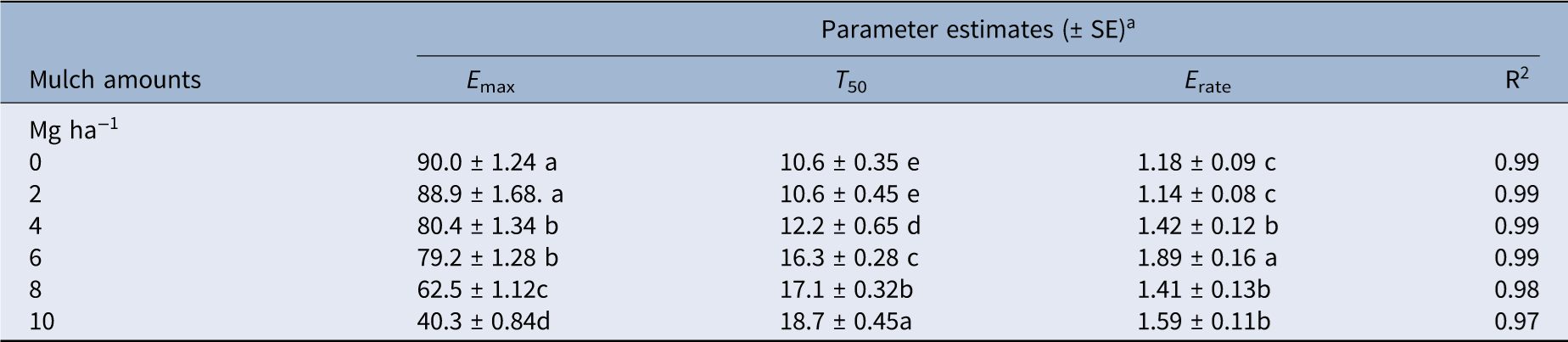
Seedling emergence of C. communis showed a sigmoid response to wheat residue cover (Figure 6). Seedling emergence declined from 90% in the control to 40% at 10 Mg ha−1 residue (Figure 6). The wheat mulch rate required for 50% inhibition was 9 Mg ha−1. Additionally, the time required to inhibit 50% emergence increased with increasing residue levels; from 10.6 d in the control to 18.7 d at 10 Mg ha−1 (Table 2).
Wheat straw mulch amounts on seedling emergence of Commelina communis. Seedling emergence was assessed until 30 d after sowing. Error bars denote the standard errors of the means (n = 8).

Figure 6. Long description
Panel A: A line graph shows seedling emergence percentage over days after sowing for different wheat straw mulch amounts. The x-axis represents days after sowing in days, and the y-axis represents seedling emergence in percent. Different symbols represent varying mulch amounts in Mg per hectare: circles for 0 Mg ha⁻¹, triangles for 2 Mg ha⁻¹, inverted triangles for 4 Mg ha⁻¹, squares for 6 Mg ha⁻¹, and open squares for 8 Mg ha⁻¹. The graph shows that higher mulch amounts delay and reduce seedling emergence. Panel B: Another line graph shows the relationship between wheat straw mulch amounts and seedling emergence percentage. The x-axis represents wheat straw mulch amounts in Mg per hectare, and the y-axis represents seedling emergence in percent. The graph includes a fitted curve with the equation E=90.0/(1+exp(-(x-9.6)/-2.1)) and an R² value of 0.99, indicating a strong fit. The graph shows a clear negative correlation between mulch amounts and seedling emergence.
Parameter estimates of a three-parameter sigmoid model, E = E max/{1 + exp[−(x − T 50)/E rate]}, fit to seedling emergence in response to wheat straw mulch amounts.

Table 2. Long description
A table comparing parameter estimates for seedling emergence with varying mulch amounts. The table has 6 rows and 5 columns. Column headers are Mulch amounts, Emax, T50, Erate, and R2. Row labels are in Mg ha-1 units. Row 1: 0, 90.0 ± 1.24a, 10.6 ± 0.35e, 1.18 ± 0.09c, 0.99. Row 2: 2, 88.9 ± 1.68a, 10.6 ± 0.45e, 1.14 ± 0.08c, 0.99. Row 3: 4, 80.4 ± 1.34b, 12.2 ± 0.65d, 1.42 ± 0.12b, 0.99. Row 4: 6, 79.2 ± 1.28b, 16.3 ± 0.28c, 1.89 ± 0.16a, 0.99. Row 5: 8, 62.5 ± 1.12c, 17.1 ± 0.32b, 1.41 ± 0.13b, 0.98. Row 6: 10, 40.3 ± 0.84d, 18.7 ± 0.45a, 1.59 ± 0.11b, 0.97.
a E max, maximum emergence; T 50, time to reach 50% of maximum emergence; and E rate, slope. Different letters in the same column indicate a statistical difference at P < 0.05.
The practice of mulching with wheat or rice residue is widely practiced in rice production systems, particularly in the Yangtze River basin, where rice–wheat rotations dominate (Huang et al. Reference Huang, Zeng, Wu, Shi and Pan2013). Wheat residue mulch is commonly used for weed management when left in the DSR field, as it can form a physical barrier to prevent seedling emergence. A previous study indicated that crop residue cover can suppress weeds by forming a physical barrier and altering the microclimate through shading (Ranaivoson et al. Reference Ranaivoson, Naudin, Ripoche, Rabeharisoa and Corbeels2018). However, in this study, the emergence of C. communis seedlings was not sufficiently affected by the addition of wheat residue (0 to 10 Mg ha−1), a finding consistent with Zhang et al. (Reference Zhang, Xue, Gu, Wang and Chauhan2024), who reported minimal effects of wheat residue (0 to 10 Mg ha−1) on the emergence of O. sativa f. spontanea).
Even at higher rates (6 and 10 Mg ha⁻1), which are agronomically attainable in the Yangtze River Basin rice–wheat rotations (Zhu et al. Reference Zhu, Liao, Liu, Li, Ren, Cong and Lu2019), field–scale adoption faces substantial practical constraints. In our production system, straw mulching did not significantly affect seedling establishment of DSR; however, because herbicides are typically applied 2 to 3 d after sowing in the presence of straw residues, herbicide performance may be reduced (Mundt et al. Reference Mundt, Gomes, Junior, Ovejero, Velini and Carbonari2024), and the additional costs for straw incorporation further undermine economic feasibility. Collectively, while high residue retention has theoretical potential to suppress C. communis, its practical utility in DDSR is limited by potential herbicide antagonism and increased management costs, rendering it an unlikely stand–alone strategy. Therefore, reliance on wheat residue alone is not recommended for practical management of C. communis in DDSR systems.
In summary, C. communis germinates across a wide temperature range, is indifferent to light, and tolerates moderate salinity, indicating that these factors do not constrain its establishment in DDSR systems. Under the typically irrigated conditions of DDSR in China, soil moisture is seldom limiting; instead, seedling emergence is strongly influenced by burial depth. Emergence peaked at 0 to 5 cm and declined sharply with deeper sowing, whereas straw residue cover exerted only modest suppression. Consequently, the species poses the greatest threat where shallow tillage leaves seeds in the surface layer, and this risk can be mitigated by deep tillage (burying seeds below 13 cm). In addition, the thermal death threshold (160 C for 5 min) suggests that residue burning could serve as an alternative, though environmentally controversial, management tool to hinder emergence. Collectively, these findings support an IWM framework for C. communis in DDSR systems. Rather than relying on any single tactic, effective control should combine (1) deep tillage to bury seeds below the maximum emergence depth; (2) residue retention (≥6 to 9 Mg ha⁻1) as a physical barrier to supplement suppression; and (3) where locally acceptable, residue burning to deplete the surface seedbank. This multi–tactic approach, tailored to field–specific conditions, offers a more sustainable and resilient strategy than chemical–only or single–tactic interventions.
Acknowledgment
ChatGPT (Open AI, GPT-5, 2025)was used to improve the grammar of some sentences.
Funding statement
This research was funded by the National Key R&D Program of China (2023YFD1401100), the National Natural Science Foundation of China (32272563), and the Sci-Tech Empowerment of Agriculture in Suzhou under the “Unveiling the List and Assuming Leadership” (SNG2025018).
Competing interests
The authors declare no conflicts of interest.



 Open access

