Introduction
In recent decades, the proportion of elderly people in the population has been growing worldwide. This is particularly evident among those of very advanced ageQ1: Should you say what age this would be: 80 and older, say?, a group that suffers from higher levels of co-morbidity and functional deficit (Fried, Reference Fried2000). Population aging has been happening faster in developing countries, where health care systems are limited and there are difficulties in providing appropriate assistance (Carvalho & Garcia, Reference Carvalho and Garcia2003).
Given the rapid increase in aging, there is a need for more study of non-institutionalized elderly people who are functionally dependent and live at home, often without proper assistance. This group is a source of preoccupation for families and caregivers and consumes a significant amount of health care resources and attention. The high morbi-mortality of dependent and frail older adults is accompanied by an excessive use of medications, high hospitalization rates, and overwhelmed caregivers and family members (Topinková, Reference Topinková2008).
The process that begins with the onset of functional incapacitation and which evolves until death is both heterogeneous and arduous, deserving special attention from doctors (Gill, Gahbauer, Han, & Allore, Reference Gill, Gahbauer, Han and Allore2010) and other health care workers. Adjustments to primary health care action strategies targeted towards this vulnerable group could minimize these problems (World Health Organization, 2004). The objective of this study was to analyse, over a one-year period in a city in southern Brazil, the evolution of older adults who were homebound due to higher functional dependence levels and assisted by primary health care professionals.
Methodology
Our study was designed as an observational prospective cohort study with one-year follow-up. The study population was non-institutionalized elderly adults having a high level of functional dependence. We sampled individuals age 60 or older, living in an area covered by two primary health care facilities in the city of Londrina, Paraná, and they were classified as homebound due to functional limitations by an interdisciplinary team of the local health care service. Limitations were due to motor, visual, hearing, cognitive, or social problems.
Data were collected in home visits performed by multidisciplinary teams of trained researchers. At the beginning of the study (February to April 2009), we obtained consent from the elderly individuals or their caregivers, collected information on socio-demographic factors, and evaluated functional capacity. One year later (February to April 2010), follow-up visits were carried out by different researchers to identify the participants’ functional capacity level, in addition to any hospitalizations and deaths that had occurred in the 12-month study period.
Our study analysed a number of variables.
Identification: We classified study participants by age (years) and gender.
Mobility conditions: The participants were classified in three functional categories based solely on their mobility patterns: Group A consisted of those who could walk independently; Group B, of those who walked with the help of caregivers or the use of walking aids (cane, walker, or crutches); Group C, of those who were bedridden or confined to a wheelchair.
Hospitalization: We considered all hospitalizations with a duration longer than 24 hours, including those immediately preceding death. The cause of each hospitalization was identified using information given by the elderly subjects or relatives.
Mortality: We identified the situations associated with death by using, and categorizing, information provided by the families.
Data were stored and analysed using the statistics program EPI-INFO version 3.5. The chi-square test was used to compare the different proportions and frequencies in the three functional groups (A, B, and C).
This study was approved by the Ethics in Research Committee of the Hospital Universitário – Universidade Estadual de Londrina – Paraná, Brazil. The research protocol was carefully explained to the participants, family members, and/or caregivers who were subsequently invited to sign a written consent form.
Results
Initially, a sample of 160 older adults was classified as homebound by an interdisciplinary team of professionals from the Family Health Program of the local primary health care facility. There was a loss of 30 individuals (18.7%): 13 were not found after three attempts, nine refused to participate, six moved, and two were hospitalized. Accordingly, for the first evaluation, we analysed 130 seniors. At the second evaluation, after 12 months, all 130 subjects were re-evaluated.
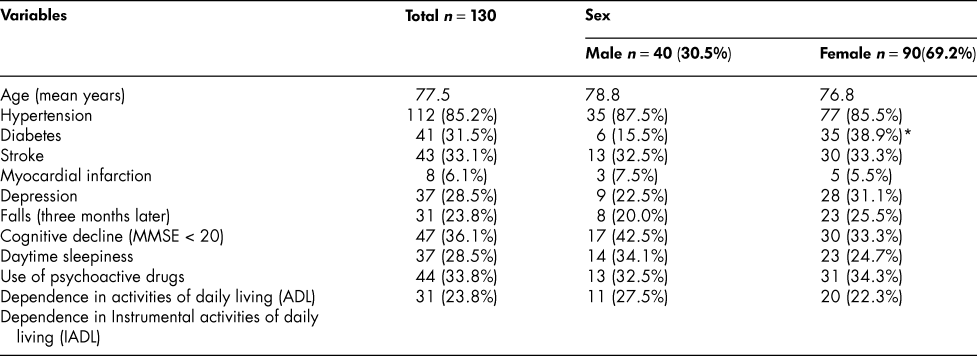
The majority of the participants (n = 90) were women (69.2%), with a mean age of 77.5 (median = 78 years). Table 1 shows the clinical characteristics. Participants were classified into three groups according to initial mobility pattern: Group A comprised 74 individuals (56.9%) who could walk independently; Group B comprised 39 individuals (30.0%) who used walking aids; and Group C comprised 17 individuals (13.1%) who were bedridden or used a wheelchair.
Clinical characteristics
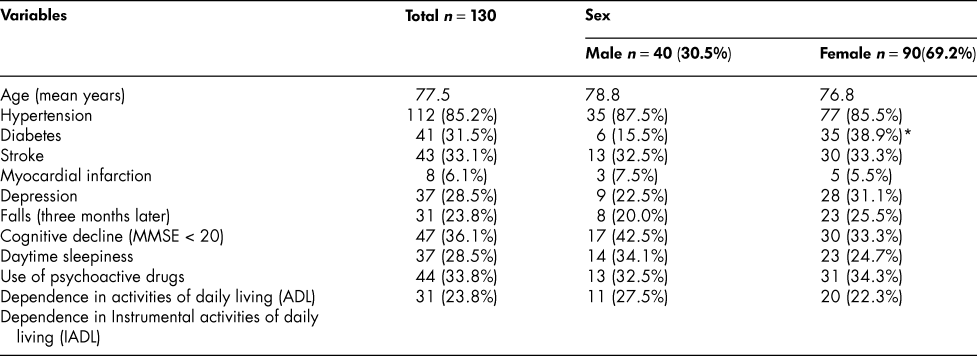
* p < .05 MMSE: mini- mental state examination
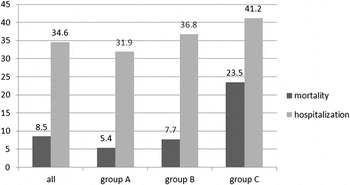
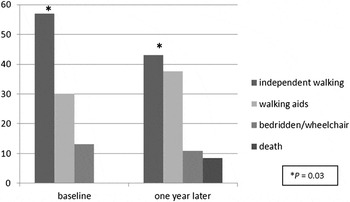
Mortality after one year was 8.5 per cent (total 11; 9 female, 2 male). Infection was the most frequent cause of death (n = 5), followed by stroke, postoperative complications, and infarction. Forty-four hospitalizations were registered (34.6%), including those leading to death. The main causes of hospitalization were as follows: (a) stroke (n = 7), (b) pneumonia (n = 7), (c) gastrointestinal disturbances (n = 6), (d) surgery (n = 6), and (e) heart failure (n = 4). The analysis of hospitalization and mortality levels in the three functional groups showed a higher tendency towards morbi-mortality in Group C, the bedridden/wheelchair group (p = .05) (see Figure 1). The functional pattern had worsened by the 12-month follow-up (see Table 2). The proportion of participants who walked without assistance had declined from 56.9 per cent to 43.1 per cent (p = .03) (see Figure 2).
One-year follow-up of mortality and hospitalization according to mobility conditions

One-year follow-up of mobility characteristics

One-year follow-up of mobility conditions according to baseline evaluation

Group A: independent walking; Group B: walking aids; Group C: bedridden/wheelchair use
* p = .05
Discussion
These results highlight the relationship between mobility and prognostication of morbi-mortality in a group of dependent older adults. The study analysed only non-institutionalized homebound older adults who were assisted by a team of primary health care professionals. This profile of elderly patients represents an important demand for care from both health services and families. It was observed that among the older adults classified as homebound, more than half were able to walk independently without the use of walking aids. However, even among this group, there was a high frequency of hospitalizations (31.9%) and high mortality (5.4%) over the study’s one-year period.
The group of participants with the highest functional deficits – those who were bedridden or wheelchair users – presented the highest mortality rates. One out of four participants in this group died before the 12-month follow-up visit. Many researchers have observed higher mortality rates Q2: Should you say what the higher rates are?among elderly adults with functional deficits (Belmini et al., Reference Belmini, Auffray, Berbezier, Boirin, Mercier and Revier2007; Carey et al., Reference Carey, Covinsky, Lui, Eng, Sands and Walter2008; Espaulella, Arnau, Cub, Ambla, & Nez, Reference Espaulella, Arnau, Cub, Ambla and Nez2007; Landi, Liperoti, Russo, Capoluongo, Barillaro, Pahor, et al., 2010), including those in Brazil (Ramos, Simoes, & Albert, Reference Ramos, Simoes and Albert2001). Such studies have evaluated functional deficits using well-validated scales or tests based on activities of daily living (ADL), instrumental activities of daily living (IADL), the Barthel index, Timed Get Up and Go test, or the AGGIR (Autonomie Gérontologique – Groupes Iso-Ressources) scale.
In other studies, a higher mortality risk was observed among the frail elderly (Graham et al., Reference Graham, Snih, Berges, Ray, Markides and Ottenbacher2009; Berges, Graham, Ostir, Markides, & Ottenbacher, Reference Berges, Graham, Ostir, Markides and Ottenbacher2009); among the measures of morbidity and functional capacity researchers have analysed is the ability to walk (Fried et al., Reference Fried, Tangen, Walston, Newman, Hirsch and Gottdiener2001).
What our study highlighted is the very simple functional evaluation: that is, the observation of locomotion pattern. This classification could even be carried out by anyone on the health teamQ3: As per your reply to copyeditor’s query, I replaced “over the telephone” with “by anyone on the health team.” OK?, and potentially facilitate the organization and prioritisation of care for the dependent older adults by the health care team.
The mortality rate observed in this group of dependent older adults was similar to that observed by other researchers. Carey et al. (Reference Carey, Covinsky, Lui, Eng, Sands and Walter2008), for example, observed a six per cent mortality rate in a low-risk elderly group and a 21 per cent rate in a high-risk group (Carey et al., Reference Carey, Covinsky, Lui, Eng, Sands and Walter2008). In a study exclusively involving the frail elderly population, Zhao, Tatara, Kuroda, and Takayama (Reference Zhao, Tatara, Kuroda and Takayama1993) observed a 23.5 per cent mortality rate over one year’s time.
Carey et al. (Reference Carey, Covinsky, Lui, Eng, Sands and Walter2008) analysed a population similar to that of the present study, including non-institutionalized frail elderly and elderly patients (mean age: 79) with chronic diseases. After multivariate analysis of the factors associated with mortality, these authors proposed a prognostic index of mortality including eight factors such as (a) being male, (b) being over 75 years old, (c) dependence in toileting, (d) dependence in dressing, (e) neoplasias, (f) heart failure, (g) chronic obstructive pulmonary disease, and (h) renal insufficiency. In Carey’s study, mobility condition was not statistically significant in the multivariate analysis, and thus was not included in the risk score. However, in another study with the same characteristics, difficulty in walking was identified as an independent risk factor of mortality within two years (Carey, Walter, Lindquist, & Covinsky, Reference Carey, Walter, Lindquist and Covinsky2004).
All kinds of alterations in mobility have been identified as an important determining factor in the life expectancy of older adults (Keeler, Guralnik, Tian, Wallace, & Reuben, Reference Keeler, Guralnik, Tian, Wallace and Reuben2010). In a population-based two-year follow-up study of older Brazilian adults, Ramos et al. (Reference Ramos, Simoes and Albert2001) observed mortality frequencies of 9.8 per cent among those with moderately compromised activities of daily living and 28 per cent among the severely compromised.
Many of the older adults in our study reported being hospitalized during the study period. The high rates of hospitalization entailed various consequences for these individuals, such as the occurrence of hospital infection, delirium, malnutrition, and iatrogenesis. In an earlier study of frail elderly adults after hospitalization, 29 per cent mortality was observed within six months (Espaulella et al., Reference Espaulella, Arnau, Cub, Ambla and Nez2007). In addition to the morbi-mortality consequences, the high hospitalization rates represent a significant increase in the cost of health care services.
In the present study, we identified situations leading to hospitalization that might have been prevented by the health care team. Infections, strokes, and gastrointestinal disorders could potentially have been avoided or minimized by proper attention to associated risk factors. Moreover, a case can be made for home hospitalization programs, which have lower costs and co-morbidities, particularly for pneumonia and diarrhea with dehydration (Ward, Drahota, Gal, Severs, & Dean, Reference Ward, Drahota, Gal, Severs and Dean2008).
The results we obtained also demonstrated a decrease in functional capacity over the short 12-month period. Apart from the 11 deaths, the ability to walk independently fell from 57 per cent to 47 per cent among the older adults who were assessed.
It is important that we identify what can be done to minimize the progression of functional incapacity, which compromises the quality of life for this population. Previous researchers have proposed physical activity, physiotherapy, nutritional information, vision care, environmental adaptation, and caregiver instruction as measures to improve quality of life (Landi, Abbatecola, Provinciali, Corsonello, Bustacchini, Manigrasso, et al., 2010; Vass, Avlund, Siersma, & Hendriksen, Reference Vass, Avlund, Siersma and Hendriksen2009). In many cases, such interventions are simple and low-cost, but they demand the attention and direction of the health care professionals. Zhao et al. (Reference Zhao, Tatara, Kuroda and Takayama1993), however, in their study on the frail elderly observed that the risk of mortality can either be decreased by good conditions or increased by bad conditions inQ4: As per your reply to the copyeditor’s query, I replaced “is altered by the conditions” with “can either be decreased by good conditions or increased by bad conditions.” OK? the home environment.
Some limitations should be noted with respect to the results of our present study. Specifically, the small number of older adults we sampled, and their specific geographic location, may have limited the evidence of associations we found, and it was not possible to carry out a multivariate analysis of the associations. Nevertheless, it was possible to recognize a mortality profile from the very simple indicator of functional capacity.
It will be important to conduct further studies with non-institutionalized dependent elderly adults, particularly in developing countries, where health care resources and organization of health care services are limited. A better understanding of the morbi-mortality characteristics of patients with this profile could help design and modify primary health care services, as this group places a high demand for care on health care institutions, the families, and society in general.