Introduction
Traumatic brain injury (TBI) is one of the most frequent global causes of hospitalisation, death and disability (GBD 2016 Traumatic Brain Injury and Spinal Cord Injury Collaborators, 2019). The early, transient, and highly variable period of recovery that occurs immediately following a TBI is commonly known as post-traumatic amnesia (PTA). Its duration is a significant outcome determinant for injury management including patient flow in acute hospital stages, discharge timing, commencement of rehabilitation, and prediction of long-term recovery (Marshman, Jakabek, Hennessy, Quirk, & Guazzo, Reference Marshman, Jakabek, Hennessy, Quirk and Guazzo2013; Tate & Pfaff, Reference Tate and Pfaff2000; Walker et al., Reference Walker, Strombert, Marwitz, Sima, Agyemang, Graham and Merchant2018). However, current methods of assessment have known limitations including a restricted assessment focus and problematic criterion for PTA emergence (Marshman et al., Reference Marshman, Jakabek, Hennessy, Quirk and Guazzo2013; Tate & Pfaff, Reference Tate and Pfaff2000). Given the heterogeneity of TBI pathology, it is logical to include a broader assessment of cognition than currently occurs. This may result in improved therapeutic assessment, clinical management, and rehabilitation strategies. From a consumer and carer perspective, unrealistic outcome expectations may occur with a narrow focus on particular elements of cognition, or a lack of focus on behavioural consequences. There is a need to advance PTA assessment through the development of evidence-based measures that encompass the full clinical picture that occurs during this critical stage of TBI recovery. There is also the need to consider if PTA is a misnomer that impedes accurate understanding of recovery needs during this stage of TBI (Stuss et al., Reference Stuss, Binns, Carruth, Levine, Brandys, Moulton and Schwartz1999).
Early researchers highlighted the gradual and fluctuating recovery of behaviour, cognition and mood following TBI (e.g., Symonds, Reference Symonds1937). A range of behavioural changes was commonly noted, such as being dazed, bewildered, resistive, and inappropriate (e.g., Russell, Reference Russell1932). Multiple cognitive difficulties were noted including speech, attention, visual perception and memory (e.g., Symonds, Reference Symonds1937). The term PTA was coined by Symonds (Reference Symonds1937). However, memory was not considered the only significant cognitive feature, and the term was used inclusively from a cognitive perspective (Russell & Smith, Reference Russell and Smith1961). Emergence from PTA was regarded as coexistent with the return of continuous memories, as judged by clinical observation and questioning (Symonds & Russell, Reference Symonds and Russell1943).
The potential unreliability of subjective assessment resulted in the development of prospective PTA measures. Two common scales, the Galveston Orientation and Amnesia Test (GOAT) (Levin, O’Donnell, & Grossman, Reference Levin, O’Donnell and Grossman1979) and the Westmead Post-Traumatic Amnesia Scale (WPTAS) (Shores, Marosszeky, Sandanam, & Batchelor, Reference Shores, Marosszeky, Sandanam and Batchelor1986), are exemplars of the issues inherent in current prospective PTA assessment. These include: (a) a heavy reliance on orientation items; (b) limited assessment of the components of memory; and (c) problematic criterion for emergence from PTA (Roberts, Spitz, & Ponsford, Reference Roberts, Spitz and Ponsford2015; Tate et al., Reference Tate, Baguley, Marosszeky, Gurka, Hodgkinson, King and Hanna2006). Recent PTA scales have a length and complexity that preclude routine bedside use (e.g., Sherer, Nakase-Thompson, Yablon, & Gontkovsky, Reference Sherer, Nakase-Thompson, Yablon and Gontkovsky2005), or focus on a single domain (e.g.,Andriessen, De Jong, Jacobs, Van Der Werf, & Vos, Reference Andriessen, De Jong, Jacobs, Van Der Werf and Vos2009). The brevity of PTA scale development is important in acute hospital settings. However, it should not be at the exclusion of the range of important clinical features associated with this stage of recovery.
Poor clarity regarding the PTA construct arguably impacts on the instruments created to measure it. There is a need to reconsider the evidence for behavioural and cognitive change during PTA to inform instrument development. Key areas of cognition include attention, processing speed, language, visual perception, retrograde amnesia, and memory.
Impairment in attention has long been recognised as a predominant feature of PTA (Symonds, Reference Symonds1937), and multiple attentional processes appear to be impacted at varying stages of PTA. There is evidence for impaired focus and shifting processes using verbal span tasks (e.g., number span, weekdays in reverse), tracking tasks (e.g., trail making test); sustained attention (e.g., continuous performance task); and impaired executive processes (e.g., verbal fluency (phonemic and category), Wisconsin Card Sorting Test) (Kalmar et al., Reference Kalmar, Novack, Nakase-Richardson, Sherer, Frol, Gordon and Ricker2008; Stuss et al., Reference Stuss, Binns, Carruth, Levine, Brandys, Moulton and Schwartz1999; Tittle & Burgess, Reference Tittle and Burgess2011; Wilson, Baddeley, Shiel, & Patton, Reference Wilson, Baddeley, Shiel and Patton1992; Wilson et al., Reference Wilson, Evans, Emslie, Balleny, Watson and Baddeley1999). Attention may support the recovery of orientation and memory, with the latter characterising PTA recovery once patients reach moderate levels of orientation (Leach, Kinsella, Jackson, & Matyas, Reference Leach, Kinsella, Jackson and Matyas2006; Stuss et al., Reference Stuss, Binns, Carruth, Levine, Brandys, Moulton and Schwartz1999; Tittle & Burgess, Reference Tittle and Burgess2011).
Minimal recent research has investigated processing speed, language, and visual perception. For processing speed, simple reaction time tasks are impaired (Wilson et al., Reference Wilson, Baddeley, Shiel and Patton1992, Reference Wilson, Evans, Emslie, Balleny, Watson and Baddeley1999); along with oral and written versions of the Symbol Digit Modalities Test (SDMT) (Kalmar et al., Reference Kalmar, Novack, Nakase-Richardson, Sherer, Frol, Gordon and Ricker2008; Keelan et al., Reference Keelan, Mahoney, Sherer, Hart, Giacino, Bodien and Vanderploeg2019); and complex reaction time tasks (de Simoni et al., Reference De Simoni, Grover, Jenkins, Honeyfield, Quest, Ross and Sharp2016). For language, reduced accuracy of verbal comprehension (Wilson et al., Reference Wilson, Baddeley, Shiel and Patton1992), and pragmatic communication difficulties have been noted (Steel, Ferguson, Spencer, & Togher, Reference Steel, Ferguson, Spencer and Togher2017). Visuoperceptual difficulties were regarded as significantly contributing to the confusional state (Symonds, Reference Symonds and Brock1940). However, with the exception of Wilson et al.’s (Reference Wilson, Baddeley, Shiel and Patton1992) null finding using the Rey Complex Figure copy trial, there is a paucity of research in this cognitive domain.
Retrograde amnesia refers to the length of the amnesic period immediately preceding an injury (Baddeley, Reference Baddeley1997). Retrograde amnesic periods greater than 30 min were regarded as a significant prognostic feature (Russell & Smith, Reference Russell and Smith1961). The perceived difficulty in verifying memories has led to this cognitive feature being neglected in prospective PTA measures. The exception is the GOAT, which includes a single two-part item for retrograde amnesia. Recent research has supported the clinical utility of retrograde amnesia assessment following TBI (Roberts, Spitz, Mundy, & Ponsford, Reference Roberts, Spitz, Mundy and Ponsford2018; Stiell et al., Reference Stiell, Wells, Vandemheen, Clement, Lesiuk, Laupacis and Worthington2001), noting its reliability and resilience to common confounders (Hennessy, Marshman, delle Baite, & McLellan, Reference Hennessy, Marshman, delle Baite and McLellan2020; McLellan, Marshman, & Hennessy, Reference McLellan, Marshman and Hennessy2017).
Memory assessment is commonly included in prospective PTA measures. However, the cognitive complexity of memory and its clinical utility is neglected in PTA research. Deficits in the capacity of working memory for verbal material occur (Wilson et al., Reference Wilson, Evans, Emslie, Balleny, Watson and Baddeley1999). Using list-learning tasks, the encoding of information appears passive, with limited use of organisational strategies (Fodor, Reference Fodor1972; Gasquoine, Reference Gasquoine1991). Less information is acquired using multiple learning trials for verbal and visual material (Kalmar et al., Reference Kalmar, Novack, Nakase-Richardson, Sherer, Frol, Gordon and Ricker2008; Keelan et al., Reference Keelan, Mahoney, Sherer, Hart, Giacino, Bodien and Vanderploeg2019; Wilson et al., Reference Wilson, Baddeley, Shiel and Patton1992, Reference Wilson, Evans, Emslie, Balleny, Watson and Baddeley1999). Impairment occurs for short and long-delay free recall, rates of forgetting, and recognition memory using a range of stimuli including prose passages, list learning tasks, and visual stimuli (Andriessen et al., Reference Andriessen, De Jong, Jacobs, Van Der Werf and Vos2009; Ewert, Levin, Watson, & Kalisky, Reference Ewert, Levin, Watson and Kalisky1989; Kalmar et al., Reference Kalmar, Novack, Nakase-Richardson, Sherer, Frol, Gordon and Ricker2008; Keelan et al., Reference Keelan, Mahoney, Sherer, Hart, Giacino, Bodien and Vanderploeg2019; Levin, High, & Eisenberg, Reference Levin, High and Eisenberg1988; Wilson et al., Reference Wilson, Baddeley, Shiel and Patton1992). Increased rates of forgetting and recognition recall impairment may only become apparent with longer time delays (Andriessen et al., Reference Andriessen, De Jong, Jacobs, Van Der Werf and Vos2009; Fodor, Reference Fodor1972; Levin et al., Reference Levin, High and Eisenberg1988).
In contrast, there is evidence of intact procedural memory using mirror reading, pursuit rotor, word stem completion, and the method of vanishing cues tasks (Ewert et al., Reference Ewert, Levin, Watson and Kalisky1989; Glisky & Delaney, Reference Glisky and Delaney1996; Wilson et al., Reference Wilson, Baddeley, Shiel and Patton1992). Weir, Doig, Fleming, Wiemers, and Zemljic (Reference Weir, Doig, Fleming, Wiemers and Zemljic2006) also noted the ability to learn new topographical information (e.g., route back to room from the ward) and visual information (e.g., locating buzzer) in their PTA sample.
Finally, marked alterations of behaviour and personality during PTA including exaggeration of pre-existing traits, impaired sleep–wake patterns, wandering, agitation, incoherent verbalisations, and inappropriate behaviour (e.g., Symonds, Reference Symonds1937; Weir et al., Reference Weir, Doig, Fleming, Wiemers and Zemljic2006). Rates of agitation during PTA are highly variable (7–70%) due to differences in definition and measurement (McKay, Love, Trevena-Peters, Gracey, & Ponsford, Reference McKay, Love, Trevena-Peters, Gracey and Ponsford2018). Standardised measures (e.g., Agitated Behaviour Scale – ABS) produce rates around 30–42% (McKay et al., Reference McKay, Love, Trevena-Peters, Gracey and Ponsford2018). Using the ABS, the most common behaviours during PTA include distractibility and impulsivity (Bogner & Corrigan, Reference Bogner and Corrigan2000; Nott, Chapparo, Heard, & Baguley, Reference Nott, Chapparo, Heard and Baguley2010). Weir et al. (Reference Weir, Doig, Fleming, Wiemers and Zemljic2006) reported the highest frequency behaviours (50–60%) were related to aspects of attention and concentration (unable to recognise staff, unable to attend for 30 min, absent self-monitoring). McKay et al. (Reference McKay, Love, Trevena-Peters, Gracey and Ponsford2018) noted the highest frequency behaviours in their clinically agitated PTA patients (ABS>21) were distractibility, impulsivity, resistance, and repetitive behaviours. The least common behaviours included excessive laughing/crying and self-abusive behaviours. Both an increase and decrease in behavioural agitation has been noted during emergence from PTA (Nott et al., Reference Nott, Chapparo, Heard and Baguley2010). Diurnal variation also occurs, with late afternoon peaks in behaviour (Nott et al., Reference Nott, Chapparo, Heard and Baguley2010). An understanding of the pattern of behaviour change during PTA emergence is yet to be fully examined.
It is apparent that broader elements of cognition and behaviour are impacted by PTA than are assessed by commonly used prospective measures. These include cognitive domains such as attention, processing speed, and language; along with the need to refine memory assessment. Additionally, the clinical utility of behaviour change requires further exploration. The aims of this research were to examine the clinical sensitivity of a novel integrated assessment of cognition and behaviour during PTA, with the aims of developing recommendations for a brief, comprehensive bedside tool. We also examined the construct validity of commonly used prospective PTA measures, and their estimates of PTA emergence.
Method
Participants
Participants were consecutively recruited from inpatient neurosurgical and rehabilitation wards, and a community rehabilitation facility within the Townsville Health and Hospital Service from August 2014 to March 2017. Participants were classified as mild TBI with a GCS 13–15 on hospital admission and without evidence of intracranial injury; moderate TBI was classified as GCS 13–15 with neuroradiological evidence of intracranial injury or GCS 9–12; and severe TBI was classified as GCS 3–8 (Carroll, Cassidy, Holm, Kraus, & Coronado, Reference Carroll, Cassidy, Holm, Kraus and Coronado2004; Rimel, Giordani, Barth, & Lane, Reference Rimel, Giordani, Barth and Lane1982). Eligibility criteria included being aged 18 years of age or older, current admission for a TBI, and English language fluency. Participants were excluded if they were dysphasic or had sustained an orthopaedic injury (e.g., arm fracture), limiting their ability to perform the assessment. Participants were included with a history of neurological or psychiatric conditions so that the study sample was representative of the TBI population. The study was approved by The Townsville Hospital Human Research Ethics Committee (HREC/13/QTHS/249) and acknowledged by the James Cook University Human Ethics Research Committee (H5764).
PTA participants
Twenty-four patients with a moderate-to-severe TBI comprised the PTA group. The presence of PTA was determined via consensus diagnosis from medical staff on the inpatient neurosurgical ward. Occupational therapy and nursing staff identified potential participants. Written or verbal relative assent for PTA participants was obtained. Participants were re-consented following emergence from PTA.
E-PTA participants
Twenty-three moderate-to-severe TBI patients who had emerged from PTA (E-PTA) comprised the control group. Participants were identified by allied health staff in the rehabilitation facilities. All were undergoing inpatient or community rehabilitation. Written participant consent was obtained.
Procedure
Demographic and medical information was collected from informants and/or participants, and supplemented by medical records when available. Occupational therapy staff administered the WPTAS as part of routine practice for patients in PTA in the neurosurgical and rehabilitation wards. Some participants had been previously administered the WPTAS as part of routine clinical practice. On the first day of participation in this research, the WPTAS was administered prior to the study protocol, and convenience determined the subsequent order of testing. Administration of the cognitive protocol took approximately 45 min. PTA patients were tested approximately every 24 h until they were declared out of PTA by clinical consensus, or were discharged or transferred to another facility. The cognitive assessment was conducted by the same researcher (LDB) on all occasions. Behaviour ratings were completed by informants (family members or friends) and staff (nursing, allied health) at variable times on the same day of cognitive testing. Data from the first day of study participation only was analysed in the current research.
The E-PTA group was assessed on one occasion (by LDB), and order of cognitive testing was equivalent to the initial assessment for PTA patients (i.e., WPTAS then the remainder of study protocol). Recall of the WPTAS picture cards was assessed at the end of the testing session (after approximately a 1 h interval) for practical purposes. Behaviour ratings from informants (family or friends) and staff (interprofessional team) were obtained following this.
Measures
Prospective PTA measures
GOAT
The GOAT is a daily prospective measure of PTA (Levin et al., Reference Levin, O’Donnell and Grossman1979). It includes 10 questions that assess orientation to person, place, and time, retrograde amnesia, and memory of events following the injury. Items that overlapped with the WPTAS (date of birth, day of the week, month, and year) were not re-administered to avoid repetition. Otherwise, administration and scoring followed original recommendations (Levin et al., Reference Levin, O’Donnell and Grossman1979).
WPTAS
The WPTAS is a prospective measure of PTA duration (Shores et al., Reference Shores, Marosszeky, Sandanam and Batchelor1986). It comprises 12 questions, with 7 items assessing orientation to person, place, and time, and 5 items assessing visual memory for 3 picture cards and the examiner’s face and name. Administration and scoring followed the original recommendations (Shores et al., Reference Shores, Marosszeky, Sandanam and Batchelor1986).
Cognitive measures
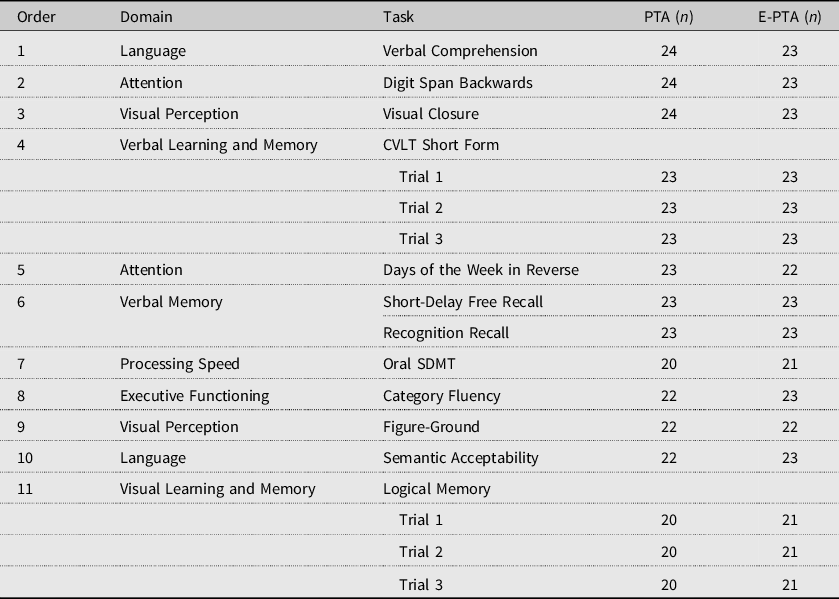
Measures were chosen to represent six cognitive domains: attention and executive functioning, language, processing speed, verbal learning and memory, visual learning and memory, and visual perception. The order of administration is summarised in Table 1, with the assessment protocol available from the corresponding author.
Number of participants with complete data and order of test administration for cognitive measures

Attention and executive functioning
Digit Span Backwards requires the ability to focus, shift, and monitor working memory processes (Lezak, Howieson, Bigler, & Tranel, Reference Lezak, Howieson, Bigler and Tranel2012). Administration included five trials, with number groups ranging from two to six digits in order of increasing length (Walterfang, Velakoulis, Gibbs, & Lloyd, Reference Walterfang, Velakoulis, Gibbs and Lloyd2003). Scores ranged from 1 to 5 based on the number of digit strings correctly recalled.
Days of the Week in Reverse requires the ability to recall, shift, and inhibit standard recall of the order of weekdays. Administration and scoring procedures followed Walterfang et al. (Reference Walterfang, Velakoulis, Gibbs and Lloyd2003). Participants began with either Sunday or Saturday, and 1 point was scored for each correct answer.
Verbal fluency involves focus, sustaining, and inhibiting working memory representations, and lexical access speed (Lezak et al., Reference Lezak, Howieson, Bigler and Tranel2012). Standard administration instructions for category fluency were used (Strauss, Sherman, & Spreen, Reference Strauss, Sherman and Spreen2006). The score used was the number of animals correctly identified in 60 s.
Language
The Semantic Acceptability subtest measures general sentence comprehension and judgement (Paradis & Libben, Reference Paradis and Libben1987). Four of the original 10 items were chosen to represent a range of difficulty levels. Participants provide a yes/no response if a sentence makes semantic sense (e.g., ‘the sun shines by night’). Scores ranged from 0 to 4 based on the number of correct items.
The Comprehension subtest from the Cognitive Test for Delirium measures an individual’s auditory comprehension abilities (Hart et al., Reference Hart, Levenson, Sessler, Best, Schwartz and Rutherford1996). Form 1 of the subtest was used, which includes four items requiring a Yes/No response (e.g., ‘will a stone float on water?’). Terminology was adapted for suitability to Australian language (e.g., kilograms rather than pounds). Scores ranged from 0 to 4 based on the number of correct items.
Processing speed
SDMT requires the speeded pairing of abstract symbols with specific numbers and assesses divided attention, visual scanning, tracking, and motor speed (Smith, Reference Smith1991; Strauss et al., Reference Strauss, Sherman and Spreen2006). An adapted oral version of the first two rows of items was used (Smith, Reference Smith1991). Scores included time to completion and total errors.
Verbal learning and memory
An adapted version of the California Verbal Learning Test, Second Edition (CVLT-II) Short Form was used. The CVLT-II measures verbal learning and memory using a multi-trial list-learning task, immediate and delayed recall, and recognition (Delis, Kramer, Kaplan, & Ober, Reference Delis, Kramer, Kaplan and Ober2000; Strauss et al., Reference Strauss, Sherman and Spreen2006). The word list was shortened to include six items (hat, cherries, wrench, lemon, belt, drill) with two items from each semantic category. Three learning trials were used for brevity, and consistency with the number of trials used for the visual memory task. Scores for each trial ranged from 0 to 6 based on the number of words recalled, and administration was discontinued when participants scored their first 6 out of 6 with subsequent trials scored as 6/6. Days of the Week in Reverse was administered during the short delay period. Following Short-Delay Free Recall, an adapted Yes/No recognition trial was administered. Three target words were removed (i.e., those removed from the word list) along with 6 distractor words for consistency, with a total list of 18 words remaining. Recognition scores ranged from 0 to 6 based on the number of target words correctly recognised, with the number of false positives also recorded.
Visual learning and memory
The Lhermitte and Signoret Logical Memory Task (Walsh, Reference Walsh1985) was used to assess visual learning and memory. This task measures an individual’s ability to learn a logical pattern of geometric shapes varying by colour (blue, red, yellow) and shape (triangle, circle, square). Nine picture cards (4.5 × 4cm) and a 13.5 × 12cm grid were used. Each picture card was placed in its specified location for 2 s during learning trials. Following administration of the nine picture cards, participants were required to identify the correct location for each card. Scores for each trial ranged from 0 to 9 based on the number of items (i.e., card positions) correctly recalled. Administration was discontinued when participants scored their first 9 out of 9, with subsequent trials scored as 9/9.
Visual perception
Visual perception was assessed using the Visual Closure and Figure-Ground tasks from the Motor-Free Visual Perception Test, Third Edition (MVPT-3) (Colarusso & Hammill, Reference Colarusso and Hammill2003). The Visual Closure task measures the ability to perceive a whole figure when only fragments are presented. The Figure-Ground task measures the ability to distinguish an object from the background or surrounding objects. One item was selected from the beginning, middle, and end of each subtest to encompass varying difficulty levels. Participants were required to select one of the four responses provided in the stimulus booklet. Scores for each subtest ranged from 0 to 3 based on the number of correct answers.
Behaviour
A behaviour rating form was administered to staff and family members for all participants. This included, in order of administration, the ABS, three items from the Confusion Assessment Protocol, and three items measuring socially inappropriate behaviour, confabulation, and self-monitoring.
The ABS was designed to measure agitation in a TBI population (Corrigan, Reference Corrigan1989). The scale includes 14 items assessing behaviours such as inattention, impulsivity, violence, restlessness, and perseveration. Items were rated on a 4-point Likert rating scale from 1 (absent) to 4 (severe impairment). Total scores range from 14 to 56. An ABS score of >21 were classified as in the clinically significant range (Nott et al., Reference Nott, Chapparo, Heard and Baguley2010). Individual items and total scores were used in data analysis.
The Confusion Assessment Protocol measures symptoms of confusion in acute TBI patients (Sherer et al., Reference Sherer, Nakase-Thompson, Yablon and Gontkovsky2005). Three items were selected to complement ABS items: sleep disturbance, daytime arousal, and thought process abnormalities. Scores ranged from 0 (not present/normal) to 3 (severe/abnormal) using a 4-point Likert rating scale. Individual item scores were used in the data analysis.
Based on prior research (e.g., Russell, Reference Russell1932; Symonds, Reference Symonds1937; Weir et al., Reference Weir, Doig, Fleming, Wiemers and Zemljic2006), three new items were included for the assessment of socially inappropriate behaviour, confabulation, and self-monitoring. Scores ranged from 0 (absent) to 3 (extreme) on a 4-point Likert rating scale. Individual item scores were used in the data analysis.
Data analysis
Missing data were minimal for the majority of measures (see Table 1), with missing values excluded on a pairwise basis. For cognitive tasks with missing data (n) for each group (PTA, E-PTA) were CVLT (1,0), Days of the Week (1,1), Oral SDMT (4,2), Category Fluency (2,0), Figure-Ground (2,1), Semantic Acceptability (2,0), and Visual Learning and Memory (4,3). For between-group comparisons, Mann–Whitney U tests were used for non-normally distributed continuous data, independent groups t-tests for normally distributed continuous data, and chi-square analyses for categorical data. Within-groups comparisons used the Friedman test, and the Wilcoxon signed-rank test for non-normally distributed data. Correlational analyses used Pearson’s r or Spearman’s rho. Significance was set at p < .05; with effect size descriptors as per Cohen (Reference Cohen1977). Scores on Day 1 of testing were used for the main statistical analyses.
Results
Sample characteristics
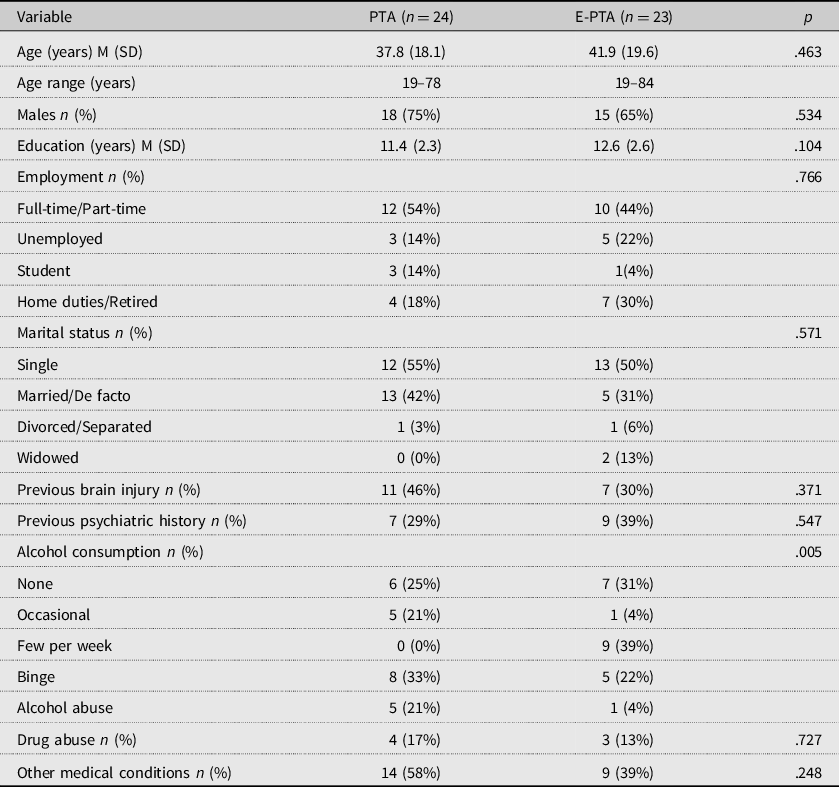
Demographics and health history are summarised in Table 2. PTA and E-PTA groups were equivalent for age, gender, years of education, employment status, and marital status. For medical history, there were no significant differences in self-reported rates of previous TBI, previous psychiatric history, drug abuse, or comorbidities. The PTA group self-reported significantly higher rates of alcohol consumption, χ2(4, n = 47) = 15.09, p = .005.
Demographic and health history information for PTA and E-PTA groups

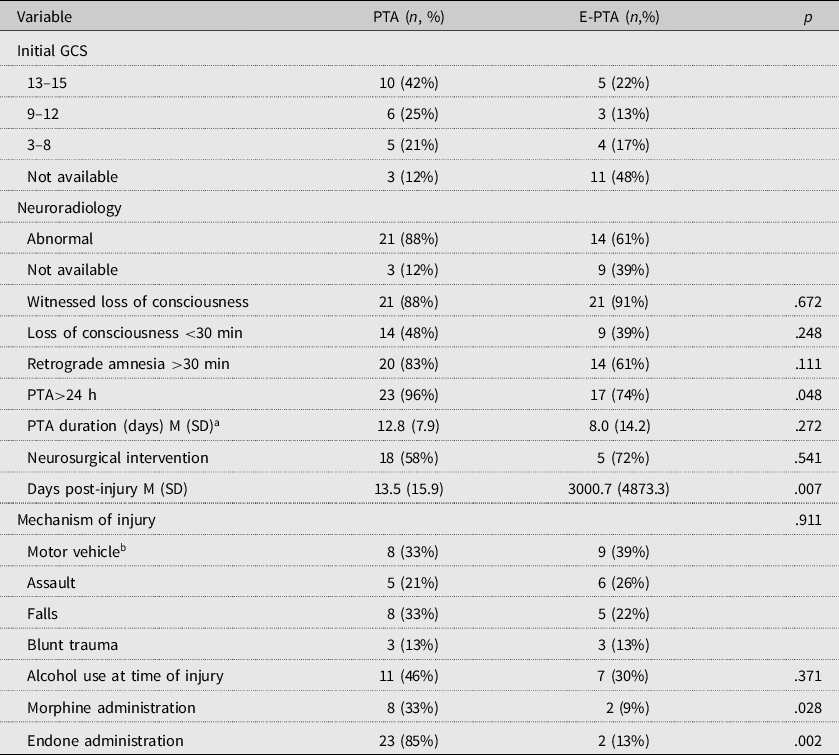
Injury-related information for the PTA and E-PTA groups is presented in Table 3. The majority of PTA participants (53%) had a GCS <13, and all PTA participants for whom scan data was available (95%) had significant acute brain injuries. The PTA group had significantly higher rates of endone (p = .002) and morphine administration (p = .028). There were no significant group differences for injury-related information.
Injury-related information for the PTA and E-PTA groups

a PTA duration n/a for n = 15 E-PTA.
b Includes car and motorbike accidents, bicycle collisions, and pedestrians struck by a vehicle.
Cognitive measures
Figure 1 provides results for the cognitive measures (see also Supplementary Tables). For attention and executive functioning, the PTA group had significantly poorer performance with a large effect size for Animal Fluency, t(43) = −3.95, p = .001, d = 1.18. Significantly poorer performance occurred during PTA for Digit Span Backwards with a small effect size, U = 182, p = .036, r = .30. For verbal learning and memory, the PTA group had significantly poorer Short-Delay Free Recall, U = 145, p = .006, r = .40, and Recognition Recall Total Correct, U = 176, p = .016, r = .35, with small effect sizes. For visual learning and memory, there was significantly poorer performance with small effect sizes in the PTA group on the last two learning trials: Trial 2, U = 168, p = .019, r = .36; Trial 3, U = 157.5, p = .016, r = .37). There were no significant group differences on the remaining cognitive measures.
Effect sizes for differences between PTA and E-PTA groups on the cognitive measures.
*Significant difference between PTA and E-PTA groups at p < .05.

Behavioural measures
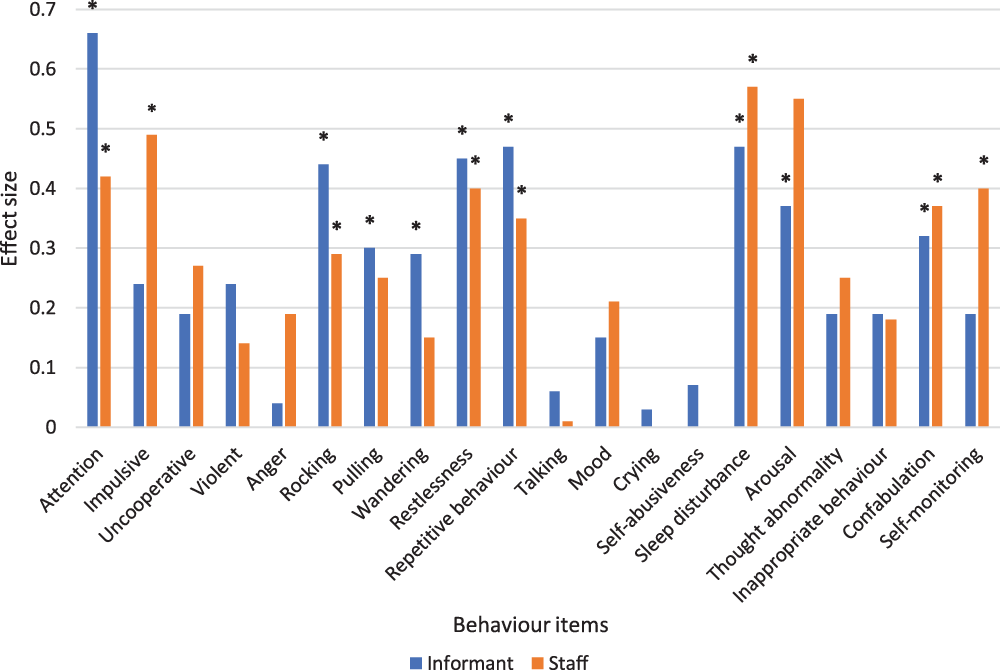
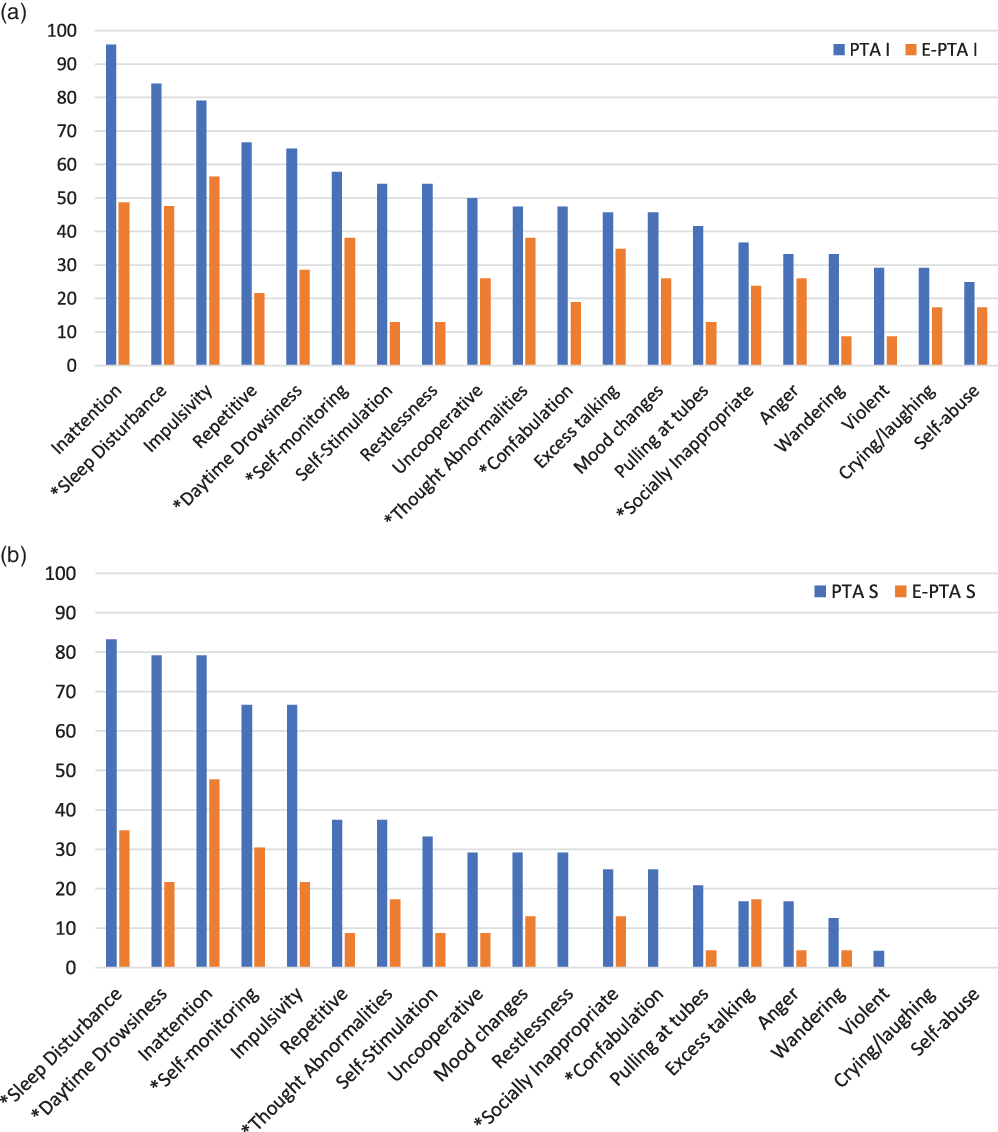
ABS scores were significantly higher during PTA with moderate effect sizes for staff ratings, U = 133.5, p = .002, r = .45; PTA, Mdn = 18.5; E-PTA Mdn = 15; and informant ratings, U = 101, p = .007, r = .43; PTA Mdn = 19; E-PTA Mdn = 16. ABS scores in the clinically significant range (ABS total > 21) occurred in 37% of the PTA group (n = 8). Of these, 16.7% (n = 8) had mild agitation (ABS 22–28), 8.4% (n = 2) had moderate agitation, and 8.4% (n = 2) had severe agitation. As the clinical utility of the ABS cut-offs has been questioned (Nott et al., Reference Nott, Chapparo, Heard and Baguley2010), the frequency with which a behaviour was rated as present (regardless of severity) was examined. Figure 2 summarises the differences in behaviour frequency between the PTA and E-PTA groups according to rater (see Supplementary material also). Significant between-group differences with small-to-moderate effect sizes were found for informant ratings of Inattention, Repetitive Behaviour, Sleep Disturbance, Self-Stimulation, Daytime Arousal, Confabulation, Pulling and Wandering; and staff ratings of Sleep Disturbance, Daytime Arousal, Impulsivity, Inattention, Restlessness, Self-Monitoring, Confabulation, Repetitive Behaviour, and Self-Stimulation. Figure 3 displays the ranked frequencies of all behaviour items rated as present by informants and staff. For informants, the highest frequency (> 50%) behaviours in the PTA group were Inattention, Sleep Disturbance, Impulsivity, Repetitive Behaviour, Daytime Arousal, Self-monitoring, Self-stimulation, and Restlessness. For staff ratings, the highest frequency behaviours in the PTA group were Sleep Disturbance, Daytime Arousal, Inattention, Self-monitoring, and Impulsivity. Five behaviours were rated as high frequency by both rating groups for PTA patients: Inattention, Impulsivity, Sleep Disturbance, Daytime Arousal, and Self-Monitoring. Of the six new behaviour items, three were rated as high-frequency behaviours during PTA for both staff and informants: Sleep Disturbance, Daytime Drowsiness, and Self-monitoring.
Behaviour frequency between PTA and E-PTA groups by informant and staff raters.
*Significance difference between PTA and E-PTA groups at p < .05.

(a) Ranked frequencies of behaviour items rated as present by informants. (b) Ranked frequencies of behaviour items rated as present by staff.
*New behavioural items.

Prospective PTA measures
On Day 1 of testing, there were significant group differences with a moderate effect size for the WPTAS, U = 126, p < .001, r = .52, indicating poorer performance for the PTA group (PTA Mdn = 10.5, E-PTA Mdn = 12). Similarly for the GOAT, there were also significant group differences with a moderate effect size, U = 78.5, p < . 001, r = .61, indicating poorer performance for the PTA group (PTA Mdn = 89, EPTA Mdn = 100). For the GOAT retrograde amnesia item, there was a significant difference with a small effect size, U = 177, p = .018, r = .35, for higher GOAT retrograde amnesia error scores in the PTA group (PTA Mdn = 0 (0–5), E-PTA Mdn = 0(0–0)). The duration of PTA (days) was examined for three variables: GOAT > 75 (Levin et al., Reference Levin, O’Donnell and Grossman1979), the Tate operational definition of WPTAS first day at 12/12 (Tate et al., Reference Tate, Baguley, Marosszeky, Gurka, Hodgkinson, King and Hanna2006), and the Shores operational definition of WPTAS three consecutive days at 12/12 (Shores et al., Reference Shores, Marosszeky, Sandanam and Batchelor1986). There was a significant difference with a large effect size between WPTAS 1st day and 3-day criteria, Z = −3.422, p = .001, r = .88, with the use of the WPTAS 3-day criteria increasing the duration of PTA by 9 days (1st day Mdn = 9; 3-day Mdn = 18). There was a significant difference with a moderate effect size for the difference between the GOAT and WPTAS 1st day criteria, Z = −2.632, p = .008, r = .62), with the GOAT estimating a shorter PTA duration by 2 days (GOAT Mdn = 7).
Construct validity of WPTAS and GOAT
Spearman’s rho correlational analyses were used to examine the construct validity of the WPTAS and GOAT with the cognitive and behavioural measures. The WPTAS and GOAT totals had significant moderate correlations in the PTA group (r = .54, p = .008) and E-PTA groups (r = .56, p = .005). For the PTA group, performance on the WPTAS had significant negative correlations with processing speed (Oral SDMT Time, r = −.60, p = .002); and significant positive correlations with language (Verbal Comprehension, r = .46, p = .023; Sentences, r = .55, p = .008), executive functioning (Animal Fluency, r = .45, p = .035), attention (Weekdays, r=.41, p = .051), and new verbal learning (Total Immediate Recall, r = .42, p = .048). The WPTAS was not significantly correlated with the other cognitive tasks. In comparison, GOAT performance for the PTA group had significant positive correlations with language (Verbal Comprehension, r = .61, p = .002; Sentences, r = .62, p = .008), verbal memory recognition (False positive errors, r = −.57, p = .005), attention (Weekdays, r = .47, p = .029), and new verbal learning (Total Immediate Recall, r = .42, p = .054; Trial 2, r = .49, p = .019; Trial 3, r = .49, p = .031). The GOAT Total was not significantly correlated with the other cognitive tasks.
Discussion
This study highlighted and extended previous research through a novel integrated assessment of clinical and behavioural features of PTA in a prospective clinical sample. We demonstrated that cognitive impairment occurs beyond memory, and includes attention and executive functioning. Behavioural disturbance related to attentional control was increased during PTA, with newly developed behavioural items capturing high-frequency problematic behaviours. Current prospective PTA measures were differentially related to components of cognition including processing speed, language, verbal memory, and attention for the WPTAS; and language, attention, and verbal memory for the GOAT. Additionally, the discrepancy of PTA duration estimates from 2 to 11 days across the GOAT and WPTAS highlight ongoing issues with emergence criteria. Our findings support the contention that the term PTA is a misnomer given the range of cognitive and behavioural changes that occur during this period of recovery (Keelan et al., Reference Keelan, Mahoney, Sherer, Hart, Giacino, Bodien and Vanderploeg2019; Stuss et al., Reference Stuss, Binns, Carruth, Levine, Brandys, Moulton and Schwartz1999; Wilson et al., Reference Wilson, Baddeley, Shiel and Patton1992).
The assessment of cognitive functioning during PTA should not be limited to consideration of orientation, and the basic features of visual and verbal memory. The sensitivity of attention tasks to emergence from PTA attests to the need to include these in prospective PTA measures (Kalmar et al., Reference Kalmar, Novack, Nakase-Richardson, Sherer, Frol, Gordon and Ricker2008; Wilson et al., Reference Wilson, Baddeley, Shiel and Patton1992, Reference Wilson, Evans, Emslie, Balleny, Watson and Baddeley1999). The large effect size found for category fluency, highlights the utility of this task to capture the inability to focus attention and sustain effortful retrieval of information whilst in PTA. Tasks such as Weekdays in Reverse or Digit Span Backwards make less complex demands on the attentional processes of focus, monitoring, and inhibition and are candidate measures for earlier stages of PTA recovery (Stuss et al., Reference Stuss, Binns, Carruth, Levine, Brandys, Moulton and Schwartz1999). The inclusion of multiple attention and executive tasks with increasing cognitive demands are essential to adequately detect impairment and monitor the recovery of different attentional processes during PTA emergence.
Memory impairment is clearly a significant feature of PTA. However, we assert that current prospective PTA measures do not adequately assess this cognitive domain in a manner that maximises clinical utility. Assessment of learning and memory is absent from the GOAT, and the problematic complexity of the WPTAS visual memory task has been previously identified (Tate et al., Reference Tate, Baguley, Marosszeky, Gurka, Hodgkinson, King and Hanna2006). Multiple learning trials may better detect the recovery of impaired acquisition of new information than single trials (Kalmar et al., Reference Kalmar, Novack, Nakase-Richardson, Sherer, Frol, Gordon and Ricker2008; Keelan et al., Reference Keelan, Mahoney, Sherer, Hart, Giacino, Bodien and Vanderploeg2019; Levin et al., Reference Levin, High and Eisenberg1988; Wilson et al., Reference Wilson, Baddeley, Shiel and Patton1992, Reference Wilson, Evans, Emslie, Balleny, Watson and Baddeley1999). Our study highlighted the utility of short delay periods to detect impaired verbal recall, along with the use of cued or recognition trials to examine retrieval difficulties (Andriessen et al., Reference Andriessen, De Jong, Jacobs, Van Der Werf and Vos2009; De Simoni et al., Reference De Simoni, Grover, Jenkins, Honeyfield, Quest, Ross and Sharp2016; Kalmar et al., Reference Kalmar, Novack, Nakase-Richardson, Sherer, Frol, Gordon and Ricker2008).
There is a paucity of research investigating visuoperceptual abilities during PTA. Our study used Visual Closure and Figure-Ground tasks, with no significant between-group differences. However, participant performance was highly variable on individual items, with floor and ceiling effects occurring on both tasks. Further research is needed to clarify the nature of visuoperceptual capacity during PTA.
For language, the small effect size for Verbal Comprehension supports the reduced accuracy for verbal comprehension found by Wilson et al. (Reference Wilson, Baddeley, Shiel and Patton1992) using the Speed and Capacity of Language Processing (SCOLP). Our task did not have a processing speed component, and was a purer measure of verbal comprehension. Our finding supports limited previous research highlighting pragmatic communication difficulties during PTA (Steel et al., Reference Steel, Ferguson, Spencer and Togher2017). Given the significant correlations for the WPTAS and GOAT with the two language tasks, the impact of language comprehension during PTA warrants further investigation.
For processing speed, the small effect size supports the compromised processing speed found during PTA across task paradigms including the SDMT (Kalmar et al., Reference Kalmar, Novack, Nakase-Richardson, Sherer, Frol, Gordon and Ricker2008), simple reaction time tasks (Wilson et al., Reference Wilson, Baddeley, Shiel and Patton1992, Reference Wilson, Evans, Emslie, Balleny, Watson and Baddeley1999), and complex reaction time tasks (De Simoni et al., Reference De Simoni, Grover, Jenkins, Honeyfield, Quest, Ross and Sharp2016). In particular, the use of simple reaction time tasks has been suggested as candidate measures of recovery during PTA (Wilson et al., Reference Wilson, Evans, Emslie, Balleny, Watson and Baddeley1999). Simple bedside measures of processing speed have been incorporated into cognitive screens for other medical conditions (e.g., Nazraddine et al., Reference Nasreddine, Phillips, Bedirian, Charbonneau, Whitehead, Collin and Chertkow2005), and should be incorporated into prospective PTA measures.
We found significant behaviour alterations during PTA. Similar to McKay et al. (Reference McKay, Love, Trevena-Peters, Gracey and Ponsford2018), 37% of our sample displayed behavioural disturbance at clinically elevated levels using the ABS. High-frequency behaviour changes were related to aspects of attention and concentration (inattention, impulsivity, self-monitoring). Thus, changes in attention and concentration should be considered a primary behavioural feature of PTA (Bogner & Corrigan, Reference Bogner and Corrigan2000; McKay et al., Reference McKay, Love, Trevena-Peters, Gracey and Ponsford2018; Nott et al., Reference Nott, Chapparo, Heard and Baguley2010; Weir et al., Reference Weir, Doig, Fleming, Wiemers and Zemljic2006). Newly developed behavioural items (sleep disturbance and daytime arousal) were rated as high frequency in this sample. This may reflect an earlier stage of recovery, in comparison with previous research using rehabilitation hospital participants (e.g., McKay et al., Reference McKay, Love, Trevena-Peters, Gracey and Ponsford2018; Weir et al., Reference Weir, Doig, Fleming, Wiemers and Zemljic2006). The key behavioural features of emergence from PTA may not be adequately captured by scales such as the ABS. This is supported by recent Rasch modelling of ABS items (Bogner & Corrigan, Reference Bogner and Corrigan2000), and the high-frequency ratings of new behaviour items that were included in this study. Our behavioural findings of prominent behavioural symptoms that reflect attention and concentration difficulties support the contention that recovery of attentional capacity is a primary cognitive feature of emergence from PTA.
The duration of PTA is a key clinical management indicator in the acute and rehabilitation stages, as well as being a key predictor of long-term outcomes. However, PTA duration estimates are highly variable across the GOAT and WPTAS. The use of the WPTAS 3-day rule extends the duration of PTA estimates by an average of 9 days, when compared with the WPTAS 1st day rule. Adherence to the WPTAS 3-day rule would potentially cause significant delays in the onset of rehabilitation activities, transfer from neurosurgical to rehabilitation wards, and increase hospital length of stay and cost of care. From a psychometric perspective, any obtained score on a cognitive test contains measurement error. Thus, fluctuations around 12/12 would be expected purely on this basis, and not reflect emergence from PTA or be indicative of ‘islands of memory’. Additionally, the bedside examination is, by its nature, conducted in a noisy, uncontrolled environment that is not conducive to optimal cognitive performance. This introduces more potential for measurement error, with score fluctuations unrelated to PTA. In contrast, use of the GOAT produced shorter duration estimates of PTA, being 2 days less for the WPTAS 1-day rule and 11 days less using the WPTAS 3-day rule. Given the orientation content of the GOAT, and the visual memory task of the WPTAS, we would suggest that this difference should not be interpreted as an underestimation of PTA using the GOAT. Rather the difference may be indicative of stages of emergence from PTA, and increased recovery of attention and memory that supports full orientation. We concur with Wilson et al. (Reference Wilson, Evans, Emslie, Balleny, Watson and Baddeley1999), the conceptualisation of emergence from PTA as an all-or-none phenomenon may not be clinically accurate, and prospective measurement tools that aim for this goal may be misguided.
Investigation of the construct validity of prospective PTA measures is surprisingly absent from previous research. An understanding of the areas of cognition that are related to GOAT or WPTAS performance is important given criticisms of their limited content (Marshman et al., Reference Marshman, Jakabek, Hennessy, Quirk and Guazzo2013). Both measures were moderately correlated with each other in both PTA and E-PTA groups. In the PTA group, increased GOAT scores were positively related to language comprehension, the learning and acquisition of new verbal information, and attentional control for well-learnt verbal information. There was also a moderate negative relationship with executive memory control. Increased WPTAS scores were negatively related to processing speed (speed and accuracy); and positively related to language comprehension, attention and executive functioning tasks, and acquisition of new verbal information. Given the visual content of the WPTAS stimuli, the non-significant correlations with our visual task were unexpected. These results highlight the contribution of cognitive factors aside from memory to performance on commonly used PTA measures. Primary of these were processing speed, language, attention, and executive functioning.
There must be a balance between brevity and range in prospective PTA assessments. Beyond the first 10–15 min of administration time, we began to experience participant refusal on some cognitive tasks. The most commonly refused tasks were Processing Speed and Visual Learning, which occurred at the midpoint and end of assessment, respectively. Future assessment should consider placing visual/verbal learning and memory tasks first, followed by attention, language, and processing speed, with delayed memory recall occurring last. Brief cognitive screens such as the Montreal Cognitive Assessment (Nasreddine et al., Reference Nasreddine, Phillips, Bedirian, Charbonneau, Whitehead, Collin and Chertkow2005) have used a similar procedural paradigm effectively. The measurement of high-frequency behaviour changes should also be integral to this process, with candidate symptoms including Inattention, Impulsivity, Sleep Disturbance, Daytime Arousal, and Self-Monitoring.
Our study had a number of limitations. Primary was the small sample size, however, the groups were well-matched on demographic and injury-related variables. Whilst not the focus of this study, the stage of emergence from PTA is an important clinical consideration. It is likely that our PTA participants were in the final stages of PTA emergence, due to recruitment processes used on the neurosurgical ward. Had recruitment occurred earlier post-injury, larger effect sizes may have been found for the PTA group. Our E-PTA group had highly variables times since injury which may have impacted on our ability to detect differences between the two groups. In addition, blinding of assessors (LBD, informants, staff) was not possible due to the clinical setting.
Future research may benefit from investigating specific components of cognition during PTA. This could include theoretically derived investigations of the components of attention and executive functioning, verbal and visual learning and memory, and procedural memory. The assessment of language functioning requires further investigation, in particular, verbal comprehension. Future cognitive investigations should focus on the utility of measures of the stages of PTA recovery, not all-or-none emergence (Wilson et al., Reference Wilson, Evans, Emslie, Balleny, Watson and Baddeley1999). For example, changes in the use of encoding strategies during learning trials (Gasquoine, Reference Gasquoine1991) may indicate emergence from PTA. The key behavioural features of emergence from PTA require further investigation, including the role of diurnal variation. Research should be guided by the recommendations of Shores (Reference Shores1995) noting the importance of brevity, use of meaningful material, and capacity for administration by any trained member of a multidisciplinary team. Due to the small sample size, our conclusions regarding the use of cognitive and behavioural measures should be considered preliminary and require validation in larger samples. In addition, following a sample from the time of admission to emergence from PTA would provide further clarification of the cognitive and behavioural changes during emergence from PTA; and may also shed further light on the potential misnomer of the term PTA itself.
Conclusion
Future scale development should include the integrated assessment of cognitive and behavioural features of PTA with a focus on tasks capable of measuring the stages of emergence from PTA. We recommend a focus on working memory span, verbal fluency, processing speed, and verbal comprehension; along with multi-trial learning tasks with delayed free and cued recall. Behaviour items should focus on Inattention, Impulsivity, Sleep Disturbance, Daytime Arousal, and Self-Monitoring. Finally, this research supports the contention that PTA is a misnomer for this important stage of TBI recovery. The term results in an artificial focus on memory at the expense of other clinically important indicators of recovery. Rather than naming features, we should perhaps name the stage of recovery.
Financial support
This research has received no specific grant from any funding agency, commercial, or not-for-profit sectors.
Conflict of interest
Maria J. Hennessy has no conflicts of interest to disclose. Lorryn delle Baite has no conflicts of interest to disclose. Laurence A. G. Marshman has no conflicts of interest to disclose.
Ethical standards
The authors assert that all procedures contributing to this work comply with the ethical standards of the relevant national and institutional committees on human experimentation and with the Helsinki Declaration of 1975, as revised in 2008.
Supplementary material
To view supplementary material for this article, please visit https://doi.org/10.1017/BrImp.2021.2.