Introduction
On 7 August 1826, the Asante army suffered a severe defeat to Danish and British troops and their allies on the plains of Katamanso.Footnote 1 The battle was reportedly quite balanced until the British launched their Congreve rockets, causing great losses among the Asante. The Asante king was wounded and withdrew from the battlefield. As defeat was inevitable, Kwaku Dua Paanin rushed in to salvage the Golden Stool but left behind what had obviously failed the Asante on that day: their war charms. When the victors divided the loot, the Danes were thus to receive three bundles of Arabic manuscripts, containing about 900 folios with instructions for the crafting of Islamic charms and amulets.
On 5 June 2013, The Daily Graphic, Ghana's major newspaper, reported on clashes between gang members, a neighbourhood watch committee and the police in Aboabo, one of Kumase's largest zongos. Under the heading ‘Hell breaks loose’, the report included details of the alleged killing of one of the gang's members and the resulting skirmishes that were brought to an end by the police, who arrested several suspects and confiscated ‘[a] number of weapons and ammunitions, as well as charms and amulets’ (my emphasis).
These stories resonate with what Malam Ousman, an Islamic scholar (malam) who manufactures such charms and amulets (lāyā), has told me about these: ‘My prayer is a shield and a weapon.’Footnote 2
Drawing on ethnographic fieldwork among Muslims in Asante,Footnote 3 I take a closer look at these Islamic charms and amulets and at the varied relations that they gather together. In the zongos – Muslim wards in Asante – lāyā are simultaneously rather common, highly valued and heavily contested Islamic items. According to some, they contain and therefore bestow a divine presence (baraka); according to others, such a bestowal of God's presence by a lāyā is not only impossible but runs counter to the precepts and tenets of Islam. These disparate perceptions and (non-)usages of lāyā give rise to ardent controversies in which the people of the zongo debate how to conceive of and relate to the world they find themselves in along with other entities – including jinn and other spirits or forces. In these debates, they (re)make their religion in open but not ungrounded ways. Thus, lāyā are part of wider processes that bring together and relate several phenomena, actants and discourses. Accordingly, they must be put into context if one wishes to trace the relations in which they are made and which they make in turn.
As argued by Roy Dilley (Reference Dilley and Dilley1999), contexts are not simply given but are composed of the relations in which the entities under consideration are embedded and constructed. Things, phenomena, actions, events and so on are all made in associations, and one must trace the latter to unravel the former. Drawing on Bruno Latour's (Reference Latour2005) actor–network theory, I trace and delineate the varying relations in which lāyā are enmeshed in the zongos. For the people of these wards, lāyā are matters of concern – or ‘interesting gatherings’ (ibid.: 114–15) – that leave their traces everywhere: around people's torsos and necks, in their pockets, homes, cars or shops, in their narrations, conversations, histories, debates and actions. By assembling various narratives and relations, lāyā make others do things and can be considered as actants in Latour's sense of the term, as they make a difference by transforming a state of affairs (ibid.: 52–5). In the zongos, lāyā and their surrounding debates take part in people's (re)makings of Islam and therefore matter to them.
Religions are made as various actants assemble various things (Latour Reference Latour2005: 119; Reference Latour2010) in relating to the divine (Orsi Reference Orsi2005). As argued by proponents of the ‘materialist turn’ in religious studies (Meyer and Houtman Reference Meyer, Houtman, Houtman and Meyer2012), things are not mere objects but central and acting elements in the (re)makings of the religious. As matters of concern, lāyā are complex gatherings: they are things with material properties; they are made and used by different actors and as part of diverse practices; and they are surrounded by and made sense of in various discourses. As complex gatherings, lāyā emerge from the relations in which they are assembled and which they, in turn, assemble. These relations are basically open, as various actants relate to them in different ways that are, in turn, the subject of ardent debates. In their controversies about lāyā, the people of the zongo propose different narratives of Islamically legitimate actions and agencies. For their manufacturers and those who request them, lāyā enfold a divine presence and are thus not only part of God's creation but of the divine that permeates the lāyā; for their critics, lāyā are non-Islamic idols and therefore counter to Islam, as they keep people away from God. Arguing about lāyā, the people of the zongo thus debate how to conceive of and relate to the divine and the Islamic tradition in multiple ways. Thereby, they (re)make their religion and its ‘discursive tradition’ (Asad Reference Asad1986) in open but not ungrounded ways.
This article traces lāyā and their divergent relations in the zongos. First, I introduce the historical background to this study and discuss the overall neglect of lāyā as historical sources, before I discuss the Africanist literature on Islamic amulets. In the ethnographic section, I describe lāyā in their materiality, portray how Malam Ousman manufactures such amulets, and summarize his discourse on them. I then present three everyday usages of lāyā and discuss the relations in which they are embedded and made sense of, before I come to the various criticisms of them. In the conclusion, I discuss what can be gained by tracing the divergent relations that lāyā make.
Muslim presence in Asante
Muslims from the northern savannahs have been present in AsanteFootnote 4 at least since the early eighteenth century (Levtzion Reference Levtzion1968), living among the predominantly non-Muslim Asante for whose royals they worked as scribes, diplomats, advisers, traders and healers (Owusu-Ansah Reference Owusu-Ansah1991; Wilks Reference Wilks and Lewis1966; Reference Wilks1989 [1975]). Under colonial occupation (1874–1957), the Muslim presence in the region changed significantly in number and form, as Muslim traders moved in from the north to access the regional supply in kola that had hitherto been controlled by the Asante (Arhin Reference Arhin1979). They founded their own wards, the zongos (from the Hausa zangō, meaning a camping place for trading caravans), and formed Muslim communities apart from the Asante, among whom they have remained strangers up to the present day.Footnote 5 Islam provides the otherwise quite heterogeneous people of the zongos with a common ground and shared values. As Muslims, they relate to each other, participate in each other's lives and intermarry. Theirs is a Muslim community, but their religion is anything but homogeneous or unchanging.
There are three major Sunni groupsFootnote 6 in the zongos: the nkramo, the Tijaniyya and the Sunna. Nkramo is Asante Twi for ‘Muslim’, and most of the people of the zongo identify as nkramo without further qualification. The nkramo live Islam according to locally established Sunni traditions that have changed over the historical trajectory of Muslim presence in the region as much as they are informed by and perpetuate it. Among the nkramo there are also the Tijaniyya and the Sunna groups. The TijaniyyaFootnote 7 is a Sufi order that gained religious hegemony in the zongos in the mid-twentieth century and held it until the 1970s, when they came under attack by the Sunna reformists. The Tijaniyya uphold a scriptural-cum-mystical Islam that is founded on studies of the Islamic scriptures and on spiritual experiences of the divine. When installing themselves as hegemonic, they integrated locally established tenets and practices into theirs, including the manufacture of amulets. The Salafi-/Wahhabi-oriented Sunna reformistsFootnote 8 emerged in the 1950s and have gained a prominent voice in Islamic discourses since the 1970s. They follow a solely scriptural teaching and criticize the Tijaniyya and nkramo for their mystical practices and tenets, denigrating these as bidʿa (an illegitimate innovation in the religion of Islam) or shirk (joining others to God in worship).
As expounded in more detail below, it is not by accident that lāyā have become the subject of heated contestations among members of these groups as they relate to and gather together many of their divergent Islamic knowledges, epistemes, discourses, practices and imaginaries. My nkramo and Tijaniyya interlocutors perceive them as containers and providers of baraka and manufacture them drawing on the ‘spiritual’ insight and knowledge (ʿilm bātinan) acquired from God, their ancestors, and their Muslim peers. According to my nkramo interlocutors, the baraka of their lāyā lies in the word of God from which they are made, and certain malams have a ‘deeper’ knowledge about which āyat (verses of the Qur'an) to use for a specific issue; this means that they manufacture more ‘powerful’ lāyā than others.Footnote 9 While my Tijaniyya interlocutors agreed with this assessment, they also related the ‘spiritual’ power (tumi) of their lāyā to the personal baraka they have incorporated thanks to God and their specific rituals. As a hierarchical Sufi order, the Tijaniyya advance through different ‘levels’ on their path (tariqa) to God, with the more advanced members being closer to God (walī) and acting as guides (muqaddam) or intermediaries. Thus, God's baraka is not only embodied by these malams; it also flows through them, and they can transmit it to others or the lāyā they manufacture. Such ‘spiritual’ notions are unacceptable for Ghana's Islamic reformists, who have criticized and burned lāyā in public at least since the 1950s.Footnote 10 Like other Islamic reformists in Africa (Loimeier Reference Loimeier2016; Østebø Reference Østebø2015), the Sunna in Ghana propagate anti-spiritualist discourses and seek to oust ‘spiritual’ practices, imaginaries and things (amulets, prayer beads, etc.) from the lived Islam in their communities, as they perceive these as un-Islamic. In turn, the nkramo and Tijaniyya criticize the Sunna for lacking the ‘spiritual’ insight required to understand such matters and for promoting a schism in their communities. Thus, what is considered and practised as part of the Islamic tradition by the manufacturers of lāyā and those who request them – albeit in different ways – is rejected as un-Islamic idolatry by their critics, and one encounters an irreducible diversity of Islamic conceptions, practices and imaginaries among these different actors. Lāyā and their surrounding discourses hence provide a telling example through which to trace how the people of the zongo conceive of, debate and practise their religion in divergent ways and how this has changed over time.
Unpacking lāyā
As evidenced in archaeological (Engmann Reference Engmann2013), historiographic (Owusu-Ansah Reference Owusu-Ansah1991; Wilks Reference Wilks and Lewis1966; Reference Wilks1989 [1975]: 239–41, 257–8) and ethnographic (Owusu-Ansah Reference Owusu-Ansah, Levtzion and Pouwels2000; Pontzen Reference Pontzen2021) studies, lāyā have not only been a pervasive feature of Muslim presence in the region; they have been in great demand by the Asante as well, despite their considerable costs. Bestowing a divine presence on their wearers thanks to the word of God from which they are made, lāyā can be used for various purposes and act in diverse ways: they cure, provide spiritual protection, help in love or business affairs, ward against or hinder others, provide an advantage in war, etc. However, while their historical presence has been asserted, a detailed history of lāyā is still in its early stages.
The reasons for this become obvious when one looks closer at the handling of the 900 folios looted in 1826. The three bundles found their way to the Royal Archive in Copenhagen, where they were stored away and sank into oblivion (Levtzion Reference Levtzion1965) until they were retrieved by Robert Kea in 1963. Out of the 900 folios, which were mainly written between 1795 and 1820, twenty-six are considered as ‘items which, by virtue of their references to specific persons and places, are of relevance [to Western historians]’ (Wilks et al. Reference Wilks, Levtzion and Haight1986: 202); the more than 880 other folios are instructions for manufacturing lāyā. These twenty-six ‘items of relevance’ were carefully edited and commented on by three distinguished scholars as part of a volume of original sources on local history, which, according to the editors, is made by specific persons in specific places. This is not to denigrate the ground-breaking work of these scholars, but, as stated by Dipesh Chakrabarty, ‘[a] secular subject like history faces certain problems in handling practices in which gods, spirits, or the supernatural have agency in the world … Secular histories are usually produced by ignoring the signs of these presences’ (Chakrabarty Reference Chakrabarty2008 [2000]: 72, cf. 72–96), and this seems to have happened here. The other folios were left in the hands of a PhD student, David Owusu-Ansah, who has written a pioneering history of lāyā in Asante (Owusu-Ansah Reference Owusu-Ansah1991). This division of labour highlights what is considered to be a legitimate historical source and what is not. Another striking example is found in Arabic Literature of Africa (Wilks et al. Reference Wilks, Hunwick, Sey and Hunwick2003), an annotated bibliography of historical Islamic writings from the region that does not refer to instructions for the writing of amulets at all. Such instructions do not tell of social, political or economic events or phenomena;Footnote 11 they are commonly undated, without specific authors, and without further content as to the writing of lāyā. Nonetheless, they speak of something: ‘the spiritual’Footnote 12 and the varied relations to or engagements with it. As stated by Owusu-Ansah: ‘As “potent miniatures,” Islamic amulets always contain more than can be understood by the uninitiated’ (Reference Owusu-Ansah1991: 94). And they can tell us a lot, once we begin to trace them – inter alia that in non-secular histories and world-makings ‘humans are not the only meaningful agents’ (Chakrabarty Reference Chakrabarty2008 [2000]: 72).
Islamic charms and amulets, as well as their surrounding discourses and practices, have been and are quite common across Islamic societies and history (Gruber Reference Gruber and Leonie2016; Hamès Reference Hamès2001; Reference Hamès2007; Savage-Smith Reference Savage-Smith2004). Yet, their study is scattered across separate literatures, so that one finds several strands of argument and separate regional research but no coherent debate on them. In the Africanist literature, Islamic amulets were originally presented as one of the defining features of an ‘African Islam’ that allegedly resulted from Africans ‘mixing’ or ‘syncretizing’ fetishes with Islamic scriptures and beliefs (Marty Reference Marty1914; cf. Fisher Reference Fisher and Brett1973; Goody Reference Goody and Goody1968; el-Tom Reference el-Tom1985; Reference el-Tom1987). Later writers sought to overcome the essentializing and derogatory presumptions of this view but continued to put people's beliefs at the centre of their analyses as they relocated amulets in the field of (Islamic) healing (Fisher Reference Fisher and Brett1973; Owusu-Ansah Reference Owusu-Ansah1991; Reference Owusu-Ansah, Levtzion and Pouwels2000) and applied a symbolic analysis to them, relating their content to the issue at hand (el-Tom Reference el-Tom1985; Reference el-Tom1987; Marty Reference Marty1914; Mommersteeg Reference Mommersteeg1988). Yet, Islamic amulets are more complex and contested gatherings than that, and, since the early 2000s, numerous authors have sought to overcome such reductionist approaches. The discourses and practices surrounding lāyā are part of Islamic knowledge (ʿilm), and they inform people's varied dealings in divine and ‘spiritual’ powers (Brenner Reference Brenner2000; Lambek Reference Lambek1993; Salomon Reference Salomon2013; Soares Reference Soares2005; Ware Reference Ware2014). As recent research has highlighted, amulets were never a matter of unquestioned belief but constantly and ardently debated (Brenner Reference Brenner and Hamès2007; Hamès Reference Hamès2007; Owusu-Ansah Reference Owusu-Ansah1991). They are embedded in varied relations, addressing various social as well as personal issues, and serving as a means of social control (Fisher Reference Fisher and Brett1973; Handloff Reference Handloff1982; Last Reference Last, Cruise O'Brien and Coulon1988; Soares Reference Soares2005). Furthermore, they provide people with practical means and narratives for their hermeneutical engagements with and creative dealings in ‘spiritual’ matters (Brenner Reference Brenner2000; Graw Reference Graw2009; Jansen Reference Jansen2009). Accordingly, research on Islamic amulets in Africa has moved beyond simplifying reductions to an ‘African Islam’ or ‘syncretism’ and turned to more nuanced analyses of the complex and divergent relations in which they are involved.
In his recent book on Islamic knowledge practices and their longue durée in West African history, Rudolph Ware also argues against syncretism as a defining feature of Islam in Africa (Ware Reference Ware2014: 19–23). Discussing West African Muslims’ knowledge and healing practices, he proposes ‘to highlight and historicize [their] embodied approach to knowledge that was once paradigmatic but now thrives in few Muslim societies’ (ibid.: 23, emphasis omitted). According to Ware, West African Muslims ‘conserve and elaborate modalities of Islamic understanding and practice after they have been largely abandoned elsewhere in the Muslim world’ (ibid.: 63). For Ware, Islamic knowledge practices in West Africa are anything but syncretic, as they stem directly from the times of the prophet and thus belong to an ‘original’ Islam. Apart from its rather normative take on ‘Islam’, I have several reservations with this analysis. Muslims’ conceptions and practices of ʿilm have been diverse and subject to debate since the time of the prophet (Ahmed Reference Ahmed2016; Brenner Reference Brenner and Hamès2007; De Jong and Radtke Reference De Jong and Radtke1999; Diagne Reference Diagne2018; Hirji Reference Hirji and Hirji2010; Rosenthal Reference Rosenthal2007 [1970]), so, if anything, not a single or particular one but all of their divergent knowledge practices and their surrounding debates would have been ‘originally Islamic’. Furthermore, as Ware depicts the knowledge practices of West African Muslims as ‘timeless’ (Ware Reference Ware2014: 246) and equates them with an ‘original’ Islamic past, he denies their historicity and coeval presence with other Islamic knowledge practices (cf. Fabian Reference Fabian1983; Marsh Reference Marsh2015). Lastly, despite the West African exceptionalism that Ware argues for, the embodied knowledge and healing practices that he writes about are by no means confined to Africa. Muslims throughout the world and history have been widely engaged in and have debated such practices, which are not ‘African’ but part of the ‘discursive tradition’ of Islam (Hamès Reference Hamès2001; cf. Bowen Reference Bowen1993; Flueckiger Reference Flueckiger2006; Marsden Reference Marsden2005; McIntosh Reference McIntosh2009). There quite simply is no ‘Islam’ specific to West Africa; Africa and the history or actual presence of Islam are too diverse to be subsumed under a single label. Islam emerges in diverse relations in which various actants (re)make and live it – be it on a global scale or in communities such as the zongos – and lāyā and their surrounding discourses and practices are informed by and participate in the (re)making of these relations.
Manufacturing lāyā
In what follows, I describe lāyā in their materiality and manufacture, tracing the relations in which they are made. I portray Malam Ousman, a manufacturer of lāyā, to provide some background knowledge about the formation that is required for this. Finally, I give a summary of Malam Ousman's discourse about his practices to trace the relations in which he locates and makes sense of lāyā.
Lāyā materialities
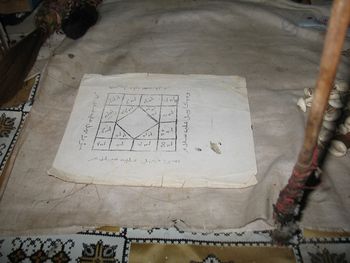
Tracing lāyā in their materiality and manufacture places them within wider and complex relations that gather together various things, actants, practices, narratives and the divine. Basically, a lāyā is an Islamic prayer converted into a graphic design.Footnote 13 It is made from a sheet of paper with specific designs, numbers and inscriptions. The paper is folded, laced up, and sewn into a leather pouch to protect it from pollution and the gaze of others. The packet is to be worn on one's body or placed in one's surroundings, depending on its purpose. The design is designated as hātim (seal) and consists of squares, circles or other figures (see Figure 1). The outer boxes contain Arabic numerals, the inner box the lāyā's purpose. The numerals stand for specific verses of the Qur'an and a certain number of recitations, converted by a numerology that only the well-versed can apply. Commonly, names or prayer formulas in Arabic are written around the hātim. The names belong to angels or other spiritual beings who hold the hātim as they hold the verses of the Qur'an in heaven, or they can be one of God's ninety-nine names or one of his ism al-aʿẓam (God's greatest names). When a malam manufactures a lāyā, heFootnote 14 commonly adds some herbs, woods, incense or perfume to give it a pleasant smell; this is supposed to keep malevolent spirits at bay, as they are attracted to filth and stench but repelled by purity and pleasant fragrances. One can use specific animal skins to sew up the parcel to further add to its efficacy: a tortoise shell, for instance, could be used for protective lāyā. Furthermore, some of the malams dry spit or breathe over their lāyā before they wrap them up to infuse them with their personal baraka. Depending on their purpose and any special ingredients, the cost of such an amulet can be quite substantial (cf. Wilks Reference Wilks1989 [1975]: 239–40, 257–8). A lāyā is far from inexpensive, especially as anyone requesting one should share out ṣadaqa (pious donations) to ‘boost’Footnote 15 its workings. Yet, a simple sheet of paper with a hātim could also do the job, as, in the end, ‘it all depends on God’, as Malam Ousman repeatedly told me.
A hātim, Kokote Zongo, 2013.

Malam Ousman's training and his spiritual practices
Malam Ousman,Footnote 16 as he calls himself in veneration of his grandfather, whose ‘spiritual inheritor’ he claims to be, strives to become one of Kokote Zongo's leading Tijaniyya malams. However, he has not yet acquired the standing he wishes to have, as he has completed his Islamic education only recently and is somewhat ‘difficult’ in character, which means that the other malams of this zongo regard him with certain reservations. He received his Islamic education from his father, other local Tijaniyya malams, and Shehu Lawal, a Tijaniyya sheikh in Nigeria who instructed him in the tarbiya, the ‘spiritual training’ of the Tijaniyya, thanks to which he has come ‘to see God’.Footnote 17 As a malam, Malam Ousman is well-versed in ʿilm Footnote 18 and not only has scriptural Islamic knowledge – i.e. fluency in Arabic and a thorough knowledge of the scriptures – but also has acquired ‘deeper’ or ‘spiritual’ insights. He calls the first aspect ʿilm zāhiran (open knowledge) – discursive knowledge acquired through intellectual effort. The other aspect is founded on ʿilm zāhiran but ‘goes deeper’ than that; ʿilm bātinan (covered knowledge) comprises an experiential knowledge of the divine that one acquires in mystical experiences, God willing. Hence, for Malam Ousman, there are scriptural and spiritual aspects to ʿilm, and he relies on both in his work as a malam.
Malam Ousman works in an antechamber of his home. Photographs on the wall depict the malams under whom he has studied or who he acknowledges as ‘spiritual leaders’. He thereby displays and adheres to the principle of taqlīd (imitation) – i.e. a personalized transmission of ʿilm – and places himself in a line of Tijaniyya malams that provides him with the authority to perform the practices he conducts in his chamber.Footnote 19 The chamber also contains his library and a collection of sirr (secrets) – a pile of about 500 single sheets of paper with instructions for manufacturing lāyā. Furthermore, the materials he needs for his work as a malam are here: a wooden board and writing sticks, soaps, perfumes, incense, herbs and woods. A bowl contains some bottles of rubūtū (Qur'anic liquids) he has prepared overnight for his supplicants. Malam Ousman wears an impressive outfit and sits on a prayer mat in the middle of the room, his supplicant in front of him. In between them lies a small rug with Malam Ousman's ‘999 bullets’, a tasbīḥ (prayer beads) with 999 beads, that he uses in his divinations.
When a supplicant enters the room, Malam Ousman places his right hand on the tasbīḥ and silently utters a specific prayer to involve ‘God's hand’ and baraka. Then, he lets the person grab the tasbīḥ and counts the number of beads they hold, uttering prayers and applying his ʿilm in numerology. He repeats this procedure three times, and the result allows him to establish the ‘house’ of jinn involved. Having established this, he asks the supplicant about the reason for their visit. He thereby consults both the spiritual world and the supplicant to establish the problem and its causes. The next step is the expulsion of the jinn from the supplicant. This is achieved by sharing out the ṣadaqa demanded by the relevant house of jinn and by the rubūtū Malam Ousman writes. The rubūtū consists of rinsed-off verses of the Qur'an that Malam Ousman writes on the board and washes into the bowl. Part of the rubūtū is mixed with soaps and perfumes for the person requesting it to bathe with; another part is infused with herbs and woods for the person to drink. The supplicant thereby incorporates the word of God, which expels the jinn causing their troubles. Once this is achieved, the jinn tend to attack and possess their victims again, which is where the lāyā come in, as they repel the jinn and thus protect their wearer from them. Usually, Malam Ousman consults his collection of sirr to find a suitable lāyā for the case at hand. Furthermore, he offers prayers for his supplicants, asks them to do the same, and prompts them to share out ample ṣadaqa to (re)acquire God's baraka as protection from the jinn. When the supplicants depart, they leave some money as ṣadaqa for Malam Ousman, but he generates the bigger part of his income from the tokens of gratitude they provide him with after his work has achieved its full effect. Malam Ousman claims that they do this ‘from their heart’; he never asks for anything, as ‘it is all from God’.Footnote 20
Malam Ousman's discourse on lāyā
For Malam Ousman, ‘every lāyā is a prayer’. He is aware that they are criticized by others, but he perceives these people as mistaken; he uses ‘nothing but the word of God’ in manufacturing lāyā and accordingly considers them as fully Islamic. In the elaborate discourse he holds on his practices he employs the rhetoric of dalīl (evidence) to relate them to and ground them in the Islamic scriptures and tradition. In what follows, I summarize what I have garnered from numerous conversations with Malam Ousman.Footnote 21
When God began his creation, there was nothing but him, and he was light. He made the whole creation from his light, and his light animates everything within it. The first things he created were his board and pen, and he ordered them to write the Qur'an, which was the first thing put into language, followed by the names of everything in his creation, and all that was to come and happen within it. Accordingly, his word and the Qur'an take pre-eminence over everything. Then, God created the heavens, Earth, and everything within them – material and spiritual – including humans and jinn. The jinn are purely spiritual beings that roam the heavens and the Earth. Humans are made from clay and spirit and bound to the Earth by their material nature. As God has installed mankind to rule over the Earth in his place, and as he has gifted humans with thought and language, the jinn have therefore always envied and tried to harm them. Being endowed with spirit, humans are vulnerable to the jinn and their actions but are unable to perceive them due to their material nature. The jinn can enter humans or their relationships and cause myriad troubles without them perceiving it, unless they overcome their material limitations and become able ‘to see things in spirit’ – as has Malam Ousman, thanks to his tarbiya. Malam Ousman is thus able to perceive the spiritual side of things, which allows him to conduct the practices he offers to his supplicants.
As stated in the Qur'an, the jinn can harm mankind only ‘by the leave of God’ (Qur'an 2.102). Malam Ousman renders this āya as ‘God's hand is not in it’, and it is his work as a malam to (re-)establish God's presence for his supplicants. To this end, he uses the word of God as revealed in the Qur'an, which is ‘a healing and mercy to those who believe’ (Qur'an 17.82) and, as seen above, takes pre-eminence over everything. God's word expels the jinn and (re)assures his presence, and thanks to this the jinn can no longer harm their victim. Drawing on his ‘spiritual insight’, Malam Ousman selects the Qur'anic versesFootnote 22 befitting the specific issue and house of jinn and employs these in making prayers, rubūtū and lāyā. This insight and the procedures that unfold from it draw on the ʿilm bātinan he has acquired in his formation and thanks to his constant dhikr (remembrance of God). Furthermore, the hātim are not human inventions but part of God's creation. Every prophet had such a seal on his body, and Muhammad was covered all over with them. Their knowledge is kept secret among the malams, as the hātim are quite powerful and could also serve nefarious purposes. They are transferred in personal interactions only, which is why no collection of hātim is the same as another. Malam Ousman has acquired all but four of his sirr in such interactions; the others were revealed to him directly by God in dreams or in the state of maʿrifa (gnosis), while he was one with God.
Yet, there is more to the workings of a hātim than the knowledge of their outer form: baraka – a presence of the divine within them – is also necessary. Without baraka, the hātim would not work, which is why Malam Ousman dry spits or breathes over them in their manufacture – to transfer some of his personal baraka. As a Tijaniyya, Malam Ousman not only offers the regular Islamic prayers but also conducts the supplementary Tijaniyya offices and is constantly involved in dhikr. Thanks to his constant involvement in prayer, he has incorporated the personal baraka he employs on behalf of his supplicants. Furthermore, the transfer of a hātim must include the transfer of its baraka. Therefore, the recipients must bestow a hadīya (gift) on the person revealing the hātim to please God and to obtain the hātim's baraka.Footnote 23 As the jinn could harm mankind ‘only by the leave of God’, Malam Ousman's actions aim to (re-)establish God's presence (i.e. baraka) for his supplicants, who help in this endeavour by sharing out ṣadaqa. Malam Ousman thus ‘works in spirit’ to assure God's baraka for those requesting help using nothing but God's word as revealed in the Qur'an. Thanks to God's presence, the jinn can no longer harm one, as God's words hold sway over and repel them. Accordingly, lāyā can also serve as pre-emptive or protective measures.
Everyday uses and conceptualizations of lāyā
Lāyā are manufactured and worn for various purposes and relate to various issues. The kind of lāyā presented at the start of the article protect from physical harm. Lāyā can deflect blows, seal the skin to knivesFootnote 24 and bullets, or render one invulnerable – unless one's opponent wears lāyā that are stronger than one's own or that counter them. That is why lāyā are sewn onto ‘traditional’ Asante battle dresses, why gang members wear them, and why the police confiscate them alongside weapons and ammunition. Drivers in Asante procure lāyā for their cars. Placed under one's seat, stored in the glovebox or hanging from the steering wheel, they guarantee a safe journey. They protect the car from accidents or mechanical failure, and they make it invisible to armed robbers, customs or the police. Thanks to the baraka these amulets provide, one's journeys are safe and smooth. After giving birth, many parents visit the malams and have them write lāyā for their infants. During its first days, an infant is still on the threshold between this world and the spiritual one. Sewn into white cloth and knotted around the infant's wrists and ankles, these lāyā repel the jinn who try to lure the infant back to the realm of the spiritual. These are only three of the manifold instances when lāyā provide their wearers with spiritual protection. Thus, lāyā relate to people's lives and, in turn, relate them to the world they find themselves in.
As seen with Malam Ousman, the world is made from both the spiritual and the physical. The two are intertwined with and affect each other. Furthermore, the people of the zongo make no stark Cartesian separation between them – the spiritual and the physical are not irreconcilable but rather complementary aspects of the same things and phenomena. ‘Ordinary’ human beings may be unable to perceive the spiritual, but this does not mean that they cannot be affected by it or affect it. Humans can give ṣadaqa to assure themselves of God's spiritual presence, they can pray and turn to God, and lāyā become polluted and less effective due to the impure substances they accumulate over time.Footnote 25 Thus, the material affects the spiritual and its ways and workings, but this can never be as powerful or decisive as the way in which the spiritual affects the material, as the spiritual surpasses and holds sway over the material and what goes on within it. One can ‘work on things in spirit’, as my interlocutors put it, as the material world is encompassed by the spiritual and depends on it. The jinn can enter humans or their relationships, possess them, and cause great harm; lāyā can render one invisible or seal the skin to bullets; and God holds sway over his creation and everything must obey God's word. Human beings are ordinarily bound to this world, but they can aim at transcending it. By sharing out ṣadaqa or by offering a prayer, one reaches out to the divine, and lāyā provide one with God's presence and protection.
I found this to be common knowledge not only among the people of the zongo but also among the Asante, most of whom are non-Muslims. They share a similar world view and perceive the material as embedded in and surmounted by the spiritual. Furthermore, the Asante acknowledge the Qur'an as ‘a book full of spiritual powers’, as stated by the Offinsohene Footnote 26 in a public address,Footnote 27 and they also procure lāyā from the malams. Thus, lāyā also relate Muslims and non-Muslims, as they circulate and mediate between them. However, while the Asante consider lāyā as simply Islamic, lāyā do not go uncontested in the zongos, whose people relate to and make sense of them in divergent ways.
Discourses against lāyā
Besides the commonly acknowledged dangers of being cheated by deceitful malams, there are two types of critical discourses against lāyā. One, which is held among the nkramo and the Tijaniyya, considers them as Islamic but scolds the practitioners for their claims to personal baraka and those who request them for relying on them ‘too much’. The other, which is held by the Sunna, rejects lāyā as un-Islamic and criticizes those who use them for committing shirk – the only unforgiveable transgression in Islam (Qur'an 4.48). Accordingly, the Sunna ardently preach against lāyā and their use and thereby fuel the ongoing debates on them. Thus, the ways in which different Islamic actors relate to and make sense of lāyā vary widely.
From the nkramo: Malam Aoudou
As the Tijaniyya have integrated the locally established manufacture of amulets into their Islamic practices, it is no surprise that malams of the nkramo, who historically preceded them, are frequently engaged in these practices as well, and Malam Aoudou is among them.Footnote 28 Malam Aoudou is a father in his late forties and one of Kokote Zongo's leading nkramo malams. Being well-established in his community, he frequently delivers sermons in Kokote Zongo's Central Mosque. He makes a living as an Islamic teacher in the community school and from his work as a malam. He also bases his practices on the Islamic tradition, relates the manufacture of lāyā to the Islamic scriptures, and shares Malam Ousman's notion that lāyā are nothing but prayers made from the word of God. The criticisms he raises in relation to Malam Ousman are hence not aimed at his lāyā but at how he relates them to his Tijaniyya tenets and practices.
Like Malam Ousman, Malam Aoudou perceives lāyā as (re)assuring God's baraka for those who wear them; by God's word and presence, they are protected from malevolent jinn and other kinds of harm. Yet, in contrast to Malam Ousman, Malam Aoudou refutes the idea that baraka can be personified, as it is impossible for God's presence to become a personal attribute. What makes lāyā work is not the baraka incorporated and transferred by the manufacturer but the baraka of God's word contained within them. He agrees with Malam Ousman that ‘it is all from God’, but Malam Aoudou does not agree that malams can act as intermediaries between God and the supplicants or as transmitters of baraka, which he perceives as an immediate presence of and relation to the divine. For him, the malams distinguish themselves from their supplicants by their ʿilm. They have the spiritual insight to select the appropriate lāyā and the knowledge to manufacture them. But, in principle, lāyā could be written by anybody,Footnote 29 as their power lies in their content and in relating their wearers to God – not in those who manufacture them.
Hence, Malam Aoudou perceives lāyā as fully Islamic and uses and manufactures them, too. I found his criticism of the notion of personal baraka – a notion common among the Tijaniyya – to be shared by other nkramo malams. The nkramo are thus not opposed to lāyā per se but relate to them in other ways than the Tijaniyya.
From the Tijaniyya: Abdul Karim
The Tijaniyya commonly perceive, manufacture and use lāyā as Islamic items. Nonetheless, I have met one Tijaniyya adept who, unlike most of his Tijaniyya peers, is opposed to the use and manufacture of lāyā and bases this on Tijaniyya tenets and practices: Abdul Karim.Footnote 30 Abdul Karim is a murid (adept) in his early thirties and has studied under different Tijaniyya malams whose ranks he aspires to join. He does not object to lāyā in that they are un-Islamic, but that they keep one ‘away from God’ instead of relating one to him.
In the past, Abdul Karim was engaged in such practices himself. He trained a young boy to become his oracle and used him to divine the spiritual causes of the troubles of his supplicants and then dealt with these by writing rubūtū and lāyā. Yet, he gradually reached the conclusion that these practices kept him away from God. On the one hand, they took too much time, which he could have spent studying or doing dhikr to increase his ʿilm and to draw closer to God. On the other hand, and much worse than that, he came to recognize that his supplicants and fellow malams used them too lightly and too frequently. As a Tijaniyya, he aims to put his unconditional trust in God, which means that one should place one's confidence in God and his qadr (preordainment) instead of questioning it or attempting to change it. Whatever God allows to happen happens for a reason, and one should rather strive to find out this reason and change it through one's own deeds instead of relying on the works of others. The lāyā prevent people not only from doing this but from putting their unconditional faith in God. They are not un-Islamic, and he sees them as deriving from the Islamic tradition, but there are better and more suitable means to find one's way and relate oneself to God. As a result, the only thing he offers to his by now drastically decreased number of supplicants is to recite the Qur'an and to counsel them on how to live an Islamic life.
Yet, his criticism is an exception. The common stance among the Tijaniyya is like Malam Ousman's, according to whom the lāyā are not only in full accordance with Tijaniyya tenets and practices but reinforced by the baraka acquired through these. This is not only doubted but rejected outright by Sunna reformists.
From the Sunna: Sheikh Abdulkadir
Not a single sermon, tafsīr (elucidation of the Qur'an) or consultation goes by without Sheikh Abdulkadir, Kokote Zongo's leading Sunna malam, admonishing his listeners to refrain from what he labels as ‘bōkā’.Footnote 31 The Hausa term ‘bōkā’ is quite complex, as it refers to a whole range of ‘traditional’ imaginaries and practices that involve dealings with the world of spirits to cure or bolster people in their endeavours.Footnote 32 As these imaginaries are polytheistic, Muslims perceive ‘bōkā’ as shirk and refrain from it. It is therefore not a minor thing to accuse one's fellow malams of being involved in such practices. According to Abdulkadir, lāyā are not only un-Islamic but opposed to the religion of Islam as he understands and lives it. The relations in which he places and makes sense of lāyā thus differ significantly from those of the others.
Abdulkadir is not aware of any sūra or ḥadīth (report of a deed or saying of the prophet Muhammad) in which lāyā are positively referred to. Instead of the transmission and legitimization of ʿilm by taqlīd (imitation), Abdulkadir relies solely on ijtihād (effort): that is, an individual reading of and reasoning over the scriptures. In these, anyone can read that the last two sūra of the Qur'an explicitly warn of those who ‘blow in the knots’ (Qur'an 113.4), and is this not what the manufacturers of lāyā do? As the lāyā are not positively referred to in the scriptures, they must be bidʿa and should therefore be abandoned. Furthermore, lāyā are often requested for un-Islamic purposes: they can harm or denigrate others, break up marriages, spoil friendships, and so on. These people defile the word of God by using it for such nefarious purposes and soil it with impure substances as they carry their lāyā anywhere – even to the toilet. They also defile God's word by turning it into a commodity, something that stands in open contradiction to the Qur'an (5.44). And the lāyā contradict the Qur'an in other ways too. According to its wording, only God knows the future and the unseen (Qur'an 6.59, 27.65, 72.26). The divinations, which are part of the manufacture of lāyā, are thus not only impossible; their conduct and a belief in them are tantamount to rejecting God's words and therefore constitute kufr (unbelief). Abdulkadir also does not concede that there are any spiritual insights to be derived from the Qur'an, which is clear to read and to refer to (Qur'an 16.89, 41.3), and thus rejects the very ground on which the manufacturers of lāyā found their practices – the notion of ʿilm bātinan. But the gravest objection he has towards these practices is their alleged polytheism. The naming of or calling out to jinn, angels and other spiritual beings comes close to shirk for him (Qur'an 1.5, 4.48), as it relates people to these entities instead of God.
These are the ‘points’ he raises against lāyā and their surrounding practices. He does not object to the notion that the world is full of malevolent spirits and that baraka is a divine presence that protects people from these. But, for him, this is strictly a relation between God and individual Muslims – no person or thing can step in or bestow God's presence on someone. In turn, this does not mean that someone cannot and should not pray for others. On the contrary, God cherishes such prayers and will surely answer them, but they can only support and never replace those that one offers oneself; and these prayers should derive from the scriptures in a ‘straight’ and positive way and not from some ‘shady’ ancestors or dubious spiritual insights.
Conclusion
‘Ah, come on. They do it! They do it for their own!’ Malam Aoudou reacted, somewhat upset, when I confronted him with Abdulkadir's critique.Footnote 33 The whole debate is laden with resentment, and, in reply, Malam Aoudou claimed that he has learned some of his sirr from Sunna malams who are engaged in such practices themselves. Had I not seen them praying over water as he does? In fact, the Sunna pray for their supplicants or recite the Qur'an to ask God for his help and baraka. Thus, all Muslims in the zongos are involved to some extent in dealings with the spiritual and the divine, and the lāyā are but one instance of these dealings among others, albeit a quite contested one. As everyday companions and topic of debates, lāyā participate in people's lives and in their (re)makings of Islam as they relate them to God and the world they find themselves in.
Once one unravels lāyā and traces the varied relations that they gather together, one encounters diverse actants, practices, materialities, framings and discourses. Appearing as perfectly Islamic to their manufacturers and those who request them, lāyā are nonetheless open to varied interpretations and perceived as completely at odds with this religion by those who reject them. As ‘material’-cum-‘spiritual’ matters, the lāyā enfold and speak of ambiguous and contested entanglements of ‘the material’ and ‘the spiritual’ as they affect and act on each other. Yet, one encounters several, quite contested ways in which various actants conceive of and engage in their interrelations, and the lāyā remain open to varied engagements and framings. In their ongoing debates on matters such as lāyā, the people of the zongo scrutinize and argue about the legitimate ways to relate to the divine and to conceive of, engage with and practise their religion. They thereby participate in and (re-)actualize the ‘discursive tradition’ (Asad Reference Asad1986; cf. Ahmed Reference Ahmed2016; Pontzen Reference Pontzen2021) of Islam as they live it. Assembling divergent relations, lāyā are hence not syncretic fetishes, ‘original’ Islamic practices, mere objects of belief or unambiguous symbols; they are contested matters that take part in open and divergent (re)makings of Islam. Lāyā are therefore to be included in the corpus of legitimate and telling sources in studying Islamic lifeworlds and histories.
The Hausa word lāyā probably derives from the Arabic al-āya (a verse of the Qur'an),Footnote 34 and this study of the amulets that people make out of Qur'anic verses has provided nuanced insights into the varied ways in which people engage with the divine revelation and what they make of it. There is no pregiven Islam beyond or prior to its ongoing, open and contested (re)makings as various actants relate to, engage with and (re-)actualize its discursive tradition in divergent ways. Tracing lāyā and the diverse relations that they gather together, I have charted various materialities, practices and discourses through which diverse actants engage with and (re)make this religion in open and shifting relations. Enfolding ‘the material’ and ‘the spiritual’, lāyā assemble various actants, phenomena and discourses, rendering them into ‘matters of concern’ that leave their traces everywhere (Latour Reference Latour2005: 114–15). Having a closer look at such a small thing as a lāyā thus enables us to gain more nuanced understandings not only of the ways in which MuslimsFootnote 35 (re)make and live their religion but also of the various actants involved in these processes; and it also allows us to trace the divergent relations that these actants make. These traces not only lead to human actors but to a plethora of discourses as well as to spirits and other phenomena that take part in ongoing (re)makings of Islam. Maybe Shakespeare's Hamlet was right, and there are more things in heaven and earth than are dreamt of in our philosophy, especially as he was talking about a ghost.
Acknowledgements
The research was part of my PhD on Islam in the zongo and funded by the Berlin Graduate School Muslim Cultures and Societies. Writing this article, I was financed by the Bayreuth International Graduate School of African Studies. The paper was first presented at the 2017 workshop ‘The Islamic Multiverse and Histories of Everyday Social Discourse’ at New York University Abu Dhabi, convened by Erin Pettigrew, Scott Reese and Terenjit Sevea. I thank them, as well as Katharina Mühlbeyer, Rüdiger Seesemann, Usman Shah, Christian Weizel and the anonymous reviewers.