What are the effects of divided government and party volatility in emergent democracies? This is a timely question: the last three decades have seen a wave of new democracies that frequently face both conditions; that is, they adopt presidential or semi-presidential constitutional arrangements, which may lead to divided governments and witness party systems that are volatile and fragmented (see also Cheibub and Chernykh of this issue). Unfortunately, the prognosis from the extant literature is not good: studies contend that divided governments witness political muscling between parties that control the executive versus those in the legislature that end in gridlock while party volatility erodes accountability that underpins effective governance.Footnote 1 Each to its own, then, is seen as a pathology that undermines political and democratic performance so that, by the literature, new democracies with a confluence of the two are not generally given odds for political or democratic survival. It is curious, then, that emergent democracies such as Taiwan or Brazil with both conditions defy these prospects to march doggedly along political and democratic development.Footnote 2
This paper explains why predictions of political or democratic weakness are not borne out. In particular, we draw upon recent findings on executive–legislature relations and party development to offer the following interpretation: party volatility represents legislators’ strategic response to distinguish from the executive agenda under institutional separation of powers. That is, party volatility occurs as ambitious legislative and executive candidates or officials split, switch, merge, or start parties as they adapt to new found institutional eminence while divided government arises with the upsurge of parties on account of this ambition (see also Mershon; Kato and Kannon of this issue).Footnote 3 This interpretation relaxes the central assumption – that parties are stable and constant – which drives the treatment of divided governments and party volatility as emblematic of hostile ideological obstructionism that progressively and irreparably break down political and democratic performance (see also Mershon of this issue).Footnote 4 It also explains why political and democratic performance are not always jeopardized: the ambition that underlies volatility or divided government means that elected officials who want to stay in office cannot afford slack in these areas (see also Kato and Kannon; Mershon of this issue).Footnote 5
To evaluate the argument, we consider government spending in Taiwan between 1975 and 2004, that is from pre- through post-democratization periods.Footnote 6 Taiwan promises useful insights: like many emergent democracies, the nation faces a fragmented party system while its constitutional choice of semi-presidential system following democratization has given rise to divided government. Yet, the nation remains steadfast to democratic performance and even changed its electoral system to ensure political performance.Footnote 7 We focus on government spending because it is one of the most important pieces of legislation passed in any year that reveals the executive or legislature's agendas as responses to constituency demands. Also, studies show that allocations are manipulated for electoral advantage; thus, an examination of spending decisions during election years reveals which agendas are preserved or side stepped. The examination from pre-democratization spending provides a benchmark for comparing legislators’ responses when institutional separation of powers was absent after democratization.
What do we expect to find? Four results, in combination, support the argument that ambition underlies party volatility and divided government: First, we expect that government spending supports the executive's priorities, typified by defense spending, especially in presidential election years.Footnote 8 We expect this to hold true pre-democratization because of the strong executive during that period; we also expect that it holds post-democratization because the executive remains preeminent in budgetary decisions in Taiwan. Second, we expect an absence of increases in social and welfare spending, which generally depict a legislative agenda in legislative election years.Footnote 9 Such a finding underscores that party development is organized as an executive party at the expense of the legislature, so that legislators find their political survival compromised. Third, the ruling party in the legislature benefits from increases in social welfare spending allocations and loses when social welfare distributions fall. Fourth, the number of opposition parties in the legislature is negatively related to social welfare spending, that is they increase when social welfare spending decreases and the converse is true when social welfare spending increases. Together, these findings demonstrate the pursuit of party development as an executive party in Taiwan, shows that it comes at the legislators’ expense, and reveals that party volatility follows as ambitious candidates and elected legislators react by splitting, switching, or creating alternative routes to office.
The results from statistical analyses largely substantiate our expectations. They are evaluated for structural breaks between pre- and post-democratization periods, serial correlation problems, and unit-root biases and corrected where relevant; thus, we are confident that the findings are robust. In particular, defense spending is preeminent since pre-democratization periods during presidential election years while social welfare spending is not statistically different or significant between pre- and post-democratization periods or election years. These findings veer from government spending studies that generally find that defense spending decreases while social and welfare spending increases following democratization in response to populist demands. The results also show that increases in social welfare appropriations significantly improve the electoral success of the ruling party in the legislature while decreases expand the number of opposition parties in the legislature. Clearly, ambitious legislators react to the executive's failure to increase social welfare appropriations during election years.
The findings here corroborate that party volatility results from political ambitions for the legislative and executive offices as candidates leave, split, switch, or start new parties to improve electoral advantages. While we do not provide systematic findings of the effects of ambition on political or democratic performance in this paper, two anecdotal observations that are discussed in the conclusion and other papers in this issue, notably Elgie and McMenamin; Kato and Kannon; and Mershon, show that this ambition ensures political and democratic performance remain largely on track.
In the following, we discuss the literature to situate our argument, provide the background to spending decisions in Taiwan, describe the analytical tests, present the results from statistical evaluations, and conclude with a discussion of the implications of the findings.
The existing literature
A large literature shows that executive–legislature relations – in particular, divided versus unified government – affect policymaking and outcomes.Footnote 10 At one end, divided government, such as in American politics, points to power tussles between the executive and the legislature because of their independent sources of authority that may enhance incentives to check or even cause deadlock over policymaking and outcomes. At the other end, unified government, widely assumed in the study of parliamentary politics, posit successful executive–legislature cooperation on policy performance and outputs because their interdependent political survival is enhanced by strict party discipline.
Recent studies, however, question the assumption of the party as a unitary actor, that fuels conclusions regarding political antagonisms under divided government and cooperation under unified government. In particular, studies show that the realities of politicking may lead to negotiations and accommodations over time to overcome conflict between the executive and legislature even under divided governments.Footnote 11 In the same vein, ambitious politicians are unlikely to cooperate even in a system of unified government if the incentives for departing from the party line are higher.Footnote 12 These studies underscore the need to consider the incentives for the individual candidate or elected official to cooperate or challenge the goals of the party.
Relatedly, the literature on political party development has moved to consider broadly how political parties develop or institutionalize winning strategies.Footnote 13 Traditionally, studies have focused on party development in terms of accountability and responsiveness under varied electoral systems.Footnote 14 However, recent efforts consider that political parties, driven by the motivation to win office, may lead rather than react to the electoral system or electorate. Thus, changes in electoral identification or rules may be preceded by changes in the party's organization or its identification and development of new priorities.
Importantly, this means that parties may define or institutionalize their winning strategies into the organization to actively shape how party resources are used and where to compete for office. In this process, parties also influence the environment within which they compete for power, including defining or realigning party support in the electorate for their party members. Thus, the treatment relaxes previous assumptions of party development as reactive and shows that party development directly affects resources and the incentives for party members.
These developments go hand-in-hand to fundamentally challenge the core assumption that political and democratic performance is achieved through stable and constant parties, comprised of ideological politicians. Instead, they point to one motivation – political ambition or winning office – that drives individual politicians and political parties and also leads to the pursuit of political and democratic performance. Our argument builds on this motivation.
The theory
Specifically, we draw on these recent advances to raise the question: how do ambitious politicians behave in emergent democracies? Emergent democracies are significant in at least one respect: the period during which procedures and rules regarding behaviors and institutions take shape offers a window for new players to enter or old players to reinvent themselves in the policymaking arena.Footnote 15 Given the incumbency advantage as democracies mature, we expect ambitious candidates to seize opportunities to establish political footholds to ensure their survival.
Our argument develops as follows. Ambitious candidates and elected representatives to the executive and legislature prefer to survive politically and stay in office.Footnote 16 To do so, they define agendas that meet their constituency demands. Constituency support for the executive is distinct from the legislature: executives are generally accountable to a national constituency, while legislative support is typified by particularistic constituency concerns on welfare and social programs.Footnote 17 This executive–legislature agenda divide exists irrespective of united or divided government; that is, it is not shepherded by divided government. It also exists prior to democratization, although the divide is likely buried, silenced, or coopted under one-party dominated or military-supported systems, where executives dominate policymaking.
Nevertheless, democratization provides new political muscle to the legislature and opens up venues other than the executive for the politically ambitious.Footnote 18 Democratization, then, dramatizes the distinct agendas for the different constituencies, which also ramifies upon party development and how party platforms and policy outputs define or institutionalize electoral strategies for the executive versus legislative offices.Footnote 19
By this theory, party volatility occurs as ‘ambitious’ legislative and executive candidates or elected officials split, switch, merge, or start parties to define and pursue distinct agendas to satisfy their constituencies and facilitate political survival. As these changes to the parties occur, the probability of divided governments increases; however, because both divided government and party volatility derive from political ambition rather than an entrenched ideological divide, they do not presage policy gridlock or democratic weakness.Footnote 20 In the next section, we describe how resources relate to party development and the institutionalization of winning strategies in Taiwan.
Party development in Taiwan
Taiwan offers interesting study in part because of its transition from a one-party dominated political system to democracy. This section provides a brief overview of the major parties to show how resources and spending allocations are used towards party development in Taiwan.Footnote 21 We also, using the budgetary process, show how the executive dominates appropriation decisions; thus, spending decisions in Taiwan are particularly illuminative of conciliation or single-mindness in the executive. In the following, we discuss briefly the relevance of government spending before turning to party development in Taiwan specifically.
That spending allocations are used to improve electoral fortunes is clear: a large literature shows that government spending is manipulated to demonstrate constituency responsiveness to improve electoral fortunes in democracies.Footnote 22 A smaller set shows that constituency responsiveness is not limited to democracies: governments in less-democratic regimes also strategically respond to constituency demands to survive politically.Footnote 23 Indeed, evidence shows that even where executives dominate policymaking in the less-democratic periods, spending distributions are used to reward the executive party in the legislature or provide spending earmarks to ensure constituency support for the party in the legislature.Footnote 24
Democratization likely increases the relevance of government spending to electoral success as well as party development for two reasons. First, transparency demands and new rules over the control and use of political funds and patronage increase the utility of alternative funding, such as government spending. Second, studies also show that government spending is used to demonstrate constituency responsiveness in new democracies; in fact, the executive and legislature may be unwilling to contain expenditures or more willing to defer hard choices involving programmatic government spending to show responsiveness.Footnote 25 Thus, government spending reveals how agendas are pursued or if the priorities of one branch of the government dominate or displace those of another.
In Taiwan, party resources and government spending are used in the major parties in Taiwan to cultivate loyalty and control opposition to party development even prior to democratization. With democratization, the increased scrutiny of the source of party funds for the Kuomintang (KMT) party and the limited resources for the Democratic Progressive Party (DPP) fed a convergence on to government spending as a funding source for party development.
Consider the KMT party, which dominated Taiwan's political development prior to democratization. Within the KMT, the hierarchical party organization allowed the executive as party leader to distribute electoral patronage and largesse to successfully ensure discipline and loyalty to the executive. In conjunction with restrictions on group activity and political participation, coercion, imprisonment, and the suspension of national elections, which limited the organization of coherent oppositions, the party successfully muted or coopted local leaders or incipient opposition until the 1980s.Footnote 26 The change in the electoral landscape in 1987 significantly altered the KMT executive leader's control over party loyalty and development in Taiwan. In particular, political liberalization and democratization meant the executive no longer held all the electoral chips or could successfully dispense political favors or elected offices. Thus, in contrast to the muted and episodic disagreements prior to democratization, there were open challenges against the KMT executive over issues that defined the party's agenda for developing popular support. These led to public intra-party fighting and fueled party splits in the KMT.Footnote 27 Indeed, the decrease in KMT's political resources paralleled an increase in disagreements over the executive leader's political strategies for party development and choice of political successor that culminated in the defections of James Soong and his supporters in 1999 and 2000 to form the People First Party.Footnote 28
Likewise, the DPP, the opposition party until it won the presidency in 2000, relies on resources and funding to control dissent over party development, even though its limited resources to use as patronage to improve electoral advantage for ambitious supporters or to discipline errant candidates put it at a major disadvantage.Footnote 29 The DPP has its beginnings in the ‘dangwai’, literally outside-the-party, movement in the 1970s, which rose to articulate demands for democracy.Footnote 30 As a marginalized opposition, the party united its diverse members, drawn across a wide social, intellectual, and economic spectrum, in two ways: through a hierarchical, Leninist-styled party organization, and the single-minded pursuit of democratization. With electoral success, the difficulties of reconciling the disparate party agendas into a single platform surfaced into open conflict in the party.Footnote 31 Indeed, confrontation over party leaders’ party organization and development strategies are frequently public and hostile. Open fighting over party nominations for electoral seats persist through almost every election, while lackluster election results have led to regular turnovers in DPP chairs and party splits, such as in 1990 when members split to form the Chinese Social Democratic Party and the high-profile 1996 splinter to form the still-active Taiwan Independence Party.Footnote 32
The discussion reveals the relevance of resources to party development and discipline in the two major parties. Given resource constraints and the executive's primacy in spending decisions under the Taiwan constitution, the executive may use government resources and spending allocations to institutionalize strategies to reduce dissent and also to influence party development. The executive in Taiwan controls the budget and caps disbursements in three ways: first, the executive formulates the budget and presents it to the legislature at least three months before the beginning of the fiscal year for approval.Footnote 33 Second, the legislature's role in negotiating for and changing allocations is highly circumscribed: Article 70 specifies that the legislature may not increase allocations or create new expenditures in the budgetary bill presented by the executive. Third, although the legislature may reduce budget allocations, the executive may veto the legislature or counter the legislature's decision through supplementary budgets that increase appropriations.Footnote 34 As a result, more than other legislation, the budget reveals the extent to which the executive may choose to displace or accommodate legislative priorities.
In summary, the examination here highlights that the major parties in Taiwan institutionalize support for party leaders and winning strategies through patronage and resource allocations. Transparency requirements and the concomitant dwindling of resources following democratization have seen party members publicly falling out with party leadership or departing from the major parties. In this context, government spending takes on added significance as a resource for party development. In the next section, we discuss the hypotheses and operationalization of the variables for analyzing party development and divided government in budgetary decisions.
Hypotheses and variables
To recap, our argument that party volatility represents legislators’ strategic adaptive response to the executive agenda under institutional separation of powers is supported if four findings hold. First, government spending reveals an executive agenda in defense spending for both pre- and post-democratization periods during election years. Second, spending allocations do not show a legislative agenda, characterized by increases in social and welfare spending for election years. Third, the results show that the legislature, specifically the executive party's control of the legislature, improves with increases in social and welfare spending. Fourth, they also reveal that the number of opposition parties in the legislature is negatively related to social welfare spending. In conjunction, these findings demonstrate the pursuit of party development as an executive party at the legislators’ expense, so that ambitious candidates and elected legislators react by increasing party volatility.
The following hypotheses are empirically evaluated:
Hypothesis 1: Presidential election years are statistically significant in explaining increases in defense allocations, notwithstanding the strength of the executive party's control of the legislature and controlling for economic performance.
Hypothesis 2: Legislature election years do not see statistically significant increases in social and welfare spending, notwithstanding the strength of the executive party's control of the legislature and controlling for economic performance.
Hypothesis 3: The executive party's control of the legislature is positively related to social and welfare spending, controlling for economic conditions in the nation.
Hypothesis 4: The number of opposition parties in the legislature is negatively related to social and welfare spending, controlling for economic conditions in the nation.
We use time-series longitudinal analyses to test these hypotheses. The following describes the variables in the models. Political and economic data are obtained from the election commissions, statistical department, and also regional and international sources such as Beck et al.'s Database on Political Institutions, Key Indicators of the Developing Asian and Pacific Countries, and publications from the World Bank.Footnote 35
Dependent variables
There are four dependent variables of interest: government allocations for defense and social and welfare spending, the executive party's control of the legislature, and the number of opposition parties in the legislature.
Defense spending refers to spending on defense and the military. Social and welfare spending comprises spending in social welfare, economic development, education, and health. This leaves out general public or administration expenses, and interest and debt repayments that make up the rest of total government spending. We follow the conventions of the literature to adopt percentage growth in defense and civilian spending for analyses.
The executive party's control of the legislature, used in hypothesis 3, is obtained from Beck et al.'s Database on Political Institutions, which measures the fraction of seats held by the government from 1975 through 2004. To capture the number of opposition parties in the legislature, we use the measure of opposition fractionalization in the legislature from the same dataset. It quantifies the probability that two members picked at random are from different parties and is available from 1987 through 2004.Footnote 36
Independent variables of interest
We are interested in the effects of election year spending by the executive and legislature and the effects of social welfare spending on the size of the ruling party and number of opposition parties in the legislature.
To test for election year agendas, we adopt two dichotomous variables, one each for the legislative and executive elections. They take on the value of 1 when a legislative (or executive) election occurs that year and 0 for all other situations. The use of two election variables departs from extant investigations that generally use only one election variable;Footnote 37 we make this departure to ensure that changes in spending allocation patterns are attributed to the correct institution. Studies show that trends of four to six quarters for electoral spending, that is, spending targeted to affect electoral outcomes may occur in four to six quarters prior to balloting.Footnote 38 Because presidential elections occur in the first quarter of the year, we adopt a lagged-election variable for the presidential elections in addition to the presidential-year variable to ensure that we accurately capture the executive agenda in spending allocations.
We are also interested in the effects of social welfare spending on the size of the ruling party and number of opposition parties in the legislature. To capture effects, we use percentage growth in social welfare spending (see section above) and its lag; this ensures that trend effects from four to six quarters are considered.
Independent control variables
To ensure that the results are robust, we add controls to the respective hypotheses. In particular, we consider that spending allocations may be influenced by total government expenditures, economic conditions, and democratization. Also, changes in the size of the ruling party and the number of opposition parties may be affected by democratization and the state of the domestic economy. Below, we describe the controls used.
Democratization is derived from the Freedom House's Political Freedom Index.Footnote 39 Specifically, the scales measuring civil and political freedom as reported by Freedom House are added and inverted so that the scale ranges from 2 (least democratic) to 14 (most democratic).Footnote 40 The use of a scale rather than a dichotomy considers that democratization generally occurs incrementally rather than dramatically.Footnote 41 We note, nonetheless, that the results are not substantively or statistically different using a continuous [0, 1] measure or a dichotomous variable of democracy.Footnote 42
We keep with conventions in the literature and use total government spending, captured as percentage growth in total government spending, as a control. We also follow the literature and consider three economic variables to control for the domestic economy: inflation, real growth in per capita gross domestic product (GDP), and unemployment. Inflation is used because of its prominence in government economic objectives in the Asian countries as well as industrializing democracies with hyperinflation.Footnote 43 In keeping with the conventions in the literature, real growth in per capita GDP is also added as a control. We use unemployment where theoretically useful, specifically in hypotheses three and four; that is, we adopt unemployment where it has been shown to be theoretically or empirically relevant for two reasons. First, because of the small dataset, collinearity between the economic variables encumbered interpretation. Thus, in the interest of parsimony and interpretative efficiency, we use a minimum of economic controls. Second, unemployment suffered from unit root problems, which complicated its utility. Hence, we apply the variable only where relevant.
In summary, we have four dependent variables of interest, two (defense and social and welfare spending) for assessing an executive versus legislative agenda and two (executive party control of the legislature and number of opposition parties in the legislature) for analyzing the benefits of social and welfare spending to the legislature. The independent variables of interest comprise the ordinal measurement of democracy, two dichotomous variables to capture the lag and actual presidential election years, a dichotomous variable to measure legislative elections, and social welfare spending and its lag. The remaining independent controls are total government spending, democratization, and inflation, growth, and unemployment to capture effects of economic performance on government spending. The next section discusses the results.
Results
We analyze annual data from Taiwan between 1975 and 2004. Given the time-series nature of the data, we evaluate the data and models for trending, autocorrelation, and structural breaks, which, if present, lead to spurious or biased findings.Footnote 44 In general, the tests report no statistically significant breaks in patterns of government spending allocations in Taiwan. Serial correlation also does not pose a problem for the results. However, augmented Dickey−Fuller tests show that three variables suffer from unit root problems: the ordinal measure of democracy, the executive party's control of the legislature, and unemployment. All three variables are transformed through differencing to convert their series into stationary ones. With the transformation, the variables capture the change in democratization, change in the executive party's control of the legislature, and change in unemployment. The original and transformed variables are used in the following equations to evaluate hypotheses 1 to 4 respectively:


The findings support hypotheses 1 and 2 if the presidential election variables are statistically significant in explaining growth in defense allocation while the legislature election variables are not statistically significant in explaining growth in social and welfare allocations. The results support hypotheses 3 and 4 if the executive party in the legislature is positively related to social welfare spending while opposition party fragmentation is negatively related to social welfare allocations.
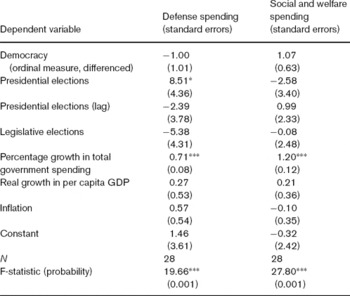
Table 1 reports the Huber−White robust regression estimation results for defense in column 1 and social and welfare spending in column 2. We checked for and found no problems from serial correlation. Huber–White estimation further ensures that the findings are robust to heteroskedasticity and residual autocorrelation problems. Generally, the results work as expected. Specifically, presidential elections are significant in explaining defense allocations; indeed, the presidential year election variable shows that the election leads to an 8.5% increase in defense allocations. Legislature year elections see no statistically significant increases in social and welfare spending. Of the control variables, growth in total government spending is statistically significant and positive in explaining both defense and social and welfare spending.
Huber–White robust regressions of percentage change in defense and social-and welfare spending in Taiwan

Notes: p < 0.1, **p < 0.05, ***p < 0.01.
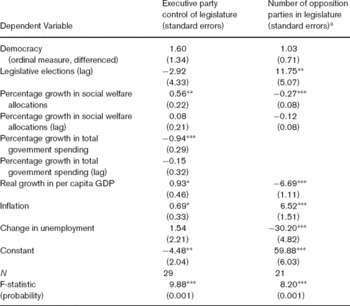
Table 2 reports the results of the effects of social and welfare spending on the change in executive party control and number of opposition parties in the legislature. Column 3 reports the results for change in executive party control in the legislature, while column 4 displays those for opposition party fragmentation. We lagged the legislative election variable because legislative elections are generally held at the end of the year in December, so that changes in the size of the ruling party or the number of opposition parties in the legislature follow from legislative elections in the previous year. Given the shorter time-series for equation (4) (1987–2004, based on the dataset), total government spending and its lag are dropped as controls in the analysis. We note that the results do not change substantively with their omission, that is the variables were not statistically significant in explaining the number of opposition parties in the legislature. Serial correlation did not pose a problem for the results, and our use of the Huber−White regression to assure robustness gives confidence that the results are robust.Footnote 45 They support our expectations; in particular, the lagged growth in social welfare spending is statistically significant and positive in explaining growth in the executive party's control of the legislature, while both social welfare spending and its lag are statistically significant and negative in explaining the number of opposition parties in the legislature.
Huber–White robust regression of percentage change in executive party control of and number of opposition parties in the legislature

Notes: (a) As discussed in the text, the shorter time-series for the opposition party fractionalization measure (from 1987–2004) led us to drop the variables of total government spending and its lag to preserve degrees of freedom. The omission of the variables does not change the results substantively.
*p < 0.1, **p < 0.05, ***p < 0.01.
Of the control variables in column 3, lagged total government spending is statistically significant and negative in explaining executive party control in the legislature; this suggests that the ruling party is held accountable for fiscal discipline in Taiwan. The economic variables of growth and inflation are also statistically significant and positive in explaining executive party control. They support the argument that the ruling party is held responsible for economic performance and is generally rewarded for a strong economy. Column 4 reports several variables to be statistically significant, including all the economic variables and legislative elections in the prior year. The results for real growth in per capita GDP and inflation are as theoretically expected; specifically, the results show that the number of opposition parties increase as a result of negative real growth in per capita GDP and high inflation.Footnote 46 The statistical significance of legislative elections in the prior year is also theoretically consistent: it shows that the number of opposition parties in the legislature increases with legislative elections in the previous years.
To summarize, the results from the longitudinal analyses show that presidential election years see significant increases in defense spending, while legislature election years fail to witness increases in social and welfare spending. The results also show that social and welfare spending is a strong predictor of legislative success for the ruling party and is negatively related to the number of opposition parties in the legislature. In conjunction, these results report that government spending supports an executive party agenda that is electorally costly to ruling party legislators and expands the number of opposition parties in the legislature.
Conclusion
The existing literature suggests that emergent democracies that face divided government and party volatility are likely to face democratic and political instability. Yet, cases of new democracies such as Taiwan and Brazil with both divided government and volatile parties have remained steadfast in their democratic and political paths. We explain that one motivation – ambition – drives divided government and party volatility in emergent democracies without jeopardizing democratic or even political performance. We test the argument with data from Taiwan.
The results corroborate our expectations that party volatility and divided government in emergent democracies occur as a result of ambitious candidates and politicians asserting distinct agenda for legislative and executive offices. In particular, the results reveal an executive agenda, typified by defense spending, in election years in both pre- and post-democratization periods. They also show an absence of a legislative agenda, characterized by increases in social and welfare spending, in election years. And, the results show that the executive party in the legislature benefits from increases in social welfare spending allocations, while the number of opposition parties increases with reductions in social welfare spending.
While the results here do not show statistically that ambition forestalls political and democratic weaknesses, two anecdotes suggest so. First, the informal pan-green and pan-blue coalitions in Taiwan, comprising the coalescence of parties that split or fractured from the major parties, underscore the effort by candidates and politicians to ensure governability and effectiveness. Second, the recent success in restructuring the electoral rules from single non-transferable votes for multiple member districts to single-member districts point to the efforts to pursue political and democratic performance. These anecdotal observations support the other studies in this issue regarding ambitious politicians and political development and substantiate our argument.
What other implications may be drawn from these findings? At a minimum, the findings reveal that the political divide in new democracies is more appropriately defined as one between executive and legislature, rather than an ideological divide between political parties of the left versus the right as experienced in the industrialized democracies. These results provide an overlooked caveat – executive–legislature tensions – to government spending studies. The executive–legislature divide also goes towards clarifying why catch-all parties in new democracies such as Taiwan may, nevertheless, experience party splintering and divided governments. We look forward to future work on how party fragmentation and divided government perpetuates democratic and political performance.
Appendix: Summary statistics of dependent and independent variables