

Over recent years, securitization theory has established itself as one of the most influential alternatives to traditional, ‘narrow’ security theory within International Relations. Developed in response to the need to expand the range of security studies after the Cold War, securitization theory offers a conceptually cogent method for studying security as the product of certain socio-political discourses and practices. As Buzan et al. explain: ‘To study securitization is to study the power politics of a concept. Based on a clear idea of the nature of security, securitization [theory] aims to gain an increasingly precise understanding of who securitizes, on what issues (threats), for whom (referent objects), why, with what results, and, not least, under what conditions (i.e., what explains when securitization is successful)’ (1998, 32). On this account, ‘security’ is a particular speech-act that can only be successful (receive acceptance by a community of speakers) under certain felicity conditions, namely situations in which ‘a securitizing actor uses a rhetoric of existential threat and thereby takes an issue out of what under those conditions is “normal politics”…. Thus the exact definition and criteria of securitization is constituted by the intersubjective establishment of an existential threat with a salience sufficient to have substantial political effects’ (1998, 25).
The fact that securitization theory offers an open-ended method for investigating concrete political discourses and practices rather than a metaphysical treatise on ‘the nature of security’ calls to mind the aspiration of much anthropological work. Indeed, the core claim of securitization theory – that ‘security’ involves a passing from one social order (‘ordinary politics’) to another (the extra-political realm of ‘emergency’) – exemplifies a manner of analysis in which anthropologists have for long been invested: that of accounting for the content of social phenomena with reference to the ‘logic’ of their articulation. The argument of this article pertains to this zone of sympathy between securitization theory and anthropology, inasmuch as it addresses the question of the different logics of the political in different contexts. To this sympathy it adds a critical spin or, put more positively, a desire to use empirical material to ‘extend’ securitization theory, and particularly the writings of the Copenhagen School, with which the theory is most closely associated.
Extending securitization theory in this way involves two steps, both of which may be seen as quintessentially anthropological. The first, which is the more critical, involves a move to relativize the theory by showing that its key premises are more contingent, historically and culturally, than they pretend. The move here, in other words, is to treat securitization theory less as a supra-historical/cultural analytical frame and more as a historical/cultural artefact in its own right. In this connection, our main claim is that, notwithstanding its fruitful application to societies other than Western democracies (Bubandt Reference Bubandt2005; Kent Reference Kent2006; Wilkinson Reference Wilkinson2007; Vuori Reference Vuori2008), securitization theory retains what we call an implicit ‘liberal’ premise: that security, in its paradigmatic form, pertains to the protection that a state or other sovereign entity is able to provide to guarantee the conditions of its citizens’ existence as relatively autonomous or free agents. With reference to counter-examples primarily from Cuba but also other state-revolutionary contexts, we argue that this basic ontological assumption about the nature, or more precisely the limits, of politics and society contains an analytical blind spot. Namely, it renders securitization theory blind to the decidedly non-liberal character of revolutionary political forms, such as those found in Cuba.
This leads to the second and more constructive step in our attempt anthropologically to extend securitization theory. How might the empirical contingencies of revolutionary politics in Cuba provide a vantage point from which securitization theory might be analytically reconstructed? In response to this question, we sketch what we call a ‘non-liberal’ (indeed, ‘revolutionary’) model of securitization. Our core point here is that, in certain revolutionary and/or state-socialist contexts, securitization pertains not to a passage from one position to another within a matrix of fixed coordinates (viz. from the realm of ordinary politics into a realm of emergency), but to a shift in the basic coordinates of the political matrix itself. In particular, as we wish to demonstrate, the shift in question amounts to a collapse of the distinction between ordinary and extraordinary politics, and between rule and exception, as these have been discussed by philosophers such as Carl Schmitt, Giorgio Agamben and Alain Badiou. This is because ‘revolutionary securitization’, as we call it, is systematically oriented towards rescinding precisely the liberal premise on which the distinction between ordinary and extraordinary politics – and the securitization model of the Copenhagen School – relies, namely the distinction between people ‘themselves’ and the external political structures by which they are governed. In this way, the characteristic ‘move’ of securitization becomes an immanent feature of revolutionary politics, provided the latter is understood in its own terms: as an ontological transformation, geared towards effecting, not just a change in the relationship between government and governed, but a wholesale re-definition of the terms of this relationship.
Given the cross-disciplinary nature of our anthropological foray into political scientific territory, it is worth being explicit here about what we take the overall theoretical stakes of our argument to be – a statement, as it were, of our anthropological ‘theory of theory’ (cf. Wæver Reference Wæver2009). For while our insistence on socio-cultural contingency as a source of theoretical critique and conceptual creativity may indeed be quintessentially anthropological, the way in which our argument casts the relationship between contingent empirical material and the theoretical conclusions that can be drawn from it exemplifies a rather particular understanding of what theory-making can be. Developing the meta-theoretical implications of the work of such anthropologists as Roy Wagner (Reference Roy1981), Marilyn Strathern (Reference Strathern2004), and Eduardo Viveiros de Castro (Reference Viveiros de Castro2010), what makes this approach distinctive – indeed contentious – within anthropology is the way in which it effectively reverses the relationship between data and analysis. In particular, it inverts the common social scientific reflex of imagining empirical data as providing ‘evidence’ (or counter-evidence, as the case may be) that may ‘support’ (or may not) theoretical models, which in that sense may (not) ‘apply’ to them. Moving instead in the opposite direction, the focus here is on the capacity that the very contingency of any given body of data (its ‘alterity’) may have to transform the conceptual coordinates of theoretical models that may purport to apply to it. So rather than imagining data as the material upon which theoretical models (viz. analytical ‘forms’) may operate, this approach posits data as the source of conceptual formations that may operate upon existing theoretical models so as to transform them into something new (Holbraad and Pedersen Reference Holbraad and Pedersen2009). Such a focus on the ‘recursive’ effects that empirical data can have on their own conceptualization tends to locate social and political theory closer to philosophy than to science, if one accepts the famous Deleuzian notion that philosophers’ prime business is to create novel conceptualizations (Deleuze and Guattari Reference Deleuze and Guattari1996). Social and political theory as an empirical philosophy of sorts (cf. Viveiros de Castro Reference Viveiros de Castro2010; Holbraad Reference Holbraad2012).
Adopting such a ‘recursive’ anthropological strategy, then, what follows can be understood as an attempt to ‘stretch’ the conceptual coordinates of the Copenhagen School model of securitization, by exposing it to the alterity of a contingent empirical case, namely the Cuban Revolution. So, our question is not so much what securitization theory can tell us about the Cuban revolution, but rather what can the Cuban revolution tell us about (or, better, do to) securitization theory. How, if you like, can the Cuban revolution serve to stretch our theoretical imagination of what securitization might be, and how it might work as a machine for thinking about security, revolution, politics, or any other contingent empirical phenomena it could serve to conceptualize? And, more specifically in the present analysis, what might the conceptual infrastructure of securitization look like if imagined in the ‘non-liberal’ terms, as we shall call them, set by the Cuban material? In short, the role of the Cuban case in our argument is not that of an object of theory, but rather that of a tool for theorization, understood as the analytical process of generating novel conceptual forms (particularly, in this case, political theoretical ones).
Our attempt in this way to ‘stretch’ the Copenhagen School model of securitization in the direction of revolution proceeds in five sections. In the first, we identify what we consider to be the implicit liberal underpinnings of securitization theory. With reference to the case of the Cuban revolution, in the second section we sketch what an account of revolution would look like from the point of view of the standard model of securitization theory. Plotted onto the essentially liberal coordinates of the model, we show, revolution would have to be parsed as a form of totalitarianism, in which the revolutionary regime engages in near-permanent acts of securitization against sundry existential threats to the people and their revolution, in whose name the state rules. With reference to the Cuban case, in the third section, we argue that, while tellingly confluent with the views expressed by the Cuban revolution's liberal critics, such an interpretation is in profound contradiction with revolutionary discourse itself, as expressed not only in the motivations and goals set forth for it by Fidel Castro and Ernesto ‘Ché’ Guevara, but also in certain forms of political organization and action that lie at the heart of the experience of revolutionary politics in Cuba. Key among these is the notion of self-sacrifice, which, as a sine qua non of revolutionary action, can be seen as the major premise of a political ontology, as we call it, that bases revolution on the annulment of the liberal (or, in the Marxist parlance that was at times adopted in Cuba and elsewhere, ‘bourgeois’) distinction between the individual person and the state. In the following section, we draw out the consequences of this alternative political ontology for securitization theory, sketching a model that posits revolutionary securitization as an event by which the coordinates of political action, and indeed social life as a whole, are transformed. Finally, in the concluding section, we return to the question of the relationship between securitization theory and anthropology. Here we contrast our own approach to existing attempts by anthropologists and political scientists who seek to show how, suitably modified and elaborated, the Copenhagen School model can be ‘applied’ to a variety of non-Western (indeed non-liberal) contexts – what we brand as the ‘add context and stir’ approach. Amplifying our meta-theoretical point about the significance of conceptualization as the major task of the present paper, we end with some reflections on the kinds of further questions this kind of anthropologically informed analysis of securitization raises for the broader project of what we call a ‘comparative ontology’ of security.
The liberal premise of securitization theory
So, what do we have in mind when we claim that securitization theory is founded on a tacit ‘liberal’ premise? To establish this point it pays to consider in its full length one of the Copenhagen School's most cited formulations of securitization as a passage from normal to special politics:
‘Security’ is the move that takes politics beyond the established rules of the game and frames the issue either as a special kind of politics or as above politics. Securitization can thus be seen as a more extreme version of politicization. In theory, any public issue can be located on the spectrum ranging from nonpoliticized (meaning the state does not deal with it and it is not in any other way made an issue of public debate and decision) through politicized (meaning the issue is part of public policy, requiring government decision and resource allocations or, more rarely, some other form of communal governance) to securitized (meaning the issue is presented as an existential threat, requiring emergency measures and justifying actions outside the normal bounds of political procedure) (Buzan et al. Reference Buzan, Wæver and de Wilde1998, 23–24).
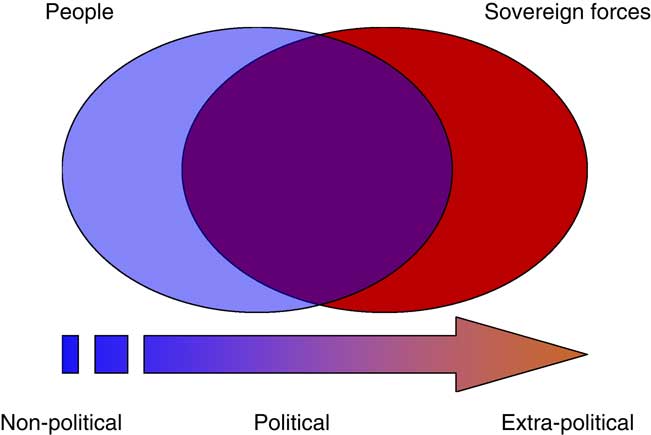
The authors make amply clear that this model of securitization is meant to have a purchase on a wide variety of empirical circumstances, and need not always pertain only to the role of the state and its military (Buzan et al. Reference Buzan, Wæver and de Wilde1998, 24) – this being their move to ‘widen’ the agenda of earlier state- and military-centric theorizations of security (however, see also Floyd Reference Floyd2007, 40–42 for an opposite contention). Nevertheless, one can also glean from the above formulation that in its ‘paradigmatic form’, to borrow Juha Vuori's formulation (Reference Vuori2008), the model does speak directly to longstanding concerns in political theory and indeed political anthropology regarding the relationship between subjects and sovereigns (or, more specifically, citizens and states) and the role of political processes in calibrating that relationship. Indeed one way to characterize the three levels of the model – for consistency let us call them ‘non-political’, ‘political’, and ‘extra-political’ – would be to correlate them in just these terms. The non-political realm, then, is the realm in which subjects act in relative autonomy from the sovereign power. Conversely, the extra-political realm of securitization is the realm in which the sovereign power acts in relative autonomy from its subjects, by way of emergency measures that have not been legitimated through the ordinary political channels. And ‘politics’ stands in the middle as the buffer-realm, in which the competing pressures of subjects’ and sovereigns’ autonomy are kept in balance. On their side, subjects recognize that some of their concerns can only be dealt with within the framework of rules that the authority of the sovereign power is able to guarantee. On its side, the sovereign power recognizes that its authority over subjects depends on the ‘legitimate’ exercise of its power, which requires that, under ordinary circumstances, it too must abide by the framework of rules or laws with whose guarantee it is entrusted. Framed in this way, the paradigmatic form of securitization is a tilting of just this balance of competing claims to autonomy: securitization becomes a process in which the sovereign power's capacity for autonomy is given precedence over the constraints of ordinary political arrangements.
The core metaphysical assumption behind securitization theory, then, is one of what one might call mutual ontological relativization: imagined as belonging to separate ontological realms, the people themselves and the political structures and the social processes to which their lives are subject exist in relative autonomy from each other, and politics is the field in which these relative capacities for autonomy are brought into relation with each other. Indeed, the model of securitization can be mapped directly onto these ontological coordinates, as seen in Figure 1.
The standard model of securitization and its ontological coordinates.

The bottom part of the figure, depicting the so-called ‘spectrum of securitization’, is adapted from Ralf Emmers’ influential presentation of the Copenhagen School model in a recent anthology (Emmers Reference Emmers2009, 112, see his Figure 7.1). The top part of the figure represents what we suggest is the core metaphysical premise of securitization theory in which political reality is imagined as consisting of two overlapping but otherwise ontologically distinct realms of ‘people’ and ‘political structures and processes’. The three ‘levels’ of the securitization model (non-political, political, and extra-political) correspond directly to the three counter-parts generated by the partial intersection (mutual relativization) of these two ontological realms.
It is this image of distinct ontological realms that we consider as the basic liberal premise of securitization theory. Mindful, obviously, of the contested and ambiguous character of the term, we use the adjective ‘liberal’ in a conceptually minimal sense, to refer to the idea that political processes operate upon (the question of sovereignty) and are sustained by (the question of legitimacy) people who in an irreducible sense remain transcendent to them. At issue here is not liberalism conceived as a particular political arrangement, ideology, or system of government, but rather a basic premise that underlies such political formations. The premise pertains to what we might call a political ontology, according to which the world consists of people (typically conceived as ‘individuals’ or ‘subjects’) who are ‘free’ inasmuch as they retain their integrity and autonomy with respect to the political structures by which they are governed. Seen from this perspective, ‘security’ represents the optimal point of balance, so to speak, between contrasting individual wills and collective agendas (Rotchshild, Reference Rotchshild1995; Rose Reference Rose1999; Burke Reference Burke2002).
Neither rule nor exception
In seeking anthropologically to extend the Copenhagen model of securitization to non-liberal and/or non-Western contexts like Cuba, our agenda may instructively be compared with Vuori's critical exploration of what he sees as the ‘democratic bias’ of the theory (Reference Vuori2008, 66). Because it was originally conceived in relation to European politics, Vuori argues, securitization theory automatically posits the ‘move’ of securitization as a passage from ordinary politics, in which issues are dealt with through ‘democratic process of government’, to one of special politics, where the use of extraordinary measures is legitimated. But what of totalitarian or other non-democratic contexts, he asks, where there is ‘no democratic process to move security away from’ (Vuori), and where it may be ‘difficult to distinguish between “normal” and “special” politics’? (2008, 69).
Like Vuori, we too wish to identify the Copenhagen School's reliance on the distinction between ordinary and special politics as a key sticking point. However, both our strategy and our aim can be articulated also by contrast to Vuori's agenda. As he puts it himself, his analysis is an exercise in ‘conceptual travel’ (Reference Vuori2008, 66). Its aim is to show that securitization theory can indeed be applied to situations in which standard ‘democratic’ distinctions between ordinary and special politics are absent. And his strategy for doing so is, effectively, to show that the Copenhagen School model can survive the trip without ‘conceptual distortion’, as he puts it (2008, 73), provided it is suitably adjusted to sidestep the ordinary/special distinction. For example, one of his central arguments is that in ‘totalitarian socialist systems’ such as China (his own primary case study) questions of security cannot be said necessarily to pertain to a realm of special politics, inasmuch as the kinds of measures one would deem as special in democratic contexts may here be deemed ordinary – even a matter of following the rules. ‘In these situations’, he argues, ‘security speech can be utilized for other purposes than legitimating the breaking of rules. Security can be used to reproduce the political order, for renewing discipline, and for controlling society and the political order’ (2008, 69). Much of his essay is devoted to extending the securitization model to incorporate these possibilities, not least by developing a more fine-grained typology of the kinds of speech-acts that securitizing moves may involve.
Our agenda in extending the model is in a sense opposite. Rather than showing how the basic conceptual coordinates of the model can be preserved by accommodating within them empirical examples that appear to contradict it, we wish to use these contradictions as a vantage point from which to alter the conceptual coordinates of the theory. In Vuori's terms, we see the possibility of ‘stretching’ concepts as we make them ‘travel’ as a positive opportunity rather than a danger (Holbraad and Pedersen Reference Holbraad and Pedersen2009). Thus, our aim is not to show how the model of securitization can be ‘applied’ to novel contexts, but to show that, inasmuch as novel contexts resist such attempts, they provide the grounds for transforming some of the premises of the theory itself.
Before exploring how the Copenhagen School's model of politics can be modified through specific counter-examples, however, it is useful to specify precisely which elements of this theory are extendable along the non-liberal lines we have indicated. Mark Neocleous's recent critique of attempts to characterize the post 9/11 world order as a ‘permanent state of emergency’ is pertinent here. The problem, as Neocleous puts it, is that ‘by separating “normal” from “emergency”, with the latter deemed “exceptional”, [such attempts parrot] the conventional wisdom that posits normalcy and emergency as two discrete and separable phenomena’ (Reference Neocleous2006, 206). This ‘essentially liberal paradigm’, then, is based on the unquestioned ontological assumption ‘that there is such a thing as “normal” order governed by rules, and that the emergency constitutes an “exception” of this normality…. Thus liberalism seeks to separate emergency rule from the normal constitutional order, thereby preserving the Constitution in its pristine form while providing the executive with the power to act in an emergency’ (2006, 206–207).
This is a useful insight for present purposes. For what Neocleous identifies as liberalism's fundamental separation between emergency rule and normal constitutional order is arguably part of the same set of liberal ontological assumptions that we have identified in securitization theory. As noted above, the crux of the liberal political imagination may thus be described as a trade-off between individuals and states, in which the former agree to cede some of their freedom in return for the security provided by the latter via the ‘rule of law’ and the formulation of rules for the regulation of social, economic, and cultural life more generally. Yet, as certain events inevitably cannot be contained by rules, liberal society also needs ‘the exception’ and the potential for extraordinary measures for which this concept allows. The result is the characteristic double-bind of securitization, which allows the sovereign simultaneously to act as the enforcer of the law and as the only agent able to violently break it. For when it comes to ventures into the realm of the extra-political, the sovereign power has both the sanction and the means to flirt with political illegitimacy. The sanction flows from the sovereign power's role as guarantor of the run of ordinary political life, including the conditions of existence of its subjects. Provided the sovereign power can demonstrate that these are under threat, it can justify using otherwise illegitimate means to defend them. Moreover, the sovereign power can avail itself of such means by definition. What distinguishes the sovereign from its subjects, after all, is precisely that the latter have entrusted it with levers of power that allow it to act as their guarantor.
We can therefore only agree with Neocleous that insofar as ‘we are genuinely looking for alternatives’ to liberal political ontology, then ‘we will have to look beyond the normal/emergency paradigm’ (Reference Neocleous2006, 194). For this, the philosophy of Agamben (Reference Agamben2005), as well as its inspiration in Carl Schmitt (Reference Schmitt2005), are germane. Contrary to how Agamben's work is depicted by contemporary social and political scientists interested in exposing the ‘dark side’ of modern states (including Neocleous himself), Agamben's concept of the state of exception cannot, we think, be reduced to the point that democracies exist in a ‘permanent state of emergency’, which produces multiple zones of spatial exclusion and suspension of laws, like the Guantanamo camp. For Agamben (and, as we shall see, his predecessor Schmitt), the state of exception refers to much more than simply an exception to a system of rules; in fact, the exception is a sui genesis ontological condition that is prior to any particular kind of politics or law.
According to Schmitt's ‘decisionist theory of sovereignty’ (Williams Reference Williams2003, 516), ‘a general norm, as represented by an ordinary legal prescription, can never encompass a total exception’ (Schmitt Reference Schmitt2005, 6). It is because of this logical priority of exceptions over rules that, for Schmitt, juridical laws and codes of conduct more generally must always be secondary to sovereign decisions and political necessity, as opposed to the other way around. After all, Schmitt argues, ‘the exception is that which cannot be subsumed; it defies general codification, but it simultaneously reveals a specifically juristic element – the decision in absolute purity. The exception appears in its absolute form when a situation in which legal prescriptions can be valid must first be brought about…. For a legal order to make sense, a normal situation must exist, and he is sovereign who absolutely decides when this normal situation actually exists’ (2005, 13). According to this decidedly non-liberal theory of politics, then, the exception is paradoxically that which makes it possible for the norm to come into being in the first place, as opposed to its being contained within the norm, as the liberal and rational legal philosophical tradition would have it:
The exception can be more important to it than the rule, not because of a romantic irony for the paradox, but because the seriousness of an insight from what ordinarily repeats itself. The exception is more interesting than the rule. The rule proves nothing; the exception proves everything: It confirms not only the rule but also its existence, which derives solely from the exception. In the exception the power of real life breaks though the crust of a mechanism that has become torpid by repetition (Schmitt Reference Schmitt2005, 15).
For Schmitt, then, the exception is both logically and ontologically prior to the rule. The exception is, so to speak what ‘causes’ the rule to exist, as opposed to the other way around as in liberal political ontology, for, apart from containing everything that has ever happened until now (as the rule does, or at least strives to), the exception comprises all the things and events that have not happened yet, and which cannot therefore logically be contained within the norm's attempt to tame the future through a predictable rule of law. This insight – that the state of exception denotes an intensive ontological state in the Deleuzian sense, as opposed to an extensive space of legal and spatial exclusion (viz. Guantanamo) – has important ramifications for our understanding of the relation between rules and exceptions in political life. More specifically, it helps open the way for extending securitization theory beyond its liberal premises. For if, as Agamben puts it, the state of exception ‘defines law's limit concept’ (Agamben Reference Agamben2005, 4; cf. Schmitt Reference Schmitt2005, 5), then it is ‘neither internal nor external to the juridical order, and the problem of defining it concerns precisely a threshold, or a zone of indifference, where inside and outside do not exclude each other but rather blur with each other’ (2005, 23).Footnote 1 Accordingly, since the state of exception ‘separates the norm from its application in order to make its application possible’ (2005, 35), then what emerges on the other side of liberal ontology – and, specifically, of securitization theory in the paradigmatic form discussed above – is an image of political life as constituted neither by rules nor by exceptions, but by perpetual and violent actualizations of the indeterminate and intensive space between them.
On this ‘poststructuralist realist’ reading of Schmitt and Agamben (to paraphrase Ole Wæver, cf. also Williams Reference Williams1998), political life is not restricted to an extensive space suspended between the two poles of absolute freedom (unrestricted individual autonomy) on the one hand and total oppression (omnipotent sovereign authority) on the other. Rather, politics pertains to the ‘virtual’ zone of intensity from which everything else is also actualized, including such ingrained liberal binaries as freedom vs. oppression, rule vs. exception, and, indeed politics vs. non-politics. Hence, ‘freedom’ here is not to be conceived as an inverse function of ‘oppression’. Rather, as flip sides of each other, they figure as opposite enactments of the same invisible ground (politics), which depend on this ‘zone of indifference’ for its existence. On this non-liberal vision of politics, a person may be both fully free and fully unfree at the same time.
Turning more specifically to the question revolutions and other kinds of radical societal upheaval, Agamben makes the point that ‘in extreme situations “force of law” floats as an indeterminate element that can be claimed both by the state authority … and by a revolutionary organization’ (Agamben 2005, 38–9). In a somewhat similar vein, Schmitt observes that ‘the exception … can at best be characterized as a case of extreme peril, a danger to the existence of the state, or the like’ (2005, 6), and that ‘what characterizes an exception is principally unlimited authority, which means the suspension of the entire existing order. In such a situation it is clear that the state remains, whereas law recedes. Because the exception is different from anarchy and chaos, order in the juristic sense still prevails even if it is not of the ordinary kind’ (2005, 12). But this raises the question: might one identify past or present political discourses and forms of sovereignty that do not operate with the ‘liberal’ distinction between rule and exception, or, put differently, between a normal political order and an extra-legal state of emergency? And what might ‘securitization’ amount to in such contexts? Revolutionary discourse and practice in Cuba, we suggest, is a case in point.
Inverse and permanent securitization
The temptation to extend securitization theory to revolutionary contexts such as the Cuban is palpable. All it takes is to conjure the image of archetypal revolutionary figures such as Robespierre, Lenin, Mao, or Fidel Castro and Ché Guevara: finger-in-the-air, inciting the masses to violent uprising, or hands-on-the-levers-of-power, administering state violence and terror in the name of revolutionary rectitude and the promise of a ‘New Man’. If the passage from ordinary politics to states of emergency is the paradigmatic image of securitization theory, then revolution seems almost to be its model form. Indeed, one may distinguish three senses in which securitization theory may have a purchase in the study of revolutions. First, one could use the theory to make sense of the security threat revolutions may pose to the regimes that they seek to overthrow. Second, one could use it to understand the perspective of the revolutionary movements themselves, and the way they enunciate their opposition to the regimes against which they revolt as a matter of security. Finally, one can imagine using the theory to articulate the point of view of the states revolutionary movements may go on to institute – states, that is, that designate themselves as ‘revolutionary’, such as the French First Republic, the Soviet Union, or the Castros’ Cuba. Our concern here is with the two latter senses, as well as the relationship between them – it being in relation to the securitizations that revolutionary movements perform as they pass from attacking state power to inhabiting it that a non-liberal alternative to the Copenhagen School model – the stretched concept of securitization and of politics we shall be calling revolutionary – emerges. To see this, however, it pays first to consider what the security stakes of revolution might look like when analysed with reference to the standard model of securitization theory.
One may start with the image of revolutionary leaders inciting the assembled masses to violent revolt against an evil and unjust regime, which captures something of the essence of the ‘extreme-times-call-for-extreme-measures’ logic of securitization. Such revolutionary incitements could be plotted onto the coordinates of securitization theory, to identify the felicity conditions under which the speech-acts in question (for surely that is just what an incitement to violence is) may effectively render feasible the nothing if not extraordinary call to popular revolt. One might want to say, for example, that in the Cuban instance revolutionary leaders such as Fidel Castro or Ché Guevara take the role of ‘securitizing actors’, the ‘Cuban people’ become the ‘audience’, the Batista's corrupt regime (the so-called batistato that Castro's rebels overthrew in 1959) becomes the ‘existential threat’, while its ‘referent object’, one might want to argue, becomes not only the well-being and dignity (or some other such vague notion) of the Cuban people, but also the values upon which these are based (ideas about justice, liberty, equality), and perhaps the basic conditions of their existence (housing, health, education, etc.) too. One could then pose questions about the conditions under which individuals such as Fidel and Ché, or ‘movements’ such as the one they lead, may attain the ‘social capital’ that would allow for the effective securitization of an entire political establishment. One could imagine, for example, articulating these conditions as particular configurations of the personal charisma of the securitizing actors, the receptivity of their popular audience, linked to their subjective perception, as well as the objective characteristics, of the regime that is designated as a ‘threat to the nation’, and the peculiar appeal of the values and promises of revolutionary rhetoric.
Were one to base one's analysis of revolutionary movements such as the Cuban on securitization theory in this way, one would arrive at an interesting reversal of the paradigmatic form of the model of securitization – a formal inversion that would seem to account for the asymmetrical way in which reigning powers and revolutionary movements, respectively, designate one another as threats. While in the standard model the suspension of ordinary politics amounts to giving precedence to the sovereign's autonomy, in the case of revolutionary movements it would appear that it is the slot for the subjects’ autonomy that gains priority. Hence, in terms of the standard model's three levels outlined above, the securitization performed by revolutionary movements takes the form, not of a move from the political into the extra-political, but rather of a move in the opposite direction, from the political to what in the standard model would be the realm of the ‘non-political’, but in the context of revolt may better be branded as ‘counter-political’, that is, a space in which subjects can exercise their autonomy in pursuit of alternative modes of politics that go beyond the political arrangements the sovereign power supports.
However, the shortcomings of this notion of ‘inverse securitization’ come to the fore when one considers how securitization theory fairs in the analysis of what follows successful revolutionary movements such as the Cuban, namely the institution of so-called ‘revolutionary states’. This apparently oxymoronic notion (viz. if the revolution occupies state power, then against whom or what is it in revolt?) has of course been a central preoccupation for theorists and protagonists of revolution alike (e.g. Draper Reference Draper1987; Parker Reference Parker1990, 28–34). Indeed, the paradox on which these concerns revolve can be put starkly in the terminology of securitization we have been developing here. If the securitizations performed by states move in the opposite direction, so to speak, from the securitization performed by revolutionary movements – that is, towards extra-political security measures vs. towards counter-political revolts, respectively – then in which direction do securitizing processes move when it comes to states that brand themselves as revolutionary?
The paradigmatic form of securitization theory, founded on the distinction between people and sovereign powers as explained above, cannot but render the question as an irresolvable paradox. If such political formations as the French First Republic, the Union of Soviet Socialist Republics (USSR), or revolutionary Cuba are to be deemed as states at all, then, from the point of view of securitization theory, their claim to revolution can only be construed as a matter of empty rhetoric: the state may evoke an image of counter-political revolt, recalling perhaps its original rise to power, but its very ability to do so qua state instantiates ipso facto that revolt – self-revolt? – is hardly what is at issue. Indeed, one is tempted to think that the apparent oxymoron ‘revolutionary state’ corresponds in fact to a peculiarly perverse form of securitization. What makes revolutionary states revolutionary is hardly that they are closer to ‘the people’, florid revolutionary rhetoric notwithstanding. Rather, their appeal to the notion of emergency that the idea of revolution connotes serves as a way for them to avail themselves of ever more opportunities to securitize. In other words, the designation of ‘revolution’ in such cases does not act to check state power, but rather to enhance it, basically serving as a weapon in the armoury of the state's extra-political, and therefore totalitarian domination of its subjects. Indeed, one could go as far as to argue that maintaining the claim to revolution even after the events of revolt are ended, and the revolutionary movement has taken firm charge of the state apparatus, is basically a way for governing regimes to sustain something akin to a permanent state of emergency in the sense discussed above: a means of permanent securitization that allows self-designated revolutionary states to resort to extra-political means and the imposition of new rules and exceptions, as and when it suits them.
Such an analysis, which is basically in line with the longstanding liberal and right-leaning determination to dismiss revolutionary politics as forms of totalitarianism or dictatorship (see Žižek Reference Žižek1999), is not hard to support empirically. There can be little doubt that revolutionary states do indeed use the notion of revolution itself (and/or cognates such as the ‘people’, the ‘nation’, ‘just society’, and so on) as a referent object for the introduction of sundry security measures that purport to protect it, and thus act as a further boost to the power of the state itself. The terror associated with Robespierre in revolutionary France, Stalin in the USSR, and Mao in China would perhaps be the most harrowing examples of this, and analogous stories could be told of Cuba (e.g. the introduction of the so-called UMAP (Unidades Militares de Ayuda a la Producción) camps from 1965, where undesirables of various kinds were sent for ‘re-education’ by the security forces – Kapcia Reference Kapcia2000, 130). Indeed, a rousing speech given in October 1959 from the terrace of the Presidential Palace in Havana by Camilo Cienfuegos, one of the most charismatic members of the Revolutionary leadership, puts the position succinctly: ‘For every traitor that appears’, he proclaimed, ‘we will make new Revolutionary laws’ (see García Luis Reference García Luis2008, 65–66).
But such interpretations are as partial in the epistemic sense as they are in the political one. In particular, at once cynical about the so-called authoritarianism of revolutionary states and patronizing of their putatively repressed subjects, such analyses remain blind to what is arguably the most striking and distinctive feature of revolutionary politics – particularly in Cuba, as we shall see, but also elsewhere: namely, its self-conscious attempt to enunciate itself as an alternative political ontology – that is, an all-together different way of doing politics and of being a political subject than one finds in liberal traditions. This alternative hinges precisely on the way revolutionary states designate the relationship between people and state – a question so basic to revolutionary politics, socialist or otherwise, that it may justly be branded as its core conundrum. In the next section, with reference primarily to the Cuban case, we present the key tenets of such a political ontology in some detail, in order to proceed in the following sections to articulate the ways in which it ‘stretches’ the Copenhagen School model of securitization.
The political ontology of revolution
Cuba offers an optimal vantage point from which to rethink the liberal premise of securitization theory precisely because its particular response to the state-revolutionary conundrum of how to think the relationship between people and state is arguably what has made it so famous. Even at the most superficial level, one might observe that the extraordinary fascination that the Cuban Revolution has held for generations of sympathizers across the globe has much to do with its projection of an apparently impossible combination of enduring revolutionary fervour with a perduring, against-the-odds statecraft: the bearded images of hope, Fidel's cigar-and-uniform, Ché's youthful martyrdom captured for eternity on t-shirts and beer-bottles. Indeed, if the Revolution's vociferous US-based detractors and liberal critiques have focused so much energy on puncturing this myth, that only underscores the power of the Cuban Revolution's image as an enduringly popular political experiment – which is to say, a revolution belonging, not to a domineering state, but still ‘of and for the people’. While it is not our concern here to pass judgement on either side of this cultural and political tussle of imageries, the fact that the Revolution's stance to the conundrum of the state's relationship to the people has been its abiding focus is our empirical point of departure.
Indeed, it is revealing that just this conundrum lies at the heart of the vast political scientific and historical literatureFootnote 2 on the Cuban Revolution, to the extent that shifting stances on the state's relationship to the people furnish the main point of debate in the overall historical narrative of Cuban revolutionary history. This narrative's abiding attractor, so to speak, has been the particular conceptualization of the relationship between people and state that the Cuban revolution has in different periods sought to represent as an alternative, not only to the political order it replaced in 1959 (or to the United States of America, ‘capitalism’ and the ‘liberal West’ more generally), but also to that of previous revolutionary movements, and not least the model of so-called ‘existing socialism’ exemplified by the USSR. Typified in the figure of (Ernesto) ‘Ché’ Guevara both as its quasi-mythical instigator and as its most articulate theorist (alongside Fidel Castro himself), this vision of revolution purports to offer a radical solution to the aforementioned conundrum. In line with earlier Marxist-inspired revolutions, such as the Russian one, the task of revolution is posited, precisely, as that of obviating the very distinction between state and people, such that the two become ontologically coterminous as the state ‘withers away’, in Engels’ famous phrase, and ‘communism’ is achieved. What makes the Cuban case in its extreme ‘Guevarist’ guise distinctive, alongside with other socialist projects formulated as an explicit alternative to the USSR such as Maoism, is that this goal is posited, not so much as a transcendent outcome projected into the future (as, e.g. in the Leninist vision of a vanguard-led dictatorship of the proletariat leading at some unspecified future to its own dissolution), but more as an immanent function of the process of revolutionary statecraft itself. According to this vision, the immediate gauge for the revolutionary state's legitimacy is the degree to which it promotes a collapse of the distinction between state and people, in a spirit of constant and abiding political experimentation.
The locus classicus of this image of revolution is Ché Guevara's 1965 text Socialism and Man in Cuba – in some ways Guevara's equivalent, or even answer, to Lenin's State and Revolution (Reference Lenin1992). Written from within the Marxist theoretical tradition in which Guevara had steeped himself as a member of the Cuban government in the early 1960s (Kapcia Reference Kapcia2000, 121), the text is presented explicitly as a refutation, based on ‘the facts as they exist in Cuba’, of the ‘common argument from the mouths of capitalist spokesmen […] that socialism, or the period of building socialism into which we have entered, is characterised by the abolition of the individual for the sake of the state’ (Guevara and Castro Reference Guevara and Castro2009, 7). At the heart of his case, is a notion of the Cuban revolution as a project of ‘simultaneous creation of socialism and communism’ (Bengelsdorf Reference Bengelsdorf1994, 91). The vision is pitched explicitly in contrast to Marxist ‘scholasticism’, and particularly theories of ‘pure transition’, in which communism is supposed to result from objective conditions emanating from the class dynamics of late capitalism and, following revolution, the dictatorship of the proletariat (Guevara and Castro Reference Guevara and Castro2009, 16–19).
On the contrary, argued Guevara, Cuba represented the possibility of speeding up the transition to socialism by supplementing the objective conditions for socialism – only partially met in the historical contingencies of revolutionary Cuba – with an irreducibly subjective component: an ongoing and deliberate effort to transform the subjectivity of the people by forging the so-called New Man, which is considered to be the existential outcome of all socialist revolutions. Alongside creating the material conditions for freedom and prosperity through new economic forms and technologies, then, an abiding objective of revolutionary states and their institutions – in political mobilizations, labour arrangements, education, the arts – is to bring about a new ‘consciousness’ (conciencia) in the individual, as the subject of its history, in an open-ended project of moral development, based on revolutionary values of voluntarism, selflessness, and public service.
A truly revolutionary politics, then, is one that is deliberately geared towards an erosion of the very distinction between the state and the people and their respective needs. The liberal charge of totalitarianism is ‘refuted’, in Guevara's words, inasmuch as the Cuban state's task is not to ‘abolish’ the individual, but rather to fashion it into a new subjectivity or consciousness that not only embodies the revolutionary ethos, but enacts the very revolutionary condition that the socialist state is charged with bringing about. At stake, then, is not a clash between two contrasting ways of instituting and organizing the relationship between a state and a people (liberal, say, vs. totalitarian), but rather two alternative ontological positions on what might count as ‘state’ and ‘people’ in the first place. Where liberal assumptions premise the two sides of this political equation as (to a degree) mutually independent variables – viz. sovereigns and subjects who retain their respective scopes for autonomy, with different degrees of relativity – Guevara seeks to articulate revolutionary politics in Cuba as a concerted attempt to render them mutually dependent: a ‘society in formation’, as he writes, ‘that will permit a complete identification between the government and the community in its entirety’ (Guevara and Castro Reference Guevara and Castro2009, 16, emphases added).
Indeed, while Guevara's elaboration of this idea goes in a number of directions we cannot chart here (e.g. on the salient role of the revolutionary vanguard, the party and the youth in bringing about such a transformation in Cuba), his notion that revolutionary politics presupposes an immediate ontological identification between sovereign and subjects is most tellingly expressed in his comments on Fidel Castro's relationship to the people. Having extolled Castro's guerrillas as the ‘generator of revolutionary consciousness’ in the period of armed combat that led to the ‘Triumph’ of 1959, Guevara is keen to dispel the misperception that, once in government, the forms of leadership and government of this socialist revolutionary vanguard might conform to the image of a ‘subordination of the individual by the state’ (Guevara and Castro Reference Guevara and Castro2009, 8, 10). While ‘the state sometimes makes mistakes’, falling out of step with the masses, ‘the difficult thing to understand for someone not living through the experience of revolution is [the] close dialectical unity [through which] the mass, as an aggregate of individuals, interacts with its leaders’ (Guevara and Castro Reference Guevara and Castro2009, 10–11). While ‘a more structured connection with the mass is needed’, Guevara goes as far as to admit, ‘as far as initiatives originating in the upper strata of government are concerned, we are currently utilizing the almost intuitive method of sounding out general reactions to the great problems we confront’:
In this Fidel is a master. His own special way of fusing himself with the people can be appreciated only by seeing him in action. At the great public mass meetings one can observe something like the dialogue of two tuning forks whose vibrations interact, producing new sounds. Fidel and the mass begin to vibrate together in a dialogue of growing intensity until they reach the climax in an abrupt conclusion crowned by our cry of struggle and victory (Guevara and Castro Reference Guevara and Castro2009, 10).
Now, the common story told about the impact of Guevara's radical vision upon the course of the Cuban revolution is one of high idealism, borne, as the 1960s unfolded, of a combination of revolutionary fervour and political and administrative inexperience, leading to a bumpy landing in the realities of state administration in the 1970s. Certainly, Guevara's account of Fidel's ‘fusion’ with the people captures much of the effervescence of the early years of the Revolution – what Jean Paul Sartre, impressed in his visit to Cuba in 1960, called ‘direct democracy’ – with overwhelming support for the revolutionary leadership (cf. Sartre Reference Sartre1961; Bengelsdorf Reference Bengelsdorf1994, 66–98; Kapcia Reference Kapcia2000, 99–146), massive popular mobilizations in ‘revolutionary offensives’ such as the literacy campaign of 1961, and, crucially, arguments spearheaded by Guevara winning the day in the so-called ‘great economic debate’ of the early 1960s, following which Castro adopted the view that the economy should be driven by moral rather than material incentives (Kapcia Reference Kapcia2000, 132–138; cf. Badiou Reference Badiou2009, 25). Equally, for many, Guevara's almost mystical faith in an ‘intuitive’ union of state and people expresses an at best naïve and worst crass disregard for due democratic process, responsible for the increasingly ineffectual revolutionary governance of the later 1960s, the failings that became apparent to all with the emblematic fiasco of the 10,000 tonnes harvest of sugarcane in 1970, which Castro's government had set up explicitly as proof of the capacities of Cuba's putative New Men in action (Mesa-Lago Reference Mesa-Lago1978). According to this common view, Castro's own admission of the failure on 26 July 1970, and the subsequent period of ‘revolutionary consolidation’ in the 1970s and early 1980s, during which the revolution was substantially institutionalized adopting Soviet-style models of bureaucratized governance, is proof positive of the unworkable idealism of Guevara's project of state-people fusion.Footnote 3
Perhaps the most detailed exposition of this view of Guevarism as a charming but unworkable ideal can be found in Carollee Bengelsdorf's seminal study, The Problem of Democracy in Cuba, tellingly subtitled ‘Between Vision and Reality’ (1994). Providing a sympathetic and wide-ranging account of both the promise and the many failings of the Cuban state's attempts to implement its own vision of socialist democracy, Bengelsdorf presents Cuba's ultimate failure to provide adequate channels for popular participation in state governance as an expression of a basic blind spot in the theoretical foundations of revolutionary socialism. As she writes:
There is nothing in the key texts of the Marxist tradition [including, as she shows in detail, Guevara's] that gives us much of a blueprint for understanding, much less charting, the transition [to socialism]. […] The beginning of ‘real history’ in classical Marxism is to be marked by the reabsorption by civil society of political society. Therefore questions of political society – of the form of nature of political institutions – are no longer relevant. The boundaries between state and civil society are thereby erased; indeed, the very need for such boundaries goes unrecognised or denied. The result, as subsequent history would show with such terrible clarity, was the confiscation of civil society by the state: statification rather than socialization (Bengelsdorf Reference Bengelsdorf1994, 6).
This analysis of ‘statification’ certainly captures much of what can be said to be wrong with Cuba's revolutionary government. At the same time, however, the very suggestion that the revolutionary government in Cuba, along with Marx, Lenin, and Guevara themselves, are blind to the need for democratic ‘mediation’ between the people and the state, as Bengelsdorf calls it, arguably tells us something important about the logic of revolutionary political discourse, understood in its own terms. If the Cuban leadership and its theoretical forefathers have been so consistently blind to such a need, we argue, that is because, in a crucial and irreducible sense, from its point of view such a need does not exist. In fact, if Bengelsdorf's analysis takes for granted a version of what we have called the liberal ontology of state vs. people (such that even a socialist revolutionary state must be built with an eye to an already given distinction between the two), that is because it fails to take into account the significance of the role of revolution itself, not just as an act that precipitates socialist emancipation, but as a constitutive element of that emancipation itself. In particular, it seems to us, to project the fusion of state and people as a future or ideal goal for revolutionary politics is unduly to focus on the content of state-revolutionary rhetoric – viz. about revolutionary politics as an ongoing project of transition, construction, and so on – at the expense of the key assumption on which this rhetoric is premised. Namely, that, from the perspective of revolutionary form, the ontological fusion of state and people, which revolutionary politics is taken to enact, is in a crucial sense already achieved.
This formal characteristic is most abidingly related to the fact that, whatever ideological content a revolution might profess (and as history shows, these can be as different as, for instance, the bourgeoisie is to the proletariat), its minimum requirement is that subjects should be prepared to sacrifice themselves for it. To revolt, simply, is to take up arms against the prevailing order, and thus to risk one's self – indeed one's life. Akin to war in this sense (Arendt Reference Arendt1990, 11–58), revolution is the politics whose price is potential death par excellence. ‘The revolutionary is a doomed man’, as the 19th century Russian conspirator Sergey Nechaev put it pithily. Indeed, this is also a direct corollary of the concept and the promise of a New Man in socialist revolutionary discourse: insofar as the state-revolutionary vanguard and the socialist cadre are ready to give up their entire former way of living – the very manner of existence as citizens – they must also be prepared to die for the revolutionary cause. These two seemingly opposite existential revolutionary outcomes – becoming a New Man, or dying for the revolution – in fact co-implicate each other: they both instantiate the capacity and the will to sacrifice what one is in order for the world to orchestrate itself in a new way. Discussing the intrinsic role of terror to revolutionary activity, Badiou (a self-proclaimed Maoist) reaches a similar conclusion:
As we've known ever since Robespierre and Saint-Just, the central category of state revolutionary formalism is terror – whether the word is pronounced or not. But it is essential to understand that terror is the protection onto the state of a subjective maxim … [T]error is nothing but the abstract upshot of a consideration required by every revolution. Since the situation is marked by an absolute antagonism, it is imperative to maintain:
• that every individual is identical to his or her political choice
• that non-choice is a (reactive) choice
• that (political) life, having taken the form of civil war, is also the exposure to death
• that, in the end, all individuals of a determinate political camp can be substituted with one another: the living take place of the dead.
… State revolutionary subjectivity, built on the confidence in the real movement of politicized consciences and the exaltation of will, brings together terrorist antagonism and the consequences of egality (Badiou Reference Badiou2009, 26).
Just this trademark of revolutionary political ontology – the formal requirement that subjects that are prepared to die for its cause – is set out with remarkable clarity by Fidel Castro himself, in an infamous speech delivered to an assembly of leading artists and intellectuals in 1961, where he attempts to allay fears that the Revolution would stifle their freedom of expression:
The revolution … should act in such a way that these artists and intellectuals who are not genuine revolutionaries can find a space within the revolution where they can work and create. Even though they are not revolutionary artists and writers, they should have the opportunity and freedom to express their creative spirit within the revolution. In other words: within the revolution everything; against the revolution, nothing. Against the revolution, nothing, because the revolution also has its rights, and the first right of the revolution is the right to exist, and no one can oppose the revolution's right to exist. Inasmuch as the revolution embodies the interests of the people, inasmuch as the revolution symbolizes the interests of the whole nation, no one can justly claim a right to oppose it…. This is not some special law or guideline for artists and writers. It is a general principle for all citizens. It is a fundamental principle of the revolution. Counterrevolutionaries … have no rights against the revolution, because the revolution has one right: the right to exist, the right to develop, and the right to be victorious. Who can cast doubt on that right, the right of a people who have said: ‘Homeland or death!’ – that is, Revolution or death (Castro Ruz, from García Luis Reference García Luis2008, 116–7, emphases added).
In essence, then, revolutionary ontology is founded on a syllogism that, as it were, has death as its major premise.Footnote 4 If to be revolutionary is to be prepared to die for the revolution, and death is understood as the paradigmatic and most complete form of self-sacrifice (see Willerslev Reference Willerslev2009), it follows that revolutionary subjectivity takes an entirely encompassed form: no part of the revolutionary subject, so to speak, remains beyond the revolution. It is in this sense, then, that the mantra-like slogan ‘Revolution or death’, taken seriously as a logical disjunction, implies the notion of revolution as a political form that, strictly speaking and in line with Castro's logic, has no legitimate outside.
Indeed, the manner in which Castro designates the question of ‘existential threat’ – so central to the theory of securitization – reveals the peculiarly ontological implications of this manner of conceiving of state-revolutionary politics. What makes Castro's pronouncement such a definitive moment for the Cuban Revolution, we would suggest, is its polemic antithesis to the notion that dissent is an expression of subjects’ freedom to choose the political structures by which they are governed – the Lockean (and in our terms ‘liberal’) image of subjects choosing their sovereign. On such a view, the existential threat of counter-revolution becomes an instance of subjects’ capacity to exercise just this freedom. Quite the contrary, Castro contends. Subjects’ freedom (in art, thought, and in general) is a function of their existence within the Revolution. Revolution is precisely the political form that recognizes no space of freedom ‘beyond’ itself, and in this sense has ‘no outside’. So: if revolution, premised on the self-sacrifice of its subjects, is the political project that creates political subjects per excellence, then those who threaten it cannot exist as political subjects at all. Seen in this light, Castro's assertion that ‘no one can oppose the revolution's right to exist’ implies also its own reversal: s/he who opposes the revolution's right to exist is no one. ‘Against the revolution’, as he says, ‘nothing’. Or, as we might put it, to threaten the revolution is to place oneself under ontological erasure: to give up one's own right to exist.
Revolutionary securitization
So the contrast with what we are broadly calling revolutionary and liberal political ontologies is radical. If liberalism depends on the separation and relative autonomy of subjects from the state, then revolution turns on their fusion: revolutionary subject and revolutionary state are politically and ontologically coterminous and, in that sense, one. This being so, it should also be clear that, inasmuch as securitization theory is premised on the dualism of liberalism (as we have argued), it is bound to misconstrue the logic of revolutionary politics. Intriguing as they may be from the viewpoint of liberal assumptions, the notions of ‘inverse securitization’ (meant to articulate the securitizations performed by revolutionary movements contra the state) and ‘permanent securitization’ (which corresponds to the ‘perverse’ securitizations with which revolutionary states are meant to dupe their citizens) turn out to be symptoms of a basic analytical distortion.
The alternative model that we are here proposing is conditional on the critique we have already offered of securitization theory, and runs as follows. We saw that securitization theory is unable to provide a fully satisfactory analysis of revolutionary ontology because it posits an ontological separation where revolutions posit an ontological identification. We also saw that the ontological identification that revolutions presuppose depends on the idea of self-sacrifice: it is the fact that people are willing to die that renders them revolutionary, and this is the premise upon which the ontological identification of revolutionary states and revolutionary subjects is built. This, then, would suggest an alternative ‘move’ of securitization. What if one were to define revolutionary securitization as the move by which the dualism of liberal ontology – state vs. subject – is collapsed into itself, so as to yield the kinds of totalizing politics revolutionary states such as Cuba take for granted? On such a view, the act of armed revolution against the reigning powers effectively takes the role of a primordial act of political cosmogony, as it were. The people take arms, not just to usurp state power, but, through the self-sacrificial logic of revolution, to render themselves ontological coterminous with it, thus giving birth, effectively, to a new political universe.
Hence, the liberal pre-revolutionary starting-point of people and state as overlapping but mutually autonomous realms (and the corresponding distinctions between non-political, political, and extra-political fields of activity) simply does not provide adequate conceptual coordinates for articulating the securitizing moves of revolutions. Rather, the logical form of revolutionary self-sacrifice gives rise to an alternative model of securitization, which centres on the ontological fusion between people and state and involves two logically (and temporally) sequential moves. In the first move, which corresponds to the period of revolutionary struggle, the reigning powers are rendered ontologically external to the people through revolutionary violence. The reigning powers become ‘anti-revolutionary’ (in the ontological as well as the political sense, so to speak as ‘anti-matter’ to the ‘matter’ of revolution), such that any political force that runs against the revolution is to be annihilated. The second move, then, corresponds to the period following the annihilation of the reigning powers, when the revolutionary forces, identified with ‘the people’, take the reins of state power and thus institute so-called state revolution. Premised on the self-sacrifice that the period of revolutionary struggle exemplifies, and which is carried forward as an ongoing process of popular self-transformation (as per the formation of the New Man in Cuba and elsewhere), this is the move of ontological fusion between state and people. Following the cosmogonic upheaval of revolutionary struggle, the period of state revolution purports to consummate a peculiarly totalizing political ontology, according to which state and people are ontologically fused – fused, that is, under the sign of revolution, understood as an ever-ongoing political, economic, social, and, above all, ethical and personal process. In this totalizing revolutionary logic, counter-revolutionary threats now feature only under ontological erasure.
Seeing this as a model specifically of securitization (i.e. as opposed, e.g. to a model of revolutionary political ontology in general), it is worth singling out its immediate implications for the notion of emergency politics on which the Copenhagen School model of securitization is based. For it would appear that the totalizing ontology of state revolution provides no space for the distinction between rule and exception, and therefore between the rule of law and authoritarian rule by dictate: if the people are the state, after all, then in what sense could they be ‘ruled’ by it, and, conversely, why should a state that is the people need rules (or exceptions) with which to govern them? In fact, formally speaking, it would seem that state-revolutionary politics provides a most explicit and logically coherent instantiation of Schmitt's and Agamben's concept of the state of exception, addressed earlier in this paper. For Agamben, as we saw, the state of emergency does not refer to an extensive space that lies beyond a given juridical order (i.e. the space in which ordinary rules are suspended and exceptions are made), but to an intensive, pre-legal threshold – a ‘zone of indifference where inside and outside do not exclude each other but rather blur with each other’ (2005, 23). Similarly, for Schmitt, we suggested, exceptions are logically and ontologically prior to norms, implying, above all, that the authority to decide when a given event or state of affairs is encompassed by rules, and when it is not, becomes the hallmark of sovereignty: ‘the essence of the state's sovereignty … must be juristically defined correctly, not as the monopoly to coerce or to rule, but as monopoly to decide. The exception reveals most clearly the essence of the state's authority. The decision parts from the legal norm, and (to formulate it paradoxically) authority proves that to produce law but need not to be based on law’ (2005, 13). In line with both thinkers, then, one might say that state revolution is most crucially a project oriented towards extending Agamben's political zone of indifference and Schmitt's sovereign decision, making them engulf the whole dominion of politics (and, by the same revolutionary token, society at large).
A full elaboration of this point with reference to our Cuban case would perhaps deserve a separate paper. It is worth pointing out, however, that such an analysis is confluent with the historical trajectory, following 1959, of Cuban law in particular. As Debra Evenson discusses in detail in her pioneering monograph on the topic (2003), a concern with redefining the role and the purpose of the Law in line with the transformative objectives of the Revolution has been central to the development of law and legal theory in revolutionary Cuba. As she shows, the role of legality as a prime force for social and political transformation, rather than merely a tool for regulating an already established status quo, was at the centre of Castro's programme as set out already in his History Will Absolve Me speech of 1953: ‘A government acclaimed by the mass of rebel people would be vested with every power, everything necessary to proceed with the effective implementation of popular will and real justice’ (Castro cited in Evenson Reference Evenson2003, 1). According to this image, ‘[l]egislation […] was expressly seen as the primary instrument of social change required for the achievement of socialism’ (2003, xii).
This idea of the Law as a force, not for the ruling of a people, but rather for the self-transformation by the people, is directly connected to just the blurring of the distinction between rule and exception our model of revolutionary securitization would imply. This is certainly legible in the legislative effervescence of the 1960s, when, empowered ‘by the popular fervour that ratified the process by enthusiastic participation’ (Evenson Reference Evenson2003, xii), the revolutionary leadership engaged in a massive dismantling of the ancien régime, issuing in a more or less improvized way major enactments and hundreds of decrees ‘intended to obliterate the old order and redraw the social, economic and political landscape’ (ibid.). This profound and at times carnivalesque indifference to the rule/exception distinction is indeed captured by Cienfuego's fervent dictum, which we cited earlier: ‘For every traitor that appears, we will make new Revolutionary laws’.
Just as significant, however, is the way in which this principle of the Law as an instrument of revolutionary transformation informed developments in the more sombre years of the so-called ‘institutionalization’ of the Revolution, in the 1970s. For, while a liberally oriented analysis might well posit these years as a period of consolidation of state power, implying a firmer institutional base for ‘ruling’ (or indeed oppressing) the citizenry, what is remarkable about the manner in which major legal reforms were instituted from the 1970s onwards (including the passing of a Revolutionary Constitution in 1976) are the intense ideological debates that surrounded them. As Evenson shows, a central point of debate concerned the definition of what Cuban jurists call ‘socialist legality’ (Evenson Reference Evenson2003, 10–14 and passim; cf. Quigley Reference Quigley1989). Put forward explicitly as a radical departure from its liberal-bourgeois counter-part, this form of Law was distinguished, precisely, by its totalizing and transformative characteristics. Indeed, in its most inclusive definitions, elaborated in the 1980s, the concept of socialist legality came to acquire much of the dynamism of revolution itself:
[T]he very process by which the socialist system continues to transform itself, thus infusing the term with a juridical-political dynamic. Understood in this way, socialist legality is more than just normative law that serves to regulate society. It also includes the values and ethics according to which laws are evaluated and amended as well as the very method by which the state governs the society (Evenson Reference Evenson2003, 12).
As Osvaldo Dórticos Torrado, Minister of Justice in the late 1970s, put it with reference to the Constitution of 1976, Law on this view ‘creates the bases to propel the socialist society into the future’, and thus takes on a transformative role that makes it a ‘transcendental’ political document (Dórticos cited in ibid.). Evenson's analysis shows that this basic principle lies at the heart of the way in which laws have been continually amended and even reversed in the years since 1976, as the political circumstances faced by the Revolution have changed (and not least following the collapse of the Soviet bloc). The rationale for what looks a lot like a state of permanent legal improvization,Footnote 5 in which the blurring of the distinction between rule and exception comes to acquire the character of a basic legal-revolutionary principle, was set out by Cuban jurists in public debate as late as 1996:
If there is something that all of us, in one way or other, expect from the Law is that the Law should, given the transformations that we have awakened in the society, be capable of not only serving as an instrument of change, but at the same time embody the values and principles and contribute effectively to… the alternative ethical content that provides the possibility of a new paradigm corresponding to the aspirations of our social project. (Narciso Cobo Roura, President of the Cuban Society of Economic and Finance Law, cited in Evenson Reference Evenson2003, 14).
Conclusion: the conceptual dividends of our anthropological ‘theory of theory’
By way of conclusion, let us return to the question of the relationship between anthropology and securitization theory, and how these two disciplinary frameworks may creatively be extended into one another. To our knowledge, only a few anthropologists have made use of securitization theory, notably Nils Bubandt, who draws on it in a very convincing analysis of transformations in political discourse in post-Suharto Indonesia (2005), and Alexandra Kent, who successfully applies the theoretical apparatus of the Copenhagen school to the case of Cambodian religious politics (2006; see also Buur et al. Reference Buur, Jensen and Stepputat2007; Jensen Reference Jensen2010). In fact, it is telling that most ‘anthropological’ engagements with the Copenhagen school have not been carried out by people designating themselves as anthropologists, but by scholars from within international relations itself, who draw heavily on postcolonial theory and anthropology (McSweeny 1996; Wilkinson Reference Wilkinson2007). In order to clarify the dividends of the kind of anthropological extension of securitization theory we have sought to articulate in this article, it is useful to contrast it explicitly to these existing anthropological (in style at least) engagements. Doing so, we hope, may also give a sense of the kind of analytical departure our particular anthropological ‘theory of theory’, as outlined in our introduction above in relation to recent meta-theoretical writings within the discipline of anthropology, claims to deliver in what we see as our cross-disciplinary foray into political scientific territory.
Common to many of these critiques is a plea for a greater sensitivity to context. It is precisely this call for further contextualization that makes these critiques ‘anthropological’, for it echoes self-critiques made inside this discipline at least since the 1980s. Essentially, the putative problem with securitization theory is thus that it is not sufficiently constructivist, for it is found to suffer from a number of implicit assumptions or epistemological blind spots in its conceptualization of identity, gender, and indeed the state, which its key figures either fail to take into account or over-essentialize. To borrow a suggestive phrase originating from second-generation critiques of first-generation feminism – ‘add women and stir’ – the central formula of this critique securitization theory may in that sense be described as ‘add context and stir’. Yet, as Michael Williams has pointed out (Reference Williams2003, 516–521), securitization theory differs from other non-traditional approaches in security studies and international relations (see also Buzan et al. Reference Buzan, Wæver and de Wilde1998, 35) by attending to the different forms (and opposed to the different contents) of the political. To blame securitization theory for not focusing sufficiently on non-Western social and cultural contexts, then, is to overlook its distinct contribution as a political theory and, indeed, an anthropological theory of politics. Namely, that rather than analysing how different contexts create different political forms (‘add context and stir’), it theorizes how political forms create their own contexts.
Nevertheless, as we have argued in this paper, while the standard ‘anthropological critique’ of securitization theory emerges as partly misplaced on account of its misrecognition of the Copenhagen School's focus on political form rather than on socio-cultural content, another objection may be raised against this theory from within an anthropological perspective. According to this alternative anthropological critique, which we presented in the first part of this paper, the problem with the Copenhagen School is not its lacklustre attention to the subtle differences between securitization processes on a cross-cultural scale, but rather this theory's largely implicit subscription to what we have called a liberal political ontology, with its key divisions between individual and state, rule and exception, and ordinary and special politics. To the extent that these distinctions break down concertedly and vividly in the case of Cuban revolutionary politics, as we have sought to show, we have used this empirical case study in order to modify the premises and thus the overall shape of the model of securitization itself. Our ‘anthropological’ manner of extending the Copenhagen School of securitization theory, then, pertains to the model's ‘intension’ rather than its ‘extension’ (Deleuze and Guattari Reference Deleuze and Guattari1999) – using empirical cases, as we suggested in the introduction, to alter the conceptual underpinnings of the model (to ask what securitization might mean in other kinds of political worlds), as opposed to extending the model to include more empirical cases (to find further contexts where, suitably modified, it might ‘apply’).
Our preference for the term non-liberal to describe the kinds of contexts that other scholars might call totalitarian or authoritarian relates to this difference in approach. For example, Vuori's (Reference Vuori2008) characterization of contemporary China in these terms, as we saw earlier, is meant as an empirical typology according to which different empirical contexts (in this instance different states such as United States of America and China) can be categorized into democratic and non-democratic or, as Vuori also calls them somewhat freely, authoritarian. By contrast, our characterization of state revolution in Cuba as ‘non-liberal’ is meant to signal our concern with conceptual form rather than empirical content. Hence, when we say that the Copenhagen School's model of securitization is liberal we do not mean that it applies best to liberal democracies (although this may be the case), but that it involves certain political ontological premises associated with liberalist thought, which relate to the distinction between ordinary and special politics, and between the concept of the everyday rule and the emergency-like exception. Similarly, in suggesting that ‘revolutionary’ politics is ‘non-liberal’ we have not been offering an empirical characterization of Cuba. Rather, we have wished to point out that this particular political formation (corresponding only to a particular aspect of the broader political situation in this country) diverges from the liberal premises that securitization theory takes for granted. Viewing the Cuban case as ‘non-liberal’, then, is the analytical move that has facilitated our attempt to adopt the Cuban revolution as a vantage point from which to rescind and transform the (liberal) premises of securitization theory.
A major corollary of this ‘empirical philosophical’ strategy of argument, as we called it in the introduction, is that the power and significance of the conceptualizations in which it issues is not to be gauged in inductive terms, as a matter of the degree to which they can be ‘generalized’. Thus, for example, our concept of revolutionary securitization, based on some of the contingencies of the Cuban case, is hardly meant to support an inductive argument about revolutions in general. Of course, to the extent that the Cuban revolution does bear resemblances to other revolutionary contexts, our analysis may well provide a useful heuristic starting-point for comparison. The point, however, is that the very fact that the conceptual innovations that our model seeks to establish are a function of the contingency of the empirical material in hand (viz. in this case, some of the salient characteristics of Cuban revolutionary discourse and practice), implies that comparisons that would reveal the peculiar characteristics of other empirical cases, would also precipitate the need for further conceptual work. To take an obvious example, one may wonder how our model of revolutionary securitization might be modified (i.e. transformed) when exposed to the empirical contingencies of the case of the French Revolution. How, in particular, might our appeal to the Cuban case to formulate a ‘non-liberal’ model of securitization tally with the explicitly liberal cause of the French Revolution? What kind of, as it were, ‘liberal-sacrificial’ political ontology might the logic of Robespierrean Terror engender?
So what our emphasis on empirically contingent conceptualizations loses in terms of generalization it gains in terms of, if you like, analytical imagination. Indeed, while the notion of securitization we have been able to advance on the basis of the Cuban case is (precisely!) contingent on the empirical circumstances that generated it, its manner of derivation suggest a much larger project of theorization – this, in fact, is precisely the dividend of setting forth conceptualization as the prime task for theory in this context. So, making virtue of the vastly variable ways in which questions of security are articulated in different social and historical settings, the anthropologically informed approach that we have sought to exemplify here could be extended into a sustained exercise in the comparative ontology of securitization processes at large. After all, state-socialist revolutionary discourse is just one of myriad ways in which such processes may depart from the ontological premises of liberal thinking. What are the ontological stakes, for example, of theocracy, of populist charisma, fascism or even, to include some of anthropologists own favoured concerns, divine kingship or the fabled egalitarianism of Amazonia's ‘primitive communists’? Indeed, precisely by virtue of its emphasis on conceptual innovation through empirical cases, such a project of comparative political ontology could also raise the theoretical stakes in the political scientific scholarship on security. Thus, the concern with conceptualizing the kinds of entities upon which processes of securitization may be said to operate in different socio-historical contexts (i.e. ontologies of ‘state’, ‘society’, ‘citizen’, ‘people’, and so on) could be complemented by further questions regarding, for example, different conceptions of power, threat, existence, or indeed time itself (see Holbraad and Pedersen Reference Holbraad and Pedersenin press). Obviously, we cannot hope here to chart out the full range of conceptual dividends such a comparative political ontology of security might yield. Our attempt, however, to re-conceptualize the notion of securitization with reference to Cuban revolutionary discourse may serve to illustrate what such dividends might look like, and how they could be prosecuted analytically. Indeed, more broadly, we hope that the way in which we have pursued such an analytical agenda in this article may serve to illustrate how (and how far) the ‘recursive’ conceptualization of the relationship between empirical materials and theoretical insight in recent anthropological writings has a purchase at least on the more comparative dimensions of the study of international relations, as well as in comparative political science more generally.
Acknowledgements
Holbraad is the principal author. The research on which this work is based was funded by the Centre for Advanced Security Theory (CAST) at Department of Political Science at the University of Copenhagen. Earlier versions have been presented at the CAST research seminar and for the ‘Anthropology and Security Reading Group’ at the Department of Anthropology, University of Copenhagen. The authors thank the participants for their many useful questions and comments. They are also grateful to Mats Fridlund, Noel Parker, Karen Lund Petersen, Lise Philipsen, and Ole Wæver (Director of CAST) for their invaluable comments and suggestions throughout the elaboration of the present paper. Finally, they thank Tony Kapcia who read a draft and provided hugely helpful commentary.