Preserved in the collections of the Foundling Museum is a simple copper disc. One side of the disc is engraved with the identifying information of a child: “Thom / Spencer / Born / Oct ye 29 / 1759.” The other side of the disc lays bare the primary function of the object: “this is / A token.”Footnote 1 Pierced at one end, a piece of ribbon or string was, presumably, threaded through the hole to allow the disc to be worn close to the body. The personalized copper disc is just one of hundreds of objects that were given to the London Foundling Hospital between 1741 and 1760, when a child could be anonymously deposited at the institution. In order to permit a future reclaiming by a parent, and to guard against a potential charge of infanticide, hospital officials required that individuals “affix on each child some particular writing, or other distinguishing mark or token, so that the children may be known hereafter if necessary.”Footnote 2 Upon admission, infants were assigned a serial number, which was stamped on a pewter tag to be worn around the neck. Any “Paper, or remarkable Thing” that accompanied the child was enclosed carefully in a document known as an entry billet. The billet, which recorded the approximate age and the gender of the infant, as well as his or her clothing, was then sealed up with wax and the child's serial number written on the outside.Footnote 3 In taking these precautions for preserving the identity of the child, the London institution followed its counterparts in Amsterdam and Paris.Footnote 4 According to the hospital's statutes, the sealed billets were “to be kept with great Care and Secrecy, in a secure Place provided for that Purpose,” and “never to be opened, but by Order of the General Committee.”Footnote 5
By instituting the token procedure, the hospital became “accidental” keeper of an evocative collection of everyday objects from the eighteenth century. In February 1806, likely aware that the value of the tokens had exceeded their original function as identifiers, the hospital appointed a select committee to take stock of the collection. The committee reported back that more than eighteen thousand tokens, the majority of which were written notes and textiles, had been received by the hospital by 1790.Footnote 6 In the middle of the nineteenth century, about two hundred of the tokens were removed from the billets for display at the hospital.Footnote 7 The two display cases that were built for that occasion are still used today by the Foundling Museum to exhibit some of the tokens.Footnote 8 In this essay, I explore the tokens received by the hospital from the time of its first admissions in 1741 to 1760, the year when a petitioning system was put in place and tokens were no longer strictly necessary. During this period, if an infant arrived with a token, it was most often a written one.Footnote 9 Authored by a parent, guardian, or parish official, these notes typically state the child's name and baptismal status. Textiles make up the next largest class of tokens. About five thousand of these survive from the middle decades of the eighteenth century, interleaved in the billet books. As John Styles points out, one must be cautious about applying the term “token” too strictly to all the textiles in the billets. Hospital officials, especially during the period of open admissions or “General Reception” (1756 to 1760), seemed simply to have cut, as convenient identifiers, swatches of fabric from the infants' clothing.Footnote 10 Still, because the supplying of personalized textile tokens (embroidered ribbons, cockades, tiny purses) predates the General Reception, we must consider textiles a crucially large group of the pre-1760 tokens. The great proportion of coins among the surviving tokens held by the Foundling Museum—of its 349 tokens, 240 are coins—shows that it was a common practice to leave a coin as a token.Footnote 11 Beyond the written notes, textiles, and coins, a host of other objects were pressed into service as tokens. These include the following: coral necklaces, pendants, rings, padlocks, keys, playing cards, teething beads, buttons, and other handcrafted items.
Fashioned in response to a specific institutional requirement, the tokens were foremost a procedural means by which to access social provision. Some of the tokens, however, seem weighed down by more than the hospital's priorities; they materialize vividly the conditions of loss, absence, and dislocation that figured in many of the contexts of child abandonment. As I argue here, one of the ways in which we can understand both the “occasional” nature of the foundling tokens and their complex emotional tonalities—of their blend of artifice and sincerity—is to approach them through the category of elegy. The essays in the Oxford Handbook of the Elegy (2010) speak to the remarkable pliancy of elegy—a form that encompasses a host of literary and nonliterary responses to loss. Underscoring its fluidity, Karen Weisman locates elegy “between the extremes of life and death, joy and sorrow, the receding past and the swiftly moving present.”Footnote 12 Given that parental illness, economic hardship, and fathers abroad accounted for a significant proportion of the children abandoned to the Foundling Hospital, we can assume that at least some of the tokens were produced by individuals in extremis.Footnote 13 Several essays in the Oxford Handbook extend our knowledge of what Weisman calls “the physical artifacts of memorialization.”Footnote 14 Increased scholarly interest in the ways in which objects are used to frame loss makes timely an elegiac approach to the foundling tokens.Footnote 15 Attending to the range of emotions that might be embodied in these objects (sorrow, grief, hope, relief), I seek in this essay to establish the elegiac characteristics of the tokens. Visible in the tokens is the self-reflexivity, sincerity, and artifice that we align with elegy. Occasional objects, the foundling tokens rely on almost startling economies of expression.
The survival of the tokens in two museum collections—the original museum at the Foundling Hospital and its modern counterpart on London's Brunswick Square—provides impetus for investigating these objects as artifacts of elegy. In the last two decades, more generally, scholars have probed how museums and the activity of collecting are connected to the emotions of longing and sadness.Footnote 16 More expansive conceptions of elegy, such as that advanced by John Vickery, have fed what might even be called an “elegiac turn” in recent scholarship on museums and material culture. As defined by Vickery, the “elegiac imagination” is that which comprehends all manner of losses (in cultures, in civilizations, in families, in personal relations).Footnote 17 Exploring parallels between “the impulse to exhibit and the impulse to mourn,” Eric Gidal sees elegy at work in the modern museum and its practices of conservation and display.Footnote 18 The conciliatory and recuperative role that Gidal stakes out for some “museum elegies” runs counter to James A. Boon's grim assessment of the museum as “a locus of dislocated fragments.” In their selective quoting, captioning, and codifying, Boon insists, museums plunder again what they would ostensibly preserve.Footnote 19 Glenn Adamson takes up the problem of “fragments” explicitly from the perspective of curators and historians who regularly confront absence and loss (of objects, images, documents). Rather than struggle to fill in gaps in museum collections or in the historical record, scholars should proceed from the assumption that the identification of “gaps within a pattern is a vital part of the process of writing history.”Footnote 20
The productive approach that Adamson urges us to take to absence, even when studying facets of material culture, resonates in an investigation of the foundling tokens. As suggested already, the tokens that are preserved in the London Foundling Museum do not constitute a complete set. As with most museum collections, what was put on display in the nineteenth century and what is exhibited today as the foundling tokens represent partial views only. The gaps in the museum collection of tokens are widened further by our limited knowledge of individual tokens. As Mihaly Csikszentmihalyi points out, “tokens of remembrance, respect, and love typically have trivial intrinsic value” when compared to objects that are used to assert dominance and superiority.Footnote 21 Because they are everyday objects, rather than the “exceptional” and luxury items that usually populate museums and collections of eighteenth-century objects, such tokens do not feature in the usual sources associated with ownership (probate inventories, auction catalogues).Footnote 22 Like objects cannot be located easily in other museum collections. Although the foundling tokens, as unique identifiers, might be thought of as a form of inheritance or even “provenance” for each child, when we approach them now as museum objects their own provenance is difficult to establish. The context of anonymity that overwrites the tokens and that the tokens were intended to guarantee, results in a group of objects that are, in some respects, even more dislocated in time and space than other museum artifacts. Only in a small number of cases can a specific token be matched with a specific billet (and entrant).Footnote 23 If the gaps between this token and that child are difficult to close, when we turn to the emotive dimensions of the tokens, the historical record is similarly opaque. As Peter Burke puts it, “the kinds of document historians use most do not tell us very much about emotions.”Footnote 24 An example of one such source is the eighteenth-century pauper inventory. Generated by overseers of the poor, usually at the time that individuals became chargeable to the parish, these lists bring into focus the material circumstances of those accessing social provision; the context from which pauper inventories issue overlaps potentially with that of the foundling tokens. Although pauper inventories yield strong quantitative data, they leave somewhat muffled the voices of the poor.Footnote 25 This essay suggests how the tokens might provide some access to these voices and where we might look for elegy among the laboring poor.
Even though we have no firsthand accounts of the precise ways in which individuals sought to convey (or to contain) their emotions through the use of objects, the meticulous record keeping of the Foundling Hospital has produced an archive that sheds strong light on the tokens and their material and emotional contexts. My treatment of the tokens relies heavily on the hospital's entry billets and, specifically, on the information recorded under the category “Marks on the Body.” During the first two decades of admissions, it was here on the billet form that hospital officials documented the receipt of tokens, transcribed written notes, and provided additional contextual details about the objects and individuals that accompanied the infants.Footnote 26 Acknowledging that the billets are, like pauper inventories and petitions, sources mediated by institutional officials, these documents nevertheless illuminate the affective context of these token submissions.
My argument falls, then, into three interrelated parts. In the first section of this essay, I establish the qualities that would have made an object a convenient identifier in the hospital's token procedure and pay particular attention to the self-consciousness of some applicants in their supplying of an appropriate token.Footnote 27 A key feature of the recent historiography on eighteenth-century poverty is the delineation of the poor's ability to “play the system”—the diverse strategies used by the London poor to access networks of social provision. My examination of the foundling tokens adds to this work by considering these objects as symbols of “makeshift” lives and as implicated in the life cycles of the poor. The second part of this essay explores what might be called the “exceptional” tokens—those of which only one or two examples survive. The singularity of a token could point simply to the randomness at play in the token procedure—that some objects were merely “things to hand.” Read a different way, the exceptional token embeds, perhaps, more intentionality and emotional investment than the common paper or coin token. In other words, the unusual token might make it a particularly strong candidate for an elegiac reading. As mediated as the tokens might be by institutional priorities, some nevertheless embody maternal love and a palpable sense of loss. The final part of my essay focuses on what might be called the “exhibit-ready” quality of the tokens and on the implications of the gathering together, in the nineteenth century and beyond, of the foundling tokens as a museum collection. Even though many applicants insist that the object supplied be kept with the infant, the material features of the tokens and their poignant contexts make them appear, especially to a modern viewer, destined for the museum. A common refrain in the notes left by applicants is for the hospital to “take care” of both the child and its “mark” (token). In swiftly sealing up the tokens in the billets and in later exhibiting a selection of them as a museum collection, we see the custodial role of the hospital merge with a curatorial one. As I argue, the London Foundling Hospital exploited the narrative capacity of the tokens; new linkages between these objects and elegy find expression in the space of the museum.
■■■
The orientation of recent historiography of eighteenth-century poverty and social policy toward the ability of the poor to access, and to manipulate, the extensive network of social assistance in London provides an important framework for analyzing compliance with the Foundling Hospital's token procedure. At stake in the “new history from below” is the agency of the poor and how it is embodied in such documents as court records, pauper letters, settlement and bastardy examinations, and petitions.Footnote 28 Recognizing that these sources were shaped by institutional imperatives, and that there was an inherent power imbalance between the officials of charitable institutions and the applicants who sought relief, much has been illuminated by Steve Hindle, Tim Hitchcock, and others regarding the strategies deployed by the poor to access social provision. Recent historiography explores the ability of the poor to compose portraits of themselves, visually and verbally, which would make them appear worthy recipients of assistance. Petitions for parish relief might, writes Hindle, “deploy a subtle blend of deference, exaggeration, and distortion.” In a chapter entitled “The Rhetoric of Rags,” Hitchcock traces the ways in which the London poor highlighted their wounds and disabilities in order to elicit donations; the ability of poor pregnant women to train the attention of passersby on their condition constituted, in Hitchcock's words, “a powerful begging strategy.” The new history from below pushes us to see that the eighteenth-century poor were not passive recipients of charity—that, at least in some measure, these individuals were “creative and imaginative actors in their own lives.”Footnote 29 If the poor made use of rhetorical strategies to obtain aid, the seeking of such assistance was, itself, a survival mechanism. Alysa Levene writes of child abandonment as a “poverty-alleviation strategy,” and analyzes the conditions that might have led one to access the hospital's services. By the mid-eighteenth century in London, the safety net for poor and pregnant women comprised, in addition to the Foundling Hospital, various lyings-in hospitals, parish workhouses, smaller charitable institutions, and crèche facilities. In an essay that acknowledges the high emotional cost of child abandonment for many mothers, Hitchcock shows that a proportion of these women, after availing themselves of this network of assistance, “went on to essentially new lives” (gaining employment and contracting future marriages).Footnote 30 As the new history from below urges us to attend to the agential capacity of the eighteenth-century poor, and as we set about shading our understanding of the life cycles of the poor, the foundling tokens offer themselves as materially vibrant sources.
In adapting the admissions practices of its counterparts in Amsterdam and Paris to permit the anonymous deposit of children and future reclaimings, the London Foundling Hospital encouraged applicants to participate in an even longer tradition of fashioning tokens or “signs” for abandoned children. Richard Trexler explores this tradition in conjunction with fifteenth-century Florentine homes for foundlings. Infants who were baptized arrived at such institutions with small sacks of salt around their necks; other identifying “signs,” which facilitated a future reclaiming, included crosses or circles.Footnote 31 The use of material objects to convey identity, legitimacy, and care for an abandoned child thus predates the London Foundling Hospital. Objects occasioned by the context of abandonment, the foundling tokens make use of these well-established economies of expression.Footnote 32 In large measure, the token procedure itself determined the kind of items hospitals and other charitable institutions received in this context. Because, in the case of the London Foundling Hospital, the token had to be “affixed” on the child, the object necessarily had to be small and portable. In their choice of an object to satisfy the hospital's token requirement, applicants clearly sought to convey their respect for the institution and their worthiness of such assistance. While it would be pressing the case too far to see each token as an unfettered expression of agency, the resonant qualities of some of the tokens supplied invite us to consider the ways in which at least some of the applicants were “actors,” to use Hitchcock's language; some applicants recognized well the emotive qualities of objects and their power to transmit narratives.
Compliance with the token procedure must also be set against a larger background in which officials, especially when entrance to the hospital was competitive, issued various judgments about the children arriving at its gates. One of the first billets made up during the 25 March 1741 taking-in describes a three-week-old female child as appearing “almost starved.” Assessments of the viability of foundlings might also invoke racial categories. The record for a two-month-old male child reads, “A Tawny moor very meanly Dressed.” Even before a standardized form came into use for this purpose in the latter part of 1741, clerks recorded details of the infants' clothing. A male infant from the 17 April 1741 taking-in wore “a fine white Indian dimnity mantle . . . exceeding neat.” By comparison, another infant brought to the hospital on the same evening was “wrapt up / in a piece of very coarse ragged blanket instead of / a mantle.” On 8 May of the same year, a male child is deemed “plainly drest,” while another in June is judged to be “clean dressed.”Footnote 33 As we will see, references by applicants to the token procedure and their explicit identification of the objects they brought as “tokens” suggest that they might well have expected to be judged (and their children accepted or rejected) on the basis of the tokens they supplied.
Coins, medals, and pendants, because they could be attached to a ribbon or string and hung around an infant's neck, were the most common means by which (after written and textile tokens) to fulfill the hospital's requirement. That coins and medals could be engraved with initials, dates, and other personal marks made them especially convenient identifiers. To return to the case study with which I began this essay, the engraved copper disc sent with Thomas Spencer, with its emphatic “this is a token,” embodies a self-consciousness about complying with the hospital's admission procedures. In the same vein, a piece of grey-pink silk is attached to a billet from 1755 with a note dated 9 August that refers to the textile as follows: “this is Sent in as a token.”Footnote 34 Not least during the hospital's period of selective entry, 1741–56, when parents were attempting to secure a place for their child, the leaving of an appropriate token demonstrated deference to the hospital and a readiness to fulfill one's obligations to this charitable institution. This concern with following the hospital's regulations is palpable in a note from the 6 July 1751 taking-in, which refers explicitly to one of the hospital's published advertisements about the token procedure. A five-week-old male infant arrived with “a Memorand According / to the Advertisement &c / W: Wilks / was born May 27: 1751.”Footnote 35 Another note from this year articulates the same self-consciousness about satisfying the institution's requirements: “this Silver Groat put about this Childs Neck is as / a Token that it may be known if enquired after and / it is desired that it may be kept always about its / neck.” The note also gives the date of the coin (1686) and how it is personalized (with the initials J. G.).Footnote 36 The majority of the coinage given to the hospital was British (silver or copper coins), followed by foreign coins, including Spanish, Portuguese, Dutch, and French pieces. A few of the coins proffered as tokens were Roman, signaling that applicants were not uniformly destitute.Footnote 37 The note supplied in 1751 with an antoninianus of the emperor Tacitus (with Mars on the reverse) is both respectful toward the institution and insistent that the coin remain with the child: “If by Gods providence this Child is so fortunate as / to be admitted into this Hospital it is humbly Desired / that it may be Christened by the Name of Sir / Edward Mansell . . . it is further Desired that the peice of Coin / which is Tied to his Neck may not be removed.”Footnote 38 Such objects bring home that the tokens functioned both, at least from the perspective of applicants, as mechanisms to secure placement for the child and forms of inheritance. A rare coin might also communicate with more immediacy the point made above and in many of the notes left with abandoned children. One, for instance, begs politely, “Pray Take Care of this Child for he is not / of a Common Rank.”Footnote 39
While the material value of the tokens varied—at the other end of the spectrum from a Roman coin is a simple yellow ribbon with the infant's name written on it in ink—applicants seem fully cognizant that these objects would be interpreted as signs of care and sincerity.Footnote 40 Accompanying a three-week-old male infant in 1749 was a paper token—the initials “R” and “F” separated by five dots. The paper token arrived with another written note, which incorporates what might be called the rhetoric of gratitude and respect with a carefully composed self-portrait of the applicant: “Gentlemen / I do most Humbly request of you / to preserve this writing, as a Mark that / my Child may be known, having a most / deare and Tender regard for it. For wch / reason I have entrusted it, to a charity / establish'd upon so good a Foundation / as knowing my Circumstances will not / permit me to take so great a care of / it, as my Duty requireth.”Footnote 41 The deferential language and the image crafted here of a mother reluctantly handing over her child to the hospital points to an applicant, perhaps assisted by a parish official or relative, who recognized well the expectations of the hospital and other such charitable institutions of those who sought relief. One of the tokens received by the hospital in 1760, a simple brass cross, can be aligned with the kind of self-portrait that we encounter in the note from 1749—that of a dutiful and humble applicant. With an elegant economy, the cross implies restraint and thus might communicate to the hospital that its bearer is a candidate for reform—and a new life.
If, at times, the artifice of such tokens and notes is palpable, and if compliance with the token procedure is properly understood in the context of the strategies deployed by the poor to obtain assistance, some of the tokens supplied and their related documentation move beyond simple expediency and the framework of “playing the system.” Billet no. 11136 from 1759 is not atypical in the quantity of “marks” left with this three-day-old male child. A parish official from Westminster details that the boy, born on 9 January 1759, is not baptized and should be named “Robert” after his father. A blue flowered ribbon and a swatch of what appears to be linen printed with purple flowers are also interleaved in the billet. To take another example of this “layering” of tokens, billet no. 436 from 1748 preserves a note that records the legitimacy, baptismal status, date and time of birth—the feast day of Saint Peter and Saint Paul—as well as a “pair of silver sleeve Buttons & / a peice of Copper Coin.”Footnote 42 One wonders if the efficacy of the token procedure was perhaps diminished as hospital officials were required to record and to preserve multiple tokens for one child. A billet with multiple tokens also invites us to consider how such objects were as much about inscribing the identity of parents (at the very moment when that identity was fracturing) as that of the abandoned child. The emotional stakes were obviously high for some of the parents who left a child with the Foundling Hospital; their hopes for a future reunion depended on their conscientious adherence to the token system and on the institution taking proper custody of both their child and the token supplied. At the 6 February 1747 taking-in, a three-week-old male arrived with a “paper on the breast” that reads, “This childs name is Richard / Baker and the Mother begs this / paper may be kept that she / may know her dear child.”Footnote 43 When the hospital began its period of open admissions, the supplying of a token took on additional significance. Anticipating the flood of children, the hospital circulated a public notice in May 1756 and placed an advertisement in newspapers in September 1757; both documents emphasized the importance of the token regulation.Footnote 44 While now not competing for a space for his or her child, the parent who hoped eventually to reclaim the child would necessarily have been invested in the token system of identification; some fifteen thousand children were admitted during these years.Footnote 45 Providing a “remarkable thing” must have been seen, at least by some, as the only way back to one's own child.
One token that appears to be singular among the objects supplied to the hospital is an eighteenth-century battledore; this was a less expensive version of a hornbook. The uniqueness of this particular token and the interpretive directions in which it leads make it worthy of consideration. In August 1756, about three months after the period of open admissions began, a boy from Saint Martin-in-the-Fields, wet-nursed but not christened, was left at the hospital. A note, still pinned to his billet, reads, “a horne Book a token.”Footnote 46 The token consists of a brightly colored cover and the battledore. The pages, glued on pasteboard or millboard, are from The Royal Primer; Or, an easy and pleasant Guide to the Art of Reading. Shown are a table of the alphabet, the Lord's Prayer, and an A-Z alphabet with woodcut illustrations of “Apple,” “Bull,” “Cat,” “Dog,” etc. One of the book's rhymes, “He that ne're learns his ABC, For ever will a Blockhead be,” functions as a headline. As a unique identifier, the battledore seems an unusual choice: such books were ubiquitous and the one provided as a token does not appear to be personalized. If, however, the applicant sought an object in which to embody her hopes for the infant and his future, the battledore is evocative. As Levene demonstrates, infants left at the hospital issue from a somewhat more heterogeneous group than has been thought previously; specifically, about 60 percent of foundlings during the period 1756–60 were legitimate.Footnote 47 Among the implications of Levene's research is that married parents made use of the Foundling Hospital when an additional child threatened the economic survival of a family. We cannot know if a relative left this token on behalf of a parent and simply thought the battledore, associated with childhood, was an appropriate object to affix to the infant. It is also conceivable, though, that the battledore was supplied by a parent and perhaps even belonged to an older sibling of the infant now being abandoned at the beginning of the General Reception. Because this token dates from the period of open admissions, it cannot be interpreted simply as a mechanism to “get the child in the door.” Knowing that her child would be accepted into the hospital's care, the parent could use the battledore token to gesture toward her status and to convey her hope, obliquely, that the child would receive an education. In other words, the battledore was a means by which to signal that the infant was worthy of the Foundling Hospital's resources.
In this section, I have focused on the self-consciousness visible in some of the tokens and in the notes about satisfying the institution's requirement for an identifier. In the context of child abandonment and the Foundling Hospital, silver groats, Roman coins, ribbons, and crosses were fashioned into evocative “signs.” Preserving not only the unique identity of an infant, such tokens also function as miniature portraits of the applicants. An awareness of the hospital's priorities suffuses some of the tokens, especially those that arrived with documentation that refers explicitly to the procedure. The careful selection by applicants of objects that would demonstrate respect and deference to the charity whose assistance was sought betrays the anxiousness of parents to secure a place for their infants at the hospital. The supplying of an appropriate token might also point to an applicant's facility with deploying what Hitchcock terms the “rhetoric of rags.” If there is anything akin to pawn in the depositing of children at the Foundling Hospital—the leaving of an object of value to be reclaimed at a later date, when “circumstances . . . inable them to take it out” again—some of the tokens, such as the battledore, resist neat integration into the “playing the system” paradigm.Footnote 48 This particular token, as a promissory note, participates in discourses of hope in more complex and emotive ways than a pawn transaction, or even than some of the coins and paper tokens. While the battledore, like the other tokens discussed in this section, conveys sincerity, the ways in which it projects both back into the past and forward into the future, as well as its very singularity, testify to its importance. Next, I turn to other “exceptional” tokens in order to trace more explicitly the discourses of loss that converge in the tokens and the ways in which these objects might be said to be a form of elegy.
■■■
One of the paradoxes that emerges in the Foundling Hospital tokens is that of the durability of these objects, even as the majority emanated from, and are symbols of, makeshift lives. The dislocation and absence that produced some of the contexts of child abandonment, and the generally precarious existence of those who needed to access the services of this charitable institution, undoubtedly figured in the very small percentage—about 1 percent—of children who were ever reclaimed. Up until 1764, the hospital had required claimants to reimburse it for the cost of raising the child.Footnote 49 The more grim reality that made successful reclaimings unlikely is that only about one-third of entrants survived their time at the institution.Footnote 50 However improbable it was that one would reclaim one's child, a common refrain in the notes preserved in the entry billets is the hope for a reunion. The following note from 1754, by a mother who had just given birth to a female child at the British Lying-in Hospital on Brownlow Street, is representative of this perspective: “I hope that in 1 year or 2 I shall / have it in my power to take it / out.” A note from 1749/50 extends the timeline for a reclaiming, somewhat, but imagines the Foundling Hospital nevertheless as a temporary measure only: “I beg for Gods Sake that you will take care of this boy til ye is / 6 Years of Age & then the Mony will be paid for him.”Footnote 51 Of course, one must be cautious about interpreting these notes as uncomplicated and “authentic” expressions of emotion. As we have seen already, some of the notes in the billets appear authored to convey sentiments that would be acceptable to the hospital. Still, even when we consider the reality that an older child would be more economically useful to a family than an infant, and that some hopes for reclaiming were overwritten by this context, we can assume that at least some parents genuinely hoped, one day, to reassemble the pieces of their lives and their families. Weisman's account of the temporality of elegy—that it emerges from between “the receding past and the swiftly moving present”—is helpful for thinking about the different timeframes and emotional contexts in which the tokens might be entangled. For those who considered the Foundling Hospital as a short-term strategy, to manage poverty and other crises, a token might embody grief at parting from a child, hope for a reunion, and perhaps relief that a (temporary) solution had been found to the extreme circumstances. If abandonment of a child to the Foundling Hospital was perceived as a more permanent measure, a parent's sorrow at this loss and separation might well have found eloquent expression in a token.Footnote 52
From our modern perspective, what makes the foundling tokens so obviously elegiac is that they are linked to so many dead children. In what follows, I delineate more precisely how these objects might have been selected to materialize some of the emotions associated with loss. In its more strict sense, elegy is an “occasional” genre in which the grief or sorrow associated with a specific death is translated into a formal poetic utterance. Representative examples of elegies by women in the long eighteenth century include Katherine Philips's “On the death of my first and dearest child, Hector Phillips” (1655) and Anne Bradstreet's “In memory of my dear grand-child Anne Bradstreet” (1669). The following lines from Philips's poem, “Tears are my muse, and sorrow all my art, / So piercing groans must be thy elegy” (lines 11-12), underscore the self-reflexivity of the genre and its complex emotional tonality.Footnote 53 In elegy, genuine grief is mediated through literary conventions and private emotions turned outward for public inspection.
Scholarship on literary elegy by Peter Sacks and Anne Mellor provides a framework for understanding hitherto unnoticed components of the foundling tokens. As I argue here, the foundling tokens add to our knowledge of what might loosely be called the material culture of elegy.Footnote 54 Sacks's important study of elegy as a symbolic, compensatory performance is rooted in Freudian theory, specifically, in the act of substitution. Lost or absent things are replaced by words in elegy and these acts of aesthetic substitution are the source of consolation. Underlining the ritual dimension of elegy, Sacks describes this process as “moving from nature to artifice.”Footnote 55 Revising some of Sacks's assumptions about the gendering of elegy, Mellor argues that female elegy during the eighteenth century participates in a kind of intuitive, non-consolatory “grief-work.” As Mellor shows, these female elegists oscillate between a conviction that the “naming of tears” through poetry is crucial for mourning their losses and the recognition that grief cannot be adequately expressed or contained by language.Footnote 56 Mellor's subtle study also explores elegy as a flexible category that, in the hands of eighteenth-century women writers, encompasses politically nuanced responses to fracturing family ties and to absent children. Drawing together strands from Sacks's and Mellor's readings of elegy, I probe the affinity of the foundling tokens with elegy. By instituting a policy that instructed mothers to supply tokens, the hospital initiated the conditions whereby substitution for a lost beloved becomes necessary. How this act of substitution was performed through objects is explored here, as well as the ways in which lamentation and consolation find expression in the tokens. If female elegists recognized that the grief attendant upon loss was sometimes incommunicable through language, the foundling tokens tell us what happened when mothers looked to objects to materialize the experience of thwarted love.
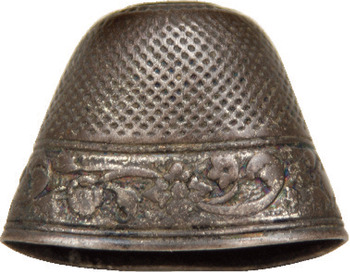
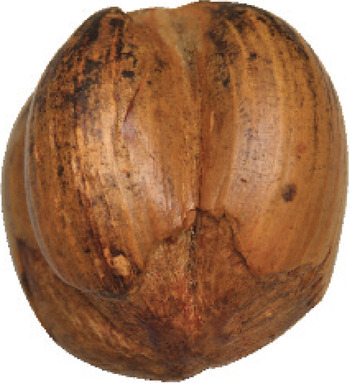
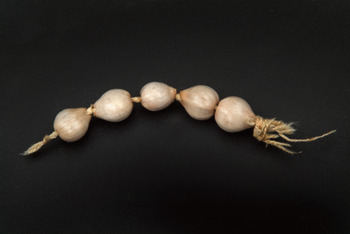
The intimate nature of the tokens is evident in their tiny size (pendants and rings) and in their proximity to the bodies of the infants (pinned to the sleeves of their clothing, hung from their necks or wrists, inserted in their ears). One can gauge the scale of these portable objects by the crushed thimble (see Figure 1) and the hazelnut (see Figure 2), which are still among the tokens preserved at the Foundling Museum. One entry billet, and the information recorded under “Marks of the Body,” evokes nicely the size of the tokens and their adjacency to the body. In August 1754, a six-week-old male infant arrived, writes a hospital clerk, with “ye Inclose'd amber Bead, tye'd/ about ye right wrist.” A note that accompanied a male seven-week-old to the hospital in August 1751 adds to this portrait of the tokens as tiny and close to the body: “it is also beg'd that the Ear / Ring may be kept in his Ear.” A two-month-old female in June 1755 was also left with an “earring drop.” Some tokens were even so small as to escape initially the notice of hospital clerks. In the case of a two-week-old male brought in December 1750, it was only after admissions that a washerwoman at the hospital found a paper, pinned to the inside of the infant's sleeve, that enclosed “the Mother's Name Ring.”Footnote 57
Metal thimble. Accession number 2005.5.365. The Foundling Museum.

Hazelnut carved into lobes. Accession number 2005.5.377. The Foundling Museum.

The often-repeated sentiment by applicants that a token (written or object) remain attached to the body of the infant reveals an important facet of compliance with the token procedure, specifically, that some applicants were unaware or oblivious to institutional pressures and practicalities. A note sent with Elizabeth Ayers in March 1741 gives the details of her christening and issues the following plea: “I beg the favour / this paper may be kept with the Child.”Footnote 58 Such polite urgings represent a naive understanding of institutions and their priorities. In as much as some applicants seem adept at “playing the system,” the naivety about where, precisely, the tokens would be preserved pushes us in another interpretive direction. If the purpose of the tokens was to permit the anonymous abandoning of a child to the hospital and to enable a cross-identification at a later date, there was no practical need to keep this object with that child. Indeed, as we know, the clerks at the hospital virtually immediately removed the tokens from the infants' bodies, enclosed the objects in the billets, and then secured the billets in a box kept under lock and key.Footnote 59 From an administrative perspective, the sealing of the tokens in the billets, rather than allowing them to remain on the infants' bodies, might guard against their being lost or stolen. In recording such objects as “marks on the body,” however, the hospital seems almost to acknowledge, much as some applicants clearly did, that the tokens were a form of inscription—of writing on the body of the child.
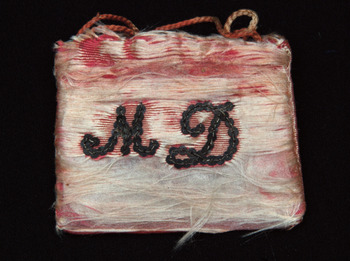
The expectation or hope, by applicants, that tokens would be kept with the bodies of the children is of a piece with another common plea we find in the foundling notes, specifically, that a baptized child be permitted to retain his or her Christian name. In cases where infants were unbaptized, applicants often urged hospital officials to adopt their suggestions for names.Footnote 60 The question of how to distinguish one's child from all the others must have been pressing for some parents. Compliance with the token procedure in the form of inscribed objects (coins, pendants, textiles) shows that some parents, even as they left their children at the hospital, still sought to assign them a concrete identity. In addition to conferring identity, some objects, especially those bearing initials articulate a persistent theme in the foundling notes: this child is “legitimate.”Footnote 61 Whereas the notes written from the first-person perspective of the children—“My name is Charles Peters / of honest but unfortunate Parents”—probably reflect the stamp of a parish official or relative, the object tokens offer us less mediated access to a parent's conviction that his or her child was unique and worthy of care.Footnote 62 Objects such as the mother's signet ring found inside the infant's sleeve and a steel seal left with two-week-old female in 1747 serve as compressed statements of family origins.Footnote 63 A delicate monogram in yellow thread, a mother-of-pearl pendant with the initials “E. L.,” and a child's silk purse embroidered with the initials “M. D.” (see Figure 3) all reflect the desire, by applicants, to hand down to the child an object that had personal meaning. The pendant and monogrammed silk purse might once have been gifts or other like products of intimate relationships.Footnote 64 In some cases, objects were fashioned specifically for the occasion of leaving a child to the Foundling Hospital. A simple engraved silver heart pendant pledges, “You have my Heart / Tho wee must Part / I*W / Nat. 6: Sep:r 1759.”Footnote 65 As the pendant marks the loss of the child by a parent, it also, like the yellow monogram and silk purse, relies on the act of naming, if only through initials, to confer identity and to signify attachment.
Monogrammed silk purse. Accession number 2005.5.387. The Foundling Museum.

At least some applicants, then, made emotional investments in the tokens they used to assign identity, to perform the work of legitimization, and to provide a material link between parent and child. The process by which a coin was taken out of circulation and personalized with initials to act as a token—its transformation from a common object into something unique and differentiated— can be tied to the dynamics operating for some parents when they abandoned their children at the Foundling Hospital. Tokens, especially those that were the product of some labor and care, such as the “I. W.” pendant described above, were attempts to differentiate one's child from the rest. Durable objects, here, stand in for identities and lives in their most precarious states. Ultimately, applicants who looked to the token procedure to inscribe the identity of their children and who hoped such personalized tokens would remain attached to the children were as naive about institutional priorities as those who urged the hospital to call the children by their given or desired names. In order to preserve the anonymity of applicants, the hospital's governors swiftly renamed the children.Footnote 66 The hospital's detaching of the object tokens from the bodies of the infants repeats the gesture by which it erased the names, and thus identities, of the children.
Mellor's reading of eighteenth-century female elegy as a genre refashioned to permit the “naming of tears” is helpful when considering those foundling mothers who were in extremis and who turned to objects or, more accurately, who were required by the hospital to turn to objects, at the moment of leaving a child to its care. When Mellor writes of the “naming of tears,” she refers to female elegists who resisted calls for stoicism in the face of a child's death and thus refined the genre of elegy to acknowledge and to give voice to intense grief.Footnote 67 Bound up in the foundling tokens, just as in literary maternal elegies, are processes of naming and grief. In one sense, the elegiac naming of tears that occurs in, and through, the foundling tokens is even more literal than that of poetic elegy: mothers are naming the children they are in the process of losing. The time frame of literary elegy also seems accelerated in the tokens; children are still alive when they become the subjects of these maternal elegies.
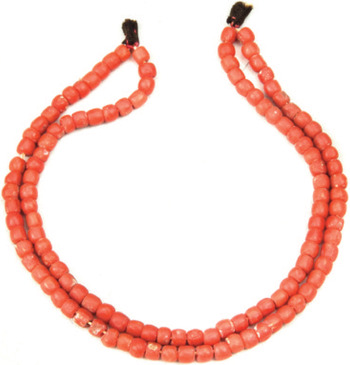
Setting the conditions by which a parent's grief is distilled in an object, the hospital's token requirement opened up, albeit unintentionally, new spaces for extra-literary elegy in the eighteenth century. One subset of the surviving tokens, that of coral necklaces and bracelets (see Figure 4), seems especially maternal and elegiac. Impulses to comfort and to protect one's child might be at work in these tokens, as well as a recognition that the parent-child bond is fracturing. From the hospital's administrative perspective, a token stood in for the identity of a child. In the case of the coral objects and others discussed in this section, some perform a second act of substitution: they become surrogates for a mother's presence. A billet for a two-month-old male, left at the hospital in January 1754, records that this child arrived with not only the silver “I. W.” pendant discussed above but also a coral necklace.Footnote 68 Such necklaces and pieces of coral attached to the end of a chain were customary gifts on the occasion of short-coating. This transition coincided with teething, and the coral acted as a teething aid.Footnote 69 The long history of coral as an amulet also made it a suitable gift for both newborns and children, and throughout the early modern period we find examples of children depicted in portraits wearing red coral necklaces.Footnote 70 The maternal impulse to soothe one's infant is reflected in two sets of teething beads in the Foundling Hospital's collection (see Figure 5). It is difficult to determine the precise genealogies of the coral items among the tokens—whether the necklaces and bracelets were owned previously by mothers or siblings of the children now abandoned or if they were gifts bestowed on the infants now entering into the hospital's care. That one coral necklace arrived with another token (the “I. W.” pendant) crafted specifically for an infant on the occasion of his abandonment suggests that this particular coral token emanates from less-than-destitute social conditions and that the abandoning of this child was not an insignificant event. Perhaps a relative thought a coral token would communicate to hospital officials the social standing of the child—that it had been already the subject of some emotional investment. The coral tokens can also be tied to the presence of silver coins among the foundling tokens; it was a tradition to give newborns silver coins.
Coral necklace. Accession number 2005.5.164. The Foundling Museum.

Teething beads. Accession number 2005.5.153. The Foundling Museum.

As signs of maternal affection, the coral items and teething beads, together with the silver coins, become more explicitly elegiac when we consider that, before they became pressed into service as tokens, they were used to mark particular stages of childhood. The coral tokens might reflect, in the face of desperate circumstances, a residual hope that the infant would pass through the normal transitions of childhood and that these would be marked appropriately. If the applicants were aware of the high infant mortality rates at the hospital and chose coral items specifically for their amulet associations, such tokens might represent a morbid (but not irrational) fear that the child would not survive his or her time at the institution. Although the primary purpose of the tokens was to facilitate a future reunion, some of these objects must also have embodied the fears and sadness of parents that no such reunion would occur.
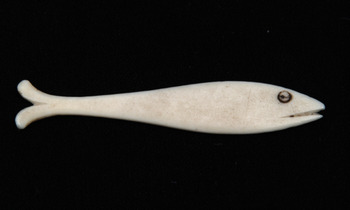
If this group of objects can be pulled into the orbit of elegy on the grounds that they materialize loss of some kind, present or anticipatory, one of the more atypical tokens, a gaming token (see Figure 6), picks up on the strains of hope embedded in customary gifts of silver coins. When the hospital's select committee examined this particular token in 1806, they found it attached to a silver four pence piece.Footnote 71 Because of its size and shape, when one views it today, the bone fish almost gives the impression of a childhood toy, even though its original use was nothing like this. Though a gambling token might seem a world apart from maternal impulses, its presence among the foundling tokens speaks to the mutability of these objects. The bone fish can be connected to the playing cards that appear with some regularity as tokens in the billet books.Footnote 72 One also finds a mother-of-pearl gaming counter bundled in with a five-week-old female infant.Footnote 73 Granted, any interpretation of the bone fish token must allow for its randomness—that it might have been an object-to-hand in the pocket of a parish official or a relative who needed to supply a token to the hospital. Yet, because the fish was a traditional symbol of good luck, in the context of the foundling's token procedure, it may also have represented parental hope for a child. Another token described in the billets reflects sentiments of hope and luck: the parents of a female infant left at the hospital in May 1757 supply a lottery ticket as a token for their child.Footnote 74 Accompanying the lottery ticket token, whose number is carefully recorded by the author(s) of the note, is the following parting wish addressed to the child: “Va mon Enfant, prend ta Fortune.” As ironic as they might now seem, we must be cautious about overwriting the sentiments of parental hope expressed above and as they are embodied in some of the tokens. If some parents used the token procedure to figure loss and to mourn, others might have looked to objects to articulate whatever faint hope they harbored for their children.
Gambling token. Accession number 2005.5.390. The Foundling Museum.

Approaching the gaming token from another direction, the ivory or bone material of the object meant that, like the coral items, it could serve a teething purpose. The coral items, the teething beads, and the bone fish might all speak to the act of substitution associated with elegy: if the maternal body cannot be near the child, such objects might provide the infant with some measure of physical comfort. In the coral and teething aids, then, we find a reconfiguration of Sacks's paradigm of elegy in which the lost beloved is memorialized in language by the bereaved, and eventually consoled, elegist. While the tokens serve as identifiers for the children, they are also substitutes for absent mothers. The consolation integral to elegy is directed, here, towards the child, and takes the form of things.
The bone fish reminds us that many tokens, including the coins and playing cards, were the stuff of everyday lives. Jeremy Boulton furnishes us with a vivid portrait of the eighteenth-century poor, focusing specifically on women who labored in what he calls the economy of “makeshift and mend.” Hawking foodstuffs, teaching school, keeping shops and taverns, and making gloves are among the occupations of poor women in Saint Martin's parish.Footnote 75 Boulton's account of the eighteenth-century poor helps us to imagine the material world of some of the women who accessed the Foundling Hospital's services. Even if we now see them as exceptions, simply because there exist only one or two examples, the bone fish token and that of the thimble are embedded in quotidian, domestic practices. Beyond its purpose as a gambling token, the bone fish might have been used as a thread winder.Footnote 76 Given the ubiquity in the eighteenth century of another object closely associated with sewing—the thimble—it seems surprising, at least initially, that only one survives as a foundling token (see Figure 1).Footnote 77 Stowed easily in workboxes or in pockets, the small portable thimble, which could be personalized with initials, would seem a likely candidate for a foundling token. Perhaps because of its utility, the thimble was not a common choice for a token.Footnote 78 If one were a seamstress or a domestic servant who was expected to sew, a thimble had great value. The ability to repair and to remake one's clothes into new items were also critical skills, especially for the class women most likely to make use of the Foundling Hospital.Footnote 79 It is probably not an accident, then, that the one thimble that comes down to us today as a token is flattened—its primary function in domestic labor lost long ago.
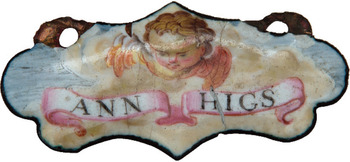
Just as the thimble might indicate a precarious livelihood, the two bottle tickets in the collection communicate makeshift lives even more directly. On at least two occasions, pendants for the hospital's token requirement were fashioned from enamel bottle tickets. One of these tickets is white with only the word “Ale” stamped in black upon it. The second depicts an image of an angel hovering above the name “Ann Higs” (see Figure 7). Transformed into a token, a bottle ticket moves from acting as a common identifier of a kind of beverage or brewery, and, perhaps like the bone fish, from being an object linked to the world of the tavern and social practices, to functioning as an evocative, if somewhat ironic, sign of purity. As Laura Schattschneider explains, it was a common trope in the paper tokens to write of the abandoned child as heaven's offspring.Footnote 80 Among the surviving tokens is, for example, a coin inscribed with an angelic image and the name and date of birth of Elizabeth Harris, abandoned to the hospital in 1756.Footnote 81 One might speculate, then, that the “Ann Higs” bottle ticket functions analogously as an attempt to portray the abandoned child as angelic and innocent. Eighteenth-century female elegy, when it was at all consolatory, Mellor writes, located comfort in the Christian paradigm of the afterlife where the elegist would be reunited with her lost beloved child.Footnote 82 While it might be pressing the case too far to suggest that this particular bottle ticket encodes the same Christian faith, when situated in the context of the other foundling tokens, the bottle ticket might well transmit this elegiac perspective. If one were to interpret this token an example of “playing the system,” one would note that whereas the applicant leaving Elizabeth Harris had to scratch out the image of an angel on a shilling, the Ann Higs bottle ticket offers itself almost as such a pre-fabricated token. Of course, the Ann Higs token might, like the hazelnut, offer another instance of the random token—of simply an object that could be attached easily to a ribbon or string and hung around an infant's neck. That only two such tokens survive indicates that a bottle ticket was not a common choice for an identifier, and, whereas the ticket with the little angelic image might be more easily aligned with a particular child, the “Ale” ticket probably shows less intentionality.
Ann Higs enamel bottle ticket. Accession number 2005.5.369. The Foundling Museum.

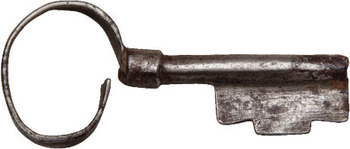
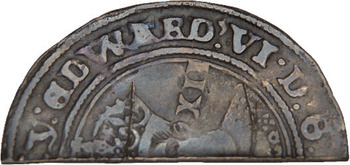
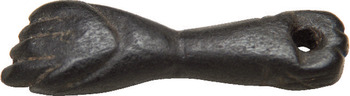
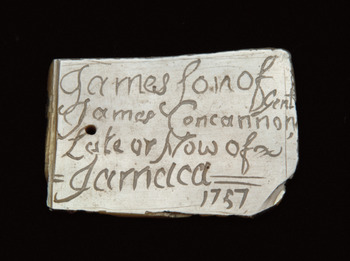
Another group of tokens seems to perform dramatically the separation and fragmentation attendant upon the loss of a child. A solitary key (see Figure 8), one half of a coin (see Figure 9), the arm severed from a black wooden doll (see Figure 10), and an engraved mother-of-pearl fragment (see Figure 11) all symbolize and replicate the loss and dislocation experienced by mothers leaving their children at the hospital. If the black doll's hand is a kind of mano fica, or amulet, its protective function would be in keeping with that of the coral tokens. The pierced mother-of-pearl tag, like other tokens we have encountered already, inscribes carefully the identity of the child. Each of the objects above suggests missing pieces or a (maternal) body from which the fragment was taken. The hospital's token requirement led naturally to applicants making copies, if they were able, of the paper tokens and coins given in with their children.Footnote 83 Objects that consisted of interlocking parts, items that could be halved, items that came in pairs, and pieces of embroidery or swatches of fabric that could be cut across their patterns, all enabled parents to keep their portion of the token until a reunion.Footnote 84 In the case of such tokens as the halved coin, the key, and the doll's arm, the implication is that the mother or relative retained the matching objects. The hospital, of course, developed the token procedure for administrative purposes only, and not to make mothers perform through objects the kind of rupture that some might have experienced in leaving a child at the institution. Still, the token requirement did create a procedure in which fragments, remnants, and halved objects would serve as acceptable identifiers. We hear, for example, that “half of an Ivory Egg” was deposited with a one-month-old female infant on 11 July 1752.Footnote 85 Artifacts of elegy, the incomplete and fragmentary state of these objects make tangible the circumstances of loss and dislocation associated with child abandonment to the hospital.
Key. Accession number 2005.5.363. The Foundling Museum.

Half of a silver shilling of Edward VI. Accession number 2005.5.367. The Foundling Museum.

Arm of black wooden doll. Accession number 2005.5.371. The Foundling Museum.

Mother-of-pearl fragment. Accession number 2005.5.388. The Foundling Museum.

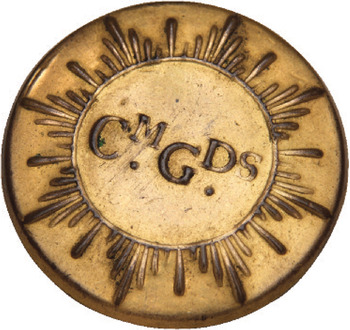
One of the particular circumstances that occasioned the abandonment of children to the Foundling Hospital, especially during the 1750s and 1760s, was absent fathers. Their absence is configured in two of the foundling tokens that evoke the wider world beyond Britain: the mother-of-pearl fragment and a brass uniform button of the Coldstream Guards (see Figure 12). We can trace some continuities between these two objects and female political elegy in the eighteenth century, specifically, the ways in which war and colonization, as causes of fracturing family ties, are expressed in the tokens. Like the I. W. pendant and other tokens bearing initials, the inscription on the mother-of-pearl fragment, “James Son of James Concannon Gent, late or now of Jamaica 1757,” seeks to confer identity on the child. Perhaps as an afterthought, the engraver squeezes in “Gent” between the first and second lines to indicate the child's uncommon rank. At the same time, though, the fragment also registers a greater uncertainty: Is the father still in Jamaica or elsewhere? Is he even alive? The memory of the father might be inscribed in the object, but so, too, is his uncertain status. By extension, the child's narrative of origins is also fragmentary. Scattered throughout the entry billets from the 1750s and 1760s are notes by applicants that refer to absent fathers, to fathers “beyond the sea,” and to fathers “gone abroad.”Footnote 86 In her discussion of female elegy in the long eighteenth century, Mellor examines the ways in which, over time, elegy became more overtly political. Especially at the end of the century and into the next, female elegies took on the manifold political and economic conditions that occasioned loss: “the male quest for military glory on land and sea, commercial and imperial expansion and domination.” As Mellor explains, elegies by such writers as Felicia Hemans and Amelia Opie addressed not only the wasting of lives by war but also “the consequences that impacted most heavily on surviving widows, mothers, and children.”Footnote 87 If, as I have been arguing here, some of the foundling tokens participate in elegy, we must consider the ways in which these symbolic performances might register critiques, even earlier in the eighteenth century than literary elegy, of political and economic imperatives.
Coldstream Guards uniform button. Accession number 2005.5.370. The Foundling Museum.

At first glance, the reference in the mother-of-pearl token to a father in Jamaica points to the number of foundling infants who were fathered by criminals bound for the colonies. Representative is a note dated 28 June 1756, written by a parish official, which states that the infant's father is a “felon lately transported.”Footnote 88 The inclusion of the title “Gent” in the fragment's inscription, however, leads us in another direction; possibly it refers to an individual associated with colonial ventures and Britain's sugar plantations. Like a number of the tokens explored in this essay, a degree of artifice might be present in the fragment. The notes authored by relatives and parish officials for the hospital frequently unfold narratives of fathers abroad for commercial purposes. To take just one example, a two-week-old left at the hospital in October 1752 has a father is “at present in ye. East indies” and a mother who died soon after childbirth. The father hopes, at his return, to reclaim his child.Footnote 89 With an economy of expression, the mother-of-pearl name tag materializes the connections between the abandoning of infants to the Foundling Hospital and the British project of colonization and trade. Setting the fragment apart from the narratives rehearsed in the foundling notes about fathers abroad is its singularity: it was not the norm for all children with a parent in the colonies to arrive with such an engraved piece, not least one that mentions Jamaica. What female literary elegy worked to communicate in the eighteenth century is articulated with immediacy by the fragment: a parent in the colonies results in a loss for the child.
The brass uniform button of a Coldstream Guard, like the mother-of-pearl fragment, also gestures towards political elegy. The Seven Years' War brought high levels of male conscription, and this global conflict overlapped with the Foundling Hospital's General Reception period.Footnote 90 David Kent and, more recently, Jennine Hurl-Eamon have explored the relationship between marital desertion and enlistment in the eighteenth century. Though Kent and Hurl-Eamon draw differing conclusions as to the motivations of husbands who enlisted, the impact on families of men “gone for a soldier,” as Levene's research demonstrates, was significant.Footnote 91 Because the Seven Years' War coincides with the period when mothers supplied tokens to the Foundling Hospital, one could speculate that this particular button belonged to a member of this famous British regiment, perhaps fighting as part of the campaign in Germany. Some of the written tokens refer explicitly to military events associated with the Seven Years' War. One note explains that the child in question was conceived while the mother accompanied the father, an admiral, to the Siege of Pondicherry (1760–61).Footnote 92 Another note, in this vein, identifies a female infant's father as a marine, Thomas Johnston, aboard the HMS Wager in 1756. A note attached to a male infant abandoned to the hospital in 1758 projects ahead in time to when the child's father “comes home from Sea” and his parents can reclaim him.Footnote 93 The level of detail in such notes points the applicants' awareness that fathers in service constituted an acceptable reason for child abandonment.
When we approach the uniform button token in conjunction with such notes, the ways in which it might perform the work of elegy come into sharper focus. An elegiac reading of this token accommodates the artifice that might be at play in the foundling notes about fathers in service. Some applicants were likely conscious that narratives featuring fathers absent for military duty would sound the right patriotic note to the hospital; the uniform button could well be implicated in such a patriotic, and perhaps even contrived, display. Just as some of the more valuable coins and pendants might have been chosen to signal to the hospital the elevated social status of a child, so, too, could the Coldstream Guards button have served this purpose.Footnote 94 What is perhaps more significant, though, is the stark truth communicated by the uniform button: fathers at war mean abandoned children. While female elegists in the long eighteenth century gradually refined the literary genre to accommodate political perspectives, the Coldstream Guards button may have served as the most compressed and eloquent of critiques of military aggression and Britain's participation in global conflicts. Pulling the object into the realm of elegy is the context of the uniform button as a token in the hospital's procedure. Framing the loss of a specific child to the Foundling Hospital, the button might distill pride in the husband's service to the nation and even suggest implicitly that child abandonment is an extension of such a sacrifice. Like some of the more political literary elegies of the period, though, the uniform button might represent a self-conscious attempt to register, through a material object, the profound loss that such service entails to families.
This section of the essay has focused on tokens that outrun their purpose as mere identifiers. The “I.W.” pendant and the mother-of-pearl fragment are more elaborate, commemorative objects than were required by the hospital. The coral items and teething beads seem chosen deliberately with the child's body and transitions in mind. Even though such a simple note as, “James Stevens / Born Sept ye 18: 1746,”Footnote 95 would have sufficed for the hospital's procedure, some applicants viewed the tokens as a means by which to “mark” their child. Applicants relied on objects to inscribe identity (that of the child and of the parent) and to signify attachment. If applicants demonstrated their agential capacity in complying with the token procedure, this agency is perhaps most on display in the more singular and freighted objects supplied as tokens. The halved objects and the fragment tokens evoke the sense of rupture that at least some mothers would have experienced when abandoning a child to the hospital. Although not the intention behind the token procedure, this institutional requirement prompted mothers to distill their grief in an object. As imaginative framings of loss, the tokens resemble the grief work of eighteenth-century female elegy. Occasional objects that bear traces of artifice and emotion, some of the tokens, in their oblique comments about absent fathers, can be aligned even more closely with female political elegy of the period.
■■■
The very qualities that rendered objects suitable as identifiers and resonant of loss result, for the Foundling Hospital, in a collection of “exhibit-ready” items. Small, portable objects, some personalized with inscriptions, the tokens lend themselves to the display cases of museums. The incompleteness of some of the tokens (halves, fragments) and the contexts of loss (poverty, illness, infant mortality, severed parent-child bonds) that coalesce in the tokens make them visually rich and emotive objects for the museum. In this final section of the essay, I shift the focus from the tokens as eighteenth-century articulations of elegy to their status as a museum collection in the nineteenth century and beyond. Even as the hospital, in the nineteenth century, sought through its display of the tokens to elicit sympathy and support for its mission, original linkages between the objects and elegy seep through and complicate the narratives framed by the hospital's exhibits. The “elegiac turn” taken by museum studies and material culture in recent years invites such a consideration of the foundling tokens as a museum collection, made up as it is of objects with deep roots in elegy. As we will see, though the relationship between elegy and the tokens is reasserted in the space of the museum, this collection does not fit neatly with either James A. Boon's museum of “context-begging specimens” or with Eric Gidal's recuperative model.Footnote 96
When the foundling tokens emerged in the mid-nineteenth century from the billet books and hospital archives to be exhibited as a collection in the institution's Picture Room, what might have been in some cases private elegies became objects of public consumption. As David Solkin shows, from the outset, the hospital recognized that the exhibition of works of art would increase support of the hospital's charitable program. The pictures displayed in its exhibition space in the mid-eighteenth century (including those by William Hogarth, Francis Hayman, Joseph Highmore, and James Wills) were designed to illustrate how a charitable gift “could satisfy the all-important conjunction of spiritual, public, and private interests.” In order to secure funds, “viewers' sympathies had to be strongly engaged on behalf of the abandoned children.”Footnote 97 The nineteenth-century imperatives of the hospital to raise funds, evoke sympathy, and demonstrate its social value did not differ substantially from those of its early years. By the mid-nineteenth century, however, the hospital now found itself in a position to offer material and visual evidence that its social experiment had worked. During this period, the paintings mentioned above continued to be displayed in the Court Room; in the Picture Room, alongside commanding portraits of patrons and governors of the hospital, the tokens were exhibited in two display cases. One case held coins and other tokens deposited with infants during the period 1741–60, while a second case held “Miscellaneous Tokens” from the same period. Four additional display cases stood in this room, exhibiting, respectively, the manuscript music of Handel, autographs of British royalty, “medals of foundlings who served in the army and navy,” and autographs of Hogarth and other “eminent persons.”Footnote 98 The Foundling Hospital, as Levene makes clear, was deeply invested in promoting the narrative that the infants it rescued were from humble origins and could be transformed into productive, patriotic members of society.Footnote 99 The nineteenth-century display of the tokens should be understood, I argue, as a key component of this narrative project. Such tokens as a flattened thimble, a piece of wire twisted into a ring, the hazelnut carved into lobes, and a crudely crafted heart, alongside the bottle tickets and the bone fish, are made, in the space of the museum, to testify to the “narrative of lowly origins.”Footnote 100 The labor associated with the thimble, wire ring, carved nutshell, and woven heart contribute to the portrait of foundlings' parents as simple and worthy of assistance.Footnote 101 In fact, it is the makeshift quality of the objects—bottle tickets as pendants, twisted wire as a ring, an inscribed coin as a name tag—that heightens this image of sincere but struggling applicants. By juxtaposing the tokens with the medals awarded to foundlings for military and naval service, the two threads of the institutional narrative—rescue and reform—come together. As curator of the tokens, the hospital could now link its preservation of the infants to its “rescue” of the tokens.
The Foundling Hospital's curatorial strategies, however, might have failed to project the intended institutional narrative. Because the tokens might function (in the cases of the mother-of-pearl fragment and the brass uniform button) as maternal elegies with political undertones, a tension is created between these two parts of the hospital's exhibition. If the tokens evoke not only the separation between mothers and their children, but also the social, political, and economic conditions that occasion loss and dislocation more generally, the naval and military medals push against the original elegiac perspectives of the tokens. The dynamic created in the museum display between the tokens and the medals awarded suggests a cyclical pattern of history—one that is dominated by discourses of loss. A display case of medals, though a demonstration of patriotism and sacrifice, and of the hospital's ability to contribute to the nation's defense, must also have reinforced themes of death and loss. In this way, the original elegiac context of the foundling tokens—the marks of a world in transit and conflict—is rendered more acute.
The music manuscripts of Handel and the royal autographs, in their display cases, would interact with the foundling tokens in other complex ways. Just as there exists a potential tension between the tokens and the medals, the royal genealogies documented by the autographs clash with the image of the foundlings—infants whose already fractured family lines were erased when they were assigned new names by the hospital.Footnote 102 Class issues would also come into focus. Humble, everyday objects are aestheticized by being exhibited alongside symbols of the polite world of music and the visual arts. Of course, the foundling tokens were appropriate aesthetic objects for the Victorian “cult of mourning,” where the need to display, often in very material ways, “respectable” and “deep grief” was paramount.Footnote 103 In the space of the hospital's gallery, visitors found humble objects to elicit just this pathos.
Today, when we encounter the foundling tokens at the museum on Brunswick Square, they are part of a social history display. As one tours the exhibit and observes the material traces of broken relationships and fractured family ties, one grasps Boon's point that museums, in their relentless displaying of fragments, are inherently melancholy places. Despite Gidal's suggestion that museums, through preservation and conservation, sometimes perform a “consolatory engagement” with the past, the objects on display at the Foundling Museum appear themselves lonely and orphaned.Footnote 104 The hospital's practice of detaching of the tokens from the children and erasing their names are evoked in these seemingly deracinated objects. Our impulse is to locate and to reassemble all the fragments—to reattach the missing limb to the body of the black wooden doll and thus to enact the ever wished-for but rarely possible reunion between mother and child. Perhaps it is the survival of the tokens that reinforces Peter Schwenger's argument about the double melancholy associated with objects: that we turn to things “when being in the world becomes a burden,” but that these objects seem “indifferent” to the human subjects who invest in them their emotions.Footnote 105 The sheer durability of such tokens as the bottle tickets—makeshift pendants that proved to be more solid and lasting than the human subjects who fashioned them and whose identities they carried—might illustrate what Schwenger construes as the indifference of objects. Though the space of the museum can be recuperative, it might also foreground the indifference of objects to the human history in which they are implicated. As remnants of the more than sixteen thousand children admitted to the hospital between 1741 and 1760, the tokens on display fail to capture the scale of the losses associated with child abandonment in eighteenth-century London.Footnote 106 That such everyday and even mundane objects (a metal thimble, a hazelnut) have survived as museum objects when the children for whom they served as unique identifiers have not is, to echo Boon, what “makes museums sad.”Footnote 107
In this essay, I have tried to show the ways in which the tokens encode a sense of loss and dislocation characteristic of elegy. By attending to the tokens as artifacts of elegy, our understanding of the category of elegy is deepened, especially as it might have operated in the spheres of the eighteenth-century laboring poor. If the impulses to mourn and to exhibit are threaded together already in some of the foundling tokens, these connections, as I have traced here, are amplified in the space of the museum. Karin Dannehl urges the compilation of more biographies of humble or everyday objects.Footnote 108 Because they have moved between different spheres, absorbed psychic investment, and become the subject of museum displays, the foundling tokens emerge here as potential “protagonists” of such biographies. As the tokens take center stage in the space of the museum and we begin to chart their life histories, we see how this collection complicates the assessments by Boon and others of the modern museum. It is not so much that these tokens have been decontextualized by the museum but that they have too much context attached to them. If, for example, one imagines encountering the Coldstream Guards uniform button at the Imperial War Museum in an exhibit about this particular regiment or the history of military uniforms, or alternatively, at the Victoria and Albert Museum in a display about the materials and design of buttons, the contexts supplied by these institutions would take us even further away from the emotive materiality of the tokens. It is because the tokens are implicated in, and symbolic of, narratives of abandonment and infant mortality that they resonate for museum visitors. Understanding them in the context of elegy helps to reintegrate the tokens into some of their original frameworks and to refine our understanding of the ways in which individuals, and museums, imagine loss through objects.