INTRODUCTION
The negative interference caused by weeds is an important limitation to achieving high levels of productivity in rice (Oerke Reference Oerke2006). Several species of the genus Echinochloa are among the major rice weeds and occur worldwide in areas cultivated with different rice establishment systems. The main weed species of this genus are E. crus-galli (barnyardgrass), Echinochloa colona (junglerice), Echinochloa phyllopogon (late watergrass), Echinochloa oryzoides (early watergrass) and Echinochloa crus-pavonis (gulf cockspur). These species have large morphological variability and intermediate traits that make species identification difficult. This problem has resulted in the denomination of ‘Echinochloa complex’ in several studies (Damalas et al. Reference Damalas, Dhima and Eleftherohorinos2008). The high frequency of these species in paddy fields has resulted in the intensive use of herbicides and consequent evolution of resistance to compounds of different mechanisms of action. Barnyardgrass has evolved resistance to propanil (Valverde et al. Reference Valverde, Chaves, Garita, Ramírez, Vargas, Carmiol, Riches and Caseley2001), atrazine (Lopez-Martinez et al. Reference Lopez-Martinez, Marshall and De Prado1997) and quinclorac (Lopez-Martinez et al. Reference Lopez-Martinez, Marshall and De Prado1997; Concenço et al. Reference Concenço, Melo, Andres, Ferreira, Galon, Ferreira and Silva2008). Recently, resistance to glyphosate has been found in junglerice (Alarcón-Reverte et al. Reference Alarcón-Reverte, García, Urzúa and Fischer2013). In addition, partial tolerance of junglerice to oxyfluorfen and pendimethalin was reported as a beginning of the evolution of resistance in this species (Jafun et al. Reference Jafun, Perryman and Moss2003). Late watergrass resistant to molinate, thiobencarb, fenoxaprop-P-ethyl, bispyribac-sodium, clomazone (Yasuor et al. Reference Yasuor, TenBrook, Tjeerdema and Fischer2008) and penoxsulam (Yasuor et al. Reference Yasuor, Osuna, Ortiz, Saldain, Eckert and Fischer2009) was found in California. Worldwide, resistance in the genus Echinochloa has been reported to all major herbicides used for its control in rice.
Several studies have been conducted to identify the main mechanism of herbicide resistance in Echinochloa. Recently, the mutation Trp574Leu was identified in four biotypes of late watergrass in Northern Greece (Kaloumenos et al. Reference Kaloumenos, Chatzilazaridou, Mylona, Polidoros and Eleftherohorinos2013) and in one biotype of barnyardgrass from Northern Italy (Panozzo et al. Reference Panozzo, Scarabel, Tranel and Sattin2013). In Arkansas, USA, Riar et al. (Reference Riar, Norsworthy, Srivastava, Nandula, Bond and Scott2013) found that the mutations Ala122Val and Ala122Thr were associated with ALS-inhibitor resistance in barnyardgrass and also identified reduced translocation, probably caused by enhanced metabolism.
Herbicide resistance caused by enhanced metabolism is associated mainly with the differential evolution of several enzymes. The cyt P450s group is the most versatile enzyme related to the detoxification of herbicides and possesses great importance for the evolution of resistance to these compounds (Siminszky Reference Siminszky2006). There are reports of herbicide degradation in the genus Echinochloa to the herbicides bispyribac-sodium, fenoxaprop-P-ethyl, thiobencarb (Yun et al. Reference Yun, Yogo, Miura, Yamasue and Fischer2005), bensulfuron-methyl (Osuna et al. Reference Osuna, Vidotto, Fischer, Bayer, De Prado and Ferrero2002), cyhalofop-butyl (Ruiz-Santaella et al. Reference Ruiz-Santaella, De Prado, Wagner, Fischer and Gerhards2006), penoxsulam (Yasuor et al. Reference Yasuor, Osuna, Ortiz, Saldain, Eckert and Fischer2009), propanil (Valverde et al. Reference Valverde, Chaves, Garita, Ramírez, Vargas, Carmiol, Riches and Caseley2001) and clomazone (Yasuor et al. Reference Yasuor, Zou, Tolstikov, Tjeerdema and Fischer2010). The resistance to quinclorac in late watergrass was attributed to a change in signal reception, causing low activity of aminocyclopropane-1-carboxylic acid (ACC) synthase and high activity of β-cyanoalanine synthase (β-CAS), which is reflected in higher cyanide detoxification (Yasuor et al. Reference Yasuor, Milan, Eckert and Fischer2012). Yasuor et al. (Reference Yasuor, Milan, Eckert and Fischer2012) also found a relationship between resistance to quinclorac and the importance of detoxification enzymes through the use of metabolism inhibitors.
Many studies have used inhibitors of plant metabolism such as 1-aminobenzotriazole (ABT), piperonyl butoxide (PBO), tridiphane, terbuphos and malathion to evaluate the occurrence of enhanced metabolism as the mechanism of herbicide resistance in weeds (Letouzé & Gasquez Reference Letouzé and Gasquez2001; Osuna et al. Reference Osuna, Vidotto, Fischer, Bayer, De Prado and Ferrero2002), indicating the involvement of cyt P450s in the process of herbicide resistance. The metabolization of imidazolinone herbicides has been demonstrated in few studies. However, enhanced metabolism was found to be the mechanism of herbicide resistance to imazamox in Helianthus annuus (Kaspar et al. Reference Kaspar, Grondona, Leon and Zambelli2011) and to imazethapyr in Digitaria sanguinalis (Hidayat & Preston Reference Hidayat and Preston2001).
The mechanism of herbicide resistance in Echinochloa that has been characterized in other studies was based on populations that originated from temperate climate regions. Several populations of the genus Echinochloa have been found to be resistant to imidazolinone and quinclorac in paddy fields in Southern Brazil, but the distribution of herbicide resistance and the mechanism of resistance are unknown. Evaluation of the evolution and distribution of the resistance are important to correctly identify the best practices for the prevention and control of herbicide resistance (Merotto Jr et al. Reference Merotto, Jasieniuk and Fischer2010). The objectives of the present study were to evaluate the frequency and evolution of the level of resistance to imidazolinone herbicides in Echinochloa in Southern Brazil, and to investigate the occurrence of enhanced metabolism and altered target site of action as the mechanisms of herbicide resistance in barnyardgrass to establish the best practices to control and prevent this problem.
MATERIALS AND METHODS
Plant material
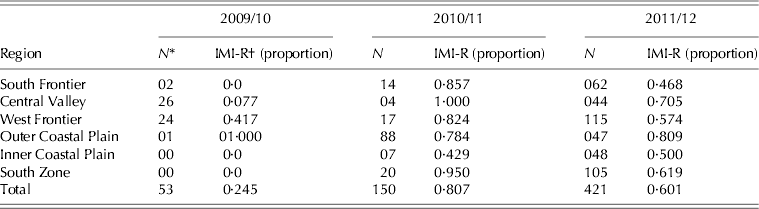
Seed samples of Echinochloa sp. were collected from paddy fields of Rio Grande do Sul, Brazil. Fields were selected based on the historic use of Clearfield®-rice cultivars and where escapees of control with imidazolinone herbicides had occurred. They were located between 30°13′S 50°18′W, 33°40′S 53°24′W, 28°29′S 55°50′W and 29°53′S 57°14′W and altitude varied from 3 to 350 m a.s.l. The numbers of sampled fields were 53, 150 and 421 for the seasons of 2009/10, 2010/11 and 2011/12, respectively, according to the distribution described in Table 1. In each area, mature panicles were collected in bulk from several plants and designated as a population. Barnyardgrass is the most frequent species in the region where the samples were collected, but junglerice and gulf cockspur are also present. Considering that the main purpose of the present study was a broad examination of herbicide resistance, identification of each sample at the species level was not evaluated due to the difficulties in uniform taxonomical analysis in field conditions.
Distribution of Echinochloa populations resistant to imidazolinone (IMI-R) herbicides during three seasons in six rice production regions of the Rio Grande do Sul, Brazil
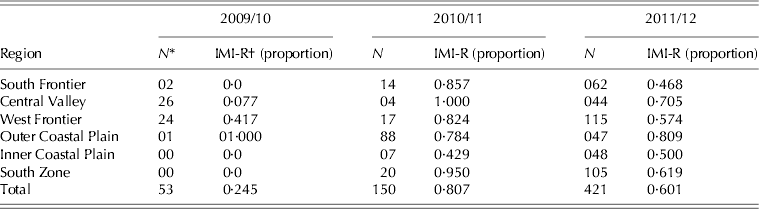
* N is thenumber of Echinochloa populations.
† IMI-R is the proportion of resistant populations.
Screening of herbicide resistance
The study was arranged using a completely randomized design with three replications. Treatments consisted of the Echinochloa populations described above and were treated or not treated with the herbicide imazethapyr + imazapic (Only) at the dose of 112·5+37·5 g/ha. This dose represents 150% of the recommended dose for barnyardgrass control in Southern Brazil. In 2011/12, the populations were also evaluated for resistance to the herbicides cyhalofop-butyl (Clincher) at a dose of 360 g/ha and quinclorac (Facet) at a dose of 500 kg/ha, representing 133% of the recommended doses for the control of barnyardgrass in southern Brazil for both herbicides. The adjuvants Dash (a mixture of methyl esters, aromatics hydrocarbons and unsaturated fatty acids, 930 g/l) at 4·65 g/l, Veget Oil (esters of vegetable fatty acids, 933 g/l) at 9·33 g/l and Assist (mineral oil obtained from paraffinic, cycle paraffinic, aromatic saturated and unsaturated hydrocarbons, 756 g/l) at 7·56 g/l were added to the herbicides imazethapyr + imazapic, cyhalofop-butyl and quinclorac, respectively. The treatments were performed with a carbon dioxide pressurized backpack sprayer, with nozzle TG 80.01 calibrated to deliver 120 l/ha.
The experimental units consisted of plastic pots (500 ml capacity) filled with hydromorphic soil. Seeds were initially exposed to a treatment of 40 °C for 4 days to break dormancy. Approximately 3 g of seeds, corresponding to ten viable seeds, were sown 2 cm deep in each pot. Pots were maintained in greenhouse conditions with a temperature of 25±4 °C and were irrigated daily by water sprinklers until growth stage (GS) 13 on the BBCH scale (Meier Reference Meier1997), when they were sprayed with the herbicide treatments. After that, the pots were flooded to maintain the water level at 4 cm above the soil.
The evaluations consisted of scoring the visual injury at 30 days after treatment (DAT), where zero corresponds to the absence of herbicide effects and 1·00 to plant death. Populations with at least one surviving plant able to produce seeds were considered as resistant to the herbicide treatment. The consideration of resistance based on the identification of one-survived plant per pot is related to the aim of the study, i.e. to identify the occurrence of resistance in a given population instead of quantify the frequency of resistance within populations. Data were analysed using ANOVA, and the frequency of resistant populations was calculated for each herbicide. In addition, box plot diagrams were calculated and the treatment mean was plotted for each season considering the visual injury of the resistant populations.
Whole-plant dose-response
The experiment was conducted in pots as described earlier using a completely randomized design in a factorial scheme with four replications. The first factor was six populations of barnyardgrass. Two of these populations were resistant to imidazolinone and quinclorac (ARRGR01 and MOSTS51), three populations were resistant to imidazolinone (PALMS01, CAMQ01 and CACHS50) and one population was susceptible to these herbicides (SUSSP01). The susceptible population was originally from an area where no herbicides had been applied, but efficient control had been obtained during previous studies using the evaluated herbicides. These populations were selected based on the screening study described above and were all collected in the 2010/11 season. All six populations were classified as barnyardgrass based on the morphological taxonomical description of Tabacchi et al. (Reference Tabacchi, Mantegazza, Spada and Ferrero2006). The criteria for choosing these populations were the pattern of cross-resistance and the origin related to the main regions where the resistance occurs. The second treatment factor was nine concentrations of imazethapyr from zero to 10 mM and nine concentrations of quinclorac from zero to 100 mM. The herbicides were applied to plants at GS 13 on the BBCH scale using a backpack sprayer as described above.
The variables analysed in the experiment were visual injury and shoot dry weight at 7 and 14 DAT for the herbicides quinclorac and imazethapyr, respectively. Data were initially subjected to analysis of variance (ANOVA). Then, if significant in the F test (P≤0·01), further analysis was performed by adjusting the three-parameter logistic equation using the statistical software program R and the software package drc (Knezevic et al. Reference Knezevic, Streibig and Ritz2007), as:
 $$f\,{\rm (}x{\rm, (}b{\rm,} d{\rm,} e{\rm )) =} \displaystyle{d \over {{\rm 1 + exp\{} b{\rm (log(}x{\rm ))} - {\rm log(}e{\rm )\}}}} $$
where f(x) represents the dependent variable, d represents the upper limit of the curve, b is the slope of the curve around the point of inflection and e is the herbicide rate at which half the effect is produced between the lower and upper limits (GR50 and C50 for plant dry weight and visual injury, respectively). Finally, the confidence interval (CI) with 95% significance was calculated for the GR50, C50, and for the resistance factor (RF), which is the ratio of the GR50 or C50 from the resistant population divided by the GR50 or C50 from the susceptible population.
Enhanced metabolic degradation
The experiment was conducted in a hydroponic solution containing potassium chloride (KCl, 0·1 mM), monobasic potassium phosphate (KH2PO4, 0·1 mM), potassium sulphate (K2SO4, 0·7 mM), calcium nitrate (Ca(NO3)2, 2 mM), magnesium sulphate (MgSO4, 0·5 mM), manganese sulphate (MnSO4, 0·5 μM), ammonium molybdate ((NH4)2 Mo O4, 0·01 μM), boric acid (H3Bo3, 10 μM), zinc sulphate (ZnSO4, 0·5 μM), copper(II) sulphate (CuSO4, 0·2 μM), iron(III) sulphate (Fe2(SO4)3, 100 μM) and disodium ethylenediaminetetraacetate (EDTA disodium, 100 μM). Initially, seeds were exposed to dormancy breaking as described earlier. Next, seeds were placed in Petri dishes with moist filter paper at 25 °C for 4 days to germinate. The experimental units consisted of a pot with a capacity of 500 ml covered with Styrofoam, where six seedlings were located in holes with a diameter of 1·5 cm supported by small Styrofoam pieces. Treatments were added to the hydroponic solution when plants reached GS 12–13 on the BBCH scale.
Preliminary experiments were conducted to define the concentrations of the inhibitors of metabolism and the herbicides using known resistant and susceptible populations of barnyardgrass. The concentrations evaluated were: 0, 1, 2·5, 5, 10, 20 and 40 mg/l PBO; 0, 0·2, 0·5, 1, 10, 20 and 40 mg/l malathion; and 0, 1, 2·5, 5, 10, 20 and 40 m/l 1-ABT (Letouzé & Gasquez Reference Letouzé and Gasquez2001). The analysis consisted of visible injury as described earlier and shoot and root dry weight. The highest concentration of each inhibitor that did not cause plant injury compared to the untreated control was chosen for the herbicide dose-response experiments. A similar preliminary experiment was conducted for the determination of the concentrations of the herbicides imazethapyr (Vezir) and quinclorac (Facet).
The experiment was conducted using a completely randomized design in a factorial scheme with four replications. The first factor was the six populations described in the whole-plant dose-response study. The second treatment factor was the concentrations of imazethapyr: 0, 0·000001, 0·00001, 0·0001, 0·001, 0·01, 0·1, 1 and 10 mM; or quinclorac: 0, 0·0001, 0·001, 0·01, 0·1, 1, 10 and 100 mM. The third factor was the metabolization inhibitors, ABT, PBO and malathion, at concentrations of 10, 20 and 10 mg/l, respectively, and a control treatment without any inhibitor. The herbicides and inhibitors were applied to the hydroponic solution when the plants reached GS 12–13 on the BBCH scale. The inhibitors were applied 2 h before the herbicide treatments according to the methodology described in Hidayat & Preston (Reference Hidayat and Preston2001), Yasuor et al. (Reference Yasuor, Osuna, Ortiz, Saldain, Eckert and Fischer2009) and Yu et al. (Reference Yu, Abdallah, Han, Owen and Powles2009). The analyses of variables and data were conducted as described for the whole-plant dose-response study, with the exception of the RF calculation, which was obtained by the ratio of the C50 value of the inhibitors ABT, PBO and malathion divided by the C50 value of the untreated control.
Acetolactase synthase activity assay
The analysis was performed by the ‘in vivo’ procedure using the adapted protocol from Gerwick et al. (Reference Gerwick, Mireles and Eilers1993) and Lamego et al. (Reference Lamego, Charlson, Delatorre, Burgos and Vidal2009). Treatments were arranged in a randomized complete block design in a factorial scheme with three replications and repeated twice. The first factor was the barnyardgrass populations described previously. The second factor consisted of imazethapyr at 12 doses ranging from zero to 3200 g/ha and Dash at 0·5% v/v. Seeds were sown in 500 ml pots as described earlier and maintained in greenhouse conditions with a temperature of 25±4 °C. After emergence, plants were thinned to one plant per pot. The herbicide treatments were applied when plants reached GS 13 on the BBCH scale using a cabinet sprayer pressurized with CO2 at 241·31 kilopascals (kPa), with nozzle TeeJet® 80.02, calibrated to deliver a spray volume of 200 litres/ha. Three hours after herbicide treatment, plants were sprayed with 960 g/ha of 1,1-cyclopropanedicarboxylic acid and the nonionic surfactant Triton X-100 at a dose of 0·25% v/v. After 24 h the leaves and stems were cut at lengths of 5–10 mm and used for the enzyme activity assay (Gerwick et al. Reference Gerwick, Mireles and Eilers1993). Data were expressed as the proportion of the untreated control and analysed with respect to normality and homogeneity of variance assumptions. Data analysis was conducted by adjusting the three-parameter logistic equation (Knezevic et al. Reference Knezevic, Streibig and Ritz2007), as described earlier.
Acetolactase synthase gene sequencing
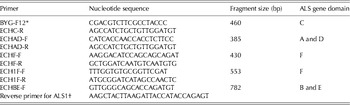
Genomic DNA was extracted from the frozen leaf tissue of four plants per biotype using the cetyltrimethylammonium bromide (CTAB) DNA protocol (Doyle & Doyle Reference Doyle and Doyle1987). Five pairs of primers for polymerase chain reaction (PCR) were designed based on the nucleotide sequences of the ALS gene from the following species, with the respective GenBank nucleotide accession numbers: Arabidopsis thaliana (X51514), Bromus tectorum (AF488771), E. phyllopogon ALS1 (AB636580) and ALS2 (AB636581) and Oryza sativa L. (AY885675). Sequences were aligned using ClustalW and the primers were designed with the program Primer 3 plus. The forward primer for the amplification of the domain C and the reverse primer for the domain BE were obtained from Riar et al. (Reference Riar, Norsworthy, Srivastava, Nandula, Bond and Scott2013) and Iwakami et al. (Reference Iwakami, Uchino, Watanabe, Yamasue and Inamura2012), respectively. The primers used in the present study are described in Table 2. Polymerase chain reaction amplification was conducted in a Mastercycler (Eppendorf AG, Hamburg, Germany) thermocycler in a total volume of 30 μl containing 50 ηg DNA, 0·15 mM of each primer, 0·2 mM deoxynucleotide triphosphates (dNTPs), 0·35 Units of Platinum Taq DNA polymerase (Invitrogen), 1·3 of 100% dimethyl sulphoxide (DMSO), 2 mM magnesium chloride (MgCl2) and 1× PCR buffer and MilliQ water. The PCR protocol consisted of 3 min DNA denaturation at 94 °C, 35 cycles of 1 min denaturation at 94 °C, 1 min at 55 °C for annealing and 90 s at 72 °C for DNA elongation, and a final 10 min step at 72 °C for elongation. The PCR products were analysed in agarose gels (2%) stained with 0·02 ml/l of ethidium bromide. The fragments obtained with sizes similar to the expected sizes were purified and sequenced using the equipment ABI 3730XL (Applied Biosystems, Foster City, CA, USA). The sequences obtained were edited by Mega software version 5.1 and aligned with the known sequences of the ALS gene from A. thaliana (NM_114714.2). The obtained sequences were deposited in the GenBank databases with accession numbers of KJ638689, KJ638690 and KJ638691 for the populations SUSSP01, MOSTS51 and PALMS01, respectively.
Nucleotide sequences of the primers utilized for the amplification of the ALS gene in barnyardgrass

* Obtained from Riar et al. (Reference Riar, Norsworthy, Srivastava, Nandula, Bond and Scott2013).
† Obtained from Iwakami et al. (Reference Iwakami, Uchino, Watanabe, Yamasue and Inamura2012).
RESULTS
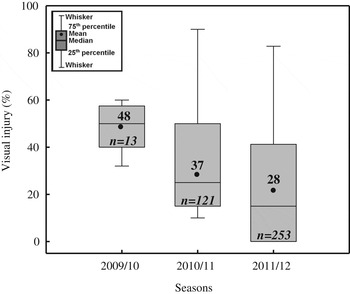
The proportion of Echinochloa populations resistant to imazethapyr+imazapic was 0·25, 0·81 and 0·60 for the 2009/10, 2010/11 and 2011/12 seasons, respectively (Table 1). The distribution of the resistant populations was variable in the six different rice-growing regions. The evolution of resistance was faster in the Central Valley and West Frontier when compared with the other regions (Table 1). The average visible injury of Echinochloa decreased along the seasons, with values of 0·49, 0·37 and 0·28 for the 2009/10, 2010/11 and 2011/12 seasons, respectively (Fig. 1), with an increasing variability in each season compared to the last, including many populations with a total absence of herbicide effects. Considering the 421 Echinochloa populations collected during the 2011/12 season, 0·60 of those were resistant to the herbicide imazethapyr+imazapic, 0·19 were resistant to quinclorac, and 0·14 showed multiple resistances to imidazolinones and quinclorac in 2011/12 (data not shown). None of the populations survived the herbicide cyhalofop-butyl. The occurrence of multiple resistances to imidazolinones and quinclorac is also present in all six rice-growing regions where the populations were collected, but most of multiple resistant populations were present in the West Frontier region (data not shown).
Box plot of visual injury at 30 days after the herbicide application of imazethapyr+imazapic in several barnyardgrass populations collected during the three seasons (2010–2012). N is the number of barnyardgrass populations resistant to ALS-inhibiting herbicides.

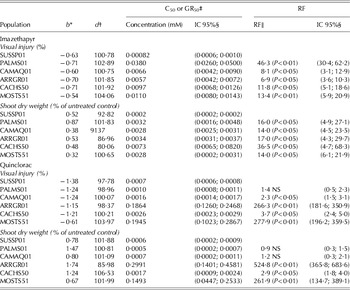
The whole-plant dose-response study confirmed the resistance of the PALMS01, CAMAQ01, ARROGR01, CACHS50 and MOSTS51 populations to imazethapyr. The RF for these populations ranged from 6·9 to 46·3 and from 14·0 to 36·5 in the evaluations of visible injury and shoot dry weight, respectively (Table 3). The RF for quinclorac for visible injury for the populations ARRGR01 and MOSTS51 was 266·3 and 277·9, respectively (Table 3). The populations CAMAQ01 and CACHS50, previously classified as susceptible to quinclorac, were 2·3 and 3·7 times more resistant than the susceptible population SUSSP01, respectively, in the analyses of visible injury (Table 3). The shoot dry weight also confirmed the resistance to population CACHS50 with an RF of 2·9, but this was not observed for the CAMAQ01 population.
Parameters of the log-logistic equation, concentrations required for 50% reduction of visual injury (C50) and shoot dry weight (GR50) of barnyardgrass to the herbicides imazethapyr and quinclorac, and RF in the whole-plant dose-response studies

* b is the slope of the curve around the point of inflection. P<0·01.
† d is the asymptotic upper value. P<0·01.
‡ Concentrations required for 50% reduction of dry weight (GR50) or visual injury (C50). P<0·05.
§ Values in this column are 95% CI.
‖ Resistance factor=C50 or GR50 ratio between the correspondent population and the susceptible SUSSP01 population.
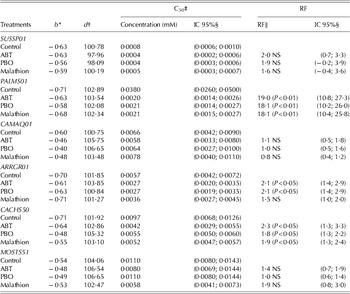
The association of imazethapyr with metabolic inhibitors resulted in significant RFs of 18·1–19·0, 1·8–2·3 and 2·1 times for the PALMS01, CACHS50 and ARRGR01 populations, respectively (Table 4). These values, compared with the control without application, resulted in reduction of the RF of 39·1–41·0, 14·9–19·3 and 30·4% for the PALMS01, CACHS50 and ARRGR01 populations, respectively. In the resistant CAMAQ01 and MOSTS51 populations, application of the inhibitors caused no significant effect. All inhibitors presented similar results for the evaluated populations, except in ARRGR01, where the effect of malathion was not significant (Table 4).
Parameters of the log-logistic equation, concentrations required for 50% reduction of visual injury (C50), and RF of barnyardgrass populations treated with imazethapyr alone or in association with inhibitors of metabolism in the whole-plant dose-response study

* b is the slope of the curve around the point of inflection. P<0·01.
† d is the asymptotic upper value. P<0·01.
‡ Concentrations required for 50% reduction of visual injury (C50). P<0·01.
§ Values in this column are 95% CI.
‖ Resistance factor=C50 ratio between the correspondent population and the susceptible SUSSP01 population.
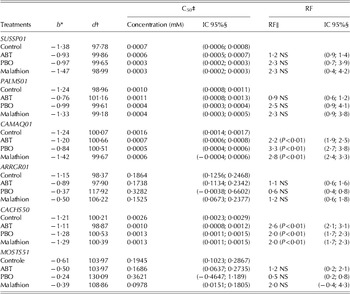
For the herbicide quinclorac, the association with ABT, PBO and malathion was significant (P<0·01) for two populations. The application of the inhibitors of metabolism resulted in a significant RF of 2·2–3·3 and of 2·0–2·6 for the CAMAQ01 and CACHS50 populations, respectively (Table 5). Compared with the susceptible population, application of metabolic inhibitors reduced the RF by 97·4–143·2 and 53·9–70·1% for the CAMAQ01 and CACHS50 populations, respectively. The effect of quinclorac was not influenced by the association with metabolic inhibitors in the resistant ARRGR01 and MOSTS51 populations, or in the quinclorac-susceptible populations of PALMS01 and SUSCP01.
Parameters of the log-logistic equation, concentrations required for 50% reduction of visual injury (C50), and RF of barnyardgrass populations treated with quinclorac alone or in association with inhibitors of metabolism in the whole-plant dose-response study

* b is the slope of the curve around the point of inflection. P<0·01.
† d is the asymptotic upper value. P<0·01.
‡ Concentrations required for 50% reduction of visual injury (C50). P<0·05.
§ Values in this column are 95% CI.
‖ Resistance factor=C50 ratio between the correspondent population and the susceptible SUSSP01 population.
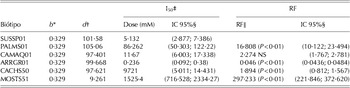
The ALS enzyme activity assay indicated that PALMS01 and MOSTS51 populations are less sensitive to imazethapyr than the other populations (Table 6). The I50 was 86·2 g/ha for the PALMS01 population and 1525·4 g/ha for the MOSTS51 population, and the RFs compared with the susceptible biotype SUSSP01 were 16·8 and 297·2 for the PALMS01 and MOSTS51 populations, respectively (Table 6). The I50 of the population ARRGR01 was 0·236, which is lower than the susceptible population SUSSP01.
Parameters of the log-logistic equation, concentrations required for 50% reduction of the enzyme activity (I50), and RF of barnyardgrass populations treated with imazethapyr in the ALS activity assay

* b is the slope of the curve around the point of inflection. P<0·01.
† d is the asymptotic upper value. P<0·01.
‡ Concentrations required for 50% reduction of the enzyme activity (I50). P<0·01.
§ Values in this column are 95% CI.
‖ Resistance factor=I50 ratio between the correspondent population and the susceptible SUSSP01 population.
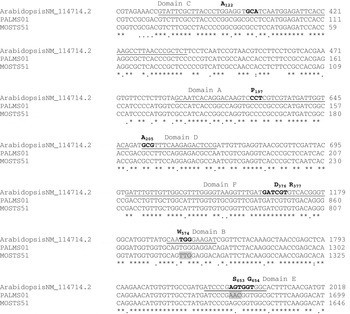
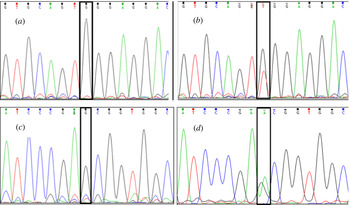
The sequence obtained for the ALS gene consisted of a contig of 1699 bp containing all six domains and eight codons related to the resistance to ALS-inhibiting herbicides. The nucleotide sequence obtained had 0·69, 0·87 and 0·99 similarity to the sequences for A. thaliana (NM_114714.2), O. sativa (AY 885675.1) and E. phyllopogon (AB 636580), respectively. The amino acid sequence of the ALS gene of the CAMAQ01, ARRGR01 and CACHS50 populations were similar to the susceptible population SUSSP01 (data not shown). However, in the MOSTS51 population, a mutation in the central position of the codon of the amino acid tryptophan W574 was observed (Fig. 2). This mutation consisted of a change from the base guanine (G) to thymine (T), resulting in a substitution of the amino acid tryptophan (TGG) for leucine (TTG) (Trp574Leu) (Fig. 2). In the PALMS01 population a mutation of guanine (G) to adenine (A) was observed in the central position of the codon of the amino acid S653. This mutation resulted in the change of the amino acid serine (AGC) to asparagine (AAC) (Ser653Asn) (Fig. 2). The chromatogram analysis of codons described above indicates that both susceptible codons TGG and AGT were also present in the resistant population in addition to the mutated codons TTG and AAC, at the positions W574 and S653, respectively (Fig. 3).
Partial nucleotide sequence of the ALS gene of the barnyardgrass populations PALMS01 and MOSTS51 and of the reference sequence NM_114714.2 of Arabidopsis thaliana, where the known mutations associated with herbicide resistance occur. Underlined regions indicate the ALS gene domains. Superscript annotations and light grey boxes indicate the position of the eight mutations associated with herbicide resistance. Dark grey boxes indicate the observed mutations in the barnyardgrass populations.

Colour online. Chromatogram of the ALS gene of the domain B of the populations SUSSP01 (a) and MOSTS51 (b) and of the domain E of the populations SUSSP01 (c) and PALMS01 (d). The highlighted codons indicate the positions Trp574 (a and b) and Ser653 (c and d).

DISCUSSION
The diagnosis of herbicide resistance should be based on direct quantification of the occurrence of this problem through conventional or molecular assays rather than analyses based only on field observations (Roso et al. Reference Roso, Merotto and Delatorre2010a). In the 2010/11 season, herbicide resistance in barnyardgrass was widespread in 0·81 of the sampled population throughout the six rice-growing areas in Rio Grande do Sul (Table 1). It is important to emphasize that this result is related to the sampling procedure, which was based on problem populations where the occurrence of resistance was suspected because escapee plants had been identified previously on these fields. Therefore, the results obtained may overestimate the regular distribution of resistance considering all infested rice fields in the studied area. In addition, the mean visible injury of Echinochloa decreased as the seasons progressed, indicating an increase in herbicide resistance in these areas (Table 1). The first fields to be reported with Echinochloa resistant to imidazolinone herbicides were in the 2008/09 season (Merotto Jr et al. Reference Merotto, Kupas, Nunes and Costa2009). The beginning of imidazolinone herbicide use associated with Clearfield® varieties occurred in 2003/04, with large-scale utilization occurring in 2005/06. Therefore, this indicated that the broad distribution of imidazolinone resistance in Echinochloa occurred just after three to four seasons from the start of the use of these herbicides in most fields. In addition to the regular processes related to the evolution of resistance, the large selection pressure caused by other ALS-inhibiting herbicides such as bispyribac-sodium and penoxsulam, as well as the previous occurrence of resistance to quinclorac, could be associated with the fast evolution of resistance in Echinochloa. The fast and broad distribution of resistance in Echinochloa to imidazolinone herbicides reported in the present study is similar to the evolution of herbicide resistance in red rice in the same region (Roso et al. Reference Roso, Merotto, Delatorre and Menezes2010b; Goulart et al. Reference Goulart, Pacheco, Nunes and Merotto2012) and in the Southern USA (Sudianto et al. Reference Sudianto, Beng-Kah, Ting-Xiang, Saldain, Scott and Burgos2013). These problems should be considered in other areas where the Clearfield®-rice varieties are at the beginning of utilization, such as in Central Europe, Latin America and Asia (Sudianto et al. Reference Sudianto, Beng-Kah, Ting-Xiang, Saldain, Scott and Burgos2013), and also for other cultivars resistant to herbicides from different modes of action than the ALS-inhibitors that are currently being developed (Harden et al. Reference Harden, Carlson, Mankin, Luzzi, Stevenson-Paulik, Guice, Youmans, Hong, Castro, Sandhu, Hofelt, McKean, Scott and More2014).
Environmental factors such as weather, soil type, farm size and the establishment system are variable in the rice production regions described in Table 1. These variations have a great influence on weed management strategies between regions and can help to explain the differences in the evolution of herbicide resistance in barnyardgrass. For example, the Central Valley region has a greater proportion of area with Clearfield®-rice varieties in comparison with the other regions and the rice fields in the West Frontier were more frequently treated with ALS-inhibitors for weed control. Thus, the selection pressure imposed by the frequent use of ALS-inhibitor herbicides is directly related to the faster evolution of barnyardgrass resistance in these regions.
The majority of resistance was to the imidazolinone herbicides, but resistance to quinclorac occurred in 0·19 of the 421 populations collected during the 2011/12 season. The spread of Echinochloa with multiple resistances is an important problem in rice areas of Rio Grande do Sul, but the results of the present study indicate that quinclorac resistance is also frequently present. The ACCase synthase-inhibiting herbicides are still effective in all the resistant populations. In addition, other herbicides such as propanil and the pre-emergence herbicides clomazone, pendimethalin, oxyfluorfen and thiobencarb are also options for resistant Echinochloa control (Matzenbacher et al. Reference Matzenbacher, Kalsing, Menezes, Barcelos and Merotto2013). However, the management of herbicide resistance in barnyardgrass requires knowledge of the mechanism(s) of resistance to design the best procedures of prevention and control of this problem in rice fields.
Selected populations from the large-scale screening study were evaluated in a dose-response experiment. The RF of variable shoot dry weight indicated that the PALMS01, CAMAQ01, ARROGR01, CACHS50 and MOSTS51 populations were resistant to imazethapyr, and the ARRGR01 and MOSTS51 populations were resistant to quinclorac (Table 3). The CACHS50 population presented a small RF in relation to the herbicide quinclorac, which may also indicate the evolution of the resistance to this herbicide. The gradual evolution of resistance is usually not evident when the mechanism of resistance is related to alteration of the target site. In this case, the action of a dominant gene is easily selected with higher doses of the herbicide by the rapid elimination of the susceptible individuals. In this scenario, the resistant allele results in a particular level of resistance that is distributed according to the resistance evolution. However, the occurrence of heterozygous alleles and different mutations in the ALS gene may result in different levels of resistance (Roso et al. Reference Roso, Merotto, Delatorre and Menezes2010b). These processes would explain the resistance to imazethapyr but may not be related to the multiple resistances to imazethapyr and quinclorac observed in some populations. Therefore, identification of the mechanism(s) of resistance in barnyardgrass is important in understanding the fast evolution of the level of resistance found in the present screening study. The occurrence of enhanced metabolism resistance as the mechanism of herbicide resistance in the genus Echinochloa found in other studies (Yasuor et al. Reference Yasuor, Osuna, Ortiz, Saldain, Eckert and Fischer2009, Reference Yasuor, Zou, Tolstikov, Tjeerdema and Fischer2010; Riar et al. Reference Riar, Norsworthy, Bond, Bararpour, Wilson and Scott2012) and the multiple herbicide resistance pattern observed in the present evaluation indicate that this mechanism may occur in the analysed populations.
The compounds ABT, PBO and malathion inhibit enzyme cyt P450s and are used as indicators of the occurrence of higher rates of herbicide detoxification (Letouzé & Gasquez Reference Letouzé and Gasquez2001). In the present study, the enhanced metabolism was related to the resistance of barnyardgrass to imidazolinone herbicides in three of the five resistant populations (Table 4). Moreover, low resistance to quinclorac was found in the CAMAQ01 and CACHS50 populations, which were previously identified as resistant to imidazolinone (Table 5). The evolution of enhanced metabolism as the partial mechanism of herbicide resistance in barnyardgrass was also found in two populations from Arkansas (Riar et al. Reference Riar, Norsworthy, Bond, Bararpour, Wilson and Scott2012) and in watergrass populations from California (Osuna et al. Reference Osuna, Vidotto, Fischer, Bayer, De Prado and Ferrero2002; Yasuor et al. Reference Yasuor, Osuna, Ortiz, Saldain, Eckert and Fischer2009). The occurrence of enhanced metabolism has been largely reported as the mechanism of resistance in Lolium rigidum (Yu et al. Reference Yu, Abdallah, Han, Owen and Powles2009) and Alopecurus myosuroides (Letouzé & Gasquez Reference Letouzé and Gasquez2001). Among the several weed species resistant to herbicides, the complex pattern of multiple resistance in A. myosuroides, L. rigidum and Echinochloa spp. characterize these species as important in the occurrence of enhanced metabolism as the mechanism of herbicide resistance. Prevention of the evolution and control of herbicide resistance caused by enhanced metabolism should be based on the combinations of compounds that inhibit plant metabolization. For example, in medicine, the association of amoxicillin and clavulanic acid is widely used, where the amoxicillin inhibits bacterial growth and the clavulanic acid inhibits degradation of amoxicillin by the enzyme beta-lactamase (White et al. Reference White, Kaye, Poupard, Pypstra, Woodnutt and Wynne2004). In agriculture, the association of propanil with piperophos is used to control E. colona, which is resistant to this herbicide (Valverde et al. Reference Valverde, Chaves, Garita, Ramírez, Vargas, Carmiol, Riches and Caseley2001). This approach can also be used to prevent the evolution of herbicide resistance in barnyardgrass. However, the combination of herbicides with inhibitors of metabolism can increase the toxicity of the herbicides to the crop and reduce growth and grain yield.
The ALS activity assay indicated that the PALMS01 and MOSTS51 populations are less sensitive to imazethapyr. The sequencing of the ALS gene identified the mutation Trp574Leu in the MOSTS51 population and Ser653Asn in the PALMS01 population. The mutation Trp574Leu was also found in barnyardgrass populations from Northern Italy (Panozzo et al. Reference Panozzo, Scarabel, Tranel and Sattin2013) and Northern Greece (Kaloumenos et al. Reference Kaloumenos, Chatzilazaridou, Mylona, Polidoros and Eleftherohorinos2013), but the mutation Ser653Asn is a novel finding in barnyardgrass. The mutation Trp574Leu has also been associated with a high level of resistance in previous studies with other species (Patzoldt & Tranel Reference Patzoldt and Tranel2007; Uchino et al. Reference Uchino, Ogata, Kohara, Yoshida, Yoshioka and Watanabe2007; Lamego et al. Reference Lamego, Charlson, Delatorre, Burgos and Vidal2009) and results in a cross-resistance pattern in all five groups of the ALS-inhibiting herbicides (Heap Reference Heap2014). The mutation Ser653Asn, found in the PALMS01 population, results in susceptibility or low resistance to sulphonylureas (SU) and triazolopyrimidines (TP) and high resistance to imidazolinones and pyrimidinylthiobenzoates (Heap Reference Heap2014). The mutation Ser653Asn may have been initially selected by the SU herbicides (pyrazosulphuron-ethyl and cyclosulphamuron) and the TP herbicide (penoxsulam) used in the study region for several years; this may have favoured selection for imazethapyr resistance and resulted in a high level of resistance. The chromatogram of DNA fragments where the ALS mutations were found in the PALMS01 and MOSTS51 populations indicated the presence of the susceptible codon in addition to the mutated codon (Fig. 3). A similar result was also found in barnyardgrass (Panozzo et al. Reference Panozzo, Scarabel, Tranel and Sattin2013; Riar et al. Reference Riar, Norsworthy, Srivastava, Nandula, Bond and Scott2013) and could be related to the heterozygosity of the evaluated plants and the occurrence of multiple copies of the ALS gene in barnyardgrass, which is reported as a hexaploid species (Brown Reference Brown1948). In addition, two copies of the ALS gene were identified in late watergrass (Iwakami et al. Reference Iwakami, Uchino, Watanabe, Yamasue and Inamura2012).
The combined analysis of the herbicide resistance pattern and the mechanism of resistance allow interpretation of the different evolutions of resistance that occurred in barnyardgrass in Southern Brazil. The PALMS01 population is susceptible to quinclorac and resistant to imidazolinone (Table 3) due to target site alteration associated with the mutation Ser653Asn (Fig. 1) and enhanced metabolism (Table 4). The MOSTS51 population is resistant to both herbicides (Table 4) and the resistance to imidazolinone is due to the mutation Trp653Leu (Fig. 1); however, the enhanced metabolism is not significant (Table 5). The other three populations did not show an altered target site and the effect of the metabolism inhibitors was partially associated with the resistance pattern. Further studies are being conducted to identify the activity of the metabolic enzymes in these populations. In addition, the occurrence of other mechanisms of resistance such as translocation, as described for barnyardgrass in a previous study (Riar et al. Reference Riar, Norsworthy, Srivastava, Nandula, Bond and Scott2013), could also be the cause of the herbicide resistance.
Herbicide resistance in barnyardgrass in Southern Brazil is associated with multiple herbicides due to multiple mechanisms and multiple mutations of the ALS gene. The occurrence of multiple herbicide resistance in barnyardgrass, caused mainly by enhanced herbicide metabolism, must be considered a problem for rice crops in this region. This characteristic indicates the necessity of adopting measures to prevent and control the evolution of multiple herbicide resistance in this species. Currently, the prevention of herbicide resistance evolution caused by target site alteration is based on the use of herbicides with different mechanisms of action, and the resistance caused by enhanced metabolism must be prevented by avoiding low herbicide doses caused by direct or indirect factors, crop rotation, mixtures of herbicides and metabolism inhibitors and different crop establishment systems. In addition, fully integrated weed management systems should be used for adequate weed control and to prevent the evolution of herbicide resistance. The adoption of measures to prevent the evolution of multiple herbicide resistance in barnyardgrass is imperative to avoid the occurrence of resistance to herbicides by different mechanisms of action.
The authors acknowledge the Extension Service of the Institute Riograndense of Rice (IRGA) and the field Agronomists of Dow AgroScience for seed collection. We also acknowledge the Brazilian Coordination for the Improvement of Higher Education Personnel (CAPES) and the National Council for Scientific and Technological Development (CNPq) for the scholarship to the first and second author and for the fellowship to fourth author.