Introduction
In recent years there has been an increasing disparity between workforce capacity and clinical demand in surgical specialities, including the field of head and neck surgery.Reference Cass and Smith1, Reference Magennis, Begley, Dhariwal, Smith and Hutchison2 In the United States, there is a substantial shortage of ENT surgeons to supply current and projected healthcare needs, primarily because of an ageing population and workforce.Reference Hughes, McMenamin, Mehta, Pillsbury and Kennedy3 Given the increasing pressures on recruitment, retention, and training across various specialties in the United Kingdom (UK),4 alongside the rising burden of head and neck disease,Reference Cancer Research5 it is likely that the United Kingdom will face similar workforce challenges.
Within the UK, head and neck surgery (HNS) can be pursued via three major specialities: ENT, oral and maxillofacial surgery (OMFS) and plastic surgery (PS). One way to improve workforce capacity is to recruit more trainees via these specialties.Reference Magennis, Begley, Dhariwal, Smith and Hutchison2 Studies consistently support that this should start early from undergraduate medical training to generate enthusiasm and foster engagment.Reference Erzurum, Obermeyer, Fecher, Thyagarajan, Tan and Koler6, Reference Greene and May7 While factors influencing motivation and interest include personal values, prestige, technical challenges and financial rewards post-training,Reference Ibrahim, Fanshawe, Patel, Goswami, Chilvers and Ting8 the most influential factor in pursuing surgical training is prior speciality exposure during medical education.Reference Erzurum, Obermeyer, Fecher, Thyagarajan, Tan and Koler6, Reference Greene and May7 In particular, operative exposure and positive interactions with role models, increase student interest and motivation in surgical specialities.Reference Erzurum, Obermeyer, Fecher, Thyagarajan, Tan and Koler6, Reference Greene and May7 Sage guidance and support from mentors improve successful recruitment by providing trainees with earlier career and academic opportunities.Reference Haggerty, Beaty, George, Arnaoutakis and Baumgartner9
On the other hand, one of the primary deterrants to pursuing a surgical career for students is the high competition ratio, coupled with the concerns of a perceived imbalance between professional and personal life.Reference Erzurum, Obermeyer, Fecher, Thyagarajan, Tan and Koler6, Reference Greene and May7 At present, undergraduate exposure within the field of HNS appears to be limited,Reference Ibrahim, Fanshawe, Patel, Goswami, Chilvers and Ting8, Reference Haggerty, Beaty, George, Arnaoutakis and Baumgartner9 restricting the opportunities for students to stimulate an interest in HNS from an early stage.
Our study aimed to identify the attitudes of final-year medical students in pursuing a career in head and neck surgery. We assessed their exposure within the field and the main factors that may motivate and deter them from pursuing a HNS career.
Materials and methods
A cross-sectional survey study was performed using a recognised survey website (Google Surveys). An online questionnaire was distributed to final-year undergraduate medical students via social media to undergraduate medical and surgical societies. The survey adopted a five-point Linkert scale to assess confidence. The questionnaire was designed and reviewed by the lead researchers with questions based on previous literature and their personal experiences.
Statistical analysis
A sample size calculator was used to calculate the required sample size to achieve 99 per cent confidence and 5 per cent margin of error.10 Data analysis for assessing internal consistency of the Likert-scale items was performed on SPSS using the Cronbach alpha coefficient.
Ethical considerations
Ethics approval was not required for this study.
Results and analysis
Sample size calculation and internal consistency of items
Data analysis on the initial 50 respondents confirmed a Cronbach alpha of 0.8 for the Likert-scale items, indicating good internal consistency. Using the Raosoft® Sample Size Calculator,10 a sample size of 621 respondents was deemed necessary to achieve 99 per cent confidence with a 5 per cent margin of error.
Exposure to HNS
In total, 633 responses were received from medical students across seven institutions. All students (n = 633) were in their final year of medical school. A total of 23.4 per cent (n = 150) of students had no exposure to HNS during their training, 66.7 per cent (n = 422) had 1–7 days of exposure and 9.6 per cent (n = 61) had more than 7 days exposure.
Fifty per cent (n = 317) of students had exposure to HNS through theatre, 16.7 per cent (n = 106) through ward rounds and 9.5 per cent (n = 60) through the outpatient clinic. A total of 86.8 per cent (n = 419) of students had exposure via ENT, 7.7 per cent (n = 37) via OMFS and 5.4 per cent (n = 26) via medical oncology. Final-year attitudes towards their undergraduate exposure and interest in HNS are summarised in Table 1. The majority of students had not assisted in or shadowed: an open resection of a head and neck cancer (n = 420; 66.3 per cent), a neck dissection (n = 482; 76.2 per cent), head and neck reconstruction (n = 542; 85.7 per cent) or robotic resection of head and neck malignancy (n = 620; 99 per cent) (Table 2).
Interest and attitudes towards undergraduate exposure to head and neck surgery.

Operative experience

Motivating and deterring factors to pursue HNS
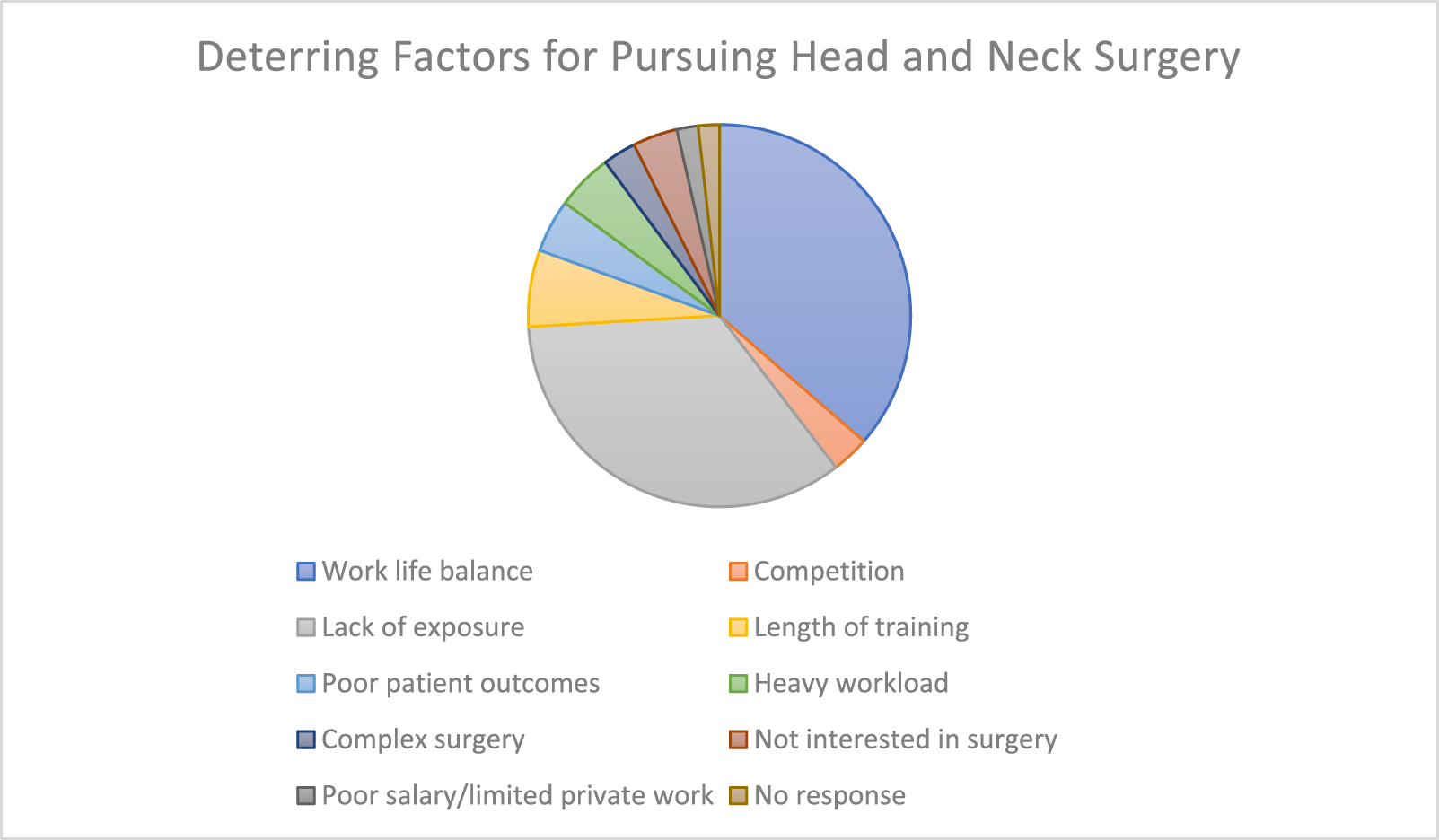
Students found both reconstruction and cancer resection the most interesting aspect of HNS (44.4 per cent; n = 281), followed by resection alone (malignant) via an open approach (27.8 per cent; n = 176), robotic resection (16.7 per cent; n = 106), reconstruction alone (11.1 per cent; n = 70) and benign HNS (0 per cent; n = 0). The main motivating factors to pursue HNS were: complex surgery (27.3 per cent; n = 173), interesting patient population (20.2 per cent; n = 128) and complex pathology (18 per cent; n = 114) (Figure 1). The main deterring factors to considering HNS as a career included: work–life balance (36.5 per cent; n = 231), lack of exposure (34.6 per cent; n = 219) and competition (3.2 per cent; n = 20) (Figure 2).
Motivating factors for students to consider pursuing head and neck surgery. Complex surgery (27.3%; n = 173), interesting patient population (20.2%; n = 128), complex pathology (18%; n = 114), MDT element (10.6%; n = 67), continuity of patient care (8.6%; n = 54), prestige (1.6%; n = 10), private work (2.6%; n = 16) and no response (11.2%; n = 71).

Deterring factors for students to pursue head and neck surgery. Work–life balance (36.5%; n = 231), competition (3.2%; n = 20), lack of exposure (34.6%; n = 219), length of training (6.5%; n = 41), poor patient outcomes (4.5%; n = 28), heavy workload (4.8%; n = 30), complex surgery (2.8%; n = 18), no interest in surgery (3.8%; n = 24), salary/lack of private work (1.8%; n = 11) and no response (1.8%; n = 11).

Most students reported if they were to consider HNS, it would be via ENT (63.2 per cent; n = 400), PS (26.3 per cent; n = 166), OMFS (6.3 per cent; n = 40) and general surgery (4.3 per cent; n = 27).
Discussion
Most students (66.7 per cent) within our cohort had 1–7 days of exposure to HNS during their undergraduate training, primarily through ENT placements. Despite this, only 33.7 per cent had shadowed/assisted in a cancer resection with even fewer witnessing a neck dissection (23.8 per cent), reconstruction (14.3 per cent) or robotic surgery (2 per cent). In keeping with prior work, 70.5 per cent of students believed they had inadequate exposure to the field during undergraduate training.Reference Soh, Lim and Yip11 Moreover, some students will be rotating through ENT placements at hospitals that do not support a HNS service, compromising opportunities and exposure further.
Within our cohort, 55.6 per cent of students felt if they had more exposure to HNS, they would be more likely to consider it as a career. This demonstrates the innate interest of medical students in the field but this requires further nurturing through exposure to the speciality and mentorship from surgeons. The clinical exposure students gain on their rotations is essential in determining their future career, with almost 50 per cent of students deciding on their career during medical school.Reference Yeom, Hardcastle and Wood12
Within our cohort, the complex nature of surgery (27.3 per cent), interesting patient population (20.2 per cent) and complex pathology (18.0 per cent) were the main motivating factors to consider HNS. On the contrary, work–life balance (36.5 per cent), lack of exposure (34.6 per cent) and length of training (6.5 per cent) were the most common deterrents.
We found that students were most interested in the resection and the reconstruction of head and neck malignancy (44.4 per cent). This is despite very few witnessing any reconstruction. Our study showed that students considered ENT as the most favourable route to pursue HNS, and OMFS as the least favourable route. This is likely due to more familiarity with ENT compared with OMFS and PS, with previous work demonstrating reduced undergraduate exposure to both specialities.Reference Kielty, O’Connor, Cotter, Goodson, Payne and Tahim13–Reference Pasha, Lumley, Dwyer-Hemmings and Fell16
Comparison with other studies
Previous work has found that one week in a speciality is insufficient to be able to make a career decision.Reference Levaillant, Levaillant, Lerolle, Vallet and Hamel-Broza17 This is in keeping with our findings: lack of exposure was the second biggest deterrent to pursuing HNS. Yet, an ever-expanding medical curriculum and limited space within the undergraduate syllabus make it increasingly difficult to increase speciality exposure. Nonetheless, there is a compelling argument for increasing the emphasis on HNS in the undergraduate curriculum. In an ageing UK population, the cases of head and neck malignancies has continued to climb, with an increasing clinical presentation to general practice, emergency medicine, oncology, geriatric medicine and critical care.Reference Cancer Research5 Thus, gaining exposure to the breadth of the speciality will not only aid in career prospects, but also give medical students insight into the management of a complex disease process that may be encountered in alternative specialities.
In terms of motivating and deterring factors, work–life balance is one of the most frequently reported considerations of medical students when contemplating a speciality.Reference Levaillant, Levaillant, Lerolle, Vallet and Hamel-Broza17 Similarly, our study highlighted a perceived negative work–life balance as a main deterrant for medical students (36.5 per cent; n = 231). Contrary to this perception, Tulunay-Ugur et al. reported 53–55 per cent of head and neck surgeons reported having a good work–life balance, with 4.2–9 per cent reporting they would have considered an alternative speciality if given the chance.Reference Tulunay-Ugur, Sinclair and Chen18 Similarly, 95 per cent of microvascular head and neck surgeons reported considerable job satisfaction.Reference Contag, Golub, Teknos, Nussenbaum, Stack and Arnold19 Comparing this to all other surgical specialities, 30.5 per cent of respondents stated they would have pursued an alternative speciality if given the chance.Reference Tulunay-Ugur, Sinclair and Chen18 Often it is the non-clinical work such as research, audit, teaching and portfolio being attributed by trainees as factors impacting personal life during training.Reference Tulunay-Ugur, Sinclair and Chen18, Reference Contag, Golub, Teknos, Nussenbaum, Stack and Arnold19 The training deanery may be better able to support trainees in achieving work–life balance by greater emphasis on time for self-development and study leave.
Strengths and limitations
One of the main strengths of this study is the inclusion of participants across seven UK medical schools, increasing the geographical and educational diversity of the the sample size. Additionally, quantitative data on the motivational and deterring factors for future career decisions provides this study with a balanced view of what influences students’ decisions regarding HNS, and can aid in developing targeted interventions to increase interest. In terms of limitations, there was likely a response bias, with undergraduates interested in surgery and anatomy being more likely to engage. Additionally, our sample size was small in the representation of the national cohort of medical students in the United Kingdom, and unavailability of university year group numbers did not allow a response rate to be calculated. However, our sample size was large enough to have sufficient power. We also did not collect demographic data on participants such as gender, age, dependent children or marital status all of which may be contributors to speciality selection. Additionally, we did not specifically assess whether students had an overall positive or negative experience in HNS placements, as this too would influence career decision-making.
Clinical applicability
Head and neck cancer has been increasing in incidence over the past decade with a further projected rise in cases in the coming decade.Reference Cancer Research5, Reference Bhattacharyya20 The disease burden is on the rise, and without a concurrent rise in head and neck surgeons, we face a potential workforce crisis.Reference Bhattacharyya20 Yet, within our cohort, most final-year medical students felt they had inadequate exposure (70.5 per cent) to HNS during undergraduate training and were not interested in pursuing a career in HNS (66.6 per cent).
Future curriculum development for clinical attachments could involve the integration of HNS as a distinct rotation, allowing students to shadow HNS specialists across relevant disciplines, including ENT, OMFS and PS. This approach would ensure comprehensive exposure to the full spectrum of HNS, encompassing reconstructive and resective surgery, and outpatient and ward care. Such an all-encompassing clinical attachment would provide students with opportunities to engage with specialists and identify mentors early in their training, thereby fostering informed career decision-making.
Ultimately, career choice is multifactorial, and a multifaceted approach should be adopted to tackle issues as discussed and maximise undergraduates considering HNS as a career.
• Given the rising burden of the disease and limited workforce capacity within the National Health Service (NHS), there is an urgent need for attracting medical students into the field of Head and neck surgery (HNS)
• No study exists to date looking specifically at student perception and experiences of HNS across United Kingdom (UK) medical schools
• Our cross-sectional survey study demonstrates 67.1 per cent of students felt they had inadequate exposure to HNS in medical school
• Within our cohort, 55.6 per cent of students felt if they had more exposure to HNS, they would be more likely to consider it as a career
• Exposure to HNS early in medical education can foster an interest and encourage medical students to pursue HNS
• A better understanding of the current state of medical education and exposure will help us design curriculums and adopt strategies that enhance interest in head and neck surgery.
Conclusion
The undergraduate curriculum must place more emphasis on HNS with students shadowing HNS specialists in ENT, OMFS and PS to cover the breadth of the speciality. There must be greater exposure to HNS and incorporation into clinical placements. Rates of head and neck cancer are likely to increase further in the coming years highlighting the need for head and neck surgeons, and the prospect of a recruitment crisis in an National Health Service (NHS) service already stretched with both capacity, workforce and resources. Surgical leadership, mentoring and teaching can serve as a contingency way to motivate future doctors to consider head and neck surgery as a career.
Author contribution statement
U.R., M.S. and P.B conceived the project and study design. U.S. and P.P. performed the data collection and analysis. U.R. and S.G. performed the writing and drafting and revisions of the manuscript. P.B. supervised the drafting of the manuscript and provided oversight.
Ethical considerations
Ethics approval was not required for this study.
Data availability statement
The data that support the findings of this study are available from the corresponding author upon reasonable request.
Declarations
Ethics approval: nil required. Consent to participate: Individual participants informed consent through participation and completed the survey voluntarily.
Competing interests
The authors of this manuscript, declare that they have no known competing financial interests or personal relationships that could have appeared to influence the work reported in this paper.