


Introduction
Perinatal mental illnesses are a major public health issue, which untreated can have devastating impacts on women and their families. In the UK, they account for almost a quarter of maternal deaths in the first postnatal year (Knight et al., Reference Knight, Tuffnell, Kenyon, Shakespeare, Gray and Kurinczuk2015), and cost around £8.1 billion a year, of which 72% relates to adverse impacts on children (Bauer et al., Reference Bauer, Parsonage, Knapp, Iemmi and Adelaja2014). Ensuring all mothers and babies receive timely and accessible perinatal mental health interventions is critical (National Institute of Health and Care Excellence, 2020; Bauer et al., Reference Bauer, Parsonage, Knapp, Iemmi and Adelaja2014). Stigma associated with perinatal mental illnesses means that women often tolerate considerable distress before seeking help (Christie and Bunting Reference Christie and Bunting2011), resulting in escalated emotional dysregulation and distorted emotional expression (Jones, Reference Jones, Pozzi-Monzo and Tydeman2007). In light of this, the UK Government significantly increased funding of mental health care for perinatal women from August 2016.
Emotional regulation in the perinatal period
Problems with emotion regulation, defined as ‘the capacity to influence one’s experience and expression of emotion’ (Rutherford et al., Reference Rutherford, Wallace, Laurent and Mayes2015; p. 1) are a feature across perinatal mental illnesses. Rutherford et al. (Reference Rutherford, Wallace, Laurent and Mayes2015) highlighted that emotion regulation during this life transition is distinct and critical to parenting. Parents have to regulate themselves in the presence of their child’s dysregulated state and simultaneously support their child to regulate themselves (Rutherford et al., Reference Rutherford, Wallace, Laurent and Mayes2015). This is complicated by reduced sleep, increased stress, and changes in identity and responsibility (O’Mahen et al., Reference O’Mahen, Fedock, Henshaw, Himle, Forman and Flynn2012; Stern, Reference Stern1998), as well as frequent exposure to the baby’s raw emotions (Fraiberg et al., Reference Fraiberg, Adelson and Shapiro1975). Previously learnt strategies for managing distress may also be ineffective or inaccessible (O’Mahen et al., Reference O’Mahen, Fedock, Henshaw, Himle, Forman and Flynn2012).
Morris et al. (Reference Morris, Silk, Steinberg, Myers and Robinson2007) describe a tripartite model by which emotion regulation skills, whether adaptive or maladaptive, are conveyed between parent and child through modelling, direct parenting practices and the parent’s ability to respond sensitively and consistently to their infant’s distress. Poor parental emotional regulation can perpetuate distress and create an emotionally invalidating environment for the infant which reinforces maladaptive coping (Linehan, Reference Linehan2015). Parental emotional regulation skills therefore have significant and long-term implications for the infant’s attachment style, and emotional and behavioural outcomes (Lieberman and van Horn, Reference Lieberman and Van Horn2008; Murray and Andrews, Reference Murray and Andrews2000; Van den Boom, Reference Van den Boom1994). For these reasons there is a need to develop clinical perinatal interventions that focus on improving parental emotion regulation (Rutherford et al., Reference Rutherford, Wallace, Laurent and Mayes2015; Maliken and Katz, Reference Maliken and Katz2013; Martin et al., Reference Martin, Roos, Zalewski and Cummins2017).
DBT skills training
Dialectical behaviour therapy (DBT) teaches management of emotional states through mindfulness, emotional regulation, distress tolerance and interpersonal effectiveness skills. Rooted in behaviourism, Zen and dialectical philosophy, DBT is a multi-pronged treatment, including group skills training, individual therapy, telephone coaching and weekly staff consultation. DBT skills training, which does not include individual therapy, has been similarly effective at reducing emotional dysregulation, depression and anger (Neacsiu et al., Reference Neacsiu, Eberle, Kramer, Wiesmann and Linehan2014; Sambrook et al., Reference Sambrook, Abba and Chadwick2006; Soler et al., Reference Soler, Pascal, Tiana, Cebrai, Barachina and Campins2009). DBT skills training has been adapted for a range of groups with positive outcomes, including adolescents with mental health difficulties (Miller et al., Reference Miller, Rathus and Linehan2006) and mothers with emotionally unstable personality disorder (EUPD) (Martin et al., Reference Martin, Roos, Zalewski and Cummins2017).
Two studies have evaluated DBT-informed interventions with perinatal women. The DBT skills group of Kleiber et al. (Reference Kleiber, Felder, Ashby, Scott, Dean and Dimidjian2017) for 25 adolescent perinatal women with depression led to a reduction in symptoms. Wilson and Donachie (Reference Wilson and Donachie2018) evaluated a 12-week skills group for 21 women attending a community perinatal mental health service. Participants significantly benefited on measures of wellbeing, functioning, distress, mental health confidence and emotional regulation. However, both studies found retention challenges with 50 and 33% of participants, respectively, not completing. Problematic discontinuation in the perinatal period has also been found in psychological interventions for depression in comparison with broader populations (Katz et al., Reference Katz, Blake, Milligan, Sharps, White, Rodan, Rossi and Murray2008; Ugarriza, Reference Ugarriza2004).
Adapting to the needs of perinatal women
Three qualitative studies examined experiences of perinatal women accessing psychological therapies. One study interviewed 14 mothers with EUPD accessing DBT-informed programmes, concluding that groups for mothers specifically focusing on emotional dysregulation would be beneficial (Zalewski et al., Reference Zalewski, Stepp, Whalen and Scott2015). O’Mahen et al. (Reference O’Mahen, Fedock, Henshaw, Himle, Forman and Flynn2012) highlighted the importance of support from other mothers with similar difficulties. A third study interviewed both postnatal women and therapists of an IAPT service (Millett et al., Reference Millett, Lever Taylor, Howard, Bick, Stanley and Johnson2017). The women reported generally positive experiences but noted that not bringing their baby created challenges. IAPT therapists noted that including babies in therapy could improve access, but also reported concerns that inclusion could reduce efficacy, or expose babies to distress. All three studies concluded that tailoring therapies to the needs of perinatal women in terms of both flexibility and content, could improve adherence and outcomes for both parents and babies. Indeed, where interventions have been tailored to the specific needs of postnatal women, completion rates have been high, and outcomes positive and sustained for both parents and babies (Stein et al., Reference Stein, Netsi, Lawrence, Granger, Kempton, Craske, Nickless, Mollison, Stewart, Rapa, West, Scerif, Cooper and Murray2018).
Aims and hypotheses
No research has investigated the effectiveness of DBT skills training with babies present, or considered the experiences of mothers in bringing their babies. DBT skills have been shown to be effective in increasing emotional regulation, and adapting therapies to the needs of perinatal women is critical. We hypothesised therefore, that community perinatal DBT skills groups would reduce emotional distress and improve emotional regulation even when babies were present, and we undertook a brief qualitative analysis to explore women’s experience of having babies in the group.
Method
Design
A mixed methods within-subjects design was conducted with quantitative outcome measures administered at two time points: pre- and post-group. Following group completion, participants were contacted by telephone and invited to participate in a qualitative semi-structured interview about their experience of bringing their babies.
Participants
All participants were under the care of the Sussex and East Surrey Specialist Perinatal Mental Health Service (SPMHS), which supports mothers with moderate to severe mental illness during pregnancy and 1 year postnatal. Participants undertook a pre-treatment session to assess suitability and commitment to the skills group.
Exclusion criteria included: current or very recent psychotic or manic illness, currently in care proceedings, and insufficient English.
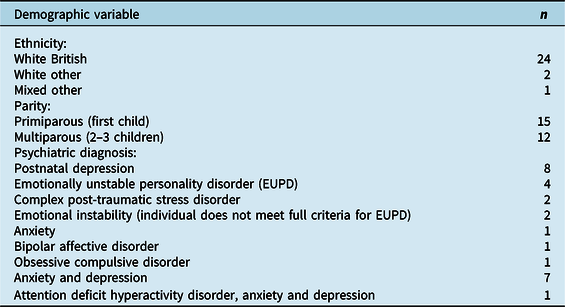
Demographic characteristics for the 27 participants who completed pre- and post-group outcomes are shown in Table 1. Of these, the majority were postnatal (25), first time mothers (55.6%), White British (88.9%), with a mean age of 34 years (range 26–45 years). This reflects service client demographics for ethnicity (89% White British), with a slightly higher mean age than the current service caseload (mean age 30 years, age range 16–47 years). The most common diagnosis was postnatal depression (29.6%; n = 8), followed by EUPD (14.8%; n = 4). Twenty-nine per cent of women (n = 8) presented with a co-morbid diagnosis, with the most common being anxiety and depression (25.9%; n = 7).
Demographic characteristics of participants

Procedure
Ethical considerations
This service evaluation was approved by the Trust’s Research and Development department (Clinical Audit No. CAG019). Data were stored anonymously in a password-protected Excel document.
Intervention
DBT skills groups ran weekly for 2 h, and were facilitated by a clinical psychologist and consultant psychiatrist or specialist perinatal nurse practitioner. All facilitators had completed an intensive 10-day licensed DBT training programme. In addition, early years practitioners were present to support mothers who brought their babies, by holding babies or playing with babies on a play mat. Six groups were facilitated across the service over 1 year. Two ran for 12 weeks and four for 14 weeks. Women were invited to bring babies under 1 year old and groups were facilitated in baby-friendly environments.
The group consisted of two sections; the first half began with mindfulness practice followed by homework review; the second half taught new skills. Group content followed an evidence-based plan (Linehan, Reference Linehan2015; p. 115) including mindfulness, emotion regulation, distress tolerance and interpersonal effectiveness. Perinatal adaptations were made, including mindfulness of everyday baby care tasks, and labelling maternal and infant emotions.
All women attending the group had a lead practitioner within the perinatal service and DBT skills telephone coaching was available.
Group facilitators participated in a weekly hour-long DBT consultation to enhance clinical skills and adherence to the model, and attended monthly clinical supervision from a licensed DBT supervisor.
Quantitative data collection
Quantitative data were collected using two self-report measures: the Clinical Outcomes in Routine Evaluation (CORE-34) and the Difficulties in Emotion Regulation Scale, 18 item (DERS-18). Data were collected at pre-treatment before group commenced (time 1) and at group completion (time 2). Pre-treatment sessions occurred in the month before group commencement. The CORE-34 (Evans et al., Reference Evans, Mellor-Clark, Margison, Barkham, Audin, Connell and McGrath2000) measures psychological distress. Clients rate 34 questions assessing symptoms over the past week using a 5-point Likert scale ranging from ‘not at all’ to ‘most or all of the time’. A mean score is calculated indicating current level of psychological distress (ranging from ‘healthy’ to ‘severe’). The CORE-34 has been found to have strong reliability (0.75–0.95) and convergent validity, and good sensitivity to change (Evans et al., Reference Evans, Connell, Barkham, Margison, McGrath, Mellor-Clark and Audin2002). The DERS-18 (Victor and Klonsky, Reference Victor and Klonsky2016) measures emotion dysregulation. Clients rate 18 items on a 5-point Likert scale ranging from ‘almost never’ to ‘almost always’. The DERS-18 has been found to have very high internal consistency (α = .91) and strong convergent and concurrent validity (Victor and Klonsky, Reference Victor and Klonsky2016).
Qualitative data collection
Seven mothers participated in a 30-minute semi-structured interview. An interview schedule was developed by the authors to ensure consistency.Footnote 1 The schedule was developed collaboratively by the authors, with questions designed to explore mothers’ lived experience of bringing their baby to the DBT skills group. This consisted of four main questions with sub-questions examining: expectations before the group about bringing their baby, experience of having their baby in the group, perceptions of their baby’s group experience and potential impact on their baby of group attendance. Interviews were chosen over focus groups to allow participants to express their unique experiences free from group dynamics (Robson, Reference Robson2017).
Data analysis
Quantitative data were analysed using Microsoft Excel 2010 (version 14.0). Change in CORE score was analysed using a one-sample Wilcoxon signed rank test versus zero as data were not normally distributed. Change in CORE category was analysed using a chi-square observed versus expected test. The DERS was analysed using a one-sample t-test versus zero as data were normally distributed. A separate correlational analysis of the CORE and DERS non-parametric Spearman’s r was performed to test whether change on the CORE was predictive of change on the DERS.
Qualitative data were analysed using thematic analysis (Braun and Clarke, Reference Braun and Clarke2006). Analysis of transcripts was broadly realist in that participants’ speech is assumed to reflect their experiences. The role of the researcher in interpreting these experiences is acknowledged. Peer debriefing was used throughout to explore and challenge potential researcher biases and assumptions (Noble and Smith, Reference Noble and Smith2015). Analysis was inductive, identifying patterns from the data that communicate participants’ perceptions. Each transcript was individually coded with initial themes being identified. All transcripts, coding and initial themes were reviewed by the research team in an iterative and systematic process of comparing, confirming and elaborating upon emergent themes and eliminating others. Source material was referred to throughout and the final three themes were present in all seven interview transcripts with verbatim extracts quoted from all participants.
Results
Attendance
Fifty-five mothers attended the first session of a DBT skills group; 35 women completed the course, giving a retention rate of 64%. The number of sessions attended by completing participants ranged from seven to 13.
Quantitative
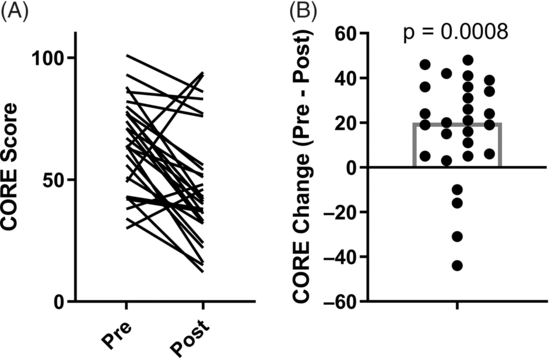
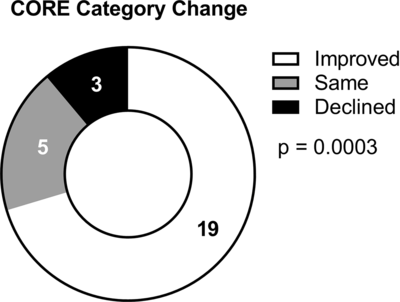
Twenty-seven women completed the CORE at both times 1 and 2, allowing us to calculate CORE change values defined as the pre-treatment score minus the post-treatment score. Clinically significant improvement on the CORE scale is reflected in a positive change value of 10 points (Evans et al., Reference Evans, Mellor-Clark, Margison, Barkham, Audin, Connell and McGrath2000). We observed a statistically significant median positive change of 20 points after DBT group participation (Fig. 1; Wilcoxon signed rank test versus zero; W = 266; p = 0.0008). A large proportion of participants underwent a positive change in their CORE category (Fig. 2; 19/27=70%), and this proportion was significantly higher than would be expected by chance [χ2 = 16.32 (d.f. = 2, n = 27), p = 0.0003].
CORE scores pre- and post-DBT skills group showing statistically significant improvement in levels of psychological distress. (A) Individual pre- and post-CORE data. Each pair of data points (connected by a line) represents one participant. (B) Individual CORE change data. Each dot represents one participant; bar shows median.

Change in CORE category showing clinically significant improvement in levels of psychological distress.

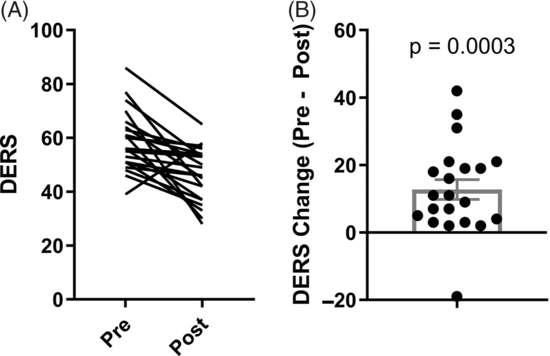
A smaller sample of 21 women completed the DERS at both times 1 and 2. We again used pre-treatment versus post-treatment scores as a measure of DERS change, with positive values reflecting improvement. We also found a statistically significant positive change in DERS scores from time 1 to time 2 (Fig. 3; mean ± SE = 12.71 ± 2.92; t 20 = 4.350; p = 0.0003).
DERS scores pre- and post-DBT skills group showing statistically significant improvement in levels of psychological distress. (A) Individual pre- and post-DERS data. Each pair of data points (connected by a line) represents one participant. (B) Individual DERS change data. Each dot represents one participant; bar shows mean; error bars show SE.

Given the significant changes on both measures, we wondered whether CORE change might be correlated with DERS change in the 21 participants who completed both questionnaires at both time points. Although we observed a positive correlation between the two change measures – indicating that participants with greater change on the CORE also broadly had greater change on the DERS – this relationship was not statistically significant (Spearman’s r = 0.25; p = 0.28).
Qualitative
Seven mothers who brought their babies to at least one DBT group session were interviewed regarding their experiences of having their baby present.
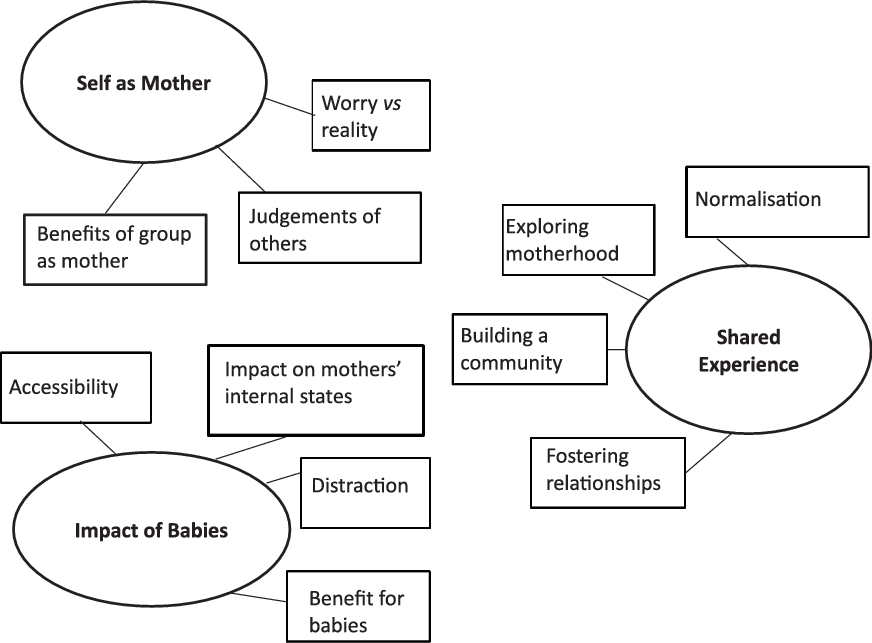
After analysis, three themes were identified, each with a number of sub-themes. These were: ‘Self as Mother’, ‘Shared Experience’ and ‘The Impact of Babies’ (Fig. 4).
Thematic map of qualitative data.

Self as Mother
Participants reflected on the anticipated and actual experience of being a mother with a baby in the group. This included the expectations of what it would be like to parent your baby in the group, whether these expectations were challenged or reinforced, and how the group benefited them as mothers.
‘I think that if I wasn’t able to settle him, for like whatever reason, I was worried I would just look like a really bad mum that can’t look after her own baby… the worry definitely lessened. I also felt like actually all the other mums there were worried about the same thing. Everyone was worried about being a bad mum or not doing enough or not doing the right thing.’ [Vicky]
Participants spoke of various benefits of group participation to their mothering role including using the skills taught to be more present, calmer and less emotionally dysregulated, enabling them to better regulate their baby’s emotions. They also spoke of feeling more confident in their parenting, resulting in reduced anxiety, and some talked of feeling more connected with their baby.
‘My mood swings aren’t as intense or as frequent because I use the tools that I learnt, so that’s going to have a positive impact on Daisy. Her environment is calmer at home.’ [Bianca]
‘I really struggled at first to bond with Athena… it actually was really nice to have that bonding time with her… because it forced me to spend that time with her because I was so scared to be alone with her…but the group forced me to be in a different environment with her which was really good for us both 100% and to see how everyone else was in the same boat.’ [Charlie]
Shared Experience
Participants spoke about exploring what it means to be a mother, the concerns commonly associated with being a mother of a small baby, and the perceived judgements, positive and negative, of others. They emphasised the importance of having these discussions with other mothers experiencing mental health difficulties.
‘I think you never really know what people are going through but I think if you’re in a group with other mums with mental health problems, I think that was helpful to me to sort of see them having a relationship with their babies.’ [Abi]
‘I remember her kicking off once and me kind of panicking about that and having a sweaty palm situation, but it didn’t last very long because no one around me actually cared because they were like “well my baby does the same thing” so it was quite nice to have someone who would look over at the baby crying and then just carry on as normal.’ [Charlie]
‘It’s all really about self-acceptance … I think that’s what a lot of the issues came from, not accepting myself as I was as a mother, and not accepting my baby for who she was. I think there were a lot of control issues, so I noticed that all of us had slight control issues in our lives, and this child threw us out of that control and we weren’t coping.’ [Helen]
Participants also spoke about how having a safe space for these discussions allowed them to build supportive relationships with other members of the group.
‘I do things with them but when things are darker for me, depressed, I try and do it but I don’t enjoy it and then I feel guilty. And when you’re feeling low the guilt compounds. And now when I feel low I try mindfulness or message the whatsapp girls, from the group, and we give each other support or advice, and then they might share somethings that helps.’ [Fiona]
The Impact of Babies
Several women spoke about how not bringing their baby would have meant they could not attend the group because of practical considerations such as childcare or maintaining breastfeeding. To some, being separated from their baby would have been anxiety provoking; being able to bring their baby made the group accessible.
‘It took away any barriers of me finding reasons not to come. Whether I could have practically left her I wouldn’t necessarily have felt comfortable doing so I may not have been as willing to put my needs above hers which is a main challenge of being a parent.’ [Fiona]
‘I guess it’s comforting to have him there, in terms of my anxiety about leaving him… It was nice to know I didn’t have to leave him if this felt too hard…’ [Vicky]
Many of the women spoke of the value of their baby’s presence in changing how they were feeling. In different ways, the baby was a tool for regulation during an anxiety-provoking situation. For instance, babies acted as an ‘icebreaker’ when forming relationships, leading to a sense of acceptance.
‘I was petrified but I thought, if I had him, he was my comfort… so if I was ignored or something I thought I could just focus on him… He was sort of a reason to start talking to people, because they would ask about him… when we got in the class everyone was like “so what’s his name” and how old is he and stuff so the other people talked to me because of him. So he was a conversation starter.’ [Nat]
Watching the babies play during the group provided a positive regulatory experience at times of high emotion.
‘It helped with the atmosphere there and I remember on one occasion Athena and Joshua were looking at each other across the table and talking to each other, and I remember everyone was really down and there were a few tears and things from the mums and then when they started talking everyone just stopped and looked at them and it was just really lovely and it just brought a smile to everyone’s face and kind of just for that second it made everyone not seem so bad…’ [Bianca]
Babies were identified as being a distraction. This was highlighted both as a tool for managing emotions, and an impediment to concentration and learning.
‘If I gave her to someone they were happy to help out and everyone seemed to enjoy other people’s children… Or while I was trying to compose myself, it was a good distraction technique.’ [Helen]
‘There were times when I didn’t have Katie there when my mum would take her. And I guess then I could listen more and pay attention more to what everyone was saying and what you [facilitators] were saying so I could pay attention more without having this little being wanting attention.’ [Charlie]
Conversely, others spoke about how having their baby in the group allowed for generalisation of skills taught to the home environment.
‘But also selfishly to some extent it meant that I got to practise the things I was trying to do with the challenge already there. So it wasn’t let’s do this with no distractions and then go home and you can’t quite do it because there are distractions. I got to trial it as it is at home.’ [Fiona]
Most of the women felt positive about bringing their baby as they believed their babies benefited directly through gaining socialisation opportunities.
‘He loved it. I could tell he loved it. In the end he was playing with the other babies and he would go over to other people.’ [Nat]
‘It was nice to see her interacting with the other babies as well. Because a couple of the other babies were a similar age as well so it was nice to see her interacting with them.’ [Abi]
Discussion
This study demonstrates that attendance at a DBT skills group for mothers and babies reduced psychological distress and emotional dysregulation in a community sample of women experiencing moderate to severe perinatal mental illness. The results corroborate other studies demonstrating the effectiveness of DBT skills group only programmes (e.g. Neacsiu et al., Reference Neacsiu, Eberle, Kramer, Wiesmann and Linehan2014), and their specific effectiveness with perinatal women (Wilson and Donachie, Reference Wilson and Donachie2018).
Most importantly, this study demonstrates that statistically and clinically significant improvements in psychological distress and emotion regulation are achieved when babies are present during skills training. Women had the option to bring their babies with the aim of increasing access to an intervention that might not be possible to attend otherwise, and in order to promote care of newborn babies in women with perinatal mental illness. Attendance was comparable to that of Wilson and Donachie (Reference Wilson and Donachie2018) and an improvement on others (Kleiber et al., Reference Kleiber, Felder, Ashby, Scott, Dean and Dimidjian2017) with two-thirds of participants completing the DBT skills group. The findings challenge previously expressed concerns that bringing babies to therapy may reduce treatment efficacy (Millett et al., Reference Millett, Lever Taylor, Howard, Bick, Stanley and Johnson2017).
The authors of this study recognise that to create a welcoming environment for mothers and babies requires some flexibility and additional resources. Location is important as adequate space and facilities for baby care is required. Each group also had an early years practitioner present to support mothers attending with babies.
This initial exploration of women’s experiences of attending perinatal DBT skills groups illuminates the quantitative findings, indicating that the reduction in emotional dysregulation was in part due to increased emotion regulation skills, which allowed mothers to better regulate their emotions and, for some, understand those of their children. The ability of parents to regulate emotions during the perinatal period is considered distinct from the emotion regulation skills implemented during other periods of life (Rutherford et al., Reference Rutherford, Wallace, Laurent and Mayes2015). Managing a baby’s distress is inherently dysregulating (Rutherford et al., Reference Rutherford, Wallace, Laurent and Mayes2015) and it is of significant benefit to parents to have sufficient skills in order to be able to regulate their own emotions in the face of their child’s distress and respond sensitively to their child’s emotions.
Despite reservations raised by participants about attending the DBT group with their baby, they reported benefits from peer support and understanding in having the dual shared experience of being a parent to a new baby and having a mental health problem. This led to positive maternal identities and increased confidence in managing babies in a group environment.
Participants highlighted that participation in validating discussions based in DBT teachings and adapted to the perinatal period, taught them about emotional regulation specifically in the context of parenting. This, together with informal social interactions in the group allowed them to experience an increased sense of social support, a major factor in helping women with perinatal mental health problems to cope (O’Mahen et al., Reference O’Mahen, Fedock, Henshaw, Himle, Forman and Flynn2012). It was also suggested that attending the DBT group impacted positively on the family environment. Previous studies identified a positive family environment as facilitating both parental emotional regulation (Morris et al., Reference Morris, Silk, Steinberg, Myers and Robinson2007) and the optimal socialisation of parental emotional regulation to children (Meyer et al., Reference Meyer, Raikes, Virmani, Waters and Thompson2014).
Furthermore, interviews highlighted additional benefits from having the baby present. The babies enabled new social relationships by generating initial conversations and creating common ground. Most interestingly, it appeared that the impact of the baby’s presence helped to regulate the mother’s emotional state during the group and sometimes those of the group as a whole. This highlighted the complex dyadic and transactional nature of emotion regulation between parent and infant in situ; the babies subtly contributed to the work of the group (Paul and Thompson-Salo, Reference Paul, Thomson-Salo and Pozzi-Monzo2007). In all contexts, parents influence their infant’s regulatory functioning but infants also impact on their parent’s regulation (Rutherford et al., Reference Rutherford, Wallace, Laurent and Mayes2015). The mother’s dysregulation at being in a new group environment, which could be detrimental to learning skills (Nix et al., Reference Nix, Bierman and McMahon2009) was in part modulated by her baby’s presence; they used their baby as a positive distraction from anxiety, enabling them to gain the social and educational benefits.
Conversely, it could be argued that attending the group without a baby would maximise learning as there are fewer distractions and some participants indicated this preference. Martin et al. (Reference Martin, Roos, Zalewski and Cummins2017) suggested that parents who struggle to regulate their emotions may find it more challenging to implement newly learnt parenting skills when in an ‘emotionally evocative context’ (p. 4); we would argue that despite this preference for some, having the baby present during learning may allow for greater generalisation of skills to the home environment. Generalisation is considered an important treatment mode in DBT (Linehan, Reference Linehan2015). Ultimately, we believe this study demonstrates the importance of giving women a choice about bringing their baby in order to allow them to engage in effective interventions in the perinatal period.
Finally, many mothers believed that the babies were active participants in the group in their own right, experiencing unique opportunities for play and socialisation as a result of attendance. This challenges previously expressed concerns that having babies attend therapy may expose them to intolerable distress (Millett et al., Reference Millett, Lever Taylor, Howard, Bick, Stanley and Johnson2017).
Limitations and recommendations for future research
This non-randomised study had a small sample size and lacked a control group. The statistically significant improvement in both psychological distress and emotion dysregulation may have been influenced by other variables such as treatment as usual, and this varied between participants. Despite 35 women completing the course, there were missing data leading to reduced sample size. Other confounding factors include varied use of telephone coaching by group members, with some not using it at all and others using it regularly. Given these and the lack of comparison group, conclusions drawn are tentative. However, the sample is a naturalistic ‘real world’ population typical of a service evaluation and these findings have value for other perinatal services. Introducing a waiting list comparison group for future research would allow for an ethical alternative to a control group.
The attrition rate was moderate and comparable to other effectiveness studies of DBT skills groups (Blackford and Love, Reference Blackford and Love2012; Wilson and Donachie, Reference Wilson and Donachie2018). Reasons for attrition were not formally assessed; however, reasons given included difficulties travelling to groups and lack of childcare for older children. Perinatal therapy retention is problematic in comparison with broader populations (Katz et al., Reference Katz, Blake, Milligan, Sharps, White, Rodan, Rossi and Murray2008; Ugarriza, Reference Ugarriza2004). However, Blackford and Love (Reference Blackford and Love2012) found that number of sessions attended correlated with symptom change. Future research could examine reasons for attrition, correlations between sessions attended and outcome, and which modules are most impactful on emotional dysregulation in perinatal women.
The sample in this study was predominantly White British and reflective of the general population served by SPMHS; however, findings cannot be considered generalisable as differences have been found in experiences of postnatal psychological distress for different ethnic groups (e.g. O’Mahen et al., Reference O’Mahen, Fedock, Henshaw, Himle, Forman and Flynn2012). Data were not collected on the demographics of those referred to the group but not considered suitable or who declined prior to the first session, and this too would have been useful in considering the generalisability of the findings.
Although partial member checking of understanding was included at interview stage, including a more formal method of respondent validation in future would increase claims of internal validity. It is also important to consider the potential impact of the pre-existing relationship between interviewers and participants. All interviewers invited participation from, and then interviewed, those participants who had attended groups at which they had been facilitators. This may have biased both the decision to participate and through social desirability factors (Hewitt, Reference Hewitt2007), their feedback about their experiences.
This study did not explore experiences of mothers that attended without babies, nor did it explore the experience of pregnant attendees; these are areas requiring further investigation. It can also be argued that for some mothers who are experiencing dysregulation in the perinatal period, recovery from birth and pregnancy, and increasing confidence in parenting skill and identity, over time, may influence the ability to regulate emotions. Allowing for a comparison with a sample of women in the postnatal period not under the care of the perinatal mental health service may indicate the impact of these variables on the findings. Whilst this small-scale study tentatively identified that through learning DBT skills women felt more confident in their mother identity, their ability to regulate their emotions and thus respond differently to their infants, it would be valuable to research further any quantifiable impact on mothers’ perceptions of their relationship with their baby. Problems with mother–infant relationships are prevalent in severe perinatal mental illnesses and interventions that improve both maternal mental health and also improve the mother–infant relationship are of critical clinical importance.
In conclusion, difficulties with emotion regulation are common across mental health problems in the perinatal period and the findings of this study support the implementation of perinatal DBT skills groups for mothers and babies in order to reduce psychological distress and improve emotional regulation. Permitting mothers to bring their babies to the group had benefits for mother and baby and thus is of clinical importance and worthy of further research and evaluation.
Acknowledgements
The authors would like to acknowledge Lucy Barkess, Claire Bradley, Sarah Clinton, Nicole Elton, Katie Fusco, Rebekah Fisher, Matthew Grubb, Michael Harris, Jayne Herriot, Helen Hutchings, Abbie Jenkins, Danielle Kershaw, Sarah Lyon, Caroline Mitchell, Anna Schutt and the mothers who gave generously of their time to participate in this research.
Financial support
No independent financial funding was provided to conduct this research.
Conflicts of interest
The authors have no known conflicts of interest to declare.
Ethics statements
The authors have abided by the Ethical Principles of Psychologists and Code of Conduct as set out by the BPS. No formal ethical approval was required for this study as it was classed as a service evaluation project.



Comments
No Comments have been published for this article.