Introduction
The elderly population size is increasing due to prolonged life expectancy and falling birth rates in both developing and developed countries (Shah and McKenzie, Reference Shah, MacKenzie, Bhugra and Bhui2007). A recent cross-national study of 62 developing and developed countries reported an increase in suicide rates with aging in males and females in 25 and 27 countries respectively (Shah, Reference Shah2007). Thus, suicides among the elderly are an important public health concern. Comprehensive understanding of the substantial worldwide variation in population patterns of suicide may be critical for developing prevention programmes (Knox et al., Reference Knox, Conwell and Caine2004).
Elderly suicide rates are associated with the elderly population size (Shah et al., Reference Shah, Bhat, MacKenzie and Koen2008a), the proportion of elderly in the general population (Kiemo, Reference Kiemo2004; Shah et al., Reference Shah, Bhat, MacKenzie and Koen2008a) and the elderly dependency ratio (i.e. the ratio of people over the age of 65 years to those under the age of 65 years) (Shah et al., Reference Shah, Padayatchi and Das2008b). This may, in part, reflect Durkheim's hypothesis that the overall cohort size may influence suicide rates due to competition for scarce resources (Shah and De, Reference Shah and De1998). Additionally, cultural factors have speculatively been used to explain the relationship between elderly suicide rates and elderly dependency ratios (Shah et al., Reference Shah, Padayatchi and Das2008b).
Suicide rates among non-white Americans (Seiden, Reference Seiden1981; Woodbury et al., Reference Woodbury, Manton and Blazer1988), Indians (Adityanjee, Reference Adityanjee1986; Bhatia et al., Reference Bhatia, Kahn and Medirrata1987), Arabs in Jordan (Daradekh, Reference Daradekh1989), men in Kuwait (Shah, Reference Shah2007), Malays in Singapore (Ko and Kua, Reference Ko and Kua1995), Indian immigrants to the U.K. (Raleigh et al., Reference Raleigh, Bulusu and Balarajan1990; Neeleman et al., Reference Neeleman, Mak and Wessely1997), and in some East European countries (Sartorius, Reference Sartorius1995) decline with aging. Traditionally, in these societies the elderly are respected, held in high esteem and live in close-knit families, and this offers protection against loneliness and despair, which otherwise may lead to suicide (Shah and De, Reference Shah and De1998). These factors may also explain the low elderly suicide rates in Thailand (Lotrakul, Reference Lotrakul2006) and among Malays in Singapore (Kua et al., Reference Kua, Ko and Ng2003). A similar hypothesis may also explain high suicide rates among the elderly in Japan (Watanabe et al., Reference Watanabe, Hasegawa and Yoshinaga1995), Hong Kong (Yip and Tan, Reference Yip and Tan1998) and China (Yip et al., Reference Yip, Callanan and Yuen2000; Reference Yip, Liu, Ku and Song2005) because they have lost their traditional role in the family. Additional evidence supporting this, from Hong Kong and China, includes: mismatch between the traditional dependence of elderly on their children for emotional and financial support and their children's ability to provide this (Yip et al., Reference Yip, Chi and Yu1998; Reference Yip, Callanan and Yuen2000; Reference Yip, Liu, Ku and Song2005); the traditional – but now unmet – expectation of the elderly that they will live with their children or grandchildren (Yip et al., Reference Yip, Callanan and Yuen2000); the greater effect on the elderly of their children's negative attitudes (Yip et al., Reference Yip, Callanan and Yuen2000); and, the migration of children to urban areas or to other countries (Yip and Tan, Reference Yip and Tan1998; Yip et al., Reference Yip, Callanan and Yuen2000). Lower suicide rates among elderly Malays in Singapore were, in part, attributed to larger household size (Kua et al., Reference Kua, Ko and Ng2003). Higher suicide rates among elderly Chinese in Singapore and the elderly in China were, in part, attributed to the reduction in the number of caregivers (Yip, Reference Yip2001; Kua et al., Reference Kua, Ko and Ng2003) and family size (Kua et al., Reference Kua, Ko and Ng2003). Countries with lower elderly dependency ratios would potentially have a greater number of younger people available to contribute positively to these cultural issues, and this may ultimately lead to a reduction in elderly suicide rates (Shah et al., Reference Shah, Padayatchi and Das2008b).
It was hypothesized that countries with low or declining population growth rates would have high elderly dependency ratios leading to high elderly suicide rates. It was also hypothesized that in countries with high population growth rates elderly suicide rates would be high because of Durkheim's hypothesis that the overall cohort size may influence suicide rates due to competition for scarce resources (Shah and De, Reference Shah and De1998). Thus, the relationship between population growth rates and elderly suicide rates was hypothesized to be curvilinear (U-shaped curve) fitting the quadratic equation y = a + bx + cx 2 (where y is the elderly suicide rate, x is the population growth rate and a, b and c are constants).
Methods
Data on elderly suicide rates for males and females in the age-bands 65–74 years and 75+ years for each listed country were ascertained from the World Health Organization (WHO) website (www.who.int/whosis/mort/table1.cfm). Data were excluded if raw numbers of suicides were available but the suicide rates were not available, unless the number of suicides was zero (thus the rate would be zero). The median (range) of the latest available year for data on elderly suicide rates was 2000 (1985–2003).
Data on the average annual population growth rate between 1975 and 2004 for each listed country were ascertained from the United Nations Development Program (UNDP) website (www.hdr.undp.org/reports/global/2005/pdf/hdr05_HDI.pdf).
Curve estimation regression models were used to examine the curvilnear relationship between elderly suicide rates and the average annual population growth fitting the quadratic equation y = a + bx + cx 2. The curve estimation regression analysis is a curve fitting model based on goodness of fit models where a single dependent variable is predicted by a single independent variable. This approach provides curve estimation regression statistics including regression coefficents, F-value, regression equation and the constants in the regression equation. SPSS version 15 was used to conduct the statistical analysis.
Results
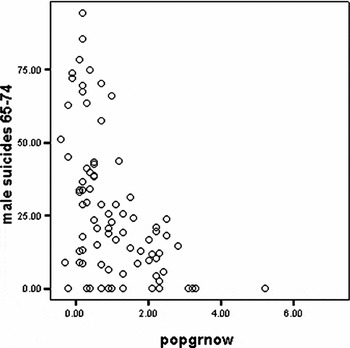
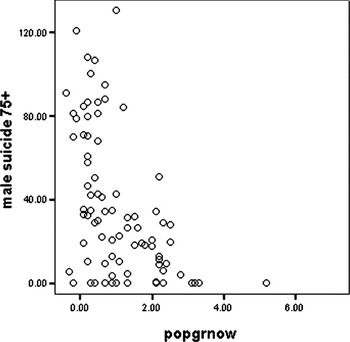
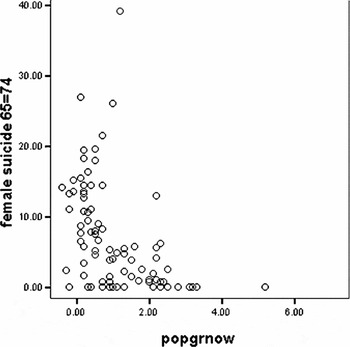
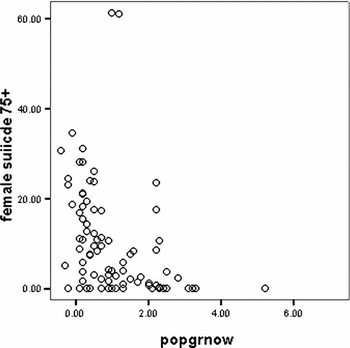
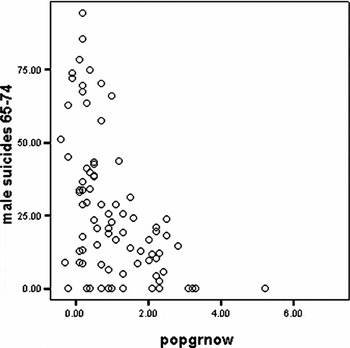
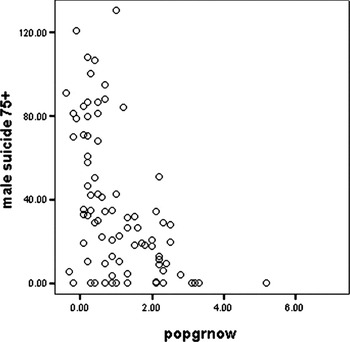
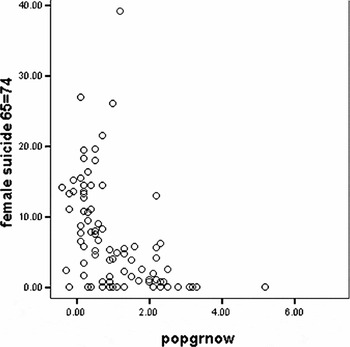
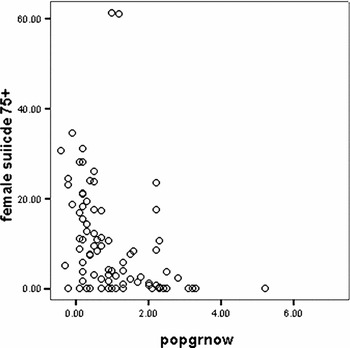
Full datasets for elderly suicide rates and the average annual population growth were available for 86 countries. Table 1 illustrates the curve estimation regression models, whereby the relationship between suicide rates in both sexes in both elderly age-bands and the average annual population growth rates was curvilinear (U-shaped curve) and fitted the quadratic equation y = a + bx + cx 2; the significance level was at least at the 0.05 level. This is further illustrated in Figures 1–4 for each sex and elderly age-band. The variance (R2) explained by this model was: males aged 65–74 years, 0.26; males aged 75+ years, 0.24; females aged 65–74 years, 0.2; and females aged 75+ years, 0.14.
Curve estimation regression models for the relationship between elderly suicide rates and the average annual population growth rate

y = suicide rates
x = average annual population growth rate
Scatter plot of suicide rates in males aged 65–74 years and population growh
Scatter plot of suicide rates in males aged 75+ years and population growh
Scatter plot of suicide rates in females aged 65–74 years and population growh
Scatter plot of suicide rates in females aged 75+ years and population growh
Discussion
Some methodological issues need consideration. Cross-national data on suicide rates should be viewed cautiously for a number of reasons: data are not available from all countries (Moscicki, Reference Moscicki1995; Wasserman et al., Reference Wasserman, Cheng and Jiang2005); the validity of these data is unclear (Diekstra, Reference Diekstra1989; Wasserman et al., Reference Wasserman, Cheng and Jiang2005); the legal criteria for the proof of suicide vary between countries and in different regions within a country (Shah and Ganesvaran, Reference Shah, Ganesvaran, Chiu and Ames1994; Wasserman et al., Reference Wasserman, Cheng and Jiang2005); some countries, particularly low-income countries, may have poor death registration facilities (Shah and Ganesvaran, Reference Shah, Ganesvaran, Chiu and Ames1994); and, cultural and religious factors and stigma attached to suicide, particularly in some Arabic and Asian countries, may lead to under-reporting of suicides (Wasserman et al., Reference Wasserman, Cheng and Jiang2005; Abrahams et al., Reference Abrahams, Abrahams and Jacob2005). Data on the average annual population growth rate should also be viewed cautiously because the validity of these data is unclear and some countries may have poor registration facilities for demographic data. Nevertheless, the best and the latest available data from the WHO and the UNDP were used.
The significant curvilinear (U-shaped curve) relationship between suicide rates and average annual population growth rates in both sexes in both elderly age-bands may be an artifact of the methodological issues described above. However, the findings confirmed the “a priori” unidirectional study hypothesis, and other possible explanations are explored below.
Population growth rate is a function of life expectancy and birth rate. Thus, in countries with low or declining average annual population growth rates, elderly dependency ratios may be high because of increased life expectancy and low birth rate (Shah and MacKenzie, Reference Shah, MacKenzie, Bhugra and Bhui2007). This, in turn, may result in increased elderly suicide rates and several potential mechanisms, mainly pertaining to cultural issues, were noted above in the Introduction. The observed associations between higher elderly suicide rates and higher elderly dependency ratios (Shah et al., Reference Shah, Padayatchi and Das2008b), higher elderly suicide rates (Shah et al., Reference Shah, Bhat, MacKenzie and Koen2008a) and general population suicide rates (Zhang, Reference Zhang1998) and increased life expectancy, and higher elderly suicide rates (Shah, Reference Shah2008) and general population suicide rates (Stack, Reference Stack1980) and lower birth rates further supports this hypothesis. This explanation can be applied to countries such as Italy, Portugal and Spain where the population growth rate is low, elderly dependency ratio high (Shah et al., Reference Shah, Padayatchi and Das2008b) and all three countries have elderly suicide rates in the third quartile of all countries reporting suicide rates on the WHO website (Shah et al., Reference Shah, Bhat, MacKenzie and Koen2007).
The average annual population growth rate may begin to increase in some countries due to an increase in birth rates. This, in turn, may lead to a decline in the elderly dependency ratio and eventually in elderly suicide rates. The observed associations between lower elderly suicide rates and lower elderly dependency ratios (Shah et al., Reference Shah, Padayatchi and Das2008b), and lower elderly suicide rates (Shah, Reference Shah2008) and general population suicide rates (Stack, Reference Stack1980) and higher birth rates further supports this hypothesis. This explanation can be applied to countries like Bahrain and Qatar where the population growth is high, elderly dependence ratio low (Shah et al., Reference Shah, Padayatchi and Das2008b) and elderly suicide rates very low (Shah et al., Reference Shah, Bhat, MacKenzie and Koen2007).
As the average annual population growth rate continues to increase, at a critical point, the composite influence of increased life expectancy, increased elderly population size and the increase in the proportion of elderly in the general population on elderly suicide rates may become more prominent. The observed association between higher elderly suicide rates (Shah et al., Reference Shah, Bhat, MacKenzie and Koen2008a) and general population suicide rates (Zhang, Reference Zhang1998) and increased life expectancy, and higher elderly suicide rates and higher elderly population size (Shah et al., Reference Shah, Bhat, MacKenzie and Koen2008a) and higher proportion of elderly in the general population (Kiemo, Reference Kiemo2004; Shah et al., Reference Shah, Bhat, MacKenzie and Koen2008a) supports this hypothesis. This may, in part, reflect Durkheim's hypothesis that the overall cohort size may influence suicide rates due to competition for scarce resources (Shah and De, Reference Shah and De1998). This explanation can be applied to countries like Israel where the population growth rate is high, elderly dependency ratio high (Shah et al., Reference Shah, Padayatchi and Das2008b) and elderly suicide rates are in the third quartile of all countries reporting suicide rates on the WHO website (Shah et al., Reference Shah, Bhat, MacKenzie and Koen2007).
Caution should be exercised in the attribution of a causal relationship and the direction of this relationship because of the cross-sectional and ecological study design whereby the findings are subject to ecological fallacy, and require rigorous testing in within-country longitudinal studies over time. Although such cross-national ecological studies cannot be used to explain longitudinal trends over time in elderly suicide rates, they allow the development of potentially testable hypotheses of explanatory models in within-country longitudinal studies over time. The proposed model could be formally tested by following up individual countries with either decreasing or increasing average annual population growth rates over time. However, such studies may not be practical or realistic because the follow-up period will be over many years (perhaps several decades). This model is complimentary to, and does not preclude, a range of other proximal and distal etiological risk factors for elderly suicides including economic growth, health and welfare services for the elderly, and psychosocial environment.
Conflict of interest
None.
Acknowledgment
The helpful comments of two anonymous reviewers were greatly appreciated.