Introduction
Early malnutrition promotes metabolic changes that may have adaptive or maladaptive consequences in later life.Reference Hales and Barker1 One of the main organs affected by nutrient reduction is the endocrine pancreas, which undergoes several structural and functional adaptations to maintain glucose homeostasis.Reference Carneiro, Mello and Gobatto2 Epidemiological and controlled animal studies have revealed that poor maternal nutrition in pregnancy and lactation alters pancreatic β-cell development and increases predisposition to diabetes.Reference Choi, Li and McDonald3, Reference Tarry-Adkins and Ozanne4 Aging is usually associated with decreasing glucose tolerance and increased susceptibility to diabetes.Reference DeFronzo5, Reference Chang and Halter6 There is a need for information on interaction of programming by the maternal diet and rate of β-cell aging. We previously reported aging of pancreatic islet glucose-stimulated insulin secretion at three different ages across the lifespan – postnatal days 36 (around puberty), 110 (young adult) and 450 (mature adult) in male offspring of mothers fed control (C) or isocaloric restricted (R) protein diet in pregnancy (50% protein of C diet), first letter and/or lactation second letter, in four groups – CC, RR, CR or RC.Reference Morimoto, Calzada and Sosa7 In these male offspring, despite minimal differences in circulating insulin and glucose maternal low-protein affected glucose-stimulated insulin secretion at all ages and aging reduced function in all restricted groups compared with CC as early as postnatal day 110 and further by 450 days of age, especially in RC.
Most of the developmental programming studies performed with maternal protein-restricted diet and in vitro insulin secretion in offspring islets have been performed in male pups,Reference Delghingaro-Augusto, Ferreira and Bordin8–Reference do Amaral, Ueno and Oliveira11 including our previous report.Reference Morimoto, Calzada and Sosa7 It is important to establish potential offspring sex differences in the impact on offspring pancreatic development by a maternal low-protein diet. We have extended the study and report here outcomes and aging of glucose-stimulated insulin secretion in female offspring in the same dietary groups and at the same ages as in the reported study of male offspring.Reference Morimoto, Calzada and Sosa7
Method
Animals and experimental groups
Details of maternal diet, breeding and management of the experimental groups of offspring have been published in detail.Reference Zambrano, Rodriguez-Gonzalez and Guzman12 Briefly, mothers were virgin female albino Wistar rats aged 15–17 weeks and weighing 240 ± 20 g, obtained from the Instituto Nacional de Ciencias Médicas y Nutrición, Salvador Zubirán (INNSZ), Mexico City. Female rats with regular cycles were maintained on Purina Laboratory 5001 and under controlled lighting (lights on from 7 am to 7 pm at 22–23°C). Female rats were mated overnight with proven male breeders. Pregnant rats were transferred to individual cages and allocated at random to one of two groups to be fed either 20% casein (control diet – C) or 10% casein isocaloric diet (restricted diet – R). Rats had free access to the experimental diet and water throughout the study. Food was provided in the form of large flat biscuits, which were retained behind a grill through which the rats nibbled the food. Offspring delivery occurred on post-conception day 22, which was designated postnatal day 0. Litter size, pup weight and morphometric parameters were recorded at birth. Ano-genital distance, anterior–posterior abdominal distance and head diameter were measured with calipers as previously reported.Reference Guzmán, Cabrera and Cárdenas13 Our published data indicate that ano-genital distance is 1.67 ± 0.13 mm (n = 291 pups from 43 litters; mean ± s.e.m.) in female pups and 3.26 ± 0.22 mm (n = 252 pups from 43 litters) in males at birth.Reference Zambrano, Rodriguez-Gonzalez and Guzman12 As a value of 2.5 mm is more than 2 s.d. from the mean of either group, sex was judged according to whether the ano-genital distance was greater (male) or less than (female) 2.5 mm. Litters of over 14 were excluded. To ensure homogeneity of offspring evaluated, all litters studied were adjusted to 10 pups per dam at postnatal day 2 with equal numbers of males and females wherever possible. For the lactation period, four groups were established: CC, RR, CR and RC (first letter denoting the maternal diet received during pregnancy and second letter denoting the maternal diet during lactation). After weaning, pups ate control diet. At postnatal days 36, 110 and 450 (n = 6 offspring from different litters per group at each age except for group RC at postnatal day 450 in which n = 4), female pups were euthanized by guillotine (Thomas Scientific, NJ, USA) and trunk blood obtained. All animal maintenance and handling was approved by the Animal Experimentation Ethics Committee, INNSZ and in accordance with the guidelines of Mexican law on animal protection (NOM-062-ZOO-1999).
Serum glucose and insulin concentrations
Fasting serum glucose was measured using the hexokinase method (Beckman Coulter, Co. CA, USA). Intra- and inter-assay CVs were <2% and <3%, respectively. Insulin concentration was determined by radioimmunoassay (RIA) in solid phase (Millipore, MA, USA). Inter- and intra-assay coefficients of variation (CV) were <4% and <6%, respectively. Homeostasis model assessment (HOMA) was calculated as HOMA = glucose (mmol/l) × insulin (μU/ml)/22.5.
Pancreatic islet isolation for in vitro studies
A bile duct catheter was introduced and pancreatic islets isolated and collected individually microscopically following collagenase digestion and cultured overnightReference Morimoto, Calzada and Sosa7 with RPMI 1640 medium at 37°C in humidified 5% CO2–95% atmospheric air. Islets were washed twice with a buffer solution (pH 7.4) containing 20 mM HEPES, 115 mM NaCl, 5 mM NaHCO3, 5 mM KCl, 2.6 mM CaCl2, 1.2 mM KH2PO4, 1.2 mM MgSO4, 3 mM D-glucose and 1% bovine serum albumin (Sigma, MO, USA).
Dose–response curve for glucose stimulation of insulin release
We determined the dose–response of insulin secretion to the media glucose concentration for insulin (Fig. 1) to evaluate maximal response in aging animals (female 450 days old offspring). Insulin secretion was assessed in groups of 10 islets (from individual animal) in presence of different glucose concentrations: 5, 7.5, 11 and 22 mM.
Insulin secretion of isolated pancreatic islets (10 per well) of female offspring at 450 postnatal days of age, in response to different glucose concentrations. *P < 0.05 v. 5 mM glucose, n = 5 (from different animals).

Glucose-stimulated insulin secretion
After consulting concentrations used by other investigatorsReference Cherif, Reusens and Ahn14, Reference Aguayo-Mazzucato, Sanchez-Soto and Godinez-Puig15 and our own data from the dose–response curve, we established two glucose concentrations 5 and 11 mM for the studies of glucose-stimulated insulin secretion. We selected 5 mM glucose as the basal glucose concentration because it represents fasting blood concentrations. In vitro insulin release was measured in groups of 10 isolated islets/well, in 1 ml of buffer solution cited above, in the presence of low (5 mM) or high (11 mM) glucose for 1 h as previously reported;Reference Morimoto, Calzada and Sosa7 these islets came from individual animals. After 1 h, the medium was collected and stored at −70°C until their analysis.
Statistical analysis
All data are presented as mean ± s.e.m. Parameters at birth were compared by t-test. Analysis of group changes according to age was calculated by two-way ANOVA with the Holm–Sidak post hoc test with comparison between low and high glucose for each group at each age by t-test with significance P < 0.05.
Results
In vivo outcomes
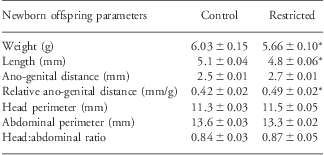
At birth, body weight and length of female pups of the restricted mothers were reduced in comparison with female pups of control mothers (body weight: C = 6.03 ± 0.15, R = 5.66 ± 0.1 g, P < 0.05; length: C = 5.1 ± 0.04, R=4.8 ± 0.06 mm, P < 0.05), whereas ano-genital distance relative to body weight was increased in the restricted group (C = 0.42 ± 0.02, R = 0.49 ± 0.02 mm/g, P < 0.05). No differences were found between control and restricted group offspring in head and abdominal perimeter and head:abdominal ratio (Table 1).
Morphometric parameters at birth in female offspring of mothers fed control or low-protein diet (restricted) during pregnancy
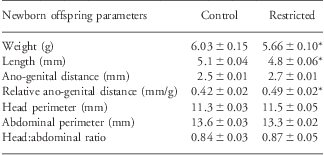
Mean ± s.e.m., n = 12 litters. *P < 0.05 v. control.
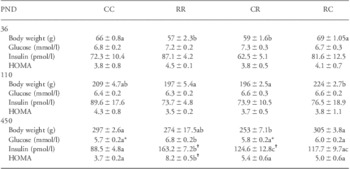
At postnatal day 36, body weight of RR and CR was reduced compared with CC, whereas all groups were the same weight at 110 days (Table 2). At 450 days of age, CR offspring weighed less than controls. Serum glucose did not differ between groups at postnatal days 36 and 110 but was elevated in RR compared with CC at postnatal day 450. Insulin did not differ in the four groups at 36 or 110 days of age but was elevated in RR and CR at day 450 (Table 2). HOMA did not differ between groups at 36 and 110 days but was elevated in RR at 450 days.
Offspring body weight, serum glucose and insulin concentration and HOMA on PNDs 36, 110 and 450 in female offspring of mothers fed control (C) or low-protein diet (R) during pregnancy and/or lactation, first and second letter, respectively

HOMA, homeostasis model assessment; PNDs, postnatal days.
Data represent mean ± s.e.m., n = 6, except RC postnatal days 450 in which n = 4, P < 0.05 for data not sharing at least one letter (a, b or c) at the same age. *v. 36 days, †v. postnatal days 36 and 110 in the same experimental group, P < 0.05.
In vitro glucose-stimulated insulin secretion: comparison between groups
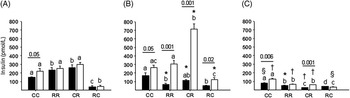
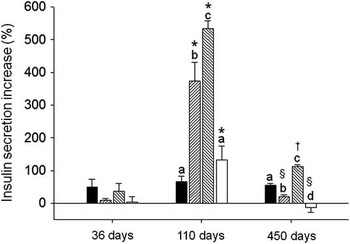
At postnatal day 36, insulin secretion at low glucose was increased in RR and CR and decreased in RC at both low and high glucose (Fig. 2A). At this age, only CC showed enhanced islet responsiveness to glucose as indicated by increased insulin secretion in response to high glucose, by around 50% in comparison with insulin secretion in response to low glucose (Fig. 3). At 110 days, both groups restricted during pregnancy (RR and RC) showed decreased responsiveness to low glucose; at high glucose concentration, CR secreted more and RC less insulin than CC (Fig. 2B). At this age, all groups showed islet responsiveness to glucose as indicated by an increase in insulin secretion in response to high glucose, over 66% in CC, 300% in RR, >500% in CR and >100% in RC in comparison with low glucose (Fig. 3). At postnatal day 450, insulin secretion to both glucose concentrations were significantly reduced for all restricted groups (Fig. 2C). Only CC and CR were capable of increased insulin secretion in response to high glucose compared with low glucose around 50% and 100% increases, respectively (Fig. 3).
Female offspring insulin secretion from isolated pancreatic islets (10 per well, all from one individual animal) on different postnatal days, in response to 5 mM-glucose (closed bars) and 11 mM-glucose (open bars). Offspring were from mothers fed either control (C) or low-protein diet (R) during pregnancy and/or lactation, first and second letter, respectively. (A) Postnatal day 36, (B) postnatal day 110 and (C) postnatal day 450. Data represent mean ± s.e.m., n = 6, except RC day 450 in which n = 4; P < 0.05 for data not sharing at least one letter (a, b or c) at the same age; *v. 36 days, †v. both postnatal days 36 and 110 and §v. postnatal days 110 at the same glucose concentration. Underlined represents a significant difference between 5 and 11 mM glucose (P ⩽ 0.05).

Insulin secretion increase as percent of secretion at 5 v. 11 mM glucose in pancreatic islets of female offspring on different postnatal days. Data represent mean ± s.e.m., n = 6, except RC day 450 in which n = 4, P < 0.05 for bars with different letters (a, b, c or d) at the same age. *P ⩽ 0.05 v. 36 days, †v. both postnatal days 36 and 110 and §P ⩽ 0.05 v. day 110. CC,  $$$$; RR,
 $$$$; CR,
 $$$$; RC,
 $$$$.

In vitro glucose-stimulated insulin secretion: comparison between ages
In the CC group, glucose-stimulated insulin secretion in response to both glucose concentrations was reduced with age (postnatal day 450); however, at the three ages studied this group presented an increased insulin secretion in response to high glucose in comparison with low glucose (Fig. 2A–2C). In the RR group, insulin secretion at low glucose was higher at 36 than at 110 and 450 days, and for high glucose stimulation the lowest response was at day 450. At 36 and 450 days of age, the RR group was not able to increase secretion in response to high glucose (Fig. 2A and 2C). CR group insulin secretion at low glucose was higher at day 36 in comparison with 110 and 450 postnatal days, but for high glucose the highest response was at 110 and the lowest at 450 days of age. The CR group showed glucose sensitivity of β-cells at 110 and 450 days of age (Fig. 2B and 2C). There were no differences in insulin secretion at low glucose in the RC group between the three ages studied; however, RC glucose-stimulated insulin secretion at high glucose was higher at 110 days of age in comparison with days 36 and 450. The RC group increased insulin secretion in response to high glucose only at postnatal day 110 (Fig. 2A–2C).
Discussion
Previous studies in rats have shown that maternal protein restriction diet during pregnancy and/or lactation can result in altered carbohydrate metabolism in offspring.Reference Fernandez-Twinn, Wayman and Ekizoglou16, Reference Zambrano, Bautista and Deás17 The majority of studies of poor maternal diet and programming of pancreatic development have been conducted in vivo.Reference Siebel, Mibus and De Blasio9, Reference Picarel-Blanchot, Alvarez and Bailbe18, Reference Chamson-Reig, Thyssen and Hill19 The few in vitro experiments on isolated pancreatic islets have been performed in males and at earlier periods of life.Reference Cherif, Reusens and Dahri20, Reference Heywood, Mian and Milla21 It is of interest to compare age-related changes in circulating metabolite values in these female offspring with our previously published male data.Reference Morimoto, Calzada and Sosa7 Serum insulin concentrations are two to five times higher in males than females at postnatal days 110 and 450, potentially reflecting an earlier onset of insulin resistance in males,Reference Basu, Man and Campioni22 as well as the documented greater clearance of insulin from the blood in femalesReference Jensen, Nielsen and Gupta23 and lower total body insulin clearance in the elderly than in the young subjects.Reference Basu, Breda and Oberg24 Insulin sensitivity was demonstrated to be higher in women before menopause than in age-matched men.Reference Riant, Waget and Cogo25 Clinical and experimental animal studies have shown that estradiol contributes to glucose homeostasis,Reference Louet, LeMay and Mauvais-Jarvis26 potentiates insulin gene transcription and increases islet insulin stores.Reference Wong, Tiano and Liu27 These studies support the beneficial effect of estrogens on insulin action and glucose homeostasis. HOMA was similar between the sexes at postnatal day 36 and all groups except RC at 110 days of age. At days 110 and 450, HOMA was much higher in males,Reference Morimoto, Calzada and Sosa7 indicating increased peripheral insulin resistance.
In the in vitro studies, we address three separate points. The response to the low glucose approximates the normal levels that the β-cell sees in vivo. It is thus of interest that at postnatal day 110 this response is decreased compared with CC in both groups restricted in pregnancy. In addition, at this age the CR group showed an increased response to high glucose. Finally, this is the only age at which all three experimental groups showed an increased response to 11 compared with 5 mM, demonstrating increased glucose sensitivity of β-cells.
At all ages and in most groups, glucose-stimulated insulin secretion was greater in female than male islets. This was especially marked at 110 days of age when, for example, female islets of the CR group secreted over five times as much insulin as corresponding male islets in high glucose. The differences in the rate of aging between the sexes are first apparent at postnatal day 110 where, although the basal responses are decreased in all restricted groups in both sexes, islets from females have a much greater islet responsiveness to high glucose at postnatal day 110 compared with 36 days of age. These findings at day 110 clearly show that although islets from males are already losing glucose sensitivity of β-cells this is not so in females. The effect of aging on insulin secretory function has been reported for rats and mice.Reference Ihm, Moon and Kang28 Our data also show lower sensitivity of β-cells with increasing age. At postnatal day 450 in females as in males, insulin secretion in response to glucose is generally reduced, compared with responses at days 36 and 110. But even at this advanced age CC and CR were all able to increase secretion in response to high glucose, again indicating that female islets are aging more slowly than male islets.Reference Morimoto, Calzada and Sosa7
It is of interest to observe that maternal protein restriction at different windows of development affects female offspring in a diverse manner. Despite a similar weight in CC at postnatal day 450, RR offspring developed the greatest insulin resistance, but at this age all restricted groups show similar reduction in glucose-stimulated insulin secretion in response to both glucose concentrations. At postnatal day 450, the restricted groups during pregnancy (RR and RC) lose the ability to increase insulin secretion in response to high glucose, showing that maternal restriction during pregnancy has a bigger impact on glucose sensitivity in pancreatic β-cells than restriction during lactation.
Type 2 diabetes represents both failure of the β-cell and decreased peripheral insulin sensitivity. There is discussion as to the temporal sequence of these two causative factors. Evaluation of isolated islets allows direct investigation of β-cell response to glucose. We have used the concept of glucose sensitivity of β-cells to address the retention or failure of the ability to respond to high glucose by increasing insulin secretion compared with low glucose. At postnatal day 36, there were no differences in islet responsiveness between high and low glucose concentrations in the restricted groups, showing that glucose sensitivity of β-cells is not yet established at this age and that β-cell function has not yet matured completely in the restricted groups. The onset of puberty in female rats is around 37 days; we have previously reported in our experimental model that restricted groups presented a delay in the onset of puberty in comparison with CC and that at this age estradiol serum concentrations were lower in the three restricted groups,Reference Guzmán, Cabrera and Cárdenas13 which may support the effect of estrogens in insulin homeostasis hypothesis. By postnatal day 110, all groups show increased islet responsiveness to high glucose doses in comparison with low glucose doses. This glucose sensitivity of β-cells is greatly diminished in all groups including CC by 450 days.
In conclusion, our observations demonstrate age-related decreased in vitro function of isolated islets from female rats tracked over a large proportion of normal adult rat life. Female islets retain their ability to increase glucose-stimulated insulin secretion longer than male islets and this may explain the greater predisposition to diabetes in malesReference Wild, Roglic and Green29 and its earlier emergence in life. We also show that the rate of aging of glucose-stimulated insulin secretion depends on the dietary history of the mothers, indicating that developmental programming must be considered as a major factor in aging-related development of predisposition to dysfunctional insulin metabolism across the life course.
Acknowledgments
This work was supported by CONACyT 155166, México and NIH HD 21350. T. C. Sosa has a postgraduate fellowship from CONACyT, Mexico.