Introduction
Transparent wood composites [Reference Zhu, Luo, Ciesielski, Fang, Zhu, Henriksson, Himmel and Hu1, Reference Zhu, Song, Li, Gong, Wang, Dai, Yao, Luo, Henderson and Hu2, Reference Li, Fu, Yu, Yan and Berglund3, Reference Yaddanapudi, Hickerson, Saini and Tiwari4, Reference Gan, Xiao, Gao, Gao, Li and Zhan5, Reference Fink6], have received great attention as energy-efficient building materials [Reference Yaddanapudi, Hickerson, Saini and Tiwari4, Reference Li, Zhu, Yang, Song, Dai, Yao, Luo, Pastel, Yang and Hu7], functional (fluorescent, magnetic, heat-shielding) transparent wood composites [Reference Li, Fu, Yu, Yan and Berglund3, Reference Gan, Xiao, Gao, Gao, Li and Zhan5, Reference Yu, Yao, Yao, Zhang, Chen, Gao and Luo8], and broadband light management layers in solar cells [Reference Zhu, Li, Davis, Yao, Dai, Wang, AlQatari, Gilman and Hu9] because of their high anisotropy, high transparency, high haze, excellent thermal insulation, and high impact absorption capability [Reference Li, Zhu, Yang, Song, Dai, Yao, Luo, Pastel, Yang and Hu7]. However, natural wood is completely nontransparent. The reasons are the large refractive index (RI) differences between the cellulose (approximately 1.53) and air (approximately 1.00), microsized channels in natural wood that scatter light in the visible range [Reference Fink6], and the fact that wood is comprised of 20–30 wt% lignin, which absorbs visible light, resulting in an opaque appearance [Reference Zhu, Luo, Ciesielski, Fang, Zhu, Henriksson, Himmel and Hu1, Reference Zheng, Tshabalala, Li and Wang11]. Great efforts have been devoted to letting light through wood by the delignification of wood and backfilling the RI matching polymer [Reference Zhu, Song, Li, Gong, Wang, Dai, Yao, Luo, Henderson and Hu2, Reference Li, Fu, Yu, Yan and Berglund3, Reference Yaddanapudi, Hickerson, Saini and Tiwari4, Reference Gan, Xiao, Gao, Gao, Li and Zhan5, Reference Fink6, Reference Li, Zhu, Yang, Song, Dai, Yao, Luo, Pastel, Yang and Hu7, Reference Yu, Yao, Yao, Zhang, Chen, Gao and Luo8, Reference Zhu, Li, Davis, Yao, Dai, Wang, AlQatari, Gilman and Hu9, Reference Frey, Widner, Segmehl, Cssdorff, Keplinger and Burgert10, Reference Li, Yu, Veinot, Linnros, Berglund and Sychugov12, Reference Gan, Gao, Xiao, Zhang, Zhan and Li13]. According to the literature, lignin can be removed by soaking wood samples in the following bleaching solutions (Table S1): solutions containing NaOH and Na2SO3, and subsequently in a H2O2 solution [Reference Zhu, Song, Li, Gong, Wang, Dai, Yao, Luo, Henderson and Hu2, Reference Li, Zhu, Yang, Song, Dai, Yao, Luo, Pastel, Yang and Hu7, Reference Yu, Yao, Yao, Zhang, Chen, Gao and Luo8, Reference Zhu, Li, Davis, Yao, Dai, Wang, AlQatari, Gilman and Hu9]; H2O2/HAc solutions [Reference Frey, Widner, Segmehl, Cssdorff, Keplinger and Burgert10]; a peracetic acid solution [Reference Fu, Medina, Li, Carosio, Hajian and Berglund14]; NaClO2 with acetate buffer solutions [Reference Li, Fu, Yu, Yan and Berglund3, Reference Yaddanapudi, Hickerson, Saini and Tiwari4, Reference Li, Yu, Veinot, Linnros, Berglund and Sychugov12]; the combination of a NaClO2 solution and H2O2 solution [Reference Gan, Xiao, Gao, Gao, Li and Zhan5, Reference Gan, Gao, Xiao, Zhang, Zhan and Li13]; and a NaClO solution [Reference Fink6, Reference Zhu, Wang, Zhu, Xu, Jia, Dai, Song, Yao, Wang, Li, Henderson, Luo, Li, Minus, Li and Hu15, Reference Jia, Li, Chen, Dai, Kierzewski, Song, Li, Yang, Wang and Hu16]. After infiltration with epoxy resin or poly (methyl methacrylate) (PMMA), Li and Li obtained 5-mm-thick basswood-based transparent wood composites with a transmittance of approximately 90% with the thickness in the longitudinal direction [Reference Li, Zhu, Yang, Song, Dai, Yao, Luo, Pastel, Yang and Hu7] and 0.7-mm-thick balsa-based transparent wood composites with a transmittance of approximately 90% with the thickness in the radial direction [Reference Li, Fu, Yu, Yan and Berglund3]. More recently, Li et al. further applied surface acetylation on delignified wood before PMMA infiltration to improve the compatibility between the hydrophilic wood template and hydrophobic PMMA, leading to a reduced interface debonding and an improved optical transmittance [Reference Li, Yang, Fu, Rojas, Yan and Berglund17]. When the balsa wood thickness was 1.5 mm in the radial direction, the transmittance of the acetylated transparent wood composite increased from 82 to 92% compared to the transmittance of nonacetylated wood. However, the process not only requires 6 h to delignify wood by acetylation but also requires additional NaClO treatment to remove the yellowish color caused by acetylation.
Theoretically, the higher the lignin removal from the wood skeleton, the lower the absorbance of visible light, the higher the porosity in the delignified wood, and the more space there is to be backfilled with polymer to eliminate the interface debonding gap between the cell walls and filled polymer, which will lead to both high optical and mechanical properties of the transparent wood composites. However, to the best of our knowledge, not only is the lignin content of existing delignified wood no less than 1.5 wt%, but both the size and thickness of transparent wood composites are no larger than 100 mm × 100 mm and 14 mm [Reference Zhu, Song, Li, Gong, Wang, Dai, Yao, Luo, Henderson and Hu2, Reference Li, Fu, Yu, Yan and Berglund3, Reference Yaddanapudi, Hickerson, Saini and Tiwari4, Reference Gan, Xiao, Gao, Gao, Li and Zhan5, Reference Fink6, Reference Li, Zhu, Yang, Song, Dai, Yao, Luo, Pastel, Yang and Hu7, Reference Yu, Yao, Yao, Zhang, Chen, Gao and Luo8, Reference Zhu, Li, Davis, Yao, Dai, Wang, AlQatari, Gilman and Hu9, Reference Li, Yu, Veinot, Linnros, Berglund and Sychugov12, Reference Gan, Gao, Xiao, Zhang, Zhan and Li13, Reference Fu, Medina, Li, Carosio, Hajian and Berglund14, Reference Zhu, Wang, Zhu, Xu, Jia, Dai, Song, Yao, Wang, Li, Henderson, Luo, Li, Minus, Li and Hu15, Reference Jia, Li, Chen, Dai, Kierzewski, Song, Li, Yang, Wang and Hu16, Reference Li, Yang, Fu, Rojas, Yan and Berglund17, Reference Li, Fu, Rojas, Yan, Lawoko and Berglund18], respectively, which is too small/thin to use for transparent building structures [Reference Li, Zhu, Yang, Song, Dai, Yao, Luo, Pastel, Yang and Hu7, Reference Yu, Yao, Yao, Zhang, Chen, Gao and Luo8, Reference Li, Fu, Rojas, Yan, Lawoko and Berglund18]. For example, to build a transparent wood composite rooftop (8 × 12 × 0.5 cm3) or a transparent wood composite window (30 × 25 × 0.5 cm3), 6 or 42 pieces of transparent wood composites, respectively, were stitched together [Reference Li, Zhu, Yang, Song, Dai, Yao, Luo, Pastel, Yang and Hu7, Reference Yu, Yao, Yao, Zhang, Chen, Gao and Luo8]. Moreover, in addition to H2O2 and peracetic acid, other bleaching chemicals are not environmentally benign for the following reasons: odorous components such as methyl mercaptan, dimethyl sulfide, and hydrogen sulfide are generated during the industrial process of Kraft pulping [Reference Li, Fu, Rojas, Yan, Lawoko and Berglund18, Reference Goodrich, Nawaz, Feih, Lattimer and Mouritz19], and the formation of toxic effluents occurs, such as chlorinated dioxins during delignification [Reference Goodrich, Nawaz, Feih, Lattimer and Mouritz19, Reference Das and Jain20].
The biggest problem of the existing solution-based delignification is that the low-lignin delignified wood might be damaged or broken into pieces in the bleaching solutions [Reference Li, Fu, Rojas, Yan, Lawoko and Berglund18] because lignin functions as a polymer matrix bonding agent for cellulose fibrils in the cell walls to endow wood with high mechanical strength. Wood cell walls comprise three ultrastructural domains: the middle lamella, the primary wall, and the secondary wall, among which the middle lamella acts to adhere adjacent cells and is heavily lignified [Reference Zhu, Luo, Ciesielski, Fang, Zhu, Henriksson, Himmel and Hu1, Reference Li, Vasileva, Sychugov, Popov and Berglund21, Reference Jeremic, Goacher, Yan, Karunakaran and Master22]. After delignification, the mechanical strength of the delignified wood is reduced, leading to severe cell wall delamination in the lignin-rich middle lamella and breaking of the delignified wood into pieces by destruction in the bleaching solutions. For example, some wood species, such as pine, break into pieces after NaClO2 solution-based delignification, limiting the number of wood species for transparent wood preparation [Reference Li, Fu, Rojas, Yan, Lawoko and Berglund18]. In this regard, handling and fabrication of delignified wood with a low lignin content is still challenging [Reference Li, Zhu, Yang, Song, Dai, Yao, Luo, Pastel, Yang and Hu7, Reference Yu, Yao, Yao, Zhang, Chen, Gao and Luo8, Reference Li, Yang, Fu, Rojas, Yan and Berglund17, Reference Li, Fu, Rojas, Yan, Lawoko and Berglund18].
To address this issue, we developed a green and universal steam delignification strategy for removing lignin from different wood samples for highly transparent wood composites. The present new delignification strategy is highly specific for thick, large wood substrates of different wood species and different cutting directions, utilizing the excellent penetration ability of steam to remove lignin from the wood cell walls. The as-prepared delignified wood skeletons show the lowest lignin content of 0.84%, a well-preserved original skeleton, the greatest thickness of 40 mm, and the largest size of 210 × 190 mm reported to date, providing a good cellulose template to produce thick, large transparent wood composites. Furthermore, we demonstrate that with the remaining lignin content of the delignified wood decreased from 1.9% (comparable with that of the solution-based delignified wood) [Reference Zhu, Song, Li, Gong, Wang, Dai, Yao, Luo, Henderson and Hu2, Reference Li, Fu, Yu, Yan and Berglund3, Reference Li, Zhu, Yang, Song, Dai, Yao, Luo, Pastel, Yang and Hu7] to 0.84%, not only the mechanical strength of the 5-mm transparent wood composite increased from 10.8 to 19.0 MPa, but the transmittance (the wavelength is 550 nm) also increased from 80 to 87% due to the lower absorbance of visible light by lignin and the suppression of the interface debonding gap between the cell walls and the backfilled epoxy resin.
Results and discussion
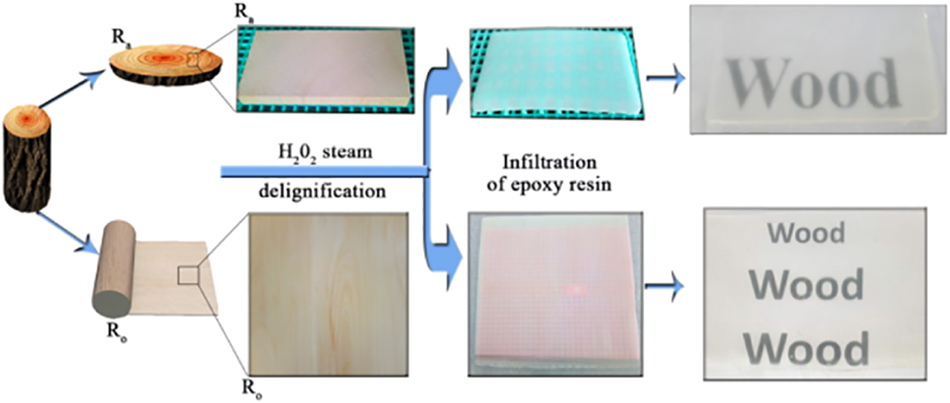
Scheme 1 illustrates how to obtain the transparent wood composites based on delignification and infiltration of the RI-matching polymer. There were two types of wood samples with different cutting directions, where the original channels in wood were aligned either perpendicular to (Ra) or along (Ro) the wood plane. Figure 1(a) graphically illustrates the design concept for steam delignification. By heating the H2O2 solution, H2O2 vapor would be generated to penetrate the wood cell walls to remove lignin. With the steam time prolonging, the moisture content in wood increased gradually. When the moisture content in the wood was saturated, the moisture would fall back down into the solution, whereby the degradation products of lignin would be dissolved in the falling droplets to attain a highly efficient delignification.
New general synthetic method for transparent wood composites.

(a) Graphical illustration of the design concept for H2O2 steam delignification. (b) A picture of the steam delignification installation in the laboratory. (c) The color changes and (d) the lignin content of Ra-type basswood during the H2O2 steam-based delignification process. (e) Cellulose, hemicellulose, and lignin content and (f) XRD of natural wood, and delignified wood after 2 and 4 h of H2O2 steam treatment.

In a typical experiment, a Ra-type basswood block with a size of 50 × 50 × 5 mm (thickness) was used for H2O2 steam delignification [Fig. 1(b)]. Because lignin is colored and cellulose is colorless, the color indicated the amount of lignin present in the wood. As shown in Figs. 1(c) and 1(d), after 0.5 h of steaming, the Ra-type basswood block changed from pale yellow to brown, although the lignin content decreased from 22.7 to 17.5%. After 1 h of the steam treatment, the brown color changed to a slightly brown color, with some zones showing white. The lignin content decreased to 9.6%. After 1.5 h of steaming, the sample almost changed to white. The lignin content decreased to 1.9%, revealing the rapid delignification in our steam process. For comparison, it took 6 h for the wood to become white (the lignin content was approximately 2%) with the combined NaOH–Na2SO3 and H2O2 solution-based delignification process [Reference Zhu, Song, Li, Gong, Wang, Dai, Yao, Luo, Henderson and Hu2, Reference Li, Zhu, Yang, Song, Dai, Yao, Luo, Pastel, Yang and Hu7, Reference Yu, Yao, Yao, Zhang, Chen, Gao and Luo8, Reference Zhu, Li, Davis, Yao, Dai, Wang, AlQatari, Gilman and Hu9]. After 2 h of steam, not only had the color changed to completely white with a further reduction in the lignin content of 1.1%, but the grids beneath the delignified basswood were also clear due to the infiltration of the water (the value of the RI was 1.33, which is close to that of cellulose). It should be noted that the delignified wood skeleton was still well preserved even after 4 h of steaming. The lignin content could be further decreased to approximately 0.84%, which is the lowest lignin content of a delignified wood skeleton to date. The grids were more visible than those of the 2-h-steam-treated sample [Fig. 1(c)]. Moreover, although the kinetics of our H2O2 steam delignification were fast, the degradation of the cellulose was negligible, while both lignin and hemicellulose were dramatically removed, as shown in Fig. 1(e) [Reference Chen, Li, Song, Yang, Kuang, Hitz, Jia, Gong, Jiang, Zhu, Yang, Xie and Hu23]. The XRD pattern further demonstrated that the cellulose crystallinity of the delignified wood was well maintained even after 4 h of H2O2 steam treatment [Fig. 1(f)]. Thus, our H2O2 steam delignification approach was simple, fast, green, and highly efficient.
The present steam-based delignification process is highly universal for different wood species, such as pine, a wood species that easily breaks into pieces after NaClO2 solution-based delignification [Reference Li, Fu, Rojas, Yan, Lawoko and Berglund18]. It took approximately 4 h to turn pine almost white (Supplementary material, Fig. S1), longer than it took for basswood due to basswood’s unique multichannel structure with ultrathin channel walls and low density [Reference Pokhrel and Viraraghavan24]. For comparison, it took 8 h for basswood (the lignin content was 22.3%) to become white in the lignin modification process, as well as 18 h for basswood to become white (the lignin content was 5.2%) in the NaClO2-based delignification process [Reference Li, Fu, Rojas, Yan, Lawoko and Berglund18]. Similar to the delignification of basswood, the lignin content of Ra-type pine wood (50 mm × 50 mm × 5 mm) decreased from 29.7% to 17.8, 2.1, 1.5, and 1.05% by prolonging the steam time from 0 h to 0.5, 1.0, 2.0, and 4.0 h, respectively (Fig. S2). Correspondingly, the color of the pinewood also changed from pale yellow to brown, slight brown, almost white, and totally white (Fig. S1). The delignified wood skeleton was also well preserved even after 8 h of steam delignification. The lignin content was further decreased to its lowest value of 0.82%.
The morphological features and microstructures of the original and delignified Ra-wood were characterized using scanning electron microscopy (SEM). Figure 2(a) shows the SEM image of the Ra-type basswood block before delignification. There are massive lumens with a diameter of approximately 10–50 μm, allowing the extraction of lignin along the channel direction [Reference Zhu, Song, Li, Gong, Wang, Dai, Yao, Luo, Henderson and Hu2, Reference Li, Fu, Yu, Yan and Berglund3]. A high-magnification SEM image [Fig. 2(b)] reveals that the original Ra-wood possesses dense, smooth cell wall corners and a middle lamella. Compared with blank Ra-wood, massive microscale pores were generated in the cell walls and cell wall corners after steam delignification [Figs. 2(c) and 2(d)].
SEM images of Ra-wood samples (a, b) before and (c, d) after delignification, as well as (e, f) polymer-filled Ra-wood composites.

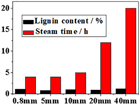
The thick Ra-type basswood could also be delignified by the above steam process. It is necessary to obtain thick transparent wood composites when used as transparent building walls [Reference Li, Yang, Fu, Rojas, Yan and Berglund17]. Thus, we tried to remove lignin from Ra-wood (100 × 50 mm) with thicknesses of 5, 10, and 20 mm. As shown in Fig. 3(a), Ra-type basswood with thicknesses of 5, 10, and 20 mm also became almost white after H2O2 steam treatment for approximately 4, 5, and 12 h, respectively. As shown in Fig. S3, 5 pieces of delignified basswood with dimensions of 100 × 50 × 20 mm were prepared by H2O2 steam treatment. Figure 3(d) displays that the lignin content of both the 10- and 20-mm Ra-wood could be decreased to less than 1%. A H2O2/HAc solution, a widely used bleaching system in the lignocellulose biorefinery field [Reference Frey, Widner, Segmehl, Cssdorff, Keplinger and Burgert10], was also used to steam samples with large thicknesses of 20 and 40 mm. When we delignified Ra-type basswood with thicknesses of 20 and 40 mm using H2O2/HAc steam, it took approximately 4 and 20 h, respectively, to become completely white [Fig. 3(c)]. Although we used different wood species with large dimensions, our steam-based method applied to the 100 × 50 × 20 mm basswood sample was simple (no infiltration in a fresh H2O2/HAc solution) and fast (4 h versus overnight/6 h). Moreover, there were some cracks in the previously delignified wood skeleton sample [Reference Frey, Widner, Segmehl, Cssdorff, Keplinger and Burgert10], which is the critical drawback to vacuum infiltration of polymer for transparent wood composites. It should be noted that our temperature was approximately 100 °C to keep the H2O2/HAc solution boiling, which was higher than that of the hot H2O2/HAc solution process at 80 °C [Reference Frey, Widner, Segmehl, Cssdorff, Keplinger and Burgert10]. Considering the shorter steam time, our energy input should be no larger than that of the hot H2O2/HAc solution method.
Optical images of (a) Ra-wood with different thicknesses and Ro-type delignified basswood with thicknesses of (b) 0.8 mm obtained by H2O2 steam, and (c) 40-mm-thick Ra-type delignified wood obtained by H2O2/HAc steam and (d) the corresponding lignin content/steam time.

The present steam-based delignification process was also suitable for wood with different cutting directions. For example, after steam delignification for approximately 4 h, the color of the Ro-type basswood slice (210 × 190 mm) with a thickness of approximately 0.8 mm became white [Fig. 3(b)], indicating the almost entire removal of lignin [Fig. 3(d)].
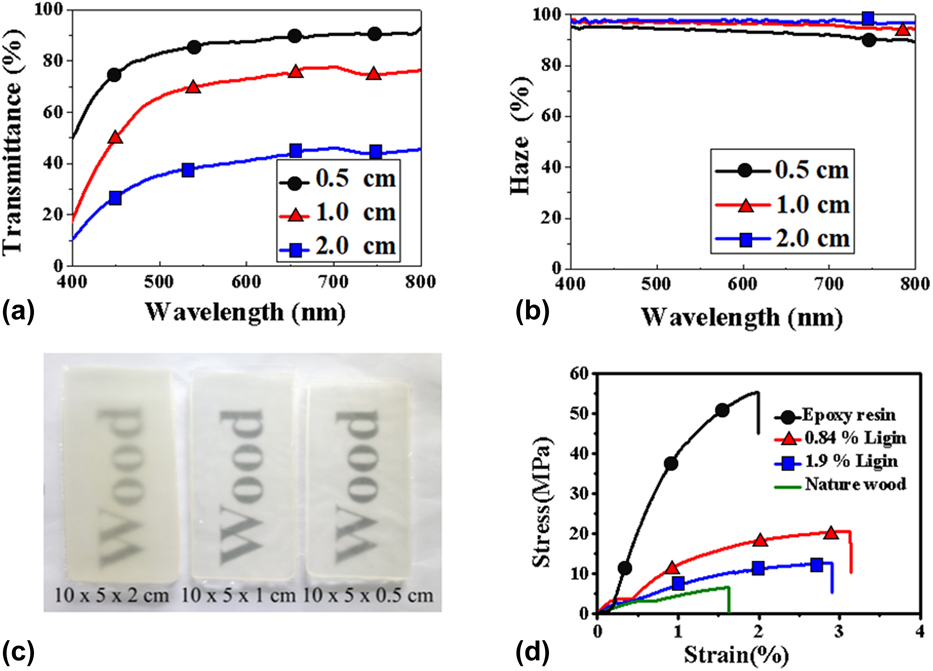
To obtain transparent wood composites, RI-matching polymer (e.g., epoxy resin) is then infiltrated into the 0.84% lignin delignified wood skeleton to suppress light scattering. As shown in Fig. 2, epoxy resin could indeed fully fill into both the lumen and the cell walls [Reference Zhu, Song, Li, Gong, Wang, Dai, Yao, Luo, Henderson and Hu2, Reference Li, Fu, Yu, Yan and Berglund3, Reference Fink6]. Figures 4, S4, and S5 show transparent basswood composites with different cutting directions, sizes, and thicknesses, which are highly transparent, and the text underneath was left clearly visible. Figures 4(a) and 4(b) illustrate that the transmittance and haze of the 5-mm-thick Ra-type transparent wood composites were 87 and 90% at 550 nm, respectively, which was slightly worse than the value reported in other studies [Reference Zhu, Song, Li, Gong, Wang, Dai, Yao, Luo, Henderson and Hu2, Reference Li, Zhu, Yang, Song, Dai, Yao, Luo, Pastel, Yang and Hu7] (the transmittance and haze were approximately 90 and 95%, respectively), and slightly better than that reported in another article [Reference Yu, Yao, Yao, Zhang, Chen, Gao and Luo8] (the transmittance and haze at 550 nm were 86 and 90%, respectively). Moreover, the values were even comparable with those of an acetylated 1.9% delignified wood-based transparent wood composite [Fig. 5(a)], which was realized by eliminating the interface debonding gap through acetylation of the delignifiedwood [Reference Li, Yang, Fu, Rojas, Yan and Berglund17]. Notably, our transmittance at a wavelength of 650–800 nm was up to approximately 90%, comparable with the value reported in other articles [Reference Zhu, Song, Li, Gong, Wang, Dai, Yao, Luo, Henderson and Hu2, Reference Li, Zhu, Yang, Song, Dai, Yao, Luo, Pastel, Yang and Hu7]. When the thickness of the transparent wood composite increased to 10 mm, its transmittance and haze were up to 70 and 95%, higher than those of an acetylated, delignified wood-based transparent wood composite with 10 mm thickness in the radial direction (approximately 60% transmittance and 80% haze, respectively) [Reference Li, Yang, Fu, Rojas, Yan and Berglund17]. Although its size was larger than that mentioned in other articles, the transmittance of the 0.8-mm-thick transparent Ro-wood was 90%, comparable to that in other studies, while the haze of it was 80%, higher than that in other studies [Reference Zhu, Song, Li, Gong, Wang, Dai, Yao, Luo, Henderson and Hu2, Reference Li, Fu, Yu, Yan and Berglund3, Reference Li, Fu, Rojas, Yan, Lawoko and Berglund18]. The 12-font-size words were clearly seen through the 0.8-mm transparent Ro-type basswood (Fig. S5). More importantly, for the first time, we studied the optical properties of 20-mm-thick Ra-type semitransparent wood (Fig. 4 and Table S2). The results showed a haze of 97% and a transmittance of 40%. Compared with both the 5- and 10-mm-thick composites, the 20-mm-thick semitransparent wood composites were slightly yellow due to the longer light path, of the remaining lignin (approximately 1%) in the 20-mm-thick composites [Reference Li, Yang, Fu, Rojas, Yan and Berglund17]. Although the tensile strength of a transparent wood composite (20.6 MPa) was lower than that of both epoxy resin (55.3 MPa) and certain epoxy resin-infiltrated transparent wood composites (23.4 MPa) [Reference Zhu, Song, Li, Gong, Wang, Dai, Yao, Luo, Henderson and Hu2], it was higher than that of another epoxy resin-infiltrated transparent wood composite (11.7 MPa) [Reference Li, Zhu, Yang, Song, Dai, Yao, Luo, Pastel, Yang and Hu7] and 3.6 times that of natural wood (5.2 MPa), as shown in Fig. 4(d). Considering the 94% transmittance, the 55.3 MPa tensile strength of the 2-mm epoxy resin film (Fig. S6), the moderate vacuum condition (0.08 MPa), and the 0.13 volume fraction of cellulose of transparent wood [Reference Li, Fu, Yu, Yan and Berglund3], both the optical and mechanical properties of our Ra-type transparent wood composites might be further boosted through interface manipulation of the delignified wood template with acetylation and optimization of either the epoxy resin or vacuum degree [Reference Li, Yang, Fu, Rojas, Yan and Berglund17].
(a) Optical transmittance, (b) haze and (c) optical image of transparent wood samples with different thicknesses on a substrate with text (the font size is 100). (d) Experimental stress–strain curves for natural wood, epoxy resin and transparent wood composites (the thickness is 0.5 cm). The homocellulose volume fraction of the transparent wood composites decreases from 0.138 to 0.129 with the lignin content of the delignified wood decreasing from 1.9 to 0.84%.

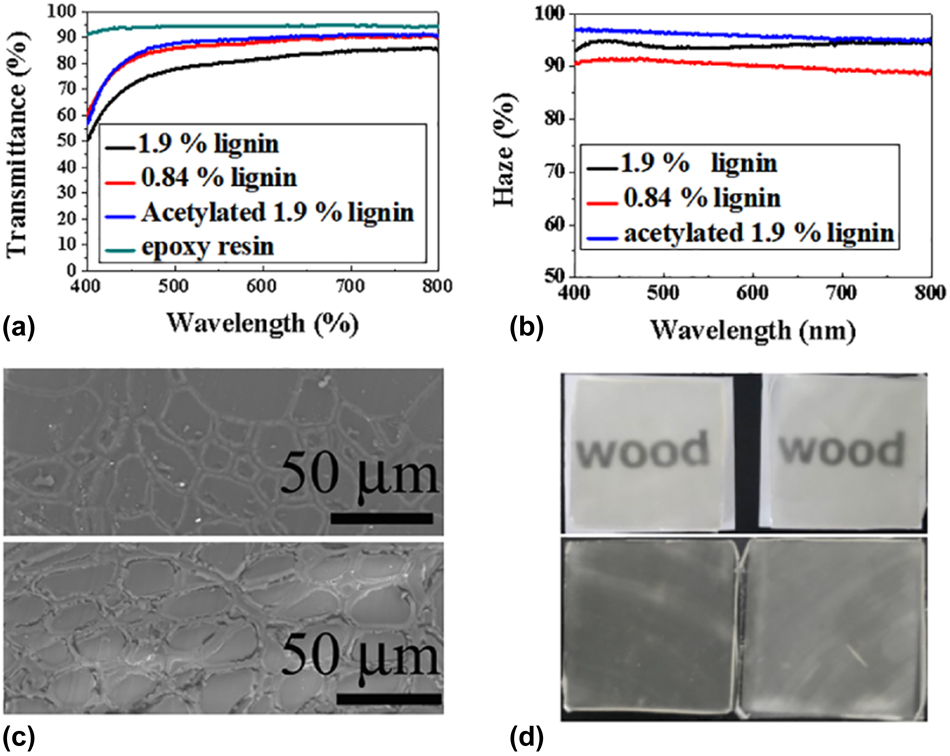
(a) Transmittance and (b) haze of the 5-mm-thick Ra-type transparent wood composites obtained by infiltration of epoxy resin into delignified wood with different lignin contents and acetylated delignified wood. (c) SEM images of the 5-mm-thick Ra-type transparent wood composites obtained from 0.84% (upper) and 1.9% (bottom) lignin content delignified wood. (d) Optical image of the 50 × 50× 5 mm Ra-type transparent wood composites obtained from 0.84% (left) and 1.9% (right) lignin content delignified wood.

To investigate the effect of the low lignin content of the delignified wood on the transparent wood composites, using SEM, the optical and mechanical properties of the 1.9% (comparable with the content of the solution-based delignified wood) [Reference Zhu, Song, Li, Gong, Wang, Dai, Yao, Luo, Henderson and Hu2, Reference Li, Zhu, Yang, Song, Dai, Yao, Luo, Pastel, Yang and Hu7] and 0.84% lignin delignified wood-based transparent wood composites were characterized. The infiltration conditions of the epoxy resin of the 1.9%, acetylated 1.9%, and 0.84% lignin delignified wood were the same for comparison purposes. As shown in Figs. 5(a) and 5(b), the transmittance of the 1.9% lignin delignified wood-based transparent wood composite was 80% at a wavelength of 550 nm, while that of the 0.84% lignin one increased to 87%, which indicated that the transmittance increased with decreasing lignin content. Although it was difficult to distinguish between the 1.9% and the 0.84% lignin delignified wood-based transparent wood composites on a white substrate with text, it was easy to distinguish between them on a black substrate [Fig. 5(d)]. From Fig. 4(d), we can see that when the lignin content of the delignified basswood decreased from 1.9 to 0.84%, the mechanical strength of the corresponding transparent wood composites also increased from 12.5 to 20.6 MPa. The reason is that with more lignin removal, more pores were generated in the lignin-rich cell wall corners [Fig. 2(d)], which provided a more convenient pathway to complete infiltration of the epoxy resin to suppress the interface debonding gap between the epoxy resin and the 0.84% lignin delignified wood by decreasing the cellulose volume fraction of the obtained transparent wood composites. The SEM image [Fig. 5(c)] further reveals that there was a micrometer-scale interface gap between the epoxy resin and delignified wood template in the 1.9% lignin delignified wood-based transparent wood composite, which would decrease both the optical and the mechanical properties. With the lignin content of the delignified wood decreasing from 1.9 to 0.84%, the cellulose volume fraction of the transparent wood composites further decreased from approximately 0.138 to 0.129, which might lead to an increase in the mechanical properties of the transparent wood.
In comparison with the solution-based delignification processes, the steam-modified delignification approach had the following advantages. First, the present steam process was simple, green, and environmentally friendly (completely sulfide free and chlorine free) [Reference Li, Yang, Fu, Rojas, Yan and Berglund17, Reference Das and Jain20, Reference Chen, Li, Song, Yang, Kuang, Hitz, Jia, Gong, Jiang, Zhu, Yang, Xie and Hu23] because only H2O2 or H2O2/HAc aqueous solution was used as delignification chemicals. Second, it was fast, highly efficient, and preserved the delignified original skeletons of thick (up to 40 mm) and large (210 × 190 mm) wood samples. For solution-based delignification, the size and thickness of the delignified wood was no larger than 100 mm × 100 mm and 14 mm, respectively [Reference Zhu, Song, Li, Gong, Wang, Dai, Yao, Luo, Henderson and Hu2, Reference Li, Fu, Yu, Yan and Berglund3, Reference Yaddanapudi, Hickerson, Saini and Tiwari4, Reference Gan, Xiao, Gao, Gao, Li and Zhan5, Reference Fink6, Reference Li, Zhu, Yang, Song, Dai, Yao, Luo, Pastel, Yang and Hu7, Reference Yu, Yao, Yao, Zhang, Chen, Gao and Luo8, Reference Zhu, Li, Davis, Yao, Dai, Wang, AlQatari, Gilman and Hu9, Reference Li, Yu, Veinot, Linnros, Berglund and Sychugov12, Reference Gan, Gao, Xiao, Zhang, Zhan and Li13, Reference Fu, Medina, Li, Carosio, Hajian and Berglund14, Reference Zhu, Wang, Zhu, Xu, Jia, Dai, Song, Yao, Wang, Li, Henderson, Luo, Li, Minus, Li and Hu15, Reference Jia, Li, Chen, Dai, Kierzewski, Song, Li, Yang, Wang and Hu16, Reference Li, Yang, Fu, Rojas, Yan and Berglund17, Reference Li, Fu, Rojas, Yan, Lawoko and Berglund18], and the lignin content was not less than 1.5%. On the one hand, the wood sample was kept away from the boiling solution by grids, keeping it from being destroyed by the boiling solution. On the other hand, the condensate solution containing the decomposition products of lignin in delignified wood could fall back down into the aqueous solution underneath through the grids [Figs. 1(b) and 1(c)], thereby avoiding the repeated pollution by the decomposition products of lignin and leading to the lowest lignin content of delignified basswood (0.84%). Notably, although the kinetics of steam delignification were fast, cellulose degradation was negligible [Figs. 1(e) and 1(f)]. Third, the obtained highly porous delignified wood skeleton was still well preserved, even though the remaining lignin content reached the lowest lignin content of 0.84% to date, which was beneficial to impregnate the porous template with epoxy resin to increase both the optical and mechanical properties of the obtained transparent wood composites. Fourth, we demonstrated that with the lignin content of the delignified basswood decreasing from 1.9 to 0.84%, not only had the mechanical strength of the corresponding transparent wood composites increased from 12.5 to 20.6 MPa, but the transmittance (the wavelength was 550 nm) had also increased from 80 to 87% due to both the elimination of the debonding interface gap between the cell walls and the backfilled epoxy resin and the decrease in the cellulose volume fraction of the obtained transparent wood composites.
Conclusions
In summary, we demonstrated a green and universal steam approach for the highly efficient removal of lignin from thick, large wood samples to produce transparent wood composites. The current delignification strategy is not only simple, green, fast, and environmentally friendly but also highly applicable to different wood species (basswood and pine), different cutting directions (Ro and Ra), different thicknesses (0.8, 5, and 40 mm), and different sizes (210 mm × 190 mm, 100 mm × 50 mm, and 50 mm × 50 mm). The as-prepared delignified wood skeleton had the lowest lignin content of 0.84% but also retained the most cellulose, providing a good skeleton and resulting in high transmittance (87%), high haze (90%), and high mechanical strength (3.6 times that of natural wood) of the transparent wood composites. Without acetylation modification and additional NaClOtreatment [Reference Li, Yang, Fu, Rojas, Yan and Berglund17], the pores generated by removing more lignin could be more conveniently backfilled by the epoxy resin to eliminate the interface gap between the cell walls and the filled epoxy resin by decreasing the cellulose volume fraction of the obtained transparent wood composites, which increased the optical and mechanical properties of our transparent wood composites to match the quality of the acetylated 1.9% lignin delignified wood-based composites. The present work provides a simple, green, fast, highly efficient, and general method to produce thick, large delignified wood skeletons with the lowest lignin content for highly transparent wood composites, which will open new avenues for the development of energy-efficient building materials, flexible electronics, and solar energy conversion devices.
Experimental section
Materials and chemicals
Basswood/pine was used in this study. There were 2 types of wood samples, where the original channels in the wood were aligned either perpendicular to the wood plane or along the wood plane (Fig. 1). Type 1 wood was obtained by radially cutting a wood trunk, also called Ra-wood. Type 2 wood was obtained by rotary cutting a wood trunk, also called Ro-wood. The chemicals used in removing lignin from the wood were hydrogen peroxide (30% solution, Sinopharm, Shanghai/China) and acetic acid (99.8%, Sinopharm, Shanghai/China). The polymer used for infiltration was epoxy resin (Npel-128 and D-230 amino-terminated polyoxypropylene hardener, Nan Ya Plastics Corporation, Taibei/China). The solvents used were ethanol alcohol (Sinopharm, Shanghai, China) and deionized water.
Lignin removal from the wood
Ra-wood blocks (the size was 50/100 × 50 mm, and the thickness was 5, 10, or 20 mm) were steamed by placing them on grids with a unit size of 5 × 5 mm, which were placed above (the distance was approximately 2 cm) a boiling H2O2 aqueous solution (30 wt%). When the yellow color of the sample disappeared (it took approximately 2–12 h), the samples were removed and rinsed with cold water and ethanol. The lignin-removed samples were stored in ethanol. Similar process was also applied to the Ro-basswood slices with different thicknesses (the sizes and thicknesses were 210 mm × 190 mm and 0.8/2.0 mm, respectively). For Ra-wood blocks with larger thicknesses of 20 and 40 mm, the mixture solutions of H2O2/HAc (volumetric ratio of 5:4) were used instead of the H2O2 solution to steam. All the reaction conditions are summarized in Table S3.
Polymer infiltration
The epoxy resin was prepared by mixing the two liquid components (Npel-128 resin, D-230 amino-terminated polyoxypropylene hardener) at a ratio of 3/1. Then, the delignified wood was placed at the bottom of a dish and immersed in the liquid resin. The solution was then degassed under vacuum (0.08 MPa) to remove the gas and ethanol solvent from the wood. After 20 min, the vacuum was released to allow the resin to fill into the delignified wood structure at atmospheric pressure. Vacuum infiltration was repeated thrice to ensure full infiltration. Finally, the dish containing the wood sample and resin was kept static at 30 °C for 24 h. The resin-infiltrated wood sample was peeled off from the dish after the resin had completely solidified.
Measurements and characterizations
The morphological features of the samples were characterized using scanning electron microscopy (SEM; TESCANVEGA3, Brno, The Czech Republic). The transmittance spectrum and haze were measured with a UV-vis spectrometer (Hitachi, U-4100, Hitachi, Tokyo, Japan) [Reference Li, Fu, Yu, Yan and Berglund3]. Cellulose, hemicellulose, and lignin contents were measured using the standard methods (Technical Association of Pulp and Paper Industry Standard Method T 222-om-83). Homocellulose volume fraction of the transparent wood composites was determined according to the previous literature [Reference Li, Fu, Yu, Yan and Berglund3]. A universal material machine (ProLineZ020TN, Zwick, Ulm, Germany) was used to measure the mechanical properties.
Supplementary material
To view supplementary material for this article, please visit https://doi.org/10.1557/jmr.2018.466.
Acknowledgments
The financial support for this research was provided by Joint Special Project of Agricultural Basic Research in Yunnan (2017FG001036) and the National Natural Science Foundation of China (41563008 and 31100420).