


Introduction
Multiple sclerosis (MS) is the most common progressive neurological condition affecting adults of working age, with a prevalence rate of 0.1% in the UK population. Relapsing and remitting multiple sclerosis (RRMS) is the most common form of MS, affecting around 80% of patients (Compston and Coles, Reference Compston and Coles2008). Following an initial attack that can impact both physical (e.g. fatigue, numbness, pain, blurred vision) and cognitive functioning (e.g. slowed processing speed, attentional problems) through demyelination of brain nerve fibres, patients can recover functioning for an unpredictable period before further attacks cause progressive deterioration. Given the unpredictable and fluctuating nature of RRMS, it is unsurprising that many patients worry about when further attacks may occur, with rates of anxiety, in particular health anxiety (HA), high in this patient group (Chwastiak et al., Reference Chwastiak, Ehde, Gibbons, Sullivan, Bowen and Kraft2002; Kehler and Hadjistavropoulos, Reference Kehler and Hadjistavropoulos2009; Korostil and Feinstein, Reference Korostil and Feinstein2007). Although earlier work has focused on general anxiety and depression, more recent work suggests that HA may be particularly relevant to the problems experienced by MS patients. Previous research found that RRMS patients with HA had lower quality of life (QoL) compared with patients without HA independent of physical disability (Hayter et al., Reference Hayter, Salkovskis, Silber and Morris2016). They also found that the health anxious RRMS patients misappraised their performance on physical and cognitive tasks and suggested that these might be targets for treatment using cognitive behavioural therapy (CBT) to reduce HA, and potentially improve QoL. The studies presented here first sought to replicate the main findings from the earlier study but then went on to treat the health anxious RRMS patients using a brief CBT intervention; presenting the findings from a consecutive AB treatment case series.
Several studies have found that emotional factors are more predictive of a patient's subjectively rated QoL than physical or cognitive impairment (Benedict et al., Reference Benedict, Wahlig, Bakshi, Fishman, Munschauer, Zivadinov and Weinstock-Guttman2005; Dennison et al., Reference Dennison, Moss-Morris and Chalder2009; Janssens et al., Reference Janssens, Van Doorn, De Boer, Kalkers, van der Meché, Passchier and Hintzen2003). For example, Benedict et al. (Reference Benedict, Wahlig, Bakshi, Fishman, Munschauer, Zivadinov and Weinstock-Guttman2005) found that cognitive dysfunction accounted for none of the variance in a measure of health-related QoL but instead was predicted by both depression and fatigue. Janssens et al. (Reference Janssens, Van Doorn, De Boer, Kalkers, van der Meché, Passchier and Hintzen2003) found in their study that the extent to which physical disability affects QoL in MS patients was moderated by anxiety and depression.
Cognitive accounts of anxiety and depression state that a person's symptoms are maintained through processes linked to unduly negative appraisals. Of particular relevance here is the cognitive model of HA (Salkovskis and Warwick, Reference Salkovskis and Warwick1986; Warwick and Salkovskis, Reference Warwick and Salkovskis1990). When a person experiences ambiguous physical or cognitive symptoms (often due to ‘normal’ bodily variations), their prior beliefs about illness lead to misinterpretation of these symptoms as signs of severe threat (i.e. a severe illness). In the model, the person remains focused on threat relevant information through attentional, physiological and behavioural processes that lead to further misinterpretation and potential increases in anxiety. The model has recently begun to be applied to patients in physical health settings [e.g. the CHAMP trial (Tyrer et al., Reference Tyrer, Cooper, Crawford, Dupont, Green, Murphy, Salkovsikis, Smith, Wang, Bhogal, Keeling, Loebenberg, Seivewright, Walker, Cooper, Evered, Kings, Kramo, McNulty, Nagar, Reid, Sanatinia, Sinclair, Trevor, Watson and Tyrer2011b)]. As such, it is particularly relevant to RRMS as high levels of anxiety can lead to transient physiological symptoms that mirror those of the illness (e.g. pins and needles, dizziness, pains, etc.). Hence RRMS patients vulnerable to HA may experience these normal bodily variations but misappraise them as signs of MS relapse, leading to increased anxiety and thus further anxiety symptoms. This would suggest that the rates of HA in RRMS are likely to be high and indeed Kehler and Hadjistavropoulos (Reference Kehler and Hadjistavropoulos2009) found the rate to be approximately 25%, while Hayter et al. (Reference Hayter, Salkovskis, Silber and Morris2016) found 29%.
Misappraisal in terms of exaggerated threat has been found in studies with MS patients who focus excessively on bodily sensations (Vercoulen et al., Reference Vercoulen, Hommes, Swanink, Jongen, Fennis, Galama, van der Meer and Bleijenberg1996) and attribute them to MS (Skerrett and Moss-Morris, Reference Skerrett and Moss-Morris2006) with associated increases in fatigue and poor social adjustment. Catastrophizing about bodily sensations has also been found to predict reduced psychological functioning even after MS-related factors have been controlled for (Osborne et al., Reference Osborne, Jensen, Ehde, Hanley and Kraft2007). MS patients who are anxious or depressed are also more likely than those not anxious or depressed to misperceive themselves as more cognitively impaired than they actually are based on objective neuropsychological test performance (Benedict et al., Reference Benedict, Cox, Thompson, Foley, Weinstock-Guttman and Munschauer2004; Julian et al., Reference Julian, Merluzzi and Mohr2007; Lovera et al., Reference Lovera, Bagert, Smoot, Wild, Frank, Bogardus, Oken, Whitman and Bourdette2006; Maor et al., Reference Maor, Olmer and Mozes2001; Middleton et al., Reference Middleton, Denney, Lynch and Parmenter2006).
In a recent study, Hayter et al. (Reference Hayter, Salkovskis, Silber and Morris2016) found that health anxious patients also had lower QoL compared with non-health anxious RRMS patients even after their level of physical disability was controlled for. The health anxious patients were also more likely than non-health anxious patients and healthy controls to attribute their ambiguous bodily sensations to their MS. Hayter et al. asked their participants to complete short ‘objective’ assessments of their cognitive and physical functioning as well as rate their perceived performance on these tasks. Even though there was no difference in performance, the health anxious MS patients subjectively rated their performance as worse than the non-health anxious and control groups and were more likely to attribute their poor performance to their MS. These findings suggest that HA in patients with RRMS is leading them to perceive themselves as more physically and cognitively impaired than they really are: with a concomitant reduction in QoL.
The implication of the above finding is that potentially QoL in health anxious RRMS patients could be improved through treatment focused on HA. Randomized controlled trials (RCTs) have shown CBT to be effective in treating HA in psychiatric populations (Clark et al., Reference Clark, Salkovskis, Hackmann, Wells, Fennell and Ludgate1998; Greeven et al., Reference Greeven, van Balkom, Visser, Merkelbach, van Rood, van Dyck, van der Does, Zitman and Spinhoven2007; Seivewright et al., Reference Seivewright, Green, Salkovskis, Barrett, Nur and Tyrer2008). The approach is to help patients actively explore (through discussion and behavioural experiments) the validity of an alternative understanding of their problem as one of misinterpretation of bodily sensations that lead to safety seeking behaviours, hypervigilance, physiological arousal etc., that in turn maintain their symptoms – rather than one of having a serious illness. More recently the approach has been applied in a physical health setting in the CHAMP trial (Tyrer et al., 2013). This was a multi-centre RCT where patients with HA across a range of co-morbid physical health conditions received on average six sessions of a manualized CBT intervention for HA delivered by non-CBT specialist health care professionals in secondary care settings. Twice as many patients in the CBT group achieved normal levels of HA compared with those in the control group with no significant increase in total treatment cost. This led the authors to suggest that a brief CBT intervention was cost effective in treating HA in patients with physical health conditions.
Relatively few studies have explored the effectiveness of CBT in treating co-morbid psychological problems in MS patients. A Cochrane review of psychological interventions in MS (Thomas et al., Reference Thomas, Thomas, Hillier, Galvin and Baker2006) found that generic CBT led to significant improvements in depression symptoms in two studies that compared it with treatment as usual (Larcombe and Wilson, Reference Larcombe and Wilson1984; Mohr et al., Reference Mohr, Likosky, Bertagnolli, Goodkin, Van Der Wende, Dwyer and Dick2000) but found no difference when compared with anti-depressant medication (Mohr et al., Reference Mohr, Boudewyn, Goodkin, Bostrom and Epstein2001). Askey-Jones et al. (Reference Askey-Jones, David, Silber, Shaw and Chalder2013) state that to date, no studies have considered the effectiveness of CBT in treating anxiety disorders in MS.
The misperception by MS patients of physical and cognitive functioning found in the Hayter et al. (Reference Hayter, Salkovskis, Silber and Morris2016) study suggest that this could be a useful target in treatment. For example, Tang and Harvey (Reference Tang and Harvey2006) targeted misappraisals in a subgroup of insomnia patients whereby they perceived themselves as having sleep problems when in fact they displayed normal patterns of sleep. The authors developed a behavioural experiment where patients compared their self-rated sleep pattern against objective feedback from actigraphy, leading to improvements in patients’ subsequent sleep ratings. Similarly, using objective data from their performance on physical and cognitive tasks might help MS patients with HA reappraise their level of functioning and reduce levels of HA. Hence a brief adapted CBT intervention for HA (CBT-HA) may be beneficial to patients with RRMS suffering from HA.
In the studies described here, we first attempt to replicate the main findings from the Hayter et al. (Reference Hayter, Salkovskis, Silber and Morris2016) study in a different sample. Replicating these findings would provide clinical justification for treating participants using a cognitive model of HA with a specific focus on misappraisals of cognitive and physical functioning and allow the identification of targets for treatment (via behavioural experiments) during therapy. Hence this study is not a full replication of Hayter et al. Thus we hypothesized in Study 1 that RRMS patients with HA would rate their QoL and performance on physical and cognitive tasks as lower than RRMS patients without HA, and attribute to a greater extent their performance on these tasks to MS. In Study 2 we present case studies of the treatment of four health anxious participants recruited from Study 1 who went on to receive a brief formulation-driven CBT-HA intervention. We expected that the participants in Study 2 would not only show reductions in HA but also improvements in QoL following the intervention.
Method
Design
Study 1 sought to replicate the Hayter et al. (Reference Hayter, Salkovskis, Silber and Morris2016) study using an independent groups design with level of HA, high health anxiety (HiHA) or low health anxiety (LowHA), as a between-subject factor. Participants from Study 1 with a score of 18 or above on the Short Health Anxiety Inventory (SHAI) were invited to take part in Study 2 where they were offered six sessions of CBT-HA in a multiple baseline across subjects case series A–B design (Barlow and Hersen, Reference Barlow and Hersen1984) with follow-up. For this design, all patients were assigned to no-treatment baselines of 2 weeks. Individual baselines acted as control periods. CBT-HA was delivered by the study's lead author (N.C.) who has received doctoral level training in clinical psychology and accredited Level 2 training in CBT (British Association for Behavioural and Cognitive Psychotherapies; BABCP). One of the study authors (P.M.S.) was responsible for developing the cognitive model of HA and is a recognized authority in the field. During the delivery of treatment, N.C. was supervised by P.M.S. through fortnightly sessions using audio-recordings from treatment to ensure adherence to the cognitive model of treatment. Follow-up of patients was planned for 5 months after completion of treatment.
Participants
Participants were recruited from the caseloads of the Community Neuro and Stroke Service and MS Neurology nurse specialists in Bath, UK. Participants on these caseloads were identified if they had a definitive diagnosis of RRMS within the last 10 years and were currently within the remitting phase of their illness. Further inclusion criteria included whether the participants were between 18 and 65 years old, were fluent in English to complete the assessment measures, and were able to give informed consent. Potential participants were approached either by the first author directly or by the MS nurse specialist. Problems with recruitment (recent changes in treatment pathways meant that very few patients at this stage in their illness were being referred to the service) meant that only 20 eligible participants were identified and approached, with four declining to take part. Given the low numbers, participants were also recruited from a local MS National Therapy Centre. Many people at this stage of their illness are high functioning, so very few with RRMS register with this organization. All seven of those with RRMS were approached by first author but three did not respond to the initial contact. In total, 20 participants took part in the first phase of the study, 17 females and three males (two of whom were in the low HA group). All participants were over the age of 18 years (range 21–54 years), were white Caucasian, and gave written informed consent to take part in the study.
Six participants who scored above 18 on the Short Health Anxiety Inventory (SHAI) were invited to take part in Study 2. However, two declined, leaving four women with age ranges from 22 to 43 years to take part. The details of cases and their treatment are given below in Study 2.
Measures
Health anxiety
HA in participants was assessed with a modified version of the 14-item Short Health Anxiety Inventory (SHAI). The 14 items assess basic HA symptoms. Scores on the measure can range between 0 and 42. Scores above 18 indicate clinical levels of HA (Seivewright et al., Reference Seivewright, Salkovskis, Green, Mullan, Behr, Carlin, Young, Goldmeier and Tyrer2004) and would meet DSM diagnostic criteria for hypochondriasis (APA, 2013; Salkovskis et al., Reference Salkovskis, Rimes, Warwick and Clark2002) while scores above 15 suggest that the person is suffering symptoms of HA. The SHAI is a reliable (Cronbach's α = .89) and valid measure in the general population (Salkovskis et al., Reference Salkovskis, Rimes, Warwick and Clark2002) and has been modified for use with patients with MS by Kehler and Hadjistavropoulos (Reference Kehler and Hadjistavropoulos2009) (the version used in the present study). This modified version added the statement ‘other than MS’ to items 5, 9, 11 and 12 so that participants’ responses were not limited by already having a serious health condition. Continuous monitoring of HA in participants undergoing treatment in the second phase of this study was assessed using a modified version of the 6-item Health Anxiety Inventory, the Very Short Health Anxiety Inventory (VSHAI). While there is currently no published data as to the VSHAI's reliability and validity, it correlates highly (r = .8) with the SHAI in clinical populations (P.M. Salkovskis, personal communication) and was used to continuously monitor symptoms during treatment as it is very quick to complete and thus reduces the time spent in session completing measures. Reduction in symptoms was confirmed by administering the SHAI at the end of treatment.
Mood
Although not a primary measure in the study, mood was assessed using the Patient Health Questionnaire (PHQ-9) (Kroenke et al., Reference Kroenke, Spitzer and Williams2001), a 9-item self-report measure assessing symptoms of depression. Scores range from 0 to 27, with scores above 10 indicating some level of depression being present. The measure has been shown to be a reliable (α = .89) and valid measure of depression severity and is used routinely in NHS primary care settings. It has also been shown to have good reliability and validity when assessed against other measures of depression in MS patients (Amtmann et al., Reference Amtmann, Kim, Chung, Bamer, Askew, Wu, Karon and Johnson2014).
Disability
The level of disability in participants due to MS was assessed using the Guy's Neurological Disability Scale (GNDS; Sharrack and Hughes, Reference Sharrack and Hughes1999). It is a MS-related disability measure that correlates highly with objective measures of MS disability and has excellent psychometric properties (Sharrack and Hughes, Reference Sharrack and Hughes1999). It assesses 12 domains of disability assoociated with MS and can be administered by non-neurologists. The domains are scored out of 5 and it thus has a range of scores from 0 to 60, with higher scores indicating greater disability. The measure has good internal reliability (α = .79) and correlates with other measures of clinician-administered MS symptom measures (ibid).
Quality of life
Quality of life was measured using the Quality of Life Index (QLI; Ferrans and Powers, Reference Ferrans and Powers2007). This measures quality of life in terms of how satisfied the participant is with different areas of their life, and also how important the participant rates each of these areas. The QLI has been used in studies of various physical health conditions (including a version tailored to MS, which was used here) demonstrating good levels of reliability (α = .79) and validity (Stuifbergen, Reference Stuifbergen1995). Scores on the measure range from 0 to 30, with higher scores indicating higher perceived quality of life.
Cognition
The two measures of cognitive functioning used in the Hayter et al. (Reference Hayter, Salkovskis, Silber and Morris2016) study were also used here. These were the Brixton Spatial Anticipation Test (BSAT; Burgess and Shallice, Reference Burgess and Shallice1997) and the Symbol Digit Modality Test (SDMT; Smith, 1982). Both are widely used, valid and reliable tests with the BSAT measuring executive functioning and the SDMT measuring processing speed and episodic memory. These tests are commonly used in the MS research literature (e.g. Summers et al., Reference Summers, Fisniku, Anderson, Miller, Cipolotti and Ron2008) to assess cognitive functioning.
Physical functioning
A hand grip dynamometer was used to measure physical grip strength following a similar protocol to the Hayter et al. (Reference Hayter, Salkovskis, Silber and Morris2016) study and developed by Rode et al. (Reference Rode, Salkovskis and Jack2001) in a study of chronic pain. Participants were asked to grip the dynamometer as hard as they could and a measure of their grip strength was taken. This was done three times and the mean of these three measures was calculated.
Misperception and misattribution
Misperception of performance on the cognitive and physical tasks was assessed using a similar measure to the one developed in the Hayter et al. study. Following the physical and cognitive tasks, participants were asked to evaluate how well they felt they performed compared with other people with MS on a scale from ‒50 (‘extremely badly in comparison to others’) to +50 (‘extremely well in comparison to others’). They then completed a measure of how much better they felt their performance on the tasks would have been if they did not have MS, from 0 (‘no better’) to 100 (‘very much better’).
Procedure
In Study 1, participants initially completed the assessment of physical and cognitive functioning before completing subjective ratings of their performance. Following this, participants completed the GNDS, QLI, PHQ-9 and SHAI. The sessions took approximately 1 hour. The assessment was conducted by the first author (N.C.) and took place in the participant's home.
Participants scoring below 18 on the SHAI then received feedback on their scores immediately following testing. Those scoring above 18 were offered the opportunity to take part in Study 2. If participants declined treatment or were not eligible then their scores on the measures were fed back to them in session and alternative treatment options discussed. This was the standard care offered by the Community Neuro Rehab and Stroke Service (none of the five participants from the MS National Therapy Centre was eligible to take part in Study 2).
Participants who agreed to take part in Study 2 were given a second set of baseline measures (SHAI and PHQ-9) to complete 1 week later and bring to their initial treatment session 2 weeks after the assessment session. Following the individual baseline period, CBT-HA was delivered over six weekly 60-min treatment sessions delivered in the participant's home. The treatment was formulation- rather than protocol-driven but did include behavioural experiments based on the data provided by them in the first phase of the study whereby they compared their perceived performance on the cognitive and physical tasks with data from their actual performance (idiosyncratic elements of treatment are presented in the case descriptions below). As these data were already available from Study 1, it involved exploration of these data with the participants, rather than further behavioural experimentation by them. All participants in Study 2 received psycho-education about the symptoms of anxiety and the extent to which they can mimic some of the symptoms of RRMS. In line with standard CBT for HA, each case was asked to consider exploring the validity of Theory A (they are experiencing an RRMS relapse) vs Theory B (they are misinterpreting ambiguous bodily sensations that lead to safety seeking behaviour, hypervigilance etc. that is maintaining their symptoms) and develop individualized behavioural experiments based on their idiosyncratic formulation. One of the cases (Patient 2) expressed a preference for a mindfulness-based approach and so this was used to help differentiate the content from the process of her worries about the illness. There is some evidence of mindfulness-based approaches being used to successfully treat HA (e.g. McManus et al., Reference McManus, Surawy, Muse, Vazquez-Montes and Williams2012) although not in patients with MS. At each treatment session participants completed the PHQ-9 measure of mood and the VSHAI measure of HA. At the end of treatment participants completed the SHAI, QLI and PHQ-9 before being offered a follow-up session in 5 months’ time.
Statistical analysis
Where parametric assumptions were met, parametric analysis was conducted with Bonferroni corrections where appropriate to control Type I error when multiple comparisons were made. For instances where parametric test assumptions are not met, Wilcox (Reference Wilcox2012) recommends using modern robust alternative tests that are not susceptible to violations of assumptions (see also Erceg-Hurn and Mirosevich, Reference Erceg-Hurn and Mirosevich2008). These include the Yuen-Welch t-test (Ty ) which uses trimmed means and Winsorized variances that are approximated to a Student's t-distribution. Monte Carlo simulation studies have found that the test controls Type I error while still maintaining power when parametric assumptions have been violated (e.g. Keselman et al., Reference Keselman, Othman, Wilcox and Fradette2004). The robust alternative tests were conducted with the statistical software package R using Wilcox's Robust Statistic (WRS) package.
For Study 2, visual inspection of the data was used to assess the change in measures from baseline and through treatment in terms of trend (direction of the data path) and level (relative value or magnitude of the data) (Lane and Gast, 2013). Reliable and significant change index (RC) in scores was calculated using the method developed by Jacobson and Truax (Reference Jacobson and Truax1991) whereby the difference between the pre- and post-treatment scores on the measures are divided by the standard error of the difference between the two test scores (see Appendix). To calculate this index, the pre-treatment standard deviations of the measures from the HiHA participants in the first phase of the study were used as representative of MS patients suffering HA.
Results
Study 1
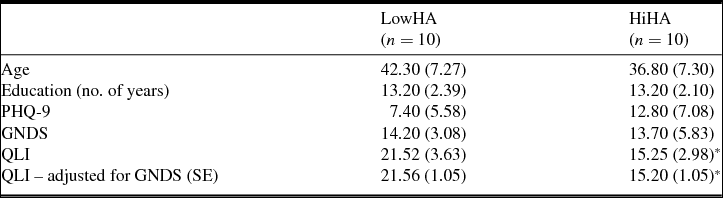
A median-split of SHAI scores (14.50) was used to assign participants to either HiHA or LowHA groups. Table 1 shows mean scores for demographic, mood and QLI measures across groups. There was no difference between groups in terms of age [t (18) = 1.69, p = .12]; educational level [Ty (13.94) = 0.10, p = .99]; physical disability (GNDS) [t (18) = 0.24, p = .82]; or mood (PHQ9) [t (18) = 1.88, p = .07]. There was a significant difference between groups on QLI scores [t (18) = 4.23, p < .001; Bonferroni p < .05]. This effect remained significant even when level of physical disability (GNDS) was controlled using ANCOVA [F (1, 17) = 18.51, p < .001]. The mean (SE) scores for QLI adjusted for GNDS are also presented in Table 1. The effect size of the difference measured by Cohen's d was 1.89 (95% CI 0.77, 2.85), suggesting a large significant effect.
Means (SD) of demographic, mood and quality of life measures across groups

LowHA, low health anxiety; HiHA, high health anxiety; PHQ-9, Patient Health Questionnaire; GNDS, Guy's Disability Scale; QLI, Quality of Life Index. *p <.05, mean difference between LowHA and HiHA.
Participants’ scores on the assessment of cognitive and physical abilities are presented in Table 2. As predicted, there was little difference between groups on any of these measures (all F values <1).
Mean (SD) scores for the cognitive and physical tasks across groups

HiHA, high health anxiety; LowHA, low health anxiety; SDMT, Symbol Digit Modality Test; Brixton, Brixton Spatial Anticipation Test.
Table 3 summarizes the data from participants’ subjective ratings of their performance on the physical and cognitive tasks as well as the extent to which they attributed their performance to MS. The mean scores show that LowHA participants rated their performance in comparison with others with MS as higher than those in the HiHA group on the tasks and attributed less of their performance to MS. A MANOVA with group as a between-subjects factor and ratings of performance on the physical and cognitive tasks as dependent variables, showed an overall effect of group [F (2,17) = 4.86, p = .02]. Subsequent univariate tests showed a significant difference in ratings of cognitive performance [F (1,18) = 7.55, p = .01] but no significant difference in ratings of physical performance [F (1,18) = 1.20, p = .29]. The effect size of the difference between groups on ratings of cognitive task performance was d = 1.23 (95% CI 0.23, 2.13), suggesting a large effect of group on this measure. An independent groups t-test revealed no significant difference between groups on how much better they thought they would have performed if they did not have MS [t (18) = 0.86, p = .40].
Participants’ subjective ratings [mean (SD)] of their performance on the cognitive and physical tasks and how much better their performance would have been without MS

LowHA, low health anxiety; HiHA, high health anxiety. *p <.05.
Study 2
Case descriptions
See the ‘Procedure’ section for common elements of treatment (that included discussion of their ratings of cognitive and physical performance).
Patient 1 was a woman in her early twenties who had suffered her first MS attack in the previous year. The attack had led to paralysis down her left side and required hospital admission. While she recovered almost all her physical functioning, she continued to notice numbness and tingling in her left arm and leg. At assessment she reported spending a great deal of time worrying about the future. In particular, she had images of herself back in hospital following a relapse and permanently disabled. Her concern was that if this happened, other people would have to look after her and she would be a burden to them. The thought that frightened her the most was that she would be unable to care for her young child. She spent long periods of time rubbing her arm to ensure she could still feel sensation in it. Whenever she noticed tingling or numbness in her arms or legs she would stand up and move around. Her belief was that if she could still move them, she was not experiencing a relapse. She would repeat this behaviour frequently during the day.
At first, Patient 1 engaged well in therapy but found talking about her fears for the future distressing, ending most of the sessions in tears. Through collaborative formulation, she recogniszd that while her images about the future may be accurate (physically disabled), the meanings she attributed to them may not be (being a bad mother/burden to others). She also recognized that her checking behaviour (rubbing her arm to ensure she still had sensation) was keeping her preoccupied with thoughts about her MS and thus maintaining her anxiety. After guided discovery around the value of rubbing her arm during the second session, she spontaneously dropped this behaviour before the third session. In Fig. 1, Patient 1’s VSHAI score can be seen to drop following her second session, suggesting a fall in her level of HA. However, at the third session a behavioural experiment was developed to help her examine what would happen if she dropped her other checking behaviour (standing and moving around to ensure her legs still worked). Her belief was that if she did not do this she would miss the onset of a next attack and while she stated she was happy to try the experiment, she did not attend her next scheduled sessions. When she was finally seen some weeks later, it emerged she was experiencing flashbacks to her time in hospital and being paralysed down her left side. She did not attend any further sessions so it was not possible to assess whether she was experiencing a trauma reaction that was inadvertently being triggered during treatment sessions that focused on her MS. The implications of this for treatment are discussed below (see Discussion).
Ratings of health anxiety (SHAI, Short Health Anxiety Inventory; VSHAI, Very Short Health Anxiety Inventory) and mood (PHQ-9, Patient Health Questionnaire) during baseline, treatment and five month follow-up.

Patient 2 was a woman who had been diagnosed with RRMS 3 years prior to the present study. Her main symptoms from her first recognized MS attack had been blurring of vision, fatigue and pain in her lower back. She has a general distrust of medical professionals; previously, when her eldest child was young and suffering a life-threatening illness, she believed it was only through her battling to secure treatment that saved their life. At her initial assessment, she reported spending long periods worrying about the future. These worries were about becoming physically disabled and unable to look after her children. She remained vigilant for physical signs she was relapsing and would use the internet to check the implications of her symptoms. She would also use the internet to keep abreast of the latest research in MS and ensure that she was prepared for her next relapse in terms of being able to ask the medical professionals for the most effective treatment.
Through discussion, Patient 2 recognized that she was less anxious about her future when she was looking after her children and too busy to use the internet (i.e. Theory B). While she did not engage in any overt checking of any physical signs of relapse, she did admit to remaining vigilant for them. A behavioural experiment was also developed to assess the impact of checking the internet on her HA. As she was reluctant to reduce this safety behaviour, she agreed to increase her checking on alternate days and compare ratings of anxiety against the days she checked at her usual level. In doing so she recognized that her checking behaviour was increasing her preoccupation with her health and subsequently reduced the number of times she checked the internet to once daily. Her treatment sessions also focused on differentiating the process of worry from its content and recognizing it was the repetitive negative thought processes and safety behaviours (checking the internet), that were maintaining her distress. Given her wish to utilize mindfulness techniques, these were introduced in her third session (a standard breathing meditation) to help her recognize her thoughts when they arrived in her mind, but not to engage in the process of worry with them. In Fig. 1, a change in trend in Patient 2’s VSHAI score can be seen following this third session. While she struggled with meditation, she was very engaged with the concept and stated she wanted to continue practising following the end of treatment.
Patient 3 was a woman diagnosed with RRMS 2 years prior to the entering the present study. She was anxious about her future and experienced intrusive images of herself in a wheelchair unable to do anything for herself. Her main concern was that she would become a burden to others who would eventually resent her. While she had discussed her condition with her partner and he had reassured her he would not abandon her, she nevertheless remained concerned that, faced with the reality of the condition, this might happen. Most mornings when she awoke she would open her eyes and scan her bedroom to ensure that her vision was still working. During a recent appointment with a neurologist he had asked her to touch each of her fingers with her thumb. She now did this a number of times a day to check that her arms were still functioning.
Guided discovery helped Patient 3 to realize that not all her physical sensations were signs of relapse. Psycho-education on the role of adrenaline and ‘fight or flight’ response helped her to have more helpful responses to signs of anxiety, rather than worry her disease was progressing. At her second treatment session, the value of knowing when a relapse had occurred was discussed and hence she devised with the therapist a behavioural experiment around reducing her thumb tapping. While this experiment was to resist thumb tapping on alternate days and compare her anxiety on these days with the days when she did thumb tap, she did not engage in the behaviour at all over the subsequent week and at the fourth session she reported dropping the behaviour completely. In Fig. 1, a change in trend in VSHAI scores can be seen following her second session after discussing her perception of physical and cognitive ability with her actual scores at assessment and development of her behavioural experiment around thumb tapping.
Patient 4 was a woman who had received her initial diagnosis almost 10 years earlier. She experienced intrusive images of herself in the future being unable to care for herself. Her worry was that in the future, her child would have to look after her and resent her for this. Rather than inflict this on the child, she believed the child would have to be cared for by others in the family and thus ‘lose’ her child. These intrusive images and thoughts occurred often during the day but were mainly associated with times when she was alone and had time to think.
Treatment initially involved exploring her perception of her physical and cognitive abilities (see ‘Procedure’ section) before exploring by way of psychoeducation, how images can be manipulated and changed to become less distressing (no actual imagery rescripting was necessary for this patient). Treatment then focused on recognizing how the repetitive process of worry kept her mind preoccupied on MS and was not necessarily accurate (i.e. Theory B). A pie chart technique was used to help her see that she could continue to be a good mother even when physically disabled. The concept of ‘worry time’ was presented in her third treatment session to help her gain control over her worrying. She reported that ‘worry time’ (setting aside a specified period of the day to worry) had a profound effect on her beliefs about controlling her worry and resulted in her worrying less about her MS. This is consistent with the fall in her VSHAI score in Fig. 1 following her third treatment session.
Treatment outcomes
The outcome of treatment in Study 2 on measures of HA (SHAI, VSHAI) and mood (PHQ-9) are presented in Fig. 1. At the start of treatment all participants had SHAI scores above threshold (18) for a diagnosis of hypochondriasis. Treatment was tracked each session using the VSHAI and PHQ-9. Visual inspection of the data for each patient in Fig. 1 reveals that Patients 2, 3 and 4 showed a level change reduction in SHAI score (p < .05) between baseline and the end of treatment. For Patient 2, this brought her to below the threshold for a diagnosis of hypochondriasis (18) while for Patients 3 and 4 their score fell to below 10 with an RC of 4.26 and 4.74, respectively, suggesting large effects of treatment and suggesting they no longer suffered from HA. Inspection of the VSHAI scores in Fig. 1 suggest that the change in trend for these patients happened after the second (Patient 3) or third (Patients 2 and 4) treatment session. Patient 1’s SHAI score had increased by the end of treatment but the change was not statistically significant. The change in trend downwards of her VSHAI score also happened after the second session for Patient 1; however, this was reversed by the time she attended her fourth treatment session.
There was also a change in trend and level for PHQ-9 scores across all patients. Patients 1, 3 and 4 showed a significant reduction in PHQ-9 scores by the end of therapy (p < .05) while Patient 2’s PHQ-9 score was already low at baseline. For Patients 1, 3 and 4 the change in trend occurred following the first treatment session while for Patient 2 it was after her second session. Subjective quality of life ratings for the patients are presented in Table 4 with all of the patients showing improvements in QLI between baseline and end of treatment.
Quality of Life Index (QLI) scores for patients at baseline, end of treatment and 5-month follow-up

At 5-month follow-up all patients, with the exception of Patient 1 who dropped out of therapy, had maintained the gains achieved during treatment.
Discussion
In Study 1, consistent with Hayter et al. (Reference Hayter, Salkovskis, Silber and Morris2016) it was found that MS patients with high HA rated their QoL lower than those with lower levels of HA, a difference that remained significant even when physical disability was accounted for. Study 2 extends this work by reporting preliminary findings on the impact of CBT-HA for HA in MS. A brief course of CBT-HA led to improvements not only in HA but also in quality of life and mood, improvements that retained at 5-month follow-up. To our knowledge, this is the first study examining the treatment of such anxiety in MS and represents a significant first step in developing effective treatments for this population. Note that in the current study the difference between the groups in HA was not as large as in the Hayter et al (Reference Hayter, Salkovskis, Silber and Morris2016) study.
Given the high rates of HA found in the MS population of between 25 and 30% (Hayter et al., Reference Hayter, Salkovskis, Silber and Morris2016; Kehler and Hadjistavropoulos, Reference Kehler and Hadjistavropoulos2009) and the concomitant cost of HA to health services (Tyrer et al., Reference Tyrer, Cooper, Crawford, Dupont, Green, Murphy, Salkovsikis, Smith, Wang, Bhogal, Keeling, Loebenberg, Seivewright, Walker, Cooper, Evered, Kings, Kramo, McNulty, Nagar, Reid, Sanatinia, Sinclair, Trevor, Watson and Tyrer2011a) the results reported here would suggest that HA should be more widely screened for and treated in MS patients. Results overall are consistent with cognitive accounts of anxiety and depression whereby symptoms are maintained through biased appraisals.
Hayter et al. (Reference Hayter, Salkovskis, Silber and Morris2016) allocated participants to groups using different criteria to the one employed here: the health anxious group had to score above 18 on the SHAI and for the non-health anxious group, 10 or lower. In the present study a median-split was used to allocate to groups and thus there was not as clear a dichotomy between them. This may explain why Hayter et al. found a significant difference between groups on a measure of mood whereas Study 1 did not. However, in Study 1 the mean score on a measure of depression (PHQ-9) was above cut-off in the HiHA group and below cut-off in the LowHA, suggesting a correlation between HA and mood, but the difference between groups was not statistically significant. This may have been due to the lower number of participants in the Study 1 which is a general limitation of the study as a whole. The link between HA and mood is given further weight with the finding in Study 2 that when HA is treated, mood improved also. A further limitation of Study 1 is that it did not include a control group. However, given the similarities in the main findings across studies, we feel confident that the effects found in Study 1 and Hayter et al. are consistent with cognitive accounts of anxiety and depression whereby symptoms are maintained through biased appraisals.
A limitation of Study 2 was that only two data points were available at baseline and thus we were unable to establish stability of the measures at this stage. This might suggest that the change in scores between baseline and the end of therapy are not as large as we suggest. To counter this we would argue that the changes in SHAI for three of the participants were large, even with a declining trend, and also correlate with improvements in mood and quality of life as well, in line with a cognitive account of HA in RRMS. A further limitation of Study 2 was a lack of control for non-specific effects of attending therapy. The initial plan was to include further baseline measurement and to counterbalance the six sessions of CBT with six relaxation training sessions but time limitations meant this was not possible. Given the theoretical rationale for the success of CBT-HA, it is not expected that the general findings would change with the inclusion of a control. Improvements to the design of Study 2 would be the inclusion of extended baseline with the potential inclusion of continuous idiographic measure of behaviours such as checking or reassurance seeking to support the standardized measures of HA and mood. This would provide greater assurance that the difference between baseline and the end of treatment was a result of the CBT-HA intervention.
Clinical implications
The case series suggests that treating HA in MS is possible using an adapted CBT approach (CBT-HA) that leads not only to improvements in HA, but also in mood and subjective quality of life. The replication of Hayter et al. was driven in part to identify targets for treatment during CBT-HA sessions. These were in the form of behavioural experiments that included explorations of the meanings of physical and cognitive symptoms through discussion of the participants’ objective and perceived scores on the cognitive and physical tasks. The use of behavioural experiments in treating anxiety in not new (e.g. Salkovskis et al., Reference Salkovskis, Warwick and Deale2003) but the present study builds on previous work by suggesting that a focus on specific targets for treatment (misappraisals of physical and cognitive functioning) can lead to significant symptom reduction in MS patients.
A large part of the treatment also focused on participants’ worries about the future; in particular what would happen if they became physically disabled. All the patients reported intrusive images of them as physically disabled in the future and unable to care for themselves. These are consistent with findings from Wells and Hackmann (Reference Wells and Hackmann1993) that images of a feared future in HA are often associated with fear of abandonment and an underestimation of coping abilities. Physical disability is a potential reality for many MS sufferers and for this reason may not represent a viable target for therapist treating HA. However, the treatment here focused on the meanings the participants attributed to this dreaded future. Across all four participants it was a concern they would become a burden to their families. Exploration of these meanings through use of Socratic questioning and guided discovery helped them to alter the meaning of the images such that while physical disability was a distinct possibility, becoming a burden (or being a bad mother) was not. Furthermore, the direct manipulation of an intrusive image by one patient led to reductions in the negative emotions associated with it (for review, see Holmes and Mathews, Reference Holmes and Mathews2010). The present case series suggests that a potential target in therapy is the unique meaning patients attribute to intrusive images in order to help them develop strategies to reduce psychological distress.
For Patient 1 in Study 2, after her third treatment session she reported other images that appeared consistent with experiencing a flashback to her stay in hospital and suggestive of a trauma reaction to this. The reason this did not emerge until later in treatment is likely to be due to her avoidance of triggers of re-experiencing and arousal symptoms. When she felt more trusting of the therapist this avoidance may have decreased but the triggering of symptoms is likely to have led to her disengagement with treatment. Post-traumatic stress disorder (PTSD) can present with elements of any of the other anxiety disorders (Butler et al., Reference Butler, Fennell and Hackmann2008) with around 60% of patients with PTSD meeting criteria for at least one other disorder (Kessler et al., Reference Kessler, Sonnega, Bromet, Hughes and Nelson1995). However, care is needed here as an emerging view in the recent literature is that intrusive images of past trauma or feared events are not confined to PTSD. Handley et al. (Reference Handley, Salkovskis, Scragg and Ehlers2009) found that the majority of patients screened for travel phobia following the London bombings in 2005 also had PTSD symptoms; with some of them reporting intrusive trauma memories and hyper-arousal. They suggest that while patients may not have met full criteria for a PTSD diagnosis, treatment should incorporate elements of PTSD treatment to help patients overcome their re-experiencing symptoms (e.g. Ehlers and Clark, Reference Ehlers and Clark2000). This seems especially relevant to patients with RRMS as their initial attack or relapse can happen suddenly with devastating impact on physical functioning (as happened with Patient 1) and experienced as a life-threatening trauma. The experience of treating Patient 1 suggests that clinicians need to be vigilant of PTSD symptoms in RRMS patients presenting with psychological complications (even if they do not meet full criteria for a PTSD diagnosis) so they can get the most appropriate treatment. Unfortunately for Patient 1, her reluctance to return to treatment meant this was not possible.
Future research
The similarity of the intrusive images (and to a large part the meanings attributed to them) across all of the patients in the present case series is intriguing. Previous research by Berna et al. (Reference Berna, Vincent, Moore, Tracey, Goodwin and Holmes2011) in patients with chronic pain revealed a wide variation in the content and meaning of intrusive of images. The similarities of images found here may have been due to the patients’ similar personal circumstances (all mothers with children living at home). It remains an empirical question as to whether the similarity of intrusive images found here is reported across the MS patient population more generally. If so, future research might consider whether the similarities are accounted for by an aspect of MS or its interaction with cognitive processes involved in the development and maintenance of HA (or anxiety disorders more generally). The extent to which these images are malleable through therapy is also a question for further research. Here the meanings of the negative images were successfully targeted but other approaches (such as imagery rescripting or retraining; Holmes et al., Reference Holmes, Arntz and Smucker2007) may lead to even greater therapeutic gains.
In Study 1, QoL was reduced for MS patients with HA compared with the non-HA patients, and improved following treatment (Study 2). These findings suggest that HA has a direct negative impact on QoL, but it remains unclear which specific mechanisms are involved. Future research might consider whether it is behavioural (e.g. safety seeking behaviours) or cognitive (e.g. negative intrusive thoughts/images) that are most responsible for reduced QoL and help to prioritize targets for treatment. Other research has targeted ‘fear of progression’ in chronic or progressive diseases. For example, Herschbach et al. (Reference Herschbach, Book, Dinkel, Berg, Waadt, Duran, Engst-Hastreiter and Henrich2010) found a that four-session group CBT approach for cancer patients reduced fear of progression as well as levels of anxiety and depression. It would be interesting to include a measure of ‘fear of progression’ in future work in MS.
Conclusions
The findings from this research support the findings from Hayter et al. (Reference Hayter, Salkovskis, Silber and Morris2016) where in MS patients HA reduces quality of life, over and above their level of physical or cognitive disability. Furthermore, they see their cognitive and physical functioning as more impaired than it actually is. Given the high prevalence rate of HA in this population, and the economic burden to health care services of patients suffering HA, Study 2 suggests that a brief CBT intervention that targets misappraisals of cognitive and physical performance as well as intrusive imagery about their feared future, could significantly improve MS patients’ wellbeing. Replicating the findings of Study 2 with improvements to the single case design (e.g. extended baselines) would pave the way for larger, controlled studies to demonstrate the effectiveness of this type of intervention.
Acknowledgements
The authors would like to thank Sharon Grainger and Beverly Bowers (MS nurse specialists) for their help in recruiting participants to this research. We would also like to thank the MS National Therapy Centre for their assistance with this research.
Ethical statement: The authors assert that all procedures contributing to this work comply with the ethical standards as set out in the Ethical Principles of Psychologists and Code of Conduct as set out by the American Psychological Association. Ethical approval for the study was obtained from the Oxford C NHS Research Ethics Committee in the UK (reference 13/SC/0547) and a university department of psychology ethics committee.
Conflicts of interest: The authors have no conflict of interest with respect to this publication.
Funding: This research received no specific grant from any funding agency in the public, commercial, or not-for-profit sectors. The first author was supported by funding from the Department of Psychology, University of Bath, UK.
Appendix: Calculation of Reliable Change Index (from Jacobson and Truax, Reference Jacobson and Truax1991)
Let X 1 = pre-test score; X 2 = post-test score; rxx = test‒retest reliability of measure; S diff = standard error of difference between the two test scores; S E = standard error of measurement.
Reliable change index (RC) is calculated by the following equation:
 $$\begin{equation*}
RC\; = \frac {{X_2}-{X_1}} {S_{\rm diff}}
\end{equation*}$$
where S diff = √2(S E)2 and S E = Sx √(1 - r xx).
An RC larger than 1.96 would be unlikely to occur (p < .05) without actual change. When RC exceeds this level, the individual can be classified as reliably changed.
The Health Anxiety Inventory has a test–retest reliability of 0.76. The standard deviation of SHAI scores in the HiHA group was 3.04. Using the above formulae, S E = 1.49 and S diff = 2.11.
 $$\begin{equation*}
{\textrm{For Patient 2}}\;RC\;{\rm{ = }}\;\left( {{\rm{25}}-{\rm{16}}} \right){\rm{/2}}{\rm{.11 = 4}}{\rm{.26}}
\end{equation*}$$
 $$\begin{equation*}
{\rm{Patient}}\;{\rm{3}}\;RC\;{\rm{ = }}\;\left( {{\rm{18}}\;{\rm{-}}\;{\rm{9}}} \right){\rm{/2}}{\rm{.11 = 4}}{\rm{.26}}
\end{equation*}$$
 $$\begin{equation*}
{\rm{Patient}}\;{\rm{4}}\;RC\;{\rm{ = }}\left( {{\rm{18 - 8}}} \right){\rm{/2}}{\rm{.11 = 4}}{\rm{.74}}
\end{equation*}$$
All values are above the cut-off of 1.96 and represent large and significant change (p < .05).







Comments
No Comments have been published for this article.