Introduction
The use of agro-industrial waste for feeding ruminants can reduce production costs and serve as an alternative to minimize the adverse effects of fluctuations in quality of some biomass species (Silva et al. Reference Silva, Figueiredo, Pedreira, Bernardino, Farias and Azêvedo2012; Gonzaga Neto et al. Reference Gonzaga Neto, Oliveira, Lima, de Medeiros, Bezerra, Viégas, do Nascimento and de Freitas Neto2015). Some agro-industrial waste has great yield potential, such as the aerial part of cassava, which produces approximately 100 t/ha/year of feed (Chauhan et al. Reference Chauhan, Beyene, Kalyaeva, Fauquet and Taylor2015; Gonçalves et al. Reference Gonçalves, Zambom, Fernandes, dos Tinini, Schimidt, Castagnara, de Canabarro and da Cruz2015; Oliveira et al. Reference Oliveira, Palmieri, Carvalho, Leão, de Abreu, Di Ribeiro, Pereira, de Carvalho and Bezerra2015). However, cassava contains toxic compounds, and the use of this waste as animal feed is minimal due to producers’ fear of its toxicity. To enable the use of aerial parts of cassava as ruminant feed, the ensiling process reduces the concentration of cyanogenic glycosides to practically zero through the volatilization of hydrocyanic acid (Soto-Blanco & Górniak Reference Soto-Blanco and Górniak2010) while still preserving the chemical characteristics of the original material (Longhi et al. Reference Longhi, Domingues, Mota, Oaigen, Calonego and Zundt2013).
The aerial part of cassava contains a high crude protein (CP) content, ranging from 154 to 203 g/kg (Gonçalves et al. Reference Gonçalves, Zambom, Fernandes, dos Tinini, Schimidt, Castagnara, de Canabarro and da Cruz2015) and even reaching up to 250 g/kg (Chauhan et al. Reference Chauhan, Beyene, Kalyaeva, Fauquet and Taylor2015), and a low concentration of water soluble carbohydrates (Oni et al. Reference Oni, Sowande, Oni, Aderinboye, Dele, Ojo, Arigbede and Onwuka2014). Dry matter (DM) content is 207 to 280 g/kg (Fernandes et al. Reference Fernandes, Guimarães Júnior, Vieira, de Fialho and Malaquias2016), which can promote secondary fermentation during ensiling. This reduces the nutritional value of silage, especially proteolysis, and affects animal intake by the presence of disagreeable odours or causing pathologies when pathogenic bacteria are present, such as Clostridium and enteric bacteria.
The use of additives may prevent the deterioration of the material by secondary fermentation (Yitbarek & Tamir Reference Yitbarek and Tamir2014) by promoting microbiological stability of the silage with lactic acid production, resulting in a suitable pH and the preservation of silage (de Morais et al. Reference de Morais, Silva, Bezerra, Carneiro, Moreira and de Medeiros2015; Medeiros et al. Reference Medeiros, Silva, Carneiro, Araújo, Morais, Moreira and Bezerra2015). Tannin may be an alternative additive due to its great affinity to proteins, polysaccharides and amino acids (Mueller-Harvey Reference Mueller-Harvey2006), where the adsorption effect plays a role in bacteriostatic actions (Oliveira & Berchielli Reference Oliveira and Berchielli2007), which can lead to a reduction in effluent and gas losses (Tabacco et al. Reference Tabacco, Borreani, Crovetto, Galassi, Colombo and Cavallarin2006) and decrease the proteolytic actions of some groups of microorganisms (Salawu et al. Reference Salawu, Acamovic, Stewart, Hvelplund and Weisbjerg1999). However, the addition of tannin levels in excess of 50 g/kg in the diet can inhibit the intake and proliferation of rumen bacteria (Oliveira & Berchielli Reference Oliveira and Berchielli2007). Therefore, the current work evaluated the fermentative characteristics, gas production kinetics and in-vitro degradability of the upper third of ensiled cassava with the addition of condensed tannin.
Materials and methods
Local and ethical considerations
The experiment was conducted at the Campus of Agricultural Sciences of the Federal University of San Francisco Valley (UNIVASF), located in the municipality of Petrolina, PE, Brazil (9°4′S; 40°19′W) and under strict accordance with the National Council Guide to Animal Experimentation Control (CONCEA). The experimental protocol was approved by the ethics committee of the Federal University of San Francisco Valley, Pernambuco, Brazil (Protocol number: 0001/040713). The experimental period was 56 days.
Silage making
The silage material was composed of the upper third section of leaves + fine stems of cassava (Manihot esculenta Crantz), because the thicker stems are less acceptable to animals, and producers use the thicker stems for cassava replanting (Sudarman et al. Reference Sudarman, Hayashida, Puspitaning, Jayanegara and Shiwachi2016; Polthanee & Wongpichet Reference Polthanee and Wongpichet2017). Plants were approximately 6 months old and 2·00 m tall, when this material naturally had approximately 300 g DM/kg. Plucked from the ground to remove the roots, the upper third of each plant was collected. The material was chopped into lengths of 2–2·5 cm using a stationary shredder forage machine. The chopped material was homogenized manually and sampled as non-ensiled material (original material), which had an average DM content of 270 g/kg, and was then ensiled in cylindrical experimental mini-silos of 10 cm diameter and 50 cm in length.
Weibull condensed tannin (TANAC® brand, Montenegro-RS, Brazil) was used according to the manufacturer's instructions; it was obtained from the aqueous tannin extract of mimosa and had a tannin content of 720 ± 2·0 g/kg as fed, a DM content of 935 g/kg, and a pH in a 20% solution that ranged from 4·5 to 5·0. The silage treatments were made with mimosa aqueous extracts powder (MAEP). The levels were 0 g/kg (no tannin) and 25, 50, 75 g tannin levels per kg of cassava silage on DM basis. About 15 kg of the upper third of cassava (natural matter) was distributed on a tarpaulin. Subsequently, a calculated amount of powder of aqueous extract mimosa was thrown into the chopped material to achieve the 0, 25 (35 g MAEP), 50 (70 g MAEP) and 75 g (105 g MAEP) (DM) inclusion levels, and mixed with a shovel.
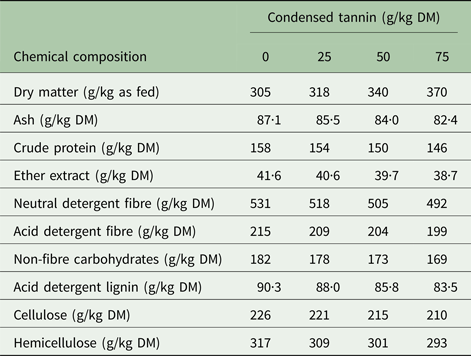
Twenty-one mini-silos (replicates) were made for each level of condensed tannin, totalling 84 mini-silos, which were all filled with cassava silage and added condensed tannin. The silage material was placed in pipes, which had been previously equipped with a cotton cloth bag containing approximately 600 g of sand for evaluating effluent losses. The silage material was compressed with a wooden plunger to achieve a density of 600 kg/m3/mini-silo. Finally, each pipe was closed with a polyvinyl chloride cap and sealed with plastic tape (Poliembalagens®, São Paulo, Brazil). The qualitative characteristics of the pre-ensiled material are shown in Table 1.
Chemical composition of ingredients used in the preparation of experimental cassava silage

DM, dry matter.
Losses and fermentation profile
The large barrels and mini-silos were stored in the shade at temperatures between 20 and 25 °C and were opened after 1, 3, 5, 7, 14, 28 and 56 days of ensiling. Dry matter losses were evaluated according to Schmidt et al. (Reference Schmidt, Rossi Junior, Junges, Dias, de Almeida and Mari2011). The effluent losses were quantified using the following equation proposed by Jobim et al. (Reference Jobim, Nussio, Reis and Schmidt2007):
 $$E({\rm kg/t}\;{\rm FMs}) = [({\rm TWo} - {\rm TWs}) / ({\rm GMef}) ] \times 100 $$
where E, effluent yield (kg/t FMs), FMs, forage mass in the silage, TWo, total weight (silo + sand + sandbag) when the silos were opened (kg), TWs, total weight (silo + sand + sandbag) when the silos were sealed (kg), and GMef, green mass of the ensiled forage (kg).
The gas losses were quantified using the following equation:
 $$GL{\rm (g/kg}\;{\rm DM) = [({\rm SWs} - {\rm SWo})/}({\rm FMs} \times {\rm DMe}){\rm ] \times 100}$$
where GL, gas losses during storage (g/kg of initial DM); SWs, silo weight during the ensilaging process; SWo, silo weight at opening; FMs, forage mass in the silage; and DMe, dry matter content of the forage in the silage (Jobim et al. Reference Jobim, Nussio, Reis and Schmidt2007). At the time of the opening of the mini-silos, fungal contaminations were removed and weighed and considered mould losses (filamentous fungi), and the silage was manually removed and collected in plastic containers for the homogenization of each sample and each opening date.
Part of the silage was pre-dried in a forced ventilation oven at 60 °C to constant weight. Another part was used fresh for pH evaluation (Wilson & Wilkins Reference Wilson and Wilkins1972) with a pH meter (MA522 model, Marconi Laboratory Equipment, Piracicaba, Brazil), and for ammonia nitrogen content analysis (mg/g total N), which was determined as described by Bolsen et al. (Reference Bolsen, Lin, Brent, Feyerherm, Urban and Aimutis1992). Samples were frozen and short-chain fatty acid (SCFA) profile (lactic, acetic, propionic and butyric acids) analysed subsequently, according to the method described by Palmquist & Conrad (Reference Palmquist and Conrad1971).
The pre-dried material (original material and silages) was dried completely in a forced circulation oven at 105 °C for 72 h, ground into 2 mm particles in a Willey knife mill and packaged in plastic bottles for further analysis. A portion of each sample (triplicate) was ground to 1 mm for the following content analysis according to AOAC (1990): DM (method no. 934·01); ash (method no. 930·05); ether extract (EE – method no. 920·39); and CP using the Kjeldahl method (method no. 981·10).
The neutral detergent fibre (NDF) content was determined as described by Van Soest et al. (Reference Van Soest, Robertson and Lewis1991) and expressed as inclusive of residual ash and where heat-stable alpha-amylase was used. Acid detergent fibre (ADF) content was determined as described by Robertson & Van Soest (Reference Robertson, Van Soest, James and Theander1981). Acid detergent lignin content was determined using the AOAC method 973·18 (2002), in which the ADF residue is treated with 72% sulphuric acid. Part of the neutral detergent residue was incinerated in an oven at 600 °C for 4 h, for ash correction. Another part was used for protein correction using the Kjeldahl method (method no. 981·10, AOAC (1990)) and obtaining the neutral detergent insoluble nitrogen content. The hemicellulose was obtained using the following equation:
 $${\rm Hemicellulose} = {\rm NDF} - {\rm ADF \; and \; cellulose}$$
where cellulose = ADF − ADL (Van Soest et al. Reference Van Soest, Robertson and Lewis1991).
Kinetics of gas production and degradability in vitro
Pre-dried samples were ground to 2 mm for degradability assays and to evaluate the kinetics of in-vitro gas production. Evaluation of the kinetics of ruminal fermentation of the silage after 28 and 56 days was conducted by an in-vitro gas production semi-automatic proposal technique by Maurício et al. (Reference Maurício, Pereira, Gonçalves and Rodriguez2003) and adapted by Menezes et al. (Reference Menezes, Costa, Araújo, Pereira, Nunes, Henriques and Rodrigues2015). Seven polystyrene boxes were used containing 26 bottles per box, in triplicate, for each level and fermentation period (4 × 3 × 2), totalling 24 bottles, plus two control bottles which contained only ruminal liquid and culture medium (buffer). To each bottle, 90 ml of culture media and 10 ml of filtered rumen fluid was added manually using a beaker, according to the methodology of Theodorou et al. (Reference Theodorou, Williams, Dhanoa, McAllen and France1994) and adapted by Maurício et al. (Reference Maurício, Pereira, Gonçalves and Rodriguez2003).
The rumen fluid used as inoculum was obtained from a castrated male bovine Holstein animal equipped with a ruminal cannula. The animal was kept on a diet of elephant grass and concentrate made of ground maize and soybean meal, the roughage–concentrate ratio was 90 : 10. The diets had approximately 130 g/kg CP and estimated total digestible nutrients (TDN) and metabolizable energy (ME) were 600 g/kg and 104·7 MJ, respectively. Pressure readings were made more frequently during the initial fermentation period and were subsequently reduced over time (2, 4, 6, 8, 9, 11, 12, 14, 17, 20, 24, 28, 34, 48, 72, 96 and 144 h).
Cumulative gas production data were analysed using the following two-compartment model cited by Schofield et al. (Reference Schofield, Pitt and Pell1994):
 $$v(t) = [vf_1 /(1 + {\rm e}^{(2 - 4m_1 ({\rm lt}))} )]{\rm} + {\rm [}vf_2 /{\rm} (1{\rm} + {\rm} e^{(2 - 4m_2 ({\rm lt})} ){\rm ]}$$
where v(t) is the maximum volume of the total gas produced; vf 1 represents the maximum gas volume fraction from rapid degradation (from non-fibre carbohydrates – NFCs); vf 2 represents the maximum gas volume fraction from slow degradation (from fibre carbohydrates – FCs); m 1 equals the specific growth rate for the fraction from rapid degradation; m 2 is equivalent to the specific growth rate of the fraction from slow degradation; e is simple exponential growth with cut-off and lt is the lag time (or colonization time). The fractional rates (/h) combined with gas production (μ) were also calculated with the following equation:
 $$\mu = b + c/Q_2 $$
where μ, the gas production rate and b (/h) and c (h −0·5), constant fractional rates and Q 2 is the lag phase when the duration of the initial digestion events, common to the two phases.
The DM degradability was estimated from the insertion of 50 µm mesh Faith satin bags containing samples of ingredients and diets tested within the fermentation jars. The bags were removed after 2, 6, 12, 24, 48, 96 and 144 h of in-vitro incubation, washed in distilled water and subsequently dried at 105 °C for 12 h (Menezes et al. Reference Menezes, Costa, Araújo, Pereira, Nunes, Henriques and Rodrigues2015). The zero time was obtained by immersing the bags into distilled water at 37 °C for 5 min prior to drying.
To determine degradability, the following Ørskov & McDonald (Reference Ørskov and McDonald1979) model was used:
 $$D = a + b{\rm (}1-{\rm e}^{ - ct} {\rm )}$$
where the gas production rate obtained by the semi-automatic gas production technique (m 1 + m 2) was used to estimate the rate of passage (k) used in the degradability test (Maurício et al. Reference Maurício, Pereira, Gonçalves and Rodriguez2003).
Experimental design and statistical analysis
The experimental design was completely randomized and treatments were arranged in a 4 × 7 factorial arrangement, consisting of four addition levels of condensed tannin as plots and seven periods of fermentation in the mini-silos (1, 3, 5, 7, 14, 28 and 56 days to silage opening) as sub-plots. Considering the standard curve fermentation of maize silage, where fermentative stability occurs after 21 days of ensiling, only 28 and 56 days silage openings were analysed for gas production and in-vitro degradability kinetics.
Data were initially analysed using the UNIVARIATE procedure to evaluate the normality of the response variables. Thereafter, as the fermentation periods were not equidistant, it was also necessary to use the SAS IML procedure for formulating the vector. Next, ANOVA (analysis of variance) was determined and regression with orthogonal contrasts and by means was determined using PROC GLM and PROC MIXED.
Gas parameters and the degradability production model were estimated using the non-linear regression procedure (PROC NLIN) in SAS® (SAS Institute 2003). Effects were significant when the error was P ⩽ 0·05 and when the trend probability was between 0·05 ⩽ P ⩽ 0·10 using SAS® Statistic Analysis System (SAS® 9.1, 2003).
Results
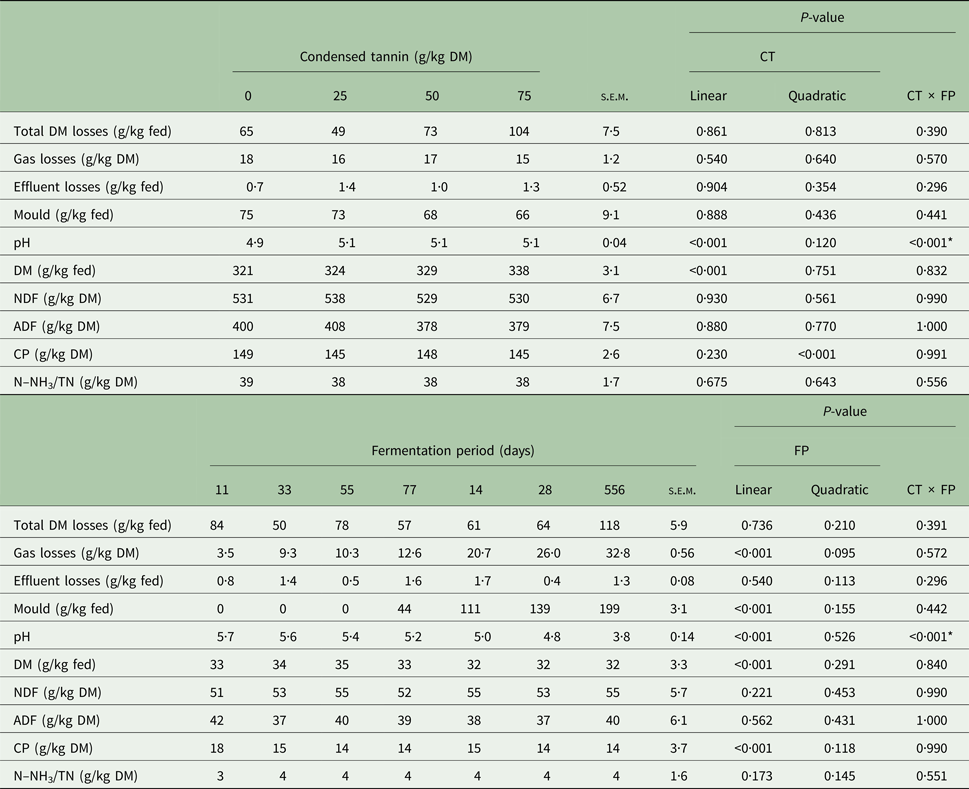
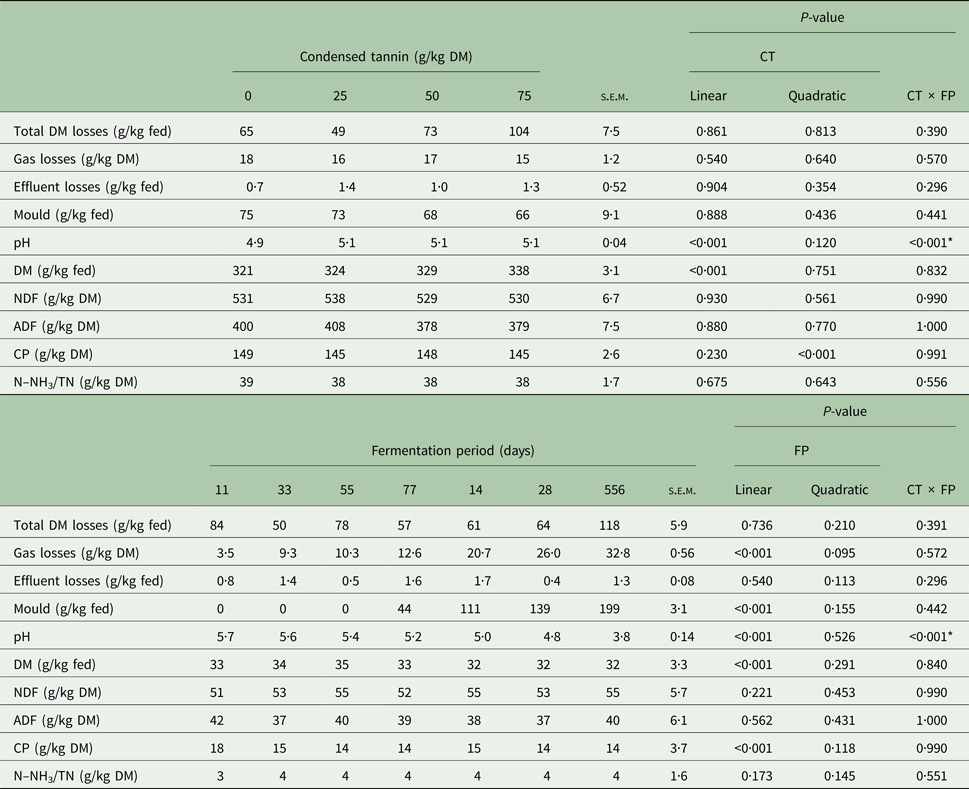
There was no interaction or effect of addition of condensed tannin on total DM losses, gas losses, effluent losses and moulds (Table 2). However, there was an effect of mini-silo fermentation period on gas losses (P < 0·001) and moulds (P < 0·001). Total DM and effluent losses were not influenced by the fermentation period. The pH, DM and CP contents were affected by the addition of tannin levels and fermentation period (P < 0·05), and significant interactions were seen between these factors and pH (P < 0·001). Neutral detergent fibre, ADF and ammonia nitrogen (N–NH3) contents, however, were not affected by any interactions, tannin level or fermentation period.
Fermentative characteristics and chemical composition of cassava silage with added condensed tannin
s.e.m., standard error of the mean; DM, dry matter; NDF, neutral detergent fibre; ADF, acid detergent fibre; CP, crude protein; N–NH3/TN, ammonia nitrogen content in relation to total nitrogen.
Significant at P < 0·05.
* Linear interaction between condensed tannin (CT) × Fermentation period (FP) (linear).
The addition of condensed tannin to silage caused a linear increase in pH and DM values (P < 0·001). Crude protein content had a positive quadratic effect and the maximum content of CP (165 g/kg) was achieved at the 55·4 g/kg addition of condensed tannin, estimated value from the regression equation. There was an interaction between the tannin level and fermentation period for pH values (P < 0·001), and the lowest value was observed on day 56 in the control treatment with a pH of 3·67. The fermentation period decreased CP content in the silage linearly (P < 0·001).
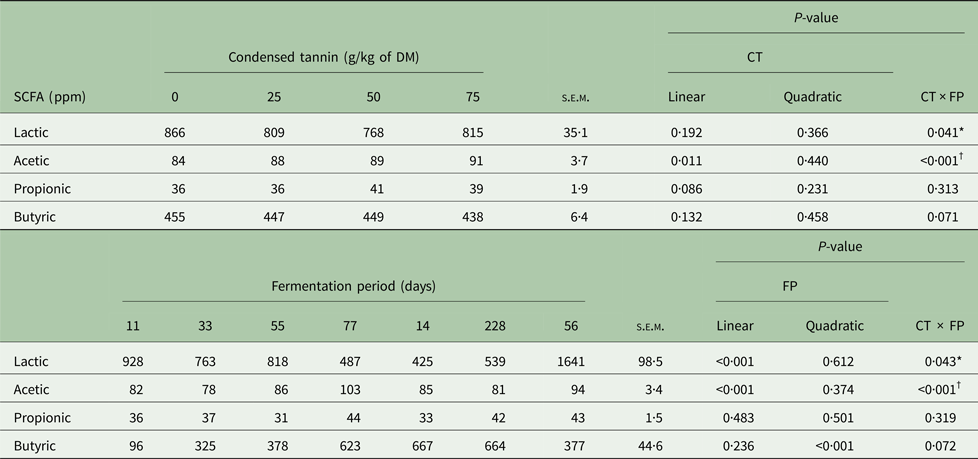
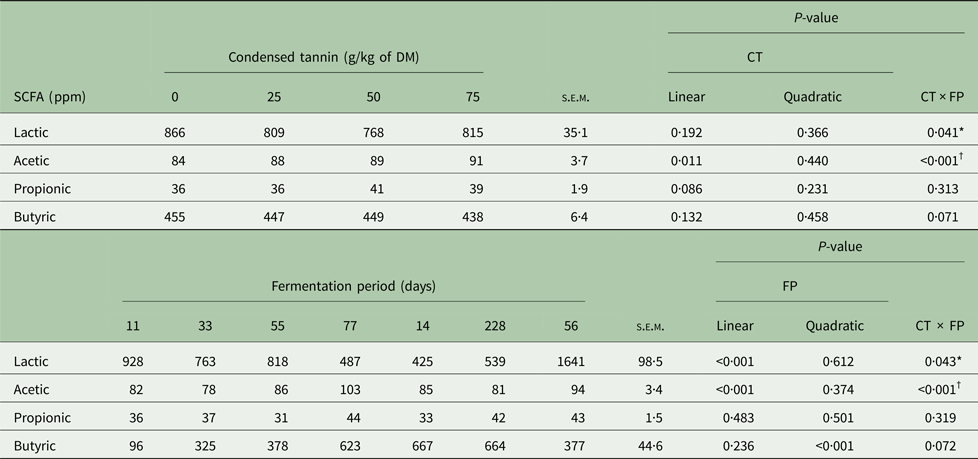
There was an interaction between the addition levels of condensed tannin and the fermentation period on lactic (P = 0·041) and acetic acid production (P < 0·001) (Table 3). There was a linear increase (P < 0·001) for silo fermentation period and lactic acid production, where lactic acid production was greater in silage at 56 days at 1641 ppm. The interaction between acetic acid and tannin levels caused a linear increase, and the interaction between acetic acid and fermentation period caused a quadratic effect, where the greatest value, 106 ppm concentration, was observed at the 56-day opening with the addition of 75 g/kg of condensed tannin.
Short-chain fatty acids (SCFA; ppm) of cassava silage with added condensed tannin
DM, dry matter; s.e.m., standard error of the mean.
Significant at P < 0·05.
* Linear interaction between condensed tannin (CT) × Fermentation period (FP) (linear).
† Quadratic interaction between condensed tannin (T) × Fermentation period (FP).
For the fermentation period, however, there was a significant effect on the production of the lactic (P < 0·001), acetic (P < 0·001) and butyric (P < 0·001) acids. Lactic acid demonstrated linear increase. Acetic acid presented similar effect towards fermentation period, and butyric acid had a positive quadratic effect, with its greatest concentration at 667 ppm on day 14. There was an increasing trend in propionic acid production with the addition of condensed tannin (P = 0·082); however, propionic acid production was not affected by the interaction or fermentation period.
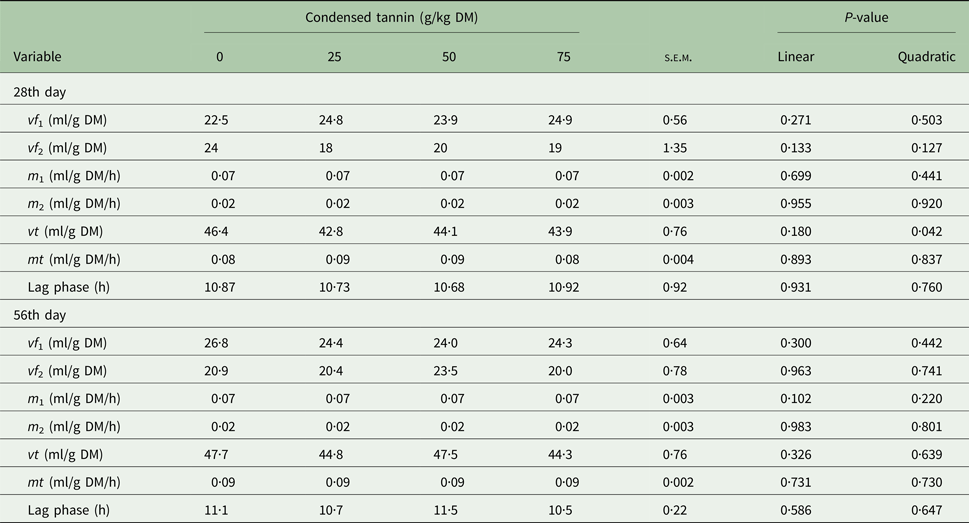
There was no significant difference in gas production kinetics, even with the variations in tannin level added in silage at the 56-day opening (Table 4). At the 28-day silage fermentation period, the maximum potential gas production in-vitro of total carbohydrates (vt) showed quadratic effect (P < 0·001), with lower production at 43·1 ml/g DM with the addition of condensed tannin at 46·6 g/kg in ensiled cassava silage.
Kinetics of gas production from cassava silage with added condensed tannin at 28 and 56 days ensiling

DM, dry matter; s.e.m., standard error of the mean.
Significant at P < 0·05.
vf1, maximum potential gas production from non-fibrous carbohydrates; vf2, maximum potential gas production from fibrous carbohydrates; m 1, gas production rates from non-fibrous carbohydrates; m 2, gas production rates from fibrous carbohydrates; vt, maximum potential gas production from total carbohydrates; Mt, total gas production rate.
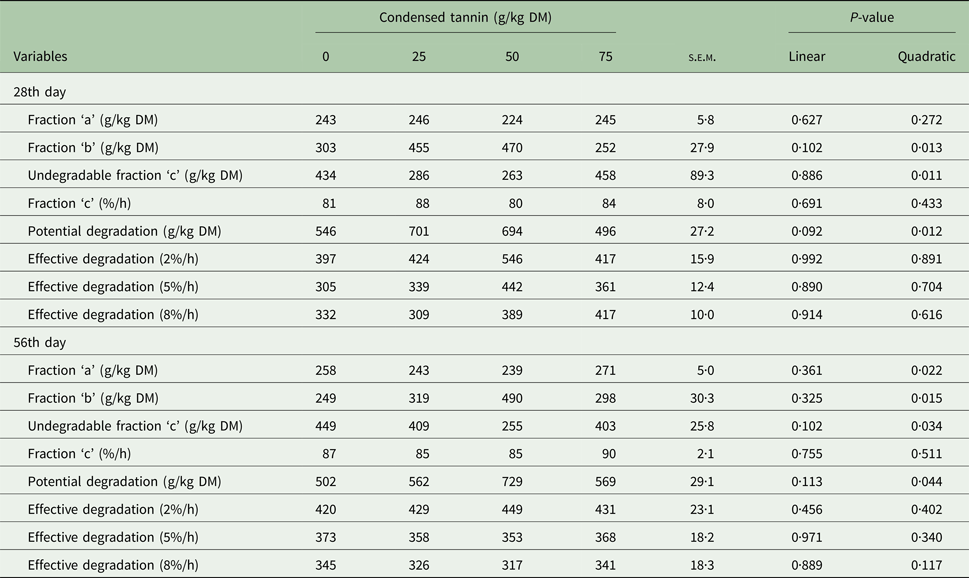
There was no effect of added tannin level on the soluble fraction (a) and the degradability of DM evaluated at the 28-day opening (Table 5). At the 28-day opening, the potentially degradable fraction (b) had positive quadratic effect (P = 0·013) with a maximum value of 486 g/kg DM with the condensed tannin level of 35·6 g/kg. Negative quadratic effect (P = 0·011) was observed for the undegradable fraction, whose lower amount, 203 g/kg of DM, was recorded with the condensed tannin level of 37·9 g/kg. The degradability of the fraction (b) had similar results at the 35·3 g/kg level, with a value of 720 g/kg DM (P = 0·011).
Degradation kinetics of cassava silage with added condensed tannin at 28 and 56 days ensiling

DM, dry matter; s.e.m., standard error of the mean.
Significant at P < 0·05.
The addition of condensed tannin caused a quadratic decrease in the degradability of fraction (a) (P = 0·022) with its lowest value being 208 g/kg after 56 days at the condensed tannin level of 33·8 g/kg. The undegradable fraction also demonstrated a quadratic reduction (P = 0·034) with a value of 236 g/kg DM at the minimum condensed tannin level of 65·9 g/kg. In contrast, the potentially degradable fraction (b) had positive quadratic effect (P = 0·015) with a peak of 517 g/kg DM at the condensed tannin level of 52·3 g/kg. There was a positive quadratic effect on the potential degradability of DM with a value of 665 g/kg at the condensed tannin level of 45·7 g/kg at the 28 days opening, and with the addition of condensed tannin at 50 g/kg, the potential degradability of the treatment reached 729 g/kg at the 56-day opening.
Discussion
There was no effect of added condensed tannin on gas losses; however, gas losses were influenced by fermentation period. This type of loss is related to the heterofermentative process or secondary fermentation caused by enterobacteria, bacilli, fungi and yeast that ferment the pyruvate molecules of acetate, lactate and CO2. Other gases may also be produced and released as ammonia due to proteolysis and nitrogen oxide, which would be derived from the metabolism of some enterobacteria (McDonald et al. Reference McDonald, Henderson and Heron1991; Muck Reference Muck2010). Many species of Enterobacteriaceae use nitrate as an electron acceptor, reducing nitrate to nitrite, which volatilizes and accounts for major gas losses in silos (Muck Reference Muck2010). The mould losses were also influenced by fermentation period, and so the ensiling time may be another possible explanation for gas losses because mould losses occurred on top of the silos where there may have been contact with oxygen. The moulds can be from various genera, such as Monascus, Geotrichum, Byssochlamys, Mucor, Monilia, Aspergillus, Penicillium and Fusarium. According to McDonald et al. (Reference McDonald, Henderson and Heron1991), high temperatures may also cause a proliferation of these fungi.
Dry matter content ranged from 303 to 356 g/kg, which were close to the values of 280–340 g/kg DM that were recommended by McDonald et al. (Reference McDonald, Henderson and Heron1991) as the ideal DM content for the fermentation process. From the 28-day opening, the control silage showed pH values close to those recommended for good quality silage at 3·8–4·2 (McDonald et al. Reference McDonald, Henderson and Heron1991; Mota et al. Reference Mota, Rocha Júnior, de Souza, dos Reis, Tomich, Caldeira, de Menezes and da Costa2011). The addition of condensed tannin delayed the time it took for the pH to reach this margin, which occurred only at the 56-day opening, this relationship will be explained better below. Despite that, the addition of 55·4 g/kg condensed tannin (estimated value from the regression equation), increased CP content, possibly by promoting the binding of tannin and proteins (Bezerra et al. Reference Bezerra, Edvan, Oliveira, Silva, Bayao, Oliveira and Pereira2015) and protecting it. However, when the pH values were reduced and, upon reaching a value below 4·9, tannin and protein binding were undone (Hagerman & Butler Reference Hagerman and Butler1981), reducing the bacteriostatic action and allowing the proliferation of fermentative bacteria and increasing the production of lactic acid, resulting in a pH consistent with good quality silage at the 56-day opening of the silos.
Lactic acid produced from homofermentative bacteria is the main organic acid responsible for the pH drop in silage. It increased more sharply without condensed tannin inclusion. The greater lactic acid concentration promoted a faster drop in pH. The lactic and acetic acid data suggest that up to the 28-day opening, tannin can inhibit homofermentative bacteria proliferation and lengthen the time required for fermentation processes (Santoso et al. Reference Santoso, Hariadia, Manik and Abubakar2011). The greater concentration of acetic acid with condensed tannin inclusion suggests the increase of heterofermentative bacteria (Yitbarek & Tamir Reference Yitbarek and Tamir2014; Tokita et al. Reference Tokita, Ogata, Oshiro, Hirayanagi, Hatori, Sato, Kurita, Yoshimura and Tokita2015). The time for pH to drop can increase with this type of bacteria. A further possible explanation might be the greater butyric acid values found, which may have resulted from secondary fermentations and reduced the rate of pH reduction (Deaville et al. Reference Deaville, Givens and Mueller-Harvey2010; Tokita et al. Reference Tokita, Ogata, Oshiro, Hirayanagi, Hatori, Sato, Kurita, Yoshimura and Tokita2015).
The fermentation periods and tannin levels did not affect NDF of silage, which ranged from 490 to 570 g/kg. These data are close to those found by Modesto et al. (Reference Modesto, dos Santos, Vilela, da Silva, Faustino, Jobim, Detmann, Zambom and de Marques2004), who observed an NDF content of 507 g/kg in cassava silage. There was a positive quadratic effect of added condensed tannin on the CP content, where a maximum value of 165 g/kg CP was observed at the condensed tannin level of 55·4 g/kg; this can be explained by tannin binding to proteins, and this tannin level may have inhibited the actions of plant and microbial enzymes (Mohammadabadi & Chaji Reference Mohammadabadi and Chaji2012).
The reduction in CP content over the silage fermentation period (P < 0·001) was not accompanied by a difference in the concentration of N–NH3/TN (P = 0·14). McDonald et al. (Reference McDonald, Henderson and Heron1991) stated that N–NH3 is the main metabolite of proteolysis, and TN is the total nitrogen. Nevertheless, the values of N–NH3/TN found in the present study were maintained at the optimal range (<100 mg/g) recommended by these authors. Crude protein content observed in the present study was greater than those reported in the literature. Man & Wiktorsson (Reference Man and Wiktorsson2001) reported values of 188–215 g/kg and Silva et al. (Reference Silva, Figueiredo, Pedreira, Bernardino, Farias and Azêvedo2012) reported a value of 180 g/kg. The difference in CP content compared with the above-mentioned research may be due to cultivation practices, the physiological stage of the plant at the time of collection or fertilization (Marques et al. Reference Marques, Rocha Júnior, dos Reis, de Souza, de Pires, de Palma, da Silva and da Antunes2013). The data indicate that in the fermentation period there was a linear reduction of CP concentration and no increase in N–NH3/TN. Protein degradation can explain this event, because it can generate such diverse compounds as peptides, amines, amides, free amino acids, nucleic acids, nitrates and ammonia (Schwab et al. Reference Schwab, Tylutki, Ordway, Sheaffer and Stern2003). Possibly some part of protein degradation generated some volatile compounds as nitrogen oxide and perhaps Enterobacteriaceae’ action reduced nitrate to nitrite (McDonald et al. Reference McDonald, Henderson and Heron1991; Muck Reference Muck2010). This characterized the increase of losses by gases found in the current data.
In evaluating the gas production kinetics, the lag time or time of colonization ranged from 10·5 to 11·5 h, which can be extrapolated to a correlation with feed degradation beginning in the rumen. The greater this time, the lower the degradability in the rumen because of the increased time spent at the start of degradation in the rumen. The addition of tannin did not affect the lag time, though this time was greater than that reported by de Figueredo et al. (Reference de Figueredo, Souza and Ferreira2006), who observed a lag time of 1·5 h for hay shoots of cassava, and Marques et al. (Reference Marques, Rocha Júnior, dos Reis, de Souza, de Pires, de Palma, da Silva and da Antunes2013), who observed a lag time of 1·28–1·69 h for silage shoots from different varieties of cassava. However, it was similar to those reported by Silva et al. (Reference Silva, Figueiredo, Pedreira, Bernardino, Farias and Azêvedo2012), who observed an average lag time of 8 h working with the aerial parts of cassava silage.
The fact that there was a difference in gas production on the 28-day opening, and this difference was not observed at the 56-day opening, may be related to the reduction of pH below 5·0. According to de Oliveira et al. (Reference de Oliveira, de Berchielli, Reis, Vechetini and dos Pedreira2009), the lower pH can undo the binding of tannin from the protein material. In animals, the lower pH is achieved in the abomasum and thus can prevent proteolytic action of rumen microorganisms.
The silage at 28- and 56-day openings had pH lower than 5·0, and undid the binding of tannin from the protein material. This process did not affect gas production in the different opening periods. Creation of the tannin–protein complex is important in ruminant nutrition. The complex can remain intact during rumination, and can be broken down later in the abomasum due to pH modification, preventing protein intake from being degraded in the rumen (Makkar Reference Makkar2003). The positive quadratic effect of potential degradation is related to the percentage of potentially degradable fraction ‘b’ and the percentage of undegradable fraction, and the addition of 35·6 g/kg of condensed tannin had the greatest effect on the degradation of fraction ‘b’.
Furthermore, a lower amount of the undegradable fraction was observed at the condensed tannin level of 37·9 g/kg, close to the tannin addition level (35·3 g/kg) that promoted a greater degradability at 720 g/kg. The data suggest that at this tannin level, there is greater potential degradability of DM, due to the lower amount of undegradable fraction that promoted better use of the material by the animal. Condensed tannin reduces the degradability of protein to amino acids via their binding with protein and thus reduces the soluble fraction ‘a’, while binding to protein also reduces the potentially soluble fraction degradation rate ‘b’ (Mlambo & Mapiye Reference Mlambo and Mapiye2015).
The data suggest that the condensed tannin levels between 25 and 50 g/kg reduce the availability of protein and increases the synchrony of nitrogen and carbohydrate availability, favouring greater DM degradability (Van Soest Reference Van Soest1994). At the condensed tannin level of 75 g/kg, there is a possibility of excess free tannins that can affect fibrolytic bacteria by changing their membranes (Makkar Reference Makkar2003) through reducing enzymatic activity and its ability to bind to the tannin enzymes, decreasing its activity and thus causing lower degradability (Tokita et al. Reference Tokita, Ogata, Oshiro, Hirayanagi, Hatori, Sato, Kurita, Yoshimura and Tokita2015). Comparing the degradability and production of total gas (vt) at the 28-day opening, it appears that there was a greater potential degradability and less gas production at the condensed tanning level between 35·3 and 46·6 g/kg, which can be related to lower belching and flatulence. However, it may also be indicative of a lower utilization of nutrients due to the bacteriostatic action of tannin that affected the utilization of silage nutrients for microbial protein and volatile fatty acid production.
The addition of 50 g/kg of condensed tannin in silage at the 56-day opening had potential degradability values close to those described by de Figueredo et al. (Reference de Figueredo, Souza and Ferreira2006), who worked with hay shoots of cassava, and this similarity can be related to the fact that similar concentrations of soluble fraction (a) were found in the present study and by de Figueredo et al. (Reference de Figueredo, Souza and Ferreira2006). Although the addition of 50 g/kg has been emphasized compared with the others, the 48 h silage data suggest a possible correlation in the feed degradability in-vivo at approximately 48 h in the gastrointestinal tract, and it can be inferred that the addition of tannin levels does not alter degradability when the material is kept ensiled for 56 days. The levels of tannin used in the current work did not affect the quality of silage, losses, fermentation characteristics, production of short-chain fatty acids (SCFA), degradability and gas production in-vitro of cassava silage at the 56-day opening.
Inclusion of condensed tannin with cassava silage at the 56-day opening had no effect on silage quality. However, increases in DM content, SCFA and potential degradation does not affect the kinetics of gas production, but has prolonged the fermentative stage and delayed stabilization to silage. The present study will guide future research on the inclusion of tannin-rich plants in silage production.
Acknowledgements
The research was supported by the National Council for Scientific and Technological Development (CNPq), by the Coordination and Improvement of Higher Level or Education Personnel (CAPES).