1. Introduction
Antisemitism – a hostile attitude towards Jews just because they are Jews – is a very old phenomenon, recorded from antiquity onwards (Lindemann and Levy, Reference Lindemann and Levy2010). It is remarkably resilient – certainly still present in the world (Lipstadt, Reference Lipstadt2019) – but there has always been variation in its prevalence. The starting point of this study is a desire to understand why antisemitism is more prevalent in some countries than others. A similar question is posed by Hillman (Reference Hillman and Asher Small2013) in his examination of the foundations of prejudice and is important to answer, since antisemitic attitudes can be linked to harmful behaviour towards Jews (Bilewicz et al., Reference Bilewicz, Winiewski, Kofta and Wójcik2013) and a lower quality of life for Jews (Vang et al., Reference Vang, Hou and Elder2019; Wigerfelt and Wigerfelt, Reference Wigerfelt and Wigerfelt2016). We propose a new explanatory factor: differences in economic freedom.
Economic freedom is the degree to which institutions and policies are market-oriented, so another way to put our research question is how a greater reliance on markets in a country relates to antisemitism. This study can hence be seen as a contribution to the literature connecting formal institutions and culture as, e.g. described by Alesina and Giuliano (Reference Alesina and Giuliano2015). By formal institutions we mean, following North (Reference North1991: 97), ‘the humanly devised constraints that structure political, economic and social interaction’ and, more precisely, the subset of such constraints that are explicit and coded (typically in the form of a written law). By culture we mean, following Beugelsdijk and Maseland (Reference Beugelsdijk and Maseland2010: 13), ‘the behavioural and ideational structures deemed essential for the constructed identity of a community’. Such structures are to a large extent transmitted from parents and the surrounding society to new generations, but there is also a potential for updates in connection with new experiences. Antisemitism is thus seen as a cultural phenomenon – as part of the behavioural and ideational structures of certain communities – subject to influence from formal institutions, in our case economic-legal ones.
We consider it fruitful to relate this kind of attitude to the character of economic institutions and policies because of the prominence given to economic factors in antisemitic propaganda throughout history.Footnote 1 As Johnson and Koyama (Reference Johnson and Koyama2019) explain, an important reason for this particular basis of antisemitism is the historical role of Jews as money-lenders, a role undertaken by many Jews following the prohibition of usury by the Catholic Church.Footnote 2 It was not only the money-lending itself that contributed to the image of the Jew as an exploiter, but also their participation in a system, upheld by the Church and the political rulers, in which rents, created by the restricted supply of capital, were extracted (cf. Koyama, Reference Koyama2010). While this system made the Church and the political rulers tolerate and to some extent protect Jews, it was what Johnson and Koyama call a ‘conditional toleration equilibrium’, which could break down at any time, especially given hostile popular sentiments.
Indeed, the greedy and power-hungry characterization of Jews is a key theme of the forged text The Protocols of the Elders of Zion, which portrays leading Jews as, among other things, planning to dominate the global economy. This points at a globalized dimension of economic antisemitism: Since Jews live all around the world and are seen as interacting with each other financially, often in networks based on bonding trust, they may in particular be associated with the kind of global capitalism that allows for free trade and capital movements, a setting which they could be suspected of using to their own benefit. As Bonefeld (Reference Bonefeld, Bonefeld and Psychopedis2004) points out, Jews tend to be cast in the role of bankers and intellectuals, in possession of money and mind, and thus as not being rooted in ‘concrete matter’, unlike nationally bound industrialists perceived to use capital for productive purposes in specific places.
Our study makes use of relatively new cross-country data on antisemitic attitudes covering up to 106 countries, which enables, to our knowledge for the first time, a broad investigation of cross-country predictors of antisemitism. The measure we use is an average of 11 attitudes towards Jews. We relate our dependent variable to the Economic Freedom of the World index, which consists of five areas indicating the degree to which market institutions and policies are in place.
Results reveal that two areas of economic freedom are related to antisemitism in a robust manner: the quality of the legal system, with a reducing impact, and freedom for goods, services and capital to move internationally, with an increasing impact. We argue that these results can be readily understood through our theoretical framework. With an effective and impartial legal system, people in general are less suspicious of minorities; and with a larger leeway for international capitalism, people in general seem to think Jews more able and willing to use the system to their relative advantage.
Previous research on determinants of antisemitism has primarily been conducted with individual-level dataFootnote 3 or on the national, regional or municipal level within single countries,Footnote 4 while cross-country studies are very sparse due to a lack of comparable data. Hence, we contribute to the literature by using the relatively new dataset from ADL covering countries all over the world to study country-level predictors of antisemitism. This enables us to focus on economic freedom and relate to and expand the literature linking economic freedom to cultural and social outcomes, most relatedly tolerance (Berggren and Nilsson, Reference Berggren and Nilsson2013, Reference Berggren and Nilsson2014, Reference Berggren and Nilsson2016) but also, e.g. social trust (Berggren and Jordahl, Reference Berggren and Jordahl2006), human rights (Dreher et al., Reference Dreher, Gassebner and Siemers2012), gender equality (Zweimuller et al., Reference Zweimuller, Winter-Ebmer and Weichselbaumer2008), materialism (Teague et al., Reference Teague, Storr and Fike2020) and life satisfaction (Berggren and Bjørnskov, Reference Berggren, Bjørnskov and Zimmermann2020).
2. Theoretical framework
Our theoretical framework is presented in Figure 1, where the arrows should be interpreted as ‘influences’. The framework links economic freedom to antisemitism through two mechanisms: one (arrows 1–2) working through the quality of the legal system, which is part of economic freedom, and one (arrows 3–5) working through the market process, enabled by economic freedom. Like the work of Johnson and Koyama (Reference Johnson and Koyama2019), our theoretical reasoning thus identifies institutional foundations of antisemitism.
How economic freedom influences antisemitism.

Before exploring the role of economic freedom, let us explain the nature and relevance of another feature of the theoretical framework which appears in both mechanisms that link economic freedom to antisemitism: stereotypes. By ‘stereotypes’ we mean over-generalized beliefs about a particular group of people; stereotypes thus amplify systematic differences between groups (Bordalo et al., Reference Bordalo, Coffman, Gennaioli and Shleifer2016; Cardwell, Reference Cardwell1996). There is often (although not necessarily) a kernel of truth at base, but its importance is exaggerated. To exemplify, a stereotype may say that ‘Jews are rich’. It may, in fact, be that the share of Jews that are rich is higher than in some other group, while still holding true that most Jews are not rich. The stereotype incorrectly generalizes a feature of the group that does not apply to all or even most individuals in the group.
Stereotypes about Jews have often resulted in Jews being regarded as an out-group throughout history (Voigtländer and Voth, Reference Voigtländer and Voth2012). As Bergmann (Reference Bergmann2008) elaborates, hostility towards an out-group is more prone to emerge the more strongly people identify with their in-group (or, in the terminology of Hillman, Reference Hillman2010, the more people's identity entails expressive utility), the more they perceive the out-group to pose some kind of threat to their social identity and the more they perceive there to be a conflict with the out-group.Footnote 5 Jews are as a rule a small and well-integrated minority in the countries in which they live, so the extent to which they are perceived as a threat is generally tied to ‘the historically transmitted image of the Jews as an internationally interconnected group that is insinuatingly presumed to exert a far-reaching and corrosive influence on the world economy and politics’ (Bergmann, Reference Bergmann2008: 358). One aspect of such presumptions is presented by Hillman (Reference Hillman and Asher Small2013: 59): ‘Jews as minorities within larger populations may be envied – and feared – because of their ability to overcome the problems of distrust and disincentives for collective action present in the larger groups’. That is, they are seen as an out-group with particular abilities to exert and sustain its influence.Footnote 6 Also, Bilewicz and Krzeminski (Reference Bilewicz and Krzeminski2015) explain how stereotypes of Jews as being of high ability coupled with an idea of harmful intentions can be used for scapegoating – these stereotypes fit well into the need for those experiencing various problems to blame someone else.Footnote 7
Against this background, let us focus attention on the first box of Figure 1, economic freedom. The first mechanism linking economic freedom to antisemitism focuses on the rule of law, i.e. high-quality legal institutions that are a key part of economic freedom. We argue, as illustrated by arrows 1 and 2, that the quality of the legal system is negatively related to antisemitism, via an effect on stereotypes: the stronger the rule of law, the less negativity is attached to stereotypes of Jews. As a result, fewer people harbour hostile attitudes towards Jews because of traits associated with being Jewish. The reason is akin to Rothstein's (Reference Rothstein2000: 491–492) argument for why the rule of law generates social trust:
In a civilized society, institutions of law and order have one particularly important task: to detect and punish people who are ‘traitors’, that is, those who break contracts, steal, murder and do other such non-cooperative things and therefore should not be trusted. Thus, if you think (i.e., if your cognitive map is) that these particular institutions do what they are supposed to do in a fair and effective manner, then you also have reason to believe that the chance people have of getting away with such treacherous behaviour is small. If so, you will believe that people will have very good reason to refrain from acting in a treacherous manner, and you will therefore believe that ‘most people can be trusted’.
With the rule of law in place (arrow 1), the fear that the Jews will behave in accordance with stereotypes relating to the exploitation of others is weakened, resulting in less antisemitism, as denoted by arrow 2. We predict that the more effective and impartial the legal institutions are, the less likely it is that people who are thought prone to engage in ‘non-cooperative things and therefore should not be trusted’ will do so, which leads holders of stereotypes to attach negative value to them and to revise their attitudes such that they distrust less and tolerate more – i.e. less hostile to Jews.
Let us next turn to the second mechanism: the market process. We again start in the box in Figure 1 entitled economic freedom, which denotes the institutions and policies enabling the market economy to function (arrow 3) – government activities in general, the rule of law, monetary policy, the rules defining the openness of the economy and regulation. The more liberal they are, the greater the scope of the market process. The market process continually generates outcomes (arrow 4), such as income, wealth, consumption and distributional patterns for these variables.Footnote 8 These are in turn evaluated by people on the basis of their perceptions of them. The intuitive beliefs about the economics of untrained people – what we refer to as folk-economic beliefs – often differ from facts and from the way economists understand them and are often characterized by systematic biases (Caplan, Reference Caplan2002; Facchini, Reference Facchini2017). Not least, as Boyer and Bang Petersen (Reference Boyer and Bang Petersen2018: 1) point out, the beliefs tend to be of a particular kind: ‘Information about modern mass-market conditions activates these specific inference systems, resulting in particular intuitions, for example, that impersonal transactions are dangerous or that international trade is a zero-sum game’. This makes it hard for many to properly understand the true character of the market process and it leads them to regard it with suspicion. When perceiving and interpreting the outcomes of the process, these are often seen through the filter of the folk-economic beliefs, and it often gives rise to negative attitudes. This implies antisemitism when the folk-economic beliefs are combined with certain stereotypes about Jews.Footnote 9 The economy is seen as a game where certain outsiders are viewed as being particularly skilled at exploiting it to their benefit at the expense of ‘the ordinary people’, and the stronger the market process, the more widespread and intensely felt is the hostility towards Jews, since they are given more room to engage in exploitation.Footnote 10 They – unlike virtually all other minorities – are stereotyped in relation to the market process.
Two areas of economic freedom can be invoked to exemplify our reasoning. The first is the institutions and policies defining the openness of an economy. The second is monetary policy, in particular whether a low-inflation regime is pursued. When it comes to openness, it is perhaps the part of the economic framework that most clearly connects with the classical stereotypes about Jews – perceived as a greedy international network with particular abilities in the area of finance and banking; and with hindrances for transactions across the countries of the world being low, they will be believed by many to be more able to enrich themselves at the expense of others. When it comes to monetary prudence, the link may not be as strong, but it could entail more antisemitism to the extent that low inflation is seen to benefit moneylenders at the expense of borrowers. High inflation has the effect of making nominally denoted loans less burdensome in real terms, while low inflation is more beneficial for banks and other financial institutes.
Previous studies, such as Berggren and Nilsson (Reference Berggren and Nilsson2013, Reference Berggren and Nilsson2015), have found that the parts of economic freedom that enable the market process to function freely stimulate tolerance, suggesting that the interaction through exchange that takes place in the market economy can make people realize that people who are different are trustworthy and not out to cheat you. As indicated above, in the particular case of antisemitism, we predict the opposite, i.e. that more open market economies generate more antisemitism. We suggest two reasons for this. First, unlike attitudes towards minorities in general, there is a stronger set of stereotypes present with regard to Jews that directly relate to the free-market system (wanting to get rich, control, international network, etc.). Second, the mechanism through which a positive effect emerges in the case of some other minorities is contact, but since Jews are a very small minority in almost all countries, it is unlikely that most people have encountered Jews, at least knowingly, in their dealings (Bergmann, Reference Bergmann2008).Footnote 11 Hence, we posit that attitudes towards Jews are more based on stereotypical beliefs than actual experiences, which, coupled with negative assessments of those stereotypes, result in antisemitism.
3. Data and empirical strategy
Our dependent variable is an indicator of antisemitism called ADL GLOBAL 100, henceforth referred to as the ADL index. It is based on a survey carried out in two waves during 2013–2015. The first comprised 53,100 randomly selected individuals in 101 countries; the second 10,002 randomly selected individuals in 19 countries. We merge data from both waves. Respondents were asked whether they consider 11 statements ‘probably true’ or not:
(1) Jews are more loyal to Israel than to [this country/the countries they live in].
(2) Jews have too much power in international financial markets.
(3) Jews have too much control over global affairs.
(4) Jews think they are better than other people.
(5) Jews have too much control over the global media.
(6) Jews are responsible for most of the world's wars.
(7) Jews have too much power in the business world.
(8) Jews don't care what happens to anyone but their own kind.
(9) People hate Jews because of the way Jews behave.
(10) Jews have too much control over the United States government.
(11) Jews still talk too much about what happened to them in the Holocaust.
If a respondent considers six or more probably true, he or she is defined as antisemitic. Our dependent variable is the share of respondents in a country that is antisemitic according to this definition. Hence, the variable spans 0–100. For a list of the countries and their values, see Table A1 in the online Appendix.
Our main explanatory variables come from the Economic Freedom of the World (EFW) index. It consists of an aggregate index that measures the degree to which the institutions and policies of an economy are market-oriented, and five separate areas: Size of government (EFW1), Legal structure and security of property rights (EFW2), Access to sound money (EFW3), Freedom to trade internationally (EFW4) and Regulation of credit, labour and business (EFW5). The maximum score, for any variable or area and for the overall index, is 10, and the minimum is 0. For a list of countries included and their values, see Table A1.
As control variables, we use: log GDP per capita (in real PPP-adjusted USD), since we expect a better material situation to imply less competition for scarce resources and less hostility between groups of people (Friedman, Reference Friedman2005; Mocan and Raschke, Reference Mocan and Raschke2016); education (average years of schooling), since we expect education to potentially reduce antisemitism through contacts with Jews and through a broadening of people's perspectives, away from stereotypes (Mocan and Raschke, Reference Mocan and Raschke2016); religion (share of Christians and share of Muslims), since antisemitism has often been based in religious traditions (Becker and Pascali, Reference Becker and Pascali2019; Jikeli, Reference Jikeli2015) and since, in addition, religions are related to economic freedom (Hillman and Potrafke, Reference Hillman and Potrafke2018); religious diversity and ethnic diversity (two Herfindahl indices), which could either be expected to increase antisemitism (if they indicate division and conflict) or to decrease it (if they indicate a greater chance of interacting with Jews, rendering stereotypes obsolete); a dummy if there is a relatively large Jewish population in the country (more than 1% of the total population); dependency ratio (the ratio of people younger than 15 or older than 64 to the working-age population), since intolerance might be larger if fewer people have to support the young and old; urban population share, since persons living in cities can be expected to have a broader outlook and a better understanding of those who are different; political rights and civil rights, since open discussion and political participation can entail better understanding and less antisemitism, but if public discourse is characterized by more populist tendencies focusing on intra-group conflict (Glaeser, Reference Glaeser2005), the relationship could be the opposite; a set of geographical dummy variables (for Eastern Europe, North Africa, Sub-Saharan Africa and the Middle East); and having information for 2 years for some countries we also include a year dummy variable for 2015 in our specifications. One possible concern is that we may be ‘overcontrolling’ by using this set of control variables, which is relatively large in relation to our sample size. We therefore use the mechanical variable-selection method LASSO as a complement (see ‘Extended analysis’). Descriptive statistics and sources for all variables are presented in Table A2 in the online Appendix.
Our empirical strategy is based on cross-sectional data and OLS. Unfortunately, the antisemitism data are only available once (or, in a few cases, twice) for each country, which means that we cannot specify a differences model or use panel techniques. Based on our theoretical considerations, we consider one potential endogeneity problem relatively small: that of reverse causality. The reason is that if antisemitism shapes economic freedom, it would reduce it, while, as outlined in section 2, we expect a positive relationship. That is, since antisemites regard free markets as arenas that Jews can use to enrich themselves while impoverishing others, antisemitism would imply less free markets, especially in the area of openness for capital, services and products (cf. D'Acunto et al., Reference D'Acunto, Prokopczuk and Weber2019).
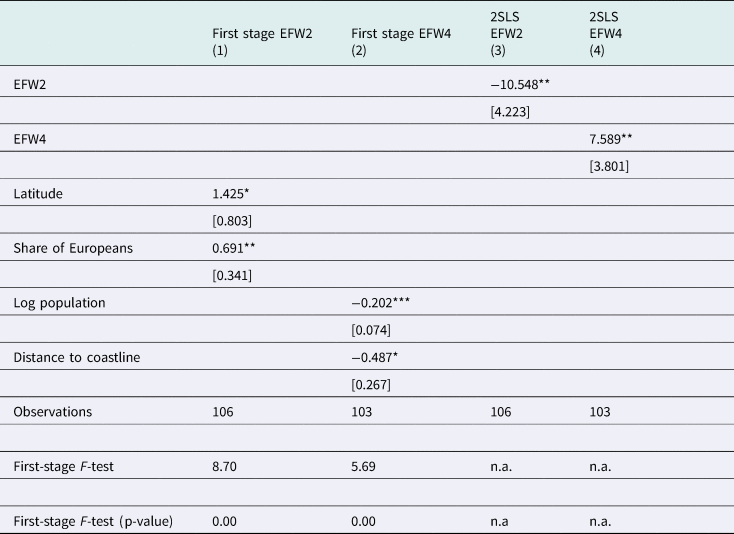
For a possibly causal interpretation, we apply an instrumental-variable approach using 2SLS, where the instruments are based on insights from the existing literature on economic freedom. As instruments for EFW2, we use the share of Europeans in the population (following Easterly and Levine, Reference Easterly and Levine2016; Gutmann and Voigt, Reference Gutmann and Voigt2018) and country latitudes, as temperate zones with higher latitudes have a better climate and disease environment, enabling the development of better institutions (Faria and Montesinos, Reference Faria and Montesinos2009; Rodrik et al., Reference Rodrik, Subramanian, A. and Trebbi2004). As instruments for EFW4, we use population size and mean country distance to the nearest coast.
As a final empirical exercise, we employ an interaction analysis to try to pinpoint some specific mechanisms through which economic freedom might affect antisemitism – in particular, GDP per capita, the average level of education and the religion shares.
For some descriptive illustrations of the data, see the online Appendix: Figure A1 is a map of the ADL index in our sample. There is great variation across countries, with low levels of antisemitism (an ADL index in the range 0–20) in, e.g. Scandinavian countries and North America, and high levels (an ADL index above 60) in the Maghreb countries and parts of the Middle East. Figure A2 illustrates the ADL Index scores in our European subsample, ranging from 4% (Sweden) to 67% (Greece), while Figure A3 plots the EFW index against the ADL index.
4. Empirical results
Baseline results
We use the following specification for our empirical analysis:

where Antisemitismi denotes the ADL index (or one of its 11 areas), where EFWi denotes the Economic Freedom of the World index (or one of its five areas) and where Xi is a vector of control variables for country i, including regional dummies and a dummy for the year 2015.
Table 1 presents the results. While the overall EFW index does not attain statistical significance, three of the areas do when included individually: EFW2, EFW3 and EFW4. While legal structure and security of property rights (EFW2) is related to lower levels of antisemitism (column 3), access to sound money (EFW3; column 4) and freedom to trade internationally (EFW4; column 5) are positively related to antisemitism. When we include all five areas of EFW in the same specification, in column 7, only legal structure and security of property rights (EFW2) and freedom to trade internationally (EFW4) remain statistically significant. The results suggest that a one-unit increase in these dimensions of economic freedom is associated with a lower share of antisemites (by 3.5 percentage points) in the case of EFW2 and with a higher share of antisemites (by 5.5 percentage points) in the case of EFW4.
Predictors of antisemitism

Note: Robust standard errors in brackets. ***p < 0.01, **p < 0.05, *p < 0.1. All regressions include regional dummies and a dummy for the year 2015.
These results can be connected to our theoretical framework of section 2 and are in line with the predications developed there. As we argued, the quality of the legal system (EFW2) reduces suspicions and fears that those who are different will engage in opportunistic behaviour, and this effect has also been shown to hold when it comes to other minorities. When it comes to the freedom to move goods, services and capital across borders (EFW4), we argued that this freedom, combined with folk-economic beliefs about the economy being essentially zero-sum and stereotypes of Jews being skilled international capitalists, can be expected to increase antisemitism.Footnote 12
Regarding the control variables, a higher level of economic development is associated with less antisemitism, and the same holds for the ratio of those outside of the labour force to those in it, implying that countries in which the working population cares for a large share of young and old dependents, this comes with more encompassing values. While antisemitism is lower when a relatively large share of the population in a country is Jewish, our measures of adherence to other religions are positive and often significant: A larger fraction of the population being Muslim or Christian is associated with more antisemitic views (although the significance is weak in the latter case). These results corroborate the findings of Gouda and Gutmann (Reference Gouda and Gutmann2020), who show that discrimination against religious minorities is higher in Muslim countries (specifically those implementing Sharia law), but also the result in Berggren et al. (Reference Berggren, Ljunge and Nilsson2019), which shows that tolerance towards gay people is lower among religious second-generation immigrants in Europe stemming from Muslim-dominated countries. Lastly, the higher the urban share of a population, the more antisemitism there is.
Results for different types of antisemitism
Since our dependent variable can be deconstructed into 11 separate indicators of antisemitism (listed in section 3), we have used each of these as dependent variables, with the same model specification as in Table 1, to gain further understanding of how to interpret the relationships. The results are available in Tables A3–A13 in the online Appendix.
The disaggregated analysis confirms that the quality of the legal system (EFW2) and international openness (EFW4) are the areas of economic freedom that are most clearly associated with different types of antisemitism. International openness is significant and positive in all but one specification – when the dependent variable measures whether people think that Jews still talk too much about what happened to them in the Holocaust – while the quality of the legal system is associated with less antisemitism in seven out of 11 cases. The fifth area of economic freedom, regulation of credit, labour and business, furthermore seems negatively related to antisemitic sentiments in five cases, but the results are only marginally significant. In terms of significance and magnitudes of the types of antisemitism that economic freedom is associated with, the relationships are stronger when the antisemitic attitudes concern control and power in business and financial markets, than when they deal with culture and heritage, arguably pointing towards stereotypes of Jews in relation to the market process.
Extended analysis
To provide further insights into the relationship between economic freedom and antisemitism, we proceed with a number of extended analysis. Based on our baseline findings, we focus on EFW2 and EFW4.
In the first extended analysis, we attempt to handle the potential endogeneity problem. As mentioned in section 3, we use instruments based on insights from the previous literature.
As can be seen in the first column of Table 2, the instruments are quite strongly correlated to the assumed endogenous variable EFW2, and have a reasonable F-statistic of 8.7. Similarly for EFW4: Column (2) reveals that the two instruments are significant with an F-statistic of about 5.7. The second stage (columns 3 and 4) indicates that the quality of the legal system is negatively and significantly related to antisemitism, while economic openness is positively and significantly related to antisemitism. This confirms our baseline findings and, possibly, a causal interpretation.
Economic freedom and antisemitism: IV analysis

Note: ***p < 0.01, **p < 0.05, *p < 0.1. The regressions include the same full set of control variables, region- and year dummies as before.
As a second exercise to gain further insights about mechanisms through which economic freedom influences antisemitism, we run regressions where we interact EFW2 and EFW4, respectively, with control variables that we consider potentially important from a theoretical perspective and/or that generally appear significant in baseline specifications. We focus on one dimension of economic freedom at the time. Figure A4 in the online Appendix plots the marginal effects of the two measures of economic freedom (with 95% confidence intervals) across levels of GDP per capita, average years of education and religious fractionalization.Footnote 13 We first note that all interaction effects are negative – the estimated coefficients become more negative or less positive in the values of the interacted variables. Second, the marginal effect of EFW2 is significant only at high levels of economic development, which suggests that the ability of the rule of law to counteract antisemitic attitudes is primarily present in wealthy countries. The marginal effect of EFW4 is significant across a larger part of the three distributions, and always at the lower end. The results indicate that economic development, human capital and exposure to a larger set of religions can have a cushioning effect, alleviating the positive impact of EFW4 on antisemitism – at least up to a point.
Figure A5 in the online Appendix shows the marginal effects of EFW2 and EFW4, respectively, when performing the same exercise for the variables urban population, age dependency and the share of Muslims in our countries. Across the two first variables, the interaction effect is again negative, while the estimated coefficients are more positive with higher values of Muslim share. The marginal effect of EFW2 is significant for high dependency ratio levels and for societies with a large share of urban population, suggesting that in very urban environments, and in societies where more than half of the population are dependent on others for their subsistence, the quality of the legal system seems to constrain the emergence of antisemitism. The marginal effect of EFW4 is significant across more or less the whole distribution of urban population and Muslim share, but in the first case it is decreasing and in the second case it is increasing. This indicates that the higher the share of urban people, the smaller is the antisemitism-inducing effect of an internationally free economy, while this effect is increasing in the share of Muslims in the country.Footnote 14
We next interact EFW4 with EFW2, as shown in Figure A6 in the online Appendix. One possibility is that the way that EFW4 relates to antisemitism is a function of EFW2 – and, indeed, for values of EFW2 up to about 6 on the 10-point scale, the higher the quality of the legal system, the smaller is the positive relationship between EFW4 and antisemitism. Hence, it seems as if strengthening EFW2 is one way through which a country opening up for more trade and capital movements can counteract an increase in antisemitism. In our sample, more than half of the countries have a value of EFW2 that is 6 or lower; the average value is 5.8.
Thirdly, we have replaced EFW2 and EFW4 by two related measures – the rule of law indicator (ROL) of Gutmann and Voigt (Reference Gutmann and Voigt2018) and the KOF Globalization Index of Gygli et al. (Reference Gygli, Haelg, Potrafke and Sturm2019). Reassuringly, the results of Table 1 hold in both cases. The findings also give some insights about what is driving these relationships. In the case of the quality of the legal system, it is checks and balances – reflecting the degree to which there are checks on the executive, judicial independence, judicial accountability and prosecutorial independence. In the case of openness, it is financial globalization. Details are presented, along with Tables A14 and A15a,b in the online appendix. These two more granular findings are quite in line with our theoretical framework.
Fourthly, we test whether a feature of our theoretical framework (arrow 5c in Figure 1) obtains support in the data, viz., that there is an interaction effect between people having folk-economic beliefs with a negative perception of the market economy and EFW4 in generating antisemitism. We test this using four attitudes from the World Values Survey. Our basic theoretical idea seems to obtain support through this interaction analysis: In each case, the positive point estimate of EFW4 is increasing in the degree of anti-market sentiments, and significantly for substantial parts of the distributions of the reply shares in three out of four cases. For example, the antisemitism-inducing effect of EFW4 increases in the share stating most strongly that competition is harmful as it brings out the worst in people, and this interaction effect is statistically significant for reply shares between 6% and 14%. Details are available in Figures A7–A10 in the online Appendix.
Lastly, we carry out some further sensitivity tests. The detailed results for the first two are presented in Table A16 in the online Appendix. First, we test the robustness of our results to the inclusion of disposable-income inequality, measured by the Gini coefficient. This exercise reduces our sample to 69 countries. EFW4 remains positive and significant while EFW2 remains negative and of the same magnitude, but less precisely estimated. The Gini is positive but insignificantly associated with antisemitism. Running our baseline specification (without Gini) on this smaller sample of countries suggests that it is the sample size rather than the inclusion of inequality that matters for the change in the significance of EFW2.
Since some studies cited above indicate that antisemitism relates to the historical spread of Protestantism, we also replace the share of Christians by both the contemporaneous and historical shares of Catholics and Protestants. While all coefficients for the share of Protestants and the share of Catholics are negative, none of them significantly correlates with the ADL index. When interacting religiosity with Protestantism, this relationship is never statistically significant at the 5% level, which suggests that the effect of Protestants cannot be shown to be relevant for antisemitism as the level of religiosity of Protestants varies. See Figures A11–A12 in the online Appendix. When interacting Protestantism and economic-freedom variables, we find quite weak indications of a role of Protestantism on how economic freedom affects antisemitism; see column 4 of Table A16 and Figures A13–14 in the online Appendix. Importantly, our baseline findings appear quite robust in taking Protestantism into consideration in various ways. Furthermore, Protestantism itself does not seem to play an important role in our sample of countries. We also replace the variable controlling for whether a country has a relatively large contemporary Jewish population with the corresponding information for around the year 1900. This replacement does not affect our baseline findings with respect to EFW2 or EFW4. The historical measure is positive but not significantly related to antisemitism.
Our next sensitivity test deals with the issue of model specification. Instead of choosing control variables ourselves, we use LASSO for a mechanical selection (Hastie et al., Reference Hastie, Tibshirani and Friedman2009). The set of potential control variables is the set of controls used in Table 1. One reason for this exercise is that this set is relatively large in relation to our sample size, which means that we may be ‘overcontrolling’; another that variable selection is made less subjective through this mechanical selection approach, and as such, it complements our own choice of variables. The results (Table A17) most importantly reveal that the two variables of economics freedom identified in Table 1 as being related to antisemitism (EFW2 and EFW4) are strongly significant and have the same signs as before. Otherwise it bears noting that the share of Muslims and the Middle East and North Africa (MENA) are strong predictors of antisemitism. We therefore also check if the results hold when excluding observations from MENA countries. This exercise reduces the number of observation to 92, but it does not change our baseline findings. Hence, the identified relationship is not exclusive to the MENA region.
We next conduct a systematic outlier check by performing a jackknife exercise. Re-testing the results of Table 1 by removing one observation at a time, results prove to be very stable for EFW2 and EFW4, both when introduced independently and in the specification including all EFW dimensions; see Table A18, where averages of all estimates are reported. We also exclude the two countries with the lowest values of EFW that could potentially be seen as outliers in Figure A3, but this does not affect our baseline findings.
Another concern might be that the two indicators civil liberties and political rights capture the quality of the legal system. We therefore replace them with a clean indicator of electoral democracy from Bjørnskov and Rode (Reference Bjørnskov and Rode2020) (Table A19). They suggest that electoral democracy is not necessarily a safeguard against antisemitism, and that our previous findings are robust to this variable change.
Next, since economic freedom is positively related to GDP per capita (Hall and Lawson, Reference Hall and Lawson2014), our inclusion of GDP per capita may confound our point estimates. We therefore (i) remove GDP per capita and (ii) estimate GDP per capita residuals and used them instead. Reassuringly, both exercises reveal that the economic-freedom estimates remain largely unchanged, both in terms of size and significance.
Another thing we check is whether the results change if the EFW2 and EFW4 are lagged by 5 or 10 years. Two things happen: the size of the estimated coefficients for the EFW variables is reduced a bit, and in the case of a 10-year lag, while statistically significant when included as the only EFW variable, EFW4 loses statistical significance when all EFW areas are included. This suggests a slightly stronger effect the closer in time to antisemitism that economic freedom is measured. For details, see Tables A20a,b.
As a last exercise, we test if our baseline results are sensitive to the inclusion of information on the country's historical experience with democracy, using data on democratic capital (Persson and Tabellini, Reference Persson and Tabellini2009). The idea is that experience of democracy accumulates in years of democracy and depreciates in years of autocracy. A country is classified as a democracy in a year if Polity2 takes a strictly positive value. Democratic capital is calculated from the year of independence or the year 1800 and takes a value between zero and one. Throughout the analysis, democratic capital is never significant and the inclusion of democratic capital as a control does not change baseline results.
5. Concluding remarks
The seemingly eternal presence of antisemitism may lead to the pessimistic conclusion that nothing can be done to combat it. While it seems nigh impossible to eradicate it fully, it is clearly the case that its prevalence varies across time and space. By trying to pinpoint country-level predictors of antisemitism, in particular the degree to which institutions and policies are market-oriented, we hope to contribute by giving new insights about factors that are related to, and possibly, through policy reforms, able to reduce, antisemitism.
Our theoretical starting point identifies two aspects of economic freedom that are relevant to the prevalence of antisemitism: the rule of law and the market process. The former denotes an effective and impartial legal system that upholds general rules. We expected it to reduce antisemitism by providing assurance to people in a society that opportunistic behaviour is prohibited and that the rules prohibiting it are effectively enforced. Such assurance can mitigate negative beliefs about Jews being out to exploit others. The latter – the market process – is enabled by institutions and policies and results in a set of outcomes, such as income, wealth and their distribution. We argued that two types of beliefs –– both imperfect and oftentimes erroneous – are applied as a filter by people when assessing market outcomes: stereotypes about Jews and folk economics. These make people prone to interpret the market process in such a way that giving it more reign increases antisemitism. More reliance on markets enable Jews, in the zero-sum game framework applied, to enrich themselves at the expense of others.
The empirical results largely support the theoretical predictions. Our indicator of the rule of law is negatively related to antisemitism in our cross-country sample, while our indicator of market openness is positively related to antisemitism. These results are quite robust across model specifications. Extended analysis, in the form of an instrumental-variable analysis, suggests that the results can tentatively be interpreted as causal, but we do not want to make any definite claims in this regard. Lastly, an interaction analysis reveals that the preventive effect of the rule of law on antisemitism is stronger in richer countries and where religious fractionalization is high, while the antisemitism-inducing effect of international openness is decreasing in GDP per capita, education level and religious fractionalization, up to a point. Moreover, in more than half of countries in our sample, with a below-average quality of the rule of law, it turns out that the positive relationship between market openness and antisemitism is decreasing with the quality of the rule of law. Hence, for such countries, reforms of the legal systems might counteract a tendency for market openness to induce antisemitism.
In his book on antisemitism, Baum (Reference Baum2012: 217–221) presents two possibilities when it comes to combatting antisemitism: education and defiance of social immorality. The suggestion regarding education receives some support in our interaction analysis, but we are able to add some further possibilities. Most centrally, that a strong rule of law seems important in providing a setting where attitudes to Jews are favourable – but also that a liberal market order can be interpreted in such a way as to breed antisemitism. This is not necessarily a reason to refrain from liberal policies in that area, but our results suggest that they might have to be combined with efforts to counter antisemitic tendencies. Some of our other findings give some hints as to what such efforts might be. For example, the share of Muslims is related to more antisemitism; and economic development seems, at later stages, to be able to stifle antisemitism. In the presence of continued antisemitism, we hope these results can provide fruitful input to public discourse on how to reduce this global problem.
Supplementary material
The supplementary material for this article can be found at https://doi.org/10.1017/S1744137420000466
Acknowledgements
We wish to thank Arye Hillman for inspiring us to undertake the research topic and Christian Bjørnskov, Jerg Gutmann and participants at the 2019 Spanish Public Choice Workshop at the University of Navarra, at the 2020 Workshop ‘How Important Is Culture in Shaping Economic Outcomes?’ at Radboud University Nijmegen and at the 2020 Danish Public Choice Workshop in Copenhagen for useful comments; Alexandra Allard and Marcos Demetry for excellent research assistance; and Jan Wallanders och Tom Hedelius stiftelse (grant P19-0180), Johan och Jakob Söderbergs stiftelse (grants 47/19, FA20-0001), the Czech Science Foundation (GA ČR) (grant 19-03102S) and Marianne och Marcus Wallenbergs Stiftelse (grant 2015.0048) for financial assistance.