1. INTRODUCTION
The dielectric function of coupled electron systems has received and stimulated considerable theoretical work and continues to present challenges as it is fundamental to the study of energy loss of ions in matter (Deutsch, Reference Deutsch1990; Gerike, Reference Gerike2002; Neff et al., Reference Neff, Knobloch, Hoffmann, Tauschwitz and Yu2006; Eisenbarth et al., Reference Eisenbarth, Rosmej, Shevelko, Blazevic and Hoffmann2007) or the properties of plasmas (Flowers & Itoh, Reference Flowers and Itoh1976; Ng et al., Reference Ng, Ao, Perrot, Dharma-Wardana and Foord2005; Fortmann et al., Reference Fortmann, Bornath, Redmer, Reinholz, Röpke, Schwarz and Thiele2009). The dynamic dielectric function (DF) of an undamped quantum electron gas was first calculated in the random phase approximation (RPA) by Lindhard (Reference Lindhard1954), and later this approach was extended to an electron gas at any degeneracy (Arista & Brandt, Reference Arista and Brandt1984). RPA is usually valid for high-velocity projectiles and in the weak coupling limit of an electron gas. But for partially coupled plasmas, RPA is not sufficient and electron collisions have to be taken into account.
It was suggested that the effects of these electron collisions could be incorporated in the RPA by assuming a finite relaxation time, τ. But this relaxation time approximation (RTA) fails to locally conserve the basic conservation laws for electron number, momentum, and energy. This results in a number of incorrect experimental predictions such as alteration of the static DF even if damping is just a dynamic phenomenon.
The first corrective measure taken to rectify this situation was carried out by Mermin (Reference Mermin1970) who was able to derive a DF that conserved electron number during collisions. This was achieved by using a relaxation-time approximation in which the collisions relax the driven electron distribution not to its global equilibrium distribution, but to a local equilibrium distribution specified by a local chemical potential μ(r,t). This number-conserving approximation has since been widely used to study the effects of scattering in several different systems such as solids (Garik & Ashcroft, Reference Garik and Ashcroft1980; Abril et al., Reference Abril, Garcia-Molina, Denton, Pérez-Pérez and Arista1998; Barriga-Carrasco & Garcia-Molina, Reference Barriga-Carrasco and Garcia-Molina2004), and plasmas (Selchow & Morawetz, Reference Selchow and Morawetz1999; Barriga-Carrasco, Reference Barriga-Carrasco2006, Reference Barriga-Carrasco2008a). Nevertheless, the Mermin DF violates the two remaining conservation laws and, in a one-component system of electrons, any mechanism that induces relaxation of a nonequilibrium electron distribution may not violate any of the three laws. Even if, in the presence of external sources, momentum loss does occur then energy conservation may not necessarily be affected as in the case of nonmagnetic static impurities.
In this work, it is shown how satisfaction of all three conservation laws, and various combinations thereof, may be achieved in determining the dynamic response of an electron gas. The proposed key to the solution is that the local equilibrium distribution must not only exhibit spatial and temporal variations in μ but also in the drift velocity v (to conserve momentum), and temperature T (to conserve energy). This idea has also been introduced, and implemented in the context of generalized quantum liquids (Röpke et al., Reference Röpke, Selchow, Wierling and Reinholz1999; Morawetz & Fuhrmann, Reference Morawetz and Fuhrmann2000; Atwal & Ashcroft, Reference Atwal and Ashcroft2002; Selchow et al., Reference Selchow, Röpke and Wierling2002). The aim of this work is to find a full conserving dielectric function as appropriate for one component quantum system of electrons at any degeneracy. We start calculating RPA and Mermin dielectric functions at any degeneracy (Barriga-Carrasco, Reference Barriga-Carrasco2007). Then we apply corrections from conservations laws to the RPA dielectric function to obtain the full conserving dielectric function.
2. RPA AND MERMIN DIELECTRIC FUNCTIONS AT ANY DEGENERACY
The RPA dielectric function is developed in terms of the wave number k and of the frequency ω provided by a consistent quantum mechanical analysis. We use atomic units (a.u.), e = ℏ = m e = 1, to simplify formulas.
The RPA analysis yields to the expression (Lindhard, Reference Lindhard1954)

where  . The temperature dependence is included through the Fermi-Dirac function

where β = 1/k BT and μ is the chemical potential of the plasma with electron density n e and temperature T. In this part of the analysis, we assume the absence of collisions so that the relaxation time tends to infinity, τ → ∞.
Analytic RPA DF for plasmas at any degeneracy can be obtained directly from Eq. (1) (Arista & Brandt, Reference Arista and Brandt1984)

where g(x) corresponds to

u = ω/kv F and z = k/2k F are the common dimensionless variables (Lindhard, Reference Lindhard1954). D = E F β is the degeneracy parameter and  is Fermi velocity in a.u.
As mentioned in the Introduction, the RPA is not sufficient for partially coupled plasmas and the target electron interactions have to be taken into account. The first corrective effect taken to rectify this situation was carried out by Mermin (Reference Mermin1970) who was able to derive a DF that conserved electron number during collisions

where εRPA(k,ω) is the RPA dielectric function from Eq. (3). Electron collisions are considered through their collision relaxation time, τ. It is easy to see that when τ → ∞, the Mermin function reproduces the RPA one.
3. FULL CONSERVING DIELECTRIC FUNCTION
Mermin DF violates the two remaining conservation laws, thus we need to extablished a new model: one-component system of electrons whereby electrons are only scattered by other electrons. Consequently, the dynamics of such scattering events are constrained by all the conservation laws. The one-component model has the additional virtue of allowing us to calculate dynamical local field corrections of the dielectric function arising entirely from electron-electron correlation effects.
In plasma physics, the polarization function, P(k, ω) is related to the dielectric function by

where V C(k) = 4π/k 2 is the Fourier -transformed Coulomb potential. Thus, we can obtain Mermin polarization function from Eq. (4) as

where P RPA (k, ω) is RPA polarization function and H x (k, ω) is the abbreviation

But if we want momentum to be conserved it is necessary to use a new polarization function (Morawetz & Fuhrmann, Reference Morawetz and Fuhrmann2000)

where

and

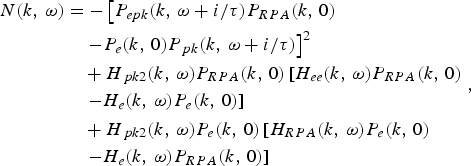
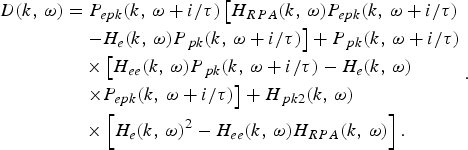
Finally, if our polarization function considers all three conservation laws (density, momentum and energy), the result is (Morawetz & Fuhrmann, Reference Morawetz and Fuhrmann2000)

where
and
We also need to define

where  is the expression for moments of the dynamic Lindhard polarizability function


Some important proprieties of the electron gas can be deduced from these last results. First, by taking the static limit ω → 0, we find ɛM,J,E (k, 0) = ɛRPA (k, 0) as expected, since relaxation processes have no relation at all with the static properties of the electron gas. Second, the full conserving dielectric function attains the correct static limit and obeys the perfect screening sum rule.
We can make comparisons of the full conserving dielectric function, ɛM,J,E (k, ω), with other common models proposed in the literature. The real and imaginary parts of the dielectric functions are compared in Figure 1 for a degenerate plasma, T = 0.056 eV and n e = 6·1022 cm−3, i.e., with degeneracy parameter D = 99.727. The finite relaxation time is set equal to τ = 16/E F. These parameters are the same as the ones used in Atwal and Ashcroft (Reference Atwal and Ashcroft2002) in order to corroborate our results.
(Color online) Real and imaginary parts of DF as a function of ω/E F for a degenerate plasma, T = 0.056 eV and n e = 6·1022 cm−3 (D = 99.727). The finite relaxation time is τ = 16/E F and the wave vector k = 0.2k F.

Solid lines represent RPA dielectric function from Eq. (3). When we consider the electron-electron collisions throught a finite relaxation time, RTA, the real and imaginary values are damped, but we did not recover the same RPA results as in the real case in the static limit, ω → 0. To solve that we can use the Mermin DF. In this case, the values are less damped but we obtain the same reults as in the RPA case for the static limit. But we know that the Mermin DF only conserves the number density violating the two remaining conservation laws. If we also consider momentum conservation, ɛM,J (k, ω), we get an important variation of all values approaching to the RPA values. This last calculation is very similar to the full conserving calculation, ɛM,J,E (k, ω). This means that energy conservation is not significant for our analysed degenerate plasma. It is not surprising that as we consider more conservation laws the behavior of the DFs more closely resembles the RPA as it is in this latter model that all the conservation laws are enforced.
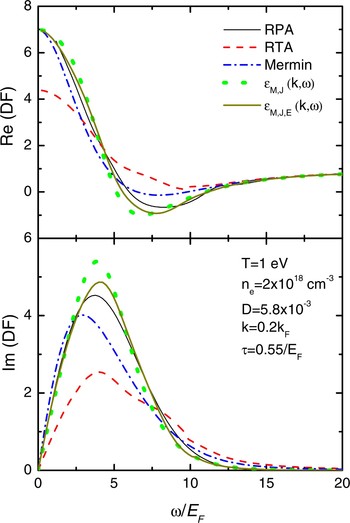
To check the reliability of our model at any degeneracy, we can repeat the calculation of the real and imaginary parts of the former dielectric functions for other plasma parameters. First, we choose temperature and electronic density values in order to consider a partially degenerate plasma, T = 10 eV and n e = 1023 cm−3. In this case, the degeneracy parameter is D = 0.785. The relaxation time is obtained from regarding only electron-electron collisions, τ = 2.65/E F (Barriga-Carrasco, Reference Barriga-Carrasco2008b). Figure 2 shows the real and imaginary parts of the RPA, RTA, Mermin, ɛM,J (k, ω), and ɛM,J,E (k, ω) dielectric functions as in Figure 1. Second, we consider a classical plasma, with T = 1 eV and n e = 2·1018 cm−3, resulting in a degeneracy parameter D = 5.8·10−3. These values, also with the relaxation time τ = 0.55/E F, are obtained from Morawetz and Fuhrmann (Reference Morawetz and Fuhrmann2000). Figure 3 shows the real and imaginary parts of the RPA, RTA, Mermin, ɛM,J (k, ω), and ɛM,J,E (k, ω) dielectric functions as in Figures 1 and 2.
(Color online) The same as Figure 1 for partially degenerate plasma, T = 10 eV and n e = 1023 cm−3 (D = 0.785). The finite relaxation time is τ = 2.65/E F and the wave vector k = 0.2k F.


The behavior of all functions for the partially degenerate and classical plasmas are similar to the degenerate case. When we consider electronic collisions through RTA, the values are damped with respect to the RPA ones. But if we consider the fulfilment of conservation laws one by one (Mermin, ɛM,J (k, ω) and ɛM,J,E (k, ω)) the results become closer to the RPA. It could be appreciated that damping produced by RTA and Mermin models and differences between full conserving dielectric function and RPA DF are more significant than for the degenerate case, but it is mainly due to the fact that the partially degenerate plasma and the classical plasma here analysed have low relaxation time values. Moreover the real part of RTA DF fails again in the static approach, and although it seems that the difference with full conserving dielectric function is more significant, that failure is also due to the relaxation time value. Another relevant issue is the fact that, for these partially degenerate and classical plasmas, the results for ɛM,J (k, ω) and ɛM,J,E (k, ω) are not very similar, meaning that energy conservation is more relevant in these occasions, because plasma temperature is higher.
4. CONCLUSIONS
The relaxation-time approach has been applied to the quantum dynamics of an electron gas where number, momentum, and energy are one by one conserved during collisions. The consequent dielectric responses have been determined and compared with others in the literature, revealing that, in general, that imposition of the conservation laws tends to make the full conserving dielectric response more similar to the RPA dielectric response than without it. In this paper, dielectric function is calculated when conservation laws are obeyed one by one, but it can be also calculated obeying them in different combinations.
The reliability of our model has been checked for other plasma degeneracy; concretely we have considered a partially degenerate plasma and a classical plasma. The behavior of the dielectric functions of these plasmas is similar to the degenerate cases. Differences among dielectric functions in these cases are more significant than for the degenerate case, but it is mainly due to low relaxation times. The most relevant issue for partially degenerate and classical plasmas is the fact that considering energy conservation in the dielectric function is more notable as plasma temperature is higher.
ACKNOWLEDGEMENTS
This work is supported by the Spanish Ministerio de Educación y Ciencia (under Projects FIS2006-05389 and RyC04) and the Consejería de Educación y Ciencia de la Junta de Comunidades de Castilla La Mancha (under Project PAI08-0182-3162).