

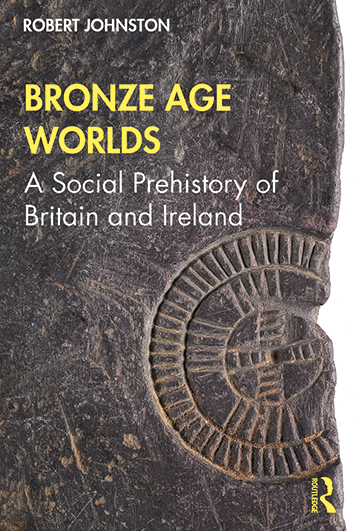
Robert Johnston's book outlines a social prehistory of Britain and Ireland in the Bronze Age rooted in analysis that centres kinship and relations. These concepts are brought together in response to two broader trends in archaeology: the emergence of relational theoretical approaches and the critique of them that argues they are often descriptive rather than explanatory; and the rise of aDNA analyses that often prioritise and privilege biological relatedness over other forms of more complex kinship, which anthropology reveals. These two threads are easily woven together and provide Johnston with a tool that he uses to produce narratives about how people related to each other, to objects, to animals and to places. Kinship and kinwork are presented as specific forms of relations, allowing Johnston to meet critiques about the generality of some relational approaches.
His approach to kinship is outlined in Chapter 1 and is built on five key premises (pp. 16–18). The first of these is that “kinship creates personhood and collective belonging”—this allows Johnston to keep his eye firmly on the human. The second is that “kinship associates people with nonhuman beings, things, and landscapes”—this gives him a broad definition, providing a means to think about how nonhumans and humans can share kinship; in so doing, it allows him to move beyond discussions of biological relatedness. The third premise is that “kinship is historically constituted, territorialised and codified” (theoreticians will notice the language of Deleuze and Guattari here). Johnston demonstrates in the text how kinship changes over time, rather than presenting a static image of relatedness. That “Kinship is made through the sharing of substances and presences” is the fourth premise. Again, it is used to show the reader that kinship need not be about biological relatedness alone, but can equally be produced through sharing with others. The final premise is that “kinship is creative, performative and political”, allowing Johnston to centre the performative aspects of Bronze Age events, from the burial of the dead to the deposition of a hoard, to the burning down of a house. He considers how such events performed kinwork and their effect on power and politics within communities.
The remainder of the book comprises three parts and a conclusion. The part on gifts addresses both mortuary practices and the deposition of metalwork and other items, touching on themes of relations, fragments and wholes. The part on dwellings considers the sweep of settlement evidence and what it tells us about kinship and domestic life. The final part, on landmarks, addresses the emergence of places in the Bronze Age, considering a wide range of evidence from burial mounds to rock art and field systems, and paints a picture of a living landscape where kinship emerged along with places and landscape features. Each part consists of a pair of chapters that are arranged chronologically. From the outset, Johnston tells us that he is avoiding the division of the Bronze Age either into sub-periods or by changes in artefact types, and instead prefers to work at the scale of centuries and decades (where possible). As a result, the linked chapters flow chronologically with some overlap within each pair, but with every chapter covering slightly different time ranges. The aim here is to better accommodate the “different rhythms, resolutions and asynchronies of change” (p. 18). In the conclusion, the three parts of the book are brought together to produce six discussions of kinship at the century level.
The text is clearly rooted in a deep engagement with relational theoretical approaches, but outside of the introduction it wears its theory quite lightly. Those familiar with relational approaches will notice the nods to new materialism, posthumanism, actor network theory and ontological approaches, but the text is not densely theoretical, giving it a broader appeal. The case studies are very well worked and demonstrate the power of theory to make us think anew. Johnston considers, for example, the dominance of monuments in the Early Bronze Age in contrast to the sparse evidence for settlement—a long-standing topic of study. Drawing on new materialism, he highlights the material choices that lead to a fragile domestic architecture in contrast to a durable, monumental one.
The descriptive and evocative text in this book is outstanding and a real strength that sets it apart. Johnston paints a picture for the reader through elegant description at the opening of each chapter. Having drawn you into his Bronze Age worlds, he then goes on to disrupt the image in order to make you view the Bronze Age differently and reconsider what you thought you knew. This is elegant archaeological writing that takes us beyond site reports and summaries and clearly presents the author's vision of the period and life in it.
Recent years have seen a flourishing of new books on the Bronze Age in Britain and Ireland, with even more in the pipeline. Johnston offers theory, period expertise and well-selected case studies that show his even-handed expertise across the period and geography. This is a book that covers key historic Bronze Age topics, such as the purpose of grave goods and the nature of life in roundhouses; current areas of fierce debate, such as the nature of migration in the emergence of the Bronze Age and the role of aDNA analyses in archaeology; and cutting-edge theoretical concerns around relations. The book is readable, accessible and detailed. Not only should it be on the shelf of every scholar of the Bronze Age, but also of archaeologists more widely.


