In this article, I explore Luciano Berio's conception of voice as a trigger to expectations of genre. I discuss his Recital I (for Cathy), a one-act/one-performer music theatre piece, the gestation of which marked Berio's speculation on voice and music theatre, both concerns that spanned his entire creative career. My research leads inevitably to the crucial role of the dedicatee in the creation and destiny of the work. Recital I, a quintessential homage to Cathy Berberian's virtuosity, is structured on musical quotations that both Berio and Berberian extrapolated from the singer's repertoire to fit the literary monologue of the libretto, and is thus idiomatically tailored to the singer's performative characteristics. In addition to participating in the creative process, Berberian took part in its choreographic and performative planning, as she stated in many biographical accounts.Footnote 4 Although Berberian's collaboration in the genesis of the musical collage is generally recognized, her participation in the finalization of the piece requires further consideration: it is this aspect that my work will develop.Footnote 5
In the following pages, I shall identify Berberian's contribution to the making of the literary monologue of Recital I, basing my observations on archival sources dated after the premiere of the work. I shall then move to consideration of the programme of Recital I at the time of its composition and in early performances, comparing its content at that time with its current form. In doing so, I shall necessarily engage with two cogent issues: on the one hand, the indisputable agency of Berberian and, on the other, the ‘open’ programmatic nature of the 1972 version, which has been totally obliterated in current published versions.Footnote 6 Finally, returning to the wider framework of twentieth-century musical monodramas scored for solo female interpreters, I shall present Recital I as a paradigmatic example of both the ‘problem of music theatre’ and Berio's exploration of the voice as a challenge to the audience's ‘horizons of expectation’.Footnote 7 Although focusing on this under-explored work raises numerous possible research topics, I shall limit my discussion here to a few aspects, leaving scope for future work.
Constructing drama ‘through the voice’
In his essay on musical drama, Carl Dahlhaus assigns equal weight to music and text in the construction of a dramaturgy, and highlights the lyrical implications of the immanent performance over the horizontality of the text:
Two dogmas have been in perpetual conflict throughout the history of theories of opera: the proposition that music is a means serving the dramatic end; and the contrary proposition that drama is a vehicle for the music. Both [are] founded on the same false premise, treating music and drama as antagonists, as if only one could be pre-eminent except when a final compromise is achievable . . . But the fact that drama can exist without music, as in the spoken genre, does not mean that in musical drama it constitutes a complete and self-sufficient element distinct from the music. A libretto is not a drama until music makes it one. It is the music that – under preconditions outlined in a libretto – constitutes the drama.Footnote 8
Recalling Joseph Kerman's discussion of the dramma per musica, Dahlhaus asserts that a musical drama is not only a drama with music but also ‘through music, by means of music’. Hence, music substantiates and amplifies the drama expressed in the literary text, to which it is intrinsically moulded.Footnote 9 Musical drama lives through the immanence of the performative momentum and therefore the two elements should neither be separated nor, even worse, set in competition with each other. In addition, Dahlhaus specifies:
Singing is the essence of operatic music, expressing as it does the present moment (it is significant that reminiscence motifs are almost always instrumental); and the musical present manifested in it is simultaneously the scenic present. Melodic expression, unlike verbal expression, does not reach beyond the present moment but exists entirely in the given situation; it isolates that situation and lifts it out of its context, so that what has gone before recedes into oblivion with no thought given to the consequences which will follow the particular moment.Footnote 10
In monologues in or with music, what we witness is a profound transformation of the structures and techniques of musical drama, which eschew conventional operatic settings, often giving way to the deliberate inconsistency of a hysterical stream of consciousness.Footnote 11 In such contexts, the bodily and vocal tessitura of the solo performer remain the only tangible dramaturgical media and the only material sources of on-stage dialectic between presence and absence, silence and noise, theatrical illusion and corporeal immanence. Only the performer's persona, with the lyrical legacy embedded in her voice and acting, maintains a connection between the ritualized setting of the musical monologue and the expectations of dramaturgical consequentiality instituted in the audience. Therefore, to paraphrase Dahlhaus, I argue that some of Berio's vocal works, and especially those which earned a performative quality by virtue of their implicit theatrical character fully realized by Berberian's original embodiment – Circles (1960), Visage (1961), Sequenza III (1965), and in particular Recital I (1972) (the latter more explicitly written for the stage) – are intended to be dramas not only ‘for the voice’, but also ‘through the voice’.
This formula is indeed applicable to Berio's conception of music theatre, which was a prominent subject in his writing. The author wrote extensively on and returned to the topic on several occasions, describing his approach to music theatre as the research and development of an implicit dramaturgy already emanating from the inner potential of the voice and its gestures.Footnote 12 For Berio, the sound of the human voice is always a quotation and a gesture, is inevitably ‘significant’, sparks associations, and brings its own self-contained model. Text and music operate within a hierarchy of relationships in which lexical and phonetic details may either be musically irrelevant, or may have thematic and generative value.Footnote 13 Furthermore:
The voice represents such a wealth of potential gestures that it becomes possible to use it alone, as tool for developing a concern with the simultaneity of different actions – that is, the concurrent but independent development of various characteristics of performance, resulting in a theatre of instrumental actions that allows the listener to perceive polyphonically what, by its very physical nature, is bound to be monodic. / The musical gesture as a whole, when developed, and when its linguistic connections are dialectically questioned, tends to become theatre. In music theatre the interpreters do not simply perform a musical work; they become actors who interpret themselves as the performers of music.Footnote 14
This polyphony emanates from the numerous languages combining to recreate the performative act, as well as from the intersubjective readings that composer, performer, and audience re-elaborate immanently, in a setting that turns any performance into a theatrical stage in its own right. Berio played a primary role in the transition from opera to music theatre in post-Second World War Italy. Contemporary authors, such as Bussotti, Pousseur, and Kagel, contributed to the exploration of interdisciplinary pathways that could have better rendered the staged fragmentation of the complex unity that had characterized the epitome of opera, and were especially interested in possible suggestions from experimental theatre, dance, and electro-acoustic practices. They experienced modes of operatic composition, especially the traditional mechanisms of the music–text setting, as limiting and claustrophobic, and considered opera to be an anachronistic genre.Footnote 15 In Berio's view, opera was no longer a form that could assume a relevant role in contemporary society but more of a manner, unable to regenerate itself, and destined only to paraphrase older models.Footnote 16 His criticism of contemporary opera and the operatic market stemmed from a profound distrust of the political meanings assigned by contemporary cultures to operatic performances and its ‘temples’, and the deployment of substantial resources to revive operatic productions, much to the detriment of performative languages and artistic manifestations that responded more immediately to the anxieties of the times.Footnote 17 For Berio and many other contemporary composers, addressing the operatic form and its anachronistic ideologies would only result in a kitsch operation, a failed attempt to revive a still important aspect of the past but which belonged more to the praxis of conservation than of renewal. Such positions certainly underpinned their efforts to create vocal and dramaturgical alternatives through music theatre, and more specifically by fostering new uses of the operatic voice.Footnote 18 However, Berio's quest for music theatre was far more articulate than that, as he also expressed, for instance, in a lecture he gave in Siena in 1995:
We are close to an idea of theatre that is a theatre of the mind and of the memory, even a virtual theatre, which invites a continuous oscillation of our attention from listening to watching, and again to listening, a theatre able constructively to challenge those who watch and listen, and that provokes the desire to listen through the gaze and watch through the ears . . . we think of a theatre that is not made necessarily understandable only by the specific things we see and hear, but also by the desire to penetrate, discover and confound the different tempi of sounds and images.Footnote 19
This theatre of mind and memory, with its ability to trigger synaesthetic effects, seems to be perfectly represented in the polysemic stream of consciousness produced by Recital I. The composer often associated his notion of music theatre with the aesthetics of the baroque stile rappresentativo, with its potential to represent reality in multiple ways and to experiment with the possibility of integrating and discovering, through music, different levels of experience.Footnote 20 This particular aspect is key to grasping his mimetic approach to the representation of consciousness, and is especially typical of his stage works conceived for solo performer. Berio's attention was oriented to the realm of the performance, which he lived as a more dynamic space, free from fixed operatic conventions. This conception assigned an intrinsic role in the artistic production to the recipient of the artistic medium, and presented the opportunity for music theatre to be lived as a genre in which ‘the wall between audience and stage was thin’, in which audience was called to decide on the meaning of the action, rather than relegated to being an object of its seduction.Footnote 21
In traditional opera, the spectator is tense with respect to the ending; the course of events is linear and grows from scene to scene; the music duplicates the text, illustrates and paints the psychic situation. In music theatre, the spectator is tense with respect to the sequence of events presented as a collage of separate situations; the music presupposes the text and takes on an attitude as a function of behaviour.Footnote 22
The intertextual correspondence instituted between the ‘work’ and the subjectivities of composer and recipient, actively filtered through that of the performer, foregrounded the basis for the ‘distributed creativity’ of the performance process.Footnote 23 The composer offered to the audience the tools to reconstruct the text and turn it into a subjective experience. Berio's compositional aesthetics were intrinsically driven by the contributions of semiotics and linguistics to the contemporary development of communication. Tenets from theories formulated by Ferdinand de Saussure and Roman Jakobson, as well as from a personal and intellectual relationship with Umberto Eco, who played a militant role in the development of contemporary European literature and philosophy, were fundamental to Berio's construction of his own aesthetics and programming of his works.
In an interview released in 1986, Eco and Berio discuss the interface between voice and genre.Footnote 24
My question starts from the presumption that you were carrying out experiments on the voice. Now if I'm right, it appears that you also experiment on the genre. The voice is a material that, like all materials, carries within it the history of the ways in which it was used. A genre is a social convention that, like all social conventions, produces ‘horizons of expectation’ on the part of the recipient, the ‘performance consumer’.Footnote 25
Here, Eco and Berio engage with the two concepts reflected in the aesthetics of composition and contemporary music theatre, supporting their views with Hans-Robert Jauss's notion of ‘horizons of expectation’, which is still prominent in contemporary reception studies.Footnote 26 The horizon of expectations is associated with the ‘recipient’ of the cultural artefact.Footnote 27 While the term ‘recipient’ avoids the specificity of ‘audience’, Eco and Berio seem to establish a direct connection between the term and the audience's agency as cultural consumer. The notion of the recipient recalls the semiotic theories enunciated by Eco in his Trattato di Semiotica Generale, in which Eco had already explained the mechanisms of communication in correspondence between cultural consumerism and the audience's ‘horizons of expectation’.Footnote 28 The performance consumer is a recipient who performs a deliberate political act in choosing one cultural product over another. For Eco, a work might be deemed successful in two ways: either by fulfilling such expectations or by being able to drag such horizons towards the work itself in original ways.Footnote 29
According to Eco, Berio conceived of the voice as a ‘material to be used’, assigning to it an instrumental quality capable of affecting the audience's perception of genre. The latter was conceived not as a normative set of formal structures governing the compositional process in programmatic terms but as a ‘social convention’ imposed by the recipient's perception, and perhaps only seconded by the composer. For instance, an opera-goer responds to predetermined rituals inherited from long-standing conventions in the consumption of operatic performances. The audience's aesthetic experience plays a fundamental role in assigning value to the cultural artefact, and represents a political act per se. Berio's answering arguments provide a window onto his approach to vocal writing, as they closely scrutinize semantically charged aspects of the operatic voice:
A few minutes ago you talked about the voice as if it were the discriminating element between what is and is not opera. It is more or less true that a performance presented in a large opera theatre needs great ‘operatic’ voices, meaning voices able to travel from the stage to the balcony, soaring over a symphonic orchestra. It is also true, for instance, that the voice of Cathy Berberian required other types of spaces, more intimate and homogeneous, where it would be possible to catch the smallest details of her voice and face, of those particular – and I would say microscopic – details, which allowed the music to penetrate with great subtlety into the totality of her vocal make-up – all those aspects, ultimately, that the singer of operatic ‘bel canto’ must necessarily neglect. However, I believe that the matter is of a different nature, otherwise it would have sufficed to give Cathy a microphone and . . . to request Pavarotti to sing with his legs up. The fact is that, when hearing operatic singing, your ‘performance consumer’ has a Pavlovian need for definitive, linear narrations capable of provoking tension about the outcome, rather than, as Brecht said, the development of the story. To conclude, I would say that styles and singing techniques are fundamental elements in providing meaning to the horizons of expectation of your ‘performance consumer’. The important thing is to use these vocal modes appropriately and, again as Brecht would say, with a certain detachment. This is all part of the dramaturgical substance, deliberately ambiguous, of La vera storia and Un re in ascolto.Footnote 30
This exchange between Eco and Berio is fertile even in its narrow context. For instance, it highlights Brecht's influence on Berio's dramaturgy, as well as the intrinsic association made by the composer between his vocal writing and Cathy Berberian's voice. Most consistently with the objectives of this article, it foregrounds the mutual inspiration they brought to each other's developing theories. According to Berio, identification of the ‘operatic voice’ with its narrative linearity is fundamental to meeting the ‘horizons of expectation’ of the opera ‘consumer’. In this process of recognition, vocal styles and singing techniques represent semiotic landmarks that help orientate the spectator's involvement within a logical dramaturgical construction. The objective of subverting the conventional identification of specific vocal idioms into recognizable forms of cultural pampering led, at least at a programmatic level, to Berio's quest for alternative dramatic solutions that passed through the voice and its multifaceted evocative potential. This process was made possible, at least in its early stages, by his proximity to the extraordinary qualities of Cathy Berberian. Through her imposing presence, her exceptional vocal versatility and performance intelligence not only partly inspired this search but also proved that such alternatives might be plausible and successful, thus enabling Berio's speculations at an engaging performative level. Berberian contributed heavily to incarnate the implicit theatricality of some of Berio's works of the 1950s and 1960s (Chamber Music [1953], Circles [1960], Visage [1961], Epifanie [1960–3]) not originally conceived for the stage, and also created an embodied vocal vocabulary that responded to Berio's creative impulses in works composed in the studio. At a later stage, as an independent performer emancipated from dyadic identification with the Italian composer, by applying her encompassing theatrical vocation to diverse styles and genres, Berberian reduced the most conventional recital settings to the stage; commissioned vocal parodies of canonical instrumental repertoire; paraphrased Beatles’ songs mocking the most reassuringly conventional vocal styles; created a disarming concoction of pop culture with modes and languages of contemporary art music, in ways that were new in the post-Second World War European avant-garde; presented avant-garde works in seamless performative settings, allowing a wider diffusion of the repertoire; and reinterpreted operatic scenes asserting the operatic voice as more than simply full sonic power. Most importantly, Berberian was the first twentieth-century vocal performer to gather her vocal creed into a manifesto, The New Vocality, a legacy left for future generations of performers, whom she empowered as ‘composers of their own performance’.Footnote 31
Issues of voice and genre in Recital I
Inquiring into genre in Recital I may seem pointless; however, the work has rarely featured in scholarship on Berio's music theatre, even though it straddled the most prolific periods of Berio's vocal writing and his most successful stage works. The composer himself seldom mentioned the work in his known interviews and writings. In my opinion, Recital I is instead a crucial link between Berio's vocal experimentations and his ongoing discovery of the morphogenetic potential of voice and language in his theatre writing, as expressed in the above-mentioned interview with Eco.Footnote 32
In his overview of Berio's theatre works, David Osmond-Smith, who closely worked on Berio until his untimely death, associates Recital I with works dealing with ‘performance neuroses’, especially Melodrama (1970), a short musical monologue for tenor initially conceived as a section of Opera but which then lived on as a solo stage work for tenor and orchestra. Both monologues are structured as a stream of consciousness and are immersed in a Monteverdian aura. Osmond-Smith also refers here to an extensive study of Recital I in the making, an essay which he probably planned but never published.Footnote 33
David Metzer and Clare Brady devote their attention instead to the assemblage of Recital I, positioning the work within the postmodern discourse on quotation, authorship and cultural meaning.Footnote 34 Metzer, in particular, frames the work and its use of fragment and quotation as a depiction of the topoi of madness and memory, and legitimately places Recital I within the tradition of neurotic scenes. Susan Youens also focuses her attention on this aspect of the work, especially the topos of memory and identity in one of the earliest published scholarly account of Recital I.Footnote 35
The most recent scholarship on Berberian provides further factual evidence about the work. Berberian's biographer, Marie-Christine Vila, outlines its genesis, basing her description mainly on the contemporary musical press, as well as on both published and unpublished interviews released by Berberian.Footnote 36 I also dealt briefly with the work in my Master's thesis, bringing to light a few unedited documents in my overview of primary sources.Footnote 37 Kate Meehan takes this approach further, mapping out the genesis of the work and supporting her discussion with other valuable primary sources.Footnote 38 She describes the work as a locus for the display of vocal styles and ranges that Berberian had already explored in pieces such as John Cage's Aria and Berio's Sequenza III. Giovanni Cestino's unpublished thesis presents further insights into the sources of Recital I, and thoroughly explores the performative agenda of the piece, framing his discussion within the philological perspective he adopts to reconstruct Berberian's approach to performance.Footnote 39
Recital I (for Cathy) was created by Berberian in Lisbon on 27 May 1972 for the Calouste Gulbenkian Foundation, with the Orchestra Gulbenkian conducted by Berio. Its original literary material is by Edoardo Sanguineti, Andrea Mosetti, and Luciano Berio.Footnote 40 While most of Berio's stage works carry a subtitle that identifies his concept of the work and testify to the engagement he sustained throughout his career with the concept of ‘genre‘, Recital I, just like Opera, lacks any reference to genre in its subtitle ‘Per mezzosoprano e 17 strumenti (1972)’.Footnote 41 Biographical entries on the composer list the work among either his vocal works or theatre pieces.Footnote 42 This ambiguity is actually noted by Raymond Fearn, who again mentions Recital I in association with Melodrama and Opera:
It is clear that in the work of Berio, not only is it often difficult to isolate ‘stage’ compositions as a separate and distinct entity for consideration, but that indeed, the interweaving of all his compositions, as well as the often ‘theatrical’ character of even the smallest solo or chamber composition could almost draw such compositions into the orbit of our consideration here, and certainly this is the case with Recital I (for Cathy).Footnote 43
Fearn also makes observations on the musical construction of the work, based on multiple musical quotations that piece together the pathological condition of the protagonist, who is stranded and even ‘imprisoned’ by the performance rituals she evokes through her polystylistic singing and spoken monologue.Footnote 44 Fearn defines Recital I as a ‘drama of the voice’, and scrutinizes the drastic, ritualized epilogue of the singer's neurotic monologue, linking the dramaturgical themes of the work to larger-scale compositions such as Opera, Passaggio, and Un re in ascolto.Footnote 45
As a whole, Recital I deploys features recognizable in the majority of twentieth-century melodramas: it is in one act; its duration is less than an hour; it is scored for a solo female interpreter; and, most importantly, it is a large-scale staging of an introspective journey by the psychological protagonist, through a stream of consciousness projected through both the spoken and the singing voice.Footnote 46
The work is, in fact, the ‘terrifying revelation’ of a cant'attrice (a singing actress) who comes to the stage to perform a recital, and whose performance gradually turns into her own biographical vicissitudes.Footnote 47 Her opening number, Monteverdi's La lettera amorosa, is suddenly disrupted by the unexpected absence of her accompanist. Outraged, the singer interrupts her solo scene to switch to a fragment of ‘Amor’ from Il lamento della ninfa, seemingly a metaphor for her present condition. After leaving the stage disappointed, the singer makes her way back, this time to deliver a monologue. From this moment on, her personal frustrations become progressively apparent. In her hysterical outbursts, she addresses her absent on-stage collaborators and even her audience in a final dramatic infringement of the fourth wall. Throughout the monologue, her spoken words and scattered musical quotations, the interplay with the orchestra, and the interference of the Wardrobe Mistress, who arrives to piece together her costume, all concur to highlight her breakdown and final descent into madness. Besides the protagonist and the Wardrobe Mistress, five masked instrumentalists enter and quietly gravitate around the singer, accentuating the surreal atmosphere of the drama; an on-stage pianist also interacts silently with the diva, while a few orchestral players from time to time echo the protagonist's words from the main monologue. The theatrical purpose of Recital I is also inferred from the score, which provides stage directions and indications about set, costumes, and lighting.
Fearn's definition of ‘drama of the voice’ fits the psychoanalytic quality of Recital I, in which the protagonist's public and private voices are amplified and intertwined to create a progressively dramatic crescendo. Fearn's definition also ties in well with the notion of ‘dramaturgy of the voice’, adopted by Di Luzio to describe Berio's vocal works. In particular, Di Luzio discusses the relationship between Berio and Sanguineti as vital to Berio's conception of theatre and vocality, and makes frequent reference to Sanguineti's essay La messa in scena della parola. Footnote 48 In works by Sanguineti and Berio, the gestuality of the ‘scene’ moulds ‘a sound dimension’ and a kind of ‘implicit theatricality’, where the sound gesture transcends the usual modes of visual representation.Footnote 49
Recital I fits within the field of ‘implicit theatricality’, ascribed to the constitutive role played by the dedicatee in the work's agenda. It might easily be inferred that any vocal work conceived for Berberian was destined to be inherently theatrical, since the singer's attitude was unavoidably performative. As Berio also said of Sequenza III, these were not only works ‘for Cathy’ but also ‘about Cathy’.Footnote 50 The same consideration fits other works inextricably linked with her vocal intelligence and scenic presence, as well as her own contribution to the formulation of the choreography, mise en scène, and costumes.Footnote 51
In his reflection on the embodied performative aspect of Circles (1960), Giordano Ferrari refers to the body as a ‘site’ (luogo) per se, which is not subjected to but actually generative of the musical and dramaturgical space. In Berio's theatre, the action springs from the ‘site’, which is a significant element per se, and not simply an adaptation to the theatrical space. To this end, the body represents one of the most structural devices of Berio's writing for music theatre, through a corporeality that emanates from a vocal writing composed in collaboration with Cathy Berberian; thus, the word becomes the source of corporeal elements that transcend the music to become theatrical, sometimes amplified through electro-acoustic manipulation.Footnote 52
Furthermore, Ferrari describes the exploration of the word and its verbal performance as one of the main elements generating this embodied theatrical space. Just as in Circles, which Berberian heavily moulded in terms of choreographic and performative devices – eventually becoming integrated into the piece itself – Recital I epitomizes the theatrical amplification of the word, expressed through ‘vocal modes’ and validated by an embedded dramatic corporeality.Footnote 53 In Recital I, a strong Berberianesque stamp characterizes the virtual identity of the dedicatee Cathy, which both Berberian and Berio fashioned through the use of musical quotations as a subjective response to the imagery evoked in the script.Footnote 54 In this case, however, the performative manufacturing of the work is profoundly integrated into its textual elaboration.Footnote 55
Recital I: the script
Translation, textual interpolation, and assemblage are intrinsic to the genesis and development of Recital I. Mosetti and Sanguineti's original text in the early 1960s did not initially satisfy the composer.Footnote 56 According to Berio and Berberian's correspondence, the composer took over the task, and in tandem with Berberian set to work to create both the monologue and the collection of excerpts to be inserted into the piece.Footnote 57 In 1966, Berberian wrote to Andriessen that she was ‘busy translating Andrea Mosetti's libretto for Recital I’.Footnote 58 This revision process resulted in a text forged specifically by Berio, ‘with occasional reference to texts by Andrea Mosetti and Edoardo Sanguineti’ and defined by Berberian as a ‘minestrone’.Footnote 59 In fact, throughout the whole process, the primacy of Berio's hand in compiling, collating, and editing the Italian libretto is indisputable. A collage within the collage per se, the literary text contains a number of more or less identifiable quotations by other authors, and even excerpts from letters and private exchanges between the composer and his friends and colleagues.Footnote 60
In a letter dated January 1972 from Berberian to Elena Hift, a musicologist working as a consultant at Universal Edition, Berberian describes early preparatory work undertaken on Recital I but also announces that Berio has asked her to perform Melodrama in Lyon:Footnote 61
Dear Elena
1) Included is a list of the excerpts I've submitted to Luciano to be set into his ‘Recital I for Cathy’ – as you will see, I have attempted to save you extra work by putting Public Domain on one page and the others on the other. Aren't I a good girl?
2) Next item – I can give you more or less the instruments Luciano has ‘provvisoriamente definitive’ decided for ‘Recital I’: 2 clarinets, 2 oboes, 1 bassoon, 1 horn, 1 trumpet, 1 trombone, 4 strings, percussion, 3 keyboards, harp (?) – plus conductor Nicholas is still negotiating for Lisbon.
3) Luciano has intention of using me in ‘Opera’ at Lyon. As a matter of fact he is thinking of changing Melodrama around to suit me – besides some other things. Melodrama is not one of my favorite pieces but maybe if he changes it, I can do something with it. But I cannot get to Lyon before October 2nd in the evening.
. . .
6) I tried to discuss the French translation of Opera [sic] with Luciano explaining how difficult if not impossible it was to do anything without the music but he evaded the issue. Anne [sic] Neuberger is worried but feels that UE has everything in hand.Footnote 62
From a biographical perspective, this letter illuminates Berberian's prominent administrative role in her work partnership with Berio, even after their separation in 1964/65. Indeed, Berberian kept a strong hold on the works that Berio composed for her, and regularly supervised negotiations in the performance and publication processes. In this case, Berberian, whom Berio had asked to realize a musical collage with excerpts from her repertoire, contacted the publishing house herself to ascertain whether copyright issues regarding the quoted excerpts had been resolved. This concern remained constant throughout the composition of the work, as shown in extensive correspondence with Universal Edition.Footnote 63 The passage also highlights the simultaneous vicissitudes of Opera (composed in 1969, revised between 1970 and 1977), and in particular Melodrama and its season of revisions. Ultimately, Berberian's letter to Hift provides insights into Berio's modus operandi with regard to translation, which was a constant preoccupation in his work, and an interest cultivated with and supervised by Berberian from the earliest years of their partnership.Footnote 64
In an unedited interview released by Berberian in 1981, the singer provides a few insights into the premiere of the work:
I'm trying to remember the year . . . I believe we were supposed to go to Lisbon first; we were doing this piece with the London Sinfonietta; either that, or we went first to London; but I don't think so, no, noFootnote 65 . . . It was Lisbon, because I remember that I did all the work on the score in Lisbon. That is, I searched for the musical references because there were about forty fragments from my repertoire that needed to be inserted in the text, and I inserted them where I thought they would go well, while taking into consideration my own vocal requirements, you know?Footnote 66
Despite Berberian's hazy memory of the episode, it seems nevertheless clear that Berio asked the singer to insert musical excerpts from her repertoire into the script while he worked on the orchestral setting, and that she busied herself with this task right up to the time of the premiere, to the point that she was unable to memorize the piece for the premiere:
That's fine, but I didn't have the time to learn it by heart! So I thought – I already had the collage with the text and music, that I had someone photocopy for my accompanist, the pianist . . . but how will I manage to do it on stage? Well, I already had the costume, which had been commissioned from an Austrian friend.Footnote 67 I had already done my rehearsals and I had the costume. So . . . what did I do? I went and asked the artistic staff there at the foundation for help: I had these huge sheets of paper for the score, I mean, for the text and this musical insertions, and I had someone make these collages on the back of each page, with different colours, artful, so that when I was holding this stack of papers in my hands, that is what you would see on the last one . . . and then I would pull one out and throw it on the floor just like a diva throws her script pages on the floor, one by one, as she reads them, get it? It was the only trick that would save me for the premiere because I didn't have any time [to memorize it].Footnote 68
Prior to the premiere, Berberian apparently urged Berio to shorten the piece, advice that the composer ignored at the time.Footnote 69 In Berberian's view, the work's mixed reception at the premiere was due to its excessive length, whereas its success was due mainly to her vocal virtuosity in delivering the different vocal styles.Footnote 70
After the premiere, Berio and Berberian decided to edit the Italian text, so the singer undertook the work of editing and translating the existing script:
So then we decided to do it in English, because in Italian it was too boring . . . well, you know, it's that only some of the things that Andrea had written had a certain colour, and the things that Luciano had written were not too . . . interesting. So I translated it into English, inserting some sentences of my own, a little bit provocative, like phrases between me and Luciano that he would recognize, and then we performed it in Holland.Footnote 71
Berberian translated the script into English and inserted some of her own sentences for the Dutch premiere. Between the first and second performances of the piece, Berio was finally persuaded to shorten it.
So I believe that I performed it by heart, but I kept saying:
Luciano, it's too long; the text needs to be cut, cut!
– No, no, no, no.
We had the premiere and after the premiere he says:
– We have to cut.
And I say:
– Well, how should we do it?
There was only a day off before the second performance, and he says:
– You do it and then show it to me.
And so I did it with a friend of mine, who was also his friend, an Armenian ladyFootnote 72 . . . We did it together, but mostly me, and then we showed it to him. He said that it was fine, that it was fine just like that. So I learned it by heart, I learned the cuts, and we did it, and it was already so much better – so much better. And this was Recital.Footnote 73
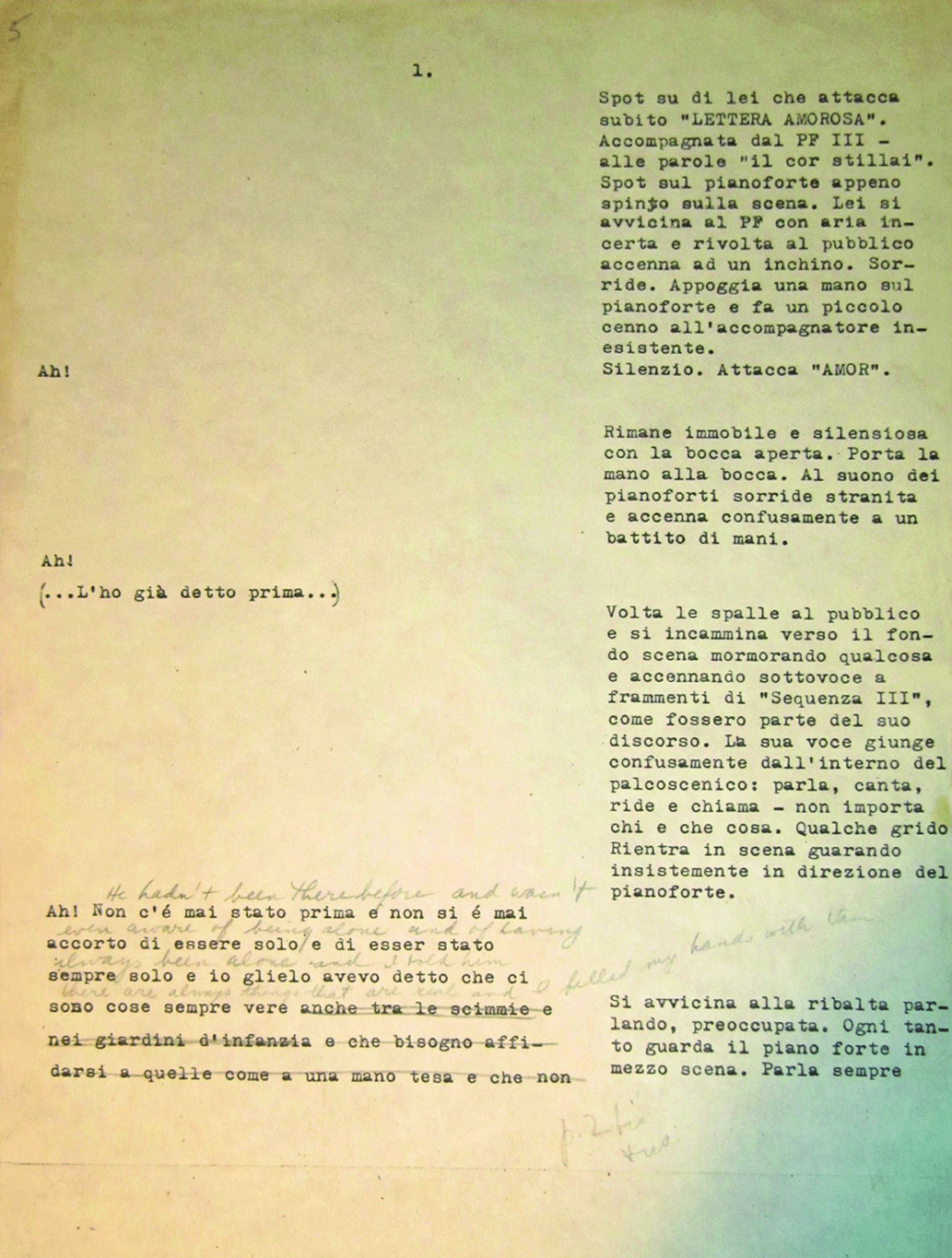
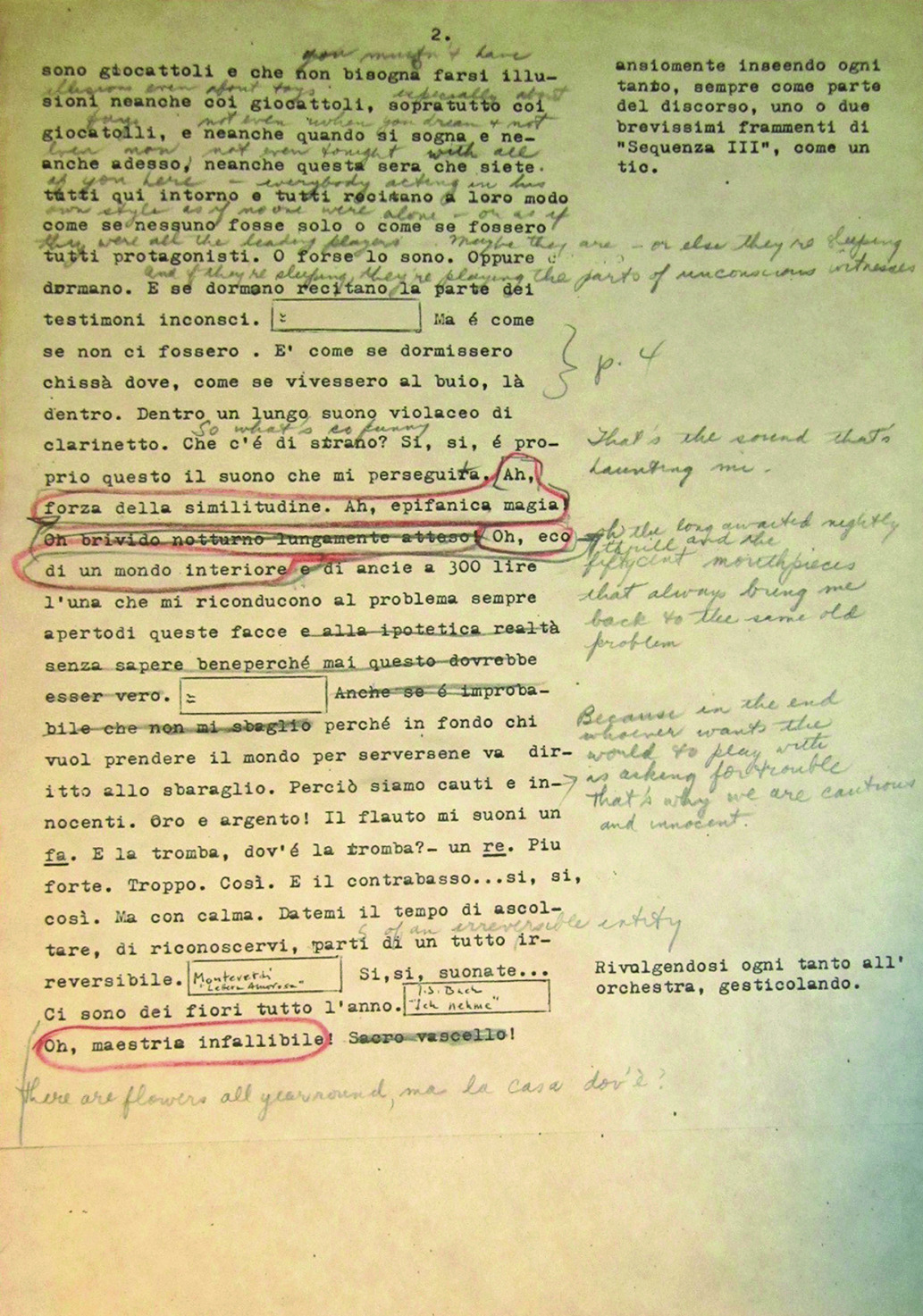
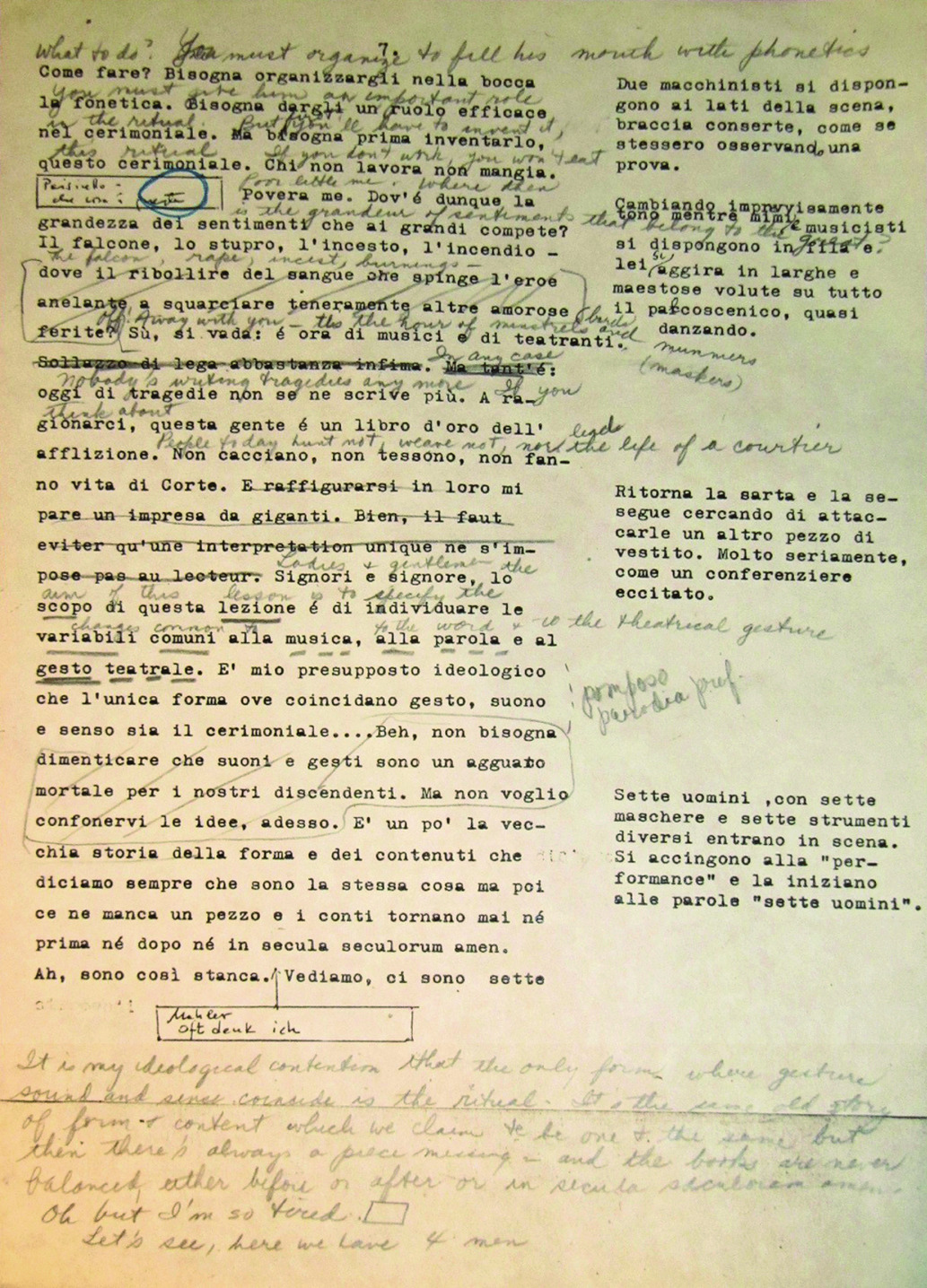
Primary sources relating to the editing work undertaken by Berberian after the premiere in Lisbon are given in Appendix A, where I include my transcription of the full script, here partially presented in Figures 1, 2, and 3. Berberian's handwritten English translation appears between the lines or alongside the typed libretto, which also presents a number of cuts, erasures, and insertions. The latter were possibly the result of further re-elaboration, proposed by Berberian and supervised by Berio, that occurred between the two Dutch performances.
Page 1 of typescript copy of Recital I monologue with Luciano Berio's and Cathy Berberian's handwritten annotation (PSS, SCBE).

Page 2 of typescript copy of Recital I monologue with Luciano Berio's and Cathy Berberian's handwritten annotation (PSS, SCBE).

Page 7 of typescript copy of Recital I monologue with Luciano Berio's and Cathy Berberian's handwritten annotation (PSS, SCBE).

Through her editorial work, Berberian produced a more subjective and concise interpretation of the existing monologue and its symbolic unfolding, thus further personalizing and adding to the underlying refined, ironic commentary on the protagonist's stream of consciousness. In fact, much of the text deleted on this occasion does not appear in the published score, which was possibly the result of a further stage of editorial work carried out by both singer and composer for the first Italian performance in Venice in September 1972 and its subsequent recording in 1973.Footnote 74
Having provided insights into the costume and set for the first performance, Berberian thus concludes her description of the work:
It's a sort of catharsis that this woman, this former singer, experiences in a nursing home, and at this moment, at this point, she loses control of her voice. I mean, she gets stuck in three notes and cannot get out, and the text is from Libera nos. And it is absolutely excruciating, you know, excruciating. You have to listen to it to understand how excruciating it really is, and see it too. We might do it in December in Milan. Anyway, it's a work that affects you. It hasn't always been highly appreciated because people usually say it's just a collage and so on, but I believe it will be re-evaluated in the future, because besides that, there's the fact that it can also be suited to other singers with their own repertoire.Footnote 75 Because for each musical insertion, he planned two or three different keys; so, if someone is a soprano, and does not feel like doing, I don't know, Carmen, she can use something else as a musical insertion, you know: it's flexible.Footnote 76
Berberian reveals that Recital I was conceived as an ‘open work’, designed to leave the performer free to piece together the musical collage suggested by the monologue. Apparently, in the early stages, the adaptability of the work was not limited to the vocal collage, but also applied to the spoken improvisation that Berberian would perform in the ‘Lesson’ section of the work.Footnote 77 The ‘flexible’ nature of the 1972 work recalls the values expressed by Eco in Opera aperta, and which other avant-garde composers of the time adopted on many occasions.Footnote 78 However, possibly soon after Berberian's 1981 interview, Recital I had already undergone structural changes. The full score published by Universal Editions presents in fact all insertions outlined by Berio and Berberian in their exchange embedded in the musical text.
Further work in conjunction with the autograph score of Recital I, which is currently unavailable for consultation, would allow further insights. Although new documents are apparently being acquired and catalogued by the Paul Sacher Foundation, the only currently accessible full score manuscript looks more like a Reinschrift than the working draft to which Berberian and Berio may have been referring in the script of the work.Footnote 79 This score has blank spaces in place of the excerpts selected by Berio and Berberian, perhaps as a consequence of copyright issues raised by Universal Edition in the early stages; it may also indicate the original intention of the composer (certainly embraced by the performer) to keep the work flexible and open. In its early performances, the work kept its musical insertions in a separate source. In 2009, two new editions of Recital I (for Cathy) appeared after Berio's death (in 2003): one is in English and closely follows the 1972 second version, and this score was also used for the 1973 recording; the other, mainly an Italian translation of the English edition, deftly shifts between English and Italian idiomatic expressions and literary quotations, borrowing a trope emerging from Berberian's translation work visible in Appendix A.
Whether the decision to actually fix the collage in print was made by the composer or by Universal Edition, as a consequence of its concerns about copyright issues, would be worth exploring through a more rigorous critical and philological approach.Footnote 80
The nature of Recital I is intimately connected with the creative agency of Cathy Berberian, as well as the ‘intrinsic theatricality’ of its literary monologue, development of which remained fluid in its initial stages. As far as genre specification goes, it might easily be inferred that stage works destined for Berberian's performative intelligence were all born with an intrinsic theatrical quality. Berberian's eclectic creativity also provided safe territory for Berio to plan an open work, varying according to the performer's textual suggestions and vocal modes and ‘moods’.
Recital I at the confluence of the New Vocality and ‘vocal gesture’
Questions remain regarding the gestation and current appearance of the work. What was Recital I originally? What is Recital I now? On the one hand, the prominence assigned to the display of vocal styles and gestures, as psychoanalytic stimuli to and prolongation of the imagery furnished by the monologue, made Recital I a formidable arena for Berberian's symbolic revisiting of her repertoire through a more or less independently instituted mechanism of memory and response. On the other hand, Berio's agency in overseeing and validating the selection is evident, and resulted from a profound familiarity with the repertoire of Berberian, his ‘instrument’. The result of this combined agency, as previously glimpsed in Sequenza III, is a work that fully explores the potential of the embodied voice and its modes and gestures, this time articulating each vocal idiom through a musical rather than phonetic quotation, and thus amplifying the symbolic unfolding of its vocal gestures. The vocabulary adopted here is not that of the intrinsic theatricality of the vocal phoneme but that of an extended musical clause: ‘everything in the voice is citation, symbol, experience’.Footnote 81
With its destabilizing range of vocal styles and quotations, Recital I is also a perfect compendium of the phenomenology of the New Vocality, a term coined by Berberian herself, which emphasizes the capacity to act vocally as a process stemming from the corporeal and intellectual engagement of the performer:
I do not want to be misunderstood: the New Vocality is emphatically not based on the inventory of more or less unedited vocal effects which the composer may devise and the singer regurgitates, but rather on the singer's ability to use the voice in all aspects of the vocal process; a process which can be integrated as flexibly as the lines and expressions on a face.Footnote 82
Furthermore, Cathy’s voice enters the composition, creating the illusion that she subjectively produces her musical references to the text. Each vocal style is conceived as a linguistic unit; each musical quotation as a phonemic part of a text, in which music and words are intermingled to synthesize the poetic and biographical reminiscences of the personage Cathy, to whom the work is dedicated. In a letter from Berio to Berberian, which may have preceded the second or third performances of the piece, Berio thus advises the singer, who is apparently taking care of the programme notes for the evening:
Dear Cathy,
I went through the text of Recital I (I also have the Italian one) over and over again.
I thought about it a lot, and I definitely don't want it to be printed in the programme. There are a thousand reasons. The spoken words in the vocal fragments are too interconnected and broken up. The images of the spoken text only have a meaning when linked to the musical images. The text, like the music, always has to come off as a sequence of ‘surprises’ linked together. If you provide a text, you make people think that the piece is actually a text set to music – and this is the most serious issue. Everybody knows that isn't the case, yet the listener has to be allowed to believe that the text is improvised by you on the spot. To be scrupulous, one would also have to print the score of your vocal part: what you say is no more important than what you sing.Footnote 83
The spoken monologue is therefore on an equal footing with the sung part. Furthermore, the sung passages must be so completely integrated into the piece as to create the illusion of a free improvisation by the singer on the spoken monologue. With its combination of spoken and sung text, Recital I unfolds as a true expressionist mimesis of the baroque recitar cantando. It is possibly this rhapsodic quality that makes Recital I not only a drama ‘of the voice’ but also a drama ‘through the voice’, an impossible task unless one can trust the interpreter's performative voice.Footnote 84 Not only was Berberian's contribution crucial to the actual writing of the work but also her performative and vocal skills, as imprinted in the creation and repetition of the work, uniquely affected its reception, as well as its legacy to future performers.Footnote 85
In fact, we have yet to come to terms with today's view of the work. The existing version crystallizes Berio's and Berberian's musical choices, yet Berberian's extensive contribution to the collaborative process remains mostly unacknowledged. Moreover, the closure of the open form of Recital I has somewhat domesticated the performer's textual rewriting of the work. However, even if we completely ignore the originally open nature of the work and validate its current fixed form, the formidable agency entrusted to the performer still makes it an exquisite locus for any singer's unique performative identity. The performer's body and her oral response to the drama becomes a compelling extra layer of text.Footnote 86
Berio also built in a silent correspondence with the audience's expectations, as in many of his compositional programmes. In Recital I, vocal gesture meets music theatre, and the voice as a material capable of triggering expectations of genres and styles becomes the currency of the implicit dramaturgy sought by Berio's messa in scena della parola. In fact, Recital I might be seen as his performable manifesto on the problems expressed in his American lectures: the lively amplification of the concept of the voice as experience, quotation, and gesture on a macroscopic level; an embodied response to the vocal and dramaturgical speculation first addressed in Sequenza III, and here expanded and articulated on a larger scale. This multiplicity of fragments may have been intended to further disorientate the listeners, rather than to orientate them within a familiar vocal soundscape. Furthermore, the occurrence of short operatic passages from famous arias abruptly halts any mechanism of self-enjoyment by either the opera lover or the performer herself. This purposely negated fulfilment of the audience's horizons of expectation establishes a correspondence between composer, performer, and listeners. They are teased and virtually dragged into the drama, and prompted to recognize the musical sources of the protagonist's musical reminiscences, thus associating their own musical experiences with Cathy’s subjectivity.
Conclusions
I have argued that Recital I establishes an intimate link between Berberian's New Vocality and Berio's theories on musical theatre and vocal gesture; it should legitimately be included in discussion of the ‘problems’ of Berio's music theatre, providing a clear example of the use of the voice to inflect expectations of genre in the audience's perception. While Berio formulated the theoretical background to his vision of sound and gesture, incarnated in the semantic weight embodied by the voice, Berberian provided the vocal and bodily tessitura to that exploration, as well as her own semantic contribution to both the literary script and the musical collage. Looking at Berio's overall theatrical production, stage works like A-Ronne, La vera storia, Un re in ascolto, Outis and Cronaca del Luogo, capitalise on a similar sensitivity and on the fractured narrative distinctive of Recital I. Works like Passaggio, Esposizione, Opera maintain as a common thread a dramaturgical quality and symbolic references to Monteverdi's dramma per musica, along with open references to twentieth-century psychoanalytic drama featuring largely in Recital I (and Melodrama). Recital I, with its ritualistic staging and sporadic references to the operatic language, fully embodies Berio's criticism of the utilitarian conventions of the ‘operatic self-protective supermarket’.Footnote 87 Recital I is an ideal incarnation of Berio's view of music theatre in its earliest formulations. Its genealogy establishes it as a drama unfolding not only through music, but also ‘through the voice’ – the dedicatee's unique performative vocality. This quality is originally engendered by an intersubjective practice between composer and performer, through a number of musical responses dictated by memory and subjectivity, but it affects the sphere of meaning, and ultimately its musical substance. Moreover, this fragmented flow stimulates an interactive mosaic of responses in the audience, challenged to reconstruct the new meaning of each strand in association with its specific placement in the monologue, and de-territorialized from its safe original position in familiar operatic and vocal repertoire.
Looking at the larger framework from which this research work stemmed, ascribing Recital I to the monodramatic repertoire raises further issues, and expands the parameters of an already slippery, if not impossible, homogeneous definition of the genre. Recital I challenges notions of vocal consistency extant in pieces such as La Voix humaine and Erwartung, while its dramaturgical plan differentiates it from works such as Neither, in which, despite clear reference to genre, there is no sense of conventional dramaturgical development. In any case, Recital I is yet another anomaly or, better, unicum in the repertoire of twentieth- and twenty-first-century staged works for female soloist. In these widely differing works, the only common element is the agency of the performers who first embodied them. In Berberian's case, as in most cases, these exceptionally gifted performers represented not only an intelligent medium, but also a formidable living collaborator who field-tested the limits of the composition in the making. This occurred either during the creative process or at its performative stage, or both, yet the singers’ contribution has usually remained unrecognized. Making some of these voices ‘visible’ and audible again would provide a greater understanding of the cultural and political implications of that exchange, behind and beyond the score.
Appendix A: Transcript of textual monologue for Recital I
Editorial criteria
Appendix A presents a transcribed edition of a literary source preserved in the Cathy Berberian Collection at the Paul Sacher Stiftung (Sammlung Cathy Berberian, SCBE). The source is the full script of the textual monologue of Recital I in nine pages in A4 format, presenting Berberian's handwritten editing work as well as Berio's annotations of musical titles for the musical collage. Three facsimiles of the sources are visible in Figures 1, 2, and 3.
The original source presents three layers. The first layer is the typescript version of the Italian text drafted by Berio, possibly dating to the second performance of Recital I (The Netherlands, 1972); the typescript text presents two columns, one for the monologue, the other for the stage directions. The second layer includes Berberian's pencilled annotations and translations annotated on the typescript. The third layer features Berio's handwritten annotations carrying the titles of the musical excerpts in the boxes interspersed in the text.
Even if it strives to be faithful to the original as much as possible, my transcription does not aim to be diplomatic, or a critical edition of the source.
Original punctuation and interlining of the typescript text was maintained, as well as the recurrence of lower case in the first word of each line. The division in syllables from a line to the following was kept as well. Spelling, grammar mistakes, and typos were corrected without specification in both the typed and the handwritten text.
In transcribing handwritten work carried on the typescript, I chose to maintain the original position of the handwritten text throughout, in order to provide a visual translation of the immediacy of the translation and editing work carried by Berberian on the original script. Her pencilled annotations in fact appear either across the lines of the typescript, at the bottom, or alongside each page. I distinguish the two different layouts in all instances, using normal text for the typescript and italics for Berberian's handwriting. Throughout the typescript text, some passages appear deleted by pencil, and not translated. I barred those passages throughout using a grey strikethrough line and maintained the same font in the text. Where handwritten annotations appear at the margins of the text, and are unrelated to the monologue, I used italics within square brackets to differentiate them from editorial work carried on the text. The occurrence of page numbers written in pencil in Berberian's hand, and which perhaps refer to a different working score, were as well rendered in italics, and their position in the Italian text maintained where possible in correspondence to the lines of text. I also chose to omit a few marking and scattered annotations irrelevant to the ends of this transcription. I rendered underlined passages in two distinct ways: those typescripted were maintained in the font colour of the text. Those underlined in pencil marking were underlined in grey. In both cases, I distinguished between dashed underlines and continuous underlining. Where blocks of text are circled, I used round-cornered boxes to recall the original drafting. Where the circles are in colour in the original, I indicated the different colouring in footnote.
References to musical snippets, all encapsulated in boxes, recur throughout. Where boxes appear in the margins of the page and connected to the text by darts, I inserted them directly in the text. In some places, boxes are left blank, probably because too obvious or because not needed anymore. To distinguish Berio's insertions of titles from musical excerpts, I maintained the italics, but used bold and a smaller size font.
Notes to the reader
✓ Normal font for typescript passages – for example, Volge le spalle, Standing in the middle,

✓ Italics for Berberian's handwritten annotations: i.e. he hadn't been there before
✓ Pencil marks in Berberian's hand:
• Strikethrough for erased passages – for example,
• Underlines:
○ Continuous – for example, variabili comuni
○ Discontinuous – for example,
• Circles around text – for example,
• Other scattered annotations – for example, [p. 4]
✓ Smaller-sized bold italics for Berio's handwritten insertions – for example,