To Ugo (2002–14) who never ran after the ball.
The Not-So-Familiar Domestic Dog
The domestic dog, Canis familiaris, is an elusive creature. It is the animal that has the highest biological and ecological diversity: think of the shih-tzu and the Tibetan mastiff, a lap dog and a rugged Himalayan Plateau roamer. My big mutt walks like a lion and looks like a bear, and sometimes like a seal. He howls like a coyote. Pet dogs in Tang and Song court paintings are easily mistaken for cats; reclining dogs in Yuan sculptures, for cows or sheep. The pairs of lions in front of Chinese temples and wealthy households are dogs in disguise. The Beast of Tenby and the Montauk Monster, animal experts say, turned out to be dogs. The crocodile found in the Yangzi, giving rise to a rethinking of the dragon, had a canine face.
The dog has great cognitive skills, human-like sentience, and the ability to perform all kinds of jobs, including those that humans cannot, especially thanks to its extraordinary olfactory sense. The dog is the closest animal to humans. And yet—or rather because of the familiarity—the dog has an ambivalent status in the eyes of humans across cultures and civilizations, and even within a particular culture or civilization.
All civilizations have myths linking canines to humans, from dogs acting as psychopomps to their being our ancestors, sometimes generating hybrid creatures, part-dog and part-human. These myths spring from prolonged coexistence and are motivated on one hand by the humans’ inability to explain the dogs’ fabulous skill sets and, on the other by the recognition of shared behaviors and interspecies communication. Chinese civilization is of course no exception. It is even “by far the world's richest sampling of cynanthropic mythology” (White Reference White1991, 140). Scholars who study Chinese dog myths admit to being unable to tie together the various manifestations and versions throughout the vast land called China. It is a “canine conundrum” (Mair Reference Mair1998). I would say more, it is a complex web of oral traditions coming from various tribes that Han scholars transcribed and by doing so created a tenacious discourse of otherness, whereby the non-Han are not quite human. I believe that this iffy and unstable dichotomy between cynanthropomorphized barbarians and the all-too-human Han Chinese harks back to the fourth century CE.
My own investigation into the human-canine relationship in Chinese culture and civilization is based on hard facts, if you can so call Chinese dictionaries. I will present the definitions around the word “dog” and question the diverse graphic representations of the dog—its numerous avatars. Unlike other Western scholars, whose motivation is Chinese religion or mythology and who see no scientificity in premodern Chinese texts, I will demonstrate that the Chinese had vast cynological knowledge, so far-reaching that it is only coming to the fore in science today. Unlike Chinese scholars who claim that the Chinese language is the most misocynic language, where derogatory terms related to the dog have always been part of popular discourse, I will show the gradual demotion of the dog, from the fourth century to its final demise in the eleventh to twelfth centuries. The definitive demise of the dog marks an epistemic shift in Chinese civilization, from a human-animal congruity and shared agency to an anthropocentric worldview. Perhaps in no other language than Chinese can one trace in the words themselves this split between humans and animals.
The Not-So-Weird Classification of Animals in Chinese
The dog lives and operates in many overlapping worlds. It has a polyvalent, trans- and cross-over life, similar to humans. It is as difficult to discern and define as the human. The Linnaean classification of animals, mainly based on anatomy, but also on eating and reproductive patterns, has been disputed by scientists and no longer holds much ground since geneticists have regrouped animals in clades, and also since historians such as Harriet Ritvo (Reference Ritvo1997) have shown its limitations with the discovery of New World creatures, like the platypus, a mammal that lays eggs. In the philosophical arena, Jorge Luis Borges threw a bomb at analytical thinking by providing a Chinese classification of animals, exotically named the “Celestial Emporium of Benevolent Knowledge.” The list divides all animals into one of fourteen categories:
• Those that belong to the emperor
• Embalmed ones
• Those that are trained
• Suckling pigs
• Mermaids (or Sirens)
• Fabulous ones
• Stray dogs
• Those that are included in this classification
• Those that tremble as if they were mad
• Innumerable ones
• Those drawn with a very fine camel hair brush
• Et cetera
• Those that have just broken the flower vase
• Those that, at a distance, resemble flies. (Wikipedia 2015)
This list challenging Western Cartesian thinking—for instance, “stray dogs” is juxtaposed to “those that, at a distance, resemble flies”—was cited by Michel Foucault in his ground-breaking work The Order of Things (Reference Foucault1966). Foucault used the “Chinese” list as an extreme example of what cannot be thought with the grammar of Indo-European languages. That grammar determines how its users think to such an extent that they cannot conceive of transgressions as placing a meta-entry like “those that are included in this classification” on equal footing with a nearly normative one, “those that are trained.” Foucault deconstructs the ingrained dualistic way of analyzing, shattering long-held binaries, such as normal versus schizophrenic or diseased, normative versus criminal, heterosexual versus homosexual, and so on. The dog helps us to think poststructurally, in a Foucauldian and also Deleuzian way: domestic blends in with wild; the wild becomes domestic, while retaining wild features; and none of the events are fixed states. Definitions that follow exclusion logic and identity do not work when you discuss dogs: a dog is never only X, but also Y; a dog resembles X, Y, and Z; a dog does X, Y, and sometimes Z. Dogs help us to think heterotopically.
Borges's Chinese list is probably spurious and one more testament to the exotic fantasy for the Oriental faraway land called China. Nevertheless, it does have resonance with Chinese classification because of the nature of Chinese writing. Chinese is a nonalphabetic language that is written with signs that originally were pictographs and ideographs. The graph for a canid initially looked like the drawn outline of a canid, a pictograph; the action of a canid vocalizing was represented by that same drawing of a canid with the addition of an arrow line starting at the back of its body and pointing to its mouth, an ideograph. As language and its writing developed, the graphs became more stylized visually and more complex semantically, but words kept their graphic and semantic component—their etymology. China's first dictionary, the Shuowen jiezi 說文解字 (hereafter Shuowen), translated as “Explaining and analyzing characters” and dated 121 CE, is built on these semantic graphs.Footnote 1 The author Xu Shen 許愼 designed them as headers that organize the writing system and that list the categories of the world. Later these graphically and semantically motivated headers would become what are known as “radicals.” Throughout Chinese civilization, the dog has been one such header or radical, and it is written as 犬 or 犭. Neither the cat nor the wolf is a header. The cat today in simplified Chinese is under the dog radical 猫; the wolf, since the Shuowen, has always been under the dog radical 狼. Apart from canid names and types, the dog grouping in the Shuowen comprises entries for behaviors and skills as well as dog-like animals, many of which defy logical expectations. Foucault would have been delighted by heterogeneous inclusions such as the following: the otter, the appearance of a thing or a person, the meta-word “category,” the qualifier “crafty,” and the state of happiness are all under the same roof—the dog's.
Inasmuch as most people of Indo-European cultures today are ignorant of or ignore the roots of everyday words and the history behind them, most Chinese readers do not know nor care to know the etymology and genealogy of Chinese characters, for example why the word “category” has a dog radical. Who still knows why the term “cynicism” comes from the Greek word “kyon,” which means canine or dog in English? Culture is embedded in the roots of Indo-European languages and in the radicals of the Chinese writing system. Unlike Diogenes, who self-deprecatingly compared himself to pariah dogs, Confucius shared the emotions of a distraught dog without a home. Dogs in early China were intricately linked to humans. They were guards, hunters, scavengers, and food. Things changed when the idea of a polis somewhat like Athens, demarcating the haves and the have-nots, emerged in the fourth century. The shifting view of the dog is discernable in the development of Chinese writing.
This is why the Shuowen dictionary is the starting point for this investigation. Its author Xu Shen devised an etymological system for the written language that embodied the Chinese “order of things.” He created 540 headers from the existing graphs, which were for his time the meaningful categories in and of the world. This type of classification with graphically and semantically motivated headers was groundbreaking and has remained conceptually operative throughout Chinese civilization. All lexicographic works, including the first modern dictionary, the Kangxi zidian 康熙字典 (Kangxi dictionary, hereafter Kangxi) of 1716 and the recent Hanyu da zidian 漢語大字典 (Comprehensive dictionary of Chinese characters) of 1993, owe their basic structure to the Shuowen. Because the number of headers progressively decreased from 540 in 121 CE to 214 in 1716 and then to 200 more or less in the twentieth century, for the sake of clarity I will call the modern ones “radicals” and keep the term “headers” for the Shuowen. All dictionaries over the millennia also quote the Shuowen glosses, which have concomitantly been commented upon and annotated by countless scholars. The most important of these scholars is Duan Yucai 段玉裁 (1735–1815), who spent the last three decades of his life revising all the previous comments and adding his own in a work called the Shuowen jiezi zhu 說文解字注 (Annotated Shuowen jiezi). Duan will move to center stage towards the end of this paper.
Of course, the Shuowen is weird for a mind steeped in modern, “scientific” thinking. The Shuowen, more than any previous historical or philosophical work, is a conceptual map of ancient Chinese thinking as defined by a second-century scholar. Xu Shen's designation of 540 categories for the world is based on cosmological numerology involving Yin and Yang and the heavenly stems (Bottéro and Harbsmeier Reference Bottéro and Harbsmeier2008). This suggests that Xu Shen may have occasionally stretched his idea of headers to round up to that magic number, for instance by counting as extra headers doubled or tripled graphs such as the double dog 㹜 or graphemic, nonmorphemic strokes such as 丶. The Kangxi of the eighteenth century had no such considerations and no intent to write the multifarious things of the world, but to create a useful dictionary for words. That is why the 540 headers were downsized to a nonsymbolic number of approximately 200. Reduplications were eliminated, as well as headers that could be subsumed under other visually similar graphs. This streamlining caused the etymology of many words to disappear. The modern Chinese chose ease of classification and by doing so eradicated literally the ancient traditional view of a holistic world. Human agency consequently replaced shared agency, in graphs and in values.
The dog exemplifies the disconnect between humans and animals, and by extension between humans and all other living beings. It is number 377 of the 540 headers in the Shuowen and the ninety-fourth of the 214 radicals in the Kangxi. In the Shuowen, the dog 犬 is embedded in an animal sequence that starts with the pig 豕, includes the horse 馬, the elephant 象, a lizard 易, and a mountain goat with thin horns 萈, and ends with the rat 鼠 and the bear 熊. It makes thematic sense. Of the thirty-six nonhuman species that are headers in the Shuowen, only seventeen remain as radicals in the Kangxi. For example, of the species mentioned above: the elephant 象 disappears under the pig 豕 radical, the lizard 易 under sun 日, the goat with thin horns 萈 under grass 艹, and the bear 熊 under fire 灬. It makes practical sense. The animals were subsumed under a header that contained or resembled a part of their graph, respectively, the lower 豕, the upper 日, 艹, or again the lower 灬. The Kangxi radicals are to a certain extent arbitrary, although not totally. The erased animals are no longer semantically rich or significant: the lizard, formerly connoting mutation, is written differently and refers solely to the animal 蜴; the goat with thin horns is extinct. The retained dog, pig, horse, and rat could also have been subsumed under simpler radicals. The dog 犬 could have disappeared under any of the four strokes that constitutes it: 丶, 一, 丿or 丶, or under the word “great” 大.
I believe that the maintaining of the dog as a radical is due to two interconnected reasons. The first is semantic: in contrast to the lizard, the dog became invested with more meanings and so warranted a section on its own. From a key cultural marker in ancient China, the dog became a stand-in for all manners of animals as of the fourth century, and eventually a trope for lowly humans. To wit, the dog has eighty-six entries in the Shuowen and a whopping 440 in the Kangxi. The second is graphic: as the dog's semantic field widened, a need was felt to distinguish the dog from man, and the good man from the bad and lowly folk. The dog graph, when used as a component in entries and written as 犭, became a sign of animality; by the time of the Kangxi, 422 of the 440 entries were written with 犭. The other writing of the dog graph 犬, which eerily resembles graphs related to human or celestial affairs, such as 大 (big, great [human]) or 天 (heaven), had to be revisited. The difference between greatness and the dog is that tiny curved stroke on the right side, what I call the canine dot. By the Kangxi, only eighteen words remained written as 犬. Words initially written with 犬 that were too human had to be excised of their canine dot and refashioned into the human order of things. The manipulations of the dog in Chinese writing illustrate the gradual break between humans and nonhuman animals, as China became modern, “scientific,” and anthropocentric.
Drawing and Writing the Dog (and Humans)
Today eminent sinologists claim that the Shuowen's glosses on animals may be of cultural interest, but are definitely not scientific, not even proto-scientific. Furthermore, they say, the rationalizations about the archaic graphs are fictitious (Sterckx Reference Sterckx2002, 18; Reference Sterckx2005, 32). I cannot agree. By studying one particular animal, valuable philosophical and scientific insights into the dog and its connections to humans can be uncovered. That information is embedded in the glosses for each entry and in the graphic appearance of the graph.
Xu Shen wrote the Shuowen in two different scripts. He used xiaozhuan 小篆 (small seal), a formal style, for the headers and each of its entries, and lishu 隸書 (clerical), the prevalent style of his time, for the glosses. Small seal was chosen to show the graphic etymology of each header and entry. Unfortunately, small seal is a standardized script of a miscellany of styles called dazhuan 大篆 (large seal), which stored more etymological information.
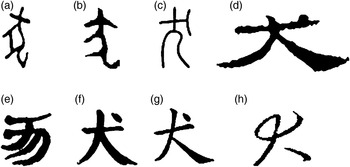
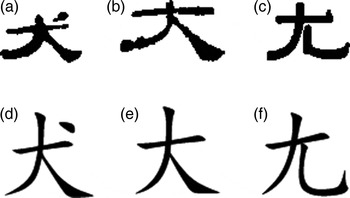
The very oldest picto/ideographic scripts, such as jiaguwen 甲骨文 (oracle bone inscriptions) and jinwen 金文 (bronze inscriptions) were archeologically lost, thus not available during Xu Shen's time. Today, samples of the various scripts have been recovered and we can see the immense changes the dog graph has undergone. The oracle bone and the bronze inscriptions (see figures 1a and 1b) can be easily accepted as full-body profiles of dogs; however, the graph used in the Shuowen header for dog is in small seal and is not pictographic: ears, tail, and paws are no longer recognizable (see figure 1c). The calligraphic style used for the glosses in the Shuowen, the clerical script, is a further stylization and abstraction (see figure 1d). I have added the dog graph in another script that was also current during Xu Shen's time, caoli 草隸 (cursive clerical; see figure 1e). The stark contrast between the clerical (see figure 1d) and the cursive clerical (see figure 1e) can be explained by the different supports used to write and/or by their purpose. Clerical was written on paper for official purposes—such as writing the Shuowen. It aimed to be bold yet elegant, and pleasant to read. Cursive clerical was written on narrow wood slips and served everyday purposes, as well as to copy texts. Cursive clerical is clerical script compressed to fit on a half-inch surface and faster to write because the strokes can be painted without lifting the brush often. I add it here because it will become the shape of the most frequent dog radical 犭 when used as a component of a word. The clerical and cursive clerical were both written with a brush, and so were later writings. Writing with brush and ink allows maximal plasticity—especially for curves and dots, and also flourishes and elisions. Note the canine dot on the clerical (see figure 1d) replacing the right line of the small seal (see figure 1c).
a to h. The dog graph. a. Oracle bone inscription. b. Bronze inscription. c. Small seal. d. Clerical. e. Cursive clerical. f. Regular. g. Regular. h. Cursive.

The original Shuowen written by Xu Shen was lost sometime during the Tang dynasty (618–907). The definitive version dates from the late tenth century. Its headers were kept in small seal script, but the glosses were written in the prevalent script of the time, kaishu 楷書 (regular script), developed from the clerical script (see figures 1f and 1g). Regular script characters—today's standard “print” writing—were codified during the Tang dynasty. Strokes were defined with strict prescriptions for the order of execution, the evenness of each stroke, and their composition within an imaginary nine-fold square. In terms of layout, the character in regular script stands in that imaginary square while the character in clerical is set in a horizontal rectangle, and the small seal, in a vertical rectangle. In terms of stroke execution, the canine dot 丶 becomes prominent in regular script while the heavy downward stroke  to the right is gradually softened. I have added yet another sample, caoshu 草書 (cursive script), to show how the cursive evades all rules of stroke differentiation, thereby creating an amalgamation where the canine dot is vaguely suggested and the heavy downward stroke to the right becomes a light, balancing calligraphic stroke (see figure 1h). These variations worked for and against the dog. Discrepancies, errors, and manipulations of the original glosses of the dog written in the Shuowen took place at the graphic and semantic levels.
With these preliminary notes, we can start reading the dog in the Shuowen. Xu Shen's gloss for the dog header is:
A dog has suspended limbs. It's a pictograph.
Confucius said: The graph for dog looks like the drawing of a dog.
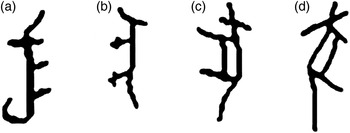
As Feng Kuanping (Reference Kuanping2007) says, no matter how hard you try—and he tries hard to locate anatomical parts—the header 犬 for dog in the Shuowen does not look like a dog (see figure 1c). Xu Shen lacked epigraphic evidence, so he relied on Confucius to say that the dog graph is pictographic. Quoting the great master Confucius is a legitimizing tactic but also a shorthand referring to Confucius's time (551–479 BCE), when official inscriptions were written in bronze. The bronze graph for dog unmistakably looks like a medium-sized domestic dog with its tail curled upwards and its slim tummy (see figure 1b). In comparison, the oldest drawing or writing of the dog on oracle bones is not so obviously a dog (see figure 2). The pictograph could be of a pig or a wolf (see figure 3).
Variants of dog in oracle bone inscriptions.

a and b. Oracle bone inscriptions. a. Pig. b. Canid.

The animal figure, drawn sideways left or right, looks like a generic quadruped, any canid, and might even be a pig, although oracle bone experts say the pig's belly is larger (see figure 3a) (Pian Reference Pian2009; Xu Reference Zhongshu1988). Cynologists say that the domestic dog is distinguished from the wolf and other wild canid species by its upward curved tail and other paedomorphic features such as a shorter muzzle, large eyes, and floppy ears (Wang and Tedford Reference Wang and Tedford2008, 166). In other words, the dog graph in oracle bone inscriptions is polyvalent—it is a canid graph. In the Shuowen, Xu Shen assigns the graph 犬 to refer specifically to the domestic dog. The wolf and other canids are subsumed under the dog header.
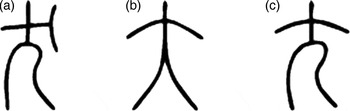
The dog graph in the Shuowen, written in small seal script (see figure 4a), is so stylized that not only has it lost its canine features, it looks like the human graph. The dog (see figure 4a) is erect like a human (see figure 4b) and has a bent, curved “leg” like a crippled person (see figure 4c). Its distinguishing trait is the short line on the right that will be whittled down to become the canine dot. From the small seal onward, the so-human graph of the dog can be easily mistaken or substituted for the human graph. In clerical and regular scripts, all that separates the animal from the human is that canine dot (see figure 5).
a to c. Small seal script. a. Dog. b. Human. c. Crippled person.

a to c. Clerical script. a. Dog. b. Human. c. Crippled person. d to f. Regular script. d. Dog. e. Human. f. Crippled person.

The Puzzling Definition of the Dog
Xu Shen's gloss on the dog begins with: “A dog has suspended limbs 縣蹏 (xuan ti).” This is mind-boggling and still baffles sinologists. In part it can be explained by the visual aspect of the graph, the bent leg. But there has to be more, some sort of semantic charge. One can wonder why Xu Shen focuses on the limb and not on those eponymous canine teeth, or else on the nose, which has 220 million olfactory receptors as compared to humans’ mere five million (Correa Reference Correa2011). One reason might be that Xu Shen follows the descriptions of wild and domestic animals in chapters 18 and 19 of the Erya 爾雅 (circa 300 BCE), a tattered text with very little to bite in, but which frequently mentions animals’ feet. The study of canine pad imprints is used today to differentiate foxes from wolves or domestic dogs. Still, this does not explain the lifted paw. Plus the term ti 蹏 (limb) can refer to the dog's leg, foot, paw, pad, digit, or dewclaw, all of which are potentially off the ground, xuan 縣. But none of these anatomical parts categorically distinguishes a canine from other animals, not even the suspended vestigial digit, since felines, like canines, have it. They all use it to dig and hold on to prey. Xu Shen is more plausibly referring to a dog's physiology, such as its mode of locomotion.
In this respect, other options appear. Dogs are digitigrades, that is, they walk on their toes, unlike bears, elephants, or humans, which are plantigrades, with full soles on the ground. Dogs, small or large, can leap and, when running at full speed, have all four feet off the ground simultaneously. Rao Jiong 饒炯, author of the 1904 Shuowen jiezi bushou ding 說文解字部首定 (Discerning the headers of the Shuowen jiezi) has a cynologically sound explanation for the lifted limb: “when running fast, there is full suspension, feet don't touch the ground” (Zhang Reference Kai2010, 184). Although the full extension gait while running is shared with other canines and felines, it is a working definition for the hunting hound, an icon of early Chinese civilization (Fiskesjö Reference Fiskesjö2001). I go one step further in the explanation of Xu Shen's lifted limb gloss: although speed is vital to catch prey, nothing will be obtained if there is no communication between the human and the dog. Lifting a limb, a leg (front or back), is one of the ways of indicating to the human co-hunter the location of the prey. Xu Shen's dog definition may be referring specifically to the hunting dog, but in fact all domestic dogs share that trait because of their inextricable bond with humans: they give a paw. This action is performed without training. Ethologists say that dogs acquire this gesture as pups when seeking and suckling the mother's teats. This paw or foreleg lifting becomes a fixed action pattern retained by adult dogs to beg for food and attention (Malm and Jensen Reference Malm and Jensen1996). Dogs, more than any other nonhuman animal, give cues and read human cues.
Xu Shen's gloss for the dog header refers to the domestic dog, that companion who partnered with humans from the very start. It is explained semantically and scripturally, sino/cynologically.
Drawing and Writing the Dog (and Animality)
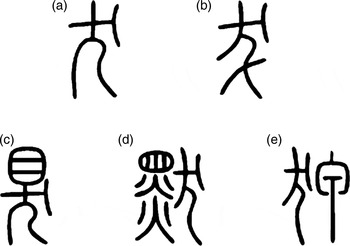
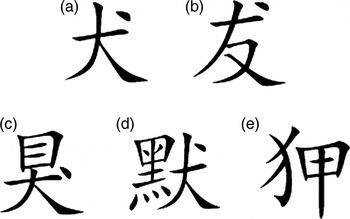
The eighty-six entries that fall under the header for dog offer a panoply of information about dogs: types, vocalization, locomotion, cognitive skills, and recognition of dogs’ sentience and even personality. Xu Shen displays a vast knowledge of dogs and their connections to humans. The dog component is easily identifiable in the examples shown below, respectively the same as the header, on the bottom, on the right or left side (see figure 6). I have added here their style in regular script, because subtle differences—akin to Derrida's différance—take place with the evolution of scripts (see figure 7).
a to e. Small seal script writing. a. Dog header b to e. Four entries under the dog header.

a to e. Regular writing of the same five graphs that appear in figure 6.

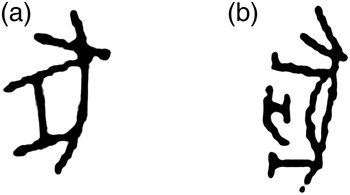
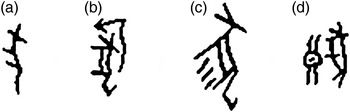
The 犬 form remains unchanged when it is positioned on the bottom, as in 狊 (see figures 6c and 7c), or on the right side, as in 默 (see figures 6d and 7d). When it is on the top, as in 犮, its downward right stroke disappears to become part of another element of the graph 又 (see figures 6b and 7b). In regular writing, this graph 犮 strikingly resembles the graph 友 with the exception of the canine dot. The meaning of 犮, the gait of a dog after its leg is pricked, indicated in small seal as the downward left stroke 丿, can easily be confused because of its graphic quasi-identity with the meaning of 友, holding hands as in friendship. When 犬 is placed on the left side of the word, it looks like this: 犭, as in 狎 (see figures 6e and 7e). This position is the most frequent. The shape 犭, as shown earlier, comes from cursive writing on narrow surfaces. It is a compressed form. What is striking about 犭 is that its shape is strongly reminiscent of the earliest drawings on oracle bones (see figure 8). The 犭 form is animalesque, whereas the 犬 form is close to god 天. Such distinctions matter because over the centuries 犭 will become the main indicator of animality, a radical for most quadrupeds, for strange creatures, and for lowly or badly behaved people. Concomitantly the dog radical written as 犬 will be divested of its human-animal agency by the willful erasure of the canine dot.
Oracle bone inscriptions of canids. a. Canid. b.to d. Composite graphs. b. Canine vocalization. c. Hairy canid. d. Obedient canid.

Cynological Knowledge Avant la Lettre
There is a wealth of cynological, especially ethological, knowledge in the Shuowen dog entries. The first entry is another term for dog: gou 狗. Much like there are two main ways to write the dog radical—犭 and 犬—there are two words used to speak and write “dog”: 犬 (quan) and 狗 (gou). Recent archaeological findings date the word and graph 狗 to Confucius's time, the Spring and Autumn period, 770–476 BCE (Pian Reference Pian2009). The origin of the word “gou” as another way of naming the domestic dog is today still unknown, as is the case for the English word “dog,” and it is contentious. Xu Shen defines the gou dog paronomastically, aligning rhyming words: gou-kou-shou 狗, 叩, 守 to say that a gou (dog) kou (barks) shou (to guard).Footnote 2 Like hunting, guarding—be it herding or escorting the dead—is one of the most representative roles of the dog's partnership with humans. Although paronomasia, a frequent mode of defining words via quasi-homophones in ancient China, is usually derided as contrived and semantically inconclusive, its use in this case is perfectly informative: a dog is a creature that barks to alert (humans or animals) if somebody (human or animal) approaches the property (home, livestock, and so forth). For today's dogs, hunting includes sniffing for drugs, bombs, or epilepsy and cancer; and guarding, comforting children in court and helping the sick or death-row prisoners to cope. Xu Shen's original definition of the dog as collaborating with humans in hunting and guarding is universally valid. Before him, the proto-encyclopedia Erya used the word “gou” to refer to dogs, but also to the offspring of other Canidae and Ursidae, and even used it for some animals’ feet—were they dog-like or just small? Xu Shen restricted the word “gou” to mean dog, giving it more or less the same semantic currency as the English word “dog.”
Until the twenty-first century, no one knew indubitably where the domestic dog had originated. Since 2002, the locus for the domestic dog has been changing with each new genetic study, from East Asia (Savolainen et al. Reference Savolainen, Zhang, Luo, Lundeberg and Leitner2002) to eastern Africa (Boyko et al. Reference Boyko, Boyko, Boyko, Parker, Castelhano, Corey and Degenhardt2009) to the Middle East (VonHoldt et al. Reference VonHoldt, Pollinger, Lohmueller, Han, Parker, Quignon and Degenhardt2010) and back to East Asia (Pang et al. Reference Pang, Kluetsch, Zou, Zhang, Luo, Angleby and Ardalan2009), but since 2012, southern (greater) China has become the likelier locus (Ding et al. Reference Ding, Oskarsson, Ardalan, Angleby, Dahlgren, Tepeli, Kirkness, Savolainen and Zhang2012).
In the twentieth century, regions such as Central Asia, Eurasia, or Africa were given as the plausible provenance of dogs (Serpell Reference Serpell1995). These assumptions, partly motivated by researchers’ personal or professional biases, were based upon archaeological findings limited to areas with established, accessible sites. China, ridden with wars, was not on the list. Furthermore, Chinese interest in digging for faunal remains had been inconsistent. It is only now that forensic zooarchaeology is going full speed ahead, now that China is recognized by geneticists as the originating center (Wu Reference Wu2014). This discovery implies that the gray wolf or a mid-range wild dog morphed into the domestic dog on Chinese territory.Footnote 3
Interestingly, there is no entry in the Shuowen for dog domestication, in contrast to other animals that are also headers. Sheep 羊, horse 馬, pig 豕, and ox 牛 all have entries dealing with domestication—養: to raise; 馴: to tame; 豢: to rear; 牧: to herd. It would thus seem that the ancient Chinese already knew the latest twenty-first-century “discovery” about dogs, that is, that the domestication of dogs was a nonevent or, better still, a series of Deleuzian events. Scientists have discovered that rice (grain) is a constituting part of the dog's genomic signature, whereas wolves cannot digest a starch-rich diet. The evolution of the canine into the omnivorous domestic dog was a slow adaptation to humans’ diet (Axelsson et al. Reference Axelsson, Ratnakumar, Arendt, Maqbool, Webster, Perloski, Liberg, Arnemo, Hedhammar and Lindblad-Toh2013). Dogs’ ancestors began to scavenge around human settlements and hung out, to the benefit of both parties—dogs patrolling and cleaning up, humans hunting with dogs, and yes, humans eating dogs, given that dog meat is a high-protein food that all early civilizations consumed.
It is also noteworthy that rice was the earliest grain cultivated in the early Neolithic, and that China's Yangzi area is most likely the earliest location (Yan Reference Yan, Aikens and Rhee1992, 121). I recall being surprised to see in the 1990s individuals (my artist friends) starting to own dogs as pets and feeding them cooked rice, the originary diet. Dogs bred for flesh have traditionally been fed on rice. The association of dogs with rice and with humans is the primordial sodality in China. There is a beautiful representation of the harmony and coevalness in early Chinese settlements: dog and human work side by side to build a civilization, the human tending to the crop, the dog to the property (see figure 9). Up until very recently, everywhere in the world, the general discourse on dog domestication celebrated human endeavor and intelligence. The accepted scenario, an anthropocentric one, was that humans “created” the dog by taming wolf puppies and eventually domesticating them, that is, transforming them for their purposes (for food, work, and companionship). Today one hears statements that go against that grain: “dog chose man” (Derr Reference Derr2012); “dogs make us human” (Tacon and Pardoe Reference Tacon and Pardoe2002). The Chinese knew that avant la lettre.
Symbiosis of human-animal-vegetal worlds in oracle bone inscriptions.

Of the eighty-six entries of the Shuowen, thirty-seven terms record dogs’ behavioral range, in situ. This way of observing animals rather than itemizing their anatomy is the fundament of the relatively new science of ethology, which studies live, nonhuman animals in their environment. 默 (mo): to chase a person for a short while; 猝 (cu): to appear from the thicket and suddenly chase a person; 㺑 (can): to squeeze into a tight space, head first; 犯 (fan): to approach gradually; 獧 (juan): to leap suddenly; 倏 (shu): to run; 狟 (huan): to walk; 犻 (bo): to whiz by so fast that a human cannot catch it;  (zhe): to raise its ears; 猌 (yin): to bare teeth in anger; 犮 (ba): to run when a leg has been pricked; 戾 (li): to curve the body to exit the household;
 (yan) and 獟 (yao): to chase tigers; 猋 (biao): to run in a pack. The focus on modes of mobility denotes the great range of dogs' reactions but also their calculations. Two words describe the way a dog eats: when eating soft food, such as rice, with the tongue—狧 (ta)—and when eating meat and bones, with the teeth—㹽 (chan). Another word is indirectly linked to food: to entice a dog (with food, most likely)—獎 (jiang). There is of course a word for smelling—臭 (xiu)—but also a word for the way a dog looks or stares—狊 (ju). The word for “smelling” is given a beautiful gloss that points to the infinitely powerful nose of a dog: “The birds may have flown away, but the dogs can smell them anyway.” The word for “looking” 狊 is constructed in the same way as the word for “smelling” 臭: the dog's eye 目 instead of its nose 自, attesting to the importance of both of these senses in the dog—be it a guard or a hunter. Cognitive scientists have recently proven that dogs can visually differentiate species, even virtually. When shown pictures of humans, sheep, pigs, and so on, dogs unfailingly distinguish their own species, regardless of the appearance, on a computer screen (Autier-Dérian et al. Reference Autier-Dérian, Deputte, Chalvet-Monfray, Coulon and Mounier2013). Another study shows that the reason why humans and their dogs look alike is due to their long-term cohabitation and communication, which results in the two partners having the same gaze (Nakajima, Yamamoto, and Yoshimoto Reference Nakajima, Yamamoto and Yoshimoto2009). Dogs of course can count sheep when herding, detect impending earthquakes—all dog “owners” know they can even sense good or bad vibes from humans.
Of these thirty-seven terms, eleven entries concern dog vocalizations. Why? Ethologists say that dog vocalization is the primary and primeval means of communication between dogs and humans (Pongrácz et al. Reference Pongrácz, Molnár, Miklósi and Csányi2005). This lexical richness suggests that the ancient Chinese paid attention to the dog's vocal communication and discriminated between dog vocalizations in terms of length, pitch, frequency, and situation:  (yan) is the sound of a dog stuck in a hole; 猩猩 (xing xing) is a string of two barks, an onomatopoeic approximation; and so is 獿獿 (e e), more likely referring to a syncopated vocalization, or panting; 㺒 (xiao) is the act of emitting that syncopated vocalization; 㺌 (xian) is prolonged, sonorous howling; 㺖 (han) is the yelping, whining, or whimpering of pups; 狠 (hen) and 㺕 (fan) both refer to growling, when dogs quarrel; and finally, three words simply refer to the act of barking, 㹞 (yin), 猥 (wei), and 吠 (fei), which is the only term still used in that sense today. The different registers communicate a wide range of emotions: fear, happiness, loneliness, annoyance, pain, surprise, excitement, contentment, need, admonition, even that Eureka cry of discovery. It is “an inadvertent symptom of domestication” (Lindsay Reference Lindsay2000, 1:16). And the ancient Chinese could discern and interpret them.
The ancient Chinese acknowledged a dog's psychological, physiological, and cognitive makeup; they recognized that dogs had a personality, as the next thirteen entries indicate. In the Shuowen, dogs can be angry: 狋 (shi) and 獳 (nou); disobedient: 獡 (que) and 獷 (guang); docile and trainable: 狎 (xia); and stubborn:  (zang). They can read human intentions—獒 (ao)—and be proud: 狃 (niu); wary of intruders: 猜 (qing/cai); fearful: 㹤 (qie); independent and with a fighting spirit: 獨 (du); as well as narrow-minded and impetuous: 狷 (juan). These traits are of course from a human point of view, but they are assigned to dogs considered as individuals, maybe even as persons who have personalities and respond differently when confronted with a particular situation. These attributes are also indicators of sentience, which is only now being empirically proven in animals. Animals perceive, process, and store information—that is cognition—and they also have feelings and are aware of a variety of states and sensations—that is sentience (Proctor Reference Proctor2012). Dogs process semantic information and emotional cues in speech in different parts of the brain, just like humans (Ratcliffe and Reby Reference Ratcliffe and Reby2014). In modern Chinese, the term “du” 獨 still means alone, unique, or solitary, and in compounds, individual or independent (單獨, 獨立). It is intriguing to me that this very common word, which carries no negative connotations, has not been humanized, that the 犭 is still part of the word. Xu Shen gives two examples of the dog's independent mind: “sheep are in herds, the dog is alone” and “a dog will fight other dogs to get what it wants.” That is human too, is it not?
A Puzzling Bestiary
Twenty-one types of dogs and fourteen other animals are listed in the Shuowen under “dog.” All manner of features—color, size, length of snout, type of fur, fat content, health condition, and geographical provenance—are enumerated. It is rather easy to concoct a list that echoes the categories in Borges's so-called Chinese encyclopedia:
• Those that come from old books (Erya and Shijing)
• Castrated ones
• Those that have long snouts
• Otters and apes
• Those that eat tigers and leopards
• Fabulous ones
• Dogs in the pot
• Those that are included or not in this classification
• Those that are mad
• Shaggy-haired ones
• The appearance of things
• And so on
• Red dogs of the Di tribe
• Those that are under the table
This mock list shakes up the modern mind's distinctions between the Same and the Other and undoes the hierarchical ordering of meta definitions and definitions, as well as fixed binomial oppositions. The Chinese language facilitates such an extravaganza because of its written system, where each written word potentially signifies more than its meaning thanks to its embedded etymology in the appearance of each graph.
Two words are today names of breeds: the large mastiff, ao 獒—who can kill for humans—and the short-legged ba 猈, probably the happa dog or Pekingese—waiting for scraps under the table. One large, strong type of dog was trained for war, transport, and other big jobs; one small type, for scavenging and ratting. There is also the castrated dog, yi 猗, which was probably the rice-fattened edible dog and the dog in the pot, xian 獻, dog meat as sacrificial viand. Two entries concern the rabid dog, zhi 狾 and kuang 狂, rabies being a disease well known by the early Chinese and still a serious public health problem in China today. Three entries distinguish types of dogs by the length of their snout: a short-snouted dog is ge 猲 or xiao 獢, while the long-snouted dog is xian 獫. These distinctions must refer to particular uses in a range of hunting environments—for scent, sight, and tracking; for small or large game. These dogs have no modern referent, no more than the shaggy dogs, with two entries, the good one called mang 尨 and the bad one, nong 㺜. They come from older texts, the proto-encyclopedia Erya and the first collection of poetry, the Shijing 詩經 (Classic of poetry). There is zhu 㹥, a black and yellow dog that has also disappeared from the books, perhaps because color matters less than in ancient China. In those days, for sacrifices and for gastronomy, the yellow dog was best, the black second best. Other dogs have no color or attribute other than that they are robust—健 (jian), 猛 (meng), 犺 (kang), 獜 (lin), and 狦 (shan). Multitasking dogs, maybe. Then there are names for dogs from tribes surrounding the Han people: from the south, there was the sou 獀—no features given; from the north, the jiao 狡 and the hui 獪, both black-bodied dogs with large muzzles belonging to the feared Xiongnu tribe; and last but not least, the di 狄, the red dogs of the Rong Di, a northern tribe alternately friend and foe of the Han Chinese.
The last fourteen entries under the dog header deal with different species of canids or species resembling dogs. Many of these species have not yet been identified, and are thus untranslatable. They are the hu 㺉; the wolf, 狼 (lang); the bo 狛; and the man 獌. The rest of the species entries are a heterogeneous assortment of quadrupeds—several primates: the hou 猴, the jue 玃, the you 猶, and the ju 狙; water animals: the otter, 獭 (ta), defined as a “water dog,” and bian 猵; wild cats: the suanni 狻猊 that eats tigers and leopards—later discerned as the lion—and the hu 狐—later known as the fox, but here treated as a fabulous beast ridden by ghosts. Lastly, there are the hui  and the yayu 猰貐, which are simply said to be shou 獸, beasts. It is difficult to explain this hodgepodge that concludes the dog entries. Xu Shen took glosses verbatim from the Erya for animals he probably had no knowledge of, such as the suanni, but he did not include other creatures with no connection to canids that were previously in the Erya subsumed under the dog, such as the orangutan—feifei 狒狒—which the Erya describes as resembling a human and a human-eater, or the badger—huan 獾—said to be the female of the lang 狼, wolf. The Erya furthermore contains entries for fabulous composite creatures, and they are distributed among several animal headers, such as dog 犭, pig 豕, beast 豸, or crawling insect 虫.
Another older text containing myriads of strange creatures is the Shanhajing 山海經 (Guideways through mountains and seas).Footnote 4 This early encyclopedia of mythology and cosmography was written sometime between the fourth and third centuries BCE, was spared from the burning of the books in 213 BCE, but somehow became fragmented and was only pieced together in the fourth century by Guo Pu 郭璞 (276–324). It is the earliest version available. What matters here is that the dog radical written as 犭 is by far the most frequent radical for legendary beasts in Guo Pu's transcription of the Shanhaijing. Here are a few examples: the boshi 猼訑, a goat with nine tails and four ears and with eyes on its back; the huahuai 猾褢, a humanoid with a pig's bristles; the yingru  , a deer with a white tail, horse's hooves, human hands, and four horns; the zheng 猙, a red leopard with five tails and a single horn; the bibi 獙獙, a fox with wings; and the dugu 獨
 , a tiger-like creature with a white body, a pig's bristles, a dog's head, and a horse's tail.
Throughout the classification of all things linked to dogs, Xu Shen attempts, as I have shown, to confine his entries to the dog—its skills, behavior, and appearance in action—as well as to other canids. Because the Shuowen's purpose was etymological, he therefore acknowledged the dog as it was used in the graphs of his time but did not go out of his way to include noncanids in his dog radical entries. The monkey 猴 was already written with the dog in small seal script; the gibbon 猿, now written with 犭, was then written with the crawling insect 虫—thus its absence in the dog header of the Shuowen (see figure 10). However, by the time of the transcription of the Shanhaijing in the fourth century, the dog marker written as 犭 had become the foremost floating signifier of animality—with connotations of beastliness, but also of otherness.
a and b. Small seal script. a. Monkey 猴 with a dog component. b. Gibbon 猿 with a crawling insect component.

The ascription of 犭 to dehumanize ethnic groups other than the Han follows the massive migration of Han Chinese in 310 CE, according to Victor Mair, who calls this process “cynanthropomorphization” (Mair Reference Mair1998, 18, 61). Guo Pu, who chose to use the dog radical 犭 for strange creatures in the Shanhaijing, was part of that exodus wave of Han people who moved to the south. They were artists, intellectuals, and aristocrats who formed an urban elite in the city of Jiankang, today's Nanjing. They lived free and unfettered, far away from the reality of war and survival. Nature was elegantly sung, written, and painted; the wild and the unsightly were safely removed from sight.
Magnus Fiskesjö (Reference Fiskesjö2012, 71) claims that the writing of non-Han people's names with animal radicals, such as the dog 犭, the beast 豸, and the crawling insect 虫, dates to the History of the Wei 魏書 by Wei Shou 魏收 (551 CE). It is a continuation and an extension of the privileged urbanite's discourse of otherness. Fiskesjö (Reference Fiskesjö2012) also says that by the Song dynasty (960–1279), most of these ethnonyms were written with the dog 犭. This concurs with my findings of the final demise of the dog and of its scapegoating by the twelfth century. The Tang and Song dynasties had highly developed urban centers, in Xi'an, then Kaifeng, and Hangzhou, and, except for a very few—in particular women who doted on tiny pet creatures—no one who was anyone cared for the humble dog.
Down with the Dog!
The hyperbolic use of the dog—and not of any other species—can be explained by its ubiquity, in the city, suburbs, and countryside, as well as embedded in war zones or in bed with us. A dog can stretch the idea of a dog and also the concept of a species. In my mock Borgesian list, I left three Shuowen entries undiscussed until now: “Those that are included or not in this classification,” “The appearance of things,” and “And so on.” They refer respectively to the words “lei” 類 for “category,” “zhuang” 狀 for “physical appearance,” and “you” 猶 for “similarity”—all written with the dog component. Judging by these words, the ancient Chinese chose to highlight the diversity of physical forms by opting for the chameleonic dog, the animal that has the highest biological and ecological range, rather than a more stable form to indicate the appearance of things: zhuang 狀. In the same spirit, the multifarious and multitasking dog is used to exemplify similarity: you 猶. Implying dissimilarity, the choice of the dog as exemplar offers a concept of sameness that is not based on a stable identity or difference as it is in modern Western discourse, but on complementarity and potentiality, as it is in postmodern thinking. Finally, to choose the dog, rice, and a human head as signifiers of the animal, vegetal, and human to mean “category” (lei 類 = dog 犬 + rice 米 + head 頁) and to place this word under the dog header shows how fundamental and generic the dog was in early Chinese thinking. Here again the same logic of almost incommensurable inclusiveness is at work. Xu Shen's gloss of lei (category) illustrates it well: “Of the kinds and groups [types, species] that are bound by similarity, the dog is the best example” (Zhonglei xiangsi, wei quan wei shen 種類相似唯犬為甚). The dog is the best example because it pushes to the limits the idea of “category” as a finite and therefore knowable set of things. Xu Shen's original gloss is profound and insightful: in its comprehensiveness, its vast range of sizes, forms, and skill sets, the dog indicates liminality, exclusion, and inclusion—in other words, the difficulty, if not the impossibility itself, of defining. Today the word “lei” 類 means to differ and to resemble.Footnote 5 Is that not the elusive dog?
The facts that the dog is a transgressor—it is here and there—and that a dog is for the human “almost the same, but not quite” (Bhabha Reference Bhabha1991, 85–92) generate contempt and anxiety. In Chinese culture, as of the fourth century, two discernable patterns attested to the demise of the dog: scapegoating and the erasure of (shared) agency.
The great exegetist Duan Yucai, who toiled over the Shuowen for three decades, mentions in passing a list of thirty words in the Shuowen that contain the dog component (written as 犬 or 犭) that are used to speak of humans (Duan [1815] Reference Yucai1981, 63). He does not comment on this semantic transfer, nor does he note that more than half of those words connote negative human behavior.
In order to date the emergence of pejorative connotations, I have checked the thirty words in the Kangxi dictionary, which records all definitions of words from the Shuowen up to the eighteenth century. A generalized scapegoating of the dog was part of the dominant discourse by the eleventh century. The following are examples of revised definitions, some as early as the sixth century. The “young dog” 狡 of the Shuowen turns into a “treacherous human” and a “strong dog” 犺 becomes a “wanton human” in the Yupian 玉篇 dictionary dated 543, which is based on the Shuowen. A “trainable dog” 狎 becomes an “improperly familiar human” in the History of the Wei dated 551. A “disobedient dog” 獷 becomes a “boor” in the Yiwen leiju 藝文類聚 encyclopedia dated 624. The Guangyun 廣韻 and the Jiyun 集韵, both rhyme dictionaries dated respectively 1008 and 1037,Footnote 6 contain many shifted definitions: a “crafty dog” 獪 turns into a “cunning human”; a “dog with rabies” 狂, a “mentally deranged human”; and a “fearful dog” 㹤, a “cowardly human.” The “sound of dogs barking” 猥 is shifted to mean “obscene,” while a “strong and bad dog” 狦 now refers to a “debauched person.” “Dogs growling while quarreling” 狠 connotes a “ruthless person”; a “dog curving its body to leave the household” 戾 designates a “human criminal.”
Strangely, Duan does not list these thirty transfer words when commenting on the dog header, but under another header, the twenty-fifth in the Shuowen, which is “to cry, to wail” 哭. Duan notes that this word ought to be an entry under the dog header. He is of course right in terms of graphic etymology. The word comprises the dog component 犬 with two mouths 吅 on top—dogs vocalizing to signify crying when mourning. While I did not spend as long as Duan did on the Shuowen, I would venture to say that Xu Shen made a separate header for “crying,” just as he did for the double dog 㹜, header number 378, because the dog's vocalizations are used metaphorically in these cases. In “crying,” the dog's vocalization serves to indicate the raw emotion humans feel at the loss of someone and certainly not that dogs were physically present at funerals. It is the same logic for the “double dog” header, which is glossed as “dogs barking at each other,” and which has the entry for “just” 獄 (which became “court of justice,” later extended to mean “prison”) where speech 言 is flanked by two barking dogs. To my knowledge, dogs were not present in court, but interrogation in lawsuits was an important component of trials. People would face one another and bark at each other. The dog was deemed so close to humans, its vocalizations so versatile, that it could stand in for a range of human vociferations and feelings.
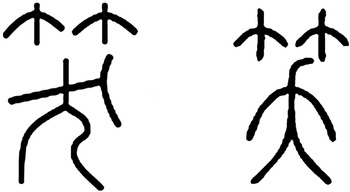
Today the word “to cry” 哭 has remained graphically unchanged, although the association with dogs is mentally erased. Perhaps the dog component will surreptitiously morph into the great/human 大 soon because “to laugh,” initially also written with a dog component, has been humanized. At the time of the Shuowen, it was written as  , that is, bamboo 竹 on top and dog 犬 on bottom. It illustrated a state of happiness, or rather indicated an event of happiness, that of being in a bamboo grove with a dog. Unfortunately, as early as the Tang dynasty, the dog component was deleted. This willful change is one of the most telling illustrations of the disconnect between humans and animals, as well as the vegetal world. The component 夭 (yao) replaced the dog 犬. In the Shuowen, 夭 is header number 392: it means “bent” and comes from the word “great” 大 with an additional upper stroke. Whereas in the Shuowen 夭 could refer to luxuriant vegetation as well as to young humans, by the sixth century, it was already restricted to the human domain. 夭 was easy to switch for 犬 for two reasons. First, 夭 pronounced yao, unlike 犬 pronounced quan, rhymes with the word “happiness,” pronounced xiao. Similar sounds made the words fit together. Second, both graphs contain 大 with an extra stroke. So became 笑. The meaning also changed: from the “state of happiness,” it became “to laugh.”
Duan Yucai ([1815] Reference Yucai1981, 198–99) provided an account of the fortune of these two graphs in what may well be his longest commentary (600 words in translation) in the entire Shuowen. He was the one who reinstated the word with the original graph containing the dog , but only specialists paid heed. Briefly, Duan wrote that the manipulations of the graph were easily endorsed because already in the sixth century people could not relate the dog to a positive human state of mind. Hence, the dog was replaced by the already humanized bent head. The first sixth-century gloss on the newly revised word with bent head instead of dog goes as follows: bamboo 竹 refers to a musical instrument; a gentleman after playing or listening to the music, is happy and then laughs. A century later, another philologist, this time a Buddhist monk, could not link the idea of a dog with that of laughing and therefore maintained 夭 instead of 犬. Then, in the eighth century, Li Yangbing 李陽冰, an expert in small seal script, rewrote the Shuowen. He gave a new, definitive definition of 笑: “bamboo in the wind—its stem bends like a person laughing.” Li set in stone the new graph 笑, which he wrote in small seal script, the style of the original Shuowen (see figure 11). Afterwards, the Song edition of the Shuowen, as well as the various dictionaries and encyclopedias of the Song and of the following dynasties, all used 笑 with the meaning of a person laughing with head bent like bamboo in the wind. Duan Yucai restored the dog in the word “to laugh” —but today that graph is just a curio variant.
a and b. “Happiness” becomes “to laugh” in small seal script. a.. b. 笑.

The willful erasure of the canine dot 丶 has been an ongoing process. Song dynasty dictionaries switched the 犬 component in the word “award” 獎 with two different radicals: 獎 became 奬 with the human 大 and  with the joined human hands 廾. Whereas the word had meant “to incite a dog,” probably with a treat, the revised etymology refers strictly to the rewarding and awarding of human achievements. Today, in simplified writing, the canine dot is absent: 奖. Sometimes, it is also absent in traditional script. The latest case of willful erasure of the dog is in the word “category” 類. Various computer fonts already have no canine dot for that word, for instance, the popular font Ming Dynasty (MS 明朝): 類. The disappearance of the dog in these words obliterates the dog's importance and partnership with humans at the beginning of Chinese civilization and well into at least the Han dynasty, when Xu Shen wrote the Shuowen. The graphs have become, almost like the Latin alphabet, arbitrary.
Dog Despot! Damn You, Listen! If You Dare to Swagger Around and Lord It over the Working People, We Will Beat Your Dog Muscle, Dig Out Your Dog Heart, and Chop Off Your Dog Head. Damn You If You Want to Rise Again!
In conclusion, I would like to offer some context for the vilification of the dog by the eleventh to twelfth centuries. Urbanization is one major cause.Footnote 7 As of the fourth century, urban centers such as present-day Nanjing had developed. The city-dwellers were rich and educated. During the Tang dynasty, the capital Chang'an (Xi'an) was one of the most advanced poleis in the world but was out of bounds for the poor. With the Song dynasty capitals of Kaifeng and Hangzhou, urbanization with a fully developed infrastructure took place. Secularization was a fait accompli. Emperor Huizong of the Song (r. 1100–26) decreed that dog meat—which represented sacrificial meat offerings 獻—would no longer be part of the ritual sacrificial fare, given that people did not eat dog anymore, so why should the gods (Ebrey Reference Ebrey2014, 249). Naturally the very sophisticated Emperor Huizong, who made his women run with hounds in his park for fun, was referring to the gentry, those urbanites with educated palates who feasted on exotic things. Fancy restaurant menus did not feature lowly dog meat. Cats, which had before then taken over the job of ratting from the dogs, became preferred pets—their masters proudly described them as useless. Dogs were superfluous in all respects. Peasants who had moved into the city were responsible for hygiene, including night soil removal. Considered outcasts and extremely poor, they often resorted to scavenging, once a dog's job. As policemen surveilled the city, few households felt the need for a guard dog—except carved in stone and adorning the front door. Thus dogs became undesirable. Dogs were pariahs in the polis—like during Diogenes's time. The sad picture of the dog was as a rabies-ridden pest that roamed, stole food, and fornicated in plain daylight. Here are some expressions that encapsulate the feeling of the times:
• “To advertise a sheep's head but sell dog meat” 挂羊頭賣狗肉: to deceive clients by selling cheap stuff (collection of Buddhist sayings Wudeng huiyuan 五燈會元, eleventh century).
• “To add a dog's tail to a marten sable” 狗尾续貂: a person who is not as lofty as he claims to be (the novel Water Margin, 水滸傳, fourteenth century).
• “No ivory teeth will come out of a dog's mouth” 狗嘴里吐不出象牙: do not expect any intelligent words from lowly people (the play Meeting the Emperor 遇上皇, fourteenth century).
• “A dog will always eat shit” 狗改不了吃屎: a bad person will not amend his ways (the novel Jin Ping Mei 金瓶梅, seventeenth century).
Mao Zedong made much use of dog metaphors to defile the comprador bourgeoisie and other enemies. The animal rhetoric of the Cultural Revolution did not spare the dog, on the contrary.Footnote 8 The word “gou” 狗 (dog) itself operates as a swear word. Sadly, even the expression “lost like a dog without a home” 喪家之狗 (sang jia zhi gou), originally describing Confucius's unsettled state of mind akin to a homeless dog's when he found himself all alone in an unfamiliar place, is now totally negative. It is used to speak of the down-and-outers, those smelly homeless people roaming the country—or should I say, roaming the cities.
Chinese scholars maintain that the Chinese language has more derogatory terms with “dog” than any other language. The contemporary linguist Shen Xilun 沈锡伦 is often quoted: “Of all the animals, the dog is most used in Chinese curse words; the dog is most vilified in Chinese culture; from time immemorial 古往今来 [we] Chinese have used the dog to insult people; it's as though the only way to rid oneself of anger is to insult people by comparing them to dogs” (Duan Yunheng Reference Yunheng2012; Ma Reference Lan2008; Pian Reference Pian2009; Sangji Reference Sangji1998; Zhao Reference Ruijing2009; Zhou Reference Yuanlin2006; emphasis added). The peremptory statement sweeps too much history, but worse, it preempts any careful study of archaeological (etymological and textual) layerings in the complex and shifting human-animal alliances. My paper was a humble undertaking in this sense. I tracked down one animal by way of one reference work. Granted, both the dog and the Shuowen have an exemplary track record, as they are fundamental and key civilizational markers in China.
Acknowledgments
My very special thanks go to Dr. Jeff Wasserstrom, the editor of the Journal of Asian Studies, who encouraged me with a few smart and timely words throughout the process—he even replied to me on New Year's Eve. Of course, I also thank the external reviewers for liking my work from the onset and bearing with me through the revisions. I am grateful to Dr. Victor Mair for his critique of my first presentation, “Shuo ‘Gou’ Jie ‘Quan’: When Cynology Informs Sinology,” at the 2012 Association for Asian Studies annual conference in Toronto and for his subsequent e-mail correspondence in 2012–13 in which he explained historical phonetics around the global word for “dog.” My presentation lacked phonological considerations, and after realizing how complex this issue was, I reoriented my research, leaving such questions to expert ethnolinguists.