Introduction
Neoliberal policies have had significant effects on housing sectors across a wide range of societies. State rental sectors, in particular, have often been in the ideological firing line as highly visible artefacts of Keynesian welfare statism (Hackworth and Moriah, Reference Hackworth and Moriah2006: 513). Portrayed as inefficient, unresponsive, monopolistic and anachronistic, they have typically been marketised, privatised and downsized. At the same time, wider societal changes have impacted on the sector`s social role and social composition. The overall effect on many public rental sectors is now very familiar – growing social and spatial segregation, enclaves of concentrated and multiple disadvantage and increased stigmatisation. It may be that we are entering a new era of housing intervention, a post-crash/post-crisis era in which new forms of state rental and other not-for-profit forms of housing provision will emerge in the wake of a discredited neoliberalism. It is still too early to say as the consequences of the Global Financial Crisis (GFC) are still rippling through financial systems and social structures – most evidently in the highly contested and divisive austerity measures introduced in southern Europe. Moreover, with regard to public and social policy, neoliberalism as a ‘repertoire of policies’ or as a broader political project (Mudge, Reference Mudge2008) still seems remarkably robust and resilient. Indeed, a starker form of neoliberalism seems to have emerged from the crisis with ‘the cure’ being a stronger dose of the same medicine. Policy failure and systemic crisis may serve to reinvigorate rather than undermine neoliberalisation processes (Brenner et al., Reference Brenner, Peck and Theodore2010).
In this context, it is striking that in Hong Kong, one of the iconic symbols of supposedly unrestrained capitalism, public renting has not only survived but arguably thrived over the last three decades or so. Certainly from an Anglo-American perspective, the Hong Kong Housing Authority, as one of the largest public landlords in the world, would seem to be high on the list of Keynesian ‘artefacts’ and thus overdue for a strong dose of economic rationalism (Jacobs et al., Reference Jacobs, Atkinson, Spinney, Colic-Peisker, Berry and Dalton2010) and modernisation. But as various others have pointed out (notably Brenner and Theodore, Reference Brenner and Theodore2002; Jessop, Reference Jessop2002), neoliberal ideas emerge from, and are shaped by, specific national, regional and local contexts. The world of ‘actually existing neoliberalism’ (Brenner and Theodore, Reference Brenner and Theodore2002) is messy, uneven and path dependent. Indeed, the policy and business community in Hong Kong would hardly recognise the association between Keynes and public rental housing. Thus, the developmental histories and drivers of public housing systems are similarly uneven and path dependent. Apparently similar forms of state rental housing provision have been shaped by distinct political, economic and social factors. Concerns about issues such as social cohesion, pressures of economic competitiveness and perceived political advantage have combined in different ways at different times in different places to expand or diminish the role of public housing. Tenures do not have inherent features and the realities and meanings of public or social housing change over time (see, for example, Lupton et al., Reference Lupton, Tunstall, Sigle-Rushton, Obolenskaya, Sabates, Meschi, Kneale and Salter2009). Hong Kong's public rental housing has been the product of a distinct and shifting set of factors and circumstances. These include the pressures of waves of immigration, topographical constraints, concerns about social unrest, its colonial and post-colonial history, severe housing affordability problems and the maintenance of political legitimacy in the absence of universal suffrage.
The explanations for Hong Kong's apparent exceptionalism with regard to the resilience of its public rental housing system are, however, dealt with more fully elsewhere (Forrest and Yip, Reference Forrest and Yipforthcoming). This paper is concerned with a different, but interconnected, set of issues. Public rental housing has not only been severely scaled back in the neoliberal era, or in some cases almost disappeared, but attitudes to the tenure have also changed. Among politicians, policymakers and general populations, there has been little support for public rental housing and generally negative attitudes in relation to its social role and social status. For example, in Britain, only a minority of people regard public housing estates as pleasant places to live in, and this minority has generally been getting smaller, particularly among those who do not live in them. Longitudinal data from the British Social Attitudes Survey suggest that among the professional and upper classes, the belief that council housing estates were ‘pleasant places to live in’ fell from only 30 per cent in 1985 to less than 20 per cent in 1999 (British Social Attitudes Survey, various years). Similarly, Atkinson and Jacobs (Reference Atkinson and Jacobs2010) show how policy shifts, tenure-biased subsidy flows and political and academic narratives have all contributed to an increasingly negative framing of public housing in the popular imagination. With particular reference to Australia, they observe that ‘public housing is viewed as a failed endeavour that has accentuated poverty and social disadvantage to the extent that it is now in danger of falling by the wayside of mainstream policy debates and action’ (p. 158).
Is Hong Kong then also different with regard to popular attitudes towards public rental housing and public rental tenants and, if so, why? The paper explores the current position of Hong Kong's public rental housing through an examination of the experiences and perceptions of those within and outside the sector. How are public tenants perceived in relation to ideas of social status and social equality? How do public tenants see themselves? The data are drawn from a social survey undertaken across eighteen council districts of Hong Kong during November 2010 and January 2011. A total of 3,007 adults were interviewed – 2,002 public renters (intentionally oversampled); 583 private home owners, 210 government-assisted home owners (HOS), 140 private tenants and 72 sitting-tenant purchasers of public rental flats (TPS). The geographical distribution of the sample of public rental tenants was close to the overall distribution of the public rental tenant population in Hong Kong (Wu, Reference Wu2011).The survey forms part of larger study of the changing role of public rental housing in Hong Kong (see Acknowledgement below).
Public rental housing, stigma and reputation
As has been suggested already, it would be difficult to find examples of public rental sectors which, over recent decades, have acquired or maintained a very positive reputation and social status. In some countries, such as Japan, the USA or the southern Mediterranean region, public rental sectors have always been small and targeted to specific subgroups of the poor or needy. With regard to some social housing interventions, stigma and residualism were built in from their inception. Blokland (Reference Blokland2008) makes the point that US public housing emerged from the New Deal – a set of policies more concerned with stabilising the financial system than combating social inequality and poverty. Public housing and other welfare programmes were at root stigmatised necessities for those who had failed (p. 39).
Even where substantial social housing sectors developed such as in the UK and the Netherlands, there has generally been a downward trajectory in relation to size and/or scope resulting in sectors more associated with the poor and marginalised. What was working-class housing has shifted towards housing for the non-working classes through the combined processes of societal ageing and labour market restructuring. Sectors which in the past accommodated strategically important sections of the skilled working class have tended to become repositories for the economically redundant and those perceived to be socially threatening – more like keep nets than safety nets.
The social distance between public rental sectors and home ownership has widened as the social composition of public and social sectors has changed. For example, in the UK the majority of heads of household in the public rental sector are now either retired, economically inactive or unemployed. By contrast, among those buying with a mortgage, less than 10 per cent are in such categories. This is hardly surprising given that poor people are unlikely to be able to obtain or sustain mortgages (notwithstanding the short frenzy of subprime activity when mortgages for poor people became highly tradeable assets). There is also the group of outright owners, usually retired and not all either asset or income rich. Nevertheless, whilst home ownership sectors have become increasingly and inevitably more differentiated as they have expanded (Forrest et al., Reference Forrest, Murie and Williams1990), divisions have also tended to widen between home owners and public sector tenants on a number of levels and dimensions. There is the statistical reality of proportionately more poor households in many public rental sectors but there are also the more powerful and corrosive effects of an everyday discourse in which the ‘public housing’ label has become more negative, socially and spatially, implicitly and explicitly. Home ownership has been ‘normalised’ (Gurney, Reference Gurney1999) and, thus, those who are not home owners, or are not likely to become home owners, are perceived (and may well perceive themselves) as outside the norm – as socially abnormal. Particularly in societies with small, residual sectors, it is very much the ‘others’ who live in public housing. This is most evident when the relationship between disadvantage and public housing is overlain with strong ethnic dimensions. If recent economic events have affected aspirations for home ownership, it is a revived, reprieved and rehabilitated private rented sector which seems to have emerged as the alternative tenure of choice and policy support – at least in much of the Anglo-American world.
It is important, however, not to overstate or over generalise about the declining social status of public rental sectors. Such discursive practices are themselves part of a stigmatising process involving multiple and cumulative discrimination and disadvantage. Link and Phelan (Reference Link and Phelan2001) stress the necessity of the exercise of power in the stigmatisation process. It is the exercise of social, economic and political power which produces the status loss and negative labelling (p. 377) and which is historically embedded in specific ways in public rental sectors. Stigma can be created and reproduced as much through the actions and beliefs of insiders as from the negative labelling of those outside the sector. Blokland (2008), for example, illustrates how US public tenants are habituated into seeing themselves as failures, and acts of ‘dis-identifying’ with the local community and distancing from others are symptomatic of this view. The Housing Projects are for others, not them.
It is also the case that external perceptions of the lived experience of the places of ‘others’ can also be misleading and disempowering. People living in neighbourhoods popularly portrayed as disadvantaged, dangerous or divided may, however, experience where they live in a very different and positive way. Palmer et al. (Reference Palmer, Ziersch, Arthurson and Baum2007) observe that ‘the research literature finds that residents’ perceptions of their housing and location are often different to those living outside of the neighbourhood’ (p. 414). They point, for example, to surveys of public tenants which report relatively high levels of satisfaction with their housing and neighbourhoods as one indicator of this.
The position of public housing tenants depends on a variety of factors including the size of the sector, its spatial distribution and the social composition of those in the sector. The relationship between people and housing systems has been reshaped by a more general process of social restratification. In its simplest and starkest formulations, this process has involved new forms of marginality in which a middle mass becomes increasingly separated in terms of lifestyles and life chances from both the economically and socially disenfranchised at the bottom and a rich elite at the top (Therborn, Reference Therborn1985; Pahl, Reference Pahl1988). Such conceptions of social changes have also been associated with debates around ideas of a new underclass and urban ghettoisation in the USA (Murray; Reference Murray1999;Wilson, Reference Wilson1990) and with processes of housing and social exclusion in a European context (for example, Madnipour et al., Reference Madnipour, Cars and Allen1998). Wacquant (Reference Wacquant2007) has referred to the emergence of advanced marginality and explored inter alia processes of ‘spatial stigmatization’ and ‘public sector dereliction’. In a recent analysis of welfare developments in the USA, he goes so far as to suggest that budgetary reversals indicate that ‘the construction of prisons has effectively become the country's main public housing program’ (Wacquant, Reference Wacquant2008: 160).
It should also be emphasised that these ‘pockets’ of marginality in cities can encompass private tenants, public tenants and home owners (see, for example, Allen, Reference Allen2008). Public rental housing has not been exclusively affected by these demographic, social and economic changes but it has been at the sharp end – particularly in those countries where there was extensive development of state housing after the Second World War. There was little scope for change where such sectors were already small and residual. But relatively large public rental sectors have generally undergone, or are undergoing, marked transformations.
In 1981, some 38 per cent of households in Northern Ireland were in public housing, 5 per cent higher than in Hong Kong at that time. Privatisation policies and reduced investment have now shrunk the sector to just over 20 per cent (Paris, Reference Paris2008). A report by the Northern Ireland Housing Executive in 2009 referred to the ‘growing residualisation of the Housing Executive's stock, characterised by a growing concentration of low income households’ (NIHE, 2009, 17). In Australia, Arthurson (Reference Arthurson2004) describes a similar process: ‘Whereas in 1966 over 80% of tenants in public housing nationally were employed, by the mid-1980s a similar proportion, 84% of tenants were in receipt of welfare benefits increasing to 89% by 2000’ (p. 256). Palmer et al. (Reference Palmer, Ziersch, Arthurson and Baum2007) discuss how this change has contributed to a growing stigmatisation of Australian public housing and public housing tenants and draw parallels with similar processes in European societies as varied as Norway and Belgium. Living in stigmatised places can affect life chances in a variety of ways (see Ellen and Turner, Reference Ellen and Turner1997; Forrest and Kearns, Reference Forrest and Kearns2001). Negative labelling can affect job prospects. If you live on an estate with a ‘bad’ reputation employers may be less inclined to hire you. In this, and in other ways, the process becomes self-reinforcing often producing a cumulative decline of an area with regard to rising unemployment, social malaise and social exclusion. Areas acquire reputations as places to avoid and negative images and perceptions cling to places and become difficult to change. Research on regenerated neighbourhoods in the UK, for example, has shown how difficult it is to shift perceptions of areas held both by intermediary agencies and by residents (Dean and Hastings, Reference Dean and Hastings2000).
One of the fundamental issues which affects the social status and quality of social housing is its relationship to private sector housing and, in particular, whether those in other tenures regard it as unjustifiably subsidised and inappropriately targeted. There is something of a paradox here. The histories of public rental provision would indicate that the greater the social mix and the perception that there are ‘too many wealthy tenants who should be elsewhere’, the higher its social status. The post-war expansion of public rental housing in Europe was aimed at the deserving and economically valuable skilled working classes. The very poor were elsewhere, mainly in private rented sectors. Over time, with rising affluence, a significant proportion of public sector tenants became relatively well-off and pressure grew to persuade or cajole those better-off tenants to leave. With changing aspirations, growing propensities to buy and with strong policy support, that was the pattern in a number of countries. However, with more effective targeting comes greater social distance between public renting and other tenures and often a diminution of political and popular support. This distancing also emerges in relation to building form and quality. The lower the social status of public housing, the more pressure there is to differentiate it from the housing which can be obtained in the private sector. Housing for the poor should not be overly attractive, or else profitable opportunities in the market sector will shrink. To that extent, stigma can literally be built into housing systems, particularly if public housing is strongly distinguishable in terms of design and location.
Attitudes towards public rental housing in Hong Kong
It follows from what has already been said that any considered reading of the housing literature would show that attitudes towards, and experiences of, different housing tenures are contingent on a range of factors. Images and experiences of any form of housing provision change over time. Given the recent experience of many home owners during the credit crunch and subprime crisis, it is evident that security and stability are not fixed qualities of home ownership. Similarly, subsidised, state rental housing can enjoy relatively high status and social reputation (Forrest, Reference Forrest, Malpass and Rowlands2009; Lupton et al., Reference Lupton, Tunstall, Sigle-Rushton, Obolenskaya, Sabates, Meschi, Kneale and Salter2009). In Rex and Moore's (1967) highly influential conception of housing classes, council housing in Birmingham was ranked in second place in terms of desirability in the status hierarchy of tenures. As regards the role and position of public rental housing in contemporary Hong Kong, is it seen as a form of housing to aspire to or escape from? Is it a tenure of choice or constraint? How is it perceived by the wider community, among those not in the tenure?
Before exploring these issues further it is necessary to provide some brief context concerning the key changes which have affected public rental housing in Hong Kong. As indicated in the introduction to this paper, a key feature of Hong Kong's public rental sector is that it remains substantial. In proportionate terms, the peak was in the early 1990s when the sector housed around 39 per cent of all households. By the 2006 census, this had fallen by 9 percentage points to 30 per cent. The 2011 census shows that in percentage terms, the tenure structure of Hong Kong has hardly changed over the last five years. Public rental housing still accommodates just over 30 per cent of households. Moreover, in absolute numbers, population growth has meant that there are more public tenants now than in 1981. The social role and social composition of the sector has, however, changed in a number of significant ways over recent decades.
• There have been demographic changes associated with societal ageing. The population of Hong Kong has aged and the population in the public rental sector has become disproportionately older. By 2006, almost a fifth of public tenants were aged sixty or over
• As in many societies, there has been a growth of single-parent households. One in twenty public rental households are single parents and the tenure accommodates more than half of all such households
• Hong Kong's public rental sector now houses a higher proportion of poorer households and those in least-skilled occupations. A combination of societal ageing and a changing income structure associated with the shift towards a service sector city has had a major impact on the sector's socio-economic profile. Those in skilled manual work have been replaced by those in elementary occupations. There are considerably fewer upper decile households in the public rental sector and more lower decile households
• Part of the background is the decline and changing role of the private rented sector. Private renting is now mainly for the professional, high-income groups. The poor have migrated to public renting.
Now these kinds of changes in the social profile of Hong Kong's public renters are not dissimilar from developments in some other societies and could be interpreted as a clear shift towards a more residual role – towards a tenure associated more with the poor, the elderly and economically marginal. Such a direction of change could certainly indicate that the social status of the tenure might be in decline and that there might be an increasingly negative set of attitudes towards the sector and perhaps more negative experiences and views among those within public renting. One major difference, however, between the profile of public rental tenants in Hong Kong and that of tenants in say the UK or the USA is the extremely low level of unemployment among those of working age. There are large numbers of low-income and underemployed households. Hong Kong has one of the most unequal income structures in the world with median monthly incomes showing little change over the past decade – between HK $10,000 and $11,000. Income disparities have increased, but it is the growth of smaller, elderly households which has been a major contributor to this trend. Nonetheless, in relation to the working population, public rental housing in Hong Kong undoubtedly plays a key role in accommodating (and some would say sustaining) some of the lowest earning groups. But, it is a population in work and by no means economically marginal.
With the above as background the paper now goes on to ask a number of fairly straightforward questions. First, how do public rental tenants in Hong Kong regard public rental housing and where do they see themselves in the social structure? Second, how do those outside public housing regard the sector? Third, is public rental housing generally seen as making a positive contribution to social equality in Hong Kong?
How public sector tenants see themselves?
In terms of basic customer satisfaction scores, public rental tenants as a whole are quite positive about their situation. As regards the actual property they are living in, the ‘likes’ outnumber the ‘dislikes’ by 38 percentage points. Just over half of the sampled tenants like their flat ‘a lot’ or ‘quite a lot’, whereas only 13 per cent feel negative; a third have no feelings either way. The picture is very similar with regard to the wider neighbourhood. Those expressing positive feelings towards their estate outnumber those with negative feelings by around 40 percentage points. Moreover, whilst a quarter of tenants said they liked their estate ‘a lot’, only 3.5 per cent of tenants were wholly negative. This was consistent with views about the trajectory of change. Did public sector tenants think their estate was getting better or worse? The general direction of change from the broad statistics discussed earlier might suggest a downward trend but that was not how things were perceived by tenants. Some 47 per cent of those interviewed thought that their estate had become a better place to live with only 7 per cent feeling that it had become worse. There were inevitably some variations within the tenant population. For example, a fifth of tenants in the thirty-five to thirty-nine age range disliked their flats compared to only 8.5 per cent of those aged sixty-five or over. Understandably perhaps, it is that stage in the life course when the pressures of a growing family and frustrated aspirations are probably at their highest.
How did public sector tenants see themselves relative to others in the public sector? Did they think their own estate was better or worse than others? Did they feel relatively well-off, or relatively poorer? Consistent with the data on satisfaction, tenants generally felt better-off rather than worse-off. In terms of the people around them, they tended to see themselves as being in a similar situation to everyone else on the estate. Only, 10 per cent of tenants thought their estate was worse than public housing elsewhere in Hong Kong but more than a third felt their estate was better. Roughly similar proportions of people felt better-off (8 per cent) or worse-off (9 per cent) than their neighbours; the vast majority thought they were about average.
Public sector tenants’ perception of their material situation relative to the population as a whole was slightly different and indicated a realistic assessment of relative position. Some 30 per cent of public sector tenants felt worse-off ‘than many people in Hong Kong’; 4.5 per cent felt better-off. To put those figures in perspective, when private home owners were asked the same question, a fifth thought they were better-off than most, and 11 per cent thought they were worse-off. As Table 1 shows, among public sector tenants, there is some relationship between feeling better-off than most and having positive feelings about the dwelling or the estate. The small group of public tenants who feel ‘better-off’ are also considerably more likely than others to have very positive views about where they live.
Public rental tenants: thinking about people who live in Hong Kong more generally, do you feel better-off than many, worse-off than most, about average?

Note: Because of rounding, percentages may not total 100.
There was also very little evidence of any strong desire to exit public housing, although it is difficult here to separate choice from constraint. There is clearly a high level of satisfaction with public rental housing in Hong Kong but those apparently positive attitudes are shaped by the lack of desirable or attainable alternatives on offer. Only 16 per cent of tenants said that they would ‘like to move out of public rental housing in the foreseeable future’ but two-thirds also thought that it had become more difficult to do so. When asked why, the overwhelming reason was that it was ‘too expensive’. With real estate prices among the highest in the world, and with house price/income ratios at over 30:1 (Property Investment Index, 2012), this is hardly surprising. The broader context for this pattern of response is revealed when public tenants are asked if they would ‘ideally’ prefer to own, rent privately or remain in the public rental sector. Almost 50 per cent state that they would ideally like to own a property – the younger the tenant the greater the desire to own. It is, however, equally striking that 44 per cent of public tenants would ideally prefer to stay where they are. Only 2 per cent would prefer private renting.
Advantage, disadvantage and social status
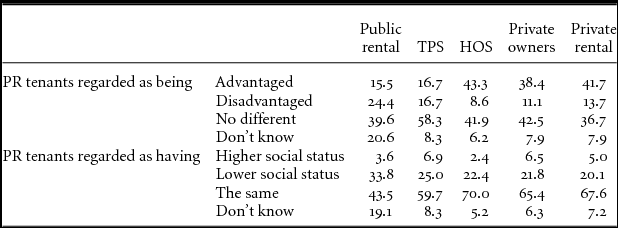
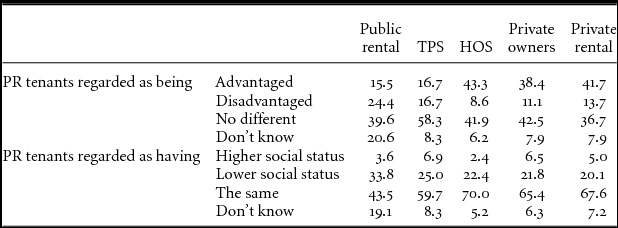
What about feelings of being advantaged or disadvantaged or perceptions of social status? Public tenants were asked how they thought they were perceived by those living outside the sector. The responses varied (Table 2). Whilst 15 per cent believed they would be perceived as advantaged, 24 per cent thought the opposite. Most thought (40 per cent) that public sector tenants would be regarded as being no different (neither advantaged nor disadvantaged) to anyone else. It is, however, evident from the survey that ‘advantage’ in the Hong Kong context has to be interpreted in relation to subsidy and rental costs. Tenants feeling advantaged refer primarily to the low rent, rather than, for example, the quality of their living environment, stability or safety (though these are mentioned). Disadvantage is, however, more typically interpreted on a different dimension and more predictably in relation to having a low income, not owning property and having a lower standard of living. Among those giving a reason for feeling disadvantaged, only around 10 per cent referred to negative stereotyping of public tenants.
Current tenure, social status and whether public rental tenants are advantaged or disadvantaged (all percentages)
Among public sector tenants, perceptions also varied by occupational status. Public sector tenants in higher-status occupations were more likely to see themselves as disadvantaged. This did not however hold true for external perceptions. Occupational status had little discernible difference in relation to views about public tenants among those outside the sector. However, again advantage/disadvantage was clearly being interpreted in different ways. The pattern of response would suggest that among those in higher-status occupations within the public rental sector, advantage is closely linked to social status. However, among those outside the sector, it is evidently strongly connected to perceptions that public tenants enjoy overgenerous subsidies. Around a third of those outside public renting regard the sector as advantaged and refer to aspects of housing costs (low rents, no mortgage, no maintenance fees, government subsidies) as the reason for their attitude.
When asked about social status, however, public tenants have a clearer view of themselves. Very few (3.6 per cent) believe that they are perceived as having relatively high social status whilst a third think they are generally perceived as having lower social status compared to others.
We have already touched upon the perceptions of public renting among those living in other tenures and perceptions of advantage/disadvantage are clearly related to tenure status. As Table 2 shows, public rental tenants are less likely to think of themselves as advantaged and more likely to think of themselves as disadvantaged when compared with other groups. It is the assisted home owners and unassisted private renters who are most likely to see public tenants as advantaged.
It is of some interest to note that public rental tenants are more likely than those in other tenures to believe they are regarded as having lower social status. As Table 2 shows, whilst a third of public tenants have this view, only around a fifth of private owners or private tenants think this is the case. Indeed, a small proportion of private owners believe that public tenants would be regarded in Hong Kong as having higher social status. The strongest message, however, from Table 2 is that although considerably more people think that public tenants are regarded as having lower rather than higher social status, the majority of respondents feel that people are generally in the same social status positions regardless of housing tenure. More qualitative research would be necessary to unpack the various elements which have produced this pattern of responses. It is evident, for example, that subjective notions of social status are intertwined with feelings about the fairness or otherwise of the pattern of housing subsidies. Moreover, there may be a tendency to avoid expressing feelings of apparent superiority in a social survey.
Position on the housing ladder
Another way of getting at some of these issues is with reference to the popular idea of a housing ladder. People were asked where they would put themselves on an imaginary ladder with ten rungs, the top rung representing ‘best-off’ and the bottom rung ‘worst-off’. They were also asked whether they thought they were moving up or down this ladder. As can be seen from Table 3, evaluations of where people think they are located tend towards the mean. In other words, the strongest message is that people generally think they are somewhere around the middle of the housing status hierarchy. Again, this could be produced by the same tendency noted above for people in Hong Kong to be unwilling to suggest they are in any way better than others. Equally, however, it may be a genuine expression of how people see themselves in the housing system. It is also particularly notable that the mean rung for public sector tenants is second only to private renters, and that private owners are second to last on that measure. Moreover, a quarter of public sector tenants believe they are on an upward trajectory, with only 8 per cent thinking they might be going down the rungs. Overall, it seems that in Hong Kong as a whole, at least in relation to housing, optimists far outweigh pessimists. There are, of course, numerous qualifying variables in this pattern of responses. For example, age exerts an influence. Among public sector tenants, it is the young and the elderly who put themselves on the highest positions. Those in the middle age ranges tend to place themselves lower. Age is also a factor with regard to whether people think they are on an upward or downward trajectory. As might be expected, optimism declines with age. For the whole sample, whilst 44 per cent of eighteen- to twenty-four-year-olds expect to be moving up the ladder, only 19 per cent of those over aged sixty-five and over expect to (still perhaps a surprisingly high proportion). This general pattern also held for public sector tenants.
Position on notional housing ladder and whether respondents see themselves on an upward or downward trajectory

On this simple measure, therefore, and reminiscent of Rex and Moore's (1967) hierarchy, in Hong Kong, public renting appears to be in second place. There are, of course, numerous ways to interpret and qualify interpretations of these data. The standard deviation is highest for the public rental group. However, rung 5 is the median position for all groups and while over 6 per cent of public tenants put themselves on the bottom two rungs, 7.2 per cent see themselves on rungs 9 or 10. Among private owners, it may also be that the ladder is perceived to be much longer. Therefore, in terms of aspirations with regard to space and price, there may be a greater tendency to see the climb as much greater. Nevertheless, it does pose the question, unfortunately unanswerable given the lack of comparable data, as to whether this pattern of response would be very different in other cultural contexts where public rental housing sits in a rather different position in the social structure. For example, in the USA or the UK, would (m)any public tenants place themselves at the top of the ladder?
Creating a more equal society
Finally, did people think positively about public rental housing contributing towards a more equal society? Here there was some divergence of opinion across the tenure groups. The more closely related to the public housing system the group was, the more likely they were to affirm the contribution of public housing toward greater social equality – thus, a higher proportion of current tenants, sitting-tenant purchasers (TPS) and public home owners (HOS) had a positive view than home owners or private tenants. Some 14 per cent of private renters and 13 per cent of private owners thought public rental housing made Hong Kong a less equal society – an opinion shared by 9 per cent of public rental tenants. But even among private tenants, those believing public rental housing made a positive contribution (39 per cent) far outweighed those with a negative view. Again the issue of housing subsidies and their perceived fairness is evidently a significant factor in shaping responses. Because of the strong tendency for public housing to have become more residual, and because of pervasive affordability problems, the housing and social policy literature tends to frame these kinds of questions, implicity or explicitly, in terms of market-driven inequality. Market processes produce inequalities of access and conditions – public housing helps ameliorate those inequalities – or some version of that. In Hong Kong, however, the frame of reference is rather different. The perception among some, that public rental tenants are advantaged, also may explain why some people believe that the tenure makes Hong Kong less equal. This seems a more plausible explanation than this view being taken because of a more complex set of beliefs that public rental housing somehow damages tenants and makes them less able to succeed in life (a view held by some critics of public sector housing elsewhere).
Discussion
Many of the poorest households in Hong Kong are concentrated in the public rental sector. The census figures for the last few decades show a clear trend in that direction. Many of the ingredients for stigma and low reputation appear, therefore, to be there. However, currently, that is evidently not how tenants see themselves or how others see them. Public sector tenants may have a realistic assessment of their weaker economic status and that there are others who are considerably better off. The findings, however, suggest that tenants most typically see themselves as no better-off, nor worse-off, than others. Moreover, those outside public sector housing hold a similar view. Public rental tenants are ‘people like us’ rather than ‘people like them’. Public rental housing in Hong Kong is still a ‘normal’ tenure. A significant proportion of public sector tenants may ideally aspire to home ownership but they are not dissatisfied with, nor feel damaged by, their public sector tenancy status. This may not be surprising given the size of the sector and the continuing level of investment in it. Moreover, if there are negative views towards the tenure from outside, they seem more likely to be associated with the low rents enjoyed by public sector tenants rather than with issues of reputation or stigma. There is certainly little evidence from these data to suggest that the ‘dis-identifying’ or distancing identified by Blokland would be a strong aspect of the discursive practices of public tenants in Hong Kong. The public tenants in this survey do not see themselves as being any ‘better’ or ‘more respectable’ than those around them.
The empirical material presented in this paper could be interpreted as a positive message regarding public housing specifically and social cohesion more generally in Hong Kong. Certainly, the more general evidence indicates that social and spatial divisions within public housing sector, and between tenures, is less marked in Hong Kong than in many other major cities (Delang and Lung, Reference Delang and Lung2010; Forrest et al., Reference Forrest, Grange and Yip2004). However, urban social structures are always in a process of transformation and Hong Kong is changing with new population influxes and with the development of a more established middle class. Also, somewhat contrary to the evidence presented here, proposals for new public housing do meet increased resistance. This was highlighted in the Chief Executive's 2011 policy address which observed ‘the objection of some local communities to PRH development. In my view, these objections are prejudiced and not in the public interest’ (Tsang, Reference Tsang2011). These kinds of objections may be expressed in terms of concerns about infrastructure overload or property values, but stigma lurks close to the surface. It is also cautionary to look to other countries to see how quickly social status and reputation can change. England provides, perhaps the best example. With some echoes of contemporary Hong Kong, council housing was regarded by many as a privileged and oversubsidised tenure in the late 1960s, housing too many ‘rich’ households. It moved rapidly to being regarded as a housing tenure of last resort with policy preoccupations no longer focused on better targeting but on improving social mix and combating social exclusion.
Social differentiation between home owners and public tenants which is often stark in other cities is not so evident in Hong Kong. Home owners and public tenants, by and large, are not two distinct groups. A baby boomer generation may have become middle-class home owners but most were brought up in public rental housing. Their parents were, and many still are, public rental tenants. Ownership may have become a common middle-class aspiration, but it seems that there is currently little stigma attached to public rental housing. A majority of the governing and business elite of Hong Kong were probably brought up in public rental housing. This cross-tenure connection is evident from this study. A third of private home owners in the survey had experience of living in public rental housing and this figure excludes those currently living in state subsidised, home-ownership-scheme flats or sitting-tenant purchasers. Elsewhere, if tenant purchase type schemes are taken out of the equation, many home owners have little if any experience of public rental housing – the middle class progress to home ownership via private renting.
In Hong Kong, as in other East Asian societies, there has been rapid and extensive socio-economic change – a feature of what Chang (Reference Chang2010) has conceptualised as compressed modernity. The rapidity of social change combined with the pervasive role played by public rental housing in the shaping of life chances has meant that the social distance between the tenures is small in terms of lived experience – there is considerable generational overlap. As has been argued, the contemporary position of public rental housing in Hong Kong is more generally illustrative of the contingent nature of the social relations of housing tenure. Neither public rental housing nor home ownership come with any inherent or inevitable social or economic qualities. Contemporary attitudes to public rental housing in Hong Kong, from within and without, are explained by its distinct historical embeddedness in relation to policy and political history, institutional development and a particular social and economic trajectory. Some wider lessons may, nevertheless, be drawn from this distinctiveness and particularly for other cities in East Asia facing rapid population growth, widening income inequalities, divergent housing opportunities and escalating property values. Contingent on a range of factors alluded to above, high-density public rental housing can still clearly play an effective and popular role in alleviating the housing pressures of the contemporary city, provided it is well managed and well maintained. The rather different and generally negative views of state rental housing systems found in much of the housing policy debate and literature derive from experiences in different times and in different places.
Acknowledgement
The work described in this paper was supported by a grant from the Central Policy Unit of the Government of Hong Kong Special Administrative Region and the Research Grants Council of the Special Administrative Region, China. Exploring Peripheralisation and Residualisation in Hong Kong's Public Rental Housing: New Policy Challenges (Project No. 956001).