INTRODUCTION
Acquired brain injury (ABI) is defined as damage that occurs beginning 28 days after birth. It has different degrees of severity and is the result of various factors, such as oxygen deprivation, substance abuse, stroke, infections, or a traumatic brain injury (TBI), and affects emotional, cognitive, and physical aspects, temporarily or permanently (McKinlay et al., Reference McKinlay, Linder, DePompei, Aaro Jonsson, Anderson, Braga and Wicks2016). Children with ABI can present with disruptive behavior that has been related to injury and family factors (Durish et al., Reference Durish, Yeates, Stancin, Taylor, Walz and Wade2018; Ganesalingam, Sanson, Anderson, & Yeates, Reference Ganesalingam, Sanson, Anderson and Yeates2007; Rao et al., Reference Rao, Rosenberg, Bertrand, Salehinia, Spiro, Vaishnavi and Miles2009).
Specifically, family factors such as parents’ mental health, parents’ executive functions, and dysfunctional parenting practices have an impact on the child’s long-term development after ABI (Greenham et al., Reference Greenham, Hearps, Gomes, Rinehart, Gonzalez, Gordon and Anderson2015; Ryan et al., Reference Ryan, van Bijnen, Catroppa, Beauchamp, Crossley, Hearps and Anderson2016; Wade, Zhang, Yeates, Stancin, & Taylor, Reference Wade, Zhang, Yeates, Stancin and Taylor2016). We aimed to test the mediation of potential intervention targets (parental stress, child disinhibition, parenting practices) between parent factors (trait-anxiety, executive dysfunction) and child disruptive behavior after pediatric ABI. This study advances knowledge by using mediation and path analysis to examine potential intervention targets, parent factors, and child disruptive behavior together in a single model. To date, interventions overlook parent factors that could be involved in treatment outcomes. Investigating these factors together may lead to the detection of potential intervention targets to reduce disruptive behavior after ABI.
Parenting Practices
Parenting practices were included as a potential intervention due to their modifiability. Parenting practices can be conceptualized by three dimensions: (1) warmth, which refers to fostering self-regulation by supporting the child’s needs and demands; (2) behavioral control, which involves providing clear expectations for behavior together with appropriate limits; and (3) autonomy support, which involves encouraging children to formulate their perspective and goals (Braumind, Reference Braumind1971; Prinzie et al., Reference Prinzie, Onghena, Hellinckx, Grietens, Ghesquière and Colpin2003; Prinzie, Stams, Dekovic, Reijntjes, & Belsky, Reference Prinzie, Stams, Dekovic, Reijntjes and Belsky2009).
Based on these dimensions, parenting styles can be classified into authoritative, authoritarian, permissive, and uninvolved styles (Siegler et al., Reference Siegler, Saffran, Eisenberg, DeLoache, Gershoff and Leaper2017). The authoritative parenting style balances between the warmth/responsiveness, control/demandingness, and autonomy/support dimensions (Siegler et al., Reference Siegler, Saffran, Eisenberg, DeLoache, Gershoff and Leaper2017). In typically developing children, optimal outcomes are evident when parents present authoritative parenting practices (Amato & Fowler, Reference Amato and Fowler2002). In contrast, dysfunctional parenting practices, such as authoritarian, permissive, and uninvolved practices can interfere with the child’s development (Amato & Fowler, Reference Amato and Fowler2002). Implementation of authoritative parenting practices reduced disruptive behavior after childhood ABI in the home settings (Chavez-Arana et al., Reference Chavez-Arana, Catroppa, Yáñez Téllez, Godfrey, Prieto-Corona, De León and Anderson2017; Durish et al., Reference Durish, Yeates, Stancin, Taylor, Walz and Wade2018; Greenham et al., Reference Greenham, Hearps, Gomes, Rinehart, Gonzalez, Gordon and Anderson2015; Rashid et al., Reference Rashid, Goez, Mabood, Damanhoury, Yager, Joyce and Newton2014; Root et al., Reference Root, Wimsatt, Rubin, Bigler, Dennis, Gerhardt and Yeates2016).
However, studies in the field of pediatric ABI have encountered difficulties when attempting to investigate if authoritative parenting practices foster reduced disruptive behavior in school settings due to the lack participation from school staff (Brown, Whittingham, Boyd, McKinlay, & Sofronoff, Reference Brown, Whittingham, Boyd, McKinlay and Sofronoff2014). To date, the results from a pilot study (Chavez-Arana et al., Reference Chavez-Arana, Catroppa, Yáñez Téllez, Godfrey, Prieto-Corona, De León and Anderson2017) and a randomized controlled trial (Chavez-Arana, Catroppa, Yáñez-Téllez, et al., Reference Chavez-Arana, Catroppa, Hearps, Yáñez Téllez, Prieto-Corona and de León2018) suggest that the implementation of authoritative parenting practices does not reduce disruptive behavior in school settings.
Parent’s Trait-Anxiety
It is common for parents of children with ABI to experience high levels of anxiety. Anxiety is experienced during situations perceived as threatening and is accompanied by negative expectations and concerns (Eysenck, Derakshan, Santos, & Calvo, Reference Eysenck, Derakshan, Santos and Calvo2007; Gu, Huang, & Luo, Reference Gu, Huang and Luo2010). Trait-anxiety indicates excessive levels of worry (Aktar, Nikolic, & Bögels, Reference Aktar, Nikolic and Bögels2017). Parents with high trait-anxiety experience more parental stress, tend to make pessimistic interpretations, report more negative life events, and are more intolerant (Gu et al., Reference Gu, Huang and Luo2010; Pluess, Bolten, Pirke, & Hellhammer, Reference Pluess, Bolten, Pirke and Hellhammer2010). A high trait-anxiety undermines parents’ ability to initiate and maintain warmth interactions with the child and may lead to intrusive and overprotective parenting practices (Prinzie et al., Reference Prinzie, Stams, Dekovic, Reijntjes and Belsky2009). Parents with high trait-anxiety tend to attribute negative intentions to their children when they misbehave, which may increase parental stress (Gu et al., Reference Gu, Huang and Luo2010; Pluess et al., Reference Pluess, Bolten, Pirke and Hellhammer2010; Prinzie et al., Reference Prinzie, Stams, Dekovic, Reijntjes and Belsky2009).
High levels of trait-anxiety in parents may hinder the development of children’s executive functions (Henrichs et al., Reference Henrichs, Schenk, Kok, Ftitache, Schmidt, Hofman and Tiemeier2011). Similarly, children who present with behavioral disinhibition in early childhood are more likely to present with trait-anxiety during adolescence (Lewis-Morrarty et al., Reference Lewis-Morrarty, Degnan, Chronis-Tuscano, Pine, Henderson and Fox2015). Trait-anxiety has been associated with failures in the development or functioning of the central nervous system and genetic and environmental factors (Aktar et al., Reference Aktar, Nikolic and Bögels2017; Henrichs et al., Reference Henrichs, Schenk, Kok, Ftitache, Schmidt, Hofman and Tiemeier2011; Lewis-Morrarty et al., Reference Lewis-Morrarty, Degnan, Chronis-Tuscano, Pine, Henderson and Fox2015; Verkhratsky & Parpura, Reference Verkhratsky and Parpura2014). These neurological, environmental, and genetic factors may explain why trait-anxiety runs in families (Aktar et al., Reference Aktar, Nikolic and Bögels2017).
Parental Stress
Parental stress is defined as the level of stress experienced in the parenting role and derived from the parent’s interaction with the child (Abidin, Reference Abidin2012). Parents of children with ABI present with elevated parental stress, perhaps as a consequence of the diagnosis, treatment process, and concerns regarding their child’s future (Hawley, Ward, Magnay, & Long, Reference Hawley, Ward, Magnay and Long2009; Micklewright, King, O’Toole, Henrich, & Floyd, Reference Micklewright, King, O’Toole, Henrich and Floyd2012; Muscara et al., Reference Muscara, Burke, McCarthy, Anderson, Hearps, Hearps and Nicholson2015; Prigatano & Gray, Reference Prigatano and Gray2007). Parents’ vulnerability may intensify as they face academic, behavioral, and social challenges associated with brain injury, such as the need for rehabilitation, advocacy, and additional support (Jordan & Linden, Reference Jordan and Linden2013; Micklewright et al., Reference Micklewright, King, O’Toole, Henrich and Floyd2012; Prigatano & Gray, Reference Prigatano and Gray2007).
Parent’s Executive Dysfunction
Anxiety also has a detrimental effect on executive functions (Eysenck et al., Reference Eysenck, Derakshan, Santos and Calvo2007; Shields, Moons, Tewell, & Yonelinas, Reference Shields, Moons, Tewell and Yonelinas2016). Executive functions are the cognitive processes involved in the conscious control of thought and action (Zelazo, Qu, & Kesek, Reference Zelazo, Qu and Kesek2010). Parents require executive functions to respond appropriately to their child’s needs, require cognitive flexibility to switch responses across situational demands, and working memory to temporarily store and manipulate information about the parent–child interaction (Barrett & Fleming, Reference Barrett and Fleming2011). Parents’ executive functions influence their parenting skills (Bridgett, Burt, Edwards, & Deater-Deckard, Reference Bridgett, Burt, Edwards and Deater-Deckard2015; Bridgett, Kanya, Rutherford, & Mayes, Reference Bridgett, Kanya, Rutherford and Mayes2017; Crandall, Deater-Deckard, & Riley, Reference Crandall, Deater-Deckard and Riley2015).
Parents with executive dysfunction have more difficulty consistently applying authoritative parenting practices, such as engaging in warmth interactions, applying adequate limits and providing autonomy support, and tend to present with reactive and harsh parenting (Bridgett et al., Reference Bridgett, Kanya, Rutherford and Mayes2017; Crandall et al., Reference Crandall, Deater-Deckard and Riley2015; Cuevas et al., Reference Cuevas, Deater-Deckard, Kim-Spoon, Watson, Morasch and Bell2014; Prinzie et al., Reference Prinzie, Onghena, Hellinckx, Grietens, Ghesquière and Colpin2003, Reference Prinzie, Stams, Dekovic, Reijntjes and Belsky2009). Therefore, it has been suggested that parents’ executive dysfunction impacts child behavior via dysfunctional parenting practices (Bridgett et al., Reference Bridgett, Kanya, Rutherford and Mayes2017).
Child Disinhibition
During development, children transit from external regulation to self-regulation (Bernier, Carlson, & Whipple, Reference Bernier, Carlson and Whipple2010). They learn to regulate their behavior by interacting with their caregivers (Bernier et al., Reference Bernier, Carlson and Whipple2010; Morris, Silk, Steinberg, Myers, & Robinson, Reference Morris, Silk, Steinberg, Myers and Robinson2007). Behavior regulation requires the adequate development of inhibition (Barkley, Reference Barkley2001). Inhibition consists of (a) inhibiting the initial prepotent response, (b) interrupting an ineffective ongoing response, and (c) protecting self-directed responses from interference (Barkley, Reference Barkley2001). Inhibition involves creating a delay and valuing long-term consequences over short-term ones (Barkley, Reference Barkley2001). Poor child inhibition capacity or disinhibition is a risk factor for disruptive behavior (Schoemaker, Bunte, Espy, Dekovic, & Matthys, 2014; Sobanski et al., Reference Sobanski, Banaschewski, Asherson, Buitelaar, Chen, Franke and Faraone2010; Munoz & Anastassiou-Hadjicharalambous, Reference Munoz and Anastassiou-Hadjicharalambous2011).
Disruptive Behavior
Disruptive behavior is a common consequence in children with ABI and is associated with disinhibition (Chavez et al., Reference Chavez, Yanez, Catroppa, Rojas, Escartin, Hearps and Garcia2015; Max et al., Reference Max, Koele, Smith, Sato, Lindgren, Robin and Arndt1998; Rao et al., Reference Rao, Rosenberg, Bertrand, Salehinia, Spiro, Vaishnavi and Miles2009). Disruptive behavior includes noncompliance, defiance, and aggressiveness (Eyberg & Pincus, Reference Eyberg and Pincus1999). It is also reported as one of the most problematic consequences of ABI by parents, teachers, and friends (Feeney, Reference Feeney2010; Sobanski et al., Reference Sobanski, Banaschewski, Asherson, Buitelaar, Chen, Franke and Faraone2010). Disruptive behavior in children with ABI is a consequence of injury and parent factors (Jacobs, Harvey, & Anderson, Reference Jacobs, Harvey and Anderson2011; Spencer-Smith & Anderson, Reference Spencer-Smith and Anderson2009). Brain networks are not yet refined during childhood and are damaged by ABI mechanisms, such as elevated intracranial pressure, diffuse axonal injury, edema, and shearing strain (Jacobs et al., Reference Jacobs, Harvey and Anderson2011; Spencer-Smith & Anderson, Reference Spencer-Smith and Anderson2009).
For this reason, a younger age at injury onset has been associated with more severe damage to neural networks and its functions (Anderson, Catroppa, Haritou, Morse, & Rosenfeld, Reference Anderson, Catroppa, Haritou, Morse and Rosenfeld2005; Crowe, Catroppa, Babl, Rosenfeld, & Anderson, Reference Crowe, Catroppa, Babl, Rosenfeld and Anderson2012). However, the relationship between age and outcome is not linear and depends on the maturational stage during injury onset (Crowe et al., Reference Crowe, Catroppa, Babl, Rosenfeld and Anderson2012; Jacobs et al., Reference Jacobs, Harvey and Anderson2011; Spencer-Smith & Anderson, Reference Spencer-Smith and Anderson2009).
Several studies have identified parent factors that enhance or diminish disruptive behavior after ABI (Anderson et al., 2012; Greenham et al., Reference Greenham, Hearps, Gomes, Rinehart, Gonzalez, Gordon and Anderson2015; Ryan et al., Reference Ryan, van Bijnen, Catroppa, Beauchamp, Crossley, Hearps and Anderson2016; Wade et al., Reference Wade, Zhang, Yeates, Stancin and Taylor2016). How these factors interact remains unclear. We aim to test if potential intervention targets (parental stress, child disinhibition, and parenting practices) mediate the association of parent factors (trait-anxiety and executive dysfunction) and child disruptive behavior, and to investigate how these factors interact in a single model to influence child disruptive behavior after ABI.
It is known that children actively influence their environment and can evoke behaviors in their parents (Rashid et al., Reference Rashid, Goez, Mabood, Damanhoury, Yager, Joyce and Newton2014; Siegler et al., Reference Siegler, Saffran, Eisenberg, DeLoache, Gershoff and Leaper2017; Taylor et al., Reference Taylor, Yeates, Wade, Drotar, Stancin and Burant2001). However, this study is mainly interested in parent factors that contribute to child disruptive behavior. This study aims to provide a clearer understanding of the interaction among parent factors and child disruptive behavior after pediatric ABI.
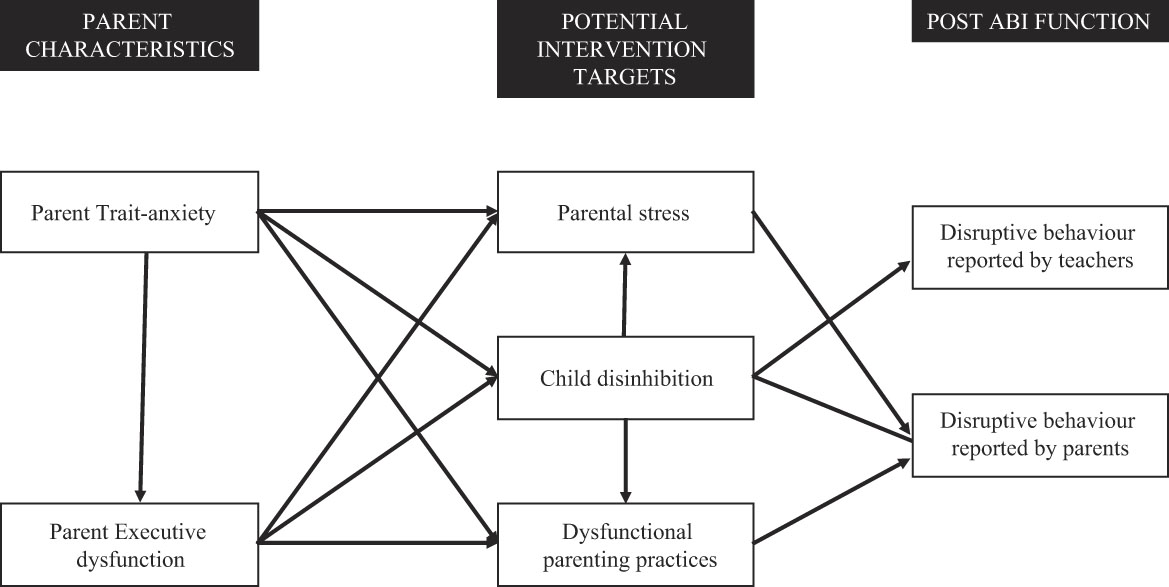
It was hypothesized that potential intervention targets will mediate the association of parent factors and child disruptive behavior after ABI diagnosis; child disruptive behavior reported by parents will be associated with dysfunctional parenting practices, parental stress, and child disinhibition, while child disruptive behavior reported by teachers will be directly associated with child disinhibition. Lastly, an indirect association between parent factors (trait-anxiety and executive dysfunction) and child disruptive behavior was hypothesized. This hypothetical model based on the literature is described in Figure 1.
Hypothetical model based on the literature.

Methods
Participants
Parents of 77 children with a diagnosis of ABI participated in this study. Participants were recruited using posters and flyers located in hospitals, clinics, and universities in Mexico City. Families who were interested in participating contacted the researchers via email or phone. A face-to-face interview was arranged to provide details about the study and confirm that the participants met the inclusion criteria. Parents were asked to bring copies of the medical documentation with the description of the ABI and the imaging study when available.
Inclusion and exclusion criteria
The following inclusion criteria were required to participate in the study: (1) child aged between 6 and 12 years of age, obtained during face-to-face interviews based on medical documentation; (2) diagnosis of ABI (defined as damage to the brain diagnosed 28 days after birth) based on a medical description of the injury and/or the imaging study; (3) cause or type of ABI is documented; (4) injury occurred at least 3 months before the assessment, based on the medical description of the injury and/or the image study; (5) parents have an active and current parenting role with the child; (6) parent is over 18 years; (7) parents are able to write and read in Spanish.
The exclusion criteria were as follows: (1) parents with symptoms of psychosis or borderline personality; (2) children in ongoing medical treatment (e.g., chemotherapy, planned neurosurgery); (3) children who were currently receiving treatment to improve behavior or whose parents had been previously trained in parenting practices; (4) child or parent with a history of psychiatric diagnosis (autism, symptoms of psychosis or borderline personality; due to the high prevalence of parents with anxiety disorders, and children with anxiety disorders, attention deficit, and hyperactive disorder or learning disorder, these comorbidities and intellectual disability were not excluded); (5) child with uncontrolled seizures.
Approvals
The University of Melbourne Human Research Ethics Sub-Committee approved this study (Ethics ID: 1545487) and Mexican institutions and professionals who participated in this study assumed this opinion as their own since it protects participants’ human rights. Parents were informed about the research project, and signed informed consent was obtained before the assessment session.
Setting
The assessments were conducted at Iskalti-Condesa. This clinic is close to the center of Mexico City.
Measures
Family structure
The social risk measure was used to describe family structure. This measure classifies families into intact family (two caregivers), separated parents with dual custody, and families with a single caregiver (Murray et al., Reference Murray, Scratch, Thompson, Inder, Doyle, Anderson and Anderson2014; Roberts et al., Reference Roberts, Howard, Spittle, Brown, Anderson and Doyle2008).
The questionnaires used did not have norms for a Mexican population but were available in Spanish. Scores obtained by measuring parents’ trait-anxiety, parental stress, parenting practices, and disruptive behavior are not corrected by age (not even when the standard score is obtained). Furthermore, higher scores indicate higher dysfunction in all measures used in this study. As a consequence, raw scores were used for the analysis. While raw scores are not directly interpretable, they can provide an estimate of the severity of impairment by considering high or low punctuations.
Parent’s trait anxiety
The State-Trait Anxiety Inventory (STAI; Diaz-Guerrero & Spielberg, Reference Díaz-Guerrero and Spielberger1975) is a questionnaire that measures anxiety symptoms in adults using a Likert scale. We used the raw score of the trait subscale, which consists of 20 items for analysis. The instruction in this subscale asks one to choose the option that reflects how parents usually feel rather than how they feel at the moment. Higher scores indicate a higher level of trait-anxiety. STAI has proven a reliable and valid measure (Cronbach’s alpha [α]=0.93; Díaz-Guerrero, & Spielberg, 1975).
Parent’s executive dysfunction
The Behavior Rating Inventory of Executive Function-Adult Self-report (BRIEF-A; Roth, Isquith, & Gioia, Reference Roth, Isquith and Gioia2005) assesses executive dysfunction in daily life. It consists of 75 items scored using a Likert scale. The raw score of the Global Executive Composite was used for the analysis. Higher scores indicate greater executive dysfunction. BRIEF-A has proven a reliable and valid measure (α 0.93–0.96; Roth et al., Reference Roth, Isquith and Gioia2005).
Parental stress
The Parent Stress Index (PSI) short form (Abidin, Reference Abidin2012) was used to measure parental stress, using the Total Stress raw scores. This scale consists of 36 items that reflect the level of parental stress experienced by parents and does not consider stress related to other roles and life events (Abidin, Reference Abidin2012). Higher scores indicate an elevated level of parental stress. The PSI has proven a reliable and valid measure (α=0.90; Abidin, Reference Abidin2012).
Parenting practices
The Parenting Scale (PScale) is an index of dysfunctional parenting practices (Arnold, O’Leary, Wolff, & Acker, 1993). PScale is a 30-item questionnaire that measures over-reactivity, laxness, and verbosity, which are dysfunctional parenting practices. We used the version translated into Spanish by permission of the first author, David Arnold. The total raw score was used for the analysis. Increased scores indicate more use of dysfunctional parenting practices. This scale was previously used to study the disciplinary practices of parents of children with ABI and has proven a valid and reliable measure (α=0.84; Woods et al., 2014; Prinzie, Onghena, & Hellinckx, Reference Prinzie, Onghena and Hellinckx2007).
Child disinhibition
The inhibition subscale from the BRIEF parent form (Gioia, lsquith, Guy, & Kenworthy, Reference Gioia, lsquith, Guy and Kenworthy2000) was used to measure child disinhibition. The inhibition subscale consists of eight items. The raw score was used for the analysis. Higher scores indicate disinhibition. The inhibition subscale has proven a reliable and valid measure (α=0.96; Gioia et al., Reference Gioia, lsquith, Guy and Kenworthy2000).
Disruptive behavior
To measure disruptive behavior, we used the intensity subscale from the Eyberg Child Behavior Inventory (ECBI; Eyberg & Pincus, Reference Eyberg and Pincus1999). ECBI was answered by the primary caregiver and measures the frequency of disruptive behavior. The Student Eyberg Sutter Behavior Inventory (SESBI; Eyberg & Pincus, Reference Eyberg and Pincus1999) was used to measure disruptive behavior reported by teachers. The teacher who spent most time at school with the child answered the questionnaire. Both inventories (ECBI and SESBI) consist of 36 items and increased scores indicate a high frequency of disruptive behavior. The ECBI (α 0.95) and SESBI (α 0.98) have proven reliable and valid measures (Eyberg & Pincus, Reference Eyberg and Pincus1999).
Statistical Analysis
Descriptive statistics of the children and their primary caregiver characteristics were analyzed using IBM SPSS and are reported in Table 1.
Demographic characteristics of children and their primary caregiver

ABI=acquired brain injury; TBI=Traumatic traumatic Brain brain Injuryinjury; SD=Standard standard deviation.
Mediation
A mediation is conceived when a third variable, the mediator, intervenes between two other variables (Iacobucci, Reference Iacobucci2008; Shrout & Bolger, Reference Shrout and Bolger2002). When there are multiple mediators in one model, there can be mediator–mediator interaction as well (VanderWeele & Vansteelandt, Reference VanderWeele and Vansteelandt2014). For this reason, when a model includes more than one mediator, each mediator can be tested independently. The mediators in the final model (Figure 2) were tested independently. To test the mediation models, we followed the steps recommended by Shrout and Bolger (Reference Shrout and Bolger2002). The mediation test was carried out as follows: (Step 1) showing that the exogenous variable (X) is related the endogenous variable (Y) by testing and estimating the regression coefficient (path-c) (Shrout & Bolger, Reference Shrout and Bolger2002).
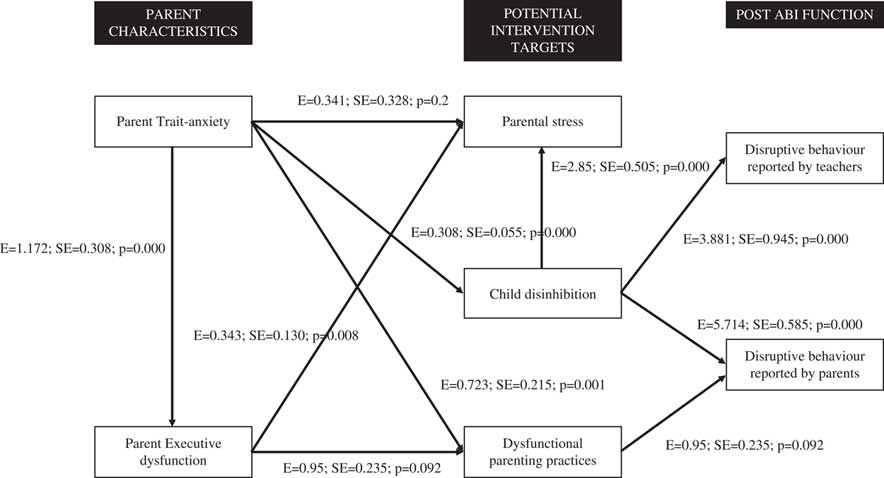
Final model.

These authors distinguish between proximal (strong empirical supported causality X-Y) and distal processes (Shrout & Bolger, Reference Shrout and Bolger2002). For proximal processes path-c must be significant, whereas for distal processes significance in path-c is not required (Shrout & Bolger, Reference Shrout and Bolger2002); (Step 2) showing that X is related to the mediator (M) by estimating and testing the regression coefficient (path-a); (Step 3) showing that M is related to Y, while X is constant by estimating the regression coefficient (path-b) in a multiple regression equation with Y as an outcome of X and M; (Step 4) while paths a and b are included, estimate and test the regression coefficient between X and Y (path-c´) (Shrout & Bolger, Reference Shrout and Bolger2002).
Mediation occurs when path-c´ (Step 4) is smaller than path-c (Step 1). Complete mediation occurs when path-c´ is not significant, whereas partial mediation occurs when path-c´ is smaller than path-c and remains significant (Fairchild & McDaniel, Reference Fairchild and McDaniel2017). To understand how factors interact in a more complex (and realistic) model, path analysis can be conducted (Streiner, 2005).
Path Analysis
Path analysis is an extension of multiple regression that allows examinations of relationships among variables and comparison of different models (Streiner, 2005). In path analysis, exogenous variables influence the endogenous variables (Peyrot, Reference Peyrot1996; Streiner, 2005). For this reason, reciprocal or bidirectional relationships are not possible with path analysis (Streiner, 2005). For example, an exogenous variable (e.g., parents’ trait-anxiety) cannot receive an arrow from an endogenous variable (e.g., child disruptive behavior). Thus, the current study focuses on understanding how parent factors influenced child outcomes. Path analysis was conducted in Mplus 7.2.
The data met the assumptions for path analysis; the variables presented with a normal distribution (skewness and kurtosis within a range of ±1.96) and was complete for all variables except for behavior reported by teachers. Eight teachers did not return the questionnaires. The analysis was conducted taking the missing values into account. A non-significant chi-square (χ2) is considered a good fit (Schreiber, Stage, King, Amaury, & Barlow, Reference Schreiber, Stage, King, Amaury and Barlow2006). Indicators of optimal model adjustment used were Comparative Fit Index (CFI) and Tucker-Lewis Index (TLI) in which values of ≥.95 are required for the acceptance of the model (Finch & West, Reference Finch and West1997; Schreiber et al., Reference Schreiber, Stage, King, Amaury and Barlow2006). A root mean square error of approximation (RMSEA) value of ≤.06 is considered an adequate model fit (Finch & West, Reference Finch and West1997; Schreiber et al., Reference Schreiber, Stage, King, Amaury and Barlow2006), as is a standardized root-mean-square residual (SRMR) value of ≤.08 (Amaya-Hernández et al., Reference Amaya-Hernández, Mancilla-Diaz, Alvarez-Rayon, Ortega-Luyando, Larios- Lopez and Martinez-Guerrero2013; Schreiber et al., Reference Schreiber, Stage, King, Amaury and Barlow2006).
Wald tests were used to identify paths that could be removed to improve the model fit. Path coefficients were used to test the direct effects and bootstrapped estimates were used to test all the indirect effects in the final model (Figure 2). The number of bootstrap samples for bias-corrected bootstrap confidence intervals was 1000 in all analyses. In line with previous studies (Micklewright et al., Reference Micklewright, King, O’Toole, Henrich and Floyd2012), the significance of indirect effects was determined by (1) the significance of the unstandardized regression coefficients and (2) exclusion of zero between the upper and lower bounds in the confidence intervals. The single step approach can be applied when the effect on the outcome is transmitted through several mediators (Saunders & Blume, Reference Saunders and Blume2017). In path analysis, the single step approach consists in testing each mediator independently, before estimating the total indirect effect in a multiple mediator model (Saunders & Blume, Reference Saunders and Blume2017). Due to the inclusion of multiple mediators in a single model (Figure 1), both analyses were conducted in the current study. In addition, the path analysis model provides a more complete picture of the interaction among these factors in a single model, which may be relevant to consider in potential intervention programs.
RESULTS
Demographics
Table 1 shows the demographic information of the participants. The age of the children participating in this study ranged between 6 and 12 years. Most children were male (59.7%). Diagnosis of a brain tumor (29.9%), brain cyst (27.3%), and TBI (23.4%) were predominant in the sample. The severity of the TBI was determined by the treating physician using the Glasgow Coma Scale and ranged from mild (six participants) and moderate (three participants) to severe (nine participants). The mother was the primary caregiver in 96.1% of families. Most families participating in this study (70.1%) comprised two caregivers living together. Children with a diagnosis of a brain cyst presented with behavioral or neurological symptoms associated with the cyst, which affected their daily activities. Eight of the participants with a diagnosis of brain cyst underwent neurosurgery. Six participants were diagnosed with developmental disorders (one with a learning disorder, three with ADHD, one with ADHD and anxiety disorder, one with ADHD and learning disorder). However, only 19% of the participants had received a neuropsychological assessment before enrolling in the current study, which may have resulted in children being underdiagnosed.
Direct Effects
The analysis revealed a significant direct effect from parents’ trait-anxiety to parents’ executive dysfunction (B=1.72; SE=.308; p<.001), child disinhibition (B=0.31; SE=0.06; p<.001) and parenting practices (B=0.72; SE=0.21; p=.001). A significant direct effect was also seen from parents’ executive dysfunction to parental stress (B=0.34; SE=0.13; p=.008) and parenting practices (B=0.18; SE=0.08; p=.036), and from child disinhibition to parental stress (B=2.09; SE=0.51; p<.001), disrupted behavior reported by parents (B=5.71; SE=0.59; p<.001) and teachers (B=3.88; SE=0.95; p<.001). No significant direct effects were found between parenting practices and disruptive behavior reported by parents (B=0.40; SE=0.24; p=.092), or between parents’ trait-anxiety and parental stress (B=0.34; SE=0.33; p=.299).
Mediation
Child disinhibition partially mediates the association of parents’ trait-anxiety and child disruptive behavior reported by parents (Path-c: E=2.124, SE=.556, p=.000; Path-a: E=.308, SE=.055, p=.000; Path-b: E=6.173, SE=.54, p=.000; Path-c´: E=.301, SE=.479, p=.53) and teachers (Path-c: E=.033, SE=.025, p=.174; Path-a: E=.308, SE=.055, p=.000; Path-b: E=3.521, SE=.883, p=.000; Path-c´: E=−0.449, SE=.65,4 p=.492). Child disinhibition partially mediates the association of parental stress and parents’ trait-anxiety (Path-c: E=1.398, SE=.308, p=.000; Path-a: E=308, SE=.055, p=.000; Path-b: E=.308, SE=.055, p=.000; Path-c´: E=.649, SE=.331, p=.050).
Dysfunctional parenting practices partially mediate the association of disruptive behavior reported by parents and their trait-anxiety (Path-c: E=2.124, SE=.556, p=.000; Path-a: E=.930, SE=.172, p=.000; Path-b: E=1.212, SE=.337, p=.000; Path-c´: E=1.407, SE=0.64, p=.028). Parents’ executive dysfunction partially mediates the association of dysfunctional parenting practices and parent trait-anxiety (Path-c: E=.903, SE=.172, p=.000; Path-a: E=1.172, SE=.308, p=.000; Path-b: E=.340, SE=.068, p=.000; Path-c´: E=.207, SE=.107, p=.053). Parents’ executive dysfunction partially mediates the association of parental stress and parents’ trait-anxiety (Path-c: E=1.398, SE=.308, p=.000; Path-a: E=1.172, SE=.308, p=.000; Path-b: E=.674, SE=.114, p=.000; Path-c´: E=.828, SE=.343, p=.016). Parenting practices partially mediate the association of executive dysfunction and disruptive behavior reported by parents (Path-c: E=.765, SE=.243, p=.000; Path-a: E=1.212, SE=.337, p=.000; Path-b: E=.340, SE=.068, p=.000; Path-c´: E=.340, SE=.068, p=.000).
Indirect Effects
Bootstrapped estimates revealed significant indirect effects between parents’ trait-anxiety on disruptive behavior reported by teachers through child disinhibition (B=1.19; SE=0.37; p=.002; 95% confidence interval [CI] [0.38, 2.33]), parents’ trait-anxiety on disruptive behavior reported by parents through child disinhibition (B=1.73; SE=0.34; p<.001; 95% CI [0.87, 2.69]), and parents’ trait-anxiety on parental stress through child disinhibition (B=0.64; SE=0.20; p=.001; 95% CI [0.20, 1.21]). Indirect effects were not significant between parents’ anxiety and child disruptive behavior reported by parents through parenting practices (B=0.28; SE=0.18; p=.12; 95% CI [−0.13, 0.889]), parents’ trait-anxiety on parenting practices through parents’ executive dysfunction (B=0.20; SE=0.11; p=.053; 95% CI [−0.10, 0.50]), child disruptive behavior reported by parents and parents’ executive dysfunction through parenting practices (B=0.07; SE=0.05; p=0.19; 95% CI [−0.05, 0.24]). Parents’ trait-anxiety on parental stress through parents’ executive dysfunction was significant (B=0.40; SE=0.17; p=.015). However, zero was included between the upper and lower bounds in the confidence intervals (95% CI [−0.03, 0.086]).
Path Analysis
Figure 2 describes the results of the path analysis model. Wald tests were applied to the hypothetical model, and, based on the results, three paths were removed: parental stress – disruptive behavior, child inhibition – dysfunctional parenting practices, and parents’ executive dysfunction – child disinhibition. Ten paths remained in the model, as described in the direct effects section below. The last model, described in Figure 2, had a good model fit. The χ2 for the path model was not significant (χ2=0.34). All indices obtained values of ≥.95, indicating good model adjustment (CFI=.990; TFI=.974). Lastly, the results of the RMSEA and SRMR indicate good model adjustment as well (RMSEA=.059; and SRMR=.059).
DISCUSSION
This study aimed to understand how parent factors (trait-anxiety and executive dysfunction) influence parental stress, dysfunctional parenting practices, and child disinhibition after ABI, and how these factors are associated with child disruptive behavior. A hypothetical model was tested in which some of the associations were confirmed, while others were not supported. Child disruptive behavior at home and school was directly associated with child disinhibition, while it was not associated with parental stress and indirectly associated with parents’ trait-anxiety.
Child disinhibition and dysfunctional parenting practices mediate the association of parents’ trait-anxiety and child disruptive behavior. Executive dysfunction mediates the influence of parents’ anxiety on dysfunctional parenting practices and parental stress. Child disinhibition was the only potential intervention target tested that remained significant in the indirect effects model. The current study provides new evidence of the underpinnings of child disruptive behavior after ABI and has relevant implications for its treatment.
The current study breaks new ground by suggesting that trait-anxiety and executive dysfunction underpin dysfunctional parenting practices commonly seen in parents of children with ABI. Parents with high trait-anxiety are more likely to unintentionally ignore positive child behavior and overreact to negative behavior (Anastopoulos, Guevremont, Shelton, & DuPaul, Reference Anastopoulos, Guevremont, Shelton and DuPaul1992). For this reason, children whose parents present with more trait-anxiety are likely to develop insecure attachment to their caregivers, which has been associated with disruptive behavior (Nachmias, Gunnar, Mangelsdorf, Parritz, & Buss, Reference Nachmias, Gunnar, Mangelsdorf, Parritz and Buss1996; Siegler et al., Reference Siegler, Saffran, Eisenberg, DeLoache, Gershoff and Leaper2017).
Furthermore, in line with previous studies (Bernier et al., Reference Bernier, Carlson and Whipple2010; Bridgett et al., Reference Bridgett, Gartstein, Putnam, Lance, Iddins, Waits and Lee2011; Bridgett et al., Reference Bridgett, Kanya, Rutherford and Mayes2017; Sandi & Richter-Levin, Reference Sandi and Richter-Levin2009), the current study indicates that efficient executive functions are required to implement authoritative parenting practices. Parents require attention to respond appropriately to their child’s needs, require cognitive flexibility to switch responses across situational demands and working memory to temporarily store and manipulate information about parent–child interaction (Barrett & Fleming, Reference Barrett and Fleming2011).
The previous literature describes how parents of children who suffered a life-threatening illness tend to be more directive, give excessive help, and as a consequence provide limited autonomy support (Fales, Essner, Harris, & Palermo, Reference Fales, Essner, Harris and Palermo2014; Power, Dahlquist, Thompson, & Warren, Reference Power, Dahlquist, Thompson and Warren2003). Parents of children with medical conditions have to monitor activities, such as playing sports, or circumstances such as taking medication, and must provide a special diet. This parental over-involvement may exacerbate the disruptive behavior (Hoehn, Foxen-Craft, Pinder, & Dahlquist, Reference Hoehn, Foxen-Craft, Pinder and Dahlquist2016; Lønfeldt, Marin, Silverman, Reinholdt-Dunne, & Esbjørn, Reference Lønfeldt, Marin, Silverman, Reinholdt-Dunne and Esbjørn2017; Woods, Catroppa, Barnett, & Anderson, Reference Woods, Catroppa, Barnett and Anderson2011).
Parents of children with ABI may benefit from psychological support to help them cope with the treatment process by providing them with strategies to enhance authoritative parenting practices (e.g., positive behavior supports) following ABI diagnosis. Cognitive behavioral interventions adapted for parents of children with ABI, such as acceptance and commitment therapy and positive psychotherapy, may help parents deal with the treatment process, but further evidence is required regarding these methods (Wilson, Winegardber, van Heugten, & Ownsworth, Reference Wilson, Winegardber, van Heugten and Ownsworth2017).
An innovative finding of the current study indicates that the development of inhibition after ABI onset is susceptible to parental expressions of anxiety. This is in line with previous research describing that children learn from parental expressions of anxiety through daily interactions (Aktar et al., Reference Aktar, Nikolic and Bögels2017); moreover, children whose parents present with dysfunctional parenting practices are at elevated risk of presenting with poor executive functions (Kok et al., Reference Kok, Lucassen, Bakermans-Kranenburg, van IJzendoorn, Ghassabian, Roza and Tiemeier2014; Lucassen et al., Reference Lucassen, Kok, Bakermans-Kranenburg, Van Ijzendoorn, Jaddoe, Hofman and Tiemeier2015).
In addition, the development of inhibition relies on brain networks commonly disrupted by ABI onset (Anderson, Jacobs, & Anderson, Reference Anderson, Jacobs and Anderson2008). The current results indicate that, in children with an ABI, the major contributor to child disruptive behavior seems to be their disinhibition. When studied independently, parenting practices mediated the association of disruptive behavior and parents’ trait-anxiety. However, if parenting practices are investigated in combination with other variables, such as child disinhibition, its impact is lessened.
Child disinhibition was the only potential intervention target tested that remained significant in the indirect effects model. This result may explain why improving parenting skills does not always lead to a reduction of disruptive behavior in children with ABI (Chavez-Arana, Catroppa, Carra, et al., Reference Chavez-Arana, Catroppa, Carranza-Escárcega, Godfrey, Yáñez-Téllez, Prieto-Corona and Anderson2018). In addition, behavior reports from teachers also show an effect of child disinhibition on disruptive behavior, indicating that, even if parents present authoritative parenting practices and low levels of trait-anxiety, children require an adequate inhibition capacity to regulate their behavior.
Identifying child disinhibition as the major contributor of child disruptive behavior after ABI has relevant implications for treatment. Child disinhibition is a potential intervention target to reduced child disruptive behavior after ABI. To date, intervention programs focused on improving inhibition after ABI are lacking. Previous interventions applied directly to the child, such as biofeedback and using video games, have shown promising results in improving disinhibited behavior in other pediatric populations (O’Neil, Jamieson, & Goodwin, Reference O’Neil, Jamieson and Goodwin2017; Schuurmans, Nijhof, Engels, & Granic, Reference Schuurmans, Nijhof, Engels and Granic2018); however, their effect on child inhibition after ABI requires further study.
Parental stress derives from parent interaction with the child (Abidin, Reference Abidin2012). To our knowledge, this is the first study in the field of pediatric ABI describing child disinhibition and parents’ executive dysfunction as mediators between parental stress and parents’ trait anxiety. Child disinhibition is seen in daily activities, such as interrupting conversations, constant movement, and the need for constant supervision, and increases the stress level of parents, especially if they already present with trait-anxiety and executive dysfunction. In other words, parents with trait-anxiety and executive dysfunction are more likely to be disturbed by disinhibited behaviors.
In addition, the current study adds to previous findings highlighting the active role of children in shaping their environment (Siegler et al., Reference Siegler, Saffran, Eisenberg, DeLoache, Gershoff and Leaper2017; Taylor et al., Reference Taylor, Yeates, Wade, Drotar, Stancin and Burant2001) by proposing that child disinhibition has an effect on parental stress. The results indicate that an intervention applied directly to the child in combination with an intervention applied directly to parents may be ideal in improving child behavior and reducing parental stress after ABI. The Program for the Education and Enrichment of Relational Skills (Laugeson & Park, Reference Laugeson and Park2014) and Cool Kids (Rapee et al., Reference Rapee, Lyneham, Schniering, Wuthrish, Abbott, Hudson and Wignall2006) are interventions applied to the child and to parents simultaneously and could serve as examples to develop interventions aiming to reduce disruptive behavior in children after ABI.
Limitations
The results of this study should be interpreted in light of its limitations. One limitation of the current study is that in path analysis, it is recommended to have 10 participants per parameter, whereas the final model had 7.7 participants per parameter. The small sample size may lead to type II errors. This may explain why the effect of dysfunctional parenting practices on disruptive child behavior and the effect of parent trait-anxiety on parental stress were significant in the mediation model but not in the path analysis. Furthermore, due to a relatively small sample, not all variables, for example, family structure and injury variables, could be included in the model. In addition, parents interested in participating in the study could present with different unknown characteristics from those who were not interested, and family sociodemographic variables were not considered in the model.
Another limitation is that due to the lack of standardized instruments with Hispanic and, specifically, with Mexican populations, raw scores were used for analysis. The lack of standardized instruments could impact the results, especially for the outcomes of parent executive dysfunction and child disinhibition in which standard scores are corrected by age.
Future Directions
The association between parents’ trait-anxiety and child disinhibition requires further study to understand how genetics, injury, sociodemographic factors, and parents’ expressions of anxiety impact the development of inhibition and behavior post-ABI. Future studies using larger samples could include more variables and provide further evidence of how child and injury factors interact. It is also essential for future studies to work on the standardization and validation in the Mexican population of the instruments used in this study.
CONCLUSION
The underpinnings of child disruptive behavior following ABI are complex. The current study provides evidence of parent anxiety and child disinhibition as major contributors of child disruptive behavior after ABI. Child disinhibition was the only potential intervention target tested that remained significant in the indirect effects model and, thus, is a prospective target to reduce child disruptive behavior after ABI. Clinicians treating children with ABI whose parents’ primary concern is their child’s disruptive behavior should consider parent anxiety and child disinhibition in their initial assessment.
ACKNOWLEDGMENTS
The authors thank Iskalti Centre of Psychological and Educational Support. The authors declare no conflict of interests. This work was supported by the Consejo Nacional de Ciencia y Tecnología (Mexico) and Melbourne School of Psychological Sciences.